
Before you even start looking at SEO agencies, the most important work happens in-house. It’s a bit like building a house – you wouldn't hire a builder without a detailed blueprint. Skipping this step is the number one reason SEO partnerships fail. It all comes down to a mismatch in expectations, usually because the goals weren't clear from the start.
Laying the Groundwork for Your SEO Partnership

An agency can only hit a target they can see. This initial planning phase is all about creating a clear brief for any potential partner. It puts you in a position of strength, allowing you to walk into those first meetings and explain exactly what success looks like for your business.
Define Your Business Objectives First
Vague goals like "more traffic" or "rank higher" are useless. They lead to vague, disappointing results. You need to tie your SEO efforts directly to tangible business outcomes. This is what turns SEO from a mysterious marketing cost into a measurable investment.
Think about what you actually need SEO to do for you. Are you a local plumber in Cambridge trying to get more calls from people within a 20-mile radius? Or are you an e-commerce brand hoping to boost online sales for a key product line by 25%? Each of these goals requires a totally different strategy.
Here are a few examples of what strong, actionable goals look like:
- Increase qualified organic leads from London-based businesses by 30% within nine months.
- Secure top-five rankings for five of our most profitable e-commerce keywords.
- Grow organic traffic to our main service pages by 40% year-on-year.
- Reduce our reliance on paid ads by generating 500 new organic conversions each month.
A well-defined goal is your North Star. It guides every single decision—from keyword choices to content plans—and makes sure every penny is spent working towards what actually matters. Without one, you and your agency are just sailing without a map.
Set a Realistic SEO Budget
Next up is the budget. It’s always tempting to find the cheapest option, but "cheap" SEO can become incredibly expensive when it goes wrong. Low-cost providers often cut corners with risky tactics that can get your site penalised by Google, leaving you with trashed rankings and a massive clean-up bill.
A proper budget reflects the value you expect to get back. In the UK, a monthly retainer with a reputable agency can range anywhere from £750 to over £5,000, depending on how competitive your industry is and the scope of work. Think of it as investing in a long-term asset: your online visibility.
When you’re setting that budget, consider the lifetime value of a customer. If a single new client is worth £2,000 to your business, investing £1,000 a month to land several new clients through organic search starts to look like a pretty solid return. This shifts the whole conversation from cost to investment.
Pinpoint Your Specific SEO Needs
Finally, you need to figure out what type of SEO you need most. Not all SEO is created equal, and a good agency will tailor its strategy to your specific situation. This means taking an honest look at your current weaknesses and opportunities.
Your needs will likely fall into one of these buckets:
- Local SEO: This is non-negotiable for bricks-and-mortar businesses or local service providers. It’s all about Google Business Profile optimisation and getting your name out there in a specific geographic area.
- Technical SEO: If you have a large, complex website or an e-commerce store with performance hiccups, this is critical. It covers things like site speed, mobile-friendliness, and making sure Google can actually crawl your pages properly.
- Content-Led SEO: Perfect for national brands or businesses in tough niches. The focus here is on creating high-quality, authoritative content that earns links and builds trust with your audience.
- E-commerce SEO: A highly specialised field focused on optimising product pages, site structure, and filtered navigation to drive more online sales.
Knowing which area you need help with helps you ask the right questions later. It's also worth taking a peek at what your rivals are up to. Understanding how to conduct competitor analysis gives you a valuable benchmark and can uncover strategic gaps that a sharp SEO company can help you exploit.
How to Vet an SEO Agency's Expertise and Results

Alright, you’ve got your goals mapped out and a budget in mind. Now for the crucial part: digging into a potential agency’s track record to see if they can actually deliver. This is where you separate the real experts from those just selling a good story.
Any decent agency will be more than happy to show you their work. If they get defensive or vague, that’s your first red flag.
A great place to start your investigation is their own website. It's their digital shop window. If they can’t rank themselves for terms like "SEO company in Cambridge," it begs the question: how will they manage to rank you? Have a good look around their site. Is it fast? Is their blog content genuinely useful? A strong online presence for themselves is the bare minimum.
Scrutinising Case Studies and Testimonials
Every SEO company has case studies, but they're not all created equal. Your job is to read between the lines and find the real substance behind the flashy headlines. A solid case study isn't just a brag sheet; it should walk you through a client's problem, the strategy they used, and the tangible results they achieved.
Here's what to look for:
- Specific Metrics: Vague statements like "we boosted traffic" are meaningless. You want hard numbers, such as "increased organic conversions by 110% in six months" or "secured page-one rankings for 15 high-value keywords."
- Clear Timelines: Real SEO takes time. A trustworthy case study will be upfront about how long it took to get results, which helps set realistic expectations for your own campaign.
- Relevance to Your Business: If you're a local plumber, a case study about a huge e-commerce brand isn't all that helpful. You want to see proof they’ve delivered for businesses like yours, in your industry or local area.
Testimonials are great for adding a human touch, but always take them with a pinch of salt. It's easy to cherry-pick a few glowing quotes. For a more balanced view, check out reviews on independent sites like Google or Clutch. If you find a particularly compelling testimonial, ask the agency if you can have a quick chat with that client. A confident firm won't hesitate.
Don't get distracted by vanity metrics like "impressions" or even "traffic growth" on its own. The only figures that truly matter are the ones tied to your business goals—leads, sales, and a solid return on investment.
The Importance of Industry Specialisation
The UK digital marketing scene is a crowded one. There are roughly 8,509 agencies competing in a market worth £20.4 billion. With so much choice, from huge networks to small, specialised firms, finding an agency that gets your world is vital.
An agency that specialises in your sector—whether that's legal services, SaaS, or home improvements—comes with a massive head start. They already speak your customers' language, they know what your competitors are up to, and they understand the unique challenges of your industry. This means they can get straight to building a winning strategy without a long, expensive learning curve.
Verifying Claims with Data
Ultimately, this all comes down to trust but verify. When an agency shows you a report, you need to know what you’re looking at. True experts are transparent with their data, explaining what each metric means and how it ladders up to the main goal. To avoid getting fooled by cherry-picked stats, it helps to understand the basics of making data tell the truth.
Ask to see a sample report. Is it clear and easy to understand, or a confusing mess of jargon? A good report focuses on the metrics that matter to you. Our guide to building a monthly SEO report template shows what a transparent partner should be providing. If their reporting seems designed to confuse or focuses on metrics that don't impact your bottom line, it's a sign of frustrating times ahead.
To help you keep everything organised, here's a simple checklist for your vetting process.
SEO Agency Vetting Checklist
Use this table to systematically check the credentials of each agency you're considering. It'll help you spot the good ones and steer clear of the bad.
| Vetting Criteria | What to Look For | Red Flag Example |
|---|---|---|
| Case Studies | Specific, measurable results (e.g., % increase in leads). Clear timelines and relevance to your industry. | "Dramatically increased website traffic for a client." |
| Testimonials & Reviews | Verifiable reviews on third-party sites like Google or Clutch. Willingness to provide client references. | Only showing curated quotes on their own website. |
| Their Own SEO | Ranks for relevant keywords in their own location/niche. High-quality, helpful blog content. | Can't be found on Google for their own services. |
| Industry Niche | Proven experience with businesses similar to yours in size, sector, or location. | Claims to be an expert in every industry under the sun. |
| Reporting & Data | Sample reports are clear, concise, and focused on ROI. Can explain their methodology easily. | Overly complex reports filled with vanity metrics. |
By being methodical and asking the right questions, you'll be in a much stronger position to find a partner who can genuinely help you grow.
Getting to Grips with Modern SEO

Before you can pick the right SEO company, you need to be able to speak their language. Knowing the basics of a modern SEO strategy is your best defence against empty promises and outdated tactics. It lets you ask the right questions and spot whether an agency is playing the long game or just looking for quick, risky wins.
A solid SEO campaign isn't about one magic trick; it's a mix of several interconnected skills. It’s so much more than just jamming keywords onto a page. A good agency will be fluent in all of them, weaving them into a strategy that actually helps your business grow.
The Four Pillars of Modern SEO
Think of a successful SEO campaign like a sturdy building. It needs a solid foundation and strong support beams to stand the test of time. If any one of these four pillars is weak, the whole thing can wobble.
-
On-Page Optimisation: This is the groundwork. It’s all about optimising your individual web pages so they rank higher and attract the right kind of traffic. This covers everything from title tags and meta descriptions to the quality and layout of your content. A great agency will be obsessed with user intent, making sure your pages give people exactly what they’re searching for.
-
Technical SEO: This is the stuff that happens behind the scenes—the plumbing and wiring of your website. If search engines can't easily find, crawl, and understand your site, even the most brilliant content will be invisible. Key bits include site speed, mobile-friendliness, a sensible site structure, and sorting out gremlins like broken links or duplicate content.
-
Content Marketing: High-quality, genuinely helpful content is the fuel that powers modern SEO. Google wants to send its users to websites that know their stuff. That means creating valuable blog posts, guides, and resources that your audience is actively looking for. It’s about building trust and becoming the go-to expert in your field.
-
Off-Page SEO: This covers everything you do outside of your website to improve your rankings. The biggest part of this is ethical link building—earning links from other credible websites. Think of these links as votes of confidence that tell Google your site is a trustworthy source. This is usually done through things like digital PR and smart outreach.
As search gets smarter, a key strategy is Answer Engine Optimisation (AEO). This involves tweaking content so it’s ready for AI models and voice search, ensuring you're not just found on Google, but also used as a source for AI assistants.
White Hat vs. Black Hat SEO
You’ll definitely hear these terms thrown around. Knowing the difference is critical because choosing the wrong path can get your website into serious trouble.
White Hat SEO is the good stuff. It means using ethical, sustainable tactics that follow Google's rules and focus on providing real value to users.
- Creating brilliant, helpful content for people first, search engines second.
- Earning backlinks the right way, by creating great resources that others want to share.
- Making sure your site is fast and works perfectly on mobile for a better user experience.
Black Hat SEO involves dodgy shortcuts and tricks designed to game the system. They might give you a quick boost, but they almost always end in a harsh penalty from Google, which could even get your site kicked off the search results entirely.
- Keyword Stuffing: Cramming a page with so many keywords it reads like nonsense.
- Buying Links: Paying for links from spammy websites to fake authority.
- Cloaking: Showing one version of a page to search engines and a different one to actual visitors.
Any agency that guarantees #1 rankings or promises results overnight is waving a massive red flag. A proper partner will be upfront about their methods and focus on building a sustainable strategy for long-term growth.
Why Content Quality and Consistency Matter So Much
In today's SEO world, content wears the crown. Google's algorithms have become incredibly good at spotting content that shows real E-E-A-T (Experience, Expertise, Authoritativeness, and Trustworthiness). A good agency knows this and will prioritise quality over quantity every single time.
One well-researched, 2,000-word guide that solves a real problem for your customers is worth more than ten flimsy, 300-word blog posts. This quality-first mindset is how you build authority and earn those valuable backlinks.
Consistency is the other half of the equation. Regularly publishing useful, optimised content tells Google your website is alive, active, and a reliable source of fresh information. Whether it’s one strategic article a month or one a week, a steady rhythm builds momentum. Each new piece is another opportunity to rank and connect with your ideal customer. Your agency should be able to work with you to map out a content plan that’s both realistic and effective.
Decoding SEO Pricing and Contract Terms in the UK
Trying to make sense of SEO pricing can feel like chasing a moving target. There’s no industry-wide standard, which means the fees and contract structures you'll see can vary wildly from one agency to the next. This lack of transparency often leaves business owners scratching their heads, unsure if they're getting a fair deal.
Getting to grips with the common pricing models here in the UK is the first step. It gives you the power to compare quotes properly and choose a setup that actually fits your budget and what you’re trying to achieve.
Common SEO Pricing Models in the UK
Most credible SEO agencies in the UK stick to one of three main pricing structures. Each has its place and is suited to different kinds of projects.
-
Monthly Retainer: This is the most common model you’ll come across. You pay a fixed fee every month for an agreed scope of ongoing work. It’s perfect for long-term strategies that include things like content creation, technical upkeep, and building links. This approach builds a real partnership, allowing the agency to adapt as search engine algorithms change.
-
Project-Based Fees: This is a one-off payment for a specific, well-defined project with a clear start and end. Think of it for things like a deep-dive technical SEO audit, a website migration, or getting your foundational local SEO set up. It's a great option if you need targeted help without locking into a long-term commitment.
-
Performance-Based SEO: This one can sound really appealing because you only pay when the agency hits certain milestones, like reaching a specific ranking. Be careful, though. This model can encourage agencies to use aggressive, short-term tactics that might get quick results but can seriously damage your website down the line. Approach with caution and only consider it with partners you trust implicitly.
Picking the right model is crucial. In the UK, businesses typically find success by prioritising agencies with verifiable results over those making vague promises. As a ballpark, you can expect SEO services to range from £750 to £5,000 per month, but this can easily climb above £10,000 for large, complex projects.
Critical Red Flags to Watch for in Contracts
A contract should be a document of trust, not a trap. Some agencies fill their agreements with jargon and restrictive clauses to lock clients into bad deals. Knowing what to look for is your best defence.
If you spot any of the following, it’s time to ask some hard questions or just walk away.
A fair contract is a sign of a confident and transparent agency. If they're trying to hide details in the small print or lock you in for an unreasonable amount of time, they're likely not confident in the results they can deliver.
Long-Term Lock-Ins Without a Break Clause
Be extremely wary of any contract demanding a 12-month commitment with no way out. A good agency is confident enough in its work to offer flexible terms, like a rolling monthly agreement after an initial three-to-six-month period. An inflexible contract could leave you stuck paying for poor performance with no escape route.
Guarantees of #1 Rankings
This is the oldest trick in the book and a massive red flag. No one can guarantee a number one spot on Google—not even people who work at Google. The algorithm is far too complex and is always changing. Any agency making this promise is either naive or dishonest. Instead, look for promises around clear deliverables and measurable growth, not impossible rankings.
Vague Deliverables and Reporting
Your contract should spell out exactly what you're paying for. Vague phrases like "SEO optimisation" or "link building activities" just don't cut it. The contract should specify the number of articles to be written, the technical fixes to be actioned, or the kinds of links to be built. If the deliverables are fuzzy, holding the agency accountable becomes impossible. Our guide on SEO costs for small business goes into more detail on what you should expect for your money.
What a Good SEO Contract Includes
A transparent, fair contract should clearly lay out the following, leaving no room for confusion:
- Detailed Scope of Work: A clear list of all monthly or project-based activities.
- Payment Terms: The exact cost, when you need to pay, and what’s included.
- Cancellation Policy: Fair terms for how either side can end the agreement.
- Ownership of Work: A clause confirming that you own all the content and assets created for you.
- Reporting Schedule: Details on how often you'll receive performance updates and what they’ll contain.
Asking the Right Questions Before You Commit
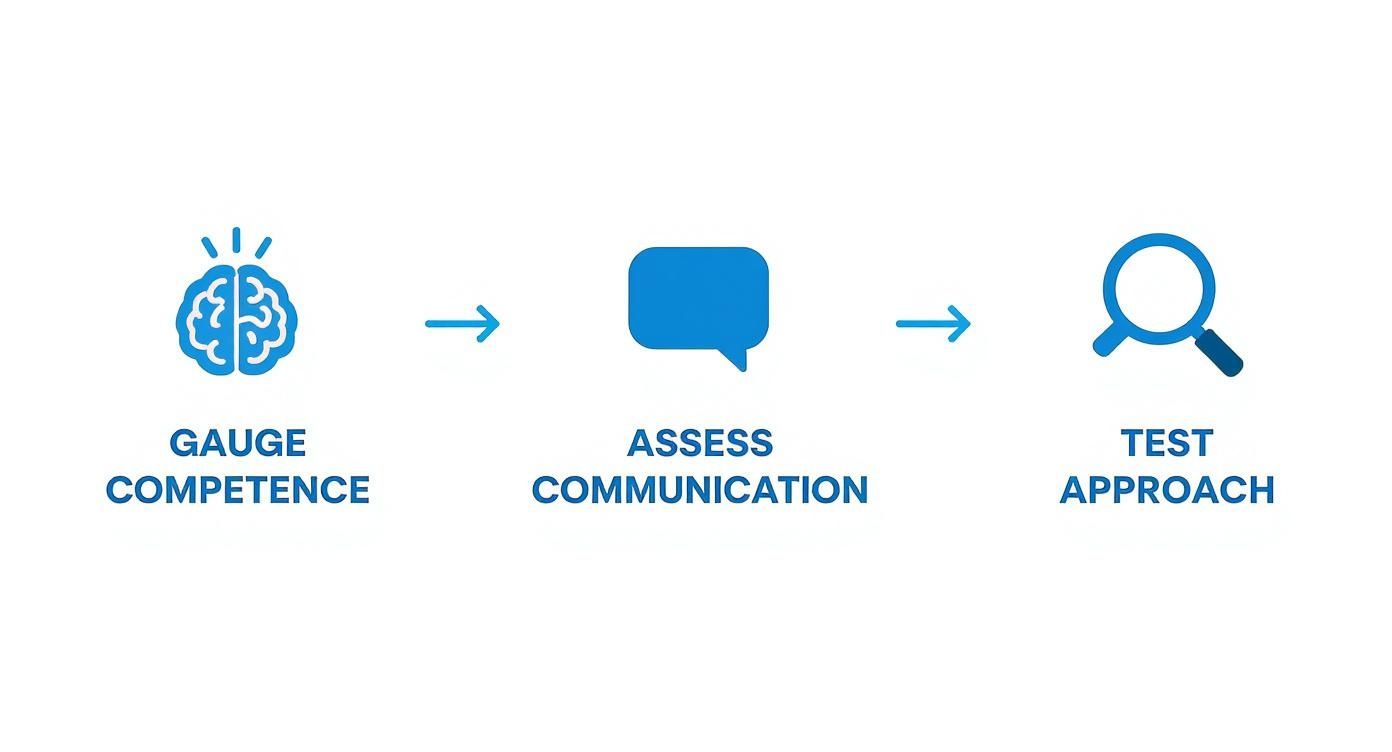
The initial chat with an agency isn't just a sales pitch. It’s your best chance to see how they really work before you sign anything. You’ve already figured out your goals and budget, so this conversation is all about separating a genuine partner from just another supplier. To do that, you need to ask questions that go deeper than the surface.
A good agency will actually welcome detailed questions. It shows you’re serious and looking for a proper partnership, not just a service. Their answers will tell you a lot about their competence, their character, and whether their approach is the right fit for your business.
Probing Their Strategy and Process
First, dig into how they would actually manage your account. You're not expecting a full-blown strategy document on the spot, but you need to get a feel for their thought process. Vague, one-size-fits-all answers are a definite red flag.
Here are a few sharp questions to get things moving:
-
"Based on your initial look at our website, what do you see as our biggest opportunity and our most urgent weakness?" This is a great test of their analytical skills and shows if they've bothered to do any homework. A strong answer will be specific, maybe pointing out poor site speed or a total lack of content around one of your key services.
-
"How do you decide which keywords to target? Can you walk me through your process?" Listen for answers that focus on user intent and commercial value, not just chasing high search volumes. A good agency will talk about understanding your ideal customer and finding keywords that actually lead to sales or enquiries.
-
"What does your content creation process look like? How do you make sure it meets Google's E-E-A-T guidelines?" This is a big one. They should be able to explain how they research topics, work with subject matter experts, and create content that’s genuinely helpful to a reader, not just stuffed with keywords.
Understanding Communication and Reporting
Nothing sours an SEO partnership faster than a complete breakdown in communication. You need to know exactly how they’ll keep you in the loop and what their reports actually show you. Get this ironed out from the start.
Set clear expectations with these questions:
-
"Who will be our day-to-day contact, and what's their level of experience?" You need to know if you'll be working directly with a seasoned pro or if your account will be handed off to a junior. Consistent, expert contact is what gets results.
-
"How often will we get performance reports, and what format do they take? Can we see an anonymised example?" This cuts through the jargon and shows you precisely what you’ll receive. A good report focuses on the metrics that matter to your business goals—like leads and revenue—not just vanity metrics like traffic.
-
"How will you communicate progress, and how often will we have scheduled meetings?" Whether it’s a monthly call or a fortnightly email update, you need a regular rhythm. Establishing this from day one keeps everyone on the same page.
Gauging Their Approach to Challenges
SEO is never a smooth, straight line upwards. There will be algorithm updates, performance will plateau, and unexpected problems will crop up. How an agency handles the tough times says a lot more about them than any slick success story.
"Can you walk me through a campaign that didn't go as planned and what you learned from it?" This is probably the single most revealing question you can ask. A confident, honest agency won't hesitate to discuss a past failure. They'll focus on what they learned and how they adapted. Evasiveness is a massive red flag.
This question uncovers humility, transparency, and a commitment to learning—all things you want in a long-term partner. You aren’t looking for perfection. You're looking for a team that can think on its feet, take accountability, and turn a setback into a smart pivot. A weak answer will involve blaming the client or a random Google update, whereas a strong one shows ownership and a real problem-solving mindset.
Making The Final Decision And Onboarding
You've done the hard work. After all the research, vetting, and conversations, you’ve probably got it narrowed down to a couple of strong contenders. Now for the final step: choosing the SEO company that will become a true partner in your growth. This isn't just about a gut feeling, though. A more structured approach will make sure you pick the right fit for the long haul.
A simple scoring matrix can cut through the noise and bring some real clarity to your decision. By scoring each finalist against your most important criteria, you can compare them objectively and see who really comes out on top.
Creating Your Decision Matrix
This doesn’t need to be some complicated spreadsheet. It’s simply about weighing up what matters most to your business and making a choice based on evidence, not just a slick sales pitch.
Grab a notepad or open a simple table and score each agency from 1 (poor) to 5 (excellent) on these key points:
- Proven Expertise & Results: How relevant and impressive were their case studies? Did they genuinely understand the nuances of your specific industry?
- Strategic Approach: Did their proposed strategy feel tailored to your business goals, or did it sound like a generic, one-size-fits-all plan they roll out for everyone?
- Communication & Transparency: How clear and open were they during your conversations? Do you feel confident you'll know what's happening and why?
- Cultural Fit: This one is crucial. Can you see yourself working well with their team? Do their company values seem to align with yours?
- Value for Money: Based on their proposal, do you believe their fee is a fair investment for the results you expect? Remember, this isn't about finding the cheapest option, but the one offering the best potential return.
Trusting Your Instincts And Checking References
Once you tally up the scores, your decision will likely be much clearer. But don't completely discount your intuition. If an agency looks perfect on paper but something just feels off, pay attention to that feeling. This is a long-term relationship, and a good rapport is essential.
Before you sign on the dotted line, there's one final check: ask to speak to one or two of their current clients. A confident agency will have no problem arranging this. When you speak to them, ask about their experience with communication, reporting, and most importantly, the results they’ve seen.
The final choice often comes down to selecting a partner, not just a supplier. You're looking for an agency that is as invested in your business's success as you are—one that will proactively bring ideas to the table and adapt its strategy as your business evolves.
This whole process is designed to help you make an informed decision when choosing the best SEO company for your small business.
The Onboarding Kick-Off
With the contract signed, a smooth onboarding process sets the stage for a great partnership. Your new agency should schedule a kick-off meeting to finalise your goals, establish clear lines of communication, and get access to necessary tools like Google Analytics. A well-organised start ensures everyone is aligned and ready to hit the ground running from day one.
Ready to partner with an SEO agency that delivers transparent results? At Bare Digital, we provide a free SEO Health Check and a clear, actionable plan to boost your rankings and grow your business. Get your free SEO proposal today.