
To generate a steady stream of real estate leads, you first need to build a rock-solid digital foundation. This means having a fast, mobile-friendly website and getting to grips with local search engine optimisation (SEO) so prospective clients can actually find you. A well-oiled online presence is your 24/7 shop front, turning casual online searches into genuine enquiries.
Building Your Digital Foundation for Lead Generation
Before you even think about running ads or creating content, your core digital assets must be in order. Think of your website and Google Business Profile as the foundations of a house. If they're shaky, everything else you build on top is at risk of collapse. A flimsy, slow, or outdated website will just leak potential leads, no matter how much traffic you throw at it.
The goal here is to move beyond a simple online brochure and create a machine that's built for conversions. This isn’t just about looking good; it's about performance. Your site has to load quickly, work flawlessly on mobile, and guide visitors towards taking action with clear, compelling calls-to-action (CTAs).
Optimise Your Website for Conversions
Your website is often the very first interaction a potential client has with your brand. It has to make a great impression straight away and work perfectly. Here are the absolute non-negotiables:
- Mobile-First Design: The vast majority of property searches now start on a smartphone. Your website must be designed for the small screen first, with easy-to-tap buttons, readable text without needing to zoom, and simple navigation.
- Lightning-Fast Load Speed: If your site takes more than three seconds to load, you're losing people. It's that simple. Optimise your images and use quality hosting to make sure your pages are practically instant.
- Strategic Calls-to-Action (CTAs): Don't make visitors guess what they should do next. Every single page should have a clear purpose, guiding users with CTAs like "Request a Free Valuation," "Book a Viewing," or "Download Our First-Time Buyer Guide."
For a deeper dive into growing your property business, you might want to explore these high-impact realtor marketing strategies to build on your foundational work.
Master Local SEO to Dominate Your Postcode
For estate agents, all SEO is local SEO. You need to show up when someone in your town searches for "estate agent near me." This is where your Google Business Profile (GBP) becomes your most powerful free tool. A fully optimised profile can land you in the coveted 'map pack' right at the top of the search results.
This flow chart breaks down how a strong digital foundation really works. It all starts with a professional website, which you then make more visible through SEO, and finally, you convert that new traffic into actual leads.
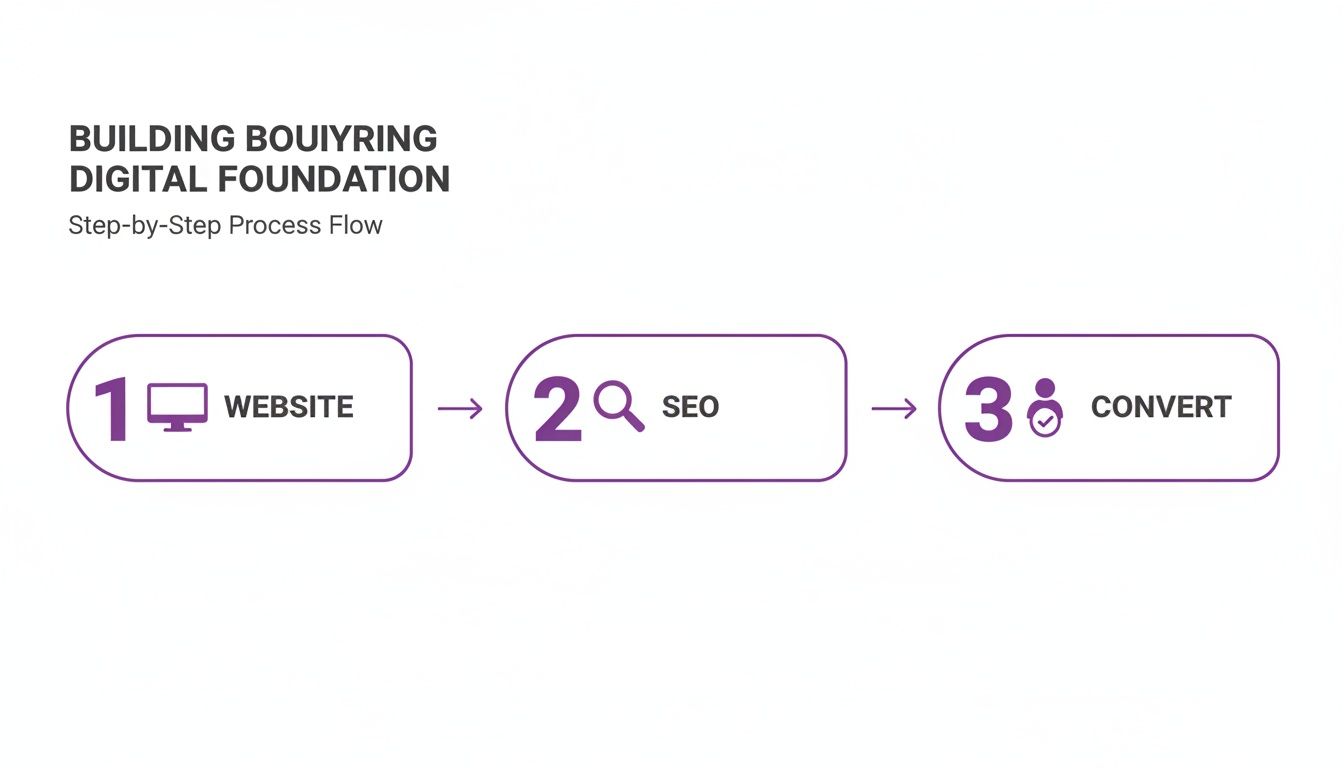
The key takeaway here is that each stage builds on the last. Great SEO is useless without a website that converts, and you can't get conversions without traffic from search in the first place.
The power of this approach is backed by solid data. In the UK property market, organic search has an average lead conversion rate of 3.2%. That means for every 100 people who find your site via Google, over three become real, workable leads. With over 95% of home searches starting online, ranking high in local search isn't just a nice-to-have; it's essential for a steady flow of targeted traffic.
We saw this firsthand with a Bristol-based agent. They saw a 40% increase in valuation requests within three months of overhauling their website speed and optimising their Google Business Profile. They simply focused on gathering reviews, adding high-quality photos, and making sure their service areas were listed accurately.
This just goes to show the direct commercial impact of getting your digital foundation right from the start. For more specific guidance on this, check out our deep dive on https://www.bare-digital.com/google-my-business-optimization/ to make sure you're getting the most out of this free tool.
Using Content and Landing Pages to Attract UK Property Leads
Once your digital foundations are solid, it's time to create content that actually speaks to your ideal clients. Let's be honest, generic blog posts about home décor aren't going to cut it. To generate real estate leads that count, your content needs to solve real problems, answer pressing questions, and stamp your name as the undeniable local property authority.
This is the point where you stop being just another agent and start becoming a trusted advisor.
Effective content isn't about shouting the loudest; it's about providing genuine value that builds trust. Put yourself in your clients' shoes. What keeps a first-time buyer in Manchester awake at night? What are the biggest worries for a landlord in Leeds? When you start addressing these specific pain points, you'll naturally attract high-quality traffic from people actively searching for solutions.

Create Content That Builds Authority
The agents who consistently win online are the ones creating hyper-local and deeply insightful content. This is how you build trust and position yourself as the go-to expert long before someone is even ready to think about a valuation.
Here are a few powerful ideas to get you started:
- Compelling Neighbourhood Guides: Go way beyond basic stats. Create in-depth guides with video tours, interviews with local coffee shop owners, and your honest take on school catchments and transport links.
- Local Market Update Videos: A short, punchy monthly video breaking down recent sales data, price trends, and what it really means for local homeowners is incredibly powerful. Share it everywhere—your blog, social media, and email newsletter.
- Insightful Articles: Write detailed posts that answer common UK-specific questions. Think "A Simple Guide to Stamp Duty Land Tax for First-Time Buyers" or "How to Prepare Your Victorian Terrace for Sale in Bristol."
For a deeper dive into structuring these efforts, getting familiar with proven content marketing best practices will give you a solid framework for your entire strategy.
Engineer High-Conversion Landing Pages
While your blog is busy building authority, your landing pages have one job and one job only: to convert. These are focused, distraction-free pages where you send traffic from your ads, social media posts, or email campaigns.
A landing page for a "Free Property Valuation," for example, shouldn't have links to your latest blog post or other listings. Its sole purpose is to capture that lead.
Here’s what every effective landing page needs:
- A Compelling Headline: It has to scream value. Ditch "Valuation Request" for something like "Discover Your Home's True Value in Under 60 Seconds."
- Concise, Benefit-Driven Copy: Use bullet points to quickly show what they get and why it matters.
- Social Proof: This is non-negotiable. Include testimonials from happy clients, logos of local papers you’ve been featured in, or a killer stat like "We’ve helped over 250 local families find their perfect home."
- A Simple Lead Capture Form: Only ask for what you absolutely need—name, email, phone, and address. Every extra field you add will lower your conversion rate.
The crucial thing to remember is that your landing page must instantly answer the visitor's question: "What's in it for me?" If the value isn't crystal clear in the first few seconds, they're gone.
Offer Irresistible Lead Magnets
A lead magnet is a valuable resource you offer for free in exchange for an email address. This is a fundamental tactic for generating leads from people who aren't quite ready for a valuation but are deep in the research phase. The trick is to provide something so genuinely useful they're happy to make the trade.
Here are a few ideas for lead magnets tailored specifically for the UK property market.
Lead Magnet Ideas for UK Estate Agents
| Target Audience | Lead Magnet Idea | Key Information to Include |
|---|---|---|
| First-Time Buyers | The Ultimate UK First-Time Buyer Checklist | Steps for mortgage pre-approval, understanding Help to Buy, questions to ask solicitors, and a moving day checklist. |
| Sellers | 10 Cost-Effective Ways to Boost Your Home's Kerb Appeal | Simple DIY tips, local contractor recommendations, and data on which improvements offer the best return on investment. |
| Landlords | Guide to the Latest UK Rental Regulations | A summary of recent changes to tenancy laws, landlord responsibilities, and tips for ensuring compliance. |
This isn't a one-off task. By consistently creating valuable content, sending that traffic to optimised landing pages, and offering compelling lead magnets, you build a powerful system that turns casual browsers into warm, qualified leads for your agency.
Running Paid Ad Campaigns for Immediate Results
While search engine optimisation (SEO) is your long game for building a sustainable pipeline, paid advertising is how you open the tap for an immediate flow of leads. Think of it as your way to attract motivated sellers and buyers right now. This is how you generate real estate leads quickly and predictably, filling your calendar while your organic efforts have time to grow.
Paid ad campaigns on platforms like Google, Facebook, and Instagram place your agency directly in front of people actively looking to make a move. You're not waiting for them to find you; you're reaching them at the exact moment of intent. It's a powerful way to accelerate growth and get a competitive edge in your local market.
Launching a Local Google Ads Campaign
Google Ads is usually the first stop for high-intent leads. When someone searches for 'estate agent in Leeds' or 'how much is my house worth in Cambridge', they’re sending a clear signal that they need your services. Your job is to be the first answer they see.
To get an effective local campaign up and running:
- Zero in on High-Intent Keywords: Target phrases that scream "I'm ready to act." These are terms like "[Your Town] property valuation," "best estate agent in [Your Postcode]," and "sell my house fast [Your City]."
- Make Your Ads Stand Out with Extensions: Use sitelink extensions to direct users straight to your valuation page or testimonials. Call extensions are brilliant for mobile users, allowing them to ring you with a single tap.
- Build a Dedicated Landing Page: Never, ever send ad traffic to your homepage. Direct them to a simple, focused landing page that delivers on the ad's promise, like a 'Free Valuation' form. It’s the single best way to maximise conversions.
Leveraging Facebook and Instagram Ads
While Google captures people who are actively searching, social media platforms like Facebook and Instagram let you find potential clients before they’ve even started looking. Here, the game is all about grabbing attention with brilliant visuals and pinpoint targeting.
A winning social media ad strategy often involves showing off your successes and expertise. For instance, a carousel ad displaying your five most recently sold properties with the caption, "We're achieving record prices in your area," can be incredibly effective. Video is also king—a short, professionally shot property tour can stop a user mid-scroll and pull them in. Our guide to search engine marketing strategies offers more ideas on blending paid search and social campaigns.
A killer tactic on social media is retargeting. It allows you to show ads specifically to people who have already visited your website. It’s a powerful way to stay top-of-mind and bring back visitors who didn't take action the first time around.
Demystifying Your Ad Budget and Metrics
Getting started with paid ads doesn't require a massive budget. You can begin with as little as £10-£20 per day just to test the waters and see what works. The most important thing is to track your return on investment like a hawk.
The UK real estate market is fierce, so knowing your numbers is vital. A qualified lead can cost anywhere from £50 to over £200, depending on your area and the quality you're after. For paid search, the average cost per lead sits around £50, with a huge 75.4% of clicks turning into valuable phone calls.
By tracking your Cost Per Lead (CPL), you can make smart decisions, pouring more budget into the campaigns that deliver results and pausing the ones that don't. Combining targeted Google Ads with engaging social media campaigns creates a powerful system for generating leads on demand, giving you the immediate results you need to complement your long-term growth.
Building a Powerful Referral Network
While digital strategies are brilliant for casting a wide net, some of your best, highest-quality leads will come from a much older source: trust and personal recommendation. Tapping into a solid referral network is a classic for a reason, but it needs a modern, organised approach. It’s all about strategically building relationships that create a consistent flow of warm introductions from people who already have confidence in you or your partners.
And let's be honest, grounding your brand in the local community works wonders. When people see you sponsoring the local school fair and then come across your glowing online reviews, it builds a multi-layered sense of trust that’s tough for competitors to copy. This is where your online authority shakes hands with your offline reputation, creating a brand that feels complete and compelling.
Forge Strategic Local Partnerships
Think about it: your ideal clients are already talking to other local professionals during their property journey. By building strong, mutually beneficial relationships with these people, you can put yourself in the perfect position to receive a steady stream of high-quality referrals.
Who are these people? They're the professionals whose services perfectly complement your own. A great referral network almost always includes:
- Mortgage Brokers: They are often the very first stop for serious buyers.
- Solicitors: They're involved in every single transaction and deal with both buyers and sellers.
- Surveyors: Their involvement is a massive signal of a buyer's serious intent.
- Financial Advisers: They guide clients through major life purchases, and property is usually the biggest one.
Reaching out doesn't need to be some grand, complicated affair. A simple, personalised email explaining how you could help each other is often the best way to start. The goal is to create a two-way street where you also feel confident sending your clients their way. It has to be a win-win.
A simple, genuine connection can be more powerful than any paid ad. I once had a mortgage broker refer a client who turned into three separate transactions over two years—all because we’d built a trusting professional relationship over a few coffees.
Before we dive into offline tactics, it's useful to see how they stack up against their digital counterparts. Each has its place, and the most successful agents use a blend of both.
Offline vs Online Lead Generation Tactics
| Tactic | Pros | Cons | Typical Lead Quality |
|---|---|---|---|
| Referral Networks | High-trust, warm leads. High conversion rate. Builds strong community ties. | Takes time and genuine effort to build. Can be inconsistent at first. | Excellent |
| Open Houses | Face-to-face interaction. Opportunity to meet multiple potential clients at once. | Can be time-consuming. Lead quality varies from serious buyers to nosy neighbours. | Variable |
| Community Events | Builds brand goodwill and recognition. Creates positive, non-salesy associations. | Very long-term strategy. ROI is difficult to measure directly. | Good (Long-Term) |
| Local SEO | Captures high-intent leads actively searching for agents. Cost-effective over time. | Takes 3-6 months to see results. Requires ongoing technical effort. | Excellent |
| PPC/Facebook Ads | Highly targeted and scalable. Delivers immediate results and lead volume. | Can be expensive. Lead quality can be lower as intent varies. | Good to Variable |
As you can see, the quality from offline, trust-based methods is often higher, even if the volume is lower. That's why they remain a crucial part of any serious agent's toolkit.
Modernise Your Open House Strategy
An open house shouldn't just be about selling one property; it's a prime lead generation event. With the right strategy, every single person who walks through that door is a potential future client. They could be a curious neighbour thinking of selling, or a buyer who isn't quite right for this home but might be perfect for another.
Ditch the old-school paper sign-in sheet and use a digital check-in on a tablet. It looks far more professional and, more importantly, allows you to capture details directly into your CRM software for immediate, organised follow-up.
Simply ask visitors if they'd like to receive updates on similar properties in the area—it’s a low-pressure way to get their permission to add them to your email lists and start nurturing that relationship.
Get Stuck into Your Community
Becoming a visible, active, and helpful member of your local community is a long-term play that pays off in spades. Sponsoring the local kids' football team or having a stall at the summer fair puts your brand in front of hundreds of local families in a positive, completely non-salesy context.
This kind of engagement builds genuine brand recognition and goodwill. When a homeowner in that community eventually decides to sell, your agency is far more likely to be the first one they think of. It’s a softer approach that beautifully complements your direct marketing, building a foundation of trust that makes every other lead generation effort that much easier.
How to Turn Fresh Leads into Signed Clients
Getting a lead is just the starting line. The real work—and where you actually make your money—is in what happens next. A solid lead nurturing system is what transforms a casual website enquiry into a signed instruction. If you don't have a repeatable process for building relationships and guiding prospects from "just looking" to "where do I sign?", you're leaving a lot of business on the table.
The absolute game-changer here is speed to lead. In today's market, getting back to someone in minutes, not hours, can make all the difference. Prospects expect an almost instant response, and the first agent to provide a genuinely helpful answer usually wins.
Your CRM is Your Agency's Central Hub
To pull this off properly, a Customer Relationship Management (CRM) system isn't just nice to have; it's essential. Think of it as the central nervous system for your agency, keeping every contact, conversation, and follow-up organised in one place. It’s what stops those hard-won leads from slipping through the cracks.
A good CRM should let you:
- Track every single interaction: See a full history of calls, emails, and texts for every lead.
- Put your follow-up on autopilot: Set up automated sequences that send messages at just the right moments, so no one ever feels ignored.
- Segment your database: Group contacts based on what they need (e.g., first-time buyers, potential sellers, landlords) to make your communication feel more personal.
This kind of organisation is the bedrock of a professional, scalable nurturing process. It's the difference between relying on sticky notes and running a streamlined, efficient business.
The Power of Automated Follow-Up
Once a lead lands in your CRM, automated email and SMS sequences can do a lot of the heavy lifting for you. They build rapport and provide value without you having to manually type out every single message. The goal is simple: stay top-of-mind by being helpful, not pushy.
This is especially true in the UK property market, where online interactions are now the standard. The rise of live chat on estate agent websites has completely changed lead capture, with a huge 75.3% of chat leads coming from potential buyers or sellers. As online engagement has gone up, agent response times have had to come down, making 'speed to lead' a massive competitive advantage.
Let's walk through a real-world example.
Scenario: A Valuation Request Comes In
- Instant Auto-Reply (SMS & Email): "Hi [Name], thanks for your valuation request for [Address]. I'm just reviewing the details and will give you a call within the next 15 minutes to discuss. Best, [Your Name]."
- Day 2 (Email): Send them a link to a genuinely useful blog post, something like "7 Simple Ways to Boost Your Home's Value Before Selling."
- Day 5 (SMS): "Hi [Name], just checking in. Did you find that article useful? Let me know if you have any questions about the local market."
- Day 10 (Email): Share a client testimonial or a quick case study of a recent successful sale in their neighbourhood.
This multi-touch, multi-channel approach keeps you on their radar, offers real value, and cements your position as the local expert. By automating these first few steps, you free yourself up to focus on the high-value conversations that actually lead to new instructions. Beyond just capturing leads, applying these Google Ads lead nurturing best practices is what helps turn prospects into profitable, long-term clients.
Personalisation is What Seals the Deal
Automation is powerful, but it should never, ever feel robotic. The best nurturing strategies blend the efficiency of automation with genuine, personal interaction. You have to use the information you've gathered about a lead to make your communication feel like it was written just for them.
If a buyer enquired about a two-bedroom flat near a particular school, mention that school in your follow-up. It's a tiny detail, but it shows you were actually listening and it transforms a generic message into a real connection. This is the kind of detail that can seriously boost your engagement and is a key part of our guide on how to improve website conversion rates.
Ultimately, a successful nurturing process is a conversation—one that guides a prospect towards making a confident decision, with you as their trusted adviser.
Got Questions? We've Got Answers

Let's be honest, navigating the world of lead generation can feel like a minefield. With the market always shifting and new digital tools popping up, it's natural to have questions.
Here, I’m tackling the most common queries I hear from UK estate agents. These are direct, no-fluff answers designed to help you sharpen your strategy, manage your budget, and finally get an edge on the competition. The goal is simple: give you the clarity to build a client pipeline that actually lasts.
How Much Should I Spend on Marketing to Generate Real Estate Leads in the UK?
There’s no magic number here. Your budget really comes down to your local market, the size of your agency, and how fast you want to grow. But if you’re looking for a solid starting point, a good rule of thumb for a smaller, independent agency is to set aside around 5-10% of your gross commission income (GCI) for marketing.
So, if you’re pulling in a GCI of £100,000, a budget of £5,000 to £10,000 a year is a realistic place to begin. My advice? Start by investing in the fundamentals—your website's performance and a rock-solid local SEO foundation. Once that's sorted, you can dip your toes into paid ads with a manageable monthly budget, maybe £300-£500 on Google or Facebook to see what sticks.
The most important thing you can do with any marketing spend is track your return on investment. You have to know your Cost Per Lead (CPL) for every channel. Once you see what's bringing in quality leads without breaking the bank, you can scale up with confidence.
What Is the Fastest Way to Generate Seller Leads?
When you need results now, nothing beats a two-pronged attack: paid ads combined with direct outreach. This approach lets you catch people actively looking for an agent while also tapping into your existing network for warm introductions.
Fire up a highly targeted Facebook or Google Ads campaign aimed at homeowners in a specific postcode. The offer? A "Free, No-Obligation Property Valuation." It’s a classic for a reason and can start generating enquiries within days.
At the same time, don't forget the goldmine you're already sitting on—your database. A quick, personalised email campaign or a few phone calls to past clients, local solicitors, and mortgage brokers can uncover referral opportunities you didn't even know were there. Just remember to balance these short-term wins with long-term plays like content and SEO for a consistently full pipeline.
How Can I Compete with Larger Estate Agencies?
You can’t outspend them, so don’t even try. You win by out-niching and out-servicing them. Stop trying to be the agent for your entire city. Instead, become the go-to expert for a specific neighbourhood, a certain type of property (like period homes), or a particular client (like first-time buyers or downsizers).
This is where you can really shine. Create the kind of hyper-local content that big, corporate agencies just don't have the time or local knowledge for. I’m talking about detailed video guides to school catchments, interviews with local business owners, or in-depth articles on the quirks of buying a listed building in your town. Your marketing should scream local expertise.
A large agency will always struggle to match the personal touch you can offer. Make that your secret weapon. Feature it in your marketing, and make sure your client testimonials and online reviews shout it from the rooftops. This is how you generate leads real estate agents with bigger budgets can only dream of.
What Are the Most Important Metrics to Track for Lead Generation?
If you’re only counting the number of enquiries, you’re flying blind. To really understand what’s working and make smart decisions, you need to focus on a few Key Performance Indicators (KPIs) that tell the whole story.
Here are the essentials:
- Number of Leads per Channel: This is your starting point. It shows you the raw volume coming from your website, social media, property portals, and referrals.
- Cost Per Lead (CPL): Simply divide your total spend on a channel by the number of leads it produced. This immediately shows you which channels are the most cost-effective.
- Lead-to-Appointment Ratio: What percentage of your leads actually turn into a valuation or viewing? This is a massive indicator of lead quality.
- Appointment-to-Instruction Ratio: Of all the valuations you conduct, how many become a signed instruction? This metric puts your sales skills under the microscope.
Tracking just these four metrics in a simple spreadsheet or your CRM gives you an instant, actionable snapshot of your entire lead generation engine.
At Bare Digital, we build SEO strategies that turn your website into a lead-generating machine. If you're ready to climb the rankings and attract more clients, get your free, no-obligation SEO proposal today.