

A solid technical SEO audit is like getting an MOT for your website—it’s an essential check-up to make sure everything ‘under the bonnet’ is running smoothly for search engines like Google. For small and medium-sized businesses in the UK, this is no longer an optional extra. It’s the very bedrock of a competitive online presence.
A technically sound website ensures that every penny you invest in content and marketing actually counts.
Why a Technical SEO Audit Is Your Website's Foundation

Imagine you’re building a new house. You wouldn't dream of spending a fortune on fancy kitchens and landscaped gardens before making sure the foundations are solid, level, and built to last. A website is exactly the same. Its technical structure is the foundation that all your other digital marketing efforts are built on.
Without that solid base, even the most brilliant content or clever ad campaigns will fall flat. You could have the best products in all of Cambridgeshire, but if Google's crawlers can't easily navigate your site, your pages might never get indexed and shown to the very people trying to find you. This is where professional technical SEO auditing services become so critical.
The Launchpad for Digital Success
A comprehensive audit is a diagnostic tool, sniffing out all the hidden issues that could be holding your website back from its true potential. These problems are often completely invisible to the average user, but they can have a massive impact on how search engines see your site's quality and relevance.
Think of it as the difference between a finely tuned engine and one that sputters and stalls. A proper technical audit gets into the nuts and bolts, investigating key areas like:
- Crawlability and Indexability: Can search engines actually find and list your pages?
- Site Speed: A slow site frustrates users and gets penalised by Google. It’s that simple.
- Mobile-Friendliness: With most searches now happening on phones, a flawless mobile experience is non-negotiable.
- Site Architecture: A logical structure helps both people and search engines find what they’re looking for without getting lost.
A technical audit doesn’t just fix problems; it unlocks opportunities. By getting your website into pristine technical shape, you’re creating the perfect platform for all your other marketing—from content to paid ads—to really fly.
The Growing Importance for UK Businesses
For UK SMEs, ignoring your website’s technical health is a huge commercial risk. The demand for flawless online performance is fuelling massive growth in the tools and expertise that power these audits. In the UK, the SEO software market—which is the engine behind technical SEO auditing services—hit a revenue of £4.2 billion in 2024. That figure is projected to more than double to £8.8 billion by 2030.
This rapid growth points to one clear reality: businesses are waking up to the fact that a technically optimised site is fundamental to survival and growth. When you invest in a thorough audit, you're not just fixing bits of code; you're building a resilient foundation for long-term digital success.
To get a better handle on the core concepts, have a look at our complete guide on what is technical SEO.
What a Thorough Technical SEO Audit Actually Covers

So, what are we actually looking at when we get under the bonnet of your website? It’s far from guesswork or vague advice. A proper technical audit is a systematic deep-dive into your site’s architecture and performance, almost like a surveyor inspecting a property from the foundations to the wiring to make sure everything is sound.
Our technical SEO auditing services take that same meticulous approach. We break your site down into its essential parts to find exactly where things can be improved. Every single check is tied directly to how you perform in search results, giving us a complete picture of your site's health and a clear road map to getting you more visibility.
A comprehensive technical SEO audit is made up of several core components. Each one plays a critical role in how search engines—and your customers—perceive your website. Let’s break down what we look for and why it’s so important for your business.
Core Elements of a Technical SEO Audit
| Audit Component | What We Check For | Why It Matters for Your Business |
|---|---|---|
| Crawlability & Indexing | robots.txt rules, noindex tags, XML sitemaps, server errors. |
If Google can't find and read your pages, you're invisible. This ensures your key content makes it into search results. |
| Site Architecture | Internal linking patterns, URL structures, orphaned pages, broken links (404s). | A logical structure helps users find what they need and tells Google which of your pages are most important. |
| Mobile-Friendliness | Responsive design, tap target size, intrusive pop-ups, viewport settings. | With mobile-first indexing, a poor mobile experience directly hurts your rankings and pushes potential customers away. |
| Site Speed & Core Web Vitals | Page load times, image sizes, server response, code efficiency. | Slow sites frustrate users and are penalised by Google. A faster site means better engagement and more conversions. |
| Schema Markup | Structured data implementation for products, reviews, events, FAQs. | Schema helps your site stand out with rich snippets (like star ratings), which boosts click-through rates from search results. |
These checks form the foundation of our audit, but the real work is in understanding how they all connect to create a high-performing website that drives business growth.
Crawlability and Indexing: The Gateway for Google
Before your website can rank for a single keyword, Google has to find and understand your pages. This two-step process is called crawling and indexing. If there are any roadblocks here, even the most brilliant content will be completely invisible to searchers.
A technical audit is all about clearing these pathways. We hunt for things like misconfigured robots.txt files that might be accidentally blocking entire sections of your site, or "noindex" tags left on important pages after a website update. An issue like this can cause a catastrophic drop in traffic if it isn't spotted and fixed fast.
Put simply, we make sure there are clear, open roads for search engine bots to travel so they can discover every valuable page you want your customers to see.
Site Architecture and Internal Linking: Your Website's Blueprint
A logical site structure is crucial for both people and search engines. Think of a library with no signs or clear sections—finding the book you want would be a frustrating, almost impossible task. Your website is exactly the same.
A well-planned architecture groups related content together, creating a clear hierarchy that flows from broad categories down to specific product or service pages. This is held together by internal linking, which acts like signposting, guiding users and search engine crawlers from one relevant page to the next.
Our audit examines this blueprint, looking for orphaned pages with no internal links, broken links that lead to dead ends (404 errors), and inefficient link paths that water down your site's authority. By tidying up the structure, we make your site easier to navigate and help Google understand which pages are the most important.
A strong site architecture doesn't just improve user experience; it distributes "link equity" or authority throughout your site, signalling to Google which pages are the pillars of your online presence. This is a critical factor in achieving higher rankings.
Mobile-Friendliness and Usability: Meeting Users Where They Are
The vast majority of searches now happen on mobile phones, making a flawless mobile experience an absolute must. Google now operates on a "mobile-first indexing" basis, which means it primarily uses the mobile version of your site for indexing and ranking.
That’s why our audit goes way beyond just checking if your site resizes on a smaller screen. We dig deeper, looking for:
- Intrusive Interstitials: Annoying pop-ups that cover the main content and create a bad user experience on mobile.
- Tap Target Size: Buttons and links that are too small or packed too closely together, making them a pain to use on a touchscreen.
- Viewport Configuration: Making sure the site displays correctly across all the different mobile devices people use.
A clunky mobile experience sends a direct signal to Google that your site isn’t user-friendly, which can seriously damage your rankings in mobile search results.
Site Speed and Core Web Vitals: The User Experience Essentials
Page speed isn't just a nice-to-have anymore; it's a core ranking factor. Slow-loading pages cause high bounce rates—people simply won't wait around. To put a number on this, Google introduced Core Web Vitals, a set of specific metrics that measure the real-world user experience.
These metrics look at three key aspects of the user's journey: loading performance, interactivity, and visual stability. Our audit uses specialised tools to analyse these vitals and pinpoint the root causes of any slowness, whether it’s oversized images, clunky code, or a slow server.
Fixing these issues doesn't just please search engines; it directly improves your conversion rates. A faster, more stable site gives visitors a better experience, encouraging them to stick around longer and do business with you. For more detail, you can explore what to expect from a technical site audit for your ecommerce business, which gives some great extra insight.
Schema Markup: Speaking Google's Language
Schema markup is a bit like adding labels to your website's information. It's a type of code that translates your content into a language Google can understand with perfect clarity.
For instance, schema can tell Google that a string of numbers is a phone number, a block of text is a customer review, or that a page is about a specific product, complete with its price and stock level. This is what allows your pages to show up in search results with "rich snippets"—things like star ratings or event details—which can make a huge difference to your click-through rates.
Our audit identifies all the opportunities to add or improve schema markup across your site, making sure you’re giving Google every possible clue it needs to rank your content where it belongs. To see everything we cover, check out our technical SEO audit checklist with 15 essential elements.
Auditing for International and Complex Websites
When your business starts to scale—maybe you're expanding into new countries or handling a massive e-commerce catalogue—a standard technical audit just won't cut it. The sheer complexity of these websites creates unique problems that, if ignored, can seriously stunt growth and leave search engines utterly confused. This is where advanced technical SEO auditing services become non-negotiable.
These specialised audits push past the basics to wrestle with the sophisticated issues plaguing large and international sites. The goal is to make sure your digital presence isn't just working, but is fine-tuned for peak performance at scale, no matter where your customers are.
Mastering International SEO with Hreflang
If you’re targeting customers in different countries or who speak different languages, getting the right content in front of them is everything. That's the job of hreflang tags. These little snippets of code are meant to tell search engines which version of a page a user should see, based on their language and location.
But getting them right is notoriously difficult. A single misplaced tag could result in Google showing your UK site to users in Germany. Even worse, it might flag your different language pages as duplicate content. An advanced audit digs deep into your implementation, which involves:
- Verification of Hreflang Attributes: We check that every language and region code is correct and actually points to a valid, indexable page.
- Checking for Return Tags: This is a classic tripwire. We confirm that if page A links to page B as an alternate version, page B correctly links back to page A.
- XML Sitemap Integration: Your sitemaps are audited to ensure hreflang annotations are properly included, giving Google another crystal-clear signal.
Fixing these issues prevents frustrating user experiences and gives each regional site a fair shot at ranking in its target market.
Taming Complexity with Advanced Canonicalisation
Large e-commerce sites often have a massive headache with duplicate or near-duplicate content. Just think about product pages with tiny variations for colour, size, or sorting filters. Each of those variations can spit out a unique URL, creating thousands of almost identical pages that dilute your site’s authority.
Advanced canonicalisation strategies are the answer here. A simple canonical tag points a duplicate page back to the main version, but a complex audit looks at the bigger picture. We hunt down patterns of duplication caused by faceted navigation and URL parameters, then put robust rules in place to funnel all those ranking signals into one, authoritative page.
This process is like telling a librarian which book is the original manuscript and which are just copies. It stops search engines from wasting time crawling duplicate pages and focuses all their attention—and your ranking power—on the pages that truly matter.
Digging Deeper with Server Log File Analysis
While a standard site crawl shows us what a crawler should see, server log file analysis tells us what it actually does. Every single time a search engine bot like Googlebot hits your site, it leaves a footprint in your server's log files.
Analysing these logs gives us priceless, unfiltered insight into how Google is really interacting with your website. We can see:
- Crawl Frequency: Which pages and sections does Google visit most often?
- Crawl Budget Waste: Is Googlebot squandering its time on low-value pages, redirects, or error pages?
- Discovery of Orphaned Pages: We can find pages that Google is crawling but aren't linked from anywhere else on your site.
- Status Code Issues: This helps us spot server errors (like 5xx errors) that are actively blocking Google's crawlers.
This level of analysis uncovers hidden gremlins that standard tools miss completely, letting us make surgical adjustments to improve how efficiently Google crawls and indexes your entire site. When auditing international and complex websites, it's also crucial to consider the legal aspects of website data collection to ensure you're compliant with global regulations. This deep dive is exactly how a more sophisticated audit solves the major challenges that hold ambitious businesses back.
Our Audit Process From Discovery to Action Plan
We believe in total transparency. When you work with us on a technical SEO audit, you're not just buying a report; you’re investing in a clear, collaborative process designed to get real results. We pull back the curtain on our methodology so you know exactly what’s happening every step of the way.
Our process isn't about running a generic bit of software and dumping a confusing spreadsheet in your inbox. It’s a proper journey that starts with understanding your business and ends with a clear, prioritised action plan that lets you make smart decisions for growth.
The Discovery and Scoping Phase
It always starts with a conversation. On our first discovery call, we get to know your business, your commercial goals, and your biggest headaches. We want to understand what success really looks like for you—whether that’s more online sales, better quality leads, or simply getting noticed in Cambridgeshire.
This chat allows us to scope the audit properly. A local service business has completely different technical needs from a national e-commerce store, and this tailored approach ensures we focus our analysis on what will actually make a commercial difference to you.
Deep-Dive Analysis and Data Gathering
Once we have a clear brief, our technical specialists roll up their sleeves. Using a mix of industry-leading tools and good old-fashioned manual checks, we perform a deep-dive analysis of your website’s technical health. This is where we go beyond surface-level checks to find the root cause of any performance issues.
We use sophisticated crawlers to see your site just like a search engine does, pinpointing problems with everything from site speed and mobile usability to indexing and internal linking. This data-driven approach takes out the guesswork and gives us a complete picture of your website’s strengths and weaknesses.
Our deliverable is more than just data; it's a strategic road map. We translate complex technical findings into a jargon-free report that pinpoints issues and provides a clear, prioritised action plan designed for business owners, not just developers.
This flowchart shows how our process flexes to handle more complex audits for different types of businesses.
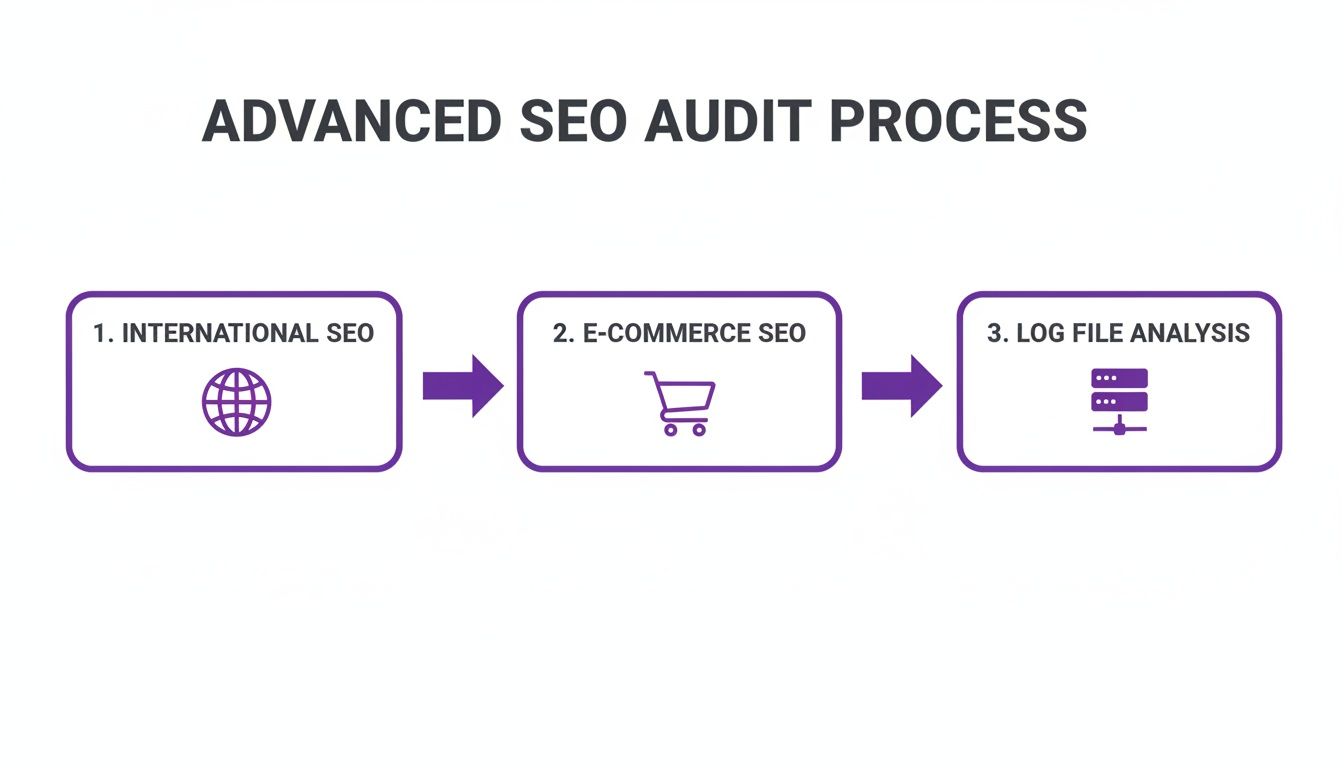
As you can see, specialised checks for international, e-commerce, and large-scale sites are built right into our core methodology.
Reporting and the Action Plan
The final—and most important—stage is delivering our findings. You’ll get a comprehensive report that’s easy to understand, even if you’re not a tech expert. We prioritise every recommendation based on its potential impact versus the effort needed to fix it, giving you a clear list of quick wins and longer-term projects.
This focus on accessible, actionable insights has never been more important. Small and medium-sized enterprises (SMEs) are now the fastest-growing group in the SEO software market, drawn to affordable tools that help them compete with bigger rivals. You can find more on this trend in the UK SEO software market report on Grand View Research.
Our service bridges the gap between the raw data these tools spit out and the strategic guidance needed to turn that information into tangible results. Your action plan is the final piece of the puzzle—a step-by-step guide to fixing what's broken and unlocking your website's true potential.
How We Put a Cambridgeshire SME Back on the Map

Theory is great, but it’s the real-world results that actually count. To show you the kind of impact our technical SEO auditing services can have, let’s walk through a recent success story with a local Cambridgeshire business we partnered with.
This was a fantastic local company with brilliant services, but they were almost completely invisible online. Their website was held back by painfully slow page speeds and dismal search visibility, which meant high-value customers simply couldn’t find them. It was a classic case of a great business being crippled by a weak technical foundation.
Uncovering the Hidden Roadblocks
Our first job was a proper deep-dive technical audit. We didn't just run a quick scan and call it a day; we got our hands dirty, meticulously picking apart every aspect of their site's architecture and performance. It didn't take long to find a handful of critical issues that were stopping them from ranking.
The main offenders were:
- Poor Mobile Optimisation: The website was clunky and a real pain to use on a smartphone. This was a massive red flag, as most of their target customers were searching on mobile.
- Widespread Index Bloat: Google had indexed hundreds of low-quality, thin pages, which was diluting the authority of their most important service pages.
- No Structured Data: The site wasn't using any schema markup, missing a huge opportunity to stand out in the search results with rich snippets like review ratings and service details.
These problems had created a perfect storm, leaving the site stranded on the back pages of Google for the keywords that mattered most.
By digging in and identifying these core technical faults, we were able to map out a targeted, prioritised action plan. The aim wasn't just to fix errors, but to rebuild their website's foundation for sustainable, long-term growth.
Implementing Targeted Fixes for Real-World Growth
With the problems laid bare, we rolled up our sleeves and got to work. Our team moved methodically through the action plan, tackling the highest-impact fixes first. We implemented a mobile-first redesign, ruthlessly pruned the junk pages from Google’s index to focus on quality content, and deployed comprehensive schema markup across all of their key service pages.
The results weren't just positive—they were transformative. Within six months of finishing the technical fixes, the business saw a 420% increase in organic traffic. They started showing up on the first page for highly competitive local search terms, which led directly to a major uplift in qualified leads coming through their website.
This kind of turnaround isn't a fluke. Across the UK, other firms have seen similar outcomes, with some boosting a client's search traffic by as much as 865% in 12 months through meticulous technical overhauls. You can read more about how this kind of expertise is driving growth in this industry report from Grand View Research.
This story is a powerful reminder that a technical audit is far more than a simple health check. For local businesses, it’s a direct investment in visibility and growth. Our tailored approach to SEO in Cambridge is all about giving SMEs in our community the strong technical foundation they need to compete and win online.
Choosing the Right Technical SEO Partner in the UK
Picking the right partner for your technical SEO auditing services is one of the most critical decisions you’ll make for your website's health. Let's be honest: not all audits are the same. A cheap, automated report often just spits out surface-level data, leaving you with a long list of problems but no real context or strategic direction. You need a partner, not just a tool.
A genuine technical SEO partner does more than run your site through a generic checklist. They take the time to get to know your business, your customers, and what you’re actually trying to achieve commercially. This is how they deliver a bespoke analysis that prioritises fixes based on what will actually impact your bottom line, making sure your time and money are spent where it counts.
Questions to Ask a Potential Agency
Before you sign on the dotted line, it's essential to ask the right questions. This is your chance to see if they really know their stuff and if they're transparent and strategic in their thinking. A good partner will welcome this and give you clear, confident answers.
Here are a few questions I always recommend asking:
- What is your audit methodology? Ask them to walk you through their process, from the initial deep dive to the final report. You’re looking for a structured approach that blends top-tier tools with hands-on, expert analysis.
- How do you prioritise your recommendations? A great agency won't just dump a massive to-do list on you. They should be able to explain why they’re suggesting certain fixes first, usually based on a balance of impact versus effort. This gives you a clear road map of quick wins and bigger projects.
- Can you show me an example of a final report? The deliverable should be clear, actionable, and written for a business owner, not just a developer. It needs to turn complex technical data into a straightforward strategy.
Look for a UK-Focused, Results-Driven Approach
Choosing a UK-based agency gives you a home-field advantage. They'll have a much deeper understanding of the local market, including the little nuances in search behaviour and the competitive landscape in your specific region. That local insight is gold, especially for businesses targeting customers in places like Cambridgeshire.
Beyond that, a relentless focus on measurable results is non-negotiable. The whole point of an audit is to improve performance. Your partner should be able to draw a straight line from their technical recommendations to real business outcomes—more traffic, better rankings, and ultimately, more conversions. The need for this is clear when you see that only 54.6% of websites globally met Core Web Vitals standards as of November 2025. You need an agency that delivers tangible improvements. You can read more on these technical SEO benchmarks and market trends on Grand View Research.
Ultimately, the right partner builds trust through transparency and a shared commitment to your success. They should feel like an extension of your team, providing the expertise and guidance needed to navigate the technical complexities of SEO.
At Bare Digital, this is exactly what we do. We combine our deep technical knowledge with a commitment to clear communication and measurable outcomes, building the kind of trust that makes a partnership successful for the long haul. For more guidance, check out our guide on how to choose an SEO agency.
Got Questions? We've Got Answers
You're not alone in wondering about the nuts and bolts of a technical SEO audit. Here are some of the most common questions we hear from UK business owners, with clear, straightforward answers to help you see the full picture.
How Much Does a Technical SEO Audit Cost in the UK?
Honestly, it varies. The cost really depends on the size and complexity of your website. For a small local business here in Cambridgeshire, an audit might start from a few hundred pounds. For a large e-commerce site with thousands of product pages, you’re looking at several thousand.
We always provide a custom quote after taking a good look at your site. This way, we’re not just throwing numbers around—we’re making sure the audit is focused on where it can make the biggest commercial impact for you, delivering a real return on your investment.
How Long Does a Technical Audit Take?
A proper, in-depth audit typically takes between one and four weeks to complete. This gives our specialists enough time to run deep data crawls, meticulously analyse everything we find, and put together a detailed, actionable report.
We always prioritise accuracy over speed. Rushing it just isn’t an option, as the goal is to create a solid foundation for your website’s long-term success.
Do You Implement the Recommended Changes?
Our core service is delivering a comprehensive report and a clear, prioritised action plan. From there, we're happy to collaborate with your in-house team to guide them through the implementation.
However, if you'd rather take a hands-off approach, we also offer a full implementation service. Our technical experts can jump in and handle all the necessary fixes for you. We’re flexible and can adapt to whatever resources you have.
The most crucial part of any technical SEO auditing service is turning insight into action. Whether you implement the changes yourself or we handle it for you, the end goal is always the same: a healthier, higher-performing website that drives tangible business results.
While more SMEs are getting comfortable with SEO software, it's the big enterprises that dominated the market in 2024. They generated the highest revenues by investing in platforms that can manage massive, complex websites with millions of pages. You can learn more about these UK SEO software market trends on Grand View Research.
How Often Should I Get My Website Audited?
We recommend a full, deep-dive audit at least once a year. It’s also a must-do before any major website redesign or platform migration.
For bigger, more dynamic websites, a lighter quarterly 'health check' is a great idea to catch and fix issues before they become major problems. Regular audits ensure your site stays in top shape and keeps up with Google’s constantly changing standards.
Ready to uncover the hidden issues holding your website back? The team at Bare Digital offers a free SEO Health Check to get you started.
Get Your Free, No-Obligation SEO Proposal Today