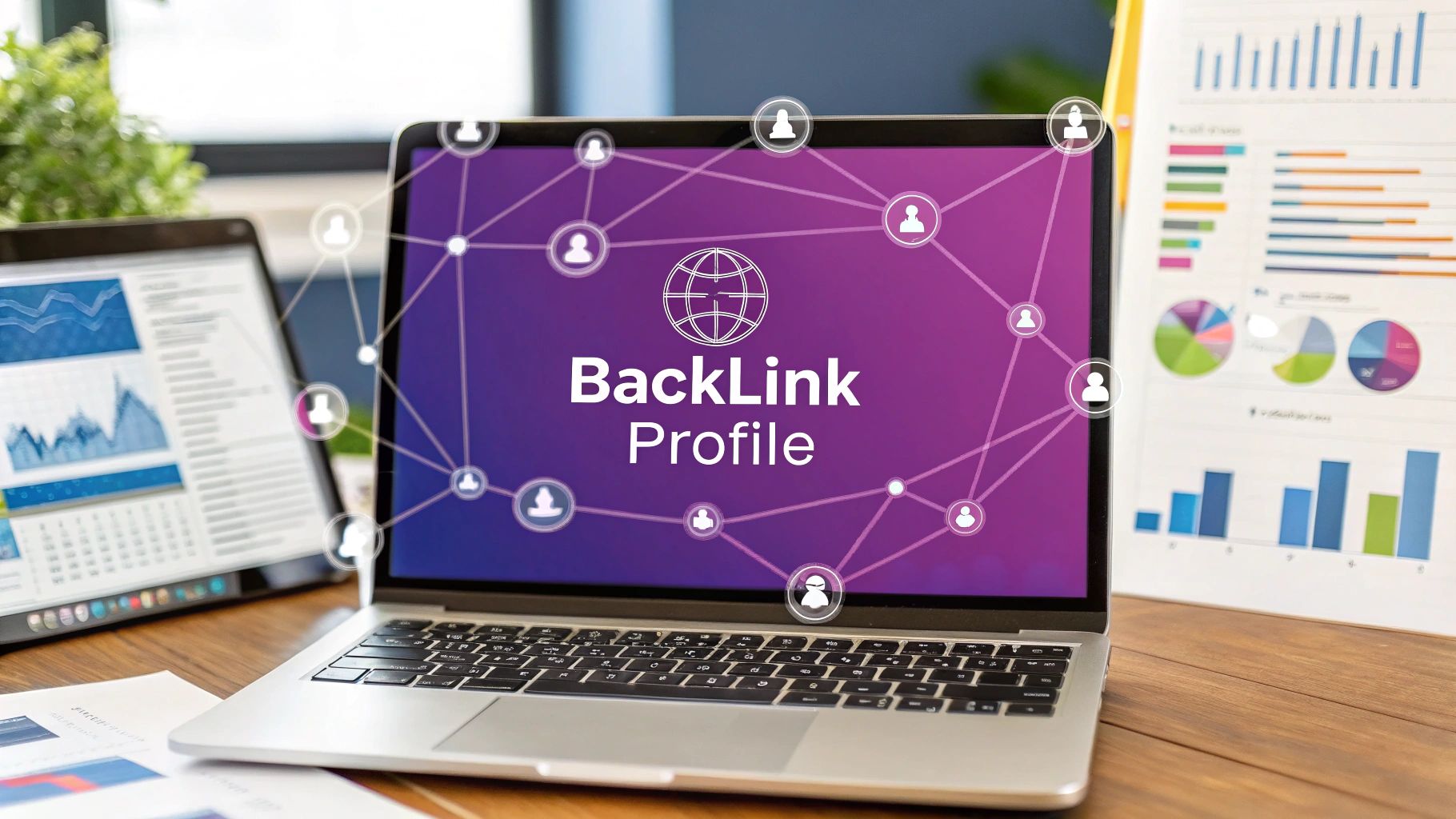

Think of your website as a business on a bustling high street. A backlink is like a recommendation from another respected local shop owner. It’s a nod of approval, a sign that you’re worth visiting.
Your backlink profile is the complete collection of all these recommendations. It’s your website’s entire digital reputation in the eyes of search engines like Google.
Your Website's Digital Reputation Explained
In simple terms, your backlink profile is the sum of every single link pointing to your website from somewhere else on the internet. It’s a comprehensive map that search engines use to judge your site's authority, trustworthiness, and relevance. Each link acts as a vote of confidence, signalling that your content is valuable enough for another site to reference.
Imagine you run a small e-commerce business in Cambridgeshire, competing against much bigger players. A strong backlink profile could be the secret weapon that helps you climb Google’s rankings and get noticed. The reality is that most websites are virtually invisible online; in fact, a staggering 95% of web pages have zero backlinks, according to recent studies. This lack of competition presents a massive opportunity for proactive businesses.
A healthy and robust profile is essential for a few key reasons:
- It builds trust: Links from reputable, authoritative websites tell Google your site is a credible source of information.
- It drives rankings: Google's algorithm relies heavily on backlink data to decide which pages deserve to rank highest for specific searches.
- It generates traffic: Backlinks don't just influence search engines. They also bring real visitors—potential customers—from other websites directly to yours.
This collection of links is a crucial part of your overall online reputation management and SEO strategy. For businesses in competitive local markets like Cambridgeshire, understanding and nurturing this profile is the first and most critical step towards outranking competitors.
Ultimately, it's not about having the most links, but about earning the right ones. A few high-quality recommendations will always beat a mountain of irrelevant ones.
Breaking Down Your Backlink Profile
To really get what a backlink profile is, you have to look under the bonnet. It’s not just a simple count of how many websites link to yours; it’s a complex web of signals that search engines like Google use to figure out your website's authority and relevance. Think of it as a detailed report card for your online reputation.
This visual shows the simple flow of how links from other websites pass authority and traffic to your own site.

This process makes it clear that not all recommendations are created equal. The quality and context of the website giving the link are what truly matter. Each piece of your backlink profile helps paint the bigger picture of your site's credibility.
Key Components of Your Profile
When we break down your profile, we’re looking at several critical parts. Each one tells a bit of your digital story and shapes how search engines see your business. Getting to grips with these is the first step in figuring out how healthy your profile really is.
- Referring Domains: This is the number of unique websites linking to you. Getting 100 links from one website is nowhere near as powerful as getting one link each from 100 different, reputable sites. A high number of referring domains suggests your brand is widely recognised.
- Anchor Text: This is the clickable text in a hyperlink. A varied and natural-looking mix of anchor text is crucial. If every single link uses the exact same keyword-stuffed phrase, it screams "manipulation" to Google. You can get the full story in our guide on what anchor text is in SEO.
- Link Quality: The authority of the site linking to you is a huge factor. A link from a major news outlet or a well-respected industry blog is worth more than hundreds of links from spammy, low-quality directories. It really is about the company you keep online.
- Topical Relevance: Links from websites in your own industry or niche carry far more weight. For a plumber based in Cambridgeshire, a backlink from a UK home improvement blog is massively more valuable than one from a random American sports website.
A healthy backlink profile is built on quality, not quantity. Google's algorithms are designed to spot and devalue manipulative tactics, rewarding websites that earn links naturally through valuable content and genuine relationships.
Dofollow vs Nofollow and Geographic Signals
Beyond the basics, a few more technical details play a role in your profile's strength. These signals add another layer of information for search engines to analyse.
A natural-looking profile needs a balanced mix of Dofollow and Nofollow links. Dofollow links are the ones that pass on SEO authority (often called "link juice"), while Nofollow links (which you often find in blog comments or on social media) don't. Both have a place in a healthy online ecosystem.
For local businesses, Geographic Distribution also comes into play. If you serve customers in Cambridgeshire, earning links from other local businesses, directories, and publications in the UK reinforces your local relevance. This helps you show up for those all-important location-specific searches. Research shows that UK sites with thousands of links from just a handful of domains or a dodgy-looking anchor text profile can actually damage their rankings, so keeping things balanced and natural is key.
How Your Backlink Profile Drives Business Growth
It’s one thing to know the technical bits and pieces of a backlink profile, but the real magic happens when you connect those details to actual business results. A strong profile isn’t just for impressing search engines; it’s a powerful engine for genuine growth, shaping how potential customers discover and think about your brand.
Think of it like this: Google’s main job is to give people the most credible answers to their questions. When it sees other respected websites linking to yours, it’s a massive vote of confidence. That trust is what pushes your site up the search rankings for the keywords that matter most to your business.
At its core, a healthy backlink profile tells Google you’re a legitimate authority in your field. This endorsement helps you climb above competitors, which in turn leads to a serious uptick in organic traffic—the lifeblood for so many companies.
From Rankings to Revenue
Getting higher rankings is the first domino to fall, but the benefits don’t stop there. A well-managed backlink profile fuels growth in several important ways:
- It brings in high-quality referral traffic. A link from a relevant industry blog doesn't just pass on SEO juice; it sends genuinely interested readers straight to your website. These aren't just random visitors—they're often highly qualified leads who are already looking for what you offer.
- It builds your brand authority. When reputable sources cite your business, it cements your reputation as an expert. This authority makes it far easier to attract customers, partners, and even media attention, creating a snowball effect of positive recognition.
- It gives you a competitive edge. Picture two local businesses in Cambridgeshire. One has a diverse mix of links from local directories, industry blogs, and news sites. The other has almost none. Guess which one will consistently pop up first in local search results and scoop up the majority of online enquiries?
A robust backlink profile is not just an SEO metric; it's a powerful driver of business growth, often stemming from a well-executed a modern content strategy for B2B growth.
For growth-stage companies in Cambridgeshire working with tight budgets, keeping an eye on your backlink profile's health is essential. UK link-building stats show that top Google positions require 3.8x more backlinks—an average of 213 for the top spot compared to just 56 for positions 2-10. But it's the quality of those links from reputable UK sites that really moves the needle.
This authority is a core business asset. You can learn more about how to improve domain authority in our detailed guide. By focusing on earning high-quality, relevant links, you're not just playing an SEO game; you're building a sustainable foundation for long-term business growth.
How to Perform a Backlink Profile Audit
Knowing what a backlink profile is gets you to the starting line. Actually digging in and auditing it is where the race is won. Think of a backlink audit as a full health check for your website's online reputation—it shows you what's working, what's not, and what might be quietly holding you back. It doesn't need to be some mythical, complex process. It's really just about taking a structured look at the data.
First things first, you need to get your hands on that data. You can't analyse what you can't see, so a good tool is non-negotiable here. Industry-standard platforms like Ahrefs, Semrush, and Moz are your best friends for this job. They crawl the web relentlessly to build a comprehensive list of every single site linking back to you, forming the bedrock of a proper audit.
Once the data is in, the real work begins. It's time to look past the vanity metric of "total backlinks" and get into the details that truly matter.

A good tool's dashboard gives you that high-level snapshot—a quick glance at your site's authority and the sheer size of its digital footprint. From there, you can start peeling back the layers.
Step 1: Start with Referring Domains
Kick things off by looking at your referring domains. These are the unique websites sending links your way, and they are far more important than the total link count. It’s much healthier to have one link from 100 different quality websites than 100 links from just one. A diverse range of domains signals broad authority and trust to search engines.
But don't stop at the number. Scrutinise the quality of these domains. Are they coming from respected players in your industry? For a business here in Cambridgeshire, are any of them from local news sites, community blogs, or even partner businesses? Links like these build powerful topical and geographic relevance at the same time.
Step 2: Analyse Your Anchor Text Distribution
Next up, put your anchor text profile under the microscope. In a natural, healthy profile, you should see a real mix of different anchor text types. If you find that nearly every link uses the exact same commercial phrase (like "best plumber in Cambridge"), it sends a huge red flag to Google that you might be trying to manipulate the system.
A balanced distribution should look something like this:
- Branded Anchors: Your actual business name (e.g., "Bare Digital").
- Naked URLs: The raw URL itself (e.g., "https://www.bare-digital.com").
- Generic Anchors: Vague phrases like "click here" or "read more."
- Partial-Match Keywords: Variations around your main target keywords.
A backlink audit is like a health check for your website's reputation. It reveals not only who is recommending you but also how they are doing it, giving you the insights needed to diagnose problems and plan for healthy growth.
Step 3: Identify and Address Toxic Links
This is the really critical part: hunting down potentially harmful or 'toxic' links. These are the backlinks from spammy, low-quality, or completely random websites that do absolutely nothing for you—and can even damage your rankings.
Your SEO tool will help flag the worst offenders, usually based on metrics like low domain authority or a high spam score. Keep an eye out for links from:
- Websites in foreign languages that have no connection to your business.
- Spam-filled blog comment sections.
- Poorly maintained, generic web directories that look like they're from 2005.
If you uncover a lot of these toxic links, Google's Disavow Tool is an option for telling the search engine to ignore them. But be warned: this should be a last resort. It's a powerful tool that can cause more harm than good if used incorrectly.
Choosing from the best SEO audit tools will give you the confidence that your analysis is solid, helping you make the right call. By following these steps, you can take what feels like a complex, murky part of SEO and turn it into a clear, actionable plan for improving your site's authority.
To help you get started, here's a simple checklist to guide you through the key areas of your audit.
Your Simple Backlink Audit Checklist
This straightforward checklist will guide you through the key areas to investigate during your backlink profile audit.
| Audit Step | What to Look For | Action If Issues Are Found |
|---|---|---|
| Referring Domains | Low number of unique domains; links from irrelevant or low-quality sites. | Focus link-building efforts on acquiring links from diverse, high-authority domains. |
| Anchor Text | Over-optimisation with exact-match keywords; lack of brand or generic anchors. | Diversify your anchor text strategy; aim for a more natural distribution. |
| Link Quality | High spam scores; links from known link farms or private blog networks (PBNs). | Identify and list all potentially toxic links for review. |
| Follow vs. Nofollow | An unnatural ratio (e.g., 100% follow links). | A natural mix is fine; no direct action is usually needed unless the ratio is extreme. |
| Topical Relevance | A high number of links from sites completely unrelated to your industry. | Prioritise building links from sites within your niche or related verticals. |
| Toxic Links | Patterns of spammy links; manual action penalties from Google. | Create a disavow file as a last resort and submit it to Google Search Console. |
Running through this checklist gives you a repeatable process for keeping your backlink profile clean, healthy, and working hard to boost your rankings.
Building a Stronger Backlink Profile
Once your audit has laid bare the good, the bad, and the ugly of your backlink profile, it’s time to switch from analysis to action. Building a stronger profile isn’t about quick fixes or dodgy shortcuts; it's a long game. You need sustainable, ‘white-hat’ strategies that deliver real, lasting value. For any business with a sensible budget, this means earning links the right way.
The aim is to build a profile that search engines see as authoritative, trustworthy, and genuinely useful. Think of it as carefully building your business’s credibility, one high-quality recommendation at a time. This approach doesn't just climb the rankings – it cements your brand as a leader in your field.
Create Genuinely Link-Worthy Content
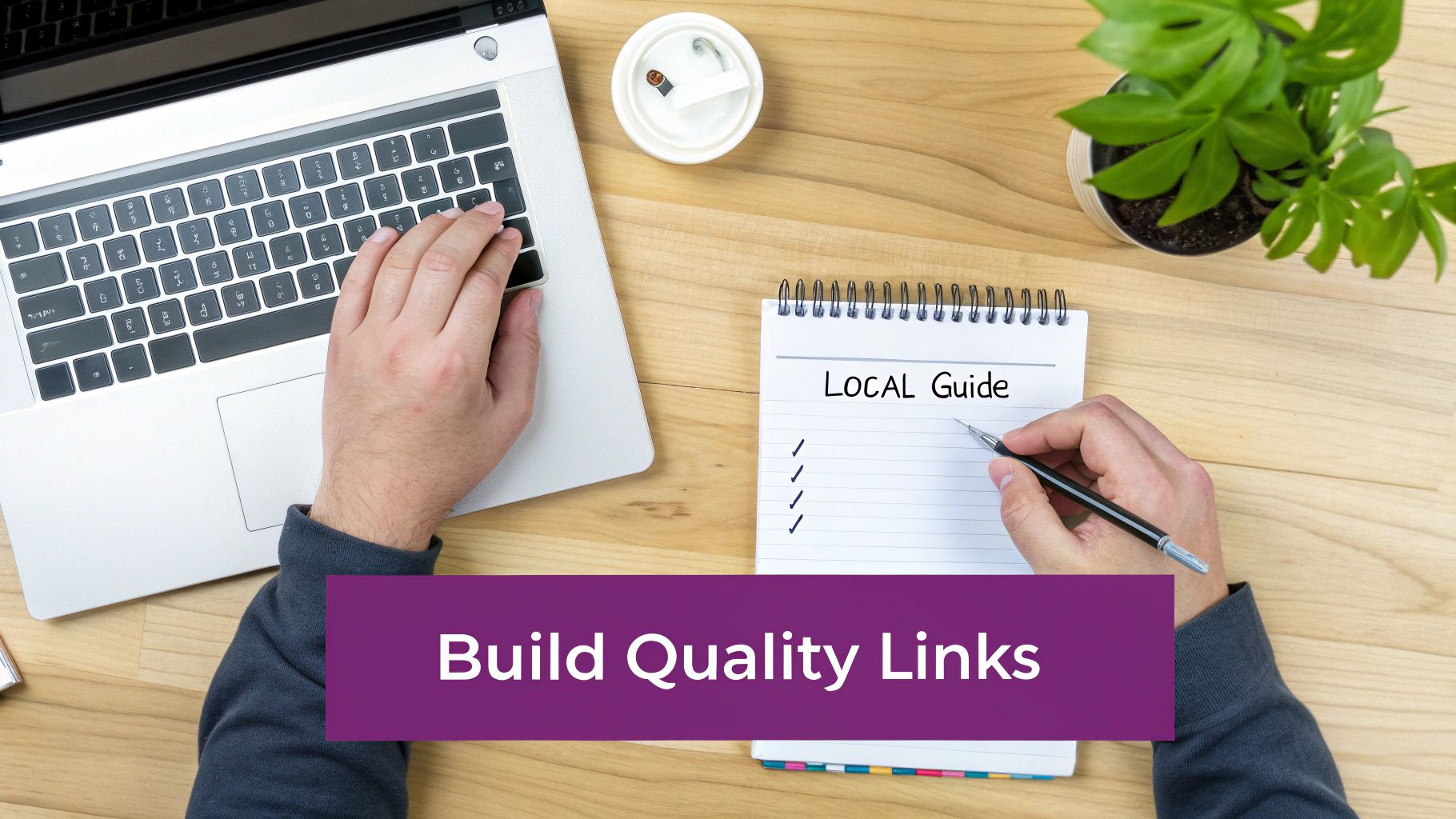
The absolute foundation of any decent link-building campaign is content that people actually want to link to. Just churning out blog posts won’t cut it. You need to create resources that are incredibly valuable, insightful, or just plain helpful for your audience.
Think about developing assets that solve a real problem for your customers or offer unique local insights. These become magnets for natural, high-quality backlinks from other websites that need a credible source to point to.
- Local Guides: A detailed guide like "The Ultimate Guide to Independent Cafes in Cambridgeshire" or "A Small Business Owner's Guide to Local Networking Events" is gold. Local publications and bloggers are always searching for this kind of stuff to share.
- Industry Reports or Original Research: Survey your customers or analyse some industry data to produce a unique report. It instantly positions you as an expert and becomes a go-to source for others in your sector.
- How-To Guides and Tutorials: Detailed, step-by-step guides that solve a common pain point are brilliant for attracting links from forums, blogs, and resource pages.
When you're ready to perform a detailed backlink profile audit, you'll need effective website audit tools to gather and analyse the necessary data.
Master Guest Posting and Digital PR
Guest posting on other relevant, UK-based blogs is a fantastic way to get your name in front of a new audience while earning a valuable backlink. The key here is quality over quantity. Find blogs your ideal customers are reading and pitch a genuinely useful article, not just a thinly-veiled ad for your business.
Digital public relations (PR) works in a similar way – it’s all about building relationships with journalists, bloggers, and publications.
Building a natural backlink profile is a long-term, multi-pronged effort. Don’t trust any expert who tries to sell you links or 'get-links-fast' strategies. Quality will always outweigh quantity in the eyes of Google.
For a business in Cambridgeshire, this could mean connecting with local news outlets or community websites. You could share your expert opinion on a local issue, announce a newsworthy company update, or offer up a unique data story they can run with.
Leverage Local Directories and Partnerships
Finally, never underestimate the power of local SEO signals. Making sure your business is listed accurately in reputable UK and Cambridgeshire-specific directories is a simple but effective way to build those foundational links. Go beyond the big names and look for niche directories relevant to your industry.
You can also forge partnerships with other local businesses that serve a similar crowd but aren't direct competitors. Co-host a webinar, create a joint guide, or simply cross-promote each other on your websites. These local collaborations create authentic links that strengthen your geographic relevance, helping you capture that all-important local search traffic.
Your Backlink Questions Answered
To wrap things up, let's tackle some of the most common questions business owners and marketers have when they first start digging into the world of backlink profiles. Getting clear, straightforward answers helps cut through the noise and lets you focus on what really matters.
How Long Does It Take to Build a Good Backlink Profile?
Let's be realistic: this is a marathon, not a sprint. Building a strong, natural backlink profile is a gradual process that takes months, not days. Think of it like building a solid reputation for your business in the real world; it simply doesn't happen overnight.
You might start to feel the initial effects of a few high-quality links within two to three months, but creating a genuinely authoritative profile is a long-term game. Consistency and quality are everything. A sudden explosion of new links looks unnatural to search engines, so a steady, organic pace is always the best approach.
Is It a Good Idea to Buy Backlinks?
Tempting as it might be for a quick win, the answer is a hard no. We strongly advise against ever buying backlinks. It's a high-risk gamble that goes directly against Google's guidelines and can undo all your hard work.
Buying backlinks is like building your business's reputation on a foundation of sand. It might look impressive for a moment, but it's destined to collapse—potentially taking your search rankings down with it and causing long-term damage to your digital credibility.
Search engines are smarter than ever at spotting these manufactured link schemes. If you get caught, your site could face a severe penalty, leading to a dramatic drop in rankings or even complete removal from search results. The short-term gain just isn't worth the long-term risk.
What Is a Toxic Backlink?
A toxic backlink is exactly what it sounds like: a link from a low-quality, spammy, or irrelevant website that can poison your SEO efforts. These links offer zero value and can signal to Google that your site is associated with a bad online neighbourhood.
Common sources of toxic links include:
- Link farms: Websites created purely for the purpose of selling links.
- Spammy directories: Low-quality, automated directories with no real oversight.
- Irrelevant sites: Links from websites in completely unrelated industries or foreign languages.
If an audit uncovers a significant number of toxic links, you can use Google's Disavow Tool to ask them to ignore these links. But this should always be a last resort. It's a powerful tool that, if used incorrectly, can do more harm than good, so proceed with extreme caution.
Do Internal Links Count Towards My Backlink Profile?
This is a really common point of confusion, but the answer is simple: no, they don't. An internal link is a link from one page on your website to another page on the same website. While they are incredibly important for site navigation and helping Google understand your site structure, they aren't part of your backlink profile.
Your backlink profile is made up exclusively of inbound links from external, third-party websites. Each of those external links acts as an independent vote of confidence from another corner of the web, which is why they carry so much weight in SEO.
Ready to build a backlink profile that drives real growth for your business? The specialists at Bare Digital offer expert SEO services tailored for Cambridgeshire businesses. Get in touch for a free, no-obligation SEO health check and a clear plan to boost your online authority. Discover our approach at https://www.bare-digital.com.