

Imagine writing something for your business that keeps working for you, day in and day out, attracting new customers for years without ever feeling old. That’s the magic of evergreen content. It’s the solid foundation that answers the core questions your audience will always have.
What Is Evergreen Content?
Evergreen content is high-quality, foundational information that stays useful and relevant to your readers for a very long time. Think of it like a hardy evergreen tree in your garden—it keeps its leaves and looks great all year round, unlike a news article about a passing trend that quickly wilts and loses its appeal. This kind of content becomes a long-term asset for your business.

It’s the complete opposite of topical or seasonal content, which has a very short shelf life. For instance, a blog post on "Christmas Marketing Ideas for 2024" is topical, but a guide on "How to Calculate Your Profit Margin" is evergreen. The first one becomes useless come January, while the second remains valuable indefinitely.
The core idea behind evergreen content is its timelessness. It tackles a fundamental need, problem, or interest that doesn't change, making it a reliable source of traffic and authority for months, or even years, after you first hit publish.
This strategy is a cornerstone of any smart content marketing and digital marketing plan because it delivers sustainable, compounding results. Instead of constantly chasing the next big trend, you’re building a library of valuable resources that continuously work to bring your ideal customers to your door.
Evergreen vs Topical Content: A Quick Comparison
To really nail the difference, let’s break down the key characteristics of evergreen and topical content side-by-side. This table should make it clear when to use each type for maximum impact.
| Characteristic | Evergreen Content | Topical Content |
|---|---|---|
| Lifespan | Long-lasting, relevant for years. | Short-lived, tied to a specific time or event. |
| Audience Need | Addresses fundamental, ongoing problems or questions. | Taps into current trends, news, or seasonal interest. |
| Traffic Pattern | Steady, consistent traffic over a long period. | A sharp spike in traffic followed by a rapid decline. |
| SEO Value | Builds long-term authority and stable rankings. | Can rank quickly for trending terms but fades fast. |
| Examples | "How-To" guides, ultimate guides, case studies. | News articles, event coverage, seasonal promotions. |
Understanding this distinction helps you balance your content strategy. While topical posts can generate quick buzz, it's the evergreen pieces that build the lasting foundation for your online presence.
Why It Matters for Your Business
Focusing on evergreen topics helps businesses, especially SMEs right here in Cambridgeshire, build a powerful and lasting online presence. It creates a stable foundation for your search engine optimisation (SEO) efforts, and the benefits are hard to ignore.
- Sustained Organic Traffic: Evergreen articles can rank on Google for years, consistently bringing visitors to your website long after you’ve published them.
- Builds Authority and Trust: When you provide reliable, comprehensive answers, you position your brand as a go-to expert in your field. People start to trust you.
- Generates Leads Over Time: A well-crafted guide or checklist can become a lead-generation machine, working around the clock to attract potential clients.
- High Return on Investment: The initial time and effort you put into creating a great evergreen piece pays off for years, offering a much better ROI than short-lived content.
Ultimately, evergreen content is a must-have for small businesses in the UK. Data from UK merchant platforms shows that focusing on this type of "pillar" content helps build topical authority, securing ongoing visibility without needing constant updates. This means you can rely less on costly paid ads. After all, organic search delivers a better ROI for 49% of businesses and accounts for a massive 53% of all web traffic.
The Real Business Case for Evergreen Content
So, we've covered the 'what'. But why should you actually care about evergreen content? Let's get down to the tangible results it can deliver for your business. This isn't just about ticking a content marketing box; it's a strategic investment with a powerful, measurable return.
Think of it this way: a single, well-crafted evergreen article can become your most reliable marketing asset. It works tirelessly for you, day and night, long after you’ve hit the publish button.
In fact, this approach often generates a higher return on investment (ROI) than almost any other marketing activity you can think of. You put in the effort once to create a genuinely helpful guide. That guide then has the potential to attract organic traffic, build your authority, and generate leads for years to come—all without you spending another penny on it.
Compare that to the endless hamster wheel of paid advertising. The second you stop paying for ads, the traffic dries up completely. It's like renting an audience. Evergreen content, on the other hand, is about building a permanent asset that you own outright.
Building Sustainable Digital Assets
The true power of an evergreen strategy is how it compounds over time. Every new evergreen piece you create is another digital asset in your portfolio, another pathway for potential customers to find you through search engines like Google.
An evergreen article is not a one-off campaign; it's a long-term lead generator. It consistently drives organic traffic and builds deep authority with both search engines and potential customers, making your marketing budget work harder for longer.
This steady performance builds serious momentum. As your library of evergreen resources grows, so does your website's overall authority on your chosen topics. This creates a rising tide that lifts all boats, making it easier for all your pages, including new ones, to rank well in search results.
The Financial Advantage for Local Businesses
For small and medium-sized enterprises (SMEs), especially those slugging it out in competitive local markets like Cambridgeshire, this financial efficiency is a game-changer. It allows you to build a significant competitive advantage without needing a massive advertising budget.
Instead of trying to outspend bigger competitors on paid search, you can outsmart them by simply becoming the most helpful and authoritative resource in your niche.
Here’s how that plays out for a local business:
- Reduced Customer Acquisition Cost (CAC): As organic traffic from your evergreen content grows, you become less reliant on expensive paid channels. This directly lowers the average cost to bring in a new customer.
- Qualified Local Leads: Content that answers specific local questions (like "Best accounting practices for Cambridgeshire startups") attracts highly relevant, ready-to-talk leads from your exact target area.
- Long-Term Budget Stability: The one-off creation cost is predictable. You’re not caught in the volatile bidding wars of pay-per-click (PPC) advertising, where costs can spike overnight without warning.
Ultimately, investing in evergreen content means you are building a resilient marketing engine for your business. It's a strategy focused on creating lasting value, establishing genuine trust, and ensuring a steady flow of high-quality leads. For an SME, this isn't just a clever marketing tactic—it's a foundational business strategy.
Proven Evergreen Formats That Actually Work
Right, let’s move past the theory. The real value is in seeing what this stuff actually looks like in the wild. These are the formats that form the bedrock of a powerful, long-term content strategy—the kind that delivers results year in, year out.
Not all content formats are created equal, though. The trick is to pick one that genuinely helps your audience while letting you flex your expertise. Let's look at the formats that consistently get the job done.
How-To Guides and Tutorials
The "how-to" guide is probably the most classic example of evergreen content, and for good reason. These articles tackle a user's problem head-on with a clear, step-by-step solution. People will always need to learn how to do things, so their value is pretty much timeless.
For a local business in Cambridge, this format is pure gold. Picture a boutique accounting firm publishing a detailed guide titled, "How to Register as a Sole Trader in Cambridgeshire." That article solves a specific, recurring problem for their ideal customer, immediately positioning the firm as a helpful local expert.
Ultimate Resource Pages and Listicles
Ultimate resource pages, often dressed up as massive listicles, are designed to be the definitive source on a topic. They gather a huge amount of information into one convenient hub, saving the reader from bouncing between a dozen different websites. They're also absolute link-magnets, as other sites will naturally point to them as the go-to resource.
Take a look at Wikipedia's page on Search Engine Optimisation. It’s a perfect example of a massive resource hub.
This page breaks down a hugely complex topic into manageable sections, making it a perennial favourite for both newcomers and seasoned pros.
A local tradesperson, say a plumber in Ely, could create something like "The Ultimate Checklist for Preventing Frozen Pipes in a UK Winter." It’s not just useful during a cold snap; it stays relevant every single year, drawing in steady traffic and building trust with homeowners.
Checklists and Templates
Checklists and templates are incredibly practical because they’re built to be used. They take a complicated process and turn it into a clear, actionable framework for people to follow. This sheer utility makes them highly shareable and perfect for bookmarking.
Evergreen content thrives on utility. By creating a resource that people can actively use, you embed your brand directly into their workflow, building a much deeper connection than a passive article ever could.
This format is also a brilliant way to capture leads. For example, offering a downloadable "Annual Business Tax Checklist" in return for an email address is a fantastic way for an accounting firm to build its mailing list with genuinely interested prospects. To make content like this perform well, you really need to know how to write SEO content that hits the mark with user intent.
Insightful Case Studies and Original Research
Case studies are all about showing, not just telling. They offer real-world proof of how your product or service solved a tangible problem for a real client. This storytelling approach is brilliant for building credibility and helping potential customers see themselves achieving similar success.
In the same vein, publishing original research or data-driven studies can cement your status as an authority in your field. This can take a few forms:
- Statistic Round-ups: Pulling together key industry data into one post. These are highly linkable and position you as a central information hub.
- Proprietary Data Reports: Analysing your own internal data to uncover unique trends or insights that nobody else has access to.
- Glossaries and 'What Is' Explainers: Defining core industry terms is a simple but incredibly effective way to capture search traffic from people who are just starting out in your field.
By focusing on these proven evergreen formats, you're doing more than just creating content; you're building a library of digital assets. Each piece works around the clock to solve customer problems, dominate local search, and establish your business as the one to trust.
Your Step-by-Step Guide to Creating Evergreen Content
Creating content that stands the test of time can feel like a huge undertaking. But it's not about being a literary genius; it's about having a solid, repeatable process. The goal here is to build a high-quality business asset, one sensible step at a time.
This guide gives you a practical, no-fluff framework that any small business can use—even if you don't have a dedicated content team. Let's walk through the steps to get you from a blank page to a published article that keeps working for you long after you hit 'publish'.
Step 1: Find Your Evergreen Topics
The bedrock of any great evergreen article is a topic your audience will always care about. Your job is to uncover the fundamental problems, questions, and curiosities that are constantly on their minds. This isn't about chasing the latest trend; it's about identifying timeless needs.
Start by brainstorming the questions your customers ask you every single day. What are their biggest headaches? What information do they always need before they can make a decision? These everyday conversations are an absolute goldmine for content ideas.
Once you have a few ideas, you can use some simple tools to check their staying power:
- Google Trends: Pop a topic in and see how its search interest looks over several years. A nice, stable, mostly horizontal line is a brilliant sign.
- AnswerThePublic: This tool is great for visualising all the questions people are asking around a keyword, giving you a direct window into their problems.
- Competitor Analysis: Take a look at the top-performing blog posts of your competitors. What topics seem to be bringing them a steady stream of traffic?
By starting with a topic that has proven, long-term relevance, you're building your content on solid ground from the very beginning.
Step 2: Craft a Comprehensive Outline
You've got your topic. Now, resist the temptation to just start writing. A detailed outline is like the architectural blueprint for your article, making sure it's deep, well-structured, and flows logically from one point to the next.
A good outline stops you from waffling and ensures every section has a clear purpose. It helps you build your case progressively, guiding the reader from the basics to the more complex insights without leaving them behind. It's also a massive help for SEO, as it gives Google a clear map of what your content is all about.
A great outline does more than just list headings. It forces you to think about the user's journey, anticipating their questions and providing answers in the order they need them. It's the difference between a random collection of facts and a genuinely helpful resource.
This planning stage is what elevates your content from just another blog post to a standout asset. It’s also a key part of a much bigger plan. To see how this fits into the wider picture, check out our guide on how to create a content strategy that actually works.
Step 3: Write with Clarity and Empathy
With your outline as your roadmap, it's finally time to write. The real key here is to focus on clarity and empathy, especially if you're tackling a complicated subject. Always write for a beginner. Ditch the industry jargon and explain things in simple, direct language.
Imagine you're having a conversation with a potential customer. Use short paragraphs, clear sentences, and natural transitions to make the whole thing easy to read and digest. Your aim is to be the most helpful, most understandable resource on the web for this specific topic.
Using formatting and visuals is also crucial for breaking up big chunks of text and keeping your reader engaged. The graphic below shows how different evergreen formats—like guides, lists, and case studies—can be structured to provide a clear path for the reader.
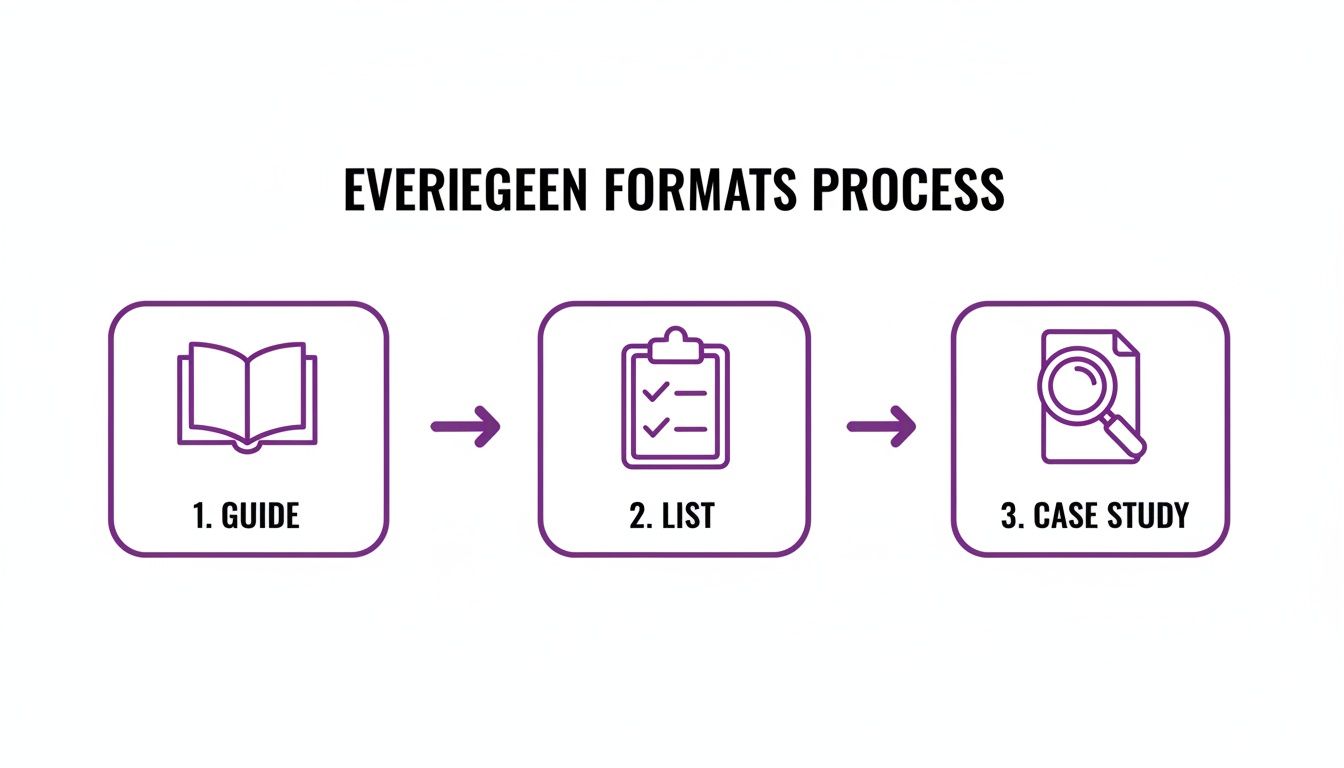
The format should always serve the reader's needs, whether they're following a step-by-step guide or looking for proof in a case study. By writing well and presenting your information clearly, you build trust and encourage people to stick around—sending a strong signal to search engines that your content is top-notch.
Keeping Your Evergreen Content Fresh and Powerful
Hitting ‘publish’ on a brilliant piece of evergreen content feels great, but the job isn’t quite finished. To make sure your hard work pays off for years to come, it needs a little upkeep. Think of it less like a statue you unveil once and more like a garden you tend; a bit of regular care keeps it healthy and performing at its absolute peak.
This ongoing attention is what separates good content from a truly powerful, long-term business asset. It ensures your information stays accurate, relevant, and authoritative in the eyes of both your readers and search engines like Google.

The good news? This doesn't mean a massive amount of extra work. A simple, scheduled routine of checks and updates is all it takes to keep your best content fresh, powerful, and driving results.
Simple Maintenance and On-Page SEO Tweaks
The heart of evergreen maintenance is simply giving your content a periodic review to ensure everything is still up to scratch. Algorithms change, new data emerges, and what was best practice last year might be slightly different today. A regular check-in keeps your content sharp.
Set a calendar reminder to look over your key evergreen pieces every 6 to 12 months. During this review, you only need to focus on a few key areas to get the most impact for your time.
Here’s a straightforward checklist for your content refresh:
- Update Statistics and Data: Swap out any old numbers or studies for the most recent data available. Fresh statistics signal that your content is current and trustworthy.
- Check for Broken Links: Use a simple tool to find and fix any links that no longer work. Broken links create a poor user experience and can harm your SEO.
- Refresh Examples and Case Studies: If your examples feel a bit dated, replace them with more current ones. This keeps the content feeling relevant to today's reader.
- Review On-Page SEO Elements: Glance over your title tag, meta description, and subheadings. Could they be tweaked to better match what users are searching for or to include more relevant keywords?
These small adjustments send positive signals to Google, showing that your content is actively maintained and remains a high-quality resource.
The Power of Internal Linking
One of the most effective—yet often overlooked—maintenance tasks is optimising your internal linking. Whenever you publish new blog posts, make it a habit to go back to your older evergreen articles and add links pointing to the new, relevant content.
This simple strategy achieves two critical goals. First, it helps your readers discover more of your valuable content, keeping them on your site longer. Second, it distributes authority (or "link equity") throughout your website, helping your new posts get indexed and ranked much faster.
Think of internal links as pathways that guide both users and search engine crawlers through your website. A strong internal linking structure makes your site easier to navigate and understand, boosting the SEO value of every single page.
Go through your top-performing evergreen articles and look for natural opportunities to link to newer, more specific posts you've written. This reinforces your topical authority and creates a deeply interconnected web of helpful resources.
Maximise Your Reach Through Content Repurposing
Finally, don't let your hard work sit in just one format. To truly maximise the lifespan and reach of your best evergreen pieces, you need to get smart with content repurposing. This is the art of transforming one successful asset into a whole ecosystem of content.
This approach lets you reach different parts of your audience on the platforms they actually use, all without having to start from scratch. It’s an incredibly efficient way to get more value from the effort you’ve already put in.
Here are just a few ways you could repurpose a single evergreen guide:
- Infographics: Turn key statistics and steps into a visually appealing infographic perfect for sharing on social media.
- Short Videos: Create a quick tutorial video for YouTube or TikTok, explaining a core concept from the article.
- Social Media Updates: Pull out key quotes, tips, or stats and share them as a series of posts on LinkedIn, Facebook, or X.
- Email Newsletters: Feature the guide in your newsletter, giving your subscribers a direct link to your most helpful resource.
By keeping your content fresh and finding new ways to present it, you ensure your evergreen assets continue to work hard for your business long into the future.
How to Measure the ROI of Your Evergreen Content
You’ve poured a lot of time and effort into creating a brilliant evergreen asset, so how do you prove it’s actually paying off? Measuring its return on investment (ROI) isn’t just about seeing a quick traffic spike; it’s about tracking the lasting value your content delivers to the business.
Unlike a short-term campaign that gives you an immediate hit, the success of evergreen content reveals itself over months, even years. This means shifting your mindset away from instant results and focusing instead on sustained, compounding growth. By keeping an eye on the right key performance indicators (KPIs), you can paint a clear picture of its business impact.
To really get to grips with the value your content is creating, you need to learn how to measure content marketing ROI like a pro. This skill turns what looks like a confusing jumble of numbers in your analytics into a clear story of success.
Key Metrics to Track for Evergreen Success
To get a proper sense of your content’s performance, you have to look beyond simple page views. The real gold is found in metrics that show long-term engagement and sustained visibility in search results. The good news? Free tools like Google Analytics and Google Search Console are all you need to get started.
Here are the most important KPIs to monitor:
- Long-Term Organic Traffic: Is the article consistently pulling in visitors from search engines, month after month? Look for a stable or gradually climbing trend over 6-12 months. This is the clearest sign you’ve got a winner.
- Keyword Rankings: Does the piece hold its high rankings for the keywords you’re targeting? A top position that stays put for years is a massive asset, acting like a tap that continuously funnels relevant people to your site.
- Backlinks Acquired: Are other websites linking to your content as a resource? Natural backlinks are a huge vote of confidence from the internet. They're a primary driver of SEO authority and a signal that your piece is a go-to source in your industry.
- Conversions and Goal Completions: Is the traffic from your evergreen content actually doing anything useful? Track metrics like newsletter sign-ups, contact form submissions, or downloads to draw a straight line from your content to your business goals.
Reporting on Business Impact
Tracking these metrics is one thing, but presenting them in a way that makes sense to everyone else is what really demonstrates ROI. Don’t just throw raw numbers at people; tell the story behind them. Frame your findings in terms of lead generation, brand authority, and how much you're saving on paid ads.
The ultimate measure of evergreen ROI is its ability to generate consistent, low-cost leads over its entire lifespan. A single article that costs £500 to produce but generates thousands in business over three years is an incredibly efficient marketing asset.
A well-structured report helps stakeholders understand the long-term value you're building. For a clear and effective way to present your findings, you might find it helpful to use a monthly SEO report template to showcase your progress. By connecting content performance to tangible business outcomes, you can confidently prove the immense value of your evergreen strategy.
Got Questions About Evergreen Content? Let's Clear a Few Things Up
Alright, let's wrap this up by tackling some of the most common questions that pop up when business owners first dip their toes into evergreen content. Getting these details straight can give you the confidence to start building your own library of valuable digital assets.
How Long Should an Evergreen Article Be?
There’s no magic number here. The simple, honest answer is: as long as it needs to be. The entire point of an evergreen piece is to become the go-to, most helpful resource on a specific topic. That usually means going deep, often landing somewhere between 1,500 and 3,000 words—sometimes even more.
But don't get hung up on word count. Instead, obsess over answering the reader's question completely. Have you covered every angle? Did you anticipate their follow-up questions? Did you provide clear, useful examples? If you nail that, the word count will take care of itself.
Your article's length should be dictated by what it takes to fully solve the reader's problem, not by hitting an arbitrary target. The goal is to create the definitive guide that leaves no stone unturned.
Truth is, a well-researched, genuinely helpful article is naturally going to be substantial. And as it happens, that’s exactly the kind of in-depth content that tends to perform best in search results over the long haul.
How Often Should I Update My Evergreen Content?
While the core advice in your evergreen content is timeless, the world around it changes. To keep your articles ranking well and feeling fresh, you should plan to give them a check-up at least once every 12 months. For topics in faster-moving industries, a six-month review is even better.
A refresh isn't a complete rewrite. You're just looking for small but vital tweaks that show Google (and your readers) that the content is still current and trustworthy.
- Hunt for outdated stats and swap them for the latest data you can find.
- Click every external link to make sure none are broken.
- Add new internal links to relevant blog posts or pages you've published since.
- Refresh screenshots or examples that might look a bit dated.
Think of it as routine maintenance. It’s a small investment of time that protects the long-term value of your hard work.
Can Any Topic Be Made Evergreen?
Not quite. Some topics just have a built-in expiry date. Anything tied to a specific event, a fleeting trend, or a particular year is, by definition, not evergreen. Think of articles like "The Top Marketing Trends for 2024" or a "Recap of the Cambridgeshire County Show." Their relevance fades quickly.
But you can almost always find an evergreen angle on a topical subject. Instead of writing about this year’s social media trends, you could create a comprehensive guide on "How to Build a Social Media Strategy from Scratch." That’s foundational knowledge that stays useful year after year.
The trick is to focus on core principles, "how-to" guidance, and fundamental knowledge, rather than breaking news or passing fads.
Ready to build a powerful evergreen content strategy that drives long-term growth? At Bare Digital, we specialise in creating high-performance SEO content for businesses in Cambridgeshire and beyond. Start with our free SEO Health Check to uncover your biggest opportunities. https://www.bare-digital.com