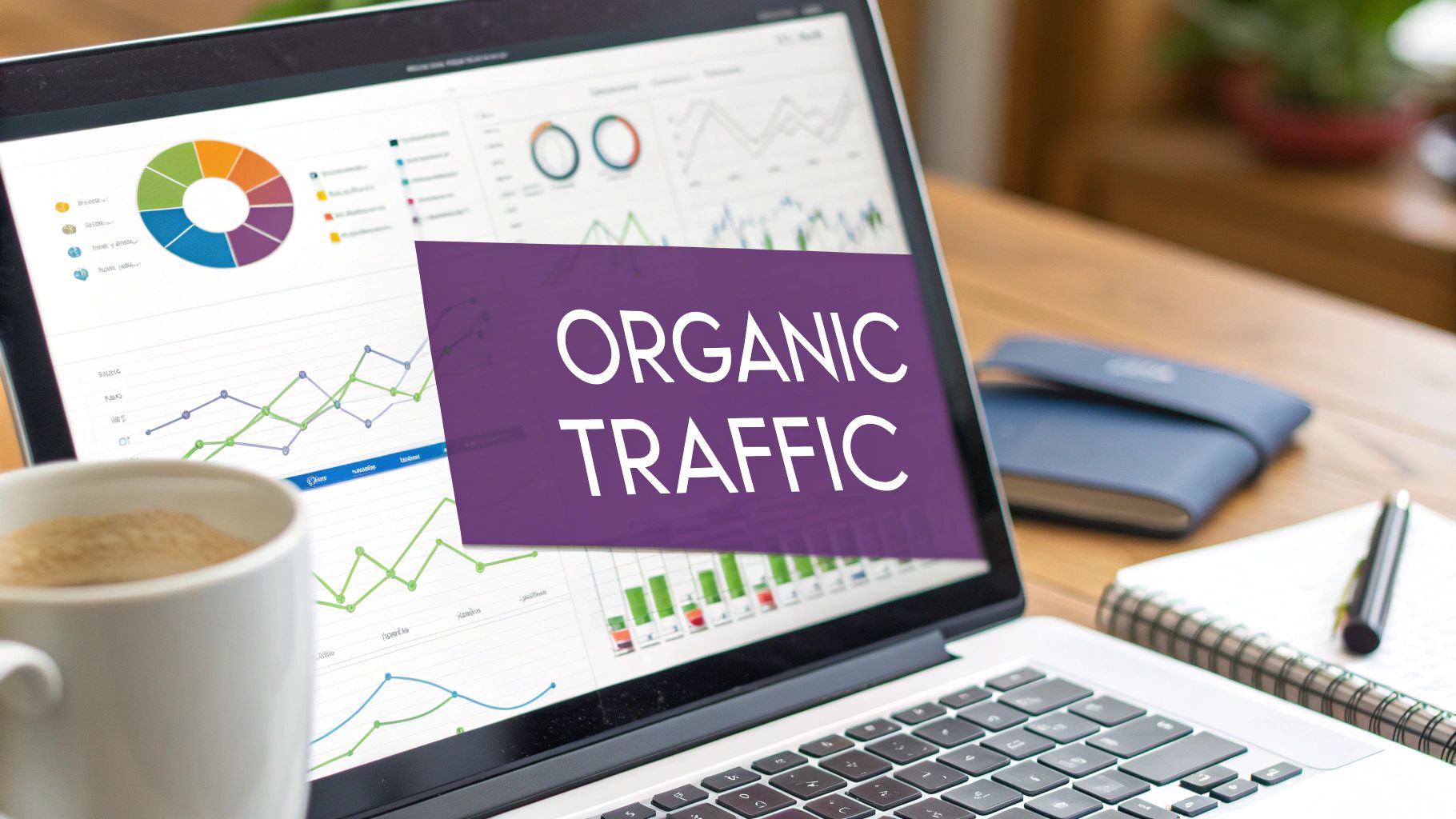

In simple terms, organic traffic is anyone who lands on your website after clicking on an unpaid search engine result. These aren't people who clicked on a sponsored ad; they found you organically because your website offered the best answer to what they were looking for.
What Does Organic Traffic Actually Mean?
Think of your business as a shop on a bustling high street. Organic traffic is the digital equivalent of someone walking through your door because your shop is in a prime, highly visible location. They weren't drawn in by a flyer or a paid promotion—they found you naturally while searching for exactly what you sell.
Visitors arriving this way already have a goal in mind, which makes them incredibly valuable from the get-go.
When someone types a question into Google, the search engine scans its massive library—a process known as search engine indexing—to find the most relevant and helpful pages. The websites that show up in the main results, just below the ads, have earned their spot. A click on one of these is what we call an organic visit.
Why It's the Bedrock of Digital Success
Paid ads are great, but the traffic stops the second you stop paying. Organic traffic, on the other hand, is an asset that builds on itself, delivering sustainable, long-term value. Every optimised blog post or technical fix acts like another brick in your foundation, strengthening your website’s authority over time.
This creates a dependable stream of potential customers who are actively looking for what you offer. For UK businesses, this is an especially powerful channel.
In the UK, organic traffic is the dominant force for small and medium-sized enterprises (SMEs), driving a massive 53.65% of all website traffic. That figure is well above the global average and completely dwarfs traffic from social media, proving that a strong SEO strategy isn't just a nice-to-have—it's essential.
Even as search technology evolves, the reliability of organic search remains remarkably consistent. You can dig deeper into the numbers in this social media traffic research study.
High Intent Equals Higher Value
What really sets organic traffic apart is user intent. Someone searching for "best running shoes for marathon training" has a clear and immediate need. If your e-commerce shop ranks for that phrase, the person clicking through isn't just window shopping; they're a highly qualified lead, often close to making a purchase.
This built-in intent is why visitors from organic search tend to stick around longer, engage more, and are far more likely to become loyal customers. Building this kind of traffic isn’t just a marketing tactic; it’s how you build a genuine, lasting business.
Comparing Your Key Website Traffic Sources
To really get why organic traffic is such a big deal, it helps to see how it stacks up against the other ways people land on your website. Think of your marketing efforts like a well-balanced team, where every player has a unique role. Not all traffic is created equal—where a visitor comes from tells you a lot about their mindset and how close they are to becoming a customer.
Your website traffic is generally split into four main channels. Each has its own flavour and value, and understanding the differences is the first step to building a solid marketing strategy that isn't dangerously reliant on just one source.
This diagram breaks down the essentials of organic traffic, showing that it’s unpaid, comes from search engines, and is driven by people who are actively looking for something.
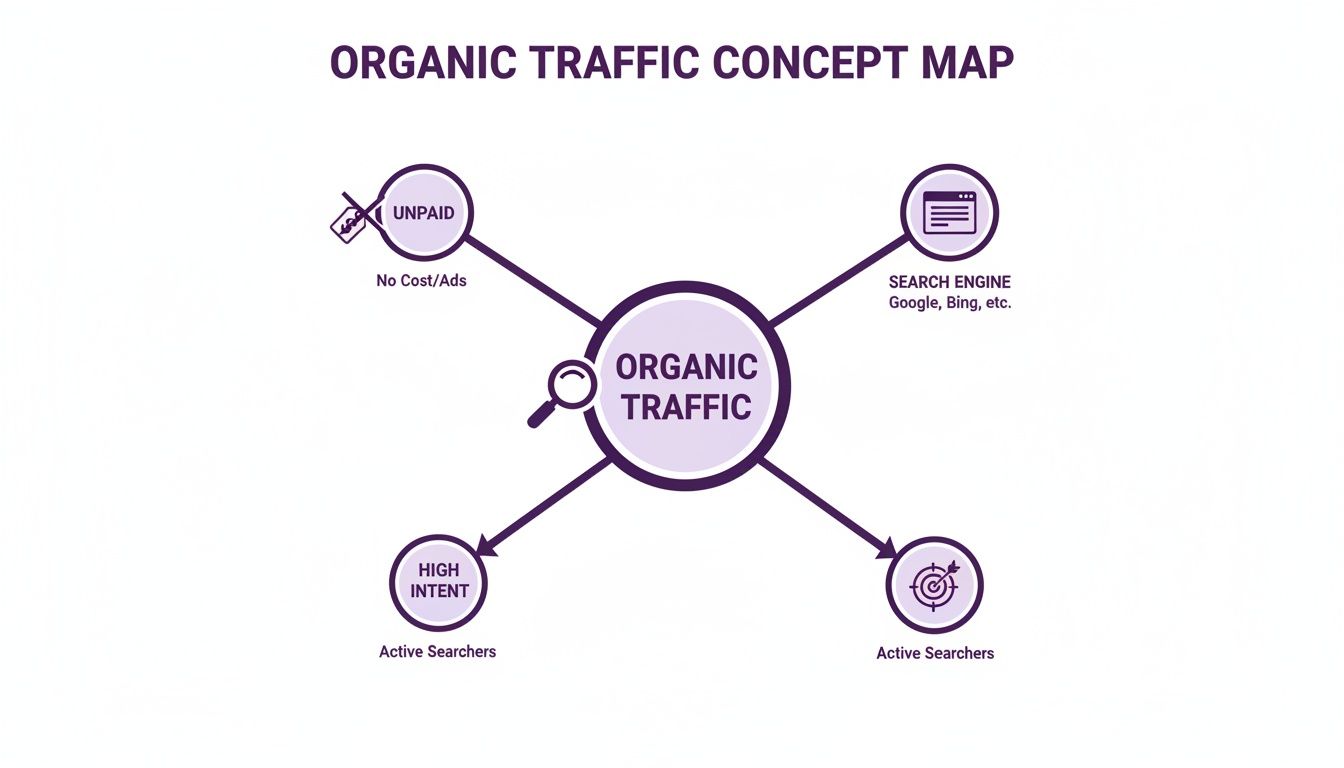
The key takeaway here is that organic visitors are on a mission to find solutions. That’s what makes this traffic source so valuable and different from the rest.
Paid Traffic: The Sponsored Advert
Paid traffic is exactly what it sounds like: visitors who click on an ad you’ve paid for, like Google Ads or a promoted post on social media. It’s the digital equivalent of taking out a sponsored advert in a local Cambridgeshire magazine. You get guaranteed placement and immediate visibility, but the second you stop paying, the ad vanishes—and so does the traffic.
This channel is fantastic for short-term campaigns or launching a new product because it delivers fast, predictable results. The catch? It’s rented space. The costs can add up quickly, and it doesn’t build any lasting digital assets for your business. For a deeper dive, you can explore the nuances of search engine marketing vs SEO.
Direct Traffic: The Regular Customer
Direct traffic is anyone who types your website address straight into their browser or clicks on a bookmark. These are often your most loyal customers or people who already know your brand inside and out. Think of this as the regular who knows your shop's location by heart and walks right in without a second thought.
While direct traffic is a brilliant sign of brand recognition and customer loyalty, it isn't a channel you can easily grow with specific marketing campaigns. It's more of a happy byproduct of great branding and customer satisfaction built up over time.
Referral Traffic: The Word-of-Mouth Recommendation
Referral traffic is the digital version of a word-of-mouth recommendation. It happens when someone clicks a link to your site from another website—maybe a local business directory, a partner’s blog, or an online article that mentioned your company.
A link from a trusted, relevant website acts as a powerful endorsement. It not only sends highly relevant visitors your way but also signals to search engines that your site is authoritative and credible, which can indirectly boost your organic rankings.
This kind of traffic is earned by building relationships and creating great content that other people genuinely want to share. It's a powerful and often overlooked source of high-quality leads.
Social Traffic: The Casual Browser
Social traffic comes from platforms like LinkedIn, Facebook, Instagram, or X (formerly Twitter). These visitors might click a link in one of your posts or one shared by someone else. While social media is great for building a community and brand awareness, the user intent is usually much lower.
People on social media are often just scrolling, not actively looking to solve a problem or buy something. Because of this, social traffic can be plentiful, but its conversion rates are often lower than organic search. Focusing your efforts can help you reduce customer acquisition cost by focusing on organic channels that bring in visitors who are ready to act.
How to Measure Your Organic Performance
You can't improve what you don't measure. It’s one thing to understand the theory behind organic traffic, but seeing its real-world impact means getting your hands dirty with data. This is where you move from concepts to concrete actions, tracking your website’s organic health to make informed decisions that drive genuine growth.
The good news? You don’t need an expensive suite of tools to get started. Two free platforms from Google provide a goldmine of information: Google Analytics 4 (GA4) and Google Search Console (GSC). Think of these as your windows into how real users find and interact with your site. They help you answer crucial questions like, "Which of our blog posts bring in the most valuable visitors?" or "What terms are my ideal customers in the UK actually searching for?"
By focusing on the right metrics, you can cut through the noise and see the tangible results of your SEO efforts.
Your Essential Organic Measurement Toolkit
Think of GA4 and GSC as two different specialists working together. GA4 is your business analyst, telling you what visitors do once they land on your site—which pages they view, how long they stay, and whether they convert. GSC, on the other hand, is your search engine insider, revealing how your site performs in Google Search itself—what people searched for to find you and which pages showed up.
Here’s a simple breakdown of what each one brings to the table:
- Google Analytics 4 (GA4): This is your go-to for understanding user behaviour. It shows you the volume and, more importantly, the quality of the organic traffic arriving on your website.
- Google Search Console (GSC): This tool offers invaluable insights straight from the source—Google. It tells you about your visibility in the search results, long before a user even clicks.
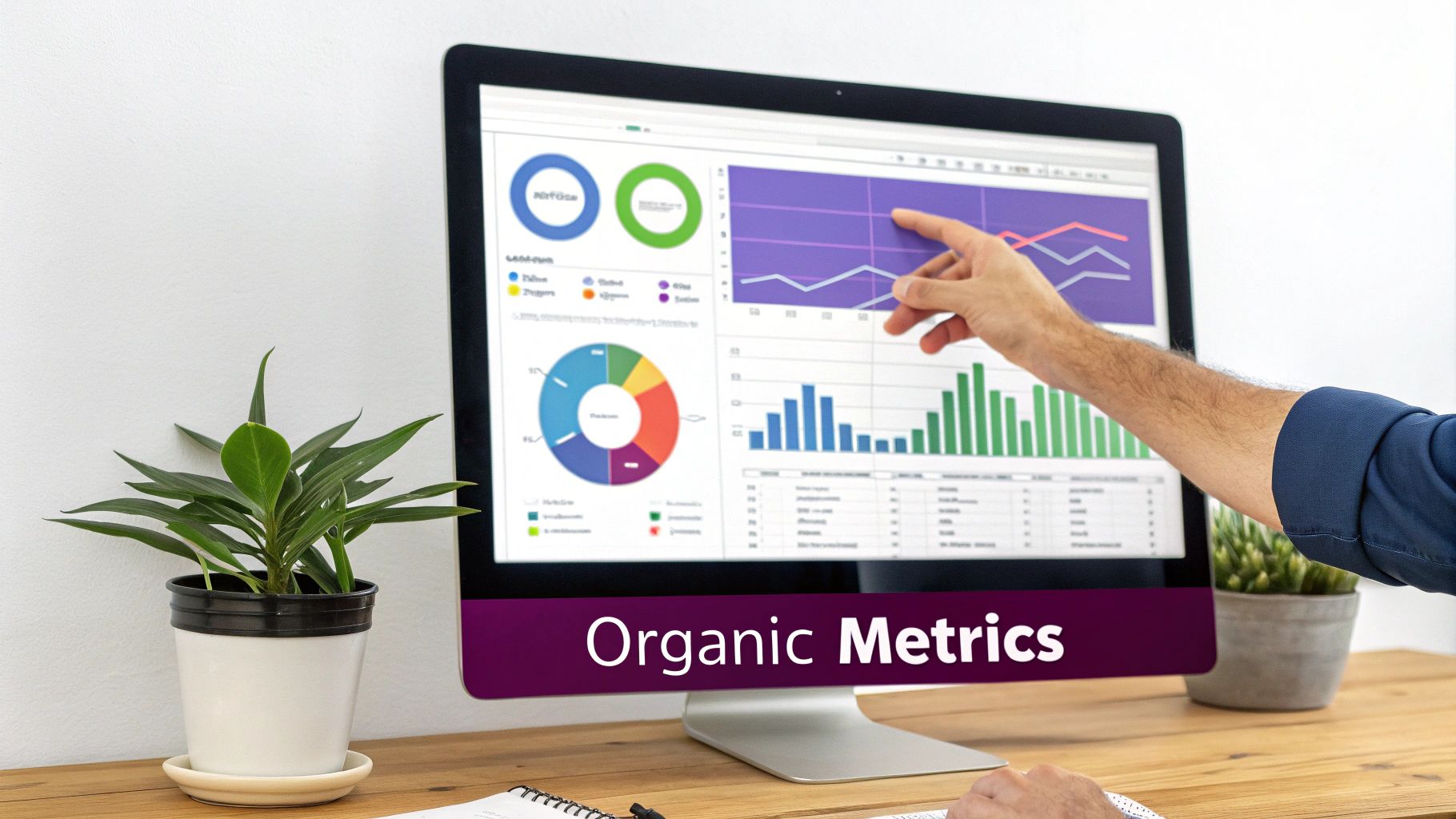
A quick look at your GA4 dashboard lets you see which channels are driving the most engagement. From there, you can start digging deeper into your organic performance and figure out what’s working.
Key Metrics That Actually Matter
It’s incredibly easy to drown in data. To avoid analysis paralysis, just focus on a handful of Key Performance Indicators (KPIs) that give you a clear, honest picture of your organic health. These metrics tell a story about how well your SEO strategy is performing and where you can make improvements.
From Google Search Console:
- Impressions: This is the total number of times one of your pages appeared in a search result. High impressions are a fantastic sign of visibility, even if they don’t all turn into clicks.
- Clicks: This one is straightforward—it’s the raw number of clicks from a Google search result that brought someone to your site. This is your organic traffic from Google, pure and simple.
- Average Click-Through Rate (CTR): Calculated as Clicks ÷ Impressions, this percentage tells you how often people who see your site in the search results actually click on it. A low CTR could mean your page titles or meta descriptions aren’t compelling enough to grab attention.
- Average Position: This shows the average ranking of your pages for a particular search term. Tracking this helps you see if your optimisation efforts are successfully pushing you up the rankings.
From Google Analytics 4:
- Organic Sessions: This metric counts the total number of visits to your site that came from an unpaid search engine result. It's the most direct measure of your organic traffic volume.
- Engaged Sessions: A session is counted as "engaged" if it lasts longer than 10 seconds, includes a conversion, or has at least 2 pageviews. This is a far better indicator of traffic quality than the old "bounce rate."
- Organic Conversions: This tracks how many visitors from organic search completed a valuable action, like filling out a contact form or making a purchase. This is the ultimate measure of your SEO's business value.
To effectively monitor your progress, compiling these data points into a clear format is vital. A well-structured report not only tracks your KPIs but also helps communicate the value of your SEO work to stakeholders. For a great starting point, check out this comprehensive monthly SEO report template.
To get the full picture, you need the right tools for tracking keyword positions and analysing the SERPs. While GSC gives you a fantastic free overview, many businesses also invest in the best SEO ranking reporting software for more granular data and competitor insights. These platforms can automate tracking and provide a much deeper level of analysis, saving you time and giving you a competitive edge.
Four Pillars for Increasing Organic Traffic
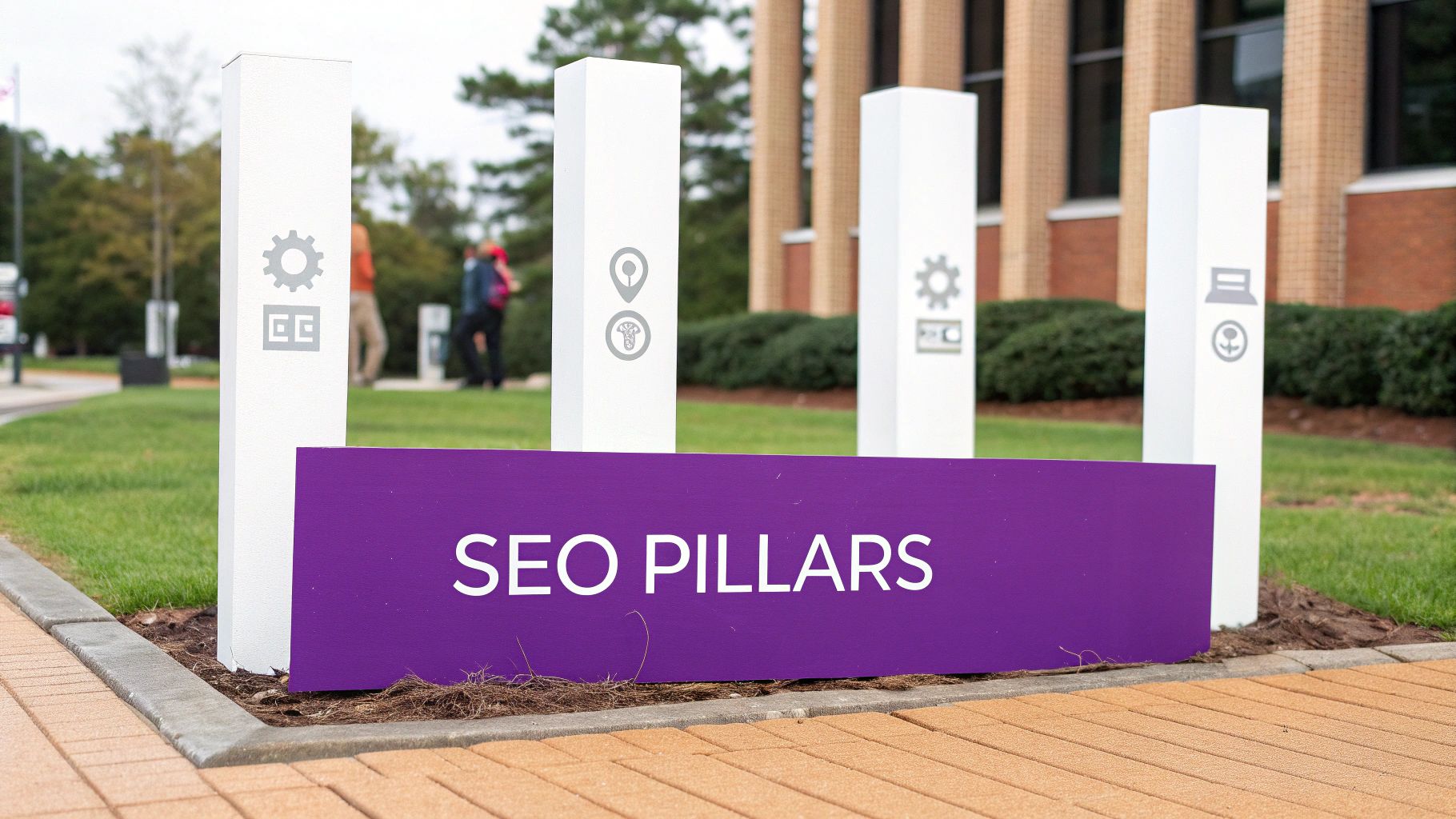
Knowing how to read the numbers is one thing, but driving real, sustainable growth? That calls for a smart, multi-faceted SEO strategy. To consistently grow your organic traffic, you need to build your approach on four essential pillars.
Think of them as the structural supports holding up your digital shopfront. If one is weak, the whole building gets shaky. A holistic approach, where each pillar reinforces the others, is what separates businesses that see a temporary bump from those that build lasting online authority.
Pillar One: Technical SEO
Technical SEO is the absolute foundation. It’s all the behind-the-scenes work that makes sure search engines like Google can actually find, crawl, and understand your website in the first place. If your technical SEO is a mess, even the most amazing content might as well be invisible.
Imagine you’ve written the best book in the world, but it’s stored in a library with no lights and blocked aisles. It doesn’t matter how good the book is if no one can find it. Technical SEO is about keeping your digital library well-lit and easy for search engine crawlers to navigate.
Key elements of technical SEO include:
- Site Speed: Pages need to load fast. A slow website is a deal-breaker for both users and search engines.
- Mobile-Friendliness: Your website must work perfectly on smartphones and tablets. A huge chunk of searches happen on mobile.
- Crawlability: Ensuring search engine bots can access your pages without hitting errors or dead ends.
- Secure Connection (HTTPS): Using HTTPS is a confirmed (though minor) ranking factor, but more importantly, it’s crucial for building user trust.
Fixing these foundational issues is often the quickest way to get an initial lift in your organic performance.
Pillar Two: On-Page SEO
Once your website is technically solid, it’s time to focus on on-page SEO. This is all about optimising individual pages to make them as relevant and user-friendly as possible for specific search terms. It’s where you align your content directly with what your audience is looking for.
If technical SEO is the library’s structure, on-page SEO is like giving each book a clear title, a helpful summary, and well-organised chapters. It makes the content easy for both people and Google to understand.
On-page optimisation is about much more than just stuffing keywords into your text. It’s about creating a fantastic user experience by structuring your content logically and providing clear, valuable information that directly answers a searcher's question.
Actionable on-page SEO tasks involve:
- Keyword Optimisation: Strategically placing your target keywords in key spots like the page title, headings (H1, H2), and body text.
- Meta Descriptions: Writing snappy summaries that show up in search results to entice people to click.
- Content Quality: Creating in-depth, well-written content that thoroughly covers a topic and satisfies the user.
- Internal Linking: Linking to other relevant pages on your own website helps users and search engines discover more of your content.
This focused optimisation sends strong signals to Google that your page is a high-quality, relevant result for specific searches.
Pillar Three: Content Strategy
Your content strategy is the heart of your organic growth engine. This pillar is all about consistently creating valuable, helpful, and engaging content that answers your audience’s questions and solves their problems. It’s how you go from just being visible to becoming a trusted authority.
Think of your content as the reason people visit your shop. You might have a great location (technical SEO) and clear signs (on-page SEO), but if your shelves are empty or full of junk, people won’t stay. A strong content strategy keeps your shelves stocked with exactly what your customers need.
A winning content strategy isn't just about blogging. It can include:
- Comprehensive guides and how-to articles
- Case studies and success stories
- Videos and webinars
- Helpful tools and calculators
This pillar works hand-in-hand with on-page SEO to pull in your target audience and keep them engaged.
Pillar Four: Off-Page SEO
The final pillar, off-page SEO, covers all the actions taken outside of your own website to build its authority and credibility. The biggest part of this is backlink building—earning links from other reputable websites.
In the digital world, a backlink is like a vote of confidence. When a respected site links to yours, it tells Google that you’re a trustworthy and valuable resource. The more high-quality "votes" you collect, the higher you’re likely to rank.
This is the digital equivalent of word-of-mouth marketing. If a well-regarded expert in your field recommends your shop, people are far more likely to trust you. Off-page SEO is about earning those powerful recommendations across the web.
For UK SMEs, this investment pays massive dividends. Organic traffic converts at impressive 2.7–3.75% rates, and leads generated from search close 8.5 times more effectively than those from outbound marketing. You can discover more insights about organic traffic's ROI. This is exactly why building your site's authority through off-page signals is so critical for real business growth.
Actionable SEO Pillar Checklist
To bring it all together, here’s a simple checklist to help you think about key actions for each pillar. These are the practical steps you can take to start strengthening your SEO foundation today.
| SEO Pillar | Key Action 1 | Key Action 2 | Tool to Use |
|---|---|---|---|
| Technical SEO | Check site speed and mobile-friendliness. | Submit an XML sitemap to Google. | Google PageSpeed Insights |
| On-Page SEO | Optimise title tags and meta descriptions. | Add internal links to relevant content. | Google Search Console |
| Content Strategy | Identify customer pain points to write about. | Create a content calendar to stay consistent. | AnswerThePublic |
| Off-Page SEO | Find relevant industry directories to get listed in. | Reach out to partners for guest post opportunities. | Ahrefs |
By methodically working on each of these areas, you create a powerful, self-reinforcing system that drives long-term organic traffic and helps your business thrive online.
Adapting Your Strategy for Modern Search
The world of search never stands still. It’s a living, breathing environment, and right now, the biggest shift we’re seeing is the rise of AI-powered results. This isn't some far-off concept; it’s fundamentally changing how people find information and what the search results page even looks like. For any business that relies on organic traffic, sitting back and watching is no longer an option.
Features like Google’s AI Overviews are built to give users direct answers right there on the results page, which can mean fewer clicks through to your website. While that might sound like a reason to panic, it’s not. Think of it as a signal to get serious and double down on what’s always mattered: creating genuinely exceptional, authoritative content.
Navigating the New Search Environment
The arrival of AI in search has already left its mark. Many UK businesses are finding the landscape tougher to navigate, and a passive approach to SEO has become a real risk. A strong, forward-thinking strategy isn't just a "nice-to-have" anymore—it’s essential for survival.
The data tells a pretty stark story. The rollout of Google’s AI search hit UK websites hard, slashing organic traffic growth by a massive 86% across 16 different sectors. Monthly growth went from a healthy 26.3% before the AI launch to a tiny 3.7% afterwards. As you can read in the full analysis of the AI search rollout, these numbers show just how quickly AI can reshape user behaviour and why a proper, expert-led SEO approach is critical.
Your goal has shifted. It’s no longer just about ranking; it’s about becoming the definitive source of information that AI models trust enough to reference.
Future-Proofing Your Organic Traffic
In this new era, the quality of your content and the authority of your website are everything. The core principles of good SEO haven’t gone away—if anything, they’re more important than ever. We’re talking about technical excellence, user-first content, and building real credibility. The focus has to move from just matching keywords to comprehensively answering the real questions your audience is asking.
This is where the idea of Answer Engine Optimisation (AEO) comes into play. While traditional SEO is about getting into those classic blue links, AEO is about positioning your content as the direct answer to a query. Get this right, and you’re far more likely to be featured in AI summaries and other rich results. If you want to get ahead of the curve, you can learn more in our guide to Answer Engine Optimisation.
The key takeaway is this: adapting to modern search isn’t about chasing algorithms. It’s about cementing your brand as the most trustworthy, helpful, and expert voice in your field. That’s how you stay visible and valuable, no matter how the search results page evolves.
To thrive from here on out, your strategy needs to prioritise:
- Deep Expertise: You need to create content that screams first-hand experience and deep knowledge. Surface-level summaries just won't cut it.
- Unique Data and Insights: Publish original research, insightful case studies, or your own data. Give people (and AI) something they can't get anywhere else.
- Building Brand Authority: Consistently prove you're the real deal. This comes from off-page signals, glowing reviews, and mentions from other trusted sources in your industry.
When you embrace these principles, you’re not just optimising for today’s search engine. You’re building a resilient digital presence that can weather future storms and keep driving valuable organic traffic for years to come.
Ready to Take the First Step?
We've covered a lot of ground—from what organic traffic actually is to why it’s the most valuable asset in your marketing toolkit. We’ve also walked through the core strategies you need to build it from the ground up.
If there’s one thing to take away, it's this: getting a steady stream of the right visitors doesn’t happen by accident. It's the result of a consistent, well-executed approach and a genuine investment in the long-term health of your business.
Growing your organic traffic isn't a guessing game. It's about putting a smart, data-led strategy in place that's built around your specific business goals. If you're ready to stop hoping for results and start building a reliable pipeline of customers who are actively looking for you, then it's time for the next step.
Our Free SEO Health Check is a no-fluff, no-obligation analysis of your website's hidden potential. Our Cambridgeshire-based team will personally review your current performance and give you a clear, actionable plan to get you on the path to sustainable growth. It's your chance to see exactly what's needed to start winning in search.
Stop leaving your most valuable traffic source to chance. A solid SEO strategy is the bedrock of digital success, turning your website into a machine for attracting and converting customers. Your journey starts here.
Your Organic Traffic Questions Answered
If you're a business owner or marketer in the UK, you've probably got some questions about how organic traffic really fits into your growth plans. Let's tackle some of the most common ones we hear from our clients, with no fluff, just straightforward answers to help you on your SEO journey.
How Long Does It Take to See SEO Results?
It’s the million-pound question, and the honest answer is: it’s a long game. While a few technical fixes might give you a small, quick bump, real, meaningful growth in organic traffic takes time. You should typically expect to see significant results within four to six months.
Why so long? Well, it takes time for Google to crawl, index, and ultimately trust your website enough to rank it above your competitors. Things like how competitive your industry is, your website's history, and how much effort you put into the campaign all play a part. We make sure you’re never in the dark, providing detailed monthly reports so you can see the progress from day one and know your investment is paying off.
Is Organic Traffic Genuinely Free?
While it’s true you aren't paying Google for every click like you do with paid ads, "free" isn't quite the right word. Getting that high-quality organic traffic requires a real investment in time, expertise, and resources. Creating great content, sorting out the technical side of your site, and earning backlinks are all essential pieces of the puzzle.
Think of it this way: with SEO, you're investing in a valuable business asset (your website's authority) rather than just renting temporary ad space. The return on that investment is almost always higher and far more sustainable than paid advertising in the long run.
Can I Do My Own SEO to Get More Organic Traffic?
Absolutely. It’s definitely possible for a business owner to learn the basics of SEO and make some headway. However, search engine optimisation is a seriously complex and constantly changing field. To get the kind of results that actually move the needle, especially in a crowded market, partnering with specialists is a much more effective route.
We live and breathe this stuff, staying on top of every algorithm update and using advanced tools to squeeze every last drop of growth out of your website. A great place to start is our free SEO Health Check – it’ll show you exactly where the opportunities are for your specific site.
How Does Local SEO Affect My Cambridgeshire Business?
For any business that serves a specific local area like Cambridgeshire, local SEO is non-negotiable. It’s all about optimising your online presence so you show up when potential customers nearby search for things like ‘plumber in Cambridge’ or ‘best coffee near me’.
This isn't just about traffic; it's about driving highly qualified, ready-to-buy local customers to your website and through your front door. The key tactics involve polishing your Google Business Profile, encouraging local reviews, and creating content that speaks directly to your local community. We specialise in building targeted local SEO campaigns that connect brilliant businesses with the people right on their doorstep.
Ready to turn these insights into action? The team at Bare Digital offers a completely free, no-obligation SEO Health Check to identify your biggest opportunities for growth. Get your personalised report and start your journey to sustainable online success today. Find out more at https://www.bare-digital.com.