

A small business SEO company is your partner in getting found by local customers on Google. Their job is to push your business higher up in search results, driving more phone calls, website visits, and foot traffic from people in your area who are actively looking for what you offer.
What a Small Business SEO Company Really Does

Think of a small business SEO company as the architect of your digital presence. Their work isn’t about baffling you with tech jargon or using quick-fix 'tricks'. It’s about getting to grips with your business, your ideal customer, and how they actually search for services like yours in your specific part of the UK.
At its heart, their job is to build a solid, reliable bridge between your business and the local customers who are already trying to find you online. This means turning your real-world goals—like more quote requests or bookings—into a digital strategy that delivers sustainable, long-term growth.
More Than Just a Supplier—A Strategic Partner
A true SEO partner does far more than just tick boxes on a to-do list. They take the time to dig into the ‘why’ behind your business, building a strategy that’s set up for success from day one.
This involves a few key things right at the start:
- Getting to know your business: They learn what makes you different, who you serve, and what a genuinely valuable lead looks like for you.
- Sizing up the competition: They figure out who’s currently winning the top spots in local search and what it will take to compete with them.
- Mapping out your digital territory: They pinpoint the exact postcodes and customer search terms that will bring you the most qualified enquiries.
This initial deep dive is absolutely crucial. It ensures every action they take is designed to generate a real return on your investment, not just chase vanity metrics. If you're curious about how we approach this, you can learn more about Bare Digital's unique process for UK businesses.
In short, a small business SEO company connects your expertise with local customer demand. They make sure that when someone in your town searches for "emergency plumber near me" or "best wedding venue in Hampshire," your business shows up as the most obvious and compelling answer.
To give you a clearer idea, here's a quick look at what these core services really mean for your day-to-day business.
SEO Services and Their Direct Business Impact
This table breaks down the key tasks an SEO agency performs and translates them into tangible business outcomes.
| Core Service | What It Means For Your Business |
|---|---|
| Local Keyword Research | Finding the exact phrases your local customers use to find you, leading to higher-quality website traffic. |
| Google Business Profile Optimisation | Making you more visible on Google Maps, resulting in more phone calls and direction requests. |
| On-Page & Technical Fixes | Ensuring your website is fast and easy for Google to understand, improving your overall ranking potential. |
| Location-Specific Content | Creating pages that prove your expertise in a specific town or county, attracting customers from those areas. |
| Local Link Building | Earning 'votes of confidence' from other local sites, boosting your authority and trust in Google's eyes. |
As you can see, every piece of the puzzle is designed to contribute directly to your bottom line.
A Focus on Business Results, Not Just Rankings
At the end of the day, the goal isn't just to rank higher; it's to grow your business. A good agency measures its success in real-world outcomes. For a comprehensive overview of the work involved, many agencies will follow a structured approach for mastering SEO of a company, which combines technical, on-page, and local strategies to fuel growth.
The work they do should directly translate into:
- More phone calls from customers ready to book or buy.
- An increase in website enquiries via contact forms.
- Higher foot traffic for your brick-and-mortar shop or office.
- Greater brand authority, establishing you as the go-to expert in your local market.
By focusing on these core business goals, they make sure their efforts have a genuine, measurable impact on your bottom line.
The Core Services That Drive Local Growth

So, let's move past the theory and get into the engine room of a local SEO strategy. A specialist small business SEO company doesn’t just flick a few switches; it uses a specific set of services designed to put your business firmly on the local map and generate real, measurable growth. These aren’t just abstract technical tasks. They are strategic actions that build visibility, create trust, and, most importantly, bring in enquiries.
Each service has its own distinct role, but they all work together to create a much more powerful effect. Getting your head around these core components will show you exactly how an agency turns its work into tangible results for your business.
Optimising Your Digital Front Door: Google Business Profile
Think of your Google Business Profile (GBP) as your most important piece of digital real estate. It's often the very first impression a potential customer gets, showing up right there in Google Maps and the local "pack" results on the main search page. It’s your digital shopfront, and it’s open 24/7.
A skilled SEO agency treats your GBP with the critical importance it deserves. Proper optimisation is about so much more than just listing your address and phone number. It’s a continuous process that involves:
- Completing every single section: This means thoroughly filling out all available fields, from your services and products to accessibility info and specific business attributes.
- Strategic category selection: It's about choosing the primary and secondary categories that perfectly match what you do and, more importantly, what your customers are actually searching for.
- Keeping it active: Regularly publishing posts, adding fresh photos, and promoting special offers sends a powerful signal to Google that your business is active and engaged.
- Managing your reputation: Actively encouraging customer reviews and responding to every single one—good or bad—is crucial for building trust and social proof.
An expertly managed GBP can dramatically increase your phone calls, direction requests, and website clicks before a user has even had to visit your site. For a deeper look, our comprehensive https://www.bare-digital.com/local-seo-checklist/ offers more practical tips on getting the most from your profile.
Speaking Your Customer's Language with Local Keyword Research
To attract the right customers, you first have to understand the exact words and phrases they're using to find you online. This is the whole point of local keyword research. It’s like learning the secret dialect of your target audience.
A small business SEO company will dive deep into the search patterns unique to your service area. This isn’t about chasing broad, generic terms. It’s about uncovering the high-intent local keywords that signal someone is ready to buy.
This research zeroes in on two critical types of searches:
- "Near Me" Searches: Phrases like "emergency plumber near me" or "best coffee shop near me" have absolutely exploded in popularity. Optimising for these helps you capture users who need an immediate solution.
- Location-Specific Searches: These are the terms that include a town, city, or even a postcode, such as "wedding photographer in the Cotswolds" or "construction firm in Manchester." These attract customers who have already decided where they need the service.
By targeting these hyper-specific phrases, the agency makes sure the traffic hitting your website isn't just high in volume, but high in quality and relevance.
Building a Flawless Foundation with On-Page and Technical SEO
Imagine your website is a library. If the books are all over the floor, the signs are confusing, and the layout is a total mess, visitors (and search engines) will give up and leave. On-page and technical SEO are the jobs of organising this library perfectly so Google can easily read, understand, and rank your content.
A website that is technically sound and well-optimised is the foundation upon which all other local SEO efforts are built. Without it, even the best content or link-building campaigns will fail to reach their full potential.
An agency will kick things off with a thorough audit to find and fix any issues holding your site back. Key actions here include:
- Improving site speed to make sure your pages load in a flash for a better user experience.
- Ensuring mobile-friendliness so your site looks and works perfectly on any device.
- Optimising title tags and meta descriptions to make your pages compelling in the search results.
- Structuring content with clear headings (H1, H2, H3) to create a logical, easy-to-read hierarchy.
These foundational fixes make your website far more appealing to both users and search engine crawlers, setting the stage for higher rankings. A vital part of any SEO company's work, especially for local businesses, is implementing these kinds of effective strategies. To get a better feel for how these services drive local growth, you can explore these Local SEO Tips for Small Business.
Establishing Your Local Authority with Content and Links
Finally, to truly stand out in local search, you need to prove to Google that you are the leading expert in both your field and your specific area. You achieve this by creating location-specific content and building up your local authority. With the UK ecommerce market hitting £127.41 billion in online retail sales in 2024, and 28% of all UK retail sales now happening online, the pressure is immense. This makes local search optimisation a critical driver of revenue.
A small business SEO company builds this authority using two main tactics:
- Location Pages: This involves creating dedicated pages on your website for each town, city, or region you serve. For instance, a roofer in London might have separate, tailored pages for "Roof Repairs in Islington" and "New Roofs in Richmond," each filled with local information and case studies.
- Targeted Content & Link Building: This means writing blog posts that answer common local questions (e.g., "Best Wedding Venues in Surrey for a Winter Wedding") and earning links from other reputable local businesses, directories, or news sites. These local links act as powerful 'votes of confidence,' significantly boosting your credibility in Google's eyes.
How Much Does Small Business SEO Cost
When you’re budgeting for growth, it’s the question that always comes up first: how much will it actually cost? With a service like SEO, the answer isn't a simple number because the price is tied directly to the value and complexity of the work.
Any reputable small business SEO company will never give you a one-size-fits-all price tag. If they do, that’s a massive red flag.
Think of it like hiring a builder. You wouldn't expect a fixed quote for an extension without them knowing the size, the materials, or how tricky the job is. SEO works the same way. The investment you need to make depends entirely on your goals, how fierce the competition is in your local area, and the current health of your website.
Understanding Common SEO Pricing Models
To make sense of the proposals you’ll get, it helps to understand the main ways agencies structure their fees. Each model has its place, and the right one depends on what you need and for how long.
Most agencies here in the UK use one of three main models:
- Monthly Retainer: This is the most common setup for ongoing SEO. You pay a fixed fee each month for a specific set of services like creating content, building links, and reporting on performance. It allows the agency to build momentum and adapt its strategy over time.
- Project-Based Fee: This is perfect for a one-off job with a clear beginning and end. Good examples are a full technical SEO audit to fix website problems or creating a batch of high-quality local landing pages.
- Flexible Packages: Many agencies offer tiered packages (e.g., Growth, Advanced, Accelerate) that bundle a clear list of deliverables. This gives you clarity on exactly what you’re getting for your money each month, letting you pick an investment level that matches your ambition.
What Is a Typical Investment for a Small Business?
So, what can you actually expect to pay? The UK small business SEO market is huge, with the wider industry projected to hit £25 billion by 2028. Investment levels vary massively based on a company's size and what it wants to achieve.
Recent figures show that small-to-medium businesses typically invest between £600 and £6,000 per month on SEO. At the other end of the scale, smaller, hyper-local businesses might spend just £50 to £600 monthly. This huge range exists because business owners realise the returns are strong, with nearly half (49%) stating that SEO provides the best ROI of any marketing channel. You can dig into these UK SEO investment statistics to get a better feel for the market.
The key takeaway is this: your SEO cost is a direct reflection of the effort needed to hit your goals. A higher investment usually means more aggressive content creation, more powerful link building, and a faster route to results, especially in a crowded market.
To give you a clearer picture, here’s how those costs might break down:
| Investment Level | Typical Monthly Cost (UK) | Best For |
|---|---|---|
| Starter / Foundation | £500 – £1,000 | Businesses in low-competition areas or those needing to fix foundational issues. |
| Growth / Competitive | £1,000 – £2,500 | Businesses in moderately competitive cities aiming for significant lead growth. |
| Accelerate / Dominance | £2,500+ | Businesses in highly competitive markets or multi-location brands seeking market leadership. |
Factors That Influence Your SEO Price
Ultimately, the quote you get from any small business SEO company will come down to a handful of key factors. Understanding these will help you judge proposals on their value, not just their price tag.
- Your Business Goals: Are you aiming to boost leads by 20%, or do you want to dominate search results across three different counties? Bigger goals require a bigger investment to get there.
- Market Competition: Ranking a plumbing business in a small town is a completely different challenge to ranking a law firm in Central London. More competition means more work is needed to get ahead and stay there.
- Scope of Work: The price will scale with the volume of work. This includes things like the number of blog posts, new website pages, and high-quality backlinks needed each month to get the job done.
Calculating the potential return on these activities can be very insightful. You can learn more about how to estimate your SEO return on investment with our dedicated guide.
Choosing the Right SEO Partner for Your Business
Picking the right small business SEO company can feel like a massive leap of faith, but it doesn't have to be. When you know what to look for and which questions to ask, you can move forward with confidence. This isn't just about hiring another supplier; it’s about finding a proper growth partner who gets your local market and is genuinely focused on delivering results that matter to your business.
The vetting process is your first, and most important, step in protecting your investment. A transparent, results-driven agency will welcome your questions and be eager to show you their value. Anyone who gets cagey or starts making wild promises should be shown the door.
Your Vetting Checklist Before You Commit
Before you even think about signing a contract, you need to do your homework. A bit of due diligence now will help you spot the difference between a professional partner and a provider who's about to burn through your time and budget.
Here’s a practical checklist to guide you:
Demand Relevant Case Studies: Don't let them show you a generic portfolio. Ask for proof of results for businesses like yours, either in the same industry or a similar local area. If you run a construction firm, a case study on how they boosted leads for another trades business is worth ten times more than one for a national fashion brand. You can see how tailored strategies work by learning about SEO for construction companies and the real impact it has.
Review Their Communication and Reporting: Ask for a sample monthly report and get them to walk you through it. Is it straightforward and easy to understand, or is it a wall of confusing jargon? A good partner reports on the metrics that actually matter—leads, phone calls, and form submissions—not just vanity metrics like rankings.
Check Their Own Online Presence: It’s the classic "practice what you preach" test. Does the agency rank well for its own target keywords, like "small business SEO company"? Is their website professional? Do they have a well-managed Google Business Profile with a healthy stream of positive reviews? If they can't do it for themselves, how can you trust them to do it for you?
Powerful Questions to Ask Any SEO Agency
Once you’ve narrowed it down to a few potential agencies, it’s time to dig a bit deeper. The way they answer these questions will tell you everything you need to know about their strategic thinking, their process, and whether their approach actually fits your goals.
- How will you measure success beyond just rankings? A great agency will immediately start talking about your business goals, like lead volume, conversion rates, and return on investment.
- What does our partnership look like in the first 90 days? Their answer should lay out a clear, structured plan, usually involving a full audit, technical fixes, foundational optimisation, and getting an initial content strategy in place.
- Who will be my day-to-day contact, and how often will we communicate? This sets clear expectations for support and collaboration right from the get-go.
- What tools do you use for keyword research, tracking, and reporting? You don’t need to be an expert on the tools, but their answer shows they have a professional setup.
A prospective partner should be able to clearly connect every proposed activity back to a specific business outcome. If they can’t explain why they are doing something in terms of how it will help you get more customers, that's a significant red flag.
Red Flags to Watch Out For
Just as important as knowing what to look for is knowing what to avoid. Certain claims and practices are the hallmarks of low-quality or even downright dangerous SEO providers. Spotting these red flags early can save you a world of frustration and wasted money.
Be wary of any small business SEO company that:
- Guarantees #1 Rankings: No one can guarantee a specific ranking on Google. The algorithm is far too complex and is always changing. This is just an empty promise designed to rush you into signing a contract.
- Lacks Transparency: If an agency is cagey about its methods, calling them "proprietary" or "trade secrets," it’s often a sign they're using outdated or risky tactics that could get your site penalised.
- Offers Unbelievably Cheap Prices: Proper SEO takes significant time, deep expertise, and expensive professional tools. A price that seems too good to be true almost certainly is. It usually means they're cutting corners, which will deliver poor results or, worse, no results at all.
Your SEO Results Timeline From 3 to 12 Months
It’s the first question every business owner asks when they hire a small business SEO company: “So, when will I actually start seeing results?” And it’s a perfectly fair question. But it's vital we set the right expectations from day one. SEO isn't an overnight fix. It’s a marathon, not a sprint.
Think of it like building a house. You don't get to move in the week after the foundations are poured. First, you need to lay the groundwork, then the frame goes up, and only then can you start seeing the finished rooms take shape. SEO works in exactly the same way, building momentum in clear, distinct phases.
This timeline breaks down the typical journey, from getting your digital foundations right to becoming a recognised authority in your local area.
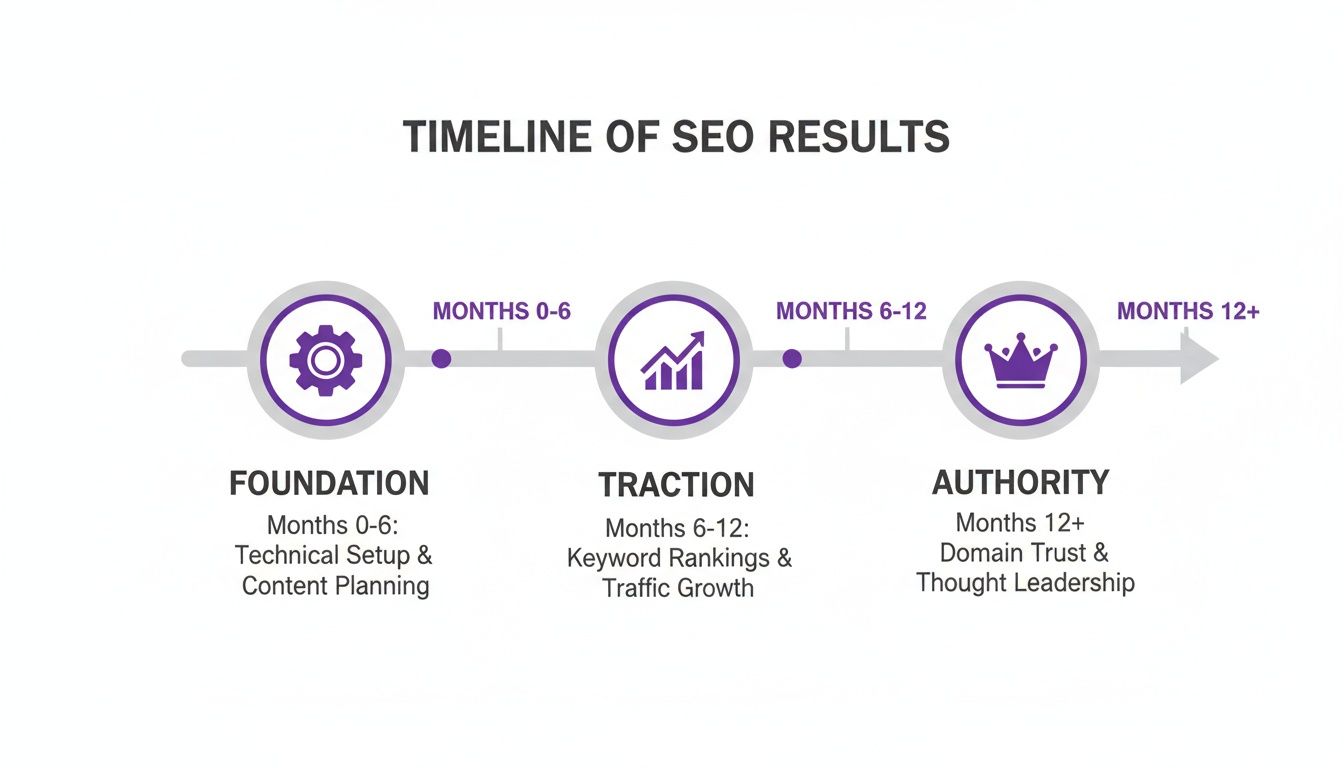
As you can see, the process flows from the essential 'behind-the-scenes' work to tangible growth and, finally, to establishing yourself as a market leader.
The Foundation Phase (Months 1–3)
The first three months are all about laying a rock-solid groundwork for everything that comes next. It’s the least glamorous part of the process, but it's easily the most important. You might not see a huge spike in leads during this period, but a huge amount of critical work is happening to get your digital house in order.
Your SEO agency will be focused on:
- Comprehensive Audits: This is a deep-dive into your website’s technical health, your current keyword positions, and what your competitors are up to. It’s all about finding the hidden issues that are holding you back.
- Technical Fixes: The agency will then start working through a priority list of fixes. This means tackling things like site speed, making sure your site is mobile-friendly, and fixing any errors that stop Google from properly reading your site.
- Google Business Profile (GBP) Optimisation: This is a top priority right out of the gate. Your profile will be fully built out, put in the right categories, and fine-tuned to start showing up in Google Maps and the local pack results.
Want to get a quick snapshot of your profile’s health? Our free Google Business Profile audit tool can show you where you stand right now.
KPIs to watch: During this stage, keep an eye on technical health scores, the number of technical issues being resolved, and improvements in your Google Business Profile’s completeness score.
The Traction Phase (Months 4–6)
With a solid foundation now in place, this next phase is all about gaining traction. This is where you’ll start to see the first exciting green shoots of growth. The foundational work begins to pay off as Google starts to recognise and reward your newly optimised website.
The focus now shifts to building momentum. Your agency will be:
- Creating Foundational Content: This means developing hyper-local landing pages for your key service areas and writing blog posts that target the specific questions your customers are asking.
- Targeting Long-Tail Keywords: You'll begin to see ranking improvements for more specific, less competitive search terms (like "emergency roof repair in Guildford" instead of just "roofer").
At this stage, you’re not likely to be ranking for your most competitive keywords yet. But you will see a noticeable increase in visibility for these highly relevant, long-tail searches, and this early traffic is often incredibly high-quality.
KPIs to watch: Look for a clear increase in organic traffic, a growing number of keywords ranking on pages 1-3, and initial growth in impressions and clicks in your Google Search Console report.
The Authority Phase (Months 7–12)
This is where all that consistent effort really starts to compound and deliver serious business results. Your website has proven its technical health and relevance, and now the focus shifts to establishing it as a true authority in your local market.
The strategy becomes more assertive, zeroing in on:
- Consistent Content & Link Building: A steady drumbeat of high-quality blog posts and strategic local link-building campaigns work together to boost your site’s authority. This is what helps you start competing for those high-value, competitive keywords.
- Measurable Lead Growth: As you begin ranking for more of these competitive terms, you should see a tangible and steady increase in phone calls, form submissions, and quote requests coming directly from search.
By the end of the first year, a successful SEO campaign will have moved way beyond just rankings and traffic. It will be a reliable, predictable source of new business, delivering a clear return on your investment and cementing your position as a leader in your local area.
KPIs to watch: The key metrics now are the ones that directly impact your bottom line: lead volume, conversion rate, and your cost per acquisition from organic search.
Frequently Asked Questions About Small Business SEO
Navigating SEO can feel like trying to solve a puzzle with a thousand moving pieces. To cut through the noise, we've rounded up the straight answers to the most common questions we hear from business owners just like you.
Why Can I Not Just Do SEO Myself?
The thought of tackling SEO in-house is always tempting, especially when you're watching every penny. But it’s crucial to weigh the perceived savings against the sheer reality of the task. Professional SEO isn't a part-time job; it’s a full-time commitment to learning, implementing, and keeping up with Google's relentless algorithm changes.
Then there are the tools. Professional-grade software for research, auditing, and tracking performance can easily run into hundreds, if not thousands, of pounds every single month. A DIY approach often means learning on the fly, which can lead to agonisingly slow progress or, worse, costly mistakes that set you back. Hiring an expert small business SEO company gives you instant access to years of hands-on experience, proven strategies, and a full toolkit from day one. This almost always delivers a far stronger and faster return on your investment.
With 99.9% of the UK's 5.9 million businesses being small to medium-sized enterprises (SMEs), the competition is fierce. For most SMEs, the choice becomes clear: you get a much better ROI by hiring a specialist agency that lives and breathes this stuff, using advanced tools and data to secure consistent growth. You can dig into more on the scale of SEO demand for UK businesses here.
How Long Does It Really Take to See Local SEO Results?
Patience is the name of the game with SEO. While you might spot some quick wins early on, you should realistically budget for a timeline of 3 to 12 months to see significant results that genuinely impact your bottom line. SEO is a long-term strategy that gathers momentum over time, not an overnight fix.
Several things can speed this up or slow it down:
- Your Competition: A roofer in a small town will probably see results much faster than a solicitor in central London, simply because the competitive landscape is worlds apart.
- Your Website's History: A brand-new website starts from scratch and will take longer to build authority than an established site with a clean track record.
- Your Budget: A larger investment allows for more firepower—more aggressive content creation and link-building campaigns—which can accelerate the timeline.
Think of it like planting a tree. The first few months are all about nurturing the roots (your foundational SEO). After that, you'll start to see the trunk and branches grow (ranking traction), and finally, it will mature and bear fruit (authority and leads).
What Is the Difference Between Local SEO and General SEO?
While they share some of the same DNA, local SEO and general (or national) SEO are playing two completely different sports. General SEO is about ranking for broad keywords across the entire country, or even globally. For example, a big e-commerce brand might want to rank for "women's running shoes."
Local SEO, on the other hand, is obsessed with geography. Its entire mission is to get your business seen for searches happening within your specific service area. It zeroes in on three critical signals that general SEO barely touches:
- Geographical Ranking Signals: Using location-specific keywords like "plumber in Bristol."
- Google Maps Visibility: Optimising your Google Business Profile to dominate the "Map Pack."
- "Near Me" Search Intent: Catching users who are actively looking for a service right here, right now.
For any business with a physical location or a defined service area, local SEO isn't just a nice-to-have—it's absolutely vital for survival and growth.
Are Long-Term Contracts Always Necessary?
Some agencies will try to lock you into a rigid 12-month contract, but it's not always the only way. However, it’s important to understand why SEO is treated as an ongoing partnership. Unlike a one-off ad campaign, SEO is a continuous process of optimising, creating content, and building authority.
Stopping your SEO efforts after a few months is like cancelling your gym membership after hitting a personal best; any gains you've made will slowly but surely fade away as your competitors keep pushing forward. A good agency will offer a degree of flexibility, but a monthly retainer is standard practice because it allows them to build and maintain the momentum needed for sustained growth. SEO isn't a task you tick off a list; it's a long-term strategy for dominating your local market.
Ready to see how a dedicated local SEO strategy can transform your business? At Bare Digital, we specialise in helping UK businesses like yours get found and get growing.
Start with your free, no-obligation SEO health check and activity plan today