

Before we even get into comparing plans, let's get one thing straight: choosing a web host is a fundamental SEO decision. For any UK business trying to win over local customers, your hosting isn't just digital storage space—it's your silent partner in getting found on Google. A fast, reliable host with UK-based servers has a direct impact on your visibility and, ultimately, your sales.
Why Your Web Host Is Your Unseen SEO Partner
Too many small businesses treat web hosting as an afterthought, just another utility bill to pay at the end of the month. This is a huge mistake. The technical foundation your host provides is directly tied to your ability to attract local customers. Slow load times, frequent downtime, and servers on the other side of the world can quietly sabotage your local SEO efforts before you’ve even started.
Imagine you run a boutique hotel in the Cotswolds. When a potential guest searches for "boutique hotel near me," Google's algorithm makes a split-second decision. It weighs hundreds of factors, but two of the most critical are your website's speed and the experience it offers. If your host's servers are slow or located overseas, your site will load like treacle for that UK-based searcher.
The link between hosting performance and local search ranking isn't just a theory; it's a fact. A slow website doesn't just frustrate users—it actively tells Google your site offers a poor experience, which can directly harm your position in the local map pack and organic results.
That delay isn't just a minor inconvenience; it's a massive red flag for search engines. In fact, a page load time of over three seconds causes 53% of mobile users to leave. When you consider that a staggering 88% of UK local searches happen on mobile devices, poor performance becomes a direct hit to your bottom line.
The Impact on Local Search Visibility
Your choice of web host becomes even more critical when you're targeting specific postcodes. A host with data centres physically located in the UK, ideally near major internet hubs like London or Manchester, gives you a clear competitive edge.
- Reduced Latency: Data simply travels faster over shorter distances. A UK-based server ensures your website content is delivered to local visitors with minimal delay, instantly improving their experience.
- Improved 'Near Me' Rankings: Google uses server location as one of its clues to figure out a business's geographic relevance. A UK IP address reinforces the message that your business serves a UK audience.
- Enhanced User Trust: A fast, responsive website builds immediate credibility. When a user clicks from a local search and your site loads instantly, it creates a positive first impression that encourages them to stick around and convert.
The UK web hosting market is a huge slice of the wider European market, which is projected to hit USD 56.55 billion by 2026. This scale means you have plenty of choices, from cheap-and-cheerful shared hosting to powerful cloud solutions. You can dig into the latest hosting statistics from Statista to see the market trends.
Ultimately, investing in a quality local host is a foundational step in any serious local SEO strategy—a topic we explore in our comprehensive local SEO checklist.
Decoding the Main Types of Web Hosting
Step into the world of web hosting and you're immediately bombarded with a dictionary of jargon. Shared, VPS, Cloud, Managed—it can feel like you need a translator just to pick a plan. But getting your head around these options is the difference between building on solid ground and starting on a shaky foundation.
Let's cut through the technical noise and talk about what these hosting types actually mean for your UK business. We'll use real-world scenarios to show you what to choose, and just as importantly, when to move on.
Web Hosting Types Compared for UK Businesses
This table gives a quick summary of the most common hosting types, highlighting their ideal user, typical cost, performance level, and scalability for UK businesses.
| Hosting Type | Best For | Typical Monthly Cost | Performance & Speed | Scalability |
|---|---|---|---|---|
| Shared | New websites, blogs, local tradespeople with simple sites, and small portfolios. | £3 – £15 | Basic; can be affected by other sites on the same server. | Low; you will need to upgrade as you grow. |
| VPS | Growing e-commerce stores, high-traffic blogs, and businesses needing stable performance. | £15 – £80 | Good and consistent; resources are dedicated to your site. | Moderate; you can easily scale up your resource allocation. |
| Cloud | High-traffic sites, agencies, and businesses with unpredictable traffic spikes. | £40 – £250+ | Excellent and reliable; handles traffic surges with ease. | High; pay-as-you-go model offers near-instant scalability. |
| Managed WP | Businesses using WordPress who want a hands-off, fully optimised experience. | £20 – £150+ | Excellent; servers are fine-tuned specifically for WordPress. | Varies based on the underlying infrastructure (VPS/Cloud). |
Understanding these distinctions is the first step. It ensures you’re not overpaying for power you don’t need, or worse, crippling your site’s growth before it even begins.
Shared Hosting: The Entry Point
Shared hosting is exactly what it sounds like. Think of it as renting a flat in a large apartment building. You get your own private space, but you’re sharing the building’s core utilities—the plumbing, the electricity, the lift—with dozens of other tenants. In hosting terms, this means your website lives on a server alongside hundreds, sometimes thousands, of others.
The huge upside here is the price. It's incredibly affordable, making it the go-to for many new businesses.
- Who it’s for: A local bakery in Bristol with a simple site showing its menu, hours, and contact details. Or a freelance photographer with a small portfolio. Traffic is generally low and predictable.
- The catch: If another website on your server suddenly goes viral (the equivalent of a massive party in the flat next door), it can hog resources and slow your site down. You have very limited control.
Shared hosting is a perfectly good place to start, but you must recognise the signs that you've outgrown it. If your pages start loading like treacle or you get alerts about downtime, it’s time to pack your bags and upgrade.
VPS Hosting: The Sensible Next Step
A Virtual Private Server, or VPS, is the logical next step up the ladder. To extend our analogy, it’s like moving from that flat into a semi-detached house. You still share the plot of land (the physical server hardware), but you have your own dedicated resources, walls, and front door. Your neighbour's noisy party can’t spill over into your living room.
With a VPS, a single powerful server is partitioned into several self-contained virtual machines. Each gets its own guaranteed slice of the pie—a specific amount of processing power (CPU) and memory (RAM). This means your website’s performance is completely ring-fenced from others.
A VPS hits the sweet spot between the low cost of shared hosting and the raw power of having your own server. It's the perfect home for businesses that are seeing real growth and need more stability without the massive price jump.
Imagine a growing e-commerce shop based in Manchester. After a successful marketing campaign, its shared plan is buckling under the strain of new visitors. Moving to a VPS would give it the consistent performance needed to handle all those extra orders, ensuring the checkout process stays fast and smooth.
This flowchart can help you figure out if a UK-based host, which often excels in VPS and Cloud offerings, is the right first move.
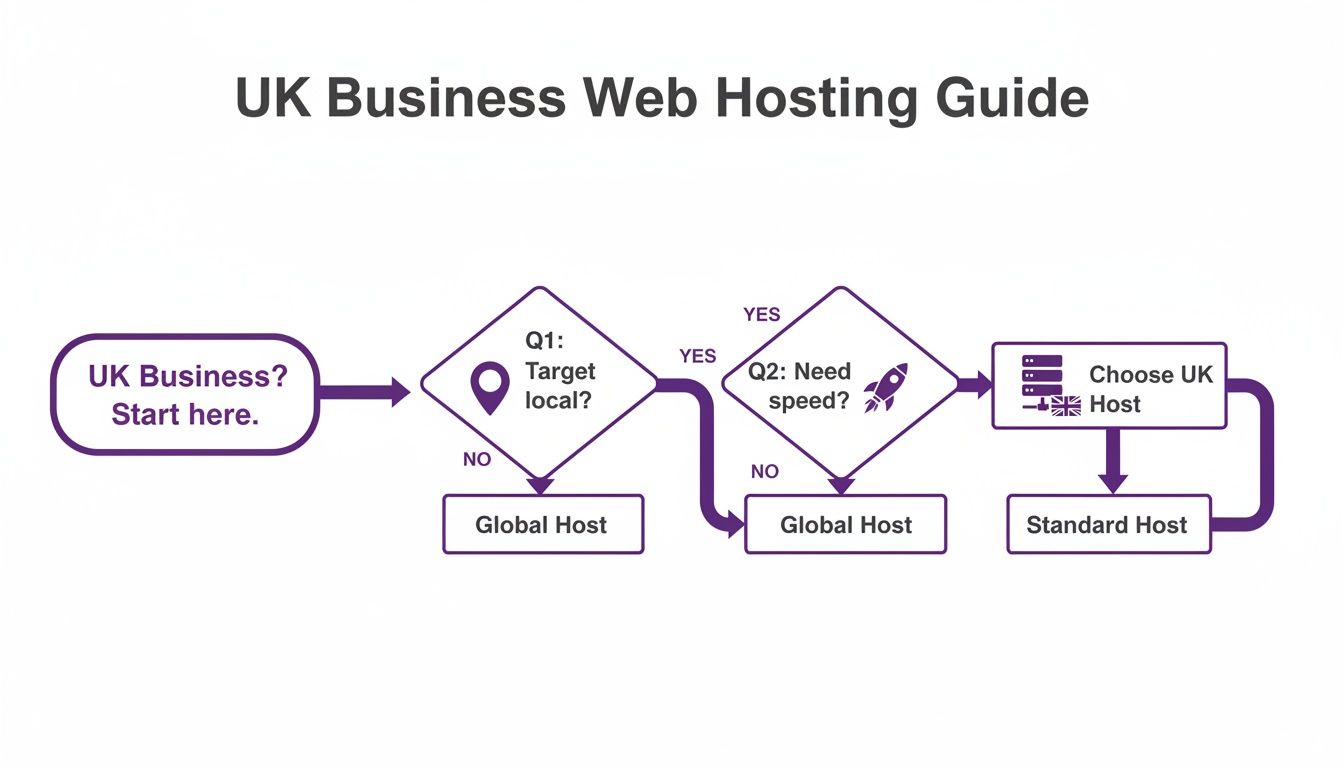
The key takeaway is that for UK businesses targeting local customers, a server physically located in the UK offers a direct speed and SEO advantage.
Cloud Hosting: For Flexibility and Power
Cloud hosting operates on a completely different principle. Instead of your site living on one single, identifiable server, it's spread across a whole network of connected servers—the "cloud". Think of it as a futuristic smart home that can instantly expand its rooms based on how many guests you have over.
If your site gets a sudden, massive rush of traffic from a viral social media post, the cloud network automatically allocates more resources in real-time to handle the load. This makes it incredibly flexible and almost bulletproof in terms of reliability. Its main benefit is the pay-for-what-you-use scalability, which is perfect for a business with fluctuating needs.
This is ideal for a London design agency whose high-traffic portfolio site needs to stay lightning-fast, even when a new project gets featured on a major design blog and attracts thousands of visitors in an hour.
Managed WordPress Hosting: For Hands-Off Peace of Mind
Finally, we have Managed WordPress hosting. This isn't a hosting type in the same way as the others, but rather a premium service built on top of them (usually on powerful VPS or cloud infrastructure). The host essentially becomes your expert technical team, taking care of all the tricky back-end WordPress maintenance for you.
This specialist service typically includes:
- Automatic core WordPress updates
- Daily, and sometimes hourly, backups
- Advanced security monitoring specifically for WordPress threats
- Performance tuning, like caching, to make your site fly
This is the perfect choice for a business that lives and breathes on its WordPress site but doesn’t have the in-house technical know-how or time to manage it. If you're weighing your options, it's worth understanding the specifics of using WordPress with a specific web host like GoDaddy to see how these specialised environments work.
It frees you up to focus on what you do best—creating great content and growing your business—while the experts keep your site fast, secure, and up-to-date.
Essential Technical Checks for UK Businesses

Once you’ve got a shortlist of hosting types that seem to fit your business, it’s time to get a bit more forensic. Choosing a web host isn’t just about picking a package; it’s about digging into the technical promises that will make or break your site's performance, security, and local SEO.
You don't need to be a server guru for this. It’s simply about knowing what to look for on a provider’s website. These are the non-negotiables that separate a solid, dependable host from one that’s guaranteed to give you headaches down the road.
Pinpoint UK-Based Data Centres
For any UK business with a local customer base, this is the most important check you can make. A host’s data centre is the physical building where your website lives. The closer that building is to your audience, the quicker your website will load for them. Simple as that.
When you’re browsing a host's site, hunt for specific mentions of UK data centres—they're often in London, Manchester, or other major internet hubs. If a provider is cagey about their server locations, that’s a big red flag. The milliseconds might seem tiny, but the lag has a real impact on user experience and your Google ranking.
It's a smart move to go with a provider that has a strong footprint here. The United Kingdom holds 3.99% of the global web hosting market, and big names like Host Europe (14.8% share) and Fasthosts (11.5% share) are popular with SMEs for a reason. As recent research from DiviFlash on web hosting stats confirms, a UK-centric host delivers the speed that local searchers expect.
Decipher Uptime Guarantees
Uptime is the percentage of time your website is online and working. You’ll see hosts throwing around figures like "99.9% uptime guaranteed," but what does that actually mean for your business in the real world?
Let’s translate those percentages into actual downtime:
- 99% Uptime: Sounds good, but it allows for up to 3.65 days of downtime per year. That's a lot of lost business.
- 99.9% Uptime: The industry standard, but it still translates to 8.77 hours of downtime a year.
- 99.99% Uptime: This is where you should be aiming. It means a maximum of just 52.6 minutes of downtime per year.
- 99.999% Uptime: The gold standard, allowing for a tiny 5.26 minutes of downtime annually.
A small difference on paper can mean hours of lost sales and frustrated customers in reality. Always look for a host with at least a 99.99% uptime guarantee, backed by a Service Level Agreement (SLA) that offers you credit if they fail to meet it.
Verify Scalable Resources
Your website’s needs are never static. A knockout marketing campaign, a viral post, or a seasonal rush can send a flood of traffic your way. Your hosting has to be ready to handle it without falling over.
This is where scalability comes in. You need to know you can easily upgrade the core parts of your hosting plan when you need to:
- RAM (Memory): Critical for running site applications smoothly, especially if you’re using a platform like WordPress.
- CPU (Processing Power): This is the server's brain. More CPU means your site can serve more visitors at once without slowing down.
- Storage (SSD): Solid-State Drives (SSDs) are light-years faster than old-school hard drives. Insist on SSD storage for better performance.
Look for a host that provides a clear and simple upgrade path. A good one will let you add more resources with just a few clicks in your control panel, giving you that vital safety net for growth.
Confirm Security Essentials
In this day and age, website security is not an optional extra. A secure site protects your business, builds trust with your customers, and is a confirmed Google ranking factor.
There are two non-negotiable security features every decent host must provide for free:
- Free SSL Certificate: An SSL certificate encrypts the data moving between your website and your visitors. It’s what gives your site the "https://" prefix and the little padlock in the browser bar. Any host still charging for a basic SSL certificate is living in the past.
- Automated Backups: Things go wrong. A dodgy plugin update, a hacking attempt, or just plain human error can take your site offline. Your host must offer free, regular, automated backups, letting you restore your site to a working state with a single click.
Getting these technical checks right is the foundation for a powerful local online presence. When you pair a solid host with a finely-tuned Google Business Profile, you create a winning combination for attracting local customers. In fact, it might be worth running a Google Business Profile audit to make sure your local listings are pulling their weight.
Balancing Cost and Performance Without Compromise
When you’re hunting for a web host, the siren song of a rock-bottom price is hard to ignore. A deal for just a few quid a month feels like a savvy business decision. But in the world of web hosting, the cheapest option almost always becomes the most expensive one in the long run.
The real cost of budget hosting doesn't show up on your monthly invoice; it’s measured in lost customers and missed opportunities. Every hour of downtime, every extra second a page takes to load, and every security scare chips away at your revenue and your reputation. You might save £5 a month on your plan but lose hundreds in sales from a single afternoon of server problems.
This is where the balancing act begins. It’s not about finding the absolute cheapest deal but identifying the best value—that sweet spot where reliable performance meets a sensible price.
The Hidden Costs of Cheap Hosting
Picture a local plumber in Leeds. Their website is their lifeline, generating most of their emergency call-out leads. To keep overheads low, they signed up for a £2/month hosting plan. But then a cold snap hits, pipes are bursting all over the city, and their server goes down for four hours straight.
That "cheap" plan just cost them a handful of high-value jobs and sent frustrated homeowners straight to their competitors. The tiny initial saving was wiped out in a single afternoon of lost business.
Now, think about a boutique hotel in the Lake District. Their website is their primary booking engine, packed with beautiful imagery to entice guests. But their slow host means those high-resolution photos take an age to load, creating a dreadful first impression. A potential guest gets fed up, hits the back button, and books with a nearby hotel whose site was slick and responsive.
These scenarios hammer home a crucial truth:
- Downtime equals lost sales. An unavailable website is the digital equivalent of locking the doors to your shop during peak business hours.
- Slow speed kills conversions. Modern users have zero patience for sluggish websites; they will simply leave and find a faster alternative.
- Poor security is a massive liability. A single breach could cost you customer data, your hard-earned reputation, and a small fortune to clean up.
Decoding Pricing Models and Hidden Fees
The hosting industry is notorious for its confusing pricing. The most common trap is the tempting introductory offer that’s followed by a shocking renewal rate. That amazing £2.50/month deal you signed up for might suddenly jump to £10/month or more after the first year.
Always, always check the renewal price before you commit. A slightly more expensive plan with a consistent rate often works out cheaper over a three-year period than a deal with a massive price hike at renewal.
Beyond the headline price, you need to watch out for the nickel-and-diming. Some budget providers will charge extra for services that should absolutely be standard. These essentials, like SSL certificates, daily backups, or malware scanning, can quickly double your monthly bill, making the "cheap" host far more expensive than a quality provider that includes them for free.
The ROI of Investing in Quality
Putting a few extra pounds a month into a better host delivers a tangible return on your investment. While cost-effectiveness is a key driver for UK businesses—making shared hosting a popular starting point—a poor choice can lead to a staggering 22% loss in revenue. On the flip side, a wise selection can boost your traffic by as much as 30%. To see how the UK market is evolving, you can explore the latest insights on UK web hosting trends on SQ Magazine.
A quality host provides the stable, high-performance foundation your business needs to thrive online. For that local plumber, it means the website is always online and ready to capture valuable leads. For the boutique hotel, it means a fast, beautiful user experience that turns browsers into paying guests.
This small extra investment pays for itself through improved customer trust, better search rankings, and ultimately, more revenue. You can even use tools to see how performance impacts profit, like our self-storage ROI calculator, to calculate the return on investment of your online efforts.
Red Flags to Spot When Choosing a Host
Choosing the right web host isn't just about ticking boxes on a feature list; it’s about knowing what to run away from. A provider that looks fantastic on the surface can easily be hiding serious problems that will cost you time, money, and even your reputation down the line.
It’s a bit like viewing a flat to rent. You don’t just admire the fresh paint; you check for signs of damp, test the water pressure, and ask about noisy neighbours. Applying that same diligence here is what will help you filter out the unreliable hosts and save your business from a whole lot of chaos.
Vague or Misleading Pricing Structures
One of the oldest tricks in the book is dodgy pricing. You’ll see hosts plastering their sites with incredibly low introductory offers, sometimes just a couple of pounds a month. While it’s tempting, these deals almost always have a sting in the tail.
The first massive red flag is a huge price hike at renewal. That tempting £2.50 per month offer can easily shoot up to £10 or £12 after your first year, locking you into a much more expensive plan. Always hunt for the renewal price before you commit; it's usually buried in the small print. A slightly higher but consistent monthly fee is nearly always the smarter long-term investment.
Another warning sign is being charged extra for things that should be standard. In today's market, essentials like SSL certificates and basic automated backups are a given. If a host tries to sell these to you as paid add-ons, it’s a clear signal their business model is built on upselling you, not on providing real value.
The ‘Unlimited’ Myth
You'll see the word "unlimited" thrown around a lot, usually for storage and bandwidth. This sounds amazing, but frankly, it's one of the biggest marketing gimmicks in the industry. The truth is, no resource is ever truly unlimited.
If you dig deep into the terms of service, you will almost certainly find a fair use policy. This clause gives the host the power to slow your site’s performance or even suspend your account entirely if you start using "too many" resources. And what counts as "too much" is often deliberately vague, leaving it completely up to them to decide.
Don’t fall for the ‘unlimited’ promise. A host that offers a clear, defined amount of SSD storage and bandwidth is being far more honest. This transparency lets you choose a plan that actually fits your needs and scale up properly when the time comes, without any nasty surprises.
A Flood of Negative Reviews and Poor Support
Every company gets a bad review now and then. But when you start seeing a consistent pattern of negative feedback across platforms like Trustpilot or Google, you need to pay close attention. The most revealing complaints almost always circle back to two things: slow support and frequent downtime.
Look for reviews that get specific:
- "My site was down for six hours, and it took four hours to even get a response from support."
- "They couldn't help with a simple WordPress issue and just told me to hire my own developer."
- "My pages are loading so slowly, but support just keeps blaming my website."
This kind of feedback is gold. It gives you a real-world peek behind the curtain at what it’s actually like to be a customer. A host with an army of positive reviews praising their fast, knowledgeable, and UK-based support team is a much safer bet. If a provider's support team is slow or useless when things go wrong, any money you saved on the initial price becomes completely meaningless.
Your Action Plan for Selecting the Right Web Host

Right, let's pull all this theory together into a practical game plan. Choosing a web host can feel overwhelming, but if you break it down into a few clear steps, the whole process becomes much more manageable. This is the exact approach we use to guide businesses from research right through to a confident final choice.
The first move is to get brutally honest about your own needs. Think about your business as it is today, but also where you plan to be in a couple of years. Are you a small local business with a simple brochure site, or an ambitious e-commerce store poised for rapid growth? Be realistic about your technical know-how and how much hand-holding you’ll need from a support team.
With your requirements pinned down, it’s time to build a shortlist. You’re aiming for three to four potential providers that look like a solid match. Use the technical checks and red flags we’ve already covered to vet them, zeroing in on things like UK data centres, uptime guarantees, and genuine customer feedback.
Organise Your Comparison
Once you have your shortlist, it's time to get organised. A simple spreadsheet is your best friend here, allowing you to compare your top contenders side-by-side. The goal is to cut through the marketing spin and focus on what actually matters for your business here in the UK.
Your comparison should include columns for:
- Renewal Price: Look past the tempting introductory offer. What’s the real long-term cost?
- Key Features: Jot down the non-negotiables like free SSL, automated daily backups, and SSD storage.
- Support Channels: Do they offer genuine 24/7 support via live chat, phone, or tickets?
- UK Performance Reviews: Hunt for recent feedback that specifically mentions speed and reliability for UK users.
This structured comparison strips away the marketing fluff and puts the focus squarely on value and performance. It transforms a complex decision into a clear, data-driven choice, empowering you to select a host that will genuinely support your business goals.
Making the Final Decision
Before you pull the trigger, reach out to each provider's pre-sales support team with a couple of sharp questions. Ask them about their migration assistance, their specific security setup, and their policy on resource upgrades. How quickly and thoroughly they respond will tell you a lot about the service you can expect once you’re a paying customer.
For those of you already stuck on an underperforming host, planning the move itself is crucial. A good new host will often offer free migration, taking care of all the technical heavy lifting for you. Make sure you confirm this service is included, as it makes the switch almost seamless.
To help guide your decision, have a look at these 10 key factors to consider when choosing your host. And if you’d rather have an expert eye on aligning your online presence with your business goals, don't hesitate to get in touch with our team at Bare Digital.
Frequently Asked Questions
When you're choosing a web host, a few nagging questions always seem to surface. Getting clear, straight answers to these common concerns is often the final piece of the puzzle, giving you the confidence to make the right call for your UK business.
Let’s cut through the noise with some quick-fire answers to the questions we hear most often.
Do I Really Need a UK-Based Host?
For any business that serves UK customers, the answer is a non-negotiable yes. While you could technically host your site on a server in the US or Germany, housing it in a UK data centre gives you an undeniable home-field advantage.
It all comes down to latency—the physical time it takes for data to travel from the server to your visitor's screen. Shorter distances mean faster load times, simple as that. A UK-based server ensures your website is delivered to local visitors with the absolute minimum delay. This directly boosts user experience and sends a big, positive signal to Google for your local SEO, reinforcing that you’re a genuine UK business for a UK audience.
What Does ‘Managed’ Hosting Truly Include?
You'll see the term "managed hosting" thrown around a lot, and its meaning can feel a bit fuzzy. At its heart, it’s a premium service where the hosting company effectively becomes your outsourced tech team, handling all the complex server admin so you don't have to.
A good managed plan is like having a professional web developer on call. They handle security, updates, and performance optimisation, freeing you to focus on running your business instead of wrestling with server configurations.
So, what are you actually paying for? Typically, a solid managed service will cover:
- Proactive Security: Constant monitoring for malware, hack attempts, and other threats.
- Automated Updates: Keeping all your website's software (like WordPress and its plugins) and the server software up to date for you.
- Performance Optimisation: Actively fine-tuning the server with tools like caching to make your site faster.
- Expert Support: Access to genuinely knowledgeable support staff who can help with tricky issues, not just basic account queries.
How Do I Handle a Website Migration?
The thought of moving your website from an old, sluggish host to a shiny new one can feel seriously daunting, but it's a very common—and manageable—process. The best hosting providers have made this as painless as possible to win your business.
In fact, many of the best hosts now offer free migration services as a key incentive to switch. Their own expert team will handle the entire transfer from start to finish. They’ll make sure all your files, databases, and emails are moved over correctly, with virtually no downtime. Before you commit to any new host, always ask if they provide a free migration. It’s a massive time-saver and removes the risk of you making a critical mistake during the move.
For more guidance on building and optimising your online presence, check out our insights at Bare Digital.
If you're ready to stop guessing and start ranking, Bare Digital can build a local SEO strategy that turns search visibility into real-world customers. Get your free, no-obligation SEO health check today.