
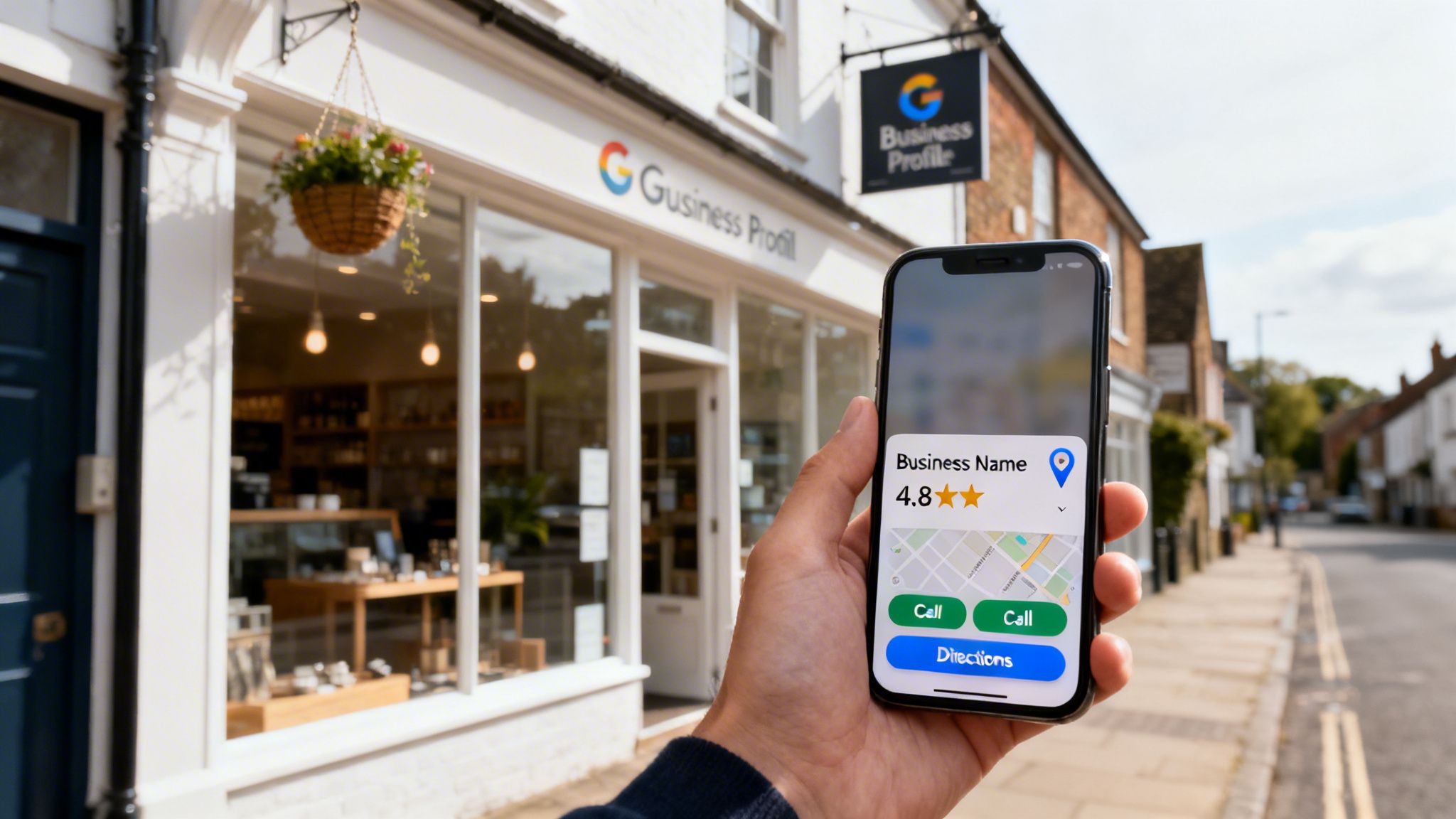
For most small businesses here in the UK, the journey to getting found online starts and ends with Google. Your Google Business Profile (GBP) is your digital shopfront, the very first impression many potential customers will have of your brand. Think of it as the cornerstone of your local SEO strategy, the engine that turns local searches into real-world customers.
Your Google Business Profile: The Foundation for Local Success
Let's be honest, for a lot of small business owners, SEO can feel like a mountain to climb. But your Google Business Profile is the most powerful and accessible place to start. It’s not just another directory listing; it's a dynamic, interactive profile that directly controls how you show up in Google Maps and the local search results.
Picture this: you run a small wedding venue in Manchester. Local couples are right there on their phones, frantically searching for ‘wedding venues near me’. Recent UK data shows a staggering 98% of UK consumers now use online searches to find local businesses just like yours. Even more compelling, 76% of people who search for something local on their mobile will visit a business within 24 hours. That's real, local intent turning into actual footfall, fast.
Selecting Your Business Categories
Your very first job is to pick the right categories. Google lets you choose one primary category and several secondary ones. Your primary category is the big one; it needs to be the most specific and accurate description of what you really do.
- Primary Category: If you're a plumber who mostly handles boiler repairs, choose ‘Boiler Supplier’ or ‘Central Heating Engineer’ over the far too generic ‘Plumber’.
- Secondary Categories: Now, use these to mop up everything else you offer. For our plumber, this might be ‘Plumber’, ‘Gas Engineer’, and ‘Bathroom Fitter’.
This level of detail is crucial. It ensures you appear for all the different services people might be looking for. Don't just pick one and hope for the best—be exhaustive.
This simple diagram shows exactly how optimised local searches translate directly into new customers walking through your door.
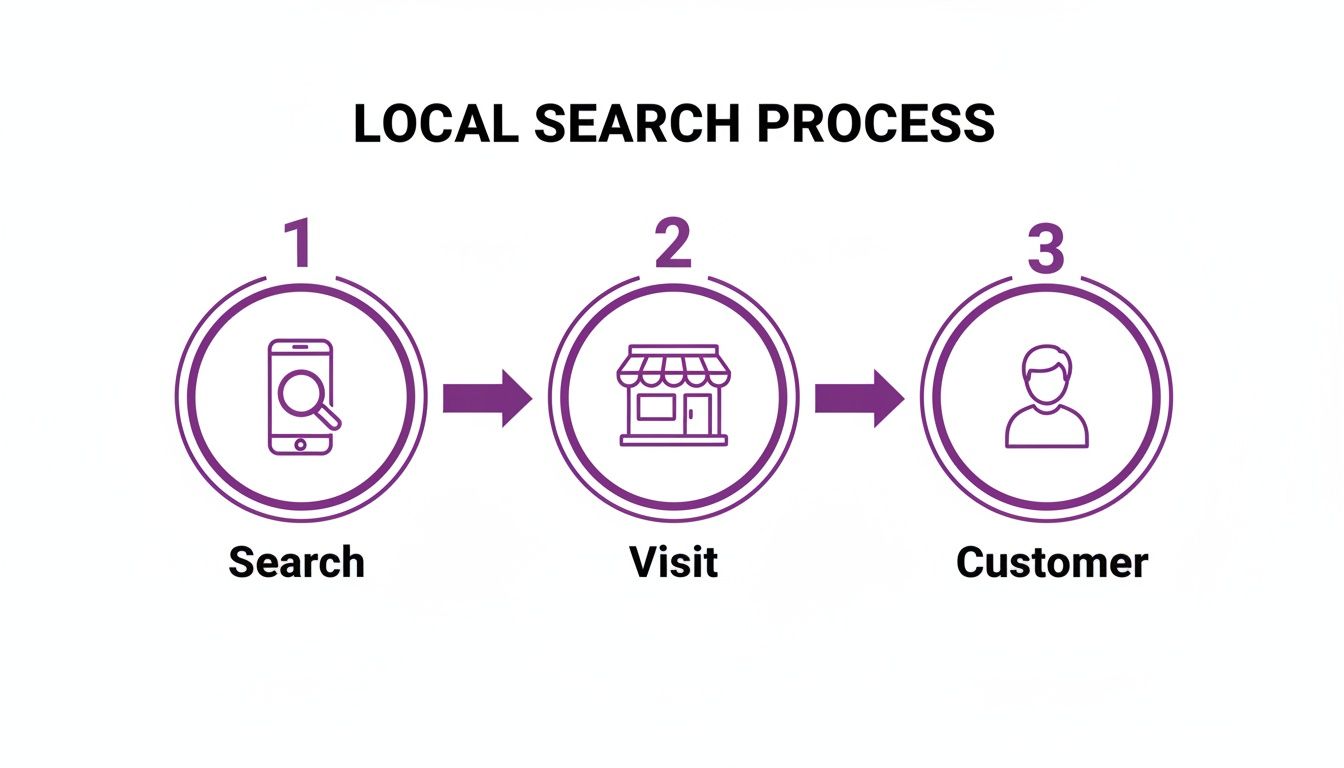
It’s a direct line from a search query on a phone to a new customer for your business, making local SEO a tangible driver of growth.
Crafting a Compelling Business Description
Your business description is your 750-character elevator pitch. Don't waste this space by stuffing it with keywords or bland corporate waffle. Instead, write it for your ideal customer.
Pro Tip: Your business description is your chance to make a connection. Talk about what makes you different, your roots in the local community, and the problems you genuinely solve for people. This is your first real shot at building trust.
Use this space to tell your story. Are you a family-run bakery in Cornwall that’s been using the same sourdough starter for 50 years? Say so. This human touch is what separates you from the big, faceless chains and is a key part of effective seo for small business uk.
Master GBP Posts and the Q&A Feature
Think of Google Business Profile Posts as your free advertising board. Use them consistently to share updates, special offers, and news. A good rhythm is to aim for one or two posts a week—it keeps your profile looking active and tells Google you’re open for business.
The Q&A section is another untapped goldmine. You can actually pre-populate this with your own questions and answers. Just think about the things customers ask you all the time on the phone and answer them right there on your profile. This not only saves you time but also shows off your expertise and helpfulness to anyone who finds you online.
Ultimately, the goal of any good SEO work is to increase website traffic organically, creating sustainable, long-term growth. A fully built-out GBP is your launchpad for making that happen. If you’re not sure where to start, our free Google Business Profile audit tool can give you a clear, actionable checklist.
Finding the Keywords Your Local UK Customers Actually Use
Effective local SEO isn't about guesswork. It’s about getting inside your customer’s head and knowing exactly what they’re typing into Google when they need you. Throwing generic keywords at your website just creates noise and attracts completely the wrong audience.
To get found by people who are actually ready to buy, you have to uncover the high-intent local phrases that drive real business. It's the difference between casting a huge, empty net and dropping a perfectly baited line right where the fish are biting.
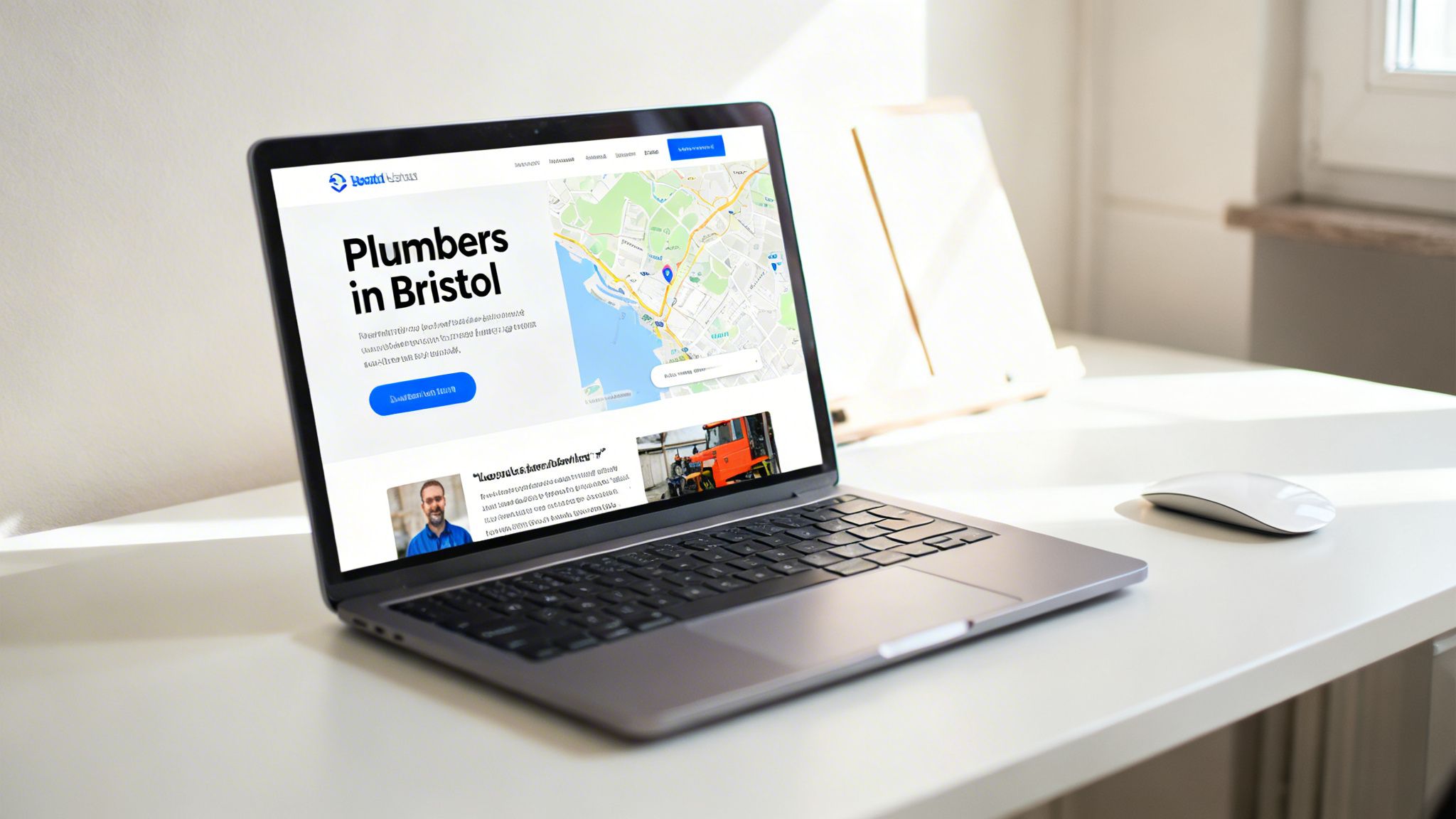
Think beyond your service. Your customers aren't just searching for "plumber"; they're desperately searching for an "emergency plumber in Bristol" when a pipe bursts at two in the morning.
Uncovering Geo-Specific Keywords
Right, let's get practical. The first step is to simply marry your services with the locations you serve. This creates powerful, long-tail keywords that scream local intent at Google.
Start by making two lists. On one, list out your core services. On the other, list every single town, city, district, and even postcode you cover. Now, combine them. For an artisan bakery in London, this simple exercise can reveal a goldmine of valuable terms.
- Service + City: "artisan bakery London"
- Service + Borough: "sourdough bread in Notting Hill"
- Adjective + Service + Area: "best croissants Kensington"
Sure, these specific phrases have lower search volumes than a broad term like "bakery". But the traffic they bring is infinitely more valuable. Someone searching for "artisan bakery in Notting Hill" is far closer to walking through your door than someone just browsing for bakeries in general.
Tapping into 'Near Me' Searches
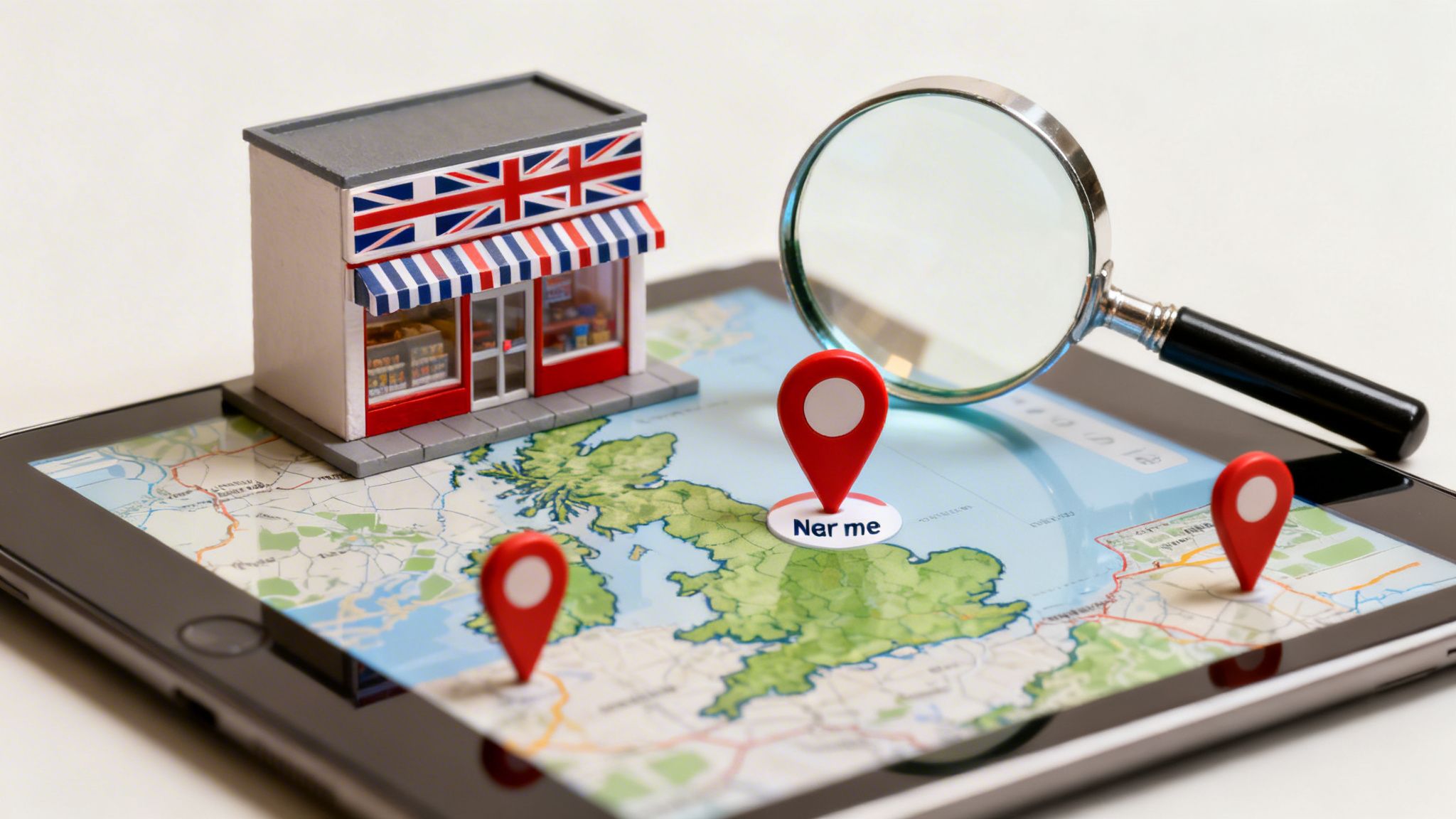
The explosion of mobile search has made ‘near me’ queries incredibly common. In fact, these searches have grown by over 200% in recent years. People now expect Google to know where they are and serve them the closest, most relevant local business.
Here’s the thing: you don't actually optimise your website for the phrase 'near me'. Instead, you focus on perfecting your Google Business Profile and ensuring your website clearly states your location and service area. Google does the rest, connecting the dots between your business and a user searching nearby. This is a fundamental part of any modern SEO for small business UK strategy.
Key Takeaway: Your goal is to mirror your customer's language. Ditch the internal jargon. Listen to how people describe their needs on the phone or in emails and use those exact phrases in your keyword strategy.
Analysing Your Competitors
One of the fastest ways to find winning keywords is to see what's already working for your local competition. Using SEO tools—and there are plenty of great free and paid options—you can peek under the bonnet of their websites and see exactly which keywords they’re ranking for.
Always be on the lookout for gaps. Perhaps a rival electrician in Leeds ranks well for ‘house rewiring Leeds’ but has completely ignored ‘EICR certificate Leeds’. That’s your opportunity. Prioritise the keywords based on their relevance, search volume, and your ability to serve that specific need better than anyone else.
Once you have your refined list, you need to map each keyword to a specific page on your website. High-intent service keywords belong on your service pages, broader terms sit on your homepage, and question-based keywords can inspire some fantastic blog posts. If you want to dive deeper into structuring your site for local success, our comprehensive local SEO checklist is an excellent resource.
This structured approach creates a powerful, cohesive strategy that tells search engines exactly what you offer and, crucially, where you offer it.
Creating Local Landing Pages That Convert
If your business serves multiple towns, or even just different patches of a big city like London or Manchester, a single service page is never going to be enough. To really get a grip on hyperlocal search and make your seo for small business uk efforts count, you need to build dedicated location landing pages.
These are pages laser-focused on ranking for "service in location" searches, like 'wedding photographer in the Cotswolds' or 'boiler repair in Hackney'. Think of each one as a micro-website, speaking directly to a specific community. It's your chance to show both Google and your potential customers that you're a genuine local player, turning each page into its own lead-generating machine.
Core On-Page Elements for Local Pages
For these pages to have any impact, they must be substantially unique. Simply copying your main service page and swapping out the town name is a fast track to being completely ignored by Google. Each page needs its own identity.
Of course, before you dive into the hyper-local details, it's worth getting the fundamentals right. Understanding the basics of how to create a landing page that converts will give you a solid foundation to build on.
As a starting point, every local page needs these essential ingredients:
- A Unique URL: Keep it clean and obvious. A structure like
yourwebsite.co.uk/service/location-name(e.g.,bestplumber.co.uk/boiler-repair/reading) is perfect. - A Location-Specific Title Tag: This is arguably your most powerful on-page signal. Stick to the formula:
[Main Service] in [Location] | [Your Brand Name]. For instance:Bespoke Kitchen Design in Harrogate | Smith & Jones. - A Clear H1 Heading: Your main on-page heading should echo the title tag. Something direct and effective like
Your Trusted Bespoke Kitchen Designers in Harrogatedoes the job perfectly.
These foundational pieces immediately tell search engines what the page is about and where it's relevant, setting the stage for the more detailed local content to come.
Bringing the Local Flavour to Your Content
Now for the part that builds real trust with local visitors. Your content has to prove you actually know the area. This is where you move beyond generic service descriptions and create something with genuine local texture.
For example, a caterer creating a page for Cambridge could mention popular wedding venues in the area they've actually worked with. If you want to see how this kind of city-specific optimisation is done, you can learn more from our dedicated article on our SEO services in Cambridge. It's this kind of detail that demonstrates direct, relevant experience.
Expert Insight: Don't just tell people you serve an area—prove it. Mentioning local landmarks, referencing specific neighbourhoods, or showcasing projects you’ve completed in that postcode adds a layer of authenticity that stock content can never replicate.
You need to weave these location-specific details throughout the page. A great way to structure this is by featuring:
- An Embedded Google Map: This visually pinpoints your service area, providing an instant geographic signal that both users and Google appreciate.
- Local Testimonials: Make sure you feature reviews from clients specifically from that town or area. A quote from "Sarah in Didsbury" on your Didsbury page is miles more powerful than a generic one.
- Area-Specific Case Studies: Showcase a project you completed nearby. Include a few photos and a brief story about the work you did for a client in that specific location.
- Local Schema Markup: This is a bit of code you add to your page’s backend to explicitly tell Google your address, service area, and other key details. It’s a powerful technical signal for local SEO.
By combining all these elements, you create a landing page that doesn't just rank for local searches. You create one that truly connects with the people who live there, drastically increasing your chances of turning them into actual customers.
A Practical Content Strategy to Attract Local Customers
For many business owners, creating content feels like a chore. It’s that one job that always gets pushed to the bottom of the to-do list. In reality, it’s one of the most powerful tools you have for building local authority, earning trust, and showing Google you’re the real deal.
A smart content strategy stops you from just selling a service and turns you into the go-to local expert. Imagine your Bristol construction firm trying to show up for 'boiler repair near me' searches. UK stats show that a huge 70-80% of people research small businesses online before they even think about buying.
And yet, a startling 80% of small businesses don't bother with content marketing at all. This leaves a massive, wide-open goal for anyone willing to put in the effort.
This isn’t about churning out generic blog posts for the sake of it. It’s about strategically answering the real questions your local customers are asking right now.
Brainstorming Topics Your Customers Care About
Forget trying to guess what your customers want to know. The best content ideas are hiding in plain sight, coming directly from the people you talk to every day. Your front-line staff, your email inbox, and your customer service calls are absolute goldmines.
Keep a running list of every single question you get asked. Even the simplest queries can be spun into incredibly valuable blog posts that attract highly motivated local searchers.
Example Content Ideas Based on Customer Questions:
- For a roofer in Leeds: A post titled "How to Choose a Reputable Roofer in Leeds (And Avoid the Cowboys)" speaks directly to a massive homeowner fear.
- For a dog-friendly café in the Lake District: An article on "The 5 Best Dog-Friendly Fell Walks Near Ambleside with a Café Stop" is both genuinely useful and a brilliant piece of self-promotion.
- For a wedding photographer: Photographers often find local content tricky. Our guide on SEO for photographers is packed with specific ideas for this creative niche.
By framing your content around these questions, you line up your website perfectly with what people are searching for. It's a cornerstone of effective SEO for small business UK.
Building Pillar and Cluster Content
A seriously smart way to organise your content and build authority is to use a 'pillar and cluster' model. It sounds a bit technical, but the idea is actually very straightforward.
Pillar and Cluster Explained: You create one huge, in-depth article on a broad topic (the 'pillar'). You then surround it with several smaller, more specific articles (the 'clusters') that all link back to that main guide. This structure shouts to Google that you're an expert on the subject.
Let's say a boutique hotel in the Cotswolds wants to dominate local search. They could create a pillar page titled "The Ultimate Guide to a Weekend Break in the Cotswolds".
This main guide would then be supported by smaller cluster posts, each targeting a more niche search:
- "Top 5 Quaint Villages to Visit in the Cotswolds"
- "Best Antique Shops in Stow-on-the-Wold"
- "A Guide to the Best Sunday Roasts Near Burford"
- "Exploring the Cotswold Way Walking Trail"
Each one of these cluster posts links back to the main "Ultimate Guide." This signals to Google that your hotel's website is a comprehensive resource for anything to do with the Cotswolds. It builds your topical authority, helping your entire site rank higher for related local searches, and establishes you as the definitive local expert.
Building a Locally Relevant Link Profile
Backlinks are still one of Google’s most powerful signals for credibility. Think of them as a digital nod of approval from another website. But for a local UK business, not all nods are created equal.
A link from the Sheffield Star is worth its weight in gold for a Sheffield-based architect. A link from a random blog in another country? Not so much. It’s all about proving you’re a real, trusted part of the local scene, and that means building a link profile that reflects your community roots.
Starting with the Low-Hanging Fruit
Link building can sound intimidating, but for a local business, your community is your biggest advantage. You don't need expensive, global campaigns; you just need to tap into the relationships you already have.
This is a core part of any sensible seo for small business uk strategy. Start with the quick wins—the organisations you’re already connected with.
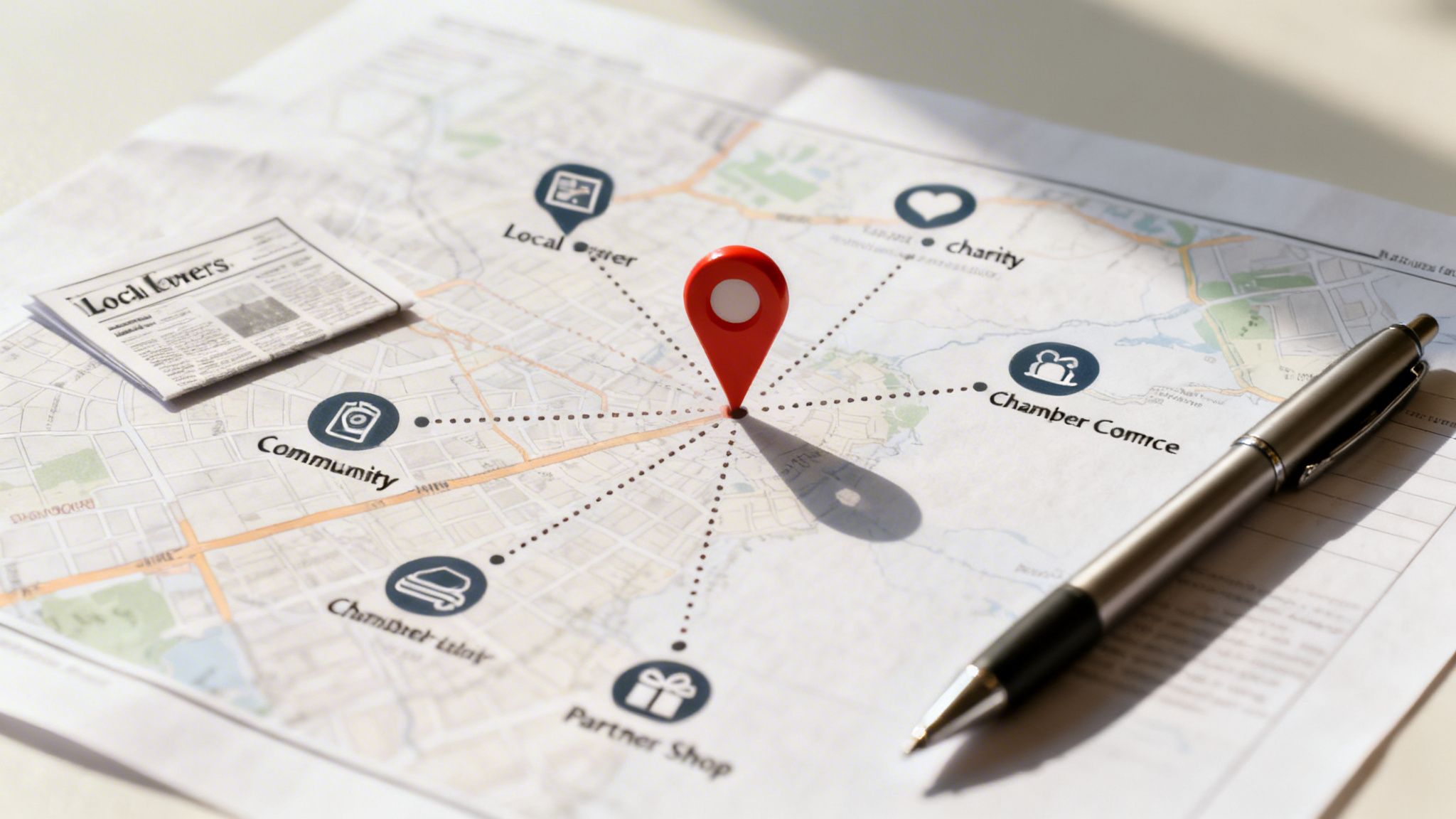
- Your Local Chamber of Commerce: Nearly all Chambers have a member directory. Getting listed is usually straightforward and bags you a highly trusted local link.
- Suppliers and Partners: Think about the businesses you work with every day. A quick email asking for a link on their partners page, or even suggesting a joint blog post, can be an easy win.
- Local Business Awards: Just being nominated for a local business award often gets you a link from the organiser’s website. Winning is even better, of course.
These early links are the bedrock of your profile. They establish that first layer of local trust, giving you a solid foundation to build on.
Tapping into Your Local Community
Once you’ve secured those foundational links, you can get a bit more creative. This is where you can really pull ahead of competitors who are completely ignoring these hyperlocal opportunities.
Think about sponsoring a local youth football team’s new kit, a charity 5k run, or a stall at the village fete. These sponsorships almost always come with a thank-you link on the organisation's website. It’s a brilliant way to do some good for the community while earning a valuable, relevant backlink.
Expert Tip: When you sponsor an event, don't just ask for a link. Offer to send them a high-quality logo and a short blurb about your business. It makes their life easier and ensures you look professional.
Another fantastic tactic is to team up with complementary local businesses. A wedding photographer in the Cotswolds, for instance, could collaborate with a local florist and a popular venue on a "Complete Cotswolds Wedding Guide". Each business contributes and links to the others, creating a powerful little network of hyper-relevant links.
Below is a quick breakdown of some common local link building tactics to help you weigh up the effort versus the potential reward.
Local Link Building Opportunities Breakdown
| Tactic | Difficulty | Typical Cost | SEO Impact |
|---|---|---|---|
| Local Directories | Easy | Free – £50/year | Low |
| Supplier/Partner Links | Easy | Free (Relational) | Medium |
| Local Sponsorships | Medium | £100 – £500+ | Medium-High |
| Guest Posts on Local Blogs | Medium | Free (Time-based) | High |
| Collaborative Content | Medium | Free (Time-based) | High |
| Local PR/News Mentions | Hard | Free (Time-based) | Very High |
As the table shows, some of the most powerful opportunities don’t require a huge budget, but they do require your time and a bit of outreach.
The investment here is often far less than you’d think, especially when you consider the dual benefit of community goodwill and SEO. While 89% of small business owners know SEO is a key driver of growth, many still underinvest. UK data shows that a smart organic strategy can be incredibly powerful for local services, often delivering a much better return than other marketing channels. You can discover more about these ecommerce and SEO statistics on Charle.co.uk. It just goes to show that a targeted, local-first approach to link building can make a massive difference.
Measuring Your SEO Success and Finding the Right Partner
SEO is a long-term investment, not an overnight fix. But how do you actually know if your investment is paying off? Tracking your success is crucial, and it goes far beyond just checking where you rank for a handful of keywords.
Real measurement is about connecting your SEO efforts to tangible business outcomes. The good news is, you can track the most important metrics for free using the tools Google itself provides.
Key Metrics to Monitor
The two essential tools in your measurement toolkit are Google Analytics 4 (GA4) and Google Search Console (GSC). Don't be put off by the dashboards; focusing on just a few key reports will tell you most of what you need to know.
These are the core metrics you should be watching:
- Organic Traffic Growth (GA4): Is the number of visitors finding you through search engines going up month-on-month? This is your top-level indicator that your SEO is working.
- Keyword Rankings (GSC): Are you showing up for your target local keywords like 'electrician in Bath' or 'cake shop near me'? Track your average position and, more importantly, the number of impressions and clicks these terms are generating.
- Google Business Profile Actions (GBP Insights): This is where you see direct local engagement. Keep an eye on the number of phone calls, requests for directions, and clicks to your website coming straight from your profile.
These metrics give you a clear picture of performance. An increase in organic traffic shows your visibility is growing, while a rise in GBP actions proves that visibility is turning into genuine customer interest.
Key Takeaway: Focus on trends, not daily fluctuations. SEO performance ebbs and flows. Look for a steady upward trajectory over a period of three to six months to gauge true progress and return on investment.
Choosing the Right SEO Partner
At some point, you might decide to bring in an expert to accelerate your growth. Choosing the right partner for your seo for small business uk strategy is a critical business decision. A good agency or consultant should feel like an extension of your team, not just another supplier.
Look for a partner who demonstrates transparency and a focus on a bespoke strategy. They should be willing to provide:
- A Clear, Actionable Plan: They need to outline exactly what they'll do in the first 30, 60, and 90 days.
- Transparent Reporting: You should get regular, easy-to-understand reports that connect their work directly to the metrics we've just discussed.
- A Focus on ROI: They must be able to explain how their activities will lead to more enquiries and sales. To get a better feel for this, our guide on calculating your self storage ROI calculator for SEO breaks down principles that apply to almost any service business.
A trustworthy partner invests time in understanding your business and sets realistic expectations from day one. Remember, powerful results take patience and a consistent, strategic approach.
Frequently Asked Questions About Small Business SEO
Getting your head around SEO can throw up a lot of questions. We get it. To cut through the noise, we've rounded up the most common queries we hear from UK business owners just like you, with straight-talking answers to get you started.
How Long Does It Really Take to See Local SEO Results in the UK?
This is the big one, isn't it? The honest answer is that while you might see some early glimmers of movement in just a few weeks from optimising your Google Business Profile, significant, lasting results take time.
You need to be thinking in terms of 3 to 6 months for real, needle-moving improvements. SEO is about building momentum, not flipping a switch.
In fiercely competitive markets like London or Manchester, or for tough industries like finance or law, you should probably budget for 6–12 months. When we talk about SEO for small business in the UK, it's about building a solid foundation. The first few months establish your authority, and the real growth compounds from there.
Our Two Cents: Patience is your greatest asset in this game. Quick wins are fantastic, but the sustainable, business-changing growth comes from consistent, focused effort over several months. Don't lose heart if you're not on page one overnight.
Can I Do SEO Myself or Should I Hire an Agency?
You can absolutely get the ball rolling yourself. High-impact basics like claiming and fully optimising your Google Business Profile, making sure your contact details are spot-on across the web, and actively asking for customer reviews are all things you can manage.
But if you want to seriously compete and drive real growth, a deeper strategy is vital. This is where you get into the weeds of technical SEO, consistent content creation, and strategic link building.
An agency brings specialised tools, years of expertise, and dedicated time that most business owners simply don't have. That experience accelerates results and helps you sidestep common, costly mistakes.
How Much Should a Small Business in the UK Budget for SEO?
SEO costs can vary massively depending on your goals, industry, and location. For a small, local business, a basic monthly retainer with a reputable UK agency will often start in the ballpark of £500–£750.
This can easily climb to several thousand pounds a month for businesses in hyper-competitive niches or for those managing multiple locations. The key is to view this as an investment in a powerful, long-term lead generation asset, not just another marketing cost.
The best way forward is to get a clear picture of where you stand right now. At Bare Digital, we provide a free, no-obligation SEO health check to analyse your current performance, pinpoint your biggest opportunities, and map out a clear plan of action.
Book your free SEO health check today and discover what a tailored strategy could really do for your business.