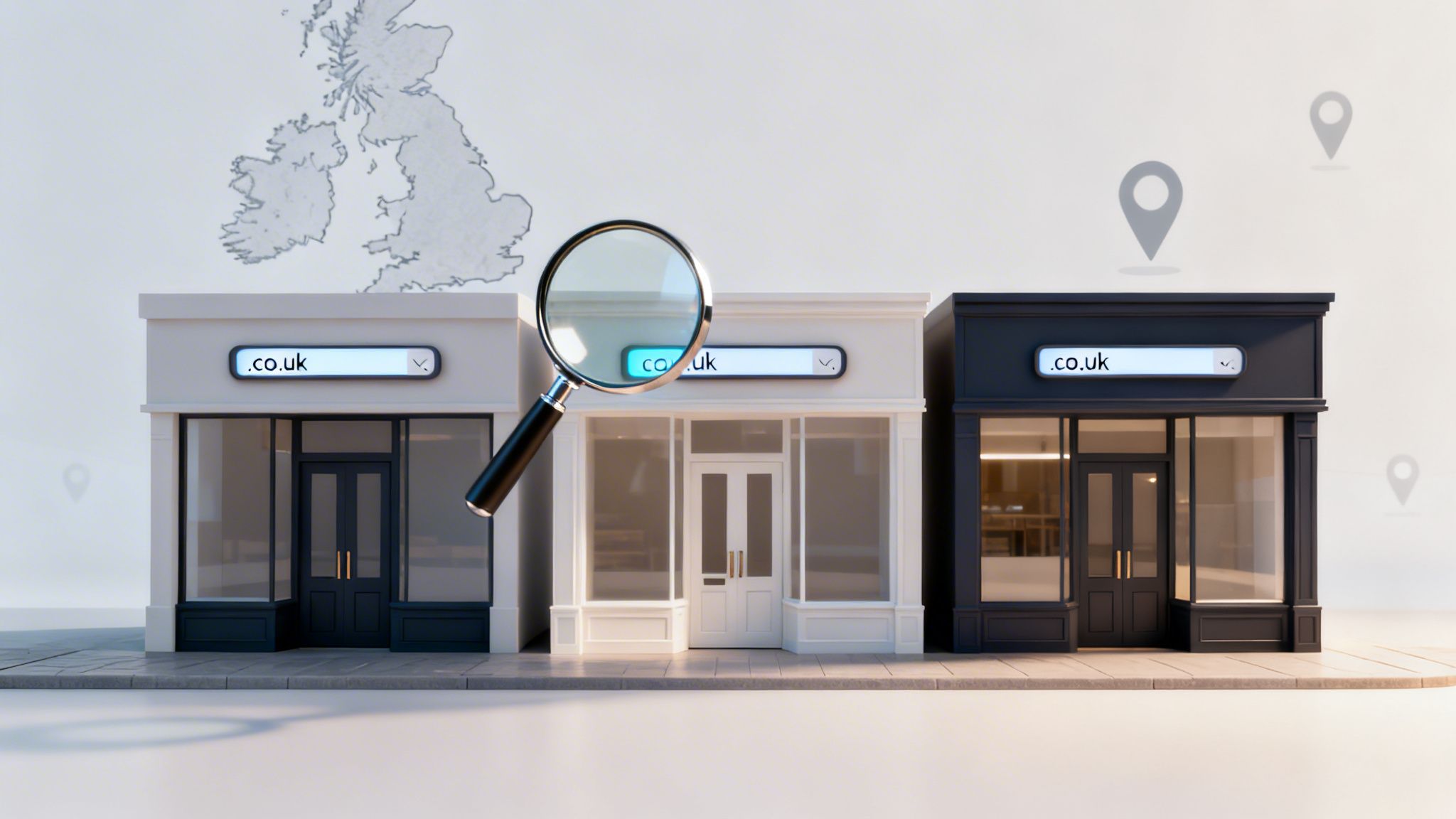

Your domain name is so much more than just a web address. It's your digital handshake, the sign hanging above your virtual shop on the busiest high street in the world. Get it right, and you build instant trust, tell people exactly what you're about, and lay the foundation for your entire search engine optimisation (SEO) strategy.
Your Domain Is Your Digital First Impression
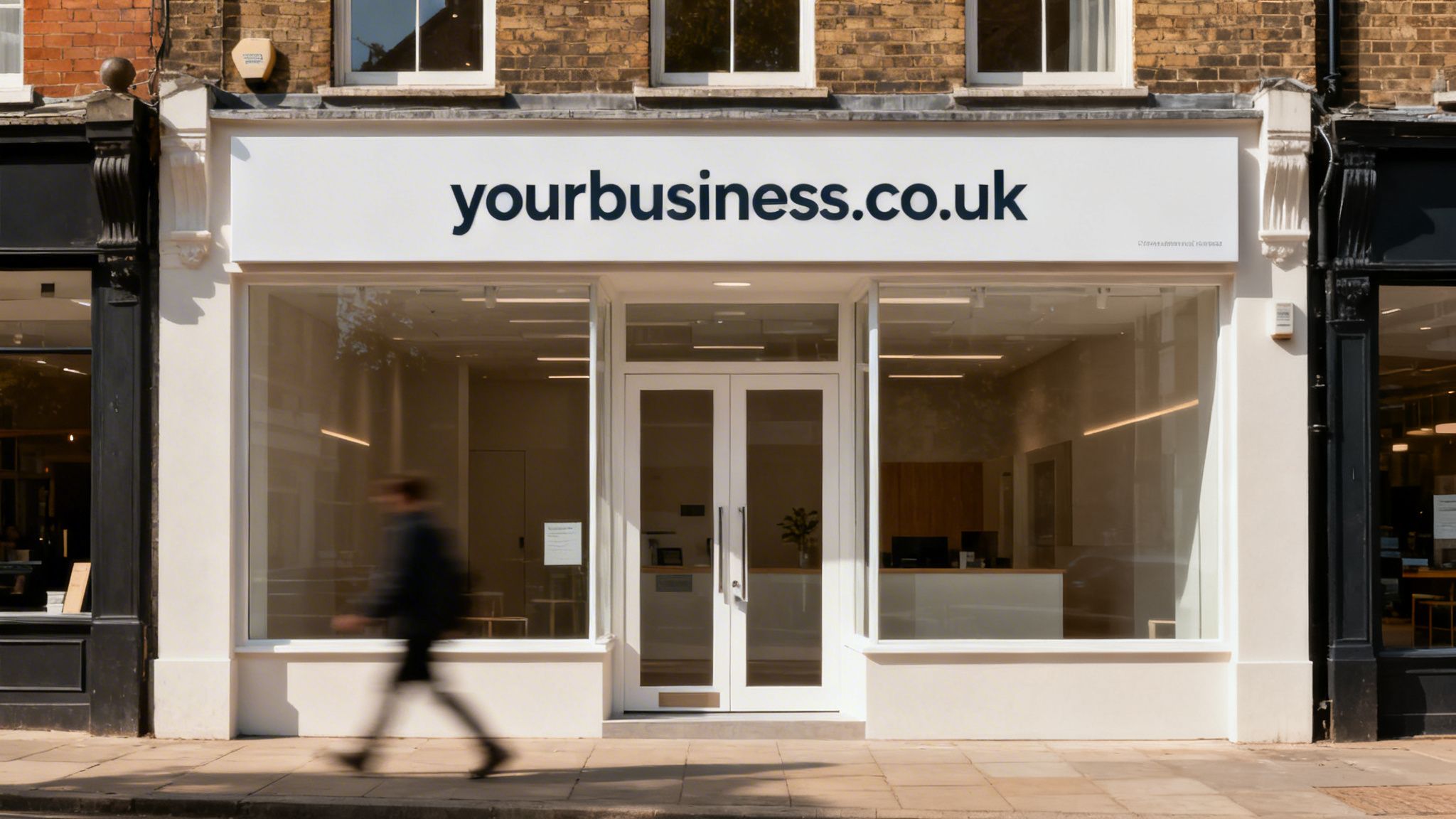
When you're thinking about domain names for SEO, it’s easy to get bogged down in the technical weeds. But at its heart, your domain is a branding and marketing tool first and foremost. It’s what customers will type into their browsers, spot in search results, and tell their friends about.
A memorable and relevant domain can be the difference between a one-time visitor who forgets you instantly and a loyal, returning customer. For UK businesses that rely on local customers, that choice carries even more weight. It's a powerful signal to both search engines and people that you are local, relevant, and trustworthy.
Your domain name is a vital piece of your online identity. It not only affects your branding and user experience but also has a direct and lasting impact on how easily customers can find you through search engines like Google.
Why Your Domain Choice Matters for Local SEO
Your domain is one of the very first clues Google looks at to figure out what your business does and who it's for. A well-chosen domain can give you immediate context, helping you show up in relevant local searches from day one. This one choice affects several critical SEO factors:
- Relevance and Authority: A domain that reflects your industry or location helps Google put your site in the right box. For instance, a plumbing company in Manchester with "plumbing" or "manchester" in its domain gets an instant relevance boost.
- User Trust and Click-Through Rate: Let's be honest, people are far more likely to click on a search result that looks professional and makes sense. A clean, clear domain builds trust; a confusing or spammy-looking one sends them running.
- Memorability and Direct Traffic: A simple, brandable domain is just easier for customers to remember. This leads to more direct traffic—people typing your address straight in—which is a strong, positive signal for search engines.
The Strategic Value for UK Businesses
For a small or multi-location UK business, your domain is a strategic asset. This isn't just about getting a website online; it's about claiming your digital patch. Whether you're a caterer in Cardiff or a design studio with offices in London and Leeds, your domain sets the stage for your entire marketing effort.
Making the right call here is crucial for turning search engine visibility into actual, paying customers. As you start to build your presence, you can explore deeper strategies; learning more about local SEO from a dedicated agency like Bare Digital can give you a significant leg-up. The sections that follow will give you the actionable advice you need to pick a domain that will support your business for years to come.
Keyword Domains vs Brandable Domains
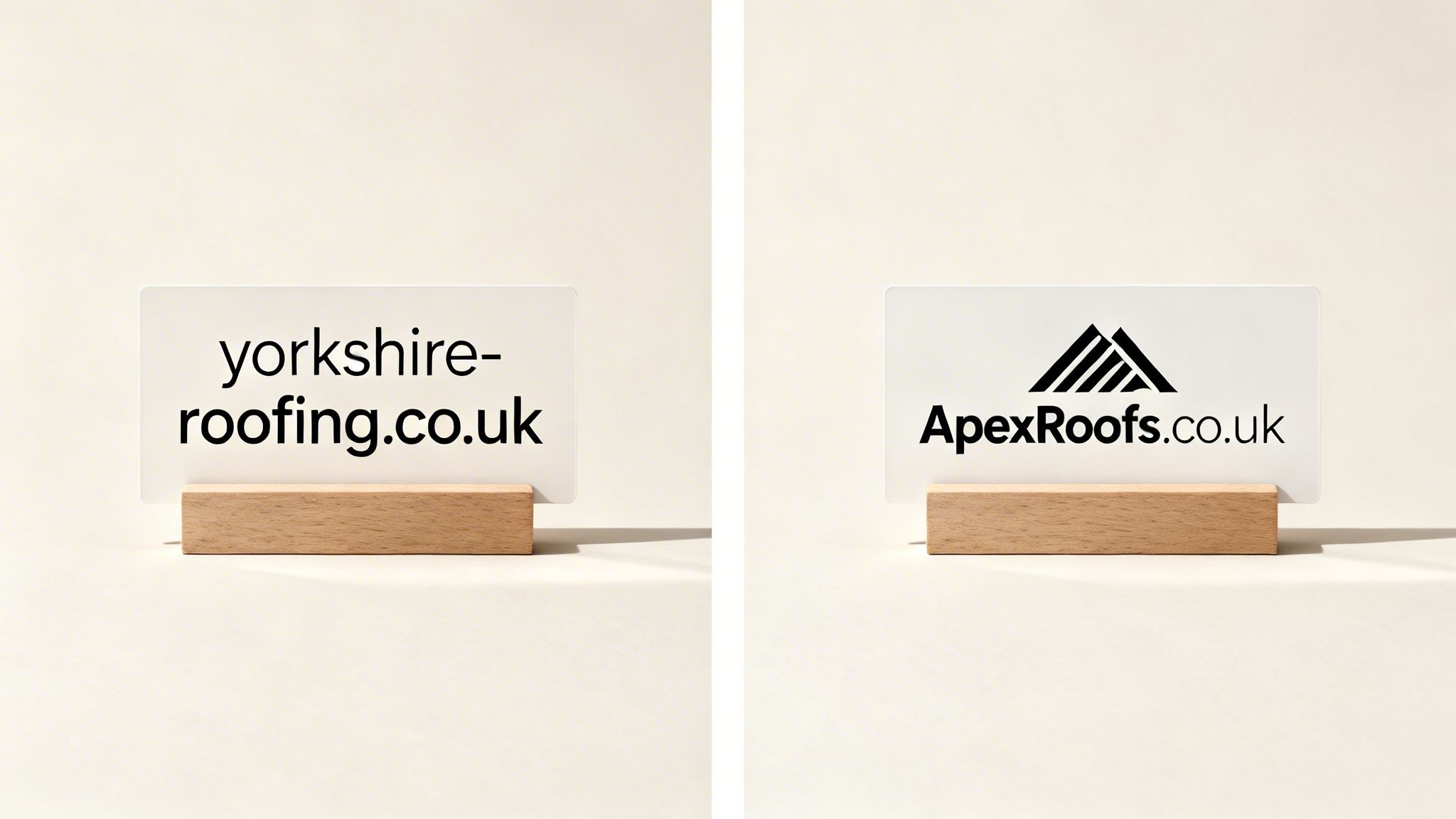
When you're picking a domain name, you're at a crossroads. Do you choose a name that spells out exactly what you do and where you do it, or do you go for something unique that you can build a brand around? This is the heart of the debate between keyword-rich domains and brandable ones.
Think of it this way. A keyword-rich domain like yorkshire-roofing.co.uk is the functional, no-nonsense option. It's a plain-English label that tells customers and Google exactly what you're about from the get-go. It's direct and practical.
On the other side, a brandable domain like ApexRoofs.co.uk is more like a creative logo. It doesn't scream your location, but it sounds professional, is easy to remember, and has the potential to become a recognised name. Both paths have big implications for your SEO and how you market your business.
The Power and Pitfalls of Keyword Domains
There was a time when keyword-stuffed domains, often called Exact Match Domains (EMDs), were a golden ticket in SEO. Google's updates have dialled that back, but they still have a place—especially for a new local business that needs to get seen quickly.
The main advantage is sheer clarity. The URL itself is a strong signal for local searches like "roofing in Yorkshire." This can give you a small initial leg-up in the rankings and often helps your click-through rate, as people see your website is a perfect match for their search.
But there are serious downsides. A keyword-heavy domain can paint you into a corner. What happens when your yorkshire-roofing.co.uk business wants to offer guttering services or expand into Lancashire? Suddenly, the name is restrictive and doesn't fit. It can also come across as a bit generic and less trustworthy than a polished brand.
While a keyword domain can give you an early, targeted SEO boost, it risks locking you into a narrow niche. A brandable domain, on the other hand, is a blank canvas that lets your business grow and evolve without being held back by its own web address.
The Case for a Brandable Domain Name
A brandable domain is unique, memorable, and often completely made up. Think of names like Zoopla or Rightmove—they don't literally say "property," but they've become famous through smart branding. This is the long-term play.
A name like ZestfulBites.co.uk for a catering company won't give you an instant keyword advantage, but its benefits stack up over time:
- Flexibility: You can add new services, pivot your business, or expand to new areas without the domain becoming a problem.
- Memorability: Unique names just stick in people's minds better. They’re easier to recall, type directly into a browser, and pass on by word-of-mouth.
- Professionalism: A creative, unique name often feels more established and professional, which helps build trust with potential customers.
The trade-off is that you have to put in the work to build its reputation. You'll need to invest more in your marketing and SEO to teach Google and your customers what your brand stands for. For businesses in creative fields, this approach often feels much more natural; our guide to SEO for photographers digs into how building a strong brand identity is key.
Keyword-Rich vs. Brandable Domains Comparison
This table breaks down the direct trade-offs between choosing a keyword-focused domain versus a unique, brandable one.
| Attribute | Keyword-Rich Domain (e.g., manchestercaterers.co.uk) | Brandable Domain (e.g., ZestfulBites.co.uk) |
|---|---|---|
| Initial SEO | Can provide a small, immediate boost for specific local keywords. | Requires more initial SEO effort to build relevance and authority. |
| Clarity | Instantly tells users and search engines what you do and where. | The meaning and service have to be established through branding. |
| Memorability | Can be generic and easy to forget or confuse with competitors. | Unique and much easier for customers to recall and share. |
| Scalability | Restrictive. Limits future expansion into new services or locations. | Highly flexible. The business can grow and evolve without constraint. |
| Trust Signal | Can sometimes appear less professional or even a bit spammy. | Often appears more established, trustworthy, and professional. |
| Long-Term Asset | Value is tied to specific keywords, which can lose relevance. | Becomes a valuable brand asset that grows with the business. |
Ultimately, the choice comes down to your long-term vision versus short-term needs. A keyword domain can be a quick win, but a brandable domain is an investment in your future.
Making the Right Choice for Your Business
So, which one is better? It all comes down to your business goals.
For a brand-new, hyper-local business that needs to generate leads fast, a hybrid approach like BrandName-Plumbing.co.uk can be a smart compromise. It gives you a bit of keyword relevance without being overly restrictive. When weighing this up, it’s worth reading expert advice on Using Keywords for Domain Name Selection to fully grasp the nuances.
However, for any business with ambitions to grow, expand, and build a name that lasts, a brandable domain is almost always the better bet. It’s an investment in a flexible, future-proof asset that you'll never outgrow.
Choosing the Right UK Domain for Local SEO
If you’re a UK business targeting British customers, the bit at the end of your web address is one of the most powerful signals you can send. That little suffix, known as a Top-Level Domain (TLD), is a non-negotiable part of your local SEO toolkit. Getting it right is like putting a massive, unambiguous "We're a UK Business" sign in your digital shop window.
When it comes to domain names for SEO here in Britain, the country-code TLDs (ccTLDs) .co.uk and .uk are your best friends. These endings immediately tell Google that your website is primarily for people searching from within the UK. This one simple choice gives you a huge, built-in head start over competitors using generic domains like .com or .net.
This isn't just some minor technical detail; it has a direct impact on whether you show up in the searches that actually matter. When someone in Bristol searches for "plumbers near me" or a family in Edinburgh looks for "local photographers," Google’s algorithm will naturally favour businesses that have clearly signalled their UK base. A .co.uk domain is one of the strongest signals you can possibly send.
Building Trust with a British Audience
Beyond the technical SEO boost, a UK-specific domain instantly builds trust with your audience. British customers know and are comfortable with .co.uk. It feels familiar, established, and reliable, whereas a .com or .biz can feel distant or less relevant to their needs.
This familiarity almost always translates into a higher click-through rate (CTR) from the search results. Imagine two businesses offering the exact same service. If one has a .co.uk domain and the other a .com, a UK searcher will instinctively be more likely to click the local option. It just feels right.
Choosing a .co.uk or .uk domain isn't just an SEO tactic; it's a fundamental part of positioning your business as a trusted, local entity. It tells both Google and your future customers that you are here, you are relevant, and you are open for UK business.
This user behaviour then sends a great signal back to Google, reinforcing your site’s relevance for UK searches. It creates a brilliant positive feedback loop: the TLD gets you more clicks, and the increase in clicks tells Google your site is a great result, which helps boost your rankings even further.
The Reigning Champion .co.uk
The sheer dominance of .co.uk in the UK market is undeniable. According to Nominet's data for early 2026, there are over 8.4 million .co.uk domains registered, absolutely dwarfing the 1.4 million .uk domains. This widespread adoption has cemented .co.uk as the gold standard for British businesses, and its prevalence influences both user trust and search engine algorithms that favour established patterns.
The choice between the traditional .co.uk and the shorter .uk often boils down to branding and availability.
- .co.uk: The long-standing favourite. It carries immense trust and familiarity and is what most people still expect to see. It’s the safe, powerful choice for almost any UK business.
- .uk: A newer, sleeker alternative. It's a solid option if the .co.uk version of your name is already taken, but it just doesn’t have the same historical weight.
For most businesses, securing the .co.uk should be your number one priority. If you can, it’s also a smart defensive move to register the .uk version and simply redirect it to your main .co.uk site. This stops a competitor from grabbing it and causing confusion. This all-around approach, detailed further in our comprehensive local SEO checklist, ensures you're covered from all angles.
Structuring Your Site for Multiple Locations
For any business with more than one physical branch—think a chain of clinics, a network of service engineers, or a retailer with shops in different cities—structuring your website correctly is absolutely critical. How do you build an online presence that serves each location without watering down your overall SEO power? It all boils down to a fundamental choice between using subfolders or subdomains.
The easiest way to get your head around this is to think of your website as a filing cabinet. Your main domain name (yourbusiness.co.uk) is the entire cabinet itself—it’s the single entity that holds all your brand authority and SEO value.
Now, let's look at the two main ways you can organise your location-specific information inside that cabinet.
The Subfolder Approach: The Organised File
A subfolder structure simply places each location’s content inside a directory of your main website. It looks like this:
yourbusiness.co.uk/bristolyourbusiness.co.uk/manchesteryourbusiness.co.uk/edinburgh
In our filing cabinet analogy, each subfolder is like a neatly labelled file tucked inside the main drawer. All the SEO authority, backlinks, and trust you’ve built up for yourbusiness.co.uk flows directly to these pages. It’s one unified system where every new file you add makes the whole cabinet stronger.
This flow chart shows the simple but powerful way authority is shared in each structure.
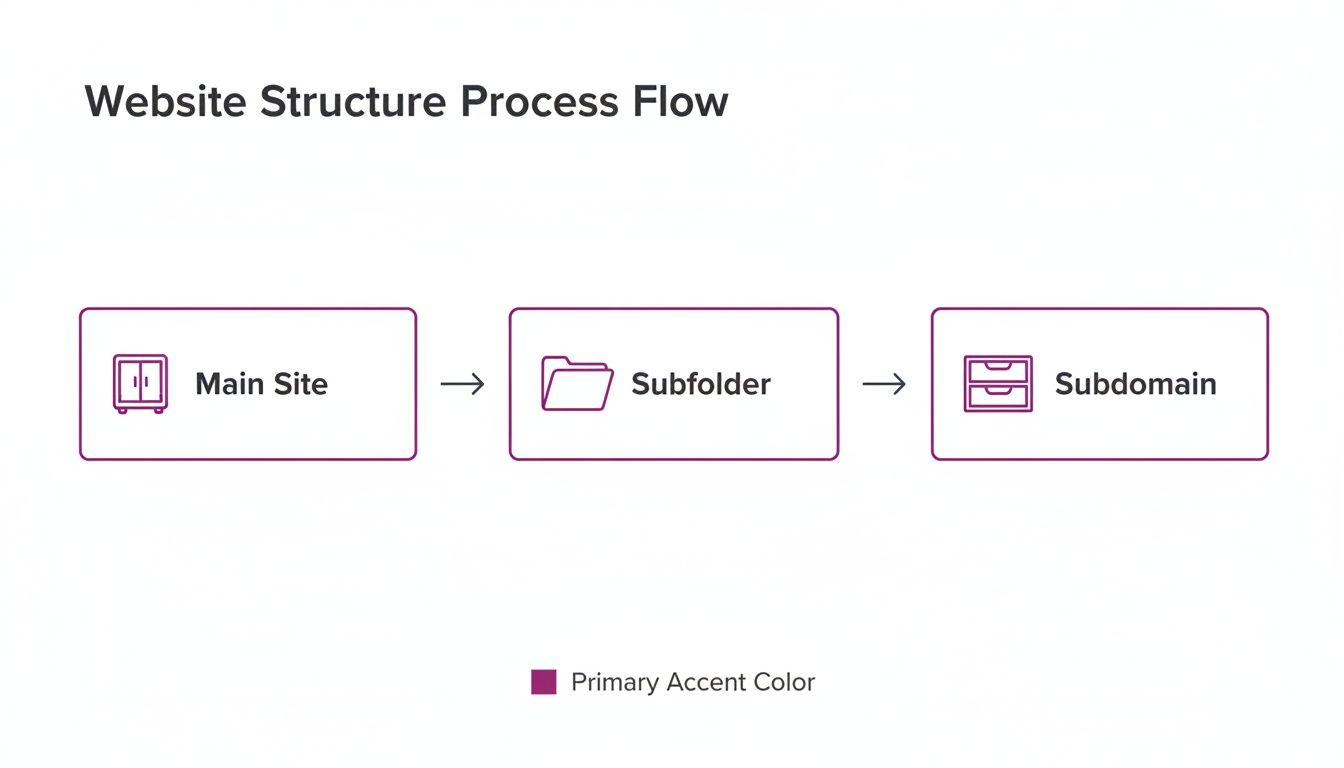
The key takeaway is that subfolders consolidate all your SEO efforts, while subdomains split them apart.
The Subdomain Approach: The Separate Drawer
In sharp contrast, a subdomain structure creates what search engines often treat as entirely separate websites. The URLs look like this:
bristol.yourbusiness.co.ukmanchester.yourbusiness.co.ukedinburgh.yourbusiness.co.uk
Back to our analogy, each subdomain is like a completely separate drawer in the filing cabinet. And while it's technically connected to the main unit, each drawer starts off empty. It needs to be filled with its own files and build its own reputation entirely from scratch.
For almost all multi-location businesses, subfolders are the superior choice for SEO. They consolidate your domain authority, simplify management, and ensure that every backlink and piece of content contributes to the strength of your main brand.
Choosing subdomains is basically choosing to run multiple mini-SEO campaigns at the same time. Each subdomain (bristol.yourbusiness.co.uk, manchester.yourbusiness.co.uk) starts with zero authority. It has to build its own backlinks and trust signals independently, which is a much harder and more expensive job. This approach dilutes your resources and fragments the precious SEO equity you’ve worked so hard to build.
Why Subfolders Win for Local SEO
For a local business trying to rank in several towns or counties, the benefits of the subfolder model are overwhelming. Every single SEO signal—backlinks, user engagement, content quality—is credited to your one powerful domain. This consolidated authority gives all your location pages a much better shot at ranking, from Peterborough to Portsmouth.
Managing SEO for a multi-location business in the UK has its unique challenges, and a subfolder structure gives you a solid, scalable foundation for a strong local SEO strategy in Peterborough and beyond.
Subdomains should only ever be considered in very specific cases, like for a completely distinct part of your business that has a different brand name or serves a different language market. For a UK service business expanding its reach, sticking with subfolders is the smartest, most effective path to SEO success.
How to Change Your Domain and Keep Your Rankings
So, you're ready for a new domain. Maybe it's a full rebrand, or you've finally snagged the perfect .co.uk you've had your eye on. It’s an exciting move, but from an SEO perspective, it’s a high-stakes operation.
Think of it like moving your entire business from a bustling high street shop to a new location. If you just vanish overnight without leaving a forwarding address, your customers are left confused, your hard-earned reputation disappears, and you’re basically starting from scratch.
That’s exactly what happens to your search rankings if a domain change is handled badly. Years of SEO equity can be wiped out. But get it right, and it’s a seamless switch that protects your traffic and carries over all that authority you've worked so hard to build.
The trick is to see it not as a simple flick of a switch, but as a meticulous migration. The entire goal is to make sure every user and search engine bot trying to find your old address is flawlessly guided to your new one, bringing all the trust and value with them.
The Foundation of a Safe Migration is the 301 Redirect
The single most important part of this whole process is the permanent 301 redirect. It’s the Royal Mail’s forwarding service, but for the internet. It tells any browser or search engine crawler trying to visit a page on your old site, "Heads up, this page has moved for good. Here’s the new address."
Crucially, a 301 redirect passes the vast majority of your old page's "link equity"—the authority it has gained from backlinks—over to the new one. This is absolutely fundamental. Without it, every link pointing to your old site becomes a dead end, and all that value vanishes instantly.
This isn’t just about the homepage, either. You must map every single important page from your old domain to its new counterpart. A lazy blanket redirect sending everything to the new homepage is a damaging shortcut that will tank your SEO.
For example, you need to set up individual redirects like this:
old-domain.co.uk/servicesmust redirect tonew-domain.co.uk/servicesold-domain.co.uk/about-usmust redirect tonew-domain.co.uk/about-usold-domain.co.uk/blog/post-titlemust redirect tonew-domain.co.uk/blog/post-title
Your Step-by-Step Domain Migration Checklist
A clean migration is a series of carefully coordinated steps. Dropping the ball on any one of these can lead to lost traffic and painful ranking drops.
1. Prepare Your New Site: Before you do anything else, the new domain must have a fully built, crawlable website on it. It needs to be 100% ready for both visitors and search engines.
2. Implement 301 Redirects: This is the most technical part. You need to set up server-level 301 redirects to map every old URL to its new equivalent. It’s a critical job that will likely need a developer's help.
3. Use Google’s Change of Address Tool: Google Search Console has a specific tool for exactly this situation. Once your redirects are live, you have to go in and officially tell Google you’ve moved. This helps them process the change much faster.
4. Update All Your Digital Assets: Your domain name is listed everywhere online. You need to hunt it down and update it across your entire digital footprint:
* Google Business Profile: This is absolutely essential for your local SEO. A mismatched URL confuses customers and hurts your visibility on Google Maps. You can learn more about optimising this crucial asset with a detailed Google Business Profile audit tool.
* Social Media Profiles: Update the website link in your bio on Facebook, Instagram, LinkedIn, X, and anywhere else you have a presence.
* Directory Listings: Go through Yell, Thomson Local, and any trade-specific directories to change your URL.
* Email Signatures: A simple but very easy one to forget.
5. Proactively Update Your Backlinks: While redirects handle the traffic, it's best practice to contact the owners of your most valuable backlinks. Ask them to update the link to your new domain. It sends a much stronger, more direct signal to Google.
A domain migration is a high-stakes procedure. There's no way to know for certain what will happen, and some sites see a temporary slump in search traffic for a few weeks or months before it recovers. A meticulous process minimises this risk.
This careful planning is more vital than ever in a competitive environment. The UK domain market is constantly growing, showing just how important a solid digital address is. As of early 2026, Nominet reported managing approximately 9.8 million active registrations, with .co.uk and .uk domains making up the vast majority. Moving your domain correctly ensures you remain a strong player in this crowded space.
Your Essential Domain Selection Checklist
Choosing or changing your domain is a big deal. After digging into the strategy behind brandable names, UK-specific extensions, and site structures, it’s time to pull it all together. Think of this checklist as your final pre-launch inspection, boiling everything we've covered down into a simple, step-by-step guide.
Work through these points carefully before you part with any cash. Getting this right means you’ll end up with a powerful domain that boosts your SEO, builds your brand, and serves your business for years to come.
1. Finalise Your Name and Extension
First things first, you need to lock in the two core parts of your new digital address. This is the foundation that everything else gets built on.
- Make it Memorable: Is the name easy to say, spell, and remember? Avoid complicated words or clunky phrasing. A good test is to imagine saying it over the phone. If you have to spell it out or explain it, it’s too complex.
- Prioritise .co.uk: If you're targeting a UK audience, a .co.uk should be your first choice, hands down. It sends a powerful local SEO signal to Google and builds instant trust with British customers. If it’s free, grab the .uk version too for brand protection.
- Keep it Professional: Stay away from hyphens and numbers. A hyphen might seem like a clever way to squeeze in a keyword, but they often look spammy and are a pain to explain out loud. Numbers just create confusion (e.g., "Is that the number 4 or the word 'four'?").
2. Conduct Your Due Diligence
Once you’ve got a name you love, it’s time to play detective. You need to check that it’s actually available and doesn’t come with any unwanted baggage. Skipping this step can lead to nasty legal headaches or inheriting someone else's bad reputation.
- Check Domain Availability: Use a domain registrar to see if your chosen
.co.ukand.ukare available. Don’t get your heart set on a name before you know you can actually have it. - Run a Trademark Search: Head over to the UK government's intellectual property database. Picking a name that steps on an existing trademark is an expensive legal battle just waiting to happen.
- Investigate Domain History: If the domain has been registered before, you absolutely must check its past. Use tools like the Wayback Machine to see what kind of website used to be on it. A history of spam, gambling, or dodgy content can bring a Google penalty along with it, poisoning your SEO efforts from day one.
Think of a pre-owned domain like a used car. It might look fine on the surface, but you need a full history check to see if it has been in any 'crashes' or has a dodgy past that could cause you problems down the road.
3. Prepare for Launch
With your perfect, fully vetted domain in hand, the final step is to secure it and plan how to integrate it into your business. A solid understanding of what makes a good domain is vital, and you can go deeper by exploring other expert resources on choosing a domain name for long-term growth.
Armed with that knowledge, you can move forward with confidence. Purchase your chosen domain from a reputable registrar. If you’re moving an existing site, you need to start methodically planning your migration by mapping out all your 301 redirects. This careful prep work ensures your new domain starts its life on the strongest possible footing.
Frequently Asked Questions About Domains and SEO
Choosing or changing a domain name always brings up a ton of questions. To cut through the noise and bust a few myths, we've rounded up the most common queries we hear from UK business owners just like you.
Think of this as your straight-talking guide for getting the answers you need to make the right call for your business.
Does Buying an Old Domain With Backlinks Help SEO?
Buying an aged domain can feel like a tempting shortcut to SEO success, but honestly, it’s a strategy loaded with risk. In a perfect world, if the domain has a squeaky-clean history and a library of relevant, high-authority backlinks, it could give you a head start that would otherwise take months or even years to build.
But this can go wrong, fast. If that domain was ever used for spam, has a history of dodgy links, or is secretly sitting on a Google penalty, you’re not buying an asset—you're inheriting a toxic problem that will poison your SEO efforts before you've even started.
Think of an aged domain like a second-hand car. It might look great on the outside, but you must look under the bonnet. A thorough audit is essential to avoid buying a lemon that will cost you more in the long run.
Before you even think about buying, you have to do your homework. Use tools to dig into its backlink profile, explore its past life on the Wayback Machine, and check for any penalties in Google Search Console. For most businesses, starting fresh with a new domain is the safer, more reliable path to long-term success.
Should I Buy Multiple Variations of My Domain Name?
Yes, absolutely. This is a smart, defensive move that we highly recommend. If your main website is mybrand.co.uk, it’s a very wise idea to also register other key variations like mybrand.uk, mybrand.com, and even common misspellings of your brand name.
The point here isn’t to build a website on each one. Instead, you simply set up permanent 301 redirects to send anyone who lands on those alternate domains straight to your primary .co.uk site. This simple action achieves two critical goals:
- Brand Protection: It stops competitors or opportunists from snapping up a similar name to impersonate your brand or steal your traffic.
- Traffic Capture: It makes sure that anyone who accidentally types in a slightly different URL still ends up exactly where you want them, on your website.
Think of this small investment as a form of brand insurance. It consolidates your online footprint and protects your digital identity from day one.
How Long Until a New Domain Starts Ranking on Google?
There's no set-in-stone timeline, but you should realistically expect a brand new domain to take a few weeks to several months to start earning Google's trust. This initial period is often called the "Google Sandbox," a time when new sites are watched closely before they’re given any significant ranking power.
Patience is vital, but you're not powerless. You can take proactive steps from day one to speed things up by focusing on building a rock-solid foundation.
To get things moving, you need to be consistently publishing genuinely helpful, high-quality content and making sure your technical SEO is flawless. Submitting your sitemap through Google Search Console and starting to build quality backlinks are also essential. With consistent, focused effort over a three-to-six-month period, you'll typically start to see real, measurable traction in the search rankings.
At Bare Digital, we specialise in turning your domain into a powerful asset for local SEO. If you're ready to dominate local search results and drive measurable growth for your UK business, start with our free SEO health check and see how we can build a winning strategy for you. Get your free activity plan from Bare Digital today.