

Here's why SEO is important for businesses: it's the bridge that connects you to customers who are right now, at this very moment, looking for exactly what you sell. With over 90% of buying journeys kicking off on search engines like Google, being invisible there means you’re invisible to almost all of your potential customers.
Why Your Business Is Invisible Without SEO

Picture this: you run a brilliant shop with top-quality products and five-star service. The only catch? It’s on an unlit, unmarked backstreet. There are no signs, zero foot traffic, and nobody can find it unless they already know it exists.
That’s your business online without a solid search engine optimisation (SEO) strategy. Your website might be a design masterpiece packed with great information, but if it's not showing up on the first page of Google, it might as well be hidden down a digital alleyway.
Securing Your Spot on the Digital High Street
Think of Google as the world's busiest high street. Millions of potential customers are marching up and down this street every single day, actively looking for specific solutions. They aren't just window shopping; they have a real need and are searching for a business to solve it.
SEO is the process of putting up the big, bright, unmissable signs that guide these high-intent customers straight to your digital front door. It’s what makes sure that when someone types in "plumber in Cambridge" or "best wedding venue in the Cotswolds," your business is right there, ready to help.
Without SEO, you’re leaving your visibility entirely to chance. You're forced to rely on word-of-mouth or paid advertising alone, while your competitors set up shop in the most prime locations on that digital high street, scooping up customers who were trying to find you.
For any business serving a specific area, investing in expert SEO services in Cambridge or your local town is what takes you from being an unknown entity to a go-to local leader.
The table below breaks down exactly why SEO is so fundamental for modern business growth.
Core Reasons SEO Is a Business Essential
This table summarises the key benefits an effective SEO strategy brings to your business, connecting each advantage to a real-world commercial outcome.
| SEO Benefit | Direct Business Impact |
|---|---|
| Increased Visibility | Attracts a consistent stream of potential customers who are actively looking for your products or services. |
| Builds Trust & Credibility | High rankings signal to users that you are an authoritative and trustworthy choice in your industry. |
| Cost-Effective Marketing | Generates leads and sales without paying for every single click, delivering a powerful long-term return on investment. |
| Targets Qualified Leads | Reaches customers at the exact moment they have a problem to solve, resulting in higher conversion rates. |
| Provides Market Insights | Uncovers valuable data about what your customers want, helping you refine your products and services. |
| Local Customer Acquisition | Connects you with nearby customers searching for local solutions, driving footfall and local sales. |
Ultimately, these benefits work together to create a powerful engine for sustainable business growth.
Attracting the Right Customers, Not Just Any Traffic
A common mistake is thinking SEO is just about getting more website visitors. While more traffic is a nice perk, the true power of SEO is in attracting the right kind of traffic. These aren't just random browsers; they are qualified leads with a genuine interest in what you offer.
A smart SEO strategy starts by understanding exactly what your ideal customers are searching for, then ensures your business shows up as the most helpful answer. This means you attract people who are much further along in their buying journey and more likely to take valuable actions, such as:
- Requesting a detailed quote for a service
- Booking an appointment or consultation
- Making a purchase directly on your site
In the end, SEO isn't just another marketing tactic; it's a fundamental business strategy for sustainable growth. It builds a powerful, long-term asset that generates predictable leads and sales, firmly establishing your brand as a trusted authority in today's UK market.
How SEO Actually Works for Business Owners
Let's cut through the jargon. At its heart, SEO is far simpler than most people think. Imagine Google is a huge, constantly growing library, and its algorithms are the world's most efficient librarians. Their only job is to find the most relevant, trustworthy, and helpful 'book' (that's your website) for whatever question a user asks.
Search engine optimisation is just the process of organising your digital book so these librarians see it as a five-star resource. It's about making sure your book is perfectly titled, packed with genuinely valuable information, easy to navigate, and highly recommended by other trusted books in the library.
When you get it right, SEO sends a clear signal to Google: your business is a credible and useful answer for your target customers. This whole process is built on three core pillars that have to work together. Understanding them is the key to understanding why SEO is so vital for your business.
The First Pillar: On-Page SEO
On-page SEO is everything to do with the content and structure of your actual website—think of it as the quality of your book itself. This is the pillar you have the most direct control over. It’s all about creating high-quality, helpful content that directly answers your customers' questions.
Put it this way: if a customer searches for "eco-friendly wedding photographer," your website needs to have pages, blog posts, and photo galleries that thoroughly cover that exact topic. Effective on-page SEO includes:
- Valuable Content: Creating blog posts, service pages, and guides that are genuinely helpful to your audience. This is what positions you as an expert. For creative professionals, learning about SEO for photographers can show how to turn a portfolio into a lead-generating machine.
- Keyword Integration: Naturally weaving the specific words and phrases your customers are searching for into your website's text and headings.
- Clear Structure: Using titles, headings (like H1, H2, H3), and short paragraphs to make your content a breeze to read for both humans and search engine crawlers.
At the end of the day, on-page SEO is about making your website the single most comprehensive and user-friendly resource out there for your chosen topics.
The Second Pillar: Off-Page SEO
Off-page SEO is all about building your website's reputation and authority across the wider internet. In our library analogy, this is like having other well-respected authors and publications recommend your book. These recommendations come in the form of backlinks—links from other websites pointing back to yours.
A backlink from a reputable industry blog or a local news site is like a powerful vote of confidence. It tells Google that other authoritative sources trust your content, which gives your own credibility and rankings a serious boost.
But it’s not just a numbers game; quality is far more important. A single, relevant backlink from a highly trusted site is worth more than hundreds of low-quality, spammy links. Building this kind of authority involves creating content so valuable that other people naturally want to link to it.
The Third Pillar: Technical SEO
Technical SEO is the foundation that everything else is built on. It’s the behind-the-scenes work that makes sure your website is healthy, fast, and accessible to search engines. If on-page is your book's content and off-page is its reputation, technical SEO is the quality of the printing and binding—it makes sure the book can actually be found and read in the first place.
Key elements of technical SEO include:
- Site Speed: Ensuring your website loads quickly. Slow sites frustrate users and are actively penalised by Google.
- Mobile-Friendliness: Making sure your site works perfectly on smartphones and tablets, where the vast majority of searches now happen.
- Crawlability: Structuring your site so that search engine 'bots' can easily discover, understand, and index all your important pages without hitting any dead ends.
Without a solid technical foundation, even the best content and strongest backlinks will fall flat. These three pillars must work in harmony to prove to search engines that your business deserves to be at the top of the results page.
Why SEO Is a Smarter Investment Than Paid Ads
Many businesses get stuck seeing their marketing budget as just another monthly expense. But if you’re trying to grasp why SEO is so important, it’s time for a mental shift. SEO isn’t a cost. It’s a strategic investment that builds a permanent, valuable digital asset for your business.
Paid advertising, or pay-per-click (PPC), can feel great because it’s fast. You pay Google, your advert shows up, and the traffic starts rolling in. But this model is just like renting a prime spot on the high street. The second you stop paying the rent, the doors shut and the footfall vanishes. Instantly.
SEO, on the other hand, is like buying the building. It takes time and effort, but once it’s yours, you own an asset that keeps bringing in customers long after the initial work is done. The authority and rankings you earn through good SEO don't just disappear. They actually compound, delivering a steady flow of qualified organic traffic for months, even years.
Building an Asset That Compounds in Value
Unlike paid ads, where the cost-per-click can creep up as more competitors pile in, the value of your SEO efforts grows over time. Every bit of quality content you publish, every authoritative backlink you earn, and every technical fix you implement adds another brick to your website's foundation, making it stronger.
This compounding effect is what makes SEO such a powerful engine for sustainable growth. The work you do today to rank for a key service will still be generating leads next month, next quarter, and well into the future, all without you having to pay for every single visit.
Earning Trust Through Organic Rankings
There's a psychological edge that organic search results have over paid ads, and it’s huge. Customers are savvy. They know the difference between a sponsored slot and a result that Google has algorithmically decided is the most relevant and trustworthy answer. Showing up organically in those top spots is a massive endorsement.
When your business ranks highly on its own merit, it builds a level of trust and credibility that money can't buy. Customers see you as an established authority in your field, making them far more likely to click on your link and ultimately do business with you.
This is exactly why so many people instinctively scroll right past the "Sponsored" section. They're looking for genuine, helpful answers, not just the company with the deepest pockets.
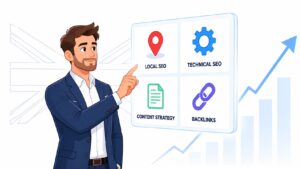
The diagram below breaks down the core pillars that work together to build this kind of lasting authority in Google's eyes.
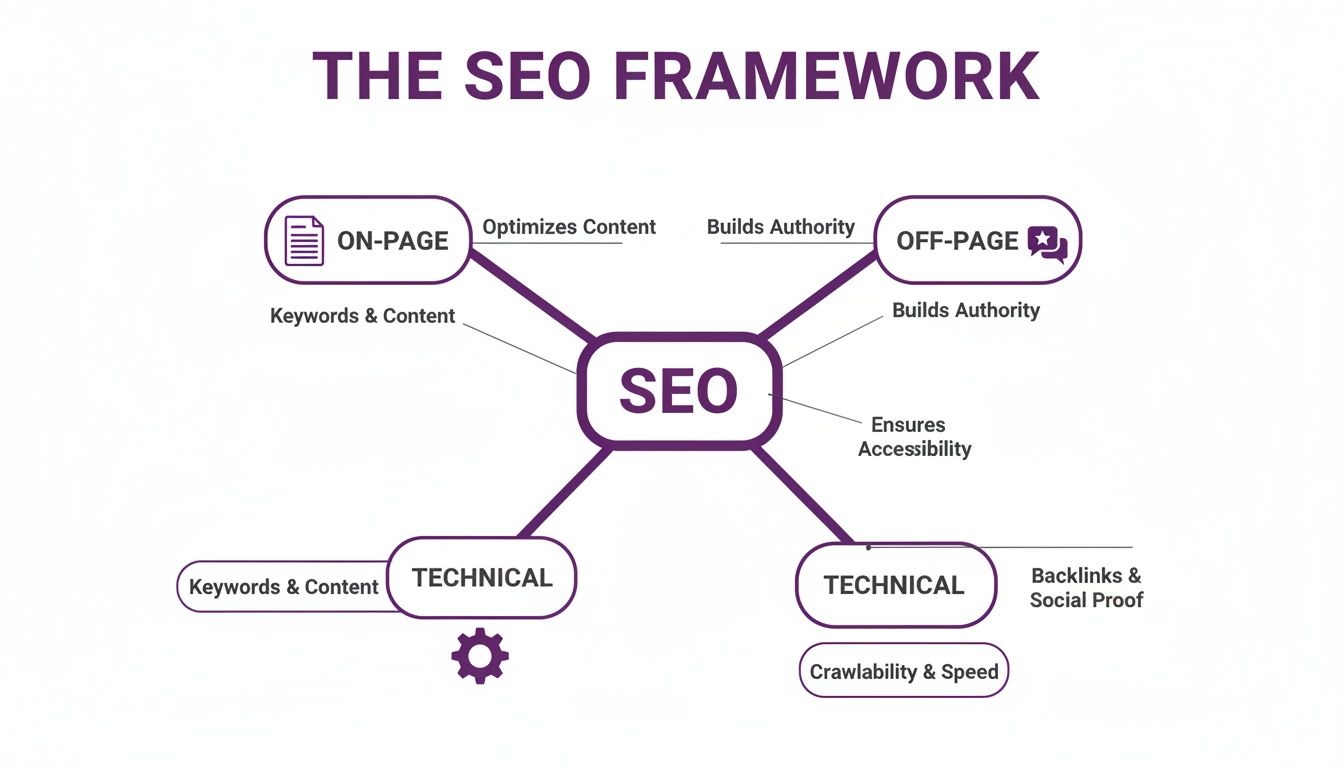
As you can see, a solid SEO strategy combines on-page content, off-page reputation, and technical health to create a website that Google trusts and rewards with high rankings.
Following the Smart Money in the UK Market
This strategic move from short-term ad spend to long-term asset building isn't just a theory; you can see it in the data. Businesses right here in the UK are increasingly recognising that the high return from SEO makes it a financial no-brainer.
Just look at the explosive growth of the UK's SEO software market. In 2024, this market generated USD 5.4 billion in revenue. That figure is projected to rocket to USD 11.3 billion by 2030. This rapid expansion, showing a compound annual growth rate of 13.5%, proves that savvy businesses are voting with their budgets. They're pouring investment into SEO because the returns are clear.
This trend is especially relevant for the small and medium-sized businesses that form the backbone of the UK economy. They are realising that to compete, they need to build their own digital assets, not just rent temporary visibility. To see how this investment translates into real-world business growth, you can explore our guide on how to calculate the ROI from your SEO efforts.
By prioritising SEO, you aren't just buying clicks for today. You are making a strategic investment in the future visibility, credibility, and profitability of your entire business.
How Local SEO Helps You Win Your Local Market
While broad SEO builds a powerful nationwide foundation, it's often a more focused discipline that unlocks immediate, measurable growth for local businesses. This is where Local SEO comes in, and it's the secret weapon for any UK business with a physical address or a defined service area.
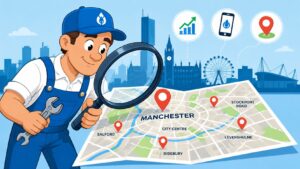
Whether you’re a tradesperson in Manchester, a wedding venue in the Cotswolds, or a clinic in Cambridge, this is how you win your neighbourhood. For these kinds of businesses, general visibility is good, but local visibility is everything. You have to connect with customers who are physically nearby and ready to spend.
Capitalising on 'Near Me' Searches
Think about how you look for local services yourself. You probably use phrases like "best café near me" or "emergency plumber in Bristol." Millions of these hyper-local searches happen every day, and they signal incredibly strong buying intent. When someone performs a 'near me' search, they aren't just browsing; they have an immediate need.
This is where Local SEO absolutely shines. Its whole purpose is to make your business the most prominent and trusted result for these high-value, location-based queries. It’s what gets you into the coveted Google Map Pack—that box of three local listings sitting right at the top of the search results page.
Landing in the Map Pack is like having your business featured on the digital high street. It gives you prime visibility, builds instant credibility, and puts your phone number and directions just one tap away for eager customers.
Without a focused local strategy, you're essentially invisible to the customers right on your doorstep. You're letting your nearest and most valuable potential clients walk straight to your competitors who have taken the time to get this right.
Dominating Your Local Area
So, how do you claim this valuable digital territory? Local SEO involves a set of practical, targeted actions all designed to signal your relevance for a specific geographic area. The goal is to turn your online presence into a magnet for local leads.
Here are the essential components of a winning local strategy:
- Google Business Profile (GBP) Optimisation: Your GBP is the absolute cornerstone of Local SEO. Think of it less as a simple listing and more as a dynamic, lead-generating mini-website. It needs to be fully completed, packed with high-quality photos, consistently updated with posts, and actively managed.
- Targeted Keyword Research: Winning locally means understanding exactly how local customers search. It involves finding and using terms like "patio installers in Surrey" or "newborn photographer near Bath," not just generic keywords.
- Building a Portfolio of Reviews: Positive reviews are one of the most powerful ranking factors for Local SEO. An ongoing strategy to encourage happy customers to leave feedback on Google not only builds immense social proof but also directly improves your visibility.
- Creating Local Citations: A citation is any online mention of your business's name, address, and phone number (NAP). Ensuring your NAP is consistent across reputable online directories (like Yelp, Thomson Local, and industry-specific sites) builds authority and confirms your physical location to Google.
Recent research highlights just how critical this has become. A 2024 survey of UK businesses revealed that while keyword research is the most common tactic (used by 84%), Local SEO is a close second, with 64% of businesses actively implementing it. This shows that the majority of your competitors are already vying for those local customers, making a strong Local SEO strategy essential for survival and growth.
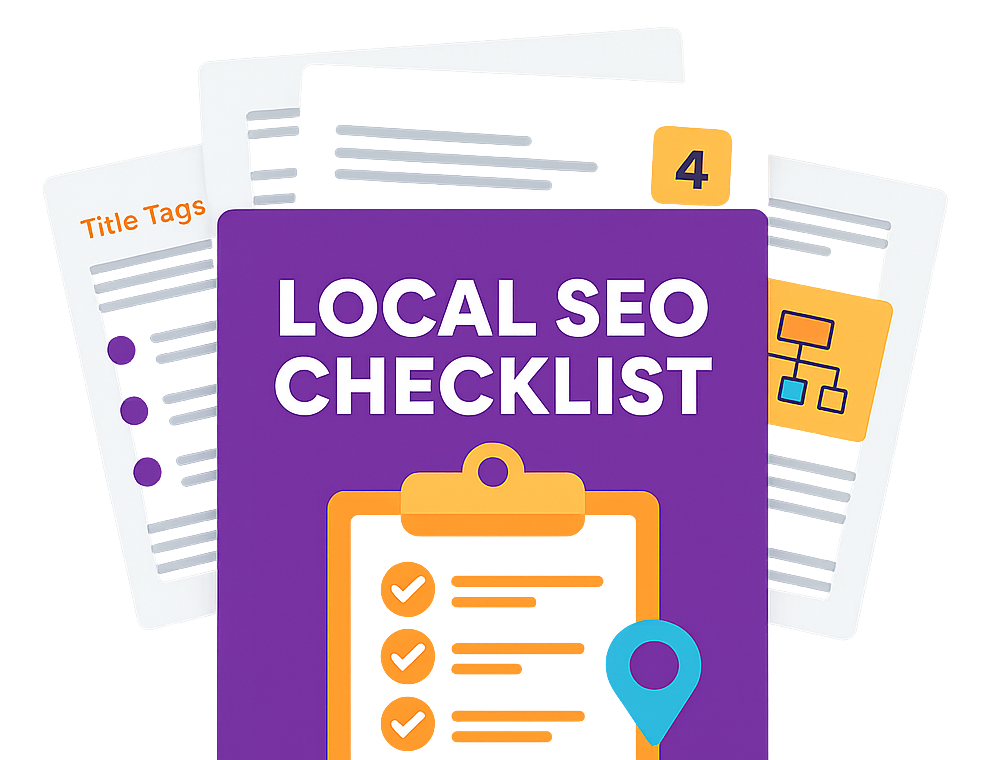
To effectively dominate your local search results, you can explore a dedicated Local SEO suite to manage your listings and optimise for geo-targeted searches. And for a step-by-step guide to getting started, our comprehensive local SEO checklist ensures all your bases are covered.
How to Measure the Real Impact of Your SEO
One of the most stubborn myths holding businesses back is the idea that the return on SEO is impossible to prove. It’s an easy trap to fall into, especially when the focus lands on "vanity metrics" like raw website traffic, which don’t tell you the whole story. To really get why SEO matters for business, we need to shift our focus from vague numbers to tangible results that actually hit your bottom line.
Measuring the real impact means tracking the Key Performance Indicators (KPIs) that represent genuine business growth. This isn’t about counting every single visitor; it’s about counting the right visitors and the valuable actions they take. This is what turns SEO from a hopeful guess into a predictable engine for new business.
From Vanity Metrics to Valuable KPIs
The first step is to stop obsessing over simple traffic figures. A huge spike in visitors means very little if none of them are your ideal customers. Instead, successful SEO measurement homes in on the progress in three critical areas that connect directly to revenue.
These are the metrics that truly matter:
- Keyword Ranking Improvements: Are you climbing the search results for your most profitable services? Tracking your position for high-intent keywords like "emergency plumber in Leeds" or "luxury wedding venue in Kent" is a direct measure of progress.
- Qualified Organic Traffic Growth: This isn’t just about more traffic, but about an increase in visitors coming from relevant, non-branded searches. It’s solid proof you're capturing new customers who didn't know your brand beforehand.
- Conversion Rate: This is the most important metric of all. It tracks the percentage of organic visitors who take a valuable action, like making a phone call, submitting a contact form, or booking an appointment. An increase here proves your SEO is attracting people who are ready to buy.
Tracking these KPIs moves the conversation from "How many people visited our site?" to "How much new business did our site generate?" It’s this focus on outcomes that reveals the true, undeniable value of your investment.
To do this effectively, you need a clear view of how your Google Business Profile is performing. You can get a quick snapshot with our free Google Business Profile audit tool to spot immediate opportunities for improvement.
Calculating Your SEO Return on Investment
Let’s translate this into a real-world example. Imagine a local service business, like an electrical contractor, invests £1,500 per month into a professional SEO campaign. Their goal is to land more high-value rewiring projects in their service area.
Here's how we calculate a clear ROI:
- Investment: The monthly SEO spend is £1,500.
- Lead Generation: Through improved rankings for terms like "house rewiring specialists," the campaign generates 10 qualified leads (form submissions and phone calls) each month.
- Conversion: The business has a solid sales process and converts 2 of those 10 leads into new projects.
- Revenue: Each rewiring project has an average value of £5,000.
- Total New Revenue: 2 projects x £5,000 = £10,000 in new monthly business.
In this scenario, a £1,500 investment directly generates £10,000 in new revenue—a powerful and easily justifiable return. This is the kind of data that proves SEO isn't a cost centre, but a profit driver.
The rapid growth of the digital marketplace only hammers this point home. The global SEO services market has surged from USD 81.46 billion in 2024 to an estimated USD 108.28 billion in 2026—a 32.9% increase in just two years. With projections hitting USD 203.83 billion by 2030, it’s clear that investing in SEO is a fundamental requirement for growth, as you can discover in more detail from this market analysis.
Your Next Steps to Unlock SEO Growth
We've covered a lot of ground. You now know what SEO is all about and, more importantly, you can see how it drives real, measurable growth for a business. It's about getting seen, building trust, and bringing in new customers far more cost-effectively than paid ads. The reasons why SEO matters are crystal clear—it’s the single best way to connect with people who are actively looking for what you do.
Now, it’s time to shift from understanding to action. The whole journey really begins with one simple, honest question.
If a potential customer searches for your most important service in your main town, does your business show up on the first page of Google?
If the answer is "no," or even "I don't know," then your business is losing ground to your competitors every single day. You're missing out on a steady stream of high-intent customers who are ready to book, buy, and become loyal clients. Every day you stay invisible is a day of lost revenue.
Knowing When to Partner with a Specialist
Getting started with SEO can feel a bit overwhelming. And while you can handle some of the basics yourself, getting those top local rankings that really move the needle often needs an expert touch. It’s probably time to think about partnering with a specialist agency like Bare Digital when you find yourself nodding along to these common problems:
- Lack of Time: You're busy running your business. You simply don't have the countless hours needed each week for keyword research, writing content, and handling all the technical stuff.
- Lack of Expertise: SEO is a complicated field that's always changing. To compete properly, you need deep knowledge of Google's algorithms, what works now, and the strategies that get results.
- Lack of Advanced Tools: Professional SEO depends on sophisticated software for digging into keywords, analysing competitors, tracking backlinks, and measuring performance. To properly track your progress, using the right resources, like the best SEO tools for bloggers, gives you crucial insights into how your organic traffic is improving.
If any of that sounds familiar, trying to go it alone could mean months of slow, frustrating progress while your competition pulls further and further ahead. An agency brings the focused time, deep expertise, and powerful tools needed to get you growing faster and secure a quicker return on your investment.
Take Your First No-Obligation Step Today
Understanding exactly where you stand is the first step towards growth. At Bare Digital, we believe in showing you the potential before you commit to anything. That's why we offer a free, no-obligation SEO health check.
This isn't some generic, computer-generated report. Our specialists will personally review your website and your online presence to pinpoint your biggest opportunities and give you a clear, actionable plan. We'll show you exactly where you can improve and how we can help you start winning new customers through search.
Let us build your personalised growth plan. Get your free SEO health check today and discover how we can turn your online visibility into measurable, sustainable business growth.
Got Questions About SEO for Your Business? We’ve Got Answers.
Even after grasping the "why," it's completely normal for business owners to have questions. SEO can feel like a complex world filled with jargon and moving targets. To cut through the noise, we've rounded up the most common queries we hear from businesses just like yours.
Think of this as your go-to guide for straight, no-nonsense answers on what really matters.
How Long Does SEO Take To Work?
This is the big one. While you might see a few small wins in the first few months, real, sustainable results from SEO typically take 6 to 12 months to properly kick in. Anyone who promises you instant first-page rankings is selling snake oil.
Think of it like planting an oak tree, not a pot of cress. The initial work is all about establishing deep roots—building your site’s authority and technical health. This foundational effort is what supports long-term, compounding growth that delivers value for years to come.
Can I Do SEO Myself or Do I Need an Agency?
You can absolutely get started with the basics. Things like claiming and optimising your Google Business Profile are powerful first steps every business owner should take. There’s a lot you can learn and implement on your own.
But effective SEO is a technical, time-consuming, and highly competitive field. Hiring a specialist agency becomes crucial when you lack the hours in the day, need to out-muscle established competitors, or want to achieve faster, more predictable growth.
What Does SEO Cost for a UK Small Business?
The cost of SEO can vary quite a bit, depending on how competitive your industry is, your location, and your specific business goals. For a small to medium-sized UK business, a monthly investment can range anywhere from £500 to over £2,500.
It’s vital to see this as an investment, not an expense. A well-executed SEO strategy isn’t just a line item on a spreadsheet; it’s an engine for growth that should always generate a clear and positive return by bringing you new, profitable customers.
Is SEO More Important Than Social Media?
They aren't rivals; they're two different tools for two different jobs, and they work best together.
SEO is all about capturing existing demand. It’s how you connect with customers who are actively searching for a solution to their problem right now. Social media, on the other hand, is brilliant for creating demand and building a community around your brand over the long haul.
For businesses that solve an immediate need—think tradespeople, professional services, or local venues—SEO is almost always the more critical channel for direct, bottom-of-the-funnel lead generation. It’s what turns a search into a phone call.
Ready to stop being invisible and start winning new customers? Bare Digital specialises in helping UK businesses like yours dominate local search. Get your free, no-obligation SEO health check today and let's build your growth plan.