

Imagine your local coffee shop. They sell fantastic coffee, sure, but they also host community open-mic nights and share stories on their blog about the local farmers who supply their milk. That’s content marketing branding in action. It's the art of blending valuable content with a strong brand identity, creating something that doesn't just sell, but builds real connection and trust.
What Is Content Marketing Branding and Why It Matters Now

Put simply, content marketing branding is the deliberate use of helpful, entertaining, or educational content to shape how people see your business. It’s a move away from shouting about your products and a step towards building a meaningful relationship before a customer even thinks about making a purchase.
Think of it this way: traditional branding gives you the logo and the colour palette. Content marketing creates the useful "how-to" guides and the engaging social media posts. Content marketing branding is the magic that ensures the helpful guide feels like it comes from the brand with that specific logo. It's about having a consistent, recognisable voice and personality in everything you create.
The Shift from Selling to Helping
Modern customers, especially within local UK communities, have grown tired of the constant hard sell. They’re looking for genuine expertise and real solutions. They want to do business with people they trust, not just the company with the loudest advert. This is where this integrated approach really starts to shine for local businesses.
By creating content that genuinely helps your audience fix a problem or learn something new, you position your brand as a generous expert and a trusted local figure. This shift from selling to helping delivers some powerful advantages:
- Builds Lasting Trust: When you offer valuable advice for free, you create goodwill and prove your expertise long before you ever ask for a sale.
- Creates Authentic Connection: Sharing your brand’s story, your values, and how you’re involved in the community helps people connect with you on a human level.
- Drives Customer Loyalty: A brand that consistently helps its audience becomes the first one they think of, fostering repeat business and powerful word-of-mouth referrals.
This isn't a niche tactic anymore; it's becoming essential. Recent data shows that a huge 65% of UK marketing professionals now integrate content marketing directly into their core strategies, signalling a major change in how businesses connect with their customers. You can check out more digital marketing statistics to see just how this trend is reshaping the path to growth.
A Clearer Definition
To really get how this all fits together, it helps to break down the different roles. Branding is your "who," content marketing is your "what," and content marketing branding is the "how" and "why" that ties them together into a single, powerful strategy.
This quick table clarifies how these three concepts differ, but more importantly, how they work together.
Branding vs Content Marketing vs Content Marketing Branding
| Concept | Primary Goal | Example Tactic |
|---|---|---|
| Branding | To create a distinct identity and be recognisable. | Designing a unique logo, colour scheme, and brand name. |
| Content Marketing | To attract and engage an audience with valuable information. | Publishing a blog post on "How to Choose the Right Boiler." |
| Content Marketing Branding | To build trust and authority through helpful content that reflects the brand's identity. | The plumber’s blog post is written in a friendly, no-jargon tone that reflects their brand value of "making home repairs simple for everyone." |
As you can see, content marketing branding isn't a separate activity but the glue that makes everything else more effective. It ensures your helpful actions build your brand reputation.
Content marketing branding is the art of telling your brand's story through helpful actions. It's proving your value, not just proclaiming it, which builds a foundation of trust that traditional advertising can't buy.
Ultimately, this integrated approach transforms your business from just another name in a Google search into a recognised and preferred local choice. It’s the key to turning online visibility into genuine loyalty, and turning casual enquiries into lasting customer relationships.
Building Your Brand Foundation with a Content Strategy
Before you write a single blog post or design an infographic, you need a blueprint. Great content that builds a memorable brand doesn't just happen by accident; it’s built on a solid strategic foundation. This is your brand's 'North Star'—the core identity that guides every single thing you create.
Think of it like building a house. You wouldn't start laying bricks without a detailed set of architectural plans. Your content strategy is exactly that: it defines the structure, purpose, and personality of your brand's voice before you get down to the creative work. To build a strong brand foundation, developing an essential content marketing strategy guide is paramount.
This strategic thinking is what separates brands that succeed from those that just add to the noise online. The proof is in the results. While content is getting better across the board, the real engine for success is strategy. In fact, a massive 74% of marketers now say that better strategy execution is the reason for their improved results.
Define Your Unique Brand Voice
Your brand voice is simply the personality your business shows through its words. Is your brand the calm, reassuring expert, like a healthcare clinic using authoritative language? Or are you the inspiring visionary, like an architectural firm using aspirational and creative descriptions?
Getting this voice right is critical for making a real connection. It’s how you make sure a blog post, a social media update, and a service page all sound like they come from the same trusted source. To find your voice, ask yourself these questions:
- If my brand were a person, what three words would describe its personality? (e.g., Knowledgeable, approachable, reliable)
- What is our relationship with our customers? (e.g., Are we a partner, a guide, a mentor?)
- What tone do we absolutely want to avoid? (e.g., Stuffy corporate jargon, overly casual slang, alarmist language)
A consistent voice makes your brand feel authentic and dependable, which is the very bedrock of customer trust.
Identify Your Ideal Local Audience
Next, you need to get crystal clear on who you're actually talking to. Go deeper than basic demographics and focus on the real-world problems your local audience is facing. What’s keeping them up at night? What questions are they typing into Google?
Don’t target "homeowners aged 30-50." Instead, target "a young family in Manchester worried about finding a reliable solicitor for their first home purchase." That level of specificity changes everything.
This deep understanding allows you to create content that gives them genuine solutions. Your audience isn't just a list of data points; they are real people with specific, location-based needs. For a proper deep dive on targeting these local searches, you can explore our comprehensive https://www.bare-digital.com/local-seo-checklist/ and learn how to line your content up with what your community is actively looking for.
Establish Your Core Messaging Pillars
Once you know your voice and your audience, the final piece of the foundation is to establish your core messaging pillars. These are the 3-5 key themes or big ideas that you want your brand to be known for. Every single piece of content you create should support one or more of these pillars.
For a local wedding venue, these pillars might look something like this:
- Unforgettable Experiences: Content showing off unique wedding setups and heartfelt testimonials from happy couples.
- Stress-Free Planning: Creating handy guides, checklists, and articles about the best local suppliers.
- Local Beauty: Highlighting the venue's deep connection to the charm and scenery of the surrounding area.
These pillars act as a creative filter. Before you publish anything, just ask: "Does this reinforce one of our core messages?" This simple check guarantees that every blog, case study, and social post is purposefully building the exact brand you want to be. This is what creates the cohesive experience that makes your content truly work for your brand.
Choosing Content Formats That Build Local Authority
With your brand strategy locked in, it's time to pick the right tools for the job. Not all content formats are created equal, especially when your goal is to become the go-to name in your local area. This isn't just about churning out articles; it’s about matching your content to the real-world journey your local customers take, from hearing about you for the first time to picking up the phone.
Think of it as a natural conversation. You don't just walk up to someone and ask for a sale. You start by being helpful, show them you know your stuff, and only then do you make it easy for them to take the next step.
The diagram below shows how a solid brand strategy is built. It’s this very foundation—your identity, your audience, and your message—that dictates which content formats will work best for you.
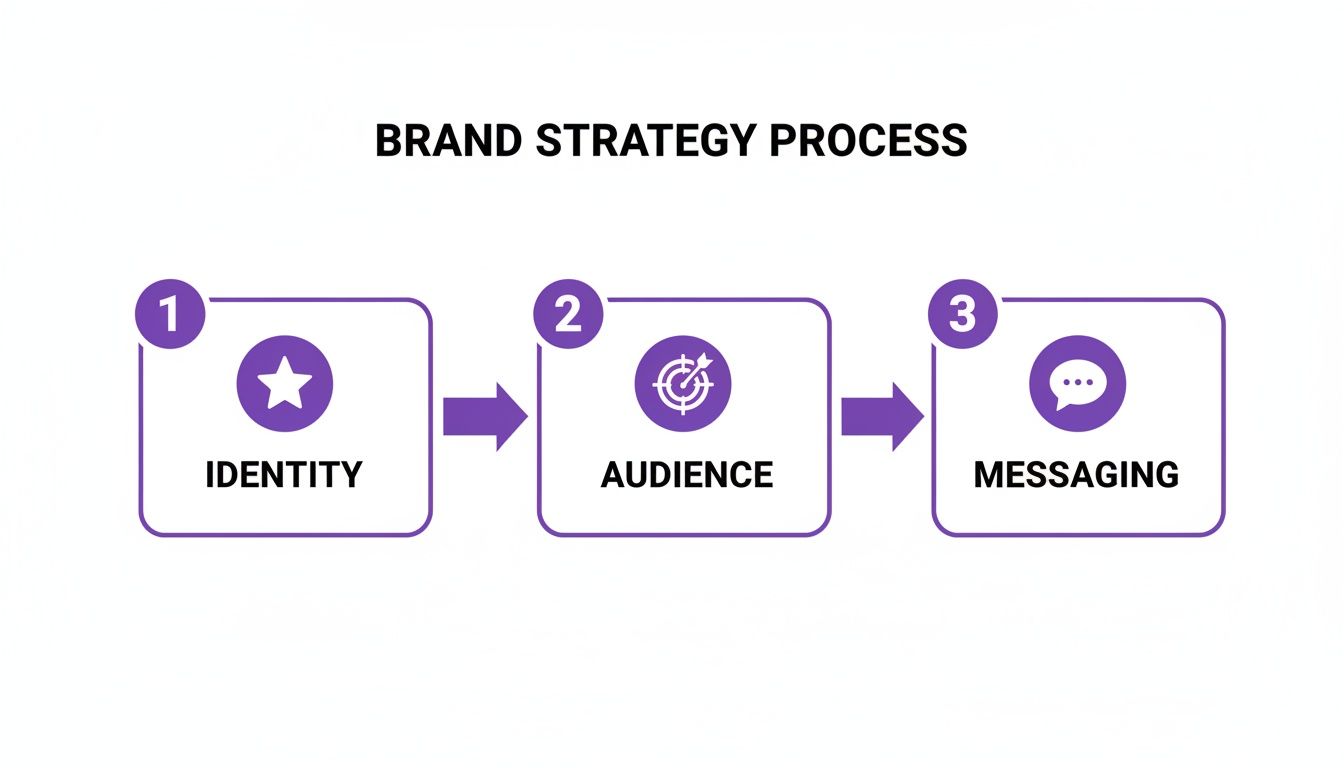
Getting this right from the start means every piece of content you create has a clear purpose.
Content For Awareness: Hyper-Local Blogs
The first job is to simply get on your local audience's radar. This is where hyper-local blog posts become one of your most powerful tools. They tap into what local people are already interested in and searching for, positioning you as a helpful, switched-on part of the community. Research shows that 33% of people read blogs to learn something new, and this is your chance to teach them about their own backyard.
A local focus grabs attention because it's immediately relevant. It signals to both Google and your neighbours that you are the expert for this specific patch.
- A local vet in Leeds: Instead of "How to care for a puppy," write "Top 5 Dog-Friendly Pubs in Leeds City Centre." It connects you with local pet owners in a genuine way.
- An estate agent in Bristol: Forget generic posts. Try "A Weekend Guide to Exploring Bristol's Harbourside." It shows you understand the lifestyle, not just the properties.
These posts build positive brand awareness long before someone actually needs your service. You become the helpful expert, not just another business.
Content For Consideration: Project Galleries and Case Studies
Once people know you exist, they start to wonder, "Are they any good?" This is the consideration stage, and now you need to provide proof. It’s time to show, not just tell, with content that highlights your expertise and the real-world results you get for people.
For any visual business—like an interior designer, architect, or wedding photographer—project galleries are non-negotiable. They offer instant, tangible proof of your skill, style, and quality of work. If you're a creative, our dedicated guide on SEO for photographers is packed with tips for getting your work seen.
Case studies, on the other hand, tell a story. They are perfect for tradespeople and service-based businesses because they detail a customer's problem, the solution you delivered, and the fantastic outcome.
A case study for a builder isn't just about the extension they built; it's about how they transformed a family's cramped kitchen into their favourite gathering space. It connects the service to a human result, building a much stronger and more memorable brand impression.
These formats are designed to build trust and answer that crucial question in a potential customer's mind: "Can this business actually do what I need them to do?"
Content For Conversion: Service Pages and FAQs
Right, your potential customer is now aware of you and confident in your abilities. When they're ready to make a move, your content needs to make it incredibly simple for them to convert. The goal here is to remove any final shred of doubt or friction.
Well-crafted service pages are the workhorses of conversion. They must clearly explain what you offer, who it's for, and why you're the best choice, all while being perfectly optimised for local search terms like "emergency electrician in Manchester."
Frequently Asked Questions (FAQ) sections are also absolute gold. They let you get ahead of the game by directly addressing the specific hesitations people have right before they decide to buy or enquire.
- Answer questions about your process: "How long does a typical kitchen installation take?"
- Tackle pricing concerns head-on: "Do you offer free, no-obligation quotes?"
- Clarify your service area: "Which parts of Cornwall do you cover?"
By answering these questions upfront, you demolish last-minute barriers, build huge credibility, and make the decision to contact you a total no-brainer. You're turning a curious visitor into a qualified lead.
Integrating Local SEO into Your Content Marketing Branding
Creating brilliant content is only half the battle. If your local community can’t actually find it, you’ve done the work for nothing. This is where local SEO stops being a dry, technical chore and becomes a vital part of your content marketing branding. It’s the craft of making your helpful content pop up for the very people searching for your services right in your area.
Think of it like this: your great content is a fantastic market stall, packed with high-quality goods. Local SEO is the big, clear sign at the end of the road that says, "Fresh, local goods this way!" It guides motivated customers straight to you, making sure all your brand-building effort actually gets seen.
This integration is all about connecting your brand’s voice with the precise language your local customers are using. You're not just writing for some anonymous online crowd; you're speaking directly to someone searching for an "emergency plumber in Sheffield" or "wedding venues near the Cotswolds."
Uncovering What Your Community Is Searching For
The entire foundation of effective local SEO is understanding the exact phrases and questions people in your area are typing into Google. This isn't guesswork. It’s about using keyword research to tap into real, local customer intent. Your goal is to find those geographically specific search terms that signal someone is ready to learn or buy.
A local tradesperson, for example, shouldn't just be targeting a generic term like "boiler repair." They need to focus on terms that attract nearby customers who can actually hire them, such as:
- "boiler repair Leeds"
- "emergency heating engineer West Yorkshire"
- "Gas Safe engineer near me"
- "cost to fix a boiler in Headingley"
These aren't just keywords; they are clear cries for help from potential customers in your patch. When you identify them, you can create content that provides a direct answer, positioning your brand as the most obvious local solution.
By focusing on local keywords, you stop competing with every business in the country and start winning the customers right on your doorstep. Your content becomes a magnet for highly qualified local leads.
Optimising Your Content for Local Discovery
Once you know what your community is searching for, you need to weave these terms strategically into your content. This process, known as on-page SEO, is how you tell search engines exactly what your content is about and, crucially, where it’s relevant. It’s a simple but powerful way to get a leg up in local search results.
You should naturally work your local keywords into these key places:
- Page Titles and Meta Descriptions: These are the first things a user sees in Google. A title like "Expert Roof Repairs in Cardiff | Free Quotes" is far more compelling than just "Roofing Services."
- Section Headings (H2, H3): Using headings like "Our Process for Loft Conversions in Bath" helps both readers and search engines follow the structure and local focus of your content.
- Body Content and Image Alt Text: Mentioning local landmarks, specific neighbourhoods, or the locations of past projects within your articles makes them feel genuinely local and hammers home your geographical relevance.
This isn't about awkwardly stuffing keywords where they don't belong. It’s about writing for humans first, while making sure your helpful content is framed in a way that search engines can easily understand and categorise for local searches.
Building Local Trust with E-E-A-T
Beyond just keywords, Google wants to promote brands that show strong E-E-A-T—that’s Experience, Expertise, Authoritativeness, and Trustworthiness. For a local business, this is a golden opportunity to turn your community presence into a powerful SEO asset. Your entire content marketing branding strategy should be designed to shout about these signals.
To build up your local E-E-A-T, you can:
- Feature Local Projects: Create detailed case studies or gallery posts of work you've completed in specific towns or neighbourhoods. Show your work in context.
- Write About Community Involvement: Are you sponsoring the local football team or taking part in a charity event? Write a blog post about it. It shows you're an active, invested member of the community.
- Highlight Geotagged Reviews: Embed customer reviews that mention their location. Seeing a review from "Sarah in Nottingham" is powerful social proof for others in the area.
This approach makes local SEO feel like a natural extension of your brand building. It amplifies your voice across your local area, turning both your website and your Google Business Profile into a trusted local hub. You can even check the health of your online presence with a free Google Business Profile audit tool to see where you can make quick improvements.
Real-World Examples from UK Local Businesses
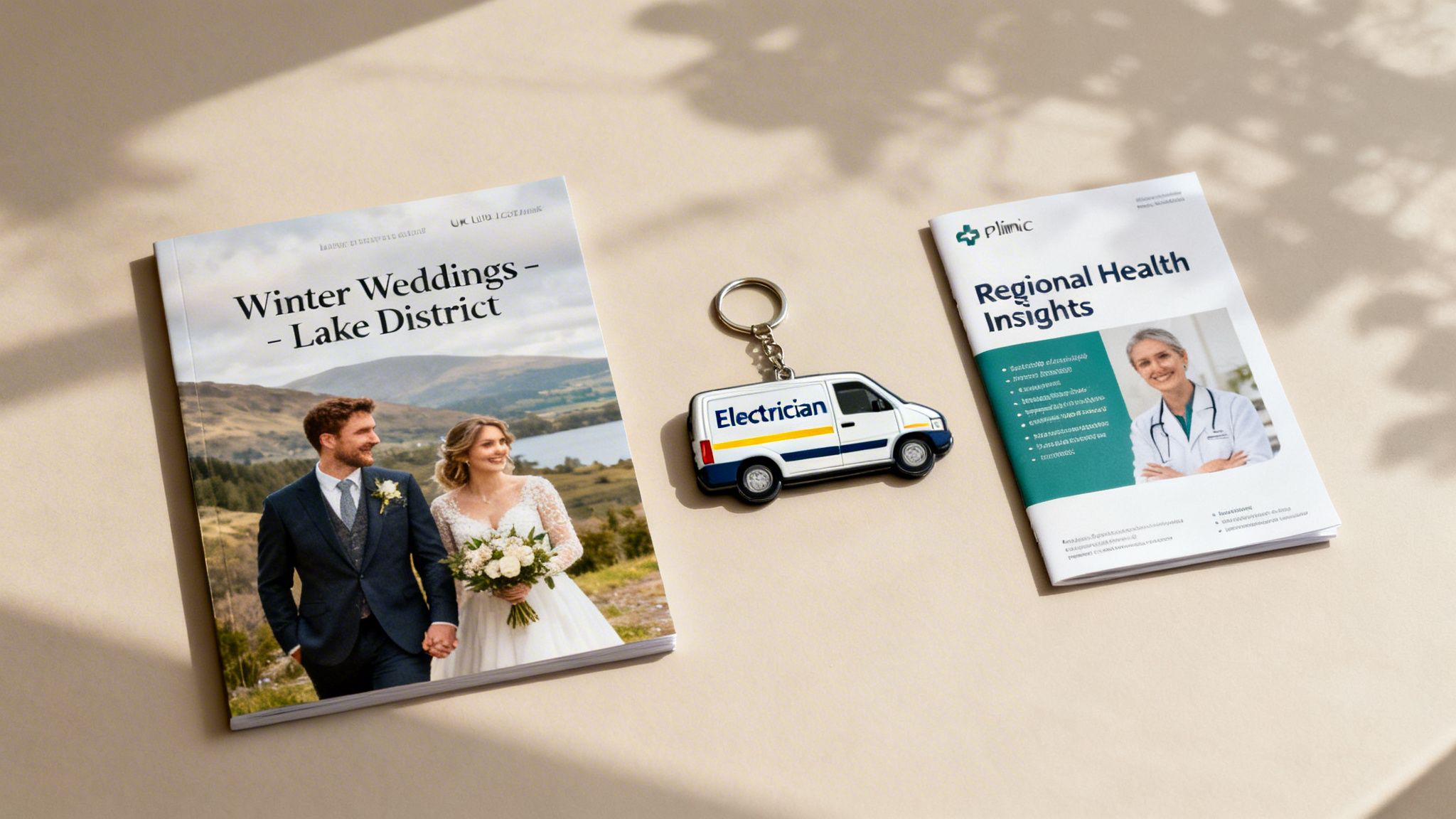
Theory is one thing, but seeing how content marketing branding actually works on the ground is where things get interesting. To bring all this to life, let’s dive into some sector-specific blueprints that UK local businesses can put into action right away.
These aren't just vague ideas. They’re practical roadmaps showing you how to fuse a genuinely helpful piece of content with a sharp brand message and a smart local SEO keyword. This is how you stop just being another option and start becoming the only choice for your ideal local customer.
Example 1: The Boutique Wedding Venue
For a boutique wedding venue, say in a stunning corner of the UK, the brand is built on pure emotion, elegance, and the promise of an unforgettable day. Your content has to sell that dream, moving way beyond just showing off the rooms.
- Content Idea: A beautifully designed blog post, "Planning the Perfect Winter Wedding in the Lake District." It wouldn't just be text; it would be a visual story with professional photos of the venue blanketed in snow, tips on seasonal décor, and a timeline for booking the best local suppliers.
- Brand Message: This immediately reinforces the venue as a premier, all-seasons destination. It positions the brand as both inspiring (the dream wedding) and incredibly practical (the stress-free partner who helps you pull it off).
- Target Local Keyword: "winter wedding venue Lake District" or "Cotswolds wedding planning tips."
On top of that, you could run an Instagram series spotlighting handpicked local partners—florists, photographers, caterers. This builds a brand rooted in community and quality, showing you're not just a venue but the central hub for the best the region has to offer.
Example 2: The Local Electrician or Tradesperson
When it comes to trades, trust is everything. Homeowners are literally inviting you into their private space, so your brand needs to radiate reliability, professionalism, and safety from the get-go. Content is the perfect tool for building that trust long before your phone ever rings.
If your trade is in construction, it's worth learning about specific SEO strategies specifically for construction companies to really get an edge.
- Content Idea: A series of short, easy-to-follow "Home Safety Check" videos for YouTube and social media. Think topics like "How to Test Your Smoke Alarms Properly" or "3 Warning Signs Your Wiring Needs a Professional Check-Up."
- Brand Message: This isn't a sales pitch; it's a public service. That powerfully reinforces a brand built on expertise and a genuine concern for the customer's wellbeing, creating massive goodwill.
- Target Local Keyword: "certified electrician Manchester" or "emergency plumber Bristol."
By being the business that offers helpful, preventative advice, you become the first and only person they call when a real problem hits. Your brand becomes synonymous with safety and reliability in your town.
The goal is to be the tradesperson your community turns to for advice, not just for quotes. This proactive helpfulness is the core of effective content marketing branding, turning you from a service provider into a trusted local figure.
Example 3: The Private Health Clinic
A private clinic, whether it’s a physio, dentist, or mental health practice, has to project two things above all else: authority and empathy. Your brand needs to be a credible, trustworthy source of health information, guiding patients with expert and compassionate care.
This is where publishing authoritative content is non-negotiable. Your expertise is your single biggest asset, and your content should put it on full display.
To give you more ideas, here’s a quick-glance table showing how this approach works across different local sectors.
Content Ideas for UK Local Sectors
| Business Sector | Content Idea | Brand Message | Target Local Keyword |
|---|---|---|---|
| Architectural Firm | A "behind the design" blog series on a recent local project. | Creativity, technical skill, and a deep understanding of the local aesthetic. | "residential architects Surrey" |
| Creative Agency | Case studies showcasing ROI for local business clients. | Results-driven, strategic, and a partner in local business growth. | "branding agency Glasgow" |
| Caterer | A downloadable guide to "Seasonal Menus Using Yorkshire Produce." | Quality, local sourcing, and culinary expertise. | "wedding caterer Yorkshire" |
As you can see, the strategy is consistent.
For a health clinic, this could mean publishing an article on a health trend specific to the region. A physiotherapist in a coastal town, for instance, could write a brilliant guide on "Managing Knee Pain for Coastal Walkers." It directly addresses a local audience's lifestyle and needs, building a brand that patients instinctively trust with their well-being.
How to Measure the Success of Your Content and Brand Growth
Creating brilliant content is one thing, but how on earth do you know if it’s actually working? Measuring the real-world impact of your content marketing branding is the only way to understand your return on investment and make smarter decisions for the future.
This isn’t about chasing vanity metrics like ‘likes’ or page views. It’s about tracking tangible growth that genuinely affects your bottom line. A good way to get your head around this is to split your measurements into two distinct but connected piles: Brand Growth and Business Performance.
Tracking Brand Growth
Brand growth is all about your rising presence and recognition in the local market. These are the signals that show your brand is becoming more memorable and is seen as a go-to name in your field. The key here is to spot the signs that people are starting to seek you out specifically.
You can get a solid read on this by looking at two crucial areas:
- Brand-Name Searches: Dive into Google Search Console and track how many people are searching directly for your company name. A steady increase over time is a powerful indicator that your brand awareness is on the rise.
- Direct Website Traffic: In Google Analytics, keep a close eye on your ‘direct’ traffic. This represents people who typed your website URL straight into their browser—a crystal-clear sign of strong brand recall.
Measuring Business Performance
While building brand awareness is vital, your content must also drive concrete business results. This is where you connect the dots between your content marketing efforts and the enquiries and sales that keep your business running.
These are the numbers that truly prove the value of your strategy. To get this right, you have to analyze content performance properly by tracking the metrics that lead directly to revenue.
Your most important metrics aren't just website visits; they are the actions that signal a potential customer is ready to engage. Focus on tracking the journey from initial interest to actual enquiry.
Here’s a sample KPI dashboard that ties your content directly to real-world outcomes:
Sample Local Business KPI Dashboard
| Metric | What It Measures | Why It Matters |
|---|---|---|
| Local Search Rankings | Your position in Google for target keywords (e.g., "builder in Bath"). | Shows your content is successfully capturing local search visibility. |
| Lead Magnet Downloads | The number of people downloading your guides or checklists. | Proves your content is valuable enough for users to exchange their contact details. |
| Form Submissions | The number of enquiries sent through your website's contact forms. | A direct measure of lead generation from your content and service pages. |
| Tracked Phone Calls | The volume of inbound calls originating from your website or Google Business Profile. | Captures high-intent leads who are ready to talk to a person. |
By tracking these specific KPIs, you move beyond guesswork and into a world of data-driven decisions. You create a clear line of sight from your content strategy to measurable business growth, allowing you to fine-tune your approach and prove its worth.
If you’re keen to dig deeper into calculating your returns, our guide on the ROI from SEO for self-storage businesses has principles that can be applied to almost any local business.
Got Questions? We’ve Got Answers.
When you're thinking about using content to build your brand, a few practical questions always pop up. To cut through the noise, we've rounded up the most common ones we hear from UK business owners, with straight, no-nonsense answers.
How Long Does It Take to See Results?
This is the number one question, and the honest answer is: it depends, but patience is your best friend here. You can definitely see some encouraging early wins from local SEO within 3 to 6 months – things like climbing the ranks on Google Maps.
But building a proper brand, where people in your area actually know and trust you, is more like a fitness programme than a quick fix. The real, lasting strength comes from consistent effort over many months, not a short sprint. The results compound over time.
Do I Need a Big Budget for This?
Absolutely not. While a bigger budget can certainly speed things up, consistency and quality will always beat a big spend. You don't need a massive marketing department to get the ball rolling.
Focus on what you can do well, right now. Start by publishing one genuinely helpful, high-quality blog post a month. Combine that with actively managing and updating your Google Business Profile. Just those two actions, done consistently, can build serious momentum without costing a fortune. You can always scale up later as your business grows.
Can I Do This Myself or Should I Hire Someone?
It’s usually a bit of both. As the business owner, your unique expertise is your secret weapon, and nobody can share that better than you. You can absolutely handle things like jotting down blog ideas based on the questions customers ask you every day, or posting project photos on social media.
Where it gets smart to bring in a specialist is for the more technical or time-consuming parts. An expert can handle the strategic planning, technical SEO, and keyword research that underpins it all. This frees you up to do what you do best – run your business – while ensuring your strategy is actually effective and sustainable for the long haul.
Ready to turn your local visibility into measurable growth? The experts at Bare Digital create bespoke SEO and content strategies that get results. Start with a free SEO health check and see how we can help.