
Social media advertising is no longer just a "nice-to-have" for UK small businesses. It's the engine that powers local dominance. It gives you a direct line to put your brand right in front of the exact customers you want to reach, on the platforms they scroll through every single day. The result? Measurable growth and a return on investment you can actually see.
Why Social Ads Are a Must for UK Small Businesses
Picture this: you run a gorgeous independent wedding venue in Manchester. The setting is perfect, your service is second to none, but bookings are hit-and-miss because you're struggling to get noticed beyond a few word-of-mouth referrals. It's a classic problem for small and medium-sized businesses all over the UK. Traditional advertising feels like a gamble—it's expensive, and proving it works is nearly impossible.
This is exactly where social media advertising completely changes the game.
Unlike passive marketing, paid social ads don't wait for customers to stumble upon you. They actively seek out and engage your ideal clients. It’s the difference between leaving a stack of flyers in a local café and personally inviting every engaged couple within a 20-mile radius to come and see your venue. That precision is what makes it so powerful.
Driving Tangible Local Growth
The real magic of social advertising is its ability to connect you with your local community. For any service-based business, this is pure gold.
Just think about these real-world scenarios:
- A catering company in Leeds can run ads targeting people who have recently got engaged or are actively planning events, all within specific postcodes.
- A construction firm in Bristol can show off testimonials and finished projects to homeowners in affluent suburbs who’ve shown an interest in home renovation.
- A local photographer in the Cotswolds can target families and couples with ads featuring stunning portraits taken in recognisable, nearby beauty spots.
This level of detail means your marketing budget isn't wasted. Every pound is spent reaching people who are actually likely to become paying customers, building your local reputation and driving genuine enquiries.
The shift towards digital is clear and quantifiable. Small businesses that embrace social advertising are not just keeping up; they are actively building a competitive advantage in their local markets.
The data speaks for itself. A 2025 report found that 83% of UK small businesses were already using Facebook for marketing. What’s more, by 2026, SMEs had boosted their social media ad spend to 12% of their total budget, leading to a 25% average increase in local enquiries for service firms.
A Foundation for Success
To get the full picture and understand the broader landscape, exploring comprehensive Social Media Marketing Strategies For Small Businesses is a great starting point. These strategies give you the framework you need to build campaigns that really work.
Ultimately, investing in social ads is about taking control of your lead generation. Instead of just waiting for customers to find you, you can proactively reach them right where they’re spending their time. For expert guidance on weaving this into a wider local SEO plan, check out our insights at https://www.bare-digital.com/.
Choosing the Right Platforms for Your Local Business
The sheer number of social media platforms can feel like a minefield. You’ve probably heard the advice to "be everywhere," but for a small business with a finite budget and even less time, that’s a fast track to burning through cash with nothing to show for it.
The real key to effective social media advertising isn’t about being omnipresent; it’s about being strategic. You need to put your marketing pounds where your ideal local customers are already scrolling, sharing, and spending their time.
This isn’t guesswork. It's about matching the platform’s unique audience and strengths to your specific business goals. The right choice for a Bristol-based interior designer will look completely different to that of a multi-location construction company operating across the Midlands. Your platform choice shapes everything that follows, from your ad creative to your budget.
Where Do Your Customers Live Online?
Before you spend a single penny, you have to answer one fundamental question: where does your target audience actually hang out online? Each platform has a distinct user base and a different reason for existing.
A wedding venue in the Home Counties, for example, will find a hugely receptive audience on visually-driven platforms. Couples planning their big day are all over Instagram and Pinterest, actively looking for inspiration. This makes them the perfect place to showcase stunning venue photography and dreamy video tours.
On the other hand, a commercial cleaning service in Glasgow would get almost zero traction there. Their audience of office managers and facilities coordinators are far more likely to be found on LinkedIn, where the focus is squarely on professional networking and B2B services.
Choosing your platform is like choosing the location for a physical shop. You wouldn't open a high-end boutique in an industrial estate; likewise, you shouldn't advertise your B2B services on a platform dominated by teenagers.
Thinking this way ensures your message lands with precision. A recent report from 2026 showed that 72% of small businesses now advertise on social platforms. It’s no surprise that Instagram leads the charge at 58% among creative sectors like architects and photographers, who rely on powerful visuals. If you're a photographer, our guide on SEO for photographers offers more specialised tips for getting seen online.
A Platform-by-Platform Breakdown for UK Businesses
Let's cut through the noise and compare the main contenders for your advertising budget, focusing on what actually matters to a local UK business. This table gives a quick overview to help you pinpoint where your efforts will have the most impact.
Social Media Platform Comparison for UK Small Businesses
| Platform | Best For (Business Type) | Key UK Audience | Top Performing Ad Format | Average UK CPC (2026) |
|---|---|---|---|---|
| Local Services, Community-Based, B2C (Construction, Healthcare, Retail) | Broad; strong in 30-65+ age range, excellent for local community groups | Lead Generation Ads, Local Awareness Ads, Event Ads | £0.65 – £1.20 | |
| Visual & Creative (Designers, Venues, Photographers, Caterers, Fashion) | Strong in 18-44 age range, highly visual and trend-driven | Reels Ads, Story Ads, Shopping Ads | £0.70 – £1.35 | |
| B2B Services, Professional Services (Architects, Consultants, Recruiters) | Professionals, decision-makers, high-income earners | Sponsored Content, Message Ads, Lead Gen Forms | £4.00 – £7.00+ | |
| TikTok | Youth-Focused Brands, E-commerce, Entertainment (Cafes, Events, Products) | Primarily 16-34, fast-paced, entertainment-focused | In-Feed Video Ads, Spark Ads, Branded Hashtags | £0.15 – £0.80 |
The data here reveals a clear strategic path for different types of businesses.
The real power of Facebook lies in its incredibly detailed targeting. A local tradesperson can reach homeowners within specific postcodes who’ve recently shown an interest in home improvement. It's an absolute workhorse for generating local leads.
Instagram, by contrast, is an aesthetic-driven powerhouse. With research showing 49% of UK consumers have made a purchase after seeing an influencer's post, boosting sales by 28% for local businesses like caterers, it's invaluable for anyone selling a lifestyle or an experience.
LinkedIn’s higher cost-per-click is easily justified by the sheer quality of its B2B audience. An architecture firm looking to connect with property developers can get a direct line to key decision-makers, making that premium cost a worthwhile investment for high-value contracts.
Meanwhile, TikTok's low CPC offers a budget-friendly way to build brand awareness with a younger crowd. It's perfect for creating a buzz around a new coffee shop or a quirky local event. By choosing wisely, you set the foundation for profitable growth.
Right, let's move from theory to action. For many small businesses, this is the most intimidating part of social media advertising. Launching that first campaign can feel like staring at a baffling control panel full of switches and dials. But with a clear framework, you can build a campaign that speaks directly to your local community and actually starts to deliver.
It all kicks off with one vital question: what do you really want to achieve? A vague goal like "get more customers" just won't cut it. You need a sharp, measurable objective. This single decision will shape every choice you make, from the ad's photo to the text on the button.
Define a Clear, Measurable Objective
Before you even dream of opening up Ads Manager, take a minute to define what success looks like. Are you trying to make the phone ring off the hook? Drive foot traffic through your front door? Or maybe just gather email addresses for your newsletter? Each of these goals demands a totally different campaign setup.
For a first local campaign, most businesses focus on one of these:
- Generating Phone Calls: Perfect for service businesses that thrive on immediate contact, like plumbers or emergency repair services.
- Driving Website Traffic: Ideal for sending potential customers to a specific page on your site, maybe one showcasing a special offer or detailing your services.
- Collecting Leads: This involves using a simple form, often right within the social media app, to capture contact details from people asking for a quote, a consultation, or a brochure.
Think about it this way. A funeral home in Leeds might have a primary goal of generating discreet enquiries through a contact form. In stark contrast, a wedding photographer based in the Cotswolds will almost certainly want to drive traffic to their online portfolio to show off their work and get booking requests.
Your campaign objective is your North Star. If you don't know where you're going, you can't be surprised when you don't get there. A specific goal like "Generate 10 qualified leads per week" is far more powerful than a generic desire for "more business."
Once that objective is set in stone, every other decision becomes simpler. You now have a filter for every option you see: "Does this help me achieve my goal?"
This thought process highlights how starting with internal clarity—knowing your business and your audience—naturally points you to the right platform, which is the bedrock of any campaign.
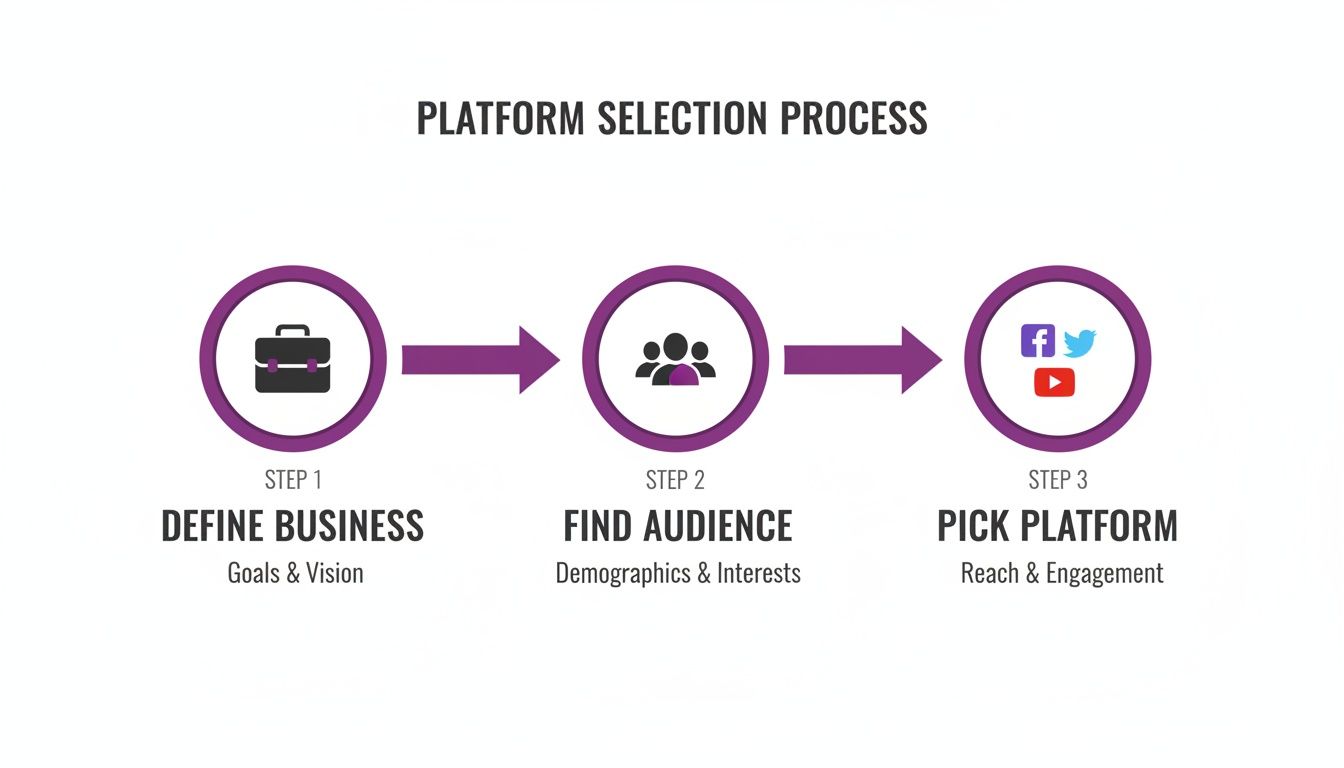
Successful advertising always starts with this kind of internal planning, long before you think about spending a single penny.
Master Local Audience Targeting
This is where social media ads truly come into their own for local businesses. Platforms like Facebook and Instagram offer incredibly detailed targeting options that let you reach your perfect customer with surgical precision. We're talking way beyond basic demographics like age and gender.
Let's go back to that Cotswolds photographer. They could create an audience of people who meet all these criteria:
- Location: People living within a 15-mile radius of their studio in Burford.
- Demographics: Women aged 28-40.
- Interests: Who have shown an interest in "weddings," "engagement photography," and brands like "Vera Wang" or "Bride Magazine."
- Behaviours: Who have recently been flagged by the platform as "newly engaged."
This powerful combination ensures the ads are only shown to a hyper-relevant, local group of people who are very likely to be in the market for a wedding photographer. This kind of precise targeting slashes wasted ad spend and dramatically boosts your chances of a great return. As you plan your campaigns, it's smart to think about the tools that can help manage the leads you generate; exploring different types of effective lead generation software for small businesses can make a huge difference.
Create Compelling Local Ad Creative
Your ad creative—the image or video and the text that goes with it—is what makes someone stop scrolling. For local campaigns, authenticity and relevance are your secret weapons. Your ads should feel like they're from a neighbour, not a faceless corporation.
Here are a few practical tips for creating ad copy and visuals that will click with a local audience:
- Reference Local Landmarks: Mentioning a well-known park, street, or building in your ad copy instantly builds a connection. An ad for a café in York could say, "Tired of walking the Shambles? Pop in for a proper coffee!"
- Use Authentic Photos: Ditch the generic stock images. Use high-quality photos of your actual shop, your team, and your happy customers. A photo of your crew in front of your branded van is far more trustworthy than a polished stock photo.
- Speak Your Customers' Language: Use the same tone and phrases your customers use. If you're a builder, talk about "loft conversions" and "kitchen extensions" in a straightforward, no-nonsense way.
- Make a Clear Offer: Your ad needs one clear call to action. Whether it's "Call now for a free quote," "Download our menu," or "Book your appointment," make it dead obvious what you want them to do next.
A great ad is simply the combination of a clear goal, sharp targeting, and creative that speaks directly to that audience. And while you're focused on ads, don't forget your main digital storefront. It's always worth running a quick check-up; our free Google Business Profile audit tool can help you spot easy wins to improve your local visibility online.
Get these core building blocks right, and you'll have the confidence to launch a campaign that genuinely connects with your community and starts bringing in business.
Setting a Realistic Budget and Measuring Success
It’s the question that comes up with every small business owner I talk to: "How much should I actually be spending on social media ads?" The good news is, you are in complete control. You don’t need a massive pot of cash to get started and see real results.
The trick is to begin with a test budget you're comfortable with—an amount you can afford to learn from. For a lot of UK businesses, this might be just £10 to £20 per day. That’s more than enough to start gathering meaningful data without breaking the bank.
Think of this first phase as buying data, not just ads. Your job is to find out which audiences are responding, what ad copy gets clicks, and which messages lead to actual enquiries. Once you’ve found a profitable formula, you can confidently start spending more because you know every pound you put in will bring a return.
How to Define Your Starting Budget
Instead of plucking a number from thin air, the best approach is to work backwards from what you want to achieve. If your goal is to generate leads, you need to ask yourself: "How much is one new lead actually worth to my business?"
If a single lead for your construction company could turn into a £5,000 project, you can obviously afford to spend more to get that lead than a local café selling £3 coffees.
A simple framework to get you started looks like this:
- Test Budget: Set a small, fixed daily amount (say, £15/day) and run your ads for the first 2-4 weeks.
- Analyse Performance: At the end of that period, dive into the data. See which campaigns brought in the best results.
- Scale the Winners: Put more money behind the ads and audiences that are performing well, and switch off the ones that aren't.
This cycle of testing, learning, and scaling is the absolute foundation of any social media advertising that’s both successful and cost-effective.
Moving Beyond Likes to Meaningful Metrics
It’s incredibly easy to get distracted by vanity metrics like likes, comments, and shares. And while high engagement is always a good sign, it doesn't pay the bills. To figure out if your ads are truly working, you have to focus on the numbers that directly impact your bottom line.
True success in social advertising isn't measured by how many people saw your ad, but by how many took the action that grows your business. Focus on outcomes, not just impressions.
For any small business, the most critical metrics are:
- Return on Ad Spend (ROAS): This is the ultimate measure of profitability. It tells you exactly how much revenue you're making for every pound you spend on ads.
- Cost Per Lead (CPL): This shows you how much it costs to get one potential customer's contact details.
- Conversion Rate: This is the percentage of people who clicked your ad and then did what you wanted them to do, like filling out a form or buying a product.
To track these properly, you absolutely must have tools like the Meta Pixel installed on your website. This little bit of code is what connects the actions people take on your site directly back to the ads they saw on Facebook or Instagram. It’s the only way to prove your ad spend is generating real enquiries and sales.
What Does Good Performance Look Like in the UK?
Knowing the industry benchmarks helps you see how you're stacking up. UK-specific data for 2026 shows small businesses are putting more into their ad spend, with 48% now going to social media for a 27% better ROI than search.
On Meta's platforms, the average cost-per-click (CPC) is typically somewhere between £0.63 and £1.20—a huge difference from the £5+ you might pay on LinkedIn. For a deeper look at the trends, you can review recent statistics on social media marketing.
If your CPC is a lot higher, it could be a warning sign that your ad creative isn't hitting the mark or your audience targeting is way too broad. To get a handle on calculating your return, you might find our guide useful, which includes a self-storage ROI calculator for SEO that can be adapted for advertising. By tracking the right numbers, you turn advertising from an expense into a predictable, profitable investment.
Integrating Social Ads with Local SEO
Treating your social media ads and your local SEO as two separate jobs is one of the biggest mistakes a small business can make. Think of them as two engines in a car. They can run on their own, sure, but you'll get far more power and efficiency when they work together.
When your social campaigns and your Google Business Profile (GBP) are in sync, you create a powerful cycle of trust that boosts your local authority. This integrated approach sends one clear, consistent message to both your customers and to Google itself.
Imagine a user sees your targeted Facebook ad for a spring gardening service. Intrigued, they pop your business name into Google. If they land on your Google Business Profile and see the very same offer, complete with matching customer photos, their confidence in your brand shoots up. It’s this seamless experience that turns a casual scroller into a paying customer.
Align Your Messaging for Maximum Impact
Your Google Business Profile is your digital shopfront in local search results. It’s very often the first and last place customers look before they decide to call or visit. To build that crucial trust, the message in your social ads has to line up perfectly with what people find on your GBP.
Let's say you're a wedding venue in the Peak District running a Meta ad for a "Last-Minute 2026 Wedding Package." That exact same offer, with the same wording, needs to be front and centre in a new post on your Google Business Profile. This creates a smooth, reassuring path for the customer.
Key alignment tactics include:
- Consistent Offers: If you’re pushing a 10% discount on Instagram, make sure a GBP Post is shouting about the same deal.
- Matching Visuals: Use the same high-quality photos or video clips from your ad campaign in your GBP updates. This creates instant visual recognition.
- Unified Language: Keep your tone of voice and keywords consistent. A customer shouldn't feel a jolt between reading your ad copy and your GBP description.
This alignment reinforces your brand and signals to Google that your business is active, relevant, and reliable—all positive ticks for your local rankings.
Driving Social Traffic to Boost Local Signals
One of the smartest ways to get these two channels working together is to use your social ads to send positive signals back to Google. While social media engagement isn't a direct ranking factor, the effect of driving targeted traffic from social platforms to your location-specific landing pages can be incredibly powerful.
When Google sees users clicking through from Facebook and spending time on a page all about your "Manchester loft conversion" services, it helps validate that page's authority for local searches on that topic.
Your social media ads can act as a catalyst for your local SEO. You are essentially paying to send highly relevant, locally-targeted users to your website, which demonstrates to Google that your content is valuable to that specific audience.
For example, a construction firm could run an ad targeting homeowners in an affluent suburb, linking directly to a detailed case study of a recent project in that exact area. This sends a concentrated stream of hyper-local traffic, reinforcing that page's geographic relevance.
Of course, this only works if your on-page and off-page SEO is solid. You can explore our comprehensive local SEO checklist to make sure you've got all the fundamentals covered.
Use Retargeting to Close the Loop
The great thing is, this integration works both ways. You can also use social ads to bring back users who found you through a local search but didn’t quite convert. By installing the Meta Pixel on your website, you can build a custom audience of everyone who has visited your site from a Google search.
This creates an incredibly high-value audience for your retargeting campaigns. You can then serve them ads that directly follow up on their initial interest.
For a photographer, this might be a targeted ad showcasing your five-star reviews or a special offer on family portrait sessions. This tactic is extremely effective because you're no longer advertising to a cold audience. You're talking to warm leads who have already shown an interest in what you do, which almost always results in a higher conversion rate and a lower cost per lead.
Common Questions About Social Media Ads for Small Businesses
Dipping your toes into social media advertising for the first time always throws up a lot of questions. For a small business, where every pound and every minute matters, you need to feel confident before you start spending. We get it.
Here, we're tackling the most common queries we hear from UK business owners. We'll give you direct, no-fluff advice to help you get over any initial hurdles and start your first campaign with clarity.
How Much Should a Small Business Spend on Social Media Ads?
This is always the first question, and the answer is refreshingly simple: start with a budget you're completely comfortable with. There's no magic number that fits everyone. The best way forward is to start small, test the waters, and see what the data tells you.
For most UK small businesses, a starting budget of £10–£20 per day is a great place to begin. It's enough to gather meaningful performance data within a couple of weeks without putting a strain on your finances. Think of this initial spend not as a cost, but as an investment in learning. You're paying to find out which audiences respond, what ad creative grabs attention, and which messages get people to act.
The most important metric isn't your daily spend, but your Return on Ad Spend (ROAS). This number shows you how much revenue you're generating for every pound you put in. Once you find a campaign that's profitably bringing in leads or sales—meaning your ROAS is positive—you can start to scale up your budget with real confidence. Your spending should always be guided by performance, not by arbitrary figures.
The goal isn't just to spend money; it's to find a profitable formula. Once you know that spending £1 brings in £3 of business, the question of "how much to spend?" becomes "how much can I afford to invest to grow?"
Of course, your budget will also be shaped by your industry, how competitive your local area is, and what you’re trying to achieve. A campaign to build brand awareness will have very different budget needs than one designed to generate high-value leads for a construction project.
Which Social Media Platform Is Best for My Business?
Choosing the right platform is less about which one is "best" and more about which one is best for your customers. The secret to effective social media advertising is to be where your audience already spends their time. Don’t waste your budget trying to be everywhere at once; focus your energy where it will make the biggest impact.
To make the right choice, you need to think about the nature of your business and the people you want to reach.
- For highly visual products and services: If you're an interior designer, a wedding venue, a caterer, or a photographer, your natural home is on Instagram and Pinterest. These platforms are built for showcasing stunning images and inspiring potential customers.
- For community-focused or local services: Businesses like construction firms, healthcare providers, or local retailers often find huge value in Facebook. Its detailed local targeting options, like postcode radius targeting and community group integration, are priceless for reaching a specific geographic area.
- For B2B (business-to-business) services: If your clients are other companies, LinkedIn is the undisputed champion. It’s the perfect platform for architects targeting property developers or consultants connecting with corporate decision-makers.
Take a local bakery in Brighton, for example. They might use Instagram to post mouth-watering photos of their cakes to attract a younger crowd. At the same time, they could use Facebook to promote a weekend family deal to local community groups. Each platform serves a distinct purpose, hitting a different part of their audience.
How Long Until I See Results from Social Ads?
While you can start generating impressions and clicks almost immediately after you launch a campaign, seeing a profitable return takes a bit longer. Realistically, you should expect a period of one to three months to gather enough data to properly optimise your campaigns for profitability.
Think of the first few weeks as a critical testing phase. This is where you're learning what works and, just as importantly, what doesn't. You’re experimenting with different variables to find that winning combination.
What you'll be testing includes:
- Audiences: Which demographic, interest, or location-based groups are the most responsive?
- Ad Creative: Do people engage more with video ads, single images, or carousels?
- Messaging: Which headlines and calls to action generate the most clicks and conversions?
Patience is a virtue in advertising. That initial data, even if it doesn't show an immediate profit, is incredibly valuable. It tells you what not to do, allowing you to fine-tune your approach and spend your budget more effectively. Consistent analysis and a willingness to adapt are the key ingredients for long-term success and a strong, sustainable return on your investment.
At Bare Digital, we specialise in turning these questions into actionable strategies. Our team helps UK small businesses navigate the world of digital advertising to achieve measurable growth. If you’re ready to dominate your local market, get in touch with us today for a free health check of your online presence.