

You have done some version of this already.
A post goes on Facebook. A few pounds go into ads. Your website sits there. Someone mentions SEO. Someone else says email works. You try a bit of everything, and at the end of the month, the essential question is still the same. Did any of it produce calls, enquiries, bookings, or sales?
That is the point where a small business marketing package starts to make sense. Not because it bundles random services together, but because it turns scattered activity into one organised system tied to commercial outcomes. For a local business, that means showing up when nearby buyers search, giving them a reason to trust you, and making it easy for them to contact you.
What Is a Small Business Marketing Package?
A small business marketing package is a monthly plan that joins the parts of your marketing that influence enquiries. For a local business, that means being visible in Google, giving people enough confidence to contact you, and making it easy to take the next step once they land on your site.

Owners come to this point after trying bits of marketing in isolation. A few social posts go out. The website gets tweaked once. Ads run for a week or two. Nothing is tied together, so it is hard to see what is generating calls and what is just creating activity.
A package should work like a system
Buying services one at a time can look cheaper at first. In practice, it can create gaps.
A local package works best when each element supports the next. Your Google Business Profile helps you appear in local searches. Service pages give searchers and Google clear evidence of what you do and where you work. Technical fixes help those pages load, index, and convert properly. Reviews, local citations, and relevant links add trust. Call tracking and form tracking show whether the work is producing leads.
That is why a package should be judged as a system, not as a shopping list.
The business problem it solves
A core problem is fragmentation. One supplier handles social media. Another built the website years ago. SEO gets mentioned, but nobody owns the full path from search to enquiry.
A useful package fixes that by setting priorities and connecting the work to outcomes a business owner can measure.
It should give you:
- A clear monthly plan with defined tasks and reasons for doing them
- Work tied to lead generation rather than generic visibility
- Tracking on calls, forms, and booked jobs so performance is visible
- A realistic sequence of improvements based on budget, competition, and your starting point
That matters in practical terms. A solicitor in Leeds, a plumber in Bristol, and a café in Brighton do not need the same mix of work, even if all three are buying a "marketing package". The right package reflects how customers choose in that sector. For a café, branding and visual presentation may carry more weight, which is why areas like food packaging branding can support the wider marketing picture. For a local trades business, search visibility, reviews, and fast contact options have a more direct effect on revenue.
A good small business marketing package answers two plain questions. What work is being done each month, and how should that work lead to more enquiries or sales?
What it should include in plain English
SEO jargon often makes packages sound more complicated than they are.
Local SEO means helping nearby customers find you when they search. Technical SEO means removing problems that stop your site from being crawled, loaded, or used properly. Conversion work means improving pages so more visitors call, book, or submit a form. Reporting means showing what happened, not hiding behind charts with no business context.
A sensible provider will also explain trade-offs. If the budget is modest, the first phase may focus on your Google Business Profile, core service pages, tracking, and basic technical fixes. If the site already performs well, more of the budget can go into content, link acquisition, or location expansion. Those choices should be explained clearly, because every hour spent on one area is an hour not spent somewhere else.
For businesses comparing providers, the local SEO and lead generation services at Bare Digital's small business marketing support give a useful reference point for what an organised package can look like. The label matters less than the structure, the reporting, and whether the work is set up to turn local demand into calls, enquiries, and sales.
The Essential Components of a Local Marketing Package
A local marketing package should answer a practical question. What has to be in place for someone nearby to find you, trust you, and contact you without friction?
That is easier to judge when each part is translated into business outcomes. One element helps you appear in local searches. Another helps the visitor understand the service and take action. Another removes the technical problems that waste traffic. The package matters less than how those pieces work together.
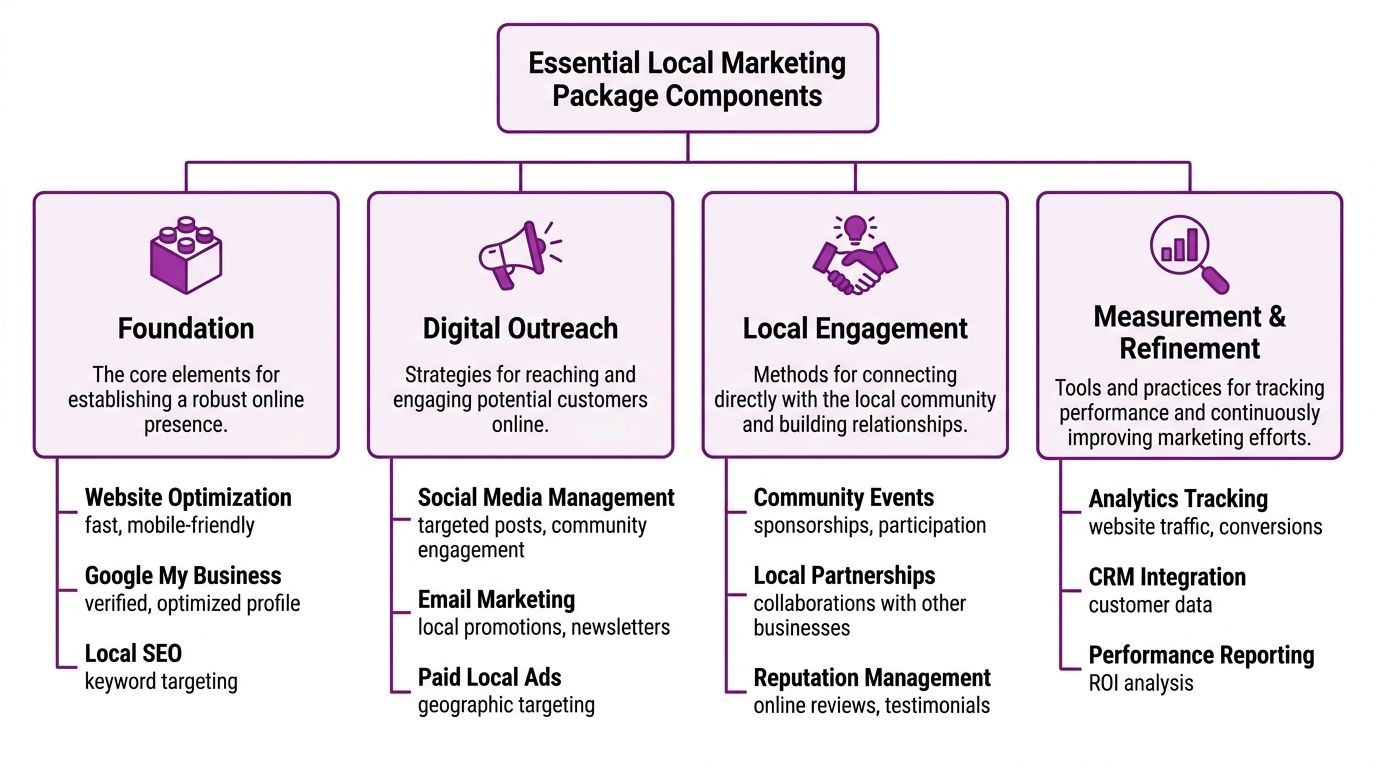
Many local campaigns underperform for a simple reason. They include activity, but not enough of the right activity in the right order. A smart package starts with the assets that can produce enquiries fastest, then expands once the foundations are sound.
Google Business Profile optimisation
Your Google Business Profile is often the first thing a local customer sees. For plumbers, dentists, salons, trades, and other service businesses, it can drive calls before the website visit even happens.
A proper setup covers the basics and the details. Categories need to match the actual service. Service areas need to reflect where the business works. Photos should show current work, premises, team, or vehicles. Reviews need replies. Opening hours and contact details must stay accurate.
This affects real actions:
- Phone calls from people ready to book
- Clicks to your service pages
- Direction requests for location-based businesses
- Trust signals from reviews, photos, and recent updates
There is also a trade-off here. If the monthly budget is tight, I would put more effort into the profile and core service pages first, because they frequently produce quicker local gains than broader content campaigns.
Local SEO on the website
If the profile gets the click, the website has to close the gap between interest and enquiry.
Local SEO on the site means making your main pages clear, specific, and easy to trust. The page should tell a visitor what you do, where you do it, and why your business is a safe choice. That sounds simple, but many small business sites still hide service areas, bury contact details, or use vague copy that could belong to any company in any town.
The right approach depends on the business model. A solicitor serving one city needs a different page structure from a roofer covering six towns. A clinic with multiple treatments needs tighter service-page targeting than a single-service trades business. Good providers explain those decisions instead of hiding them behind jargon.
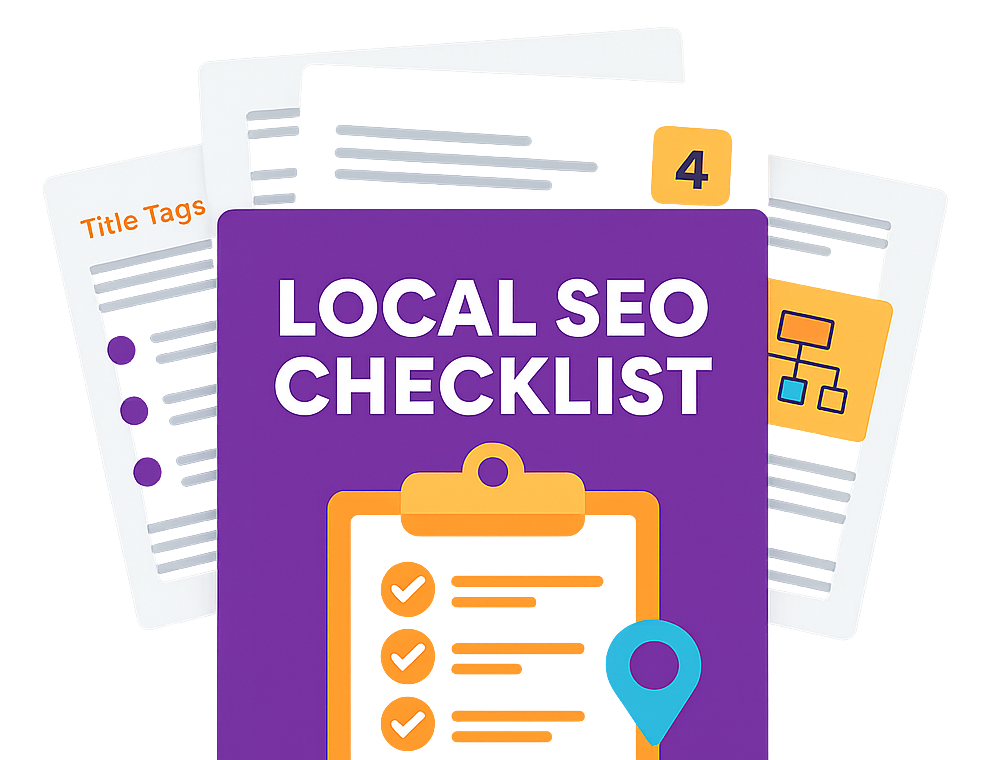
For a practical benchmark, this local SEO checklist for small businesses shows the on-page and local signals that need attention.
Content creation
Content is your expert salesperson. It answers objections, clarifies the offer, and helps a buyer decide whether to contact you.
For local businesses, useful content falls into four groups:
- Service pages that explain the job, process, pricing cues, and outcomes
- Location pages for towns or areas you serve
- High-intent articles that answer buying questions
- Trust content such as case studies, FAQs, and process pages
The standard to judge it by is simple. Does this page help a potential customer take the next step?
A Manchester accountant might need pages on limited company accounts, tax returns, and bookkeeping, plus an FAQ on deadlines and penalties. A wedding caterer in Surrey may get more value from menu pages, venue-specific guidance, and a page that explains headcount, service style, and lead times. Different sectors need different content because the buyer's questions are different.
Presentation matters as well. Offline branding offers a useful parallel. Clear packaging helps buyers understand quality and fit at a glance, which is why this article on food packaging branding is relevant. The same principle applies to service pages. If the message is unclear, the lead hesitates.
Technical SEO fixes
Technical SEO removes the problems that block visibility or waste visits after you earn them.
Common issues include slow mobile pages, broken internal links, duplicate content, indexing problems, poor page hierarchy, and forms that fail on smaller screens. These are not abstract concerns. If a customer taps through from Google and the page drags, jumps, or hides the contact form, the chance of an enquiry drops.
This work rarely looks exciting in a report. It can have a direct effect on lead quality and conversion rate.
I explain it like premises maintenance. Fresh signage gets attention, but if the front door sticks and the lights flicker, fewer people come in and fewer stay.
Link building and authority signals
Links and mentions help search engines judge whether your business is known and trusted in the places that matter.
For local firms, that means consistent citations, trade body listings, local news mentions, supplier or partner links, and references earned through useful content or community involvement. Quality matters more than volume. A respected local chamber listing or industry association mention is worth far more than a batch of irrelevant directory links bought cheaply.
This is one of the clearest differences between a serious package and a weak one. Cheap providers can sell link quantity because it is easy to describe. Better providers focus on relevance, credibility, and whether the mention supports rankings in the areas you want business from.
A strong local package is not a pile of disconnected tasks. It is a system built to turn search demand into calls, quote requests, bookings, and sales.
Understanding Pricing and Timelines for Marketing Packages
Most owners ask two questions first. What will it cost? And when will it start working?
The honest answer is that pricing depends on scope, competition, and business model. There is no single fair fee for every local business because the workload is not the same.
What changes the price
A one-location service business in a smaller town needs less work than a multi-location company competing across several cities. A business with a strong site and clean profile needs a different level of intervention than one with broken pages, duplicate listings, and no content structure.
Pricing moves up or down based on:
- Number of locations you want to rank
- Competition level in your area and sector
- How much content needs creating or rewriting
- Technical condition of the website
- How much authority work is needed
- Reporting depth and strategy input
A basic package focuses on foundation work. That means profile optimisation, core on-page fixes, a small amount of content, and reporting.
A more advanced package adds regular content production, stronger link acquisition, location page expansion, and tighter KPI tracking.
An aggressive growth package for a multi-site brand may include broader landing page builds, regional targeting, heavier authority work, and more detailed dashboarding.
What not to buy
The cheapest package can be expensive in the long run.
If the deliverables are vague, the reporting is fuzzy, and the provider cannot explain why they are doing each activity, you are paying for motion rather than progress. Local SEO work should feel methodical, not theatrical.
Watch for offers built around:
- Guaranteed rankings
- Huge volumes of links
- No discussion of conversion tracking
- No distinction between local and national intent
- Identical packages for every sector
What the timeline really looks like
Local marketing compounds. It does not switch on like paid ads.
In early months, the visible wins can come from cleaning up your profile, fixing page issues, improving service copy, and aligning your site with target locations. You may see better click quality before you see broad ranking improvements.
A little later, consistency starts to matter more. Reviews, content, authority signals, and location relevance build on one another. That is when enquiry quality can become more stable.
Longer term, the gains can become harder for competitors to dislodge because the business has stronger local relevance, better content coverage, and more trust signals attached to the right pages and profiles.
A realistic provider talks about momentum, not miracles. Local SEO is closer to building a reputation than flicking a switch.
The specific timeline also depends on your market. A funeral director in a smaller county and a construction firm in a major city will not move at the same speed. Different sectors have different search behaviour, competition, and decision cycles.
Sample Marketing Packages for Different UK Sectors
The quickest way to understand a small business marketing package is to look at how it changes by sector. The pieces are similar. The weighting is not.

In the UK, local SEO packages that optimise Google Business Profiles can lead to significantly higher conversion rates for local searches compared to national campaigns. A 2023 FSB report on 1,200 SMEs found that optimised profiles correlated with notable year-on-year revenue growth over 6 months, and 76% of location-specific mobile searches lead to a store visit within 24 hours, according to this local SEO package analysis. Those numbers explain why sector-specific local work often outperforms generic digital activity.
Wedding venue in the Cotswolds
A wedding venue sells a high-consideration purchase with a long lead time. Buyers compare several venues, save options, revisit websites, and often involve family in the decision.
That changes the package.
The priority here is not just ranking for broad venue terms. It is appearing in the right local and style-led searches, then giving couples confidence to enquire.
A strong venue package emphasises:
- Google Business Profile photo management and posts
- Location-aware venue pages
- Blog content around planning questions
- Internal linking to galleries, pricing, and enquiry pages
- Review strategy focused on trust and atmosphere
The content needs to do more than describe the space. It should answer practical buyer concerns such as capacity, seasonality, ceremony options, accommodation, and logistics.
Visual businesses also need supporting pages that catch adjacent intent. Engagement shoots, venue styling, and supplier relationships can all shape search behaviour. For photographers working in that same premium local market, this guide to SEO for photographers shows how niche search intent often works around location and portfolio confidence rather than broad traffic.
Multi-location construction firm in Manchester
Generic packages can fail for such businesses.
A construction company serving several areas cannot rely on one homepage and a single profile to rank everywhere it wants work. It needs a structure that matches how people search by service and place.
A specialized package for this type of business puts most effort into:
| Priority area | Why it matters |
|---|---|
| Location-specific landing pages | Helps match services to individual towns or districts |
| Strong internal linking | Supports authority flow between service and area pages |
| Trade and local links | Builds credibility in a competitive market |
| Review capture by branch or service area | Strengthens relevance and trust |
| Google Business Profile management per location | Keeps local presence accurate and active |
The trade-off is simple. If you spread effort too widely, no area gains enough strength. If you focus on the best commercial locations first, rankings and lead flow become easier to build on.
This matters even more when different branches offer slightly different services. The package has to reflect that reality rather than forcing every location into the same copy.
Funeral director in Kent
Funeral-related search behaves differently from most local services. The searcher often needs help immediately. The tone must be calm, direct, and practical.
A package here should avoid flashy content tactics. Clarity wins.
The most useful elements can include:
- Google Business Profile optimisation with accurate service details
- Pages for key services such as cremation, burial, and planning
- Simple mobile contact paths
- Local trust signals and reviews
- Carefully written FAQs answering urgent questions
This is one of the clearest examples of why rankings alone are not enough. If the visitor lands on a page and cannot quickly find reassurance, service information, or a phone number, the package is underperforming even if visibility improves.
In sensitive sectors, conversion work can be about reducing stress. Fast-loading pages, direct answers, and clear contact options matter as much as search placement.
Across all three examples, the lesson is the same. The best small business marketing package is not the one with the longest feature list. It is the one that puts the right weight behind the channels and pages most likely to produce qualified enquiries for that business model.
How to Measure Your Marketing Package's Success
Rankings matter, but they are not the final scoreboard. A local business needs proof that marketing activity is turning into commercial action.

A useful report should help you answer three things quickly. Where are enquiries coming from? Which actions are increasing? Which work is producing those results?
Focus on lead indicators, not vanity metrics
A spike in impressions may look nice. It does not pay wages.
For a local SEO campaign, the more useful measures are:
- Phone calls from your Google Business Profile
- Website form submissions
- Direction requests
- Clicks to key service pages
- Map rankings for your most valuable local terms
- Organic visits to service and location pages that convert
This is why dashboard setup matters. If reporting only shows traffic and position changes, it is incomplete. You need to connect activity to buyer behaviour.
One practical way to sanity-check reports is to ask whether the metrics would still matter if your rankings were hidden. Calls, forms, and booked jobs still would. Impressions on their own would not.
What a good dashboard should show
A reliable dashboard is less about flashy graphs and more about traceability.
It should let you see:
| Metric | Why it matters |
|---|---|
| Calls from profile and website | Indicates direct response from local search |
| Form fills by page | Shows which services and locations create enquiries |
| Landing page performance | Reveals which pages deserve more attention |
| Map visibility for priority searches | Helps assess local presence |
| Review growth and profile engagement | Supports trust and click-through quality |
For businesses that want to tie SEO work more closely to revenue thinking, tools such as a self storage ROI calculator for SEO illustrate the broader point. Local marketing should be measured against business return, not just search visibility.
Tie tasks to outcomes
A monthly report should not read like a chores list.
If the agency says they updated service pages, posted on the profile, improved internal links, and published a location article, the report should also explain what changed in user behaviour afterward. Even when attribution is not perfect, there should be a logical line between effort and outcome.
This is also becoming more relevant beyond classic Google rankings. Search behaviour is shifting, and businesses are paying closer attention to how AI-led discovery surfaces information. If you want context on that change, this overview of ChatGPT ranking factors is worth reading alongside your normal SEO reporting.
A short explainer can help when you want to see how reporting is discussed in practice.
If a provider cannot explain how monthly work affected enquiries, they are reporting activity, not performance.
Questions to ask when reviewing reports
Keep these in front of you during any monthly review call:
- Which pages generated the most valuable enquiries?
- Did map visibility improve for the terms that matter commercially?
- Are calls and forms coming from the desired locations?
- What was done this month that should influence next month’s lead flow?
- What needs dropping because it is not helping?
That last question matters. Good marketing packages are not just built. They are refined.
A Checklist for Choosing the Right Marketing Partner
Choosing a provider is easier when you stop looking for the cheapest quote and start looking for the clearest operator.
Most problems begin before the work starts. The wrong agency talks in abstractions, hides deliverables inside jargon, and treats every local business like the same template.
The questions worth asking
Bring these into every sales call.
- Can you explain your package in plain English? If they cannot translate the work into business outcomes, communication will stay muddy after you sign.
- How do you prioritise work in the first few months? Good providers know what gets tackled first and why.
- How do you handle businesses with multiple services or multiple locations? This tells you whether they understand local structure or just sell generic SEO.
- What does reporting include? Ask specifically about calls, forms, profile actions, and page-level performance.
- What work is done on the website versus off the website? You want balance, not a one-note service.
- How often will we speak, and who will I speak to? Strategy suffers when communication disappears into a ticket system.
- Do you require a lock-in contract? Long agreements are not always bad, but they should reflect the time local SEO needs, not trap you.
- How do you decide what success looks like for a business like mine? The answer should reference actual leads and commercial goals.
Warning signs you should take seriously
Some red flags show up fast.
- They guarantee rankings
- They avoid talking about conversions
- They promise huge link volumes
- They cannot describe sector-specific strategy
- They focus on dashboards more than decisions
- They never challenge your assumptions
A strong partner does not just nod along. They tell you when your homepage cannot rank for every service, when your site structure is weak, or when your profile setup is limiting performance.
The best agency conversations are often slightly uncomfortable. They replace hopeful assumptions with a plan you can measure.
What “fit” really means
Fit is not about whether you like the salesperson. It is about whether the provider understands how your leads happen.
A wedding venue, a builder, and a funeral director all need local visibility. They do not need the same package emphasis, the same messaging, or the same conversion path.
That is why a specialist beats a generalist for local lead generation. You want a partner who understands buyer intent in your sector, the role of Google Maps, the need for location-specific pages, and the difference between traffic that looks good and traffic that converts.
Your Next Steps with a Bespoke Bare Digital Package
A useful package should now look less mysterious.
It is not “SEO, content, and some bits around it”. It is a structured local growth system. The profile attracts local intent. The website captures and converts it. Technical work removes friction. Content expands coverage. Authority work builds trust.
That model becomes more important when a business grows beyond one branch. One underserved angle in small business marketing packages is the lack of specialized strategies for multi-location UK service businesses. Evidence suggests many multi-location SMEs struggle with local visibility, and a relatively small percentage effectively use location-specific SEO. This creates a gap for specialised packages addressing this audience, as multi-site strategies have shown a 3x higher ROI in competitive sectors, according to Bain’s analysis of underserved small business markets.
That is exactly where a custom approach matters. A single-location business in one town does not need the same package as a service brand trying to rank across several regions.
Bare Digital's Local Marketing Packages
| Package | Ideal For | Key Deliverables |
|—|—|
| Growth | Single-location businesses that need stronger local foundations | Google Business Profile optimisation, core keyword targeting, on-page improvements, technical fixes, reporting |
| Advanced | Established local businesses in more competitive markets | Ongoing content work, stronger internal linking, service page expansion, authority-building links, KPI tracking |
| Accelerate | Multi-location or aggressively growing service businesses | Location-specific landing pages, broader authority campaigns, multi-area strategy, deeper reporting, scaled local SEO execution |
How to choose the right tier
The best fit comes down to operational reality.
If your business has one physical location and weak local visibility, a foundational package can be the right starting point. If you already rank for some terms but struggle to expand or convert traffic well, a more involved package makes sense. If you are trying to win across multiple towns, branches, or service areas, you need a package built for scale rather than a stretched single-location plan.
A good provider should also adapt as data comes in. The right tier at the start is not always the right tier six months later.
What to do next
Before buying any package, get clarity on three points:
- Which services matter most commercially
- Which locations matter most commercially
- Which conversion actions matter most commercially
That gives the campaign a business spine. Without it, even decent SEO work can drift into generic activity.
If you want to discuss what a custom package could look like for your business, the best starting point is a direct conversation through https://www.bare-digital.com/contact/. The useful outcome from that conversation is not a hard sell. It is a clearer view of what should be prioritised, what can wait, and what success should look like for your market.
Bare Digital helps UK businesses turn local search visibility into measurable enquiries and sales. If you want a clearer plan for Google Maps rankings, location pages, technical fixes, and reporting that tracks real business outcomes, visit Bare Digital.