

Somewhere on your phone, there is probably a half-finished Facebook post, an Instagram draft, or a reminder to “post more this week”.
You know social media matters. You also know it can eat hours and give very little back if you use it without a plan. That is where most small businesses get stuck. They post when they remember, copy what bigger brands do, then wonder why enquiries stay flat.
For UK firms, social media for small business marketing is not really about chasing reach for its own sake. It is about showing up in the right local places, with the right proof, so nearby buyers trust you before they call. That matters because 92% of UK small businesses use social media as a core part of their marketing, and 69% link it to direct increases in qualified leads according to Marketing LTB’s social media marketing statistics roundup.
That should change how you look at it. The job is not to “do social”. The job is to turn social activity into local visibility, local trust, and local leads.
If you want a broader primer alongside the practical approach here, this Social Media Marketing for Small Business Growth Guide is a useful companion read. If your bigger challenge is how social fits into search visibility and local enquiries, the team at https://www.bare-digital.com/ works squarely in that space.
Your Starting Point with Social Media Marketing
Most owners start with the wrong question.
They ask, “What should I post today?” The better question is, “What would make someone in my area trust us enough to click, call, or visit?”
That shift fixes a lot. A builder in Portsmouth does not need nationwide attention. A wedding venue in Yorkshire does not need random followers from overseas. A solicitor, funeral director, architect, or photographer needs visibility inside a realistic catchment area.
Stop treating every platform like a content machine
Social media works poorly when it becomes a chore list.
It works far better when each post has one local job to do:
- Build recognition: remind local buyers that you exist
- Show proof: demonstrate recent work, real people, real places
- Create action: send someone to call, enquire, book, or check availability
- Support search visibility: reinforce your location and service relevance
When owners feel social is a time-sink, it is usually because none of those jobs are clearly assigned.
Local intent beats broad attention
A quiet post seen by the right fifty people in your service area can be more valuable than a flashy video seen by the wrong audience.
That is especially true for service-led businesses. If somebody searches “builder near me”, “wedding venue Kent”, or “funeral home in Leeds”, your social presence often shapes their first impression before they ever visit your website. A neglected page, patchy branding, and no recent proof make people hesitate.
Tip: If a post does not help a nearby buyer trust you, understand you, or contact you, it is probably filler.
The businesses that get traction from social media for small business marketing usually simplify it. They choose a small number of platforms, a handful of repeatable post types, and a clear local conversion path. That is enough to turn social from an obligation into a lead channel.
Laying the Groundwork Your Local Social Media Strategy
Before you post anything, decide what success looks like in business terms.
“More awareness” is too vague. “More enquiries from homeowners in two target postcodes” is usable. “More venue viewings from couples within driving distance” is usable. “More commercial fit-out leads from LinkedIn contacts in Manchester” is usable.
Set a target that connects to revenue
Use a target you can judge at the end of the month.
Good examples include:
- Enquiry quality: more of the right type of lead, not just more messages
- Location fit: enquiries from towns or postcodes you want to win
- Service focus: requests for profitable services rather than low-margin work
- Speed to contact: more calls and form fills from people ready to act. Social media can create noise if you do not narrow it, making clear targeting important. A wedding venue might attract lots of likes from people who will never book. A trades firm might get comments from outside its travel radius. A B2B consultant might spend all week on Instagram when LinkedIn is where local decision-makers engage.
Know who you want, not just who you can reach
Your local customer profile should be simple.
Write down:
What they need right now
Not a generic need. A live problem. Leaking roof. Venue shortlist. Care provider comparison. Office redesign.Where they are
Town, radius, district, or postcode cluster.What proof they need before contacting you
Photos, reviews, credentials, examples, before-and-after work, team introductions, pricing cues, or process clarity.What blocks action
Confusion, lack of trust, poor response time, weak visual proof, or uncertainty about service area.
That profile shapes your content far better than broad demographic guesses.
Choose platforms by buying intent
Platform choice should follow the way people buy your service. A useful benchmark is that a 2024-2025 Statista survey of UK marketers found 83% using Facebook, 79% Instagram, and 65% LinkedIn, and for visual businesses high-quality images can generate 650% more interactions than text-only posts, as summarised by Sixth City Marketing.
That does not mean you need all three.
It means most local businesses should start with one primary platform and one supporting platform.
Which Social Media Platform is Right for Your UK Business?
| Platform | Best For | Local Use Case Example |
|---|---|---|
| Community visibility, local groups, older demographics, service updates | A funeral home sharing practical local guidance and responding to family questions | |
| Visual proof, short-form video, venue tours, before-and-after work | A wedding venue posting seasonal set-ups, supplier collaborations, and ceremony spaces | |
| Professional services, B2B trust, partnerships, recruitment | An architect or interior designer posting project insights for commercial clients |
What usually works best by sector
Facebook for trust and local familiarity
Facebook is still strong for businesses people want to vet carefully. Think funeral homes, home care providers, local trades, family-run services, and community-facing firms.
People use it to check whether you look active, established, and responsive.
Useful Facebook content includes:
- Recent work updates: with location context where appropriate
- Community involvement: sponsorships, events, charity support, local partnerships
- Practical advice: answers to common local customer questions
- Reputation support: reminders to check reviews, call, or message
Instagram for proof and desirability
Instagram is where appearance, atmosphere, and presentation matter most.
Wedding venues, caterers, photographers, clinics, salons, architects, and interior designers usually have a stronger fit here. If your buyer needs to see the finish, not just hear about it, Instagram often carries more weight.
LinkedIn for considered B2B enquiries
LinkedIn suits firms selling expertise, reliability, and outcomes to other businesses.
Accountants, consultants, architects, commercial contractors, care operators, and specialist service providers often overlook it because it feels slower. In practice, it can produce stronger-fit leads if your content speaks to buyer concerns rather than company news.
Key takeaway: Choose the platform that matches how a customer evaluates risk before they contact you.
Build a strategy you can maintain
A simple weekly rhythm beats an ambitious plan you abandon after ten days.
For most small businesses, a workable setup looks like this:
- One proof post: recent project, result, or completed job
- One trust post: testimonial, FAQ, team member, process, or credential
- One local relevance post: area-specific advice, local partnership, venue feature, neighbourhood example
If you need a practical search-led foundation to support that work, this local SEO checklist helps tighten the basics around your wider visibility.
Optimising Social Profiles for Local Discovery
A social profile should do more than look tidy. It should tell a local buyer exactly who you help, where you work, and what to do next.
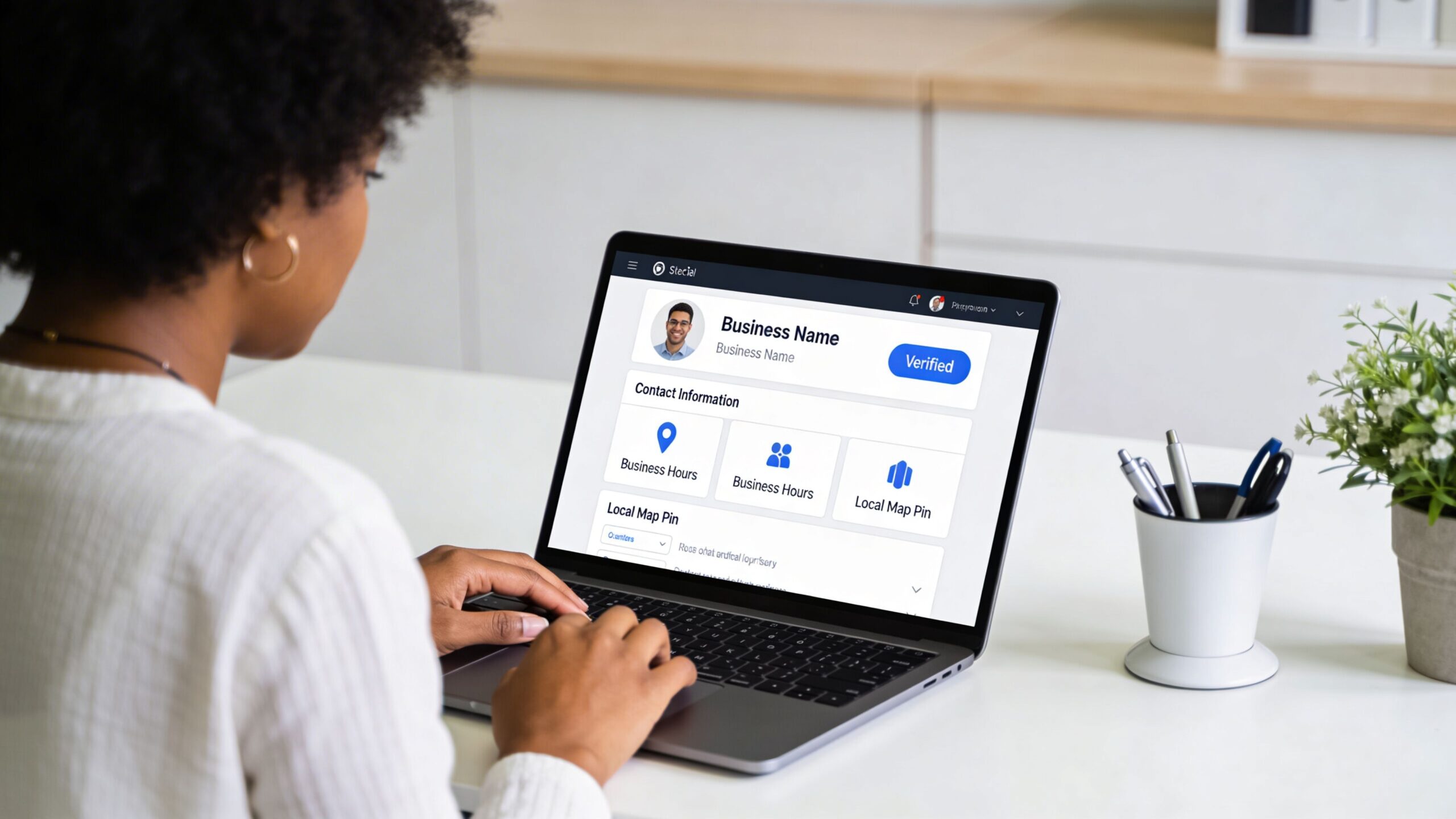
Most profiles fail in the same ways. Vague bios. No service area. No call to action. Different phone numbers on different platforms. A homepage link when a booking page would do a better job.
Write for a local buyer first
Your bio is not the place for clever slogans.
It should answer three things fast:
- What you do
- Where you do it
- How to act
A better Instagram bio says “Wedding venue in Warwickshire for countryside ceremonies and receptions” than “Creating magical moments”. A stronger Facebook description says “Builders serving North London and surrounding areas” than “High quality workmanship”.
Match your profile details across the web
Consistency matters.
Your business name, phone number, website, and address details should line up with your Google Business Profile and website. If your Facebook page uses one phone number and your website footer uses another, you create doubt for both customers and search engines.
Check these areas carefully:
- Business name: keep it consistent
- Primary phone number: use the same main contact point
- Website link: send users to the most useful page, not automatically the homepage
- Address or service area: present it clearly and in the same format where possible
If you are unsure how your local presence stacks up, a Google Business Profile audit tool is a practical place to spot gaps.
Use the features most businesses ignore
A strong profile uses the built-in tools on each platform.
Action buttons matter
Set up the most direct option available. “Call Now”, “Book Now”, “Get Directions”, or “Send Message” can reduce friction immediately.
For a restaurant or venue, booking matters. For a trades firm, calls matter. For a consultant, a contact form or discovery call page may be stronger than generic messaging.
Category choices shape visibility
Choose the closest category available on the platform. Do not pick something broad because it sounds bigger.
Specific categories make your page easier to understand and easier to surface in relevant discovery features.
Images need context, not just quality
Sharp visuals help, but context is what makes them useful locally.
A photographer should not only upload polished images. They should show recognisable venues, local landmarks where appropriate, and captions that anchor the work in place and service type.
Here is a useful walkthrough before you update your profiles:
A profile checklist you can apply today
- Headline clarity: state service and location in plain English
- Contact route: make the next step obvious
- Link destination: send traffic to the page that converts best
- Visual proof: use recent, real images of your work, premises, or team
- Service area cues: mention towns, districts, or regions naturally
- Brand consistency: use the same logo, colours, and tone across platforms
Tip: If someone lands on your profile for five seconds, they should still know what you do, where you work, and how to reach you.
Creating Local Content That Builds Community and Trust
The fastest way to run out of steam is to treat content like a daily creativity test.
Local businesses do better with repeatable content pillars. Not trends for the sake of trends. Not motivational quotes. Not generic “Happy Monday” graphics. Just reliable formats that prove you are active, trusted, and relevant in your area.

Show real work in real places
This is the pillar most firms underuse.
A construction company can post project updates from recognisable streets or neighbourhoods. A wedding venue can show a room dressed for a real event, not just a styled shoot. A funeral home can share calm, respectful information about services and support, without turning every post into a sales pitch.
The detail matters. “Kitchen extension completed in a family home near Solihull” is more useful than “Another happy customer”. It creates local relevance and stronger trust.
Turn common questions into content
Small businesses often answer the same questions every week.
Those questions should become posts.
A photographer can answer “When should we book engagement photos?” A home care provider can explain what happens during an initial consultation. An architect can break down the early stages of a residential project. A wedding venue can explain what is included in a viewing.
That kind of content works because it lowers uncertainty.
Feature people, not just services
Trust rises when people can see who is behind the business.
That does not mean forced corporate headshots. It means making the business feel present and accountable.
Useful formats include:
- Team introductions: who clients will speak to or meet
- Day-in-the-life posts: realistic glimpses of delivery work
- Supplier or partner spotlights: florists, caterers, trades, local venues, care professionals
- Client stories: shared carefully and appropriately, with permission
For visually led sectors, this also supports wider search visibility. If photography is part of your business model or a key marketing asset, SEO for photographers shows how image-led content can support discoverability beyond social alone.
Build content around local relevance
A post does not need to mention your town in a clumsy way to be local. It just needs signals that make local audiences recognise themselves in it.
Wedding venues
A venue can post:
- seasonal ceremony set-ups
- favourite local supplier collaborations
- planning tips tied to the local area
- behind-the-scenes clips from viewings or preparations
These posts do two jobs. They sell the setting and they anchor the venue in a local wedding ecosystem.
Trades and construction
A builder, roofer, or electrician should lean into proof.
Before-and-after sequences, quick site videos, material choices, common homeowner mistakes, and short explanations of process all work well. Captions should stay practical, not theatrical.
A simple post such as “Why we specified this roofline detail on a recent job in South Birmingham” does more than collect likes. It signals competence.
Healthcare and care services
These sectors need a steadier tone.
Educational posts, staff credentials, service explanations, and community involvement usually work better than aggressive promotion. People choose providers they feel safe with. Social content should reduce anxiety, not increase it.
Key takeaway: The strongest local content usually answers one of three questions. Can I trust you? Have you done this before? Do you work with people like me nearby?
Use a posting rhythm that survives busy weeks
Consistency matters more than volume.
A realistic cadence for many small businesses is two or three posts a week. That is enough to stay active without turning content into a second full-time role. If you have more capacity, use it to improve quality, not just frequency.
A practical monthly pattern might look like this:
Week one
Recent project or local job spotlightWeek two
FAQ or customer education postWeek three
Team, supplier, or behind-the-scenes featureWeek four
Testimonial, review prompt, or seasonal local advice
What usually wastes time
Some content types look busy but produce very little.
Avoid relying on:
- Generic quotes: they rarely build trust
- Over-designed graphics: especially when real photos would carry more weight
- Trend-chasing audio: if it has no relevance to your audience
- Broad motivational posts: they often attract attention without buying intent
The safest test is simple. If you removed your logo, would the post still clearly belong to a business in your area offering a specific service? If not, it is probably too generic.
The Local SEO Power-Up Connecting Social to Google
Most businesses keep social media and local SEO in separate boxes.
That is a mistake.
When you align them, social stops being just a publishing channel and starts becoming a visibility engine that strengthens your presence in Google Maps and local search. That is where social media for small business marketing gets much more useful, especially for firms that depend on local intent.
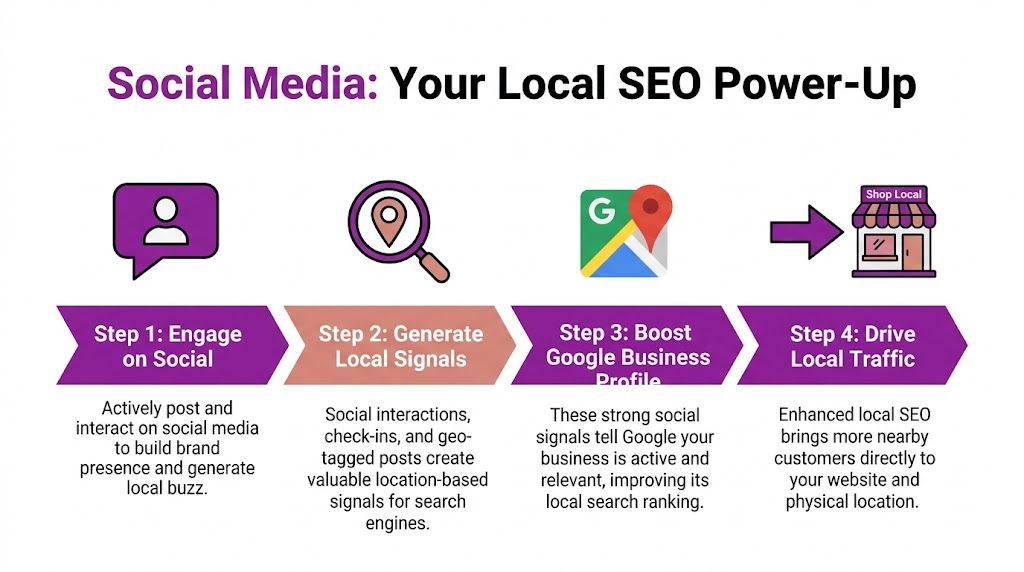
The opportunity is bigger than most firms realise. For UK small businesses, social signals can boost Google Maps rankings by up to 28% when activities are aligned. Yet only 17% of SMBs effectively connect Google Business Profile posts to social content such as Instagram Reels, according to Evoke Strategy.
What “aligned” means
It does not mean posting the same message everywhere and hoping for the best.
It means your social activity reinforces the same local signals your search presence needs:
- consistent business details
- repeated service-area relevance
- recent visual proof
- local engagement
- fresh content tied to real services and locations
Google does not need your posts to go viral. It needs enough clear evidence that your business is active, relevant, and present in the places you want to rank.
Use your social posts as raw material for Google Business Profile
If you already create a strong Instagram post, Facebook update, or LinkedIn project feature, reuse the core idea in your Google Business Profile updates. Many firms lose easy wins by overlooking this opportunity. Do not just leave your best local proof inside a social platform.
Good examples of cross-use
A wedding venue posts a reel showing a ceremony room set for a spring event. That same visual can support a Google Business Profile update about seasonal availability or venue viewings.
A builder posts before-and-after images from a loft conversion in a target area. Those photos can support a Google Business Profile post highlighting completed work in that location.
A care provider shares a staff training update on Facebook. The same proof can strengthen a Google Business Profile update about service standards and team readiness.
Reinforce place, service, and proof together
Strong local content usually combines three signals at once:
Place
The town, district, neighbourhood, or service areaService
What you provideProof
A real image, completed job, team action, client story, or useful update
That combination is much stronger than vague promotional copy. “New composite decking completed for a family in Bromsgrove” gives Google and the user more to work with than “Another excellent result from the team”.
Encourage behaviour that supports local search visibility
You cannot force rankings through social. You can encourage the actions that tend to strengthen local relevance.
Prompt review pathways carefully
If a customer praises your work on Facebook or Instagram, guide them toward leaving feedback on Google too. Do it politely and at the right moment.
This is especially useful for service businesses where trust drives conversion. The review itself sits on Google, but social often creates the interaction that leads to it.
Share location-relevant images
Use photos from real jobs, real events, and real service areas. Keep them current. A page full of stock images does not help much.
Tag local partnerships where relevant
Venues, caterers, florists, photographers, architects, and contractors often work inside local referral networks. Sensible tagging and collaboration can widen local relevance and reinforce that your business is active in a specific area.
Tip: Every strong local social post should answer this. If a nearby buyer saw this and then searched Google, would this make your business look more relevant in that area?
Build a repeatable social-to-search workflow
Many teams need a workflow, not more ins.
A practical one looks like this:
- Create one strong local post each week based on a real service, job, event, or question
- Publish it on the most relevant social platform for your audience
- Adapt it for Google Business Profile with a local angle and direct call to action
- Add the same visual language to your website where appropriate, especially on location or service pages
- Track whether enquiries mention the area, service, and content topic
That is how social compounds. Not through volume, but through repetition of useful local signals across channels.
What does not help much
Some businesses assume any social activity supports SEO. It does not.
Weak examples include:
- reposting generic memes
- publishing only stock graphics
- writing captions with no location relevance
- sharing content disconnected from your actual services
- leaving Google Business Profile untouched while posting daily on Instagram
Those actions may keep a feed moving, but they do little for local discoverability.
For multi-location businesses
If you operate across multiple towns, this matters even more.
Keep content tied to the correct branch, service area, or postcode cluster. Do not dump every update into one generic brand feed without local context. A care company serving several regions, or a construction firm working across different counties, needs content mapped to each area where practical.
That keeps your signals cleaner and your local visibility stronger.
From Posts to Profit Scaling and Measuring Your Impact
Organic social can take you a long way. Paid social becomes useful when you already know what message, offer, and location are producing the right enquiries.
That sequence matters. If you pay to amplify weak content, you just spend money faster.
Use paid social for local precision
The best local campaigns are narrow.
A wedding venue can promote open day bookings to people within a realistic travel distance. A trades business can target homeowners in chosen postcodes. A professional service can run lead ads to a tightly defined local business audience.
Keep the structure simple:
- One audience
- One local offer
- One clear action
- One landing page or contact route
Do not cram five services into one campaign. Separate them.
Match ad format to buying behaviour
Different services need different ad styles.
For quick-turn local enquiries
Use direct response formats.
Short video, strong image, or simple carousel can work well if the next step is obvious. A roofer offering emergency inspections, for example, needs clarity and speed more than brand storytelling.
For considered services
Use ads that pre-qualify.
A wedding venue, architect, or care provider often benefits from showing more detail up front. People need reassurance before they enquire. Better to attract fewer, better-fit leads than lots of casual clicks.
For partnership-led or B2B work
LinkedIn can justify the slower pace if the contract value is high enough. The creative should speak to commercial outcomes, not just aesthetics.
If your model includes creator partnerships or local ambassadors, this e-commerce influencer marketing guide is worth reading for the mechanics of structured collaboration, even if your business is service-led rather than product-led.
Handle tracking and consent properly
This part gets skipped too often.
A 2025 ICO report found that 68% of UK SMEs mishandle personal data in marketing, social media ads account for 42% of complaints, and only 23% use compliant consent tools for ad tracking, as reported by Marketing Dive.
That is not just an admin issue. It is a trust issue.
What to check before you run ads
- Cookie consent: if you use tracking that requires consent, make sure your site handles it properly
- Pixel setup: do not assume default platform settings equal compliance
- Lead forms: collect only the information you need
- Privacy wording: explain what happens to submitted data
- Audience uploads: if you use customer lists, make sure you have a lawful basis and proper handling process
If you are unsure, get legal or compliance input before scaling ad spend. It is much easier to fix setup early than unwind poor practice later.
Tip: Better tracking is not just more data. It is cleaner data you can trust.
Measure leads, not vanity metrics
Likes feel good. They do not pay wages.
For local businesses, the most useful measurements are usually closer to sales activity:
- Phone calls from profile clicks
- Form submissions from social landing pages
- Appointment or viewing requests
- Directions or map actions
- Qualified direct messages
- Enquiries mentioning a specific service area
A post with modest engagement can outperform a popular one if it produces calls from the right town.
Keep attribution practical
Attribution does not need to be perfect to be useful.
Ask every lead how they found you. Use contact forms with a simple “How did you hear about us?” field. Track landing pages used in ads. Use platform reporting as a guide, not as the only source of truth.
For many small firms, a basic tracking setup is enough:
- Dedicated landing pages for key services or areas
- Platform-specific links so you know what drove the click
- Call tracking or clear phone source reporting where available
- A monthly lead review that checks quality, not just quantity
For businesses that need to tie marketing activity back to commercial return, especially across service lines or locations, a tool like this self-storage ROI calculator for SEO is a useful reminder of how to think in revenue terms rather than surface metrics.
Scale what produces the right enquiries
Once you know which posts, offers, and areas generate solid leads, scale carefully.
Do more of the following:
- Repeat proven angles: same service type, new local example
- Promote strong proof assets: recent jobs, testimonials, walkthroughs
- Support high-value pages: send traffic to the pages that convert best
- Expand by area deliberately: one town or postcode cluster at a time
Do less of what looks active but produces weak-fit traffic.
A practical review question is this: did this month’s social activity help the sales pipeline, or just the feed? If you keep asking that, your strategy sharpens quickly.
A lean operating model for busy owners
If you have limited time, keep your system narrow:
- one main platform
- one support platform
- one weekly proof post
- one weekly trust post
- one monthly paid campaign test
- one monthly reporting review
That is enough to create momentum.
The businesses that get the best return from social media for small business marketing are rarely the loudest. They are the most consistent, the clearest about who they serve, and the best at connecting social activity to local search, trust, and action.
If you want help turning social activity into stronger Google Maps visibility, better local rankings, and more qualified enquiries, Bare Digital can help you build a practical strategy around the channels that move the needle.