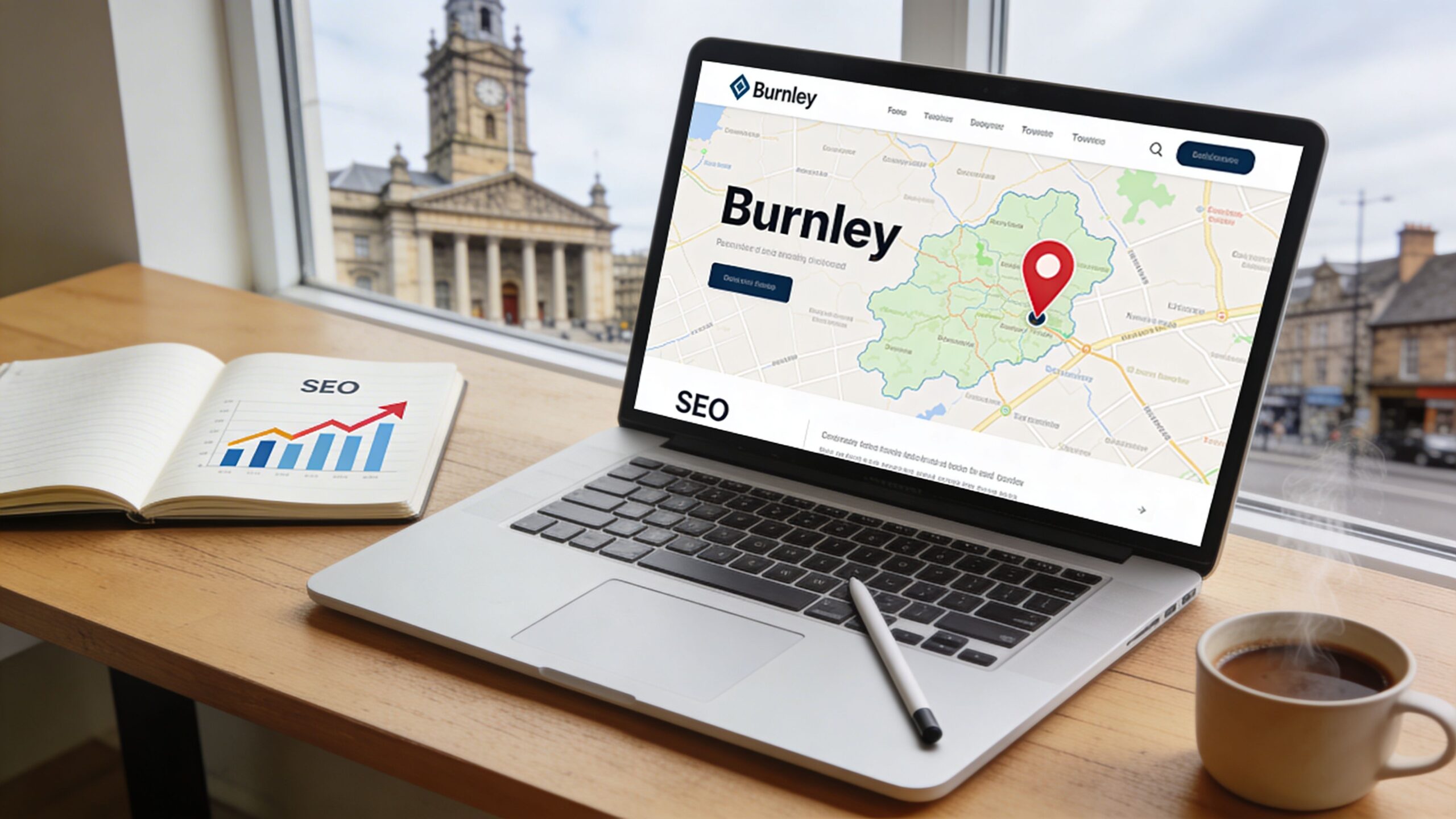

A lot of Burnley business owners are in the same position. The site looks decent, the logo is in place, the phone number is visible, and yet the enquiries do not match the effort that went into building it.
That usually happens because the website was treated like a digital brochure. It was designed to exist, not to perform. In practice, a business website needs to do three jobs at once. It needs to build trust, rank locally, and turn visitors into calls, form submissions, or booked appointments.
That gap matters in website design burnley projects. Reviews of Burnley web design results show a common pattern. Agencies talk about appearance, responsiveness, and general SEO, but they rarely explain how design decisions affect local visibility. The same review notes that 76% of mobile searches have 'near me' intent (webdesign-burnley.co.uk). If your site is missing the right page structure, local relevance signals, and integration with your Google Business Profile, it can look polished and still fail where it counts.
Your Website Isn't a Brochure It's a Lead Generation Machine
A local customer rarely lands on your website by accident. They usually arrive with intent. They need a quote, they want opening times, they are comparing providers, or they are deciding whether to trust you enough to make contact.
That changes how a site should be designed.
A brochure site focuses on you. A lead generation site focuses on the decision the visitor needs to make. Those are not the same thing. One lists services. The other removes friction, proves relevance, and gives the visitor a clear next step.
What a brochure-style site gets wrong
Most weak local websites share the same faults:
- They hide the commercial intent: The visitor cannot quickly see what you do, where you work, and who you help.
- They bury key actions: Contact forms sit on one page, phone numbers on another, and there is no clear path to enquire.
- They ignore local search signals: No location-specific service pages, weak heading structure, and no clear geographic relevance.
- They confuse design with strategy: Nice visuals cover up poor messaging and weak page architecture.
These problems are common because many design projects start with colours and layouts instead of business outcomes.
A Burnley business website should answer four questions fast. What do you do, where do you do it, why should someone trust you, and what should they do next?
The missing link between design and local SEO
Many projects go off course here. Local SEO is often treated as something that happens after launch. In reality, the design phase controls much of the foundation.
Navigation affects crawlability. Page templates affect how easily you can target service and area terms. Internal linking affects how authority flows through the site. The placement of trust signals affects conversion. Even your contact page can help or hurt local performance depending on how clearly it presents your business details.
For a Burnley trades firm, clinic, venue, or professional service, the right site is not just attractive. It is structured to win local intent. That means the site should support Google Maps visibility, organic local rankings, and enquiry conversion from day one.
Why a Burnley-Focused Designer Is Your Secret Weapon
A designer who understands Burnley brings more than convenience. They understand how local customers search, how local competitors position themselves, and what people in East Lancashire expect when they land on a business website.
That matters because context shapes conversion. A site for a Burnley accountant should not feel like a template built for a London startup. A local gym, dentist, builder, or wedding supplier needs messaging, page structure, and trust elements that fit the local market.

Local knowledge changes the brief
A Burnley-focused partner tends to make better decisions early. They are more likely to ask practical questions such as:
- Which nearby towns matter most: Padiham, Nelson, Accrington, Blackburn, or a wider Lancashire footprint.
- How customers usually make contact: Phone first, form first, or an in-person visit.
- What trust signals carry weight locally: Reviews, trade accreditations, community presence, or case examples.
- Whether the site needs booking, quote requests, or location-led landing pages: These decisions affect the whole build.
A generic designer can still build a nice site. A locally aware one is more likely to build a useful one.
Burnley Leisure shows what strategic redesign can do
A strong local example comes from Burnley Leisure. In 2019/20, Cornerstone DM delivered a rebrand and website redesign that led to an 18% increase in web sessions, 19,000 new users in the first year, and an 85% increase in total sessions (Cornerstone DM's Burnley Leisure project). That is the kind of result that shifts a website from passive asset to active growth channel.
The useful lesson is not “copy that design”. It is understanding why the project worked. The site combined UX, SEO tooling, and integrations that supported how people used the service. Strategy and design were built together.
The advantage is not only visual
A local designer should also understand where website design overlaps with search performance. That includes service-area page structure, stronger calls to action, and how the website supports broader visibility work. If you want a clearer view of how search strategy fits into growth, Bare Digital outlines that wider process in its SEO services in Peterborough page, even though the same thinking applies to local businesses elsewhere.
The main point is simple. Burnley businesses do better when the person designing the website understands the market the website has to win in.
How to Find and Vet Your Ideal Web Design Partner
Hiring a web designer should feel more like choosing a business partner than buying a logo. The wrong fit creates delays, muddled messaging, and a site that looks finished but never becomes commercially useful.
The right fit usually shows up in the questions they ask before they show you anything visual.
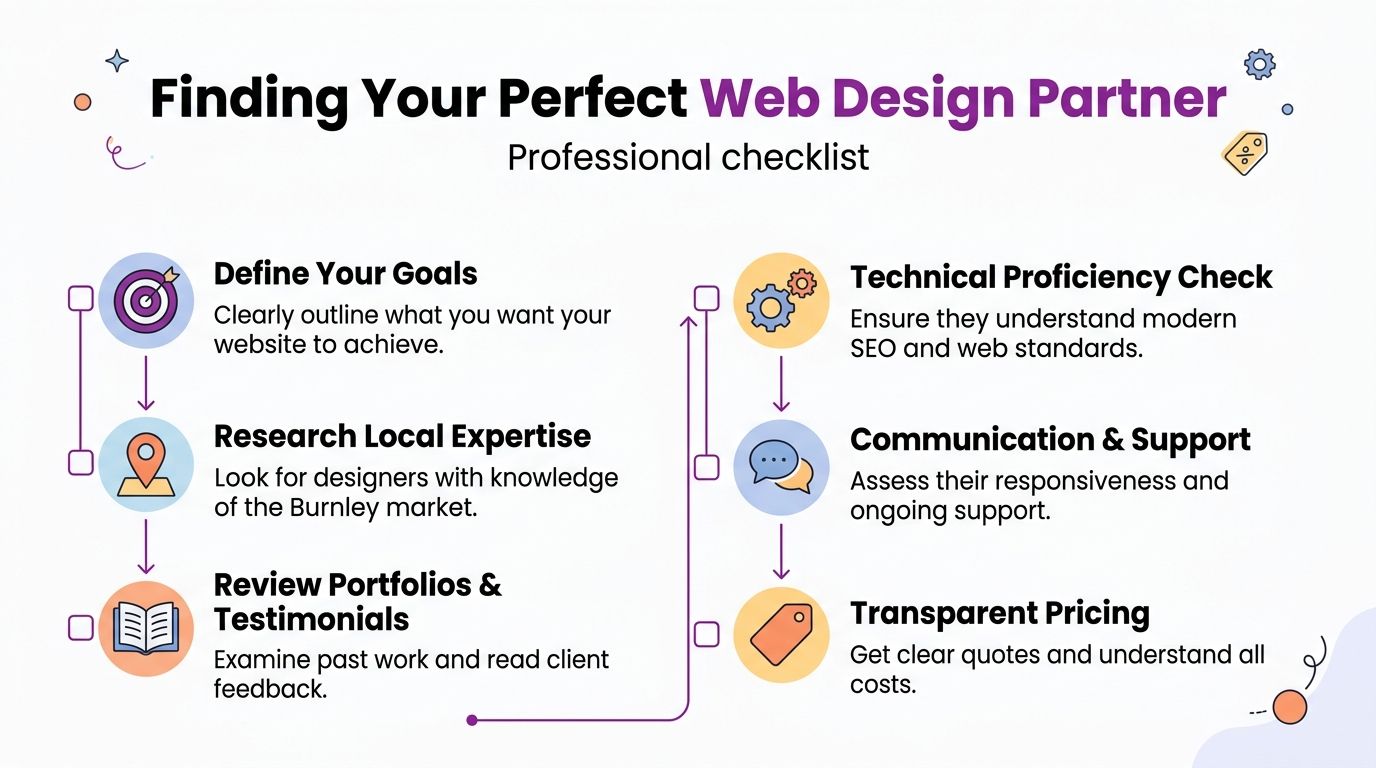
Start with your business goals
Before you compare agencies, define what success looks like.
If you cannot state that clearly, every proposal will sound reasonable and none will be easy to judge.
Use a short list:
- Primary goal: More phone calls, more quote requests, more bookings, or better quality leads.
- Target geography: Burnley only, East Lancashire, or multiple towns.
- Key services: The services that drive revenue, not every minor offering.
- Operational constraints: Who updates the site, who handles leads, and whether you need integrations.
- Commercial priorities: Speed to launch, long-term scalability, or lower maintenance.
If you want a simple outside reference on what small firms often need from a build, this overview of small business website design services is useful because it frames the basics in practical terms.
Look past the homepage in the portfolio
A polished homepage tells you very little on its own.
Open the portfolio pieces and inspect the inside pages. Check service pages, contact pages, mobile layouts, blog structure, and page speed behaviour. If all the examples look stylish but vague, that is a warning sign.
Look for evidence of these things:
- Clear page hierarchy: Service, location, about, proof, and contact pages should all have a defined role.
- Strong calls to action: Not just “learn more” but actual next-step prompts.
- Mobile usability: Tap targets, readable text, sticky contact options where appropriate.
- Content structure: Headings that support scanning and search visibility.
- Signs of maintenance thinking: Editable sections, room for future pages, and sensible CMS choices.
Ask better questions in the sales call
Most business owners ask “How much?” too early and “How do you work?” too late.
Use questions that expose process and judgement.
Questions about process
- How do you decide site structure before design starts?
- What do you need from me to write the copy or guide it?
- How do you handle revisions when feedback conflicts with conversion goals?
Questions about local SEO understanding
- How will the build support location-specific visibility?
- Do you plan service-area pages, schema, and Google Business Profile alignment during the build?
- How do you approach internal linking for service and town pages?
Questions about technical standards
- What CMS do you recommend and why?
- How do you handle image optimisation, redirects, forms, and tracking setup?
- What happens if the site slows down after launch or a feature breaks?
Questions about support
- Do you offer post-launch maintenance or training?
- Who owns the website, content, and accounts?
- How quickly do you usually respond to support requests?
If a designer talks only about branding, mock-ups, and inspiration boards, keep pushing. A business website needs commercial answers, not only creative ones.
Compare partners on decision quality, not charm
A good proposal should make trade-offs explicit. For example, a custom design may improve flexibility but increase content demands. A simpler build may launch faster but leave less room for future landing pages.
That honesty is a good sign.
A practical shortlist often comes down to three questions:
| Decision area | Strong answer looks like | Weak answer looks like |
|---|---|---|
| Strategy | Tied to enquiries, local intent, and site structure | Focused mostly on style |
| SEO readiness | Build includes local relevance and on-page basics | SEO deferred until later |
| Support | Clear ownership, training, and next steps | Vague “we can help if needed” |
If you are at the stage where you want to compare approaches with a specialist, use a direct enquiry route like Bare Digital's contact page. The point is not to collect endless quotes. It is to have a sharper conversation with the right people.
Decoding the Technical and SEO Must-Haves for 2026
Most technical website advice sounds more complicated than it is. For a Burnley business owner, the useful question is simpler. Does the build help people find you, use the site easily, and contact you without friction?
If the answer is no, the technical stack is not working hard enough.

Mobile-first is now the baseline
Your customers are not reviewing your site on a large office monitor with unlimited patience. They are checking it on a phone between tasks, comparing options quickly, and deciding whether it feels trustworthy.
That means the mobile version should not be a squeezed-down desktop layout. It should be the priority version.
Check for these basics:
- Fast access to contact options: Click-to-call, visible forms, clear directions.
- Readable text: No tiny fonts or dense paragraphs.
- Usable navigation: Menus should be short, obvious, and thumb-friendly.
- Focused page sections: One message per section, not clutter.
Speed, file size, and sustainability all overlap
Technical quality becomes visible in business terms here. A slow site wastes clicks, especially on local intent searches where the visitor can switch to a competitor in seconds.
Burnley FC provides a useful local benchmark. Consider Digital found its website had the lowest carbon footprint in the Premier League at 0.398 grams of CO2 per page view, supported by technical choices such as WebP image optimisation and efficient file sizes (Consider Digital's Premier League website carbon analysis). Those same choices also support speed and search performance.
That is the practical takeaway. Cleaner assets, lighter pages, and fewer bloated scripts tend to improve both user experience and technical SEO.
Ask your designer what they will remove, not just what they will add. Fast websites usually come from restraint.
Your CMS should be easy to live with
A site can be technically impressive and still fail if your team cannot update it.
For most SMEs, a sensible CMS matters because you will need to edit service pages, add testimonials, post updates, and create local landing pages without opening a support ticket for every small change. WordPress is common for that reason, but the main issue is not the platform name. It is whether the backend is set up cleanly.
Good setup includes:
- Editable page sections that do not break the design
- Sensible templates for services, locations, and articles
- Permission control if multiple staff need access
- Tracking and forms configured properly from launch
If you need help spotting technical faults during review or after launch, these website debugging tools are a helpful reference point.
A short explainer can also help teams understand what performance reporting is trying to show:
The local SEO elements that must be built in
This is the part many builds leave too late.
Your designer should already be thinking about title tags, heading structure, internal linking, local business details, and crawlable content blocks. If those are bolted on afterwards, the site often ends up fighting its own structure.
For a practical benchmark of what should be checked, Bare Digital provides a local SEO checklist covering the on-page and local signals many businesses miss.
Setting a Realistic Budget Timeline and Brief
Most website projects go wrong before the first design draft. The budget is unclear, the timeline is assumed, and the brief is too vague to guide good work.
That creates a familiar cycle. You get quotes that are impossible to compare, the project starts with guesswork, and revisions drag on because nobody defined the outcome properly.
Budget is really about scope
The price of a website depends less on the industry and more on the complexity of the job.
A simple brochure-style site for a single service business will usually involve fewer templates, fewer content demands, and less integration work than a site with booking flows, advanced forms, ecommerce, or multi-location landing pages. That is why two “website design burnley” quotes can look miles apart while both are reasonable.
A useful way to frame budget discussions is by asking what is included in each quote:
| Scope area | Lower-complexity build | Higher-complexity build |
|---|---|---|
| Page count | Core pages only | Service, area, and conversion pages |
| Copy support | Light editing | Messaging strategy and structured copy |
| Functionality | Basic forms and brochure content | Booking, ecommerce, CRM, or custom features |
| SEO setup | Basic on-page essentials | Broader local search support baked into templates |
| Post-launch help | Short handover | Ongoing support and iteration |
If a quote looks cheap, check what has been left out. It is often content, technical setup, redirects, analytics, or support after launch.
Timelines depend on decision speed
Business owners often ask how long a website takes. The honest answer is that internal bottlenecks usually matter as much as the agency.
A build tends to slow down when:
- Content is not approved: Service descriptions, bios, and proof points stay in draft.
- Feedback comes from too many people: Every revision creates new opinions.
- The brief changes mid-project: New pages and functions appear after design sign-off.
- Nobody owns the launch process: Forms, tracking, and contact routing are left until the end.
The fastest projects are not the ones with the biggest team. They are the ones with a clear decision-maker and a tight brief.
Write a brief your designer can use
A strong brief does not need to be long. It needs to be specific.
Include these points:
- Business overview: What you do and who you serve.
- Main services: Prioritised by commercial importance.
- Target locations: Burnley plus any surrounding towns you want to target.
- Main goal: Calls, enquiries, bookings, or a mix.
- Website must-haves: Forms, testimonials, galleries, landing pages, integrations.
- Examples you like: Not to copy, but to show preference.
- Practical constraints: Deadline, team availability, existing brand assets.
Here is a simple example for a fictional local firm.
Example brief for a Burnley service business
Business: Burnley-based roofing contractor serving homeowners and landlords.
Primary goal: Generate qualified quote requests for repair work and full roof replacements.
Priority services: Roof repairs, flat roofing, emergency callouts, guttering.
Target areas: Burnley first, then nearby towns where travel time is still commercially viable.
Audience concerns: Trust, speed of response, proof of previous work, whether the company is local.
Must-have pages: Home, core service pages, area pages, reviews, gallery, about, contact.
Must-have features: Quote form, click-to-call on mobile, clear service-area messaging, easy gallery updates.
Success measure: Better quality enquiries and a site structure that supports long-term local SEO.
If you want to connect site investment to commercial return, tools like Bare Digital's self storage ROI calculator for SEO show the broader logic behind measuring marketing value, even if your sector is different.
Beyond Launch Your Website's Role in Local Search Dominance
Launch day is not the finish line. It is the point where the website starts doing its real job.
A new site can look far better than the old one and still underperform if nobody connects it to local search activity. The website should become the centre of your local visibility system, not a stand-alone asset.
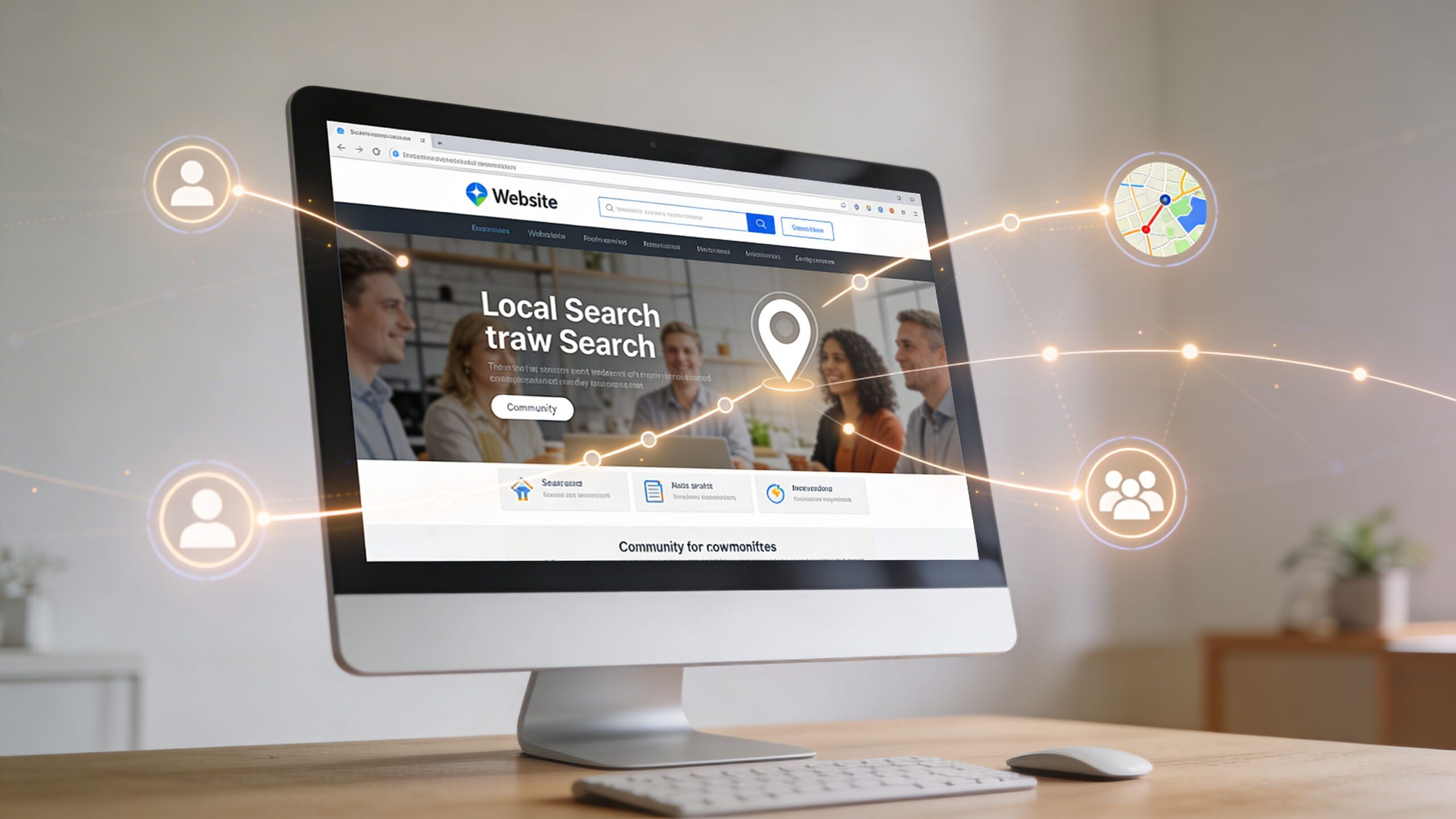
Connect the site properly to your Google Business Profile
One of the first jobs after launch is alignment.
Your business name, address, phone number, opening information, and website URL should match across your website and your Google Business Profile. Inconsistent details create confusion for both users and search engines.
Key actions:
- Use the correct landing page: Do not always send profile traffic to the homepage if a service page is more relevant.
- Match business details carefully: Keep naming and contact details consistent.
- Carry the same categories and service language through the site: The wording should support, not contradict, your local profile.
- Make contact details easy to verify: Footer, contact page, and profile should line up.
If you need to assess that local profile properly, Bare Digital has a Google Business Profile audit tool that can help identify gaps.
Build location relevance page by page
Many local businesses stop at one services page and hope Google works the rest out. It usually does not.
If you serve more than Burnley itself, create useful pages around actual service demand. That may include nearby towns, distinct service categories, or pages built around specific commercial intent. The important part is relevance. Thin, duplicated location pages usually create clutter rather than value.
A stronger local content setup often includes:
- Core service pages: One page per main revenue-driving service.
- Location pages where justified: Built around real coverage and local intent.
- Proof content: Testimonials, case examples, and FAQs that reduce hesitation.
- Support content: Articles that answer pre-sale questions and strengthen trust.
Reviews and enquiry handling matter as much as rankings
A website can win the click and still lose the customer if the follow-up is weak.
Make review generation part of your operating process. Ask satisfied customers consistently, direct them to the right platform, and reflect that proof back onto the website where appropriate. Then make sure enquiries are handled quickly and clearly. Fast response, clear next steps, and simple forms often do more for revenue than another design revision.
Good local websites are not only built well. They are maintained, expanded, and connected to the way the business wins work.
The long-term advantage comes from iteration. Add pages where demand is clear. Improve calls to action where users hesitate. Refresh service content when priorities change. Treat the website as a live sales asset, and it will keep earning its place.
If you want a website that supports local rankings as well as conversions, Bare Digital can help you assess where your current site is falling short and what needs to change. The useful starting point is not a redesign for its own sake. It is a clearer plan for turning your site into a stronger source of local enquiries.