

You’re probably in one of two situations.
Either you’ve been paying a monthly SEO retainer for a while and still can’t tell whether it’s driving real enquiries, or you’ve had enough pitches full of rankings, audits, and jargon that never seem to turn into booked jobs. The report arrives. It mentions impressions, visibility, and “ongoing optimisation”. Your phone doesn’t ring more. Your sales team doesn’t feel a difference. You’re left wondering what, exactly, you paid for.
That frustration is why more UK business owners are asking harder questions. Not “How many hours will you spend?” but “What happens to my leads, booked calls, and sales if I hire you?” That shift matters. It changes SEO from a vague marketing cost into a commercial agreement with proper accountability.
For local and multi-location businesses, that matters even more. A wedding venue doesn’t need abstract traffic. It needs brochure requests from couples in the right counties. A construction firm needs calls from people in serviceable postcodes. A care provider needs visibility town by town, not a nice graph with no commercial value.
Tired of Paying for SEO Promises Not Results
A typical story goes like this.
A plumbing company in the Midlands pays a fixed monthly fee. Six months later, the agency has delivered blog posts, title tag updates, and a ranking report covering broad keywords the owner never asked for. There’s activity everywhere, but no direct line from that activity to booked work. The owner isn’t against SEO. He’s against paying for mystery.
That’s where performance based seo starts to sound sensible.
Instead of paying only for effort, you agree what success looks like before work starts. That might be qualified contact form submissions from specific towns. It might be Google Business Profile calls. It might be revenue from organic search landing pages. The point is simple. The commercial model follows the business outcome.
Why the old model often creates friction
A fixed retainer isn’t automatically bad. Plenty of good agencies use retainers well. The problem comes when the contract rewards output that’s easy to produce instead of outcomes that matter to you.
Common complaints sound familiar:
- Too much reporting, not enough meaning: You get a dashboard, but no plain answer about leads or sales.
- Busy work replaces priorities: Content gets published because content was in the plan, not because it targets buying intent.
- No shared risk: You pay the same whether results move or not.
- Success stays fuzzy: “Improvement” gets discussed, but never properly defined.
If an agency can’t explain how SEO turns into enquiries in your business, you don’t have a strategy. You have a task list.
For sceptical owners, a results-led model feels more like hiring a salesperson than hiring a supplier. You want somebody invested in outcomes, not somebody comfortable billing while progress stays hard to verify.
That doesn’t mean every performance arrangement is fair, safe, or realistic. Some are excellent. Some are dressed-up promises. But as a concept, it answers a real frustration in the market.
If you want a quick sense of what SEO needs to produce commercially, a tool like this self-storage ROI calculator for SEO is useful because it pushes the conversation away from “traffic” and towards return.
What Performance Based SEO Really Means
Performance based seo is a commercial agreement where some or all of the agency’s fee is tied to pre-agreed outcomes.
That’s the key point. It’s not a specific SEO tactic.

An agency might still do technical SEO, on-page work, Google Business Profile optimisation, schema, internal linking, and content. What changes is the deal structure. Payment is linked to results both sides agreed in advance.
A simpler way to think about it
Think about the difference between these two hires:
- A salesperson paid the same salary whether they sell or not.
- A salesperson paid partly on commission when revenue comes in.
Most business owners instantly understand why the second model changes behaviour. The same principle applies here.
Core shift: You’re moving from paying for SEO activity to paying for SEO outcomes.
That doesn’t mean the agency only gets paid if you become number one for everything. Good agreements are more practical than that. They usually combine a base fee, clear milestones, and a variable element linked to performance.
What counts as performance
People often get confused. “Performance” can mean very different things depending on the business.
For a local service company, sensible KPIs might include:
- Qualified enquiries: Calls or forms from service areas you cover
- Google Business Profile actions: Calls, direction requests, and website visits from local intent
- Organic conversions: Leads from non-paid search landing pages
- Map Pack visibility: Stronger presence for high-intent area terms
For a multi-location business, KPIs often get more specific:
- Location page performance: Each branch or town page is measured separately
- Postcode-level lead quality: Not all traffic matters equally
- Brand and non-brand split: Growth should not come only from people already looking for you
- Cross-location consistency: One branch ranking well doesn’t solve a network problem
If you want a broader primer on how agencies structure SEO pay-for-performance models, that resource gives useful context before you compare proposals.
Why business owners like the idea
It feels fairer because the agency has skin in the game. It also forces better conversations at the start.
You can’t set a performance deal without agreeing:
- what a lead is
- how it’s tracked
- which locations count
- how attribution works
- when payment becomes due
That early clarity is healthy. Even if you don’t choose a full performance model, it exposes weak proposals quickly.
A practical first step is to review your local visibility before discussing terms. A basic Google Business Profile audit tool can help you spot whether the core issue sits in Maps visibility, local relevance, or conversion friction.
Exploring Common Pricing and Payment Models
There isn’t one single version of performance based seo. There are several. Each shifts risk in a different way.
Some work well for local lead generation. Others suit businesses with clean revenue attribution. Problems usually start when the pricing model doesn’t match the sales model.
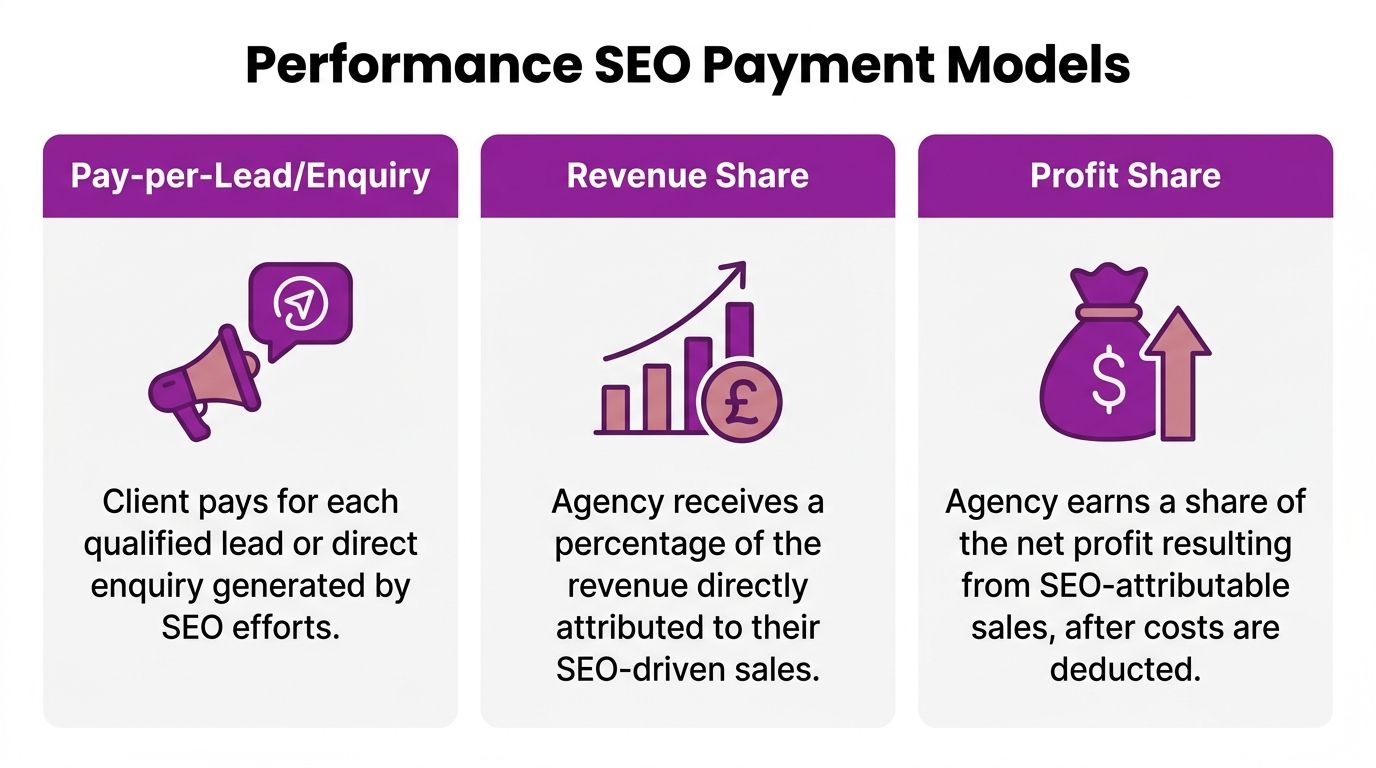
Pay per lead or enquiry
This is the easiest model for most service businesses to grasp.
The agency gets paid when SEO generates a lead that matches the contract definition. That might mean a phone call over a set duration, a contact form from a target area, or a booking request for a specific service.
This model often suits:
- trades
- architects
- wedding venues
- care providers
- local professional services
It tends to work best when sales happen offline but the enquiry itself can be tracked clearly.
The catch is qualification. If your agency says, “We sent ten leads,” and your team says, “Half were rubbish,” the contract needs a rule for that. Without one, the relationship goes sour fast.
Revenue share
Revenue share is more direct. The agency earns a percentage of revenue from SEO-attributed sales.
This is cleaner when transactions happen online or when a CRM can reliably connect organic search to closed revenue. It can also work for high-ticket local businesses with disciplined sales tracking.
What makes it attractive is alignment. If the agency helps you increase actual sales, both sides benefit. What makes it difficult is attribution. A customer might discover you through search, return via direct traffic, then convert after a phone call. Who gets credit?
For that reason, revenue share usually works best when tracking is mature and both sides trust the data.
Profit share
Profit share sounds appealing because it focuses on margin, not just top-line sales.
In practice, it’s the hardest model to manage. Agencies usually don’t control your operational costs, fulfilment efficiency, or sales team performance. If profit drops because your internal costs rise, the SEO provider may feel penalised for something outside their control.
This can work in a very transparent partnership, but it needs strong financial reporting and a clear definition of profit. For many local businesses, that level of detail becomes more hassle than it’s worth.
Rank based or hybrid deals
Some proposals tie payment to ranking positions, often around Google Maps or local organic results. Others use a hybrid model, mixing a base retainer with bonuses for hitting agreed targets.
Hybrid agreements are often the most sensible middle ground.
They acknowledge a basic truth. SEO work still takes time and effort before results show. A base fee covers core execution. The performance element rewards delivery once measurable gains arrive.
A pure pay-on-results promise can sound attractive, but a well-built hybrid often creates better behaviour on both sides.
Performance SEO Pricing Models Compared
| Model | How It Works | Best For | Primary Risk |
|---|---|---|---|
| Pay-per-Lead | Client pays when SEO generates a lead that matches agreed criteria | Trades, venues, local services, consultative businesses | Disputes over lead quality |
| Revenue Share | Agency earns a share of revenue attributed to organic search | E-commerce, bookable services, businesses with strong CRM tracking | Attribution confusion |
| Profit Share | Agency earns a share of profit from SEO-attributed sales | High-trust partnerships with detailed finance visibility | Profit is influenced by many factors outside SEO |
| Rank-Based | Payment triggered by agreed rankings or Map Pack positions | Businesses focused on local visibility goals | Rankings alone may not equal revenue |
| Hybrid | Lower base fee plus bonuses for outcomes | Most UK local and multi-location businesses | Requires precise contract drafting |
Which model usually fits UK local businesses
For many UK service firms, the best fit is often one of these two:
- Lead-based model: Useful if your website and GBP generate calls and forms, and your sales cycle starts from an enquiry.
- Hybrid model: Better if you want accountability without forcing everything through a single metric.
A funeral home, for instance, may care about call quality and review strength. A construction firm may care about postcode-specific enquiries. A wedding venue may value brochure requests first, then show-round bookings. The pricing model should reflect the actual buying journey, not an SEO template.
A practical test before you agree anything
Ask one question.
If performance improves, can both sides prove it using the same data?
If the answer is no, the pricing model is still too loose.
Look for shared access to Search Console, GA4, your call tracking system, and the CRM or booking process where leads become revenue. If those systems don’t line up, pay-per-performance becomes a debate rather than an agreement.
The Pros and Cons A Balanced View
Performance based seo sounds like the obvious answer to a broken retainer model. Sometimes it is. Sometimes it isn’t.
The strongest reason to consider it is alignment. The biggest reason to be cautious is behaviour. When money depends on hitting visible targets, agencies can become very disciplined. They can also become very short-term.
What business owners usually like
The appeal is easy to understand.
First, the goals become clearer. You’re not buying “ongoing optimisation” as a vague service. You’re agreeing what success looks like and how it will be measured.
Second, the model can reduce early risk. That matters if you’ve already paid for SEO that felt impossible to verify.
Third, reporting tends to improve. It has to. If fees depend on outcomes, the numbers need to be transparent enough for both sides to trust them.
Benefits often include:
- Better commercial focus: Leads and sales stay central
- Stronger accountability: The agency can’t hide behind activity
- Easier internal justification: It’s simpler to explain to directors or partners why the spend exists
- Clearer decision-making: You can tell faster whether the relationship is working
Where things can go wrong
The most common risk is target chasing.
If an agency is rewarded only for visible wins, they may focus on the easiest keywords, the easiest locations, or tactics that create movement without building a durable asset. You can end up with rankings that look good on paper but don’t produce the right enquiries.
A second risk is attribution friction. SEO rarely operates in a sealed box. Prospects may find you through search, then convert later through branded search, direct traffic, or a phone call after reading reviews. If the contract handles attribution badly, arguments are almost guaranteed.
A third risk sits in lead quality. A form submission isn’t always a sales opportunity. If “qualified lead” isn’t tightly defined, the agency and client can look at the same batch of enquiries and reach opposite conclusions.
Some performance contracts don’t fail because SEO failed. They fail because the definitions were sloppy.
The black-hat concern is real
This deserves plain language.
If an agency promises dramatic results fast and only gets paid when those results appear, it has an incentive to take shortcuts. That can mean manipulative links, spammy location pages, or aggressive tactics around business profiles and reviews. Those methods can create short bursts of movement and long-term risk.
That doesn’t mean performance models are unsafe by nature. It means the contract should reward sustainable outcomes, not vanity wins.
A safer agreement usually includes signs of quality, such as:
- Shared access to data: No hidden reporting
- Reasonable timelines: No fantasy deadlines
- Business-linked KPIs: Not just rankings in isolation
- Method transparency: The agency explains what it will do
When it’s a poor fit
Sometimes a standard retainer with good reporting is better.
That can be true if:
- the business is brand new and has no baseline data
- the service is very seasonal
- sales attribution is messy
- the business has long offline buying cycles
- internal lead handling is inconsistent
In those cases, a pure performance model can become unfair to both parties. SEO may be doing useful work, but the measurement environment is too noisy to support a clean outcome-based deal.
The best decision isn’t “performance is always better”. It’s “which pricing structure creates the fairest incentives for this business, with this tracking setup, in this market?”
How Performance Models Work for Local UK Businesses
For local SEO in the UK, performance based seo gets interesting when you stop talking about broad rankings and start talking about geography, intent, and branch-level commercial outcomes.
A roofer in Leeds doesn’t need more traffic from Manchester. A home care provider with several branches doesn’t need one strong location page and five weak ones. A wedding venue doesn’t need empty visibility for generic terms if the people arriving aren’t planning a visit.

Local KPIs have to match local buying behaviour
For a local business, good KPIs usually sit close to the actual customer journey.
Examples help:
- Wedding venue: Brochure downloads, viewing requests, and calls from target counties
- Construction firm: Enquiries from serviceable postcodes and “near me” search visibility in priority towns
- Architect: Qualified consultation requests from higher-value local projects
- Home care provider: Branch-specific Map Pack visibility and enquiries by town
- Funeral home: Calls, direction requests, and review quality handled with care and compliance
That’s why UK local businesses often need more than a generic “traffic growth” target. They need location intent built into the agreement.
Why this matters more in the UK market
One useful data point highlights the gap. In the UK, only 18% of creative agencies report using performance pricing, yet agencies with KPI-tied models saw 40% higher client retention in competitive sectors like wedding photography. The same source notes that top-3 Google Maps positions became 25% more influential in local search following Google’s 2025 proximity updates (kylegoldie.com).
That matters beyond photography. It suggests many UK businesses still buy local SEO on old terms, even as Maps visibility becomes more commercially important.
For a local service business, the most valuable ranking often isn’t a national keyword. It’s the search that happens a few miles from your office when somebody is ready to act.
Multi-location businesses need branch-level contracts
A multi-location agreement should never be measured only at brand level.
If you run clinics, care branches, funeral homes, or regional trade depots, each location has its own competitive environment. One town may perform strongly because the branch already has reviews and local authority. Another may lag because the page is thin, the profile is neglected, or nearby competitors are stronger.
That changes how performance should be written into the deal.
A sensible local or multi-location contract may include:
- Location-specific goals: Each branch has named KPIs
- Area terms and “near me” intent: Search behaviour is mapped to actual service zones
- Google Business Profile actions: Calls, website visits, and direction requests are measured
- Review signals: Especially important in trust-heavy sectors
- Landing page quality: The branch page must convert, not just rank
For businesses trying to map those basics before speaking to agencies, a practical local SEO checklist helps identify what needs tracking at branch and postcode level.
Review management belongs in the conversation
This gets overlooked in generic guides.
For some UK sectors, especially regulated or high-trust services, reviews aren’t a side issue. They shape conversion quality and local prominence. If the performance model ignores review generation, review freshness, and how those reviews are handled within compliance boundaries, the contract may miss a major driver of local results.
That’s why local performance agreements often work best when they combine three layers:
- Visibility outcomes such as Maps presence and local organic reach.
- Engagement outcomes such as calls, forms, and direction requests.
- Trust outcomes such as review growth, response quality, and profile completeness.
When those layers are tied together, the model looks less like a marketing gamble and more like operational growth management.
Evaluating a Performance Based SEO Proposal
A performance proposal should make you feel clearer, not more dazzled.
If you finish reading it and still can’t tell what triggers payment, what data decides success, or what happens when quality is disputed, the document isn’t protecting you. It’s protecting the agency.

What a solid contract should include
For UK local businesses, technical performance can’t be separated from commercial performance. A strong agreement should tie payments to measurable technical improvements. For example, ensuring all Core Web Vitals pass, especially Interaction to Next Paint at under 200ms, can mitigate the 53% abandonment risk from slow mobile load times, where 63.5% of UK local traffic originates. When this is tied to Google Search Console reporting, it can show the link between technical fixes and 15-25% growth in organic traffic from postcode-specific searches (gtm8020.com).
That sounds technical, but the business logic is straightforward. If your site loads poorly and reacts slowly on mobile, local visitors leave before they enquire.
Essential Contract Terms
A proposal worth taking seriously should define these points in writing:
- Lead definition: What exactly counts as a billable lead?
- Location scope: Which towns, postcodes, or branches are included?
- Tracking source: Which tools are the source of truth, such as GSC, GA4, call tracking, or CRM data?
- Payment trigger: Does invoicing happen on lead delivery, monthly validation, or a closed-sale event?
- Dispute process: How are rejected leads or attribution disagreements handled?
- Access rights: Do you keep direct access to analytics and business profile data?
If any of those stay vague, expect trouble later.
Sample KPI ideas that make sense
Good KPIs connect technical work to commercial outcomes.
That could include:
- Passing CWV thresholds: Particularly where mobile engagement is weak
- Implementing LocalBusiness schema: Useful when local landing pages support GBP visibility
- Improved visibility for target area terms: Especially for service + town combinations
- Higher quality local enquiries: Defined by geography and service match
- Better conversion on branch pages: Calls, forms, bookings, or brochure requests
Notice what’s missing. “More traffic” on its own. That’s not enough.
If the KPI doesn’t connect to a sale, a sales opportunity, or a buying signal, it’s the wrong KPI for a performance contract.
Red flags that should slow you down
Watch for these.
- Guaranteed rankings with no caveats: Search is too dynamic for reckless promises.
- No direct analytics access: If the agency owns the numbers, it controls the story.
- Payment based on vague terms: “Improved visibility” is not a contract standard.
- No mention of lead quality: A pile of poor enquiries can still hit a target if the definition is weak.
- No technical baseline: If they don’t audit the site first, they’re guessing.
If you want a better sense of what transparent reporting should look like before signing anything, Mastering Local SEO Reports That Win Clients is a useful reference because it shows how reporting can support trust instead of creating fog.
Ask to see the reporting format first
Don’t wait until month two.
Ask the agency to show the exact dashboard or report template before you sign. You want to know what data you’ll receive, how often, and in what language. Plain English beats decorative charts.
A useful report usually answers:
- What changed?
- Why did it change?
- Did that produce more qualified demand?
- What gets done next?
If you’re reviewing proposals, seeing an example GBP report can help you judge whether a local SEO provider understands the difference between profile activity and actual commercial traction.
Your Next Steps to Finding the Right SEO Partner
If you’re considering performance based seo, don’t start by comparing agency promises. Start by tightening your own numbers.
Step one, know your baseline
You need a before picture.
Check your current organic traffic, Google Business Profile actions, enquiries by location, lead quality, and how many of those leads turn into sales. If you don’t know the baseline, no future “performance” claim will be easy to test.
Step two, choose one business outcome that matters most
Not ten. One.
For a trade business, that might be qualified calls from key postcodes. For a venue, it may be brochure requests. For a multi-location service brand, it may be branch-level Google Maps visibility linked to enquiries.
That single outcome keeps the conversation grounded. It stops SEO from drifting into a list of activities that look impressive but don’t change the business.
Step three, prepare your questions before you speak to agencies
Write them down and ask them in plain language.
Useful questions include:
- How do you define a qualified lead?
- Which tool decides whether a result happened?
- What happens if rankings improve but lead quality doesn’t?
- Which tasks are included before performance payments start?
- How will this be measured by branch or postcode?
The right agency won’t be irritated by those questions. They’ll welcome them, because clear expectations make better contracts.
If you’re ready to have that conversation with a UK local SEO specialist, the simplest next step is to contact Bare Digital and ask for a plain-English discussion about tracking, KPIs, and whether a performance model fits your business at all.
Frequently Asked Questions About Performance SEO
Is performance based seo always more expensive than a retainer?
Not always. It can cost more if the agency delivers strong commercial outcomes and shares in that upside. But that isn’t automatically a bad deal. Paying more for profitable growth is different from paying less for unclear activity.
What happens if results improve, then drop later?
The contract should say. A fair agreement sets review periods, validation windows, and what happens if gains are temporary. Without that, both sides can feel exposed.
Can a brand new business use this model?
Sometimes, but it’s harder. New businesses often lack baseline data, historical rankings, and reliable conversion patterns. A hybrid arrangement is usually safer than a pure pay-on-results deal.
Which tools help prevent disputes?
Use shared systems. Google Search Console, GA4, call tracking, your CRM, and Google Business Profile data all help. The best setup is one where both sides can see the same information without relying on screenshots or selective reporting.
Are rankings enough for a performance contract?
Usually not. Rankings matter, especially in local search, but they should sit alongside lead quality, conversion behaviour, and commercial outcomes. Otherwise you can “win” the KPI and still lose money.
Bare Digital helps UK local and multi-location businesses turn search visibility into measurable enquiries and sales. If you want a transparent conversation about whether performance based seo suits your business, start with Bare Digital and ask for a clear view of the numbers, the KPIs, and the risks before you commit.