

A lot of UK business owners hit the same wall.
You’ve got a site that sort of works. You might be a wedding venue in Yorkshire, a photographer in Manchester, a caterer in London, or a trades firm trying to win enquiries from specific towns and postcodes. You know you need stronger visibility in Google Maps, better mobile performance, and a site that converts local visitors without constant technical firefighting.
Then you search shopify or woocommerce and get flooded with generic advice.
Most of it is written for broad ecommerce brands, not for local UK businesses where the question is simpler. Which platform helps you rank for local intent, support your Google Business Profile, handle UK payment and VAT realities, and turn local searches into calls, bookings, and quote requests?
That’s where the decision gets practical.
Shopify is the managed route. It gives you a hosted ecommerce setup where the platform handles much of the infrastructure. WooCommerce is the flexible route. It runs on WordPress and gives you far more control over how your site behaves, how it’s structured, and how much you can shape it around local SEO.
Neither is “best” in the abstract. The right answer depends on how your business grows.
Before we get into the detail, here’s the short version.
| Area | Shopify | WooCommerce |
|---|---|---|
| Best for | Businesses that want speed, simplicity, and low maintenance | Businesses that want deep SEO control and customisation |
| Hosting | Managed by platform | Your responsibility |
| Local SEO flexibility | Good, but often app-dependent | Excellent, especially for custom location content |
| Speed out of the box | Strong | Variable |
| Security management | Mostly handled for you | You manage updates, plugins, backups, and hosting stack |
| Cost structure | Predictable subscription, plus apps and possible extra gateway fees | Flexible, but can become fragmented with hosting, plugins, and developer time |
| Best fit in the UK | Lean teams, smaller service brands, straightforward ecommerce | Content-heavy, multi-location, technically ambitious local businesses |
The E-commerce Crossroads for UK Businesses
A wedding photographer in Leeds doesn’t need the same platform as a multi-location home care provider in the South East.
That sounds obvious, but most comparison articles flatten those differences. They compare checkout features, templates, and app stores as if every business is trying to solve the same problem. They’re not.
A local UK business usually cares about three things first.
- Visibility: Can the site support rankings for town names, service areas, and “near me” searches?
- Usability: Will mobile visitors stay on the site long enough to enquire, book, or buy?
- Maintainability: Can the business keep the site working without depending on a developer for every small change?
Those priorities change the conversation.
A London caterer might need event menus, postcode-targeted landing pages, local testimonials, and quote forms tied to service areas. A funeral home may need a site that loads quickly on mobile, feels trustworthy, and supports carefully written location pages. A construction company may need service pages for multiple towns, project galleries, and detailed content that builds local authority over time.
That’s why the question isn’t “which platform is better for ecommerce?”
It’s “which platform helps this specific business win more local searches and convert more of the right people?”
Generic platform advice often ignores that local growth isn’t just about adding products. It’s about joining up your site, your Google Business Profile, your location pages, your reviews, and your content strategy. If those pieces don’t fit together cleanly, rankings stall and conversions suffer.
For many businesses, the platform choice gets made too early and for the wrong reason. Someone likes a theme. Someone hears WordPress is better for SEO. Someone else says Shopify is easier. All of those points can be true in isolation and still lead to the wrong decision.
That’s why the better starting point is operational reality.
If your site is central to local lead generation, platform choice is an SEO decision, not just a web design decision.
If you want a broader view of local growth strategy before choosing a platform, it helps to look at how a specialist local SEO agency approaches visibility, content, and conversion together at Bare Digital.
Convenience vs Control The Fundamental Choice
The cleanest way to understand shopify or woocommerce is this.
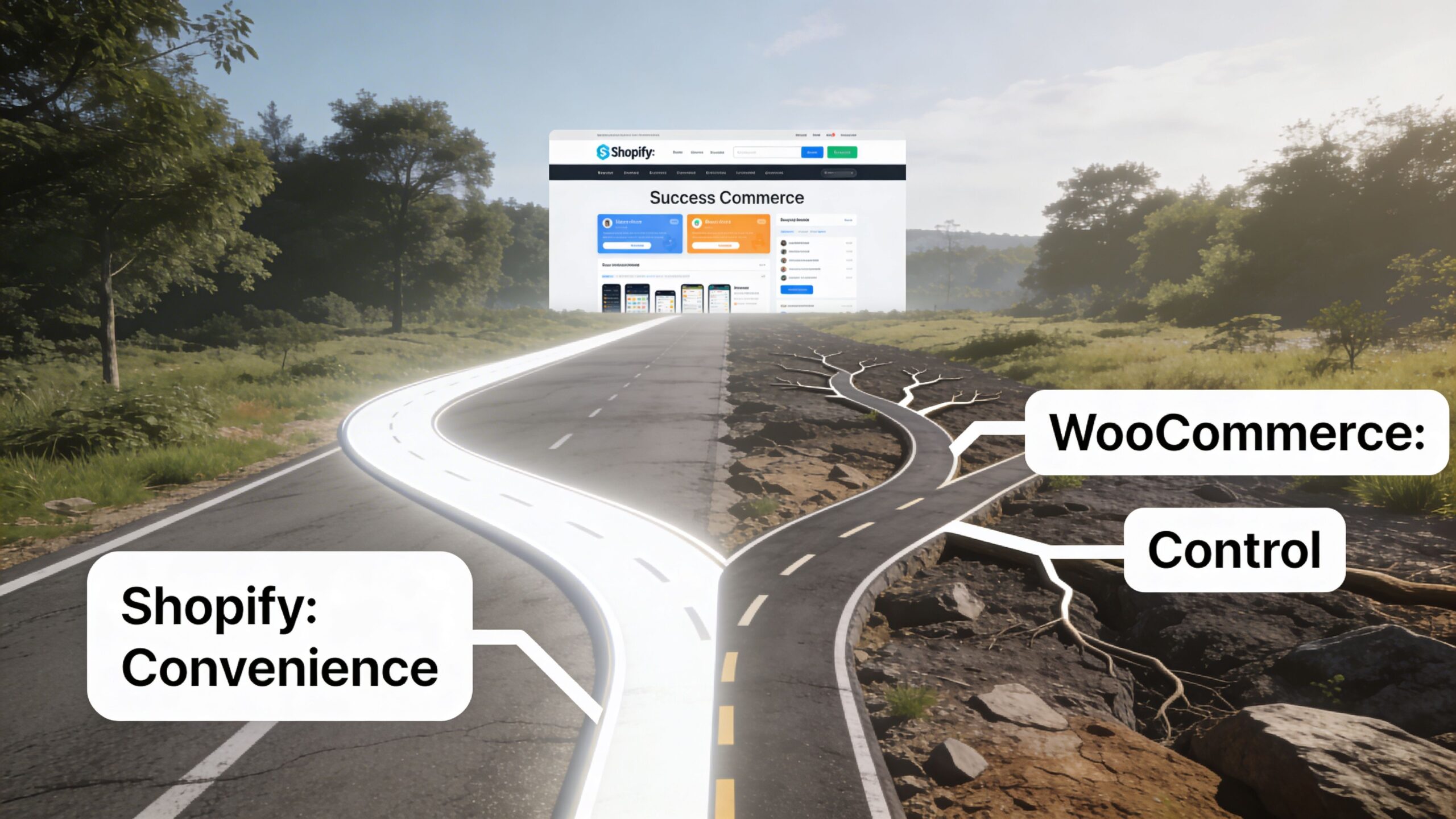
Shopify sells convenience. WooCommerce gives you control.
That trade-off shapes everything else, from SEO flexibility to maintenance workload.
What convenience actually means
With Shopify, you’re renting a well-run premises.
The hosting is handled. Security is handled. Core infrastructure is handled. You log in, configure the store, install apps, choose a theme, connect payments, and get on with trading. That simplicity is why many smaller businesses move faster on Shopify than they ever would on a self-managed setup.
That convenience also comes with limits.
You don’t control the platform at the same depth. You work within Shopify’s architecture, Shopify’s app ecosystem, and Shopify’s way of doing things. For many businesses, that’s a good trade. For others, it becomes frustrating once they need more customised SEO structures, deeper technical changes, or unusual local content layouts.
What control actually means
WooCommerce is different because it sits inside WordPress.
That means you control the hosting, the codebase, the plugins, the data structure, and the content environment. If your business needs bespoke location pages, custom schema, advanced internal linking, or a blog strategy that’s tightly tied to local search intent, WooCommerce gives you far more room to build properly.
It also gives you more responsibility.
Someone has to manage plugin compatibility. Someone has to keep WordPress updated. Someone has to make sure backups run, security is tight, forms work, pages stay fast, and the site doesn’t break after an update.
Practical rule: If your team wants the platform to stay out of the way, Shopify usually fits better. If your business model depends on technical freedom, WooCommerce usually wins.
Why both platforms remain popular
This isn’t a niche debate. Both ecosystems are huge.
Shopify powered 4.82 million stores worldwide by 2024 and recorded $292.3 billion in GMV, according to Charle Agency’s Shopify statistics roundup. That scale matters. It means Shopify is mature, tested, and built around a vast commercial ecosystem.
WooCommerce’s reach is harder to pin down precisely because it’s open-source, but that’s part of its appeal. It attracts businesses that care about ownership, flexibility, and building around WordPress rather than inside a closed platform.
The real-world choice for local businesses
For a UK local business, this convenience-versus-control split affects everyday tasks.
A Shopify site often gets launched faster and maintained with less effort. A WooCommerce site often gives better long-term freedom for local landing pages, postcode targeting, content architecture, and bespoke functionality.
If your business is straightforward, convenience can beat theoretical flexibility you’ll never use.
If your growth depends on local content depth and technical SEO precision, control is often worth the extra management burden.
A Realistic UK Cost Breakdown Beyond the Price Tag
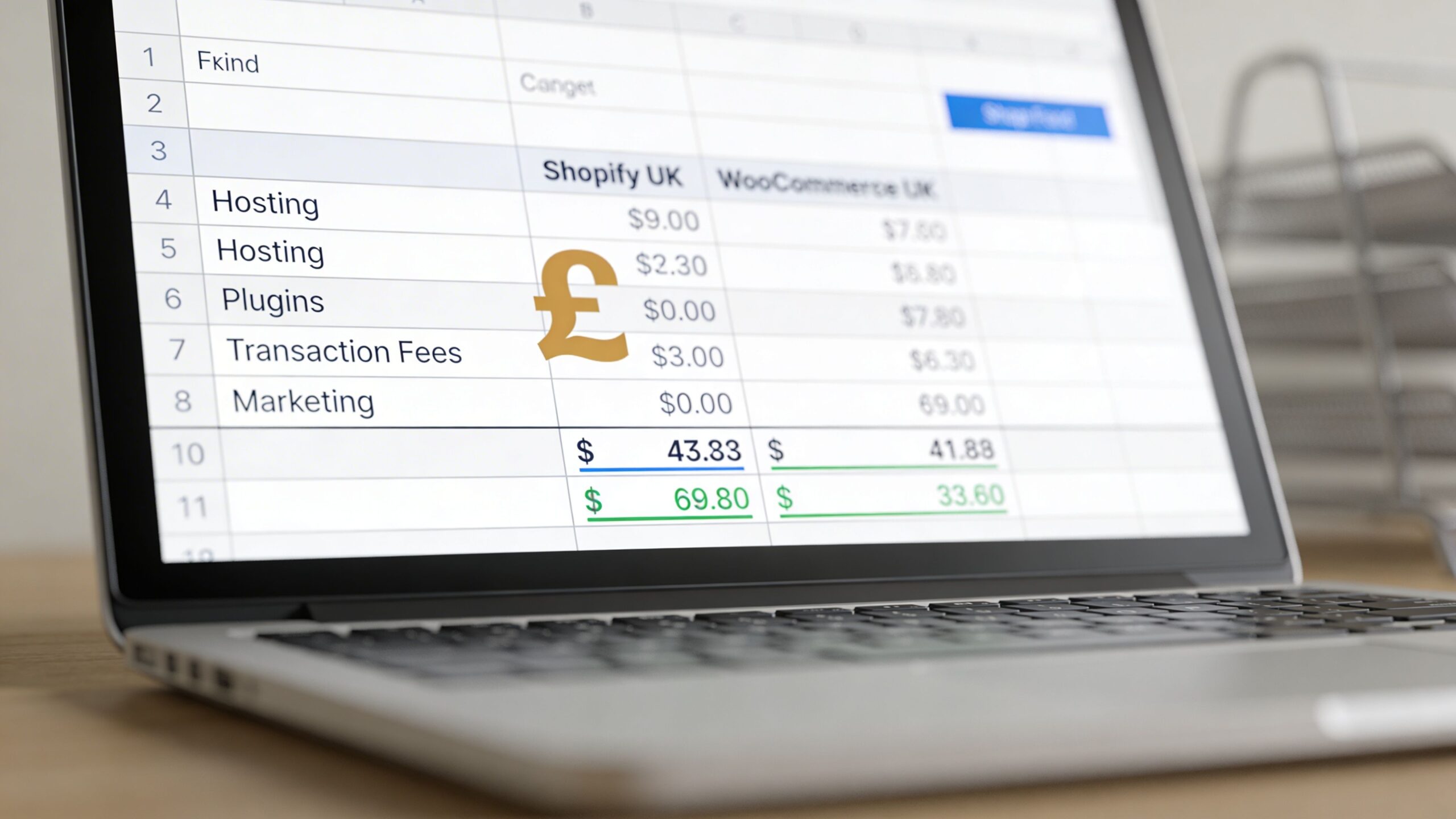
The monthly subscription is rarely the total cost.
That’s where many platform comparisons go wrong. They compare Shopify’s plan price to WooCommerce’s “free” plugin and stop there. For a UK business, the total cost sits in the surrounding decisions. Payments, VAT handling, plugins, hosting, maintenance, and the amount of developer time you’ll need to keep things clean all matter more than the headline figure.
Shopify costs are predictable until they aren’t
Shopify’s main strength on cost is clarity.
You choose a plan, launch the store, and many core ecommerce functions are already built into the platform. For businesses that want clean forecasting and fewer technical surprises, that’s useful.
The problems start when UK-specific needs enter the picture.
Post-Brexit VAT compliance and payment gateway fees are easy to underestimate. Shopify’s own comparison page says Shopify claims lower overall platform costs and higher conversion, but that framing doesn’t always reflect UK realities. If you use a non-Shopify Payments gateway in the UK, extra fees apply. The same source also notes that WooCommerce avoids platform transaction fees, while WooCommerce’s POS discontinuation complicates omnichannel setup and can increase setup complexity and costs by over 40% compared with Shopify’s integrated POS on relevant setups, according to Shopify’s Shopify vs WooCommerce comparison.
That matters for high-street businesses that sell online and in person.
A florist, bakery, or local retailer may find Shopify cheaper operationally because point of sale is cleaner. A service-led business that mainly takes deposits, bookings, or invoice-style payments may feel those extra gateway costs more sharply.
WooCommerce can be cheaper, but only on the right setup
WooCommerce is often described as cheaper because the core plugin is free.
That’s only partly true. You still need hosting, a domain, security, backups, and usually several paid plugins if you want polished ecommerce functionality.
The upside is that you’re not paying platform transaction fees in the same way. For scaling businesses, that can become meaningful over time. The downside is that your costs are more fragmented and can drift upward if the site needs premium plugins, developer support, or stronger hosting to maintain performance.
A cheap WooCommerce build often turns expensive later.
Not because WooCommerce is flawed, but because too many businesses start with bargain hosting, stack plugins without a plan, and only fix the setup once rankings, conversions, or site stability start slipping.
Cheap WooCommerce is usually the most expensive version of WooCommerce.
The hidden UK costs that affect local growth
The practical costs aren’t only financial. They also show up in lost time and weaker local visibility.
Here are the cost areas that matter most for UK businesses deciding between shopify or woocommerce:
- Payment gateway fit: Shopify can be simple, but gateway choice matters in the UK. If your preferred payment flow sits outside Shopify Payments, fee structure becomes part of the decision.
- VAT complexity: Businesses selling across different product or service scenarios often need careful setup. The platform won’t fix a poor tax workflow on its own.
- POS and offline sales: Shopify is stronger if your business needs online and in-person selling to feel joined up. WooCommerce now needs more third-party help here.
- Developer dependence: WooCommerce can save money if you already have strong WordPress support. Without that, small changes can create recurring cost.
- App and plugin sprawl: Shopify apps and WooCommerce plugins both add cost. The difference is where you feel it. Shopify tends to package cost into subscriptions. WooCommerce often packages it into maintenance.
This is also where forecasting matters. If you’re trying to estimate whether a local SEO campaign will justify platform investment, it helps to run the numbers against expected lead value and lifetime customer value, not just software bills. A useful way to think about that is through a model like this SEO ROI calculator for self-storage businesses, even if you adapt the logic to your own sector.
What works and what doesn’t
A few practical patterns show up repeatedly.
What works with Shopify
- Lean operations: Small teams who don’t want to manage hosting, updates, or technical security.
- Clear system boundaries: Businesses happy to work within the platform instead of redesigning it around unusual requirements.
- Integrated retail: Shops that want ecommerce and in-person selling to sit together more neatly.
What works with WooCommerce
- Content-heavy lead generation: Businesses that rely on service pages, local articles, and organic search depth.
- Bespoke workflows: Companies with unusual quoting, booking, or content requirements.
- Long-term ownership: Teams that want more control over data, code, and custom functionality.
What usually doesn’t work
- Choosing Shopify because it’s “easy” when your whole growth model depends on advanced local content structures.
- Choosing WooCommerce because it’s “free” when nobody in the business can maintain it properly.
Winning Local Search and Google Business Profile
If local visibility is your main goal, WooCommerce usually has the stronger ceiling.
That doesn’t mean Shopify can’t rank. It can. But for businesses that need precise postcode targeting, multiple location pages, service-area content, and structured local content around real search behaviour, WooCommerce gives you more room to build an SEO system instead of just an online shop.
Why WordPress matters for local SEO
WooCommerce’s strongest advantage is that it sits on WordPress.
That gives you better publishing control, stronger categorisation, and deeper technical access. For local SEO, those details matter more than most businesses realise.
A company targeting “wedding venue in North Yorkshire”, “barn wedding venue near Harrogate”, and “exclusive-use wedding venue Yorkshire” doesn’t just need product pages. It needs layered content. Landing pages. Supporting articles. Internal links. Custom schema. Clean URL structures. Flexible templates. WooCommerce handles that world far more naturally.
A YouTube-based comparison focused on this exact issue notes that WooCommerce offers superior technical SEO control for local businesses, including advanced categorisation and full code access for custom schema aimed at postcode-specific leads, which is especially valuable for local events or service-led businesses. That’s covered in this Shopify vs WooCommerce local SEO discussion.
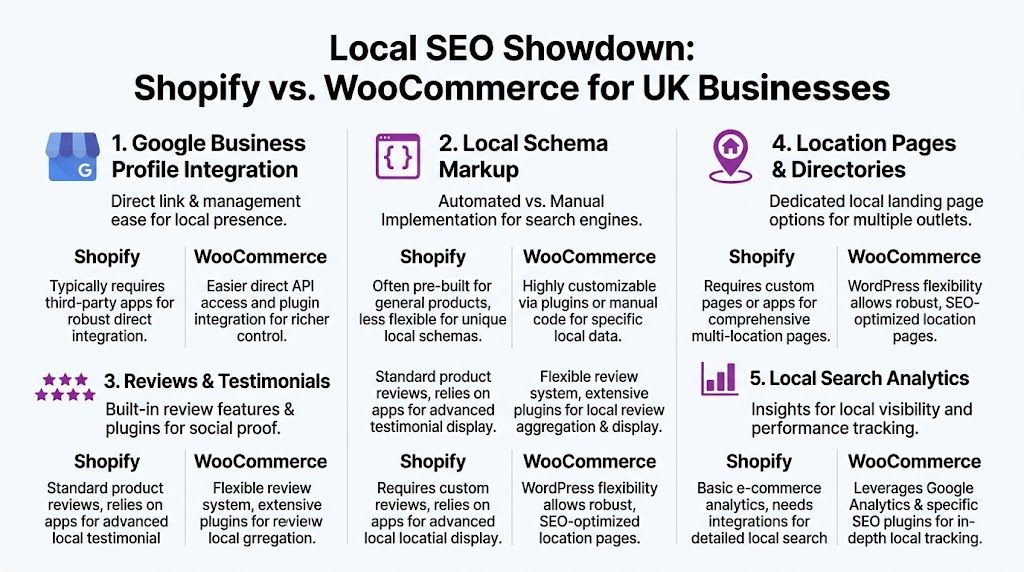
Side-by-side for local search tasks
| Local SEO task | Shopify | WooCommerce |
|---|---|---|
| Location pages | Possible, but often more rigid | Excellent flexibility through WordPress |
| Local schema | Usually app-led or theme-led | Easier to customise deeply |
| Blog-led local targeting | Usable, but more limited | Stronger by default |
| Service area architecture | Can work with planning | Better for complex structures |
| Internal linking control | Adequate | Strong |
| Google Business Profile support | Indirect | Easier to connect into broader local SEO workflows |
For many local businesses, the weak point isn’t the homepage or the store. It’s the supporting local content around it.
That’s where WooCommerce tends to outperform because WordPress was built for content first.
Google Business Profile works best when the site supports it
A Google Business Profile won’t carry local rankings on its own.
If your profile points to weak landing pages, slow pages, or generic service pages that don’t match local intent, your visibility becomes less stable. The platform decision affects how well your site supports GBP relevance.
A strong local setup usually includes:
- Dedicated location or service-area pages that match how people search
- Relevant schema markup for business details, services, events, or locations
- Useful supporting articles that reinforce geographic and service relevance
- Consistent conversion paths from GBP click to enquiry form, call, or booking
If you’re tightening up that side of the strategy, this guide on how to optimize your Google Business Profile is worth reading alongside your platform decision.
And if you want a practical benchmark for your own on-site local setup, a detailed local SEO checklist helps surface gaps in pages, content, links, and technical signals.
Here’s the visual version of the platform split for local SEO.
Where Shopify still works well
Shopify can still be the right choice for local businesses.
If your content needs are modest, your location structure is simple, and your team values ease over custom SEO implementation, Shopify can absolutely support local growth. A photographer with a tight service area, a simple product or booking offer, and limited content production might do better on a clean Shopify setup than on a badly maintained WooCommerce build.
That’s the key distinction.
Better SEO potential means nothing if the business can’t execute it.
WooCommerce gives more power. Shopify reduces friction. For local search, that’s the key trade-off.
Comparing Performance Speed and Security
A lot of businesses assume site speed is mostly a hosting decision.
That’s only half true.
Hosting matters on WooCommerce. A lot. But architecture matters too, providing Shopify a clear operational advantage for many local businesses. Its managed setup gives you a stronger baseline without needing to tune caching, CDN behaviour, or plugin conflicts yourself.
What the UK speed tests show
In 2026 UK performance tests, Shopify’s default setup recorded a mobile PageSpeed score of 72 and a 2.1s LCP out of the box, while a standard WooCommerce site on shared hosting scored 38 with a 5.8s LCP, according to Thunder PageSpeed’s Shopify vs WooCommerce speed comparison.
For a local business, that difference isn’t abstract.
A customer looking for “funeral director near me” or “emergency electrician in Bristol” is often on mobile, often in a hurry, and often impatient. If the site loads slowly, the enquiry may never happen. Slow pages also weaken the user signals that tend to support local search performance over time.
Why this matters for Google Maps and local conversions
When someone clicks from your Google Business Profile to your website, they’re not evaluating your platform choice. They’re deciding whether to trust you and whether to stay.
That’s why local businesses should care about practical speed outcomes, not just technical scores.
- Fast mobile rendering helps users reach service details quickly
- Stable layouts reduce frustration on enquiry forms and booking pages
- Shorter load times support call clicks, contact form completions, and product views
- Cleaner infrastructure lowers the chance of failure during busy periods
If you run a local campaign, feature in the map pack, or get a burst of seasonal demand, performance consistency becomes part of conversion rate.
Shopify’s advantage is maintenance, not magic
Shopify’s speed advantage doesn’t mean every Shopify store is fast.
A bloated theme, too many apps, oversized media, and poor build choices can still drag the site down. But Shopify starts from a better managed base. That matters for small teams.
WooCommerce can absolutely be fast. In the right hands, it can be excellent. But there’s a big difference between “can be fast” and “will stay fast without ongoing technical attention.”
That’s where many local businesses get caught.
They launch on WooCommerce with shared hosting and too many plugins. The site works. Rankings start to improve. Traffic grows. Then the site slows down, forms become unreliable, or update conflicts create problems no one notices immediately.
Fast enough at launch isn’t the same as fast enough six months into a local SEO campaign.
Security is a business process, not a plugin
Security has the same pattern.
On Shopify, much of the heavy lifting is handled for you. That includes core platform maintenance and PCI-related infrastructure on the ecommerce side. For many businesses, that reduction in responsibility is one of Shopify’s biggest strengths.
On WooCommerce, security depends on your stack and your discipline.
That means:
- plugin updates
- theme maintenance
- secure hosting
- backups
- malware monitoring
- user access control
- checkout and form testing after changes
None of that is impossible. It’s just work.
If your business already has strong WordPress support, WooCommerce security is manageable. If not, the risk isn’t theoretical. It shows up in hacked sites, broken forms, checkout issues, spam, and long delays fixing preventable problems.
What works in practice
Use Shopify if your team wants performance and security handled with minimal internal effort.
Use WooCommerce if you have a clear SEO and development reason for choosing it, plus a proper maintenance process behind it.
What doesn’t work is choosing WooCommerce for its flexibility, then treating maintenance as optional. For local businesses relying on Google Maps traffic, a slow or broken site wastes the visibility you worked hard to earn.
Extensibility and Scaling for UK Growth
The early version of your site isn’t the hard part.
The hard part is what happens when the business grows. More locations. More products. More service areas. More landing pages. More bookings. More demand from local search. That’s when platform choices start showing their strengths and weaknesses.

Shopify scales more cleanly for many businesses
Shopify’s biggest scaling advantage is consistency.
A 2026 analysis found that Shopify maintained a 52% mobile Core Web Vitals pass rate as inventory grew, compared with 38% for WooCommerce, according to PageSpeed Matters’ platform speed comparison. That analysis attributes Shopify’s stronger consistency to elastic scaling and edge computing.
For a growing UK business, that matters when a local campaign lands, seasonal traffic spikes hit, or new product ranges go live. Shopify generally absorbs growth more predictably.
That’s useful for:
- retailers adding stock fast
- service businesses layering ecommerce onto an existing offer
- local brands expanding into multiple trading areas
- teams without in-house technical staff
WooCommerce scales more flexibly
WooCommerce wins when growth is structurally complex.
If your business needs custom quoting, unusual product configurations, advanced content hierarchies, or tightly controlled local SEO architecture across multiple locations, WooCommerce usually gives you the better framework.
A few examples make this clearer.
A single-location photographer selling prints, deposits, and gift cards may scale perfectly well on Shopify.
A construction firm with location-specific service pages, downloadable guides, finance content, project galleries, and bespoke quote workflows will often outgrow Shopify’s default patterns much sooner.
A wedding venue that relies on content marketing, seasonal landing pages, local supplier pages, and enquiry journeys specific to different packages usually benefits from WooCommerce’s WordPress flexibility.
App store versus plugin ecosystem
The scaling difference isn’t only technical. It’s also operational.
Shopify’s app ecosystem is more curated. That usually means faster setup and fewer choices, but also less freedom if your business needs something outside the norm.
WooCommerce’s plugin ecosystem is broader and more open. That gives you more options, but also more responsibility to choose well, test properly, and keep everything stable.
Neither model is automatically better.
- Choose Shopify if you want the platform to absorb complexity for you.
- Choose WooCommerce if you want to design the system around the business.
If your growth plans are tied closely to local visibility, this is worth checking against your GBP strategy too. A business expanding into new towns or branches should review whether its website and profile setup can support that growth cleanly. A tool like this Google Business Profile audit tool can help highlight where the platform choice may start affecting local execution.
The best scaling platform isn’t the one with the most features. It’s the one that still fits once your business gets more complicated.
Where businesses make the wrong call
They choose for launch day, not for year two.
If your likely future is simple selling with low technical overhead, Shopify is often the safer bet. If your likely future involves heavy content, multiple service areas, and bespoke local search architecture, WooCommerce is often the smarter long-term choice.
The Verdict Which Platform for Your Business Type
Here’s the direct answer.
If you’re asking shopify or woocommerce, you shouldn’t decide by features alone. Decide by how your business wins customers locally.
A broad overview like this Shopify vs WooCommerce comparison can be useful for background reading, but the better decision comes from matching platform strengths to your actual business model.
Choose Shopify if simplicity is the priority
Shopify is usually the better fit if you’re a smaller UK business that needs to launch quickly, stay secure, and avoid technical maintenance.
This often suits:
- Photographers selling packages, prints, vouchers, or session bookings
- Personal trainers offering products, plans, or limited ecommerce add-ons
- Artisan producers with straightforward stock and clean fulfilment needs
- Single-location retail or service brands that want low-friction selling
Why it works:
Shopify reduces moving parts. It gives you a strong operational baseline and lets you focus on offers, customer service, and marketing instead of plugin management and hosting issues.
When it fails:
It becomes restrictive when your local SEO strategy needs deep content structures, highly customised templates, or unusual workflows.
Choose WooCommerce if local SEO is central to growth
WooCommerce is usually the better fit if your site needs to do more than sell.
This often suits:
- Wedding venues relying on content, galleries, local pages, and long-form SEO
- Construction firms targeting towns, service variants, and quote-led enquiries
- Home care providers with multiple service areas and trust-led local landing pages
- Interior designers, architects, and similar premium services where content depth supports authority
Why it works:
WooCommerce gives you the freedom to build a proper local content machine on WordPress. That means stronger location pages, more flexible internal linking, richer schema implementation, and a better foundation for sustained organic visibility.
When it fails:
It struggles when the business doesn’t have the technical support to maintain it properly.
Choose based on operating style, not hype
Some businesses need freedom. Some need stability.
If your team hates dealing with updates, hosting, and plugin maintenance, don’t buy into WooCommerce because someone said WordPress is “better for SEO.” Better potential is not the same as better results.
If your lead generation depends on location pages, service-specific articles, and technical local SEO work, don’t choose Shopify just because it’s easier. Ease can become a ceiling.
A simple decision framework
Ask these four questions.
Will local organic search be a primary lead source?
If yes, WooCommerce often has the edge.Do you need complex location or service-area content?
If yes, WooCommerce usually fits better.Do you want the platform to handle security and infrastructure?
If yes, Shopify is stronger.Can your business support ongoing WordPress maintenance properly?
If no, Shopify is often the safer call.
A good test case is photography. Many photographers need local visibility, but not all need a highly customised content structure. If that’s your sector, this guide to SEO for photographers shows how local intent and platform choice can intersect without overcomplicating the setup.
The final recommendation is straightforward.
Choose Shopify for ease, speed to market, and low maintenance. Choose WooCommerce for technical freedom, stronger local SEO control, and content-led growth.
If you want a second opinion before committing, Bare Digital can help you assess the platform decision through a local SEO lens. That means looking at your Google Business Profile, service-area targeting, site structure, speed, and conversion path together, so you choose the platform that supports rankings and enquiries rather than creating extra work later.