

A lot of Surrey business owners reach the same point in the same way. The website still technically works, but enquiries are thin, mobile pages feel clumsy, and competitors seem to appear first whenever someone searches for services nearby.
That frustration usually isn’t about design alone. It’s about missed commercial value.
If you’re searching for website designers surrey, the primary task isn’t finding someone who can make a homepage look polished. It’s finding someone who can build a site that helps your business get found locally, earns trust quickly, and turns visits into calls, form submissions, bookings, or showroom visits.
Your Surrey Business Deserves More Than Just a Website
A Surrey business owner often knows when the current site has stopped pulling its weight. The signs are familiar. The branding feels dated. The site looks awkward on mobile. Google Business Profile traffic doesn’t convert. Staff apologise for the website before sending people to it.
In a county with over 68,000 businesses, standing out online isn’t optional. It’s part of basic competitiveness. Surrey’s density makes local intent more valuable and more contested at the same time. A cleaner, faster, locally optimised site can help close that gap. Agencies working in this market report an average 35% increase in leads converting to business within the first 6 months after launching a professionally designed, locally optimised website, according to Immersive Media’s Surrey web design page.
That’s the difference between a brochure site and a business asset.
What Surrey buyers actually do
Someone looking for a wedding venue in Guildford, a builder in Woking, or an architect near Farnham rarely studies your brand in a linear way. They jump between your website, your reviews, your Google Business Profile, your service pages, and sometimes your competitors within minutes.
If your site doesn’t support that behaviour, you lose them.
A strong Surrey website should do four things well:
- Show local relevance: It should make clear where you work and who you serve.
- Reduce friction: Mobile visitors should be able to call, enquire, or book without hunting around.
- Support trust: Reviews, project examples, accreditations, and clear service detail should be easy to find.
- Guide intent: Each page should push a visitor toward the next sensible action.
A pretty website that doesn’t rank locally or convert local traffic is an expensive placeholder.
That’s why the hiring decision matters. You’re not just buying layouts, fonts, and imagery. You’re choosing whether your next website will support visibility in Surrey searches and convert the attention you’re already paying to attract.
If you’re not sure where your current site is falling short, start by reviewing the basics against a practical local SEO checklist. It will quickly show whether the issue is design, local visibility, conversion flow, or a mix of all three.
What works and what doesn’t
What works is a website built around real business actions. Calls. Enquiries. Directions. Quote requests. Consultations.
What doesn’t work is hiring a designer purely because their portfolio looks modern, then discovering they never considered local landing pages, internal linking for town-based services, or the way your Google Business Profile and website need to support each other.
That’s the gap many Surrey businesses need to close.
Laying the Groundwork for Your New Website
The worst time to decide what your website needs is after a designer has started building it.
Projects drift when the brief is vague. Pages get added on the fly. Internal stakeholders all want different things. Deadlines slip, and the budget stops meaning much. According to UK project analyses, 70% of website redesigns suffer from scope creep, while 40% experience timeline overruns due to inadequate budgeting, as outlined by Webgamma.

Start with business objectives, not design preferences
“Make it more modern” isn’t a useful goal. Neither is “we want something cleaner”.
Good briefs describe outcomes. They tell the designer what the website needs to do, not just how you want it to feel.
Write down the primary purpose of the site in plain English. For example:
- Lead generation: More quote requests for a Surrey trades business
- Bookings: More direct bookings for a venue or clinic
- Qualification: Fewer poor-fit enquiries and more serious prospects
- Reputation support: A stronger digital presence for higher-value service work
If you work in a niche market, include that too. A website for a premium interior design studio should filter and attract differently from a website for a domestic electrician. If that’s your sector, it helps to review how search intent and service messaging intersect in SEO for interior designers.
Define the non-negotiables
Many briefs immediately improve. Separate what your business needs from what sounds nice in a pitch meeting.
Your essential requirements might include:
- Key pages: Home, service pages, location pages, about, contact, reviews, case studies
- Platform preference: WordPress, Shopify, or another system your team can manage
- CRM or form requirements: Where enquiries go and who follows them up
- Mobile usability: Especially if your customers often search while travelling or comparing suppliers
- Local SEO foundations: Page structure, metadata control, service areas, and map relevance
- Content migration: Whether existing pages need rewriting, redirecting, or removing
A good designer should be able to challenge weak assumptions here. If they agree to every idea without pressure-testing it, be careful.
Build a brief that saves time later
You don’t need a glossy procurement document. You do need something organised.
A practical brief usually includes:
Business overview
What you sell, where you operate, and who you want to attract.Current website issues
Be specific. Slow pages, poor mobile experience, weak leads, hard-to-update content, unclear messaging.Commercial goals
The actions you want more users to take.Audience detail
New customers, repeat customers, high-value projects, specific Surrey towns, multi-location needs.Required functionality
Forms, booking tools, galleries, resource hubs, integrations, team profiles.Brand inputs
Logo files, colours, photography, tone of voice, competitor examples.Practical constraints
Budget range, deadline pressures, internal approvers, content ownership.
For a useful outside view of the stages involved, the entire website design process from Exclusive Addons gives a clear sequence from discovery through launch. It’s helpful because it shows where decisions usually go wrong.
Practical rule: If you can’t explain in a page or two what the site needs to achieve, you’re not ready to compare quotes.
Budget for the whole project, not just the build
The build cost is only one line item. Businesses often forget copywriting, photography, redirects, page creation, review gathering, and launch support.
That doesn’t mean every project has to be large. It means your budget should match your actual expectations. If you want strategic messaging, custom layouts, location pages, technical SEO input, and proper testing, the price should reflect that.
Cheap websites tend to hide costs in revision rounds, missing deliverables, weak setup, or post-launch fixes.
Finding and Shortlisting Potential Design Partners
Once your brief is ready, the search becomes much easier. You’re no longer browsing websites and reacting to visuals. You’re matching business requirements to likely partners.
That’s a better way to search for website designers surrey, because it filters out agencies that look polished but don’t fit the work.

Use search like a buyer, not a researcher
Start with the terms a real customer or local business owner would use. Don’t just search one phrase.
Try variations such as:
- website designers surrey
- web design guildford
- web designer woking
- wordpress designer surrey
- ecommerce web design surrey
- local seo web design surrey
Then review what shows up with a commercial eye. Does the agency’s own site load quickly? Are their service pages clear? Do they show evidence of local work? Can you tell what kind of client they’re best for?
If a design company claims to understand local visibility but has no obvious local relevance signals on its own site, that’s worth noting.
You can also use Bare Digital as a reference point for what a local search-focused service business should make clear online. Not because every web designer should look the same, but because clarity around services, outcomes, and local intent matters.
Ask the right local businesses for referrals
Referrals work best when they come from businesses with similar buying patterns, not just friendly contacts.
Useful referral sources include:
- Complementary service providers: photographers, copywriters, sign makers, printers, solicitors
- Businesses with strong local visibility: firms that consistently show up in Maps and organic search
- Owners with recent redesign experience: they’ll remember where communication or delivery was strong
Ask narrow questions. Don’t ask, “Were they good?” Ask:
- Did they hit the agreed scope?
- Were they proactive when content was delayed?
- Did they understand local search, or just design?
- What happened after launch?
Build a shortlist with range, not randomness
You usually want a shortlist of a few serious options, not a huge spreadsheet. Too many choices lead to shallow comparison.
Look for variety in:
- Agency size: one freelancer, one small studio, one more established team
- Relevant sector experience: not identical projects, but useful overlap
- Technical confidence: some are stronger in branding, others in SEO-led builds
- Communication style: the best long-term fit is often obvious early
For a grounded outside perspective, Altitude Design’s guide on how to choose a web designer is useful because it focuses on fit, process, and evidence instead of surface-level style.
Don’t shortlist designers solely because they’ve worked with “big brands”. A Surrey SME usually needs relevance, responsiveness, and commercial thinking more than prestige.
What to note during shortlisting
A simple note-taking framework helps. For each candidate, record:
- First impression of their own site
- Whether they show local or sector understanding
- Portfolio relevance
- Signs they think about conversions
- How easy it is to contact them
- Whether their process is visible and clear
At this stage, you’re not choosing a winner. You’re choosing who deserves a serious conversation.
The Vetting Process How to Evaluate a Designer
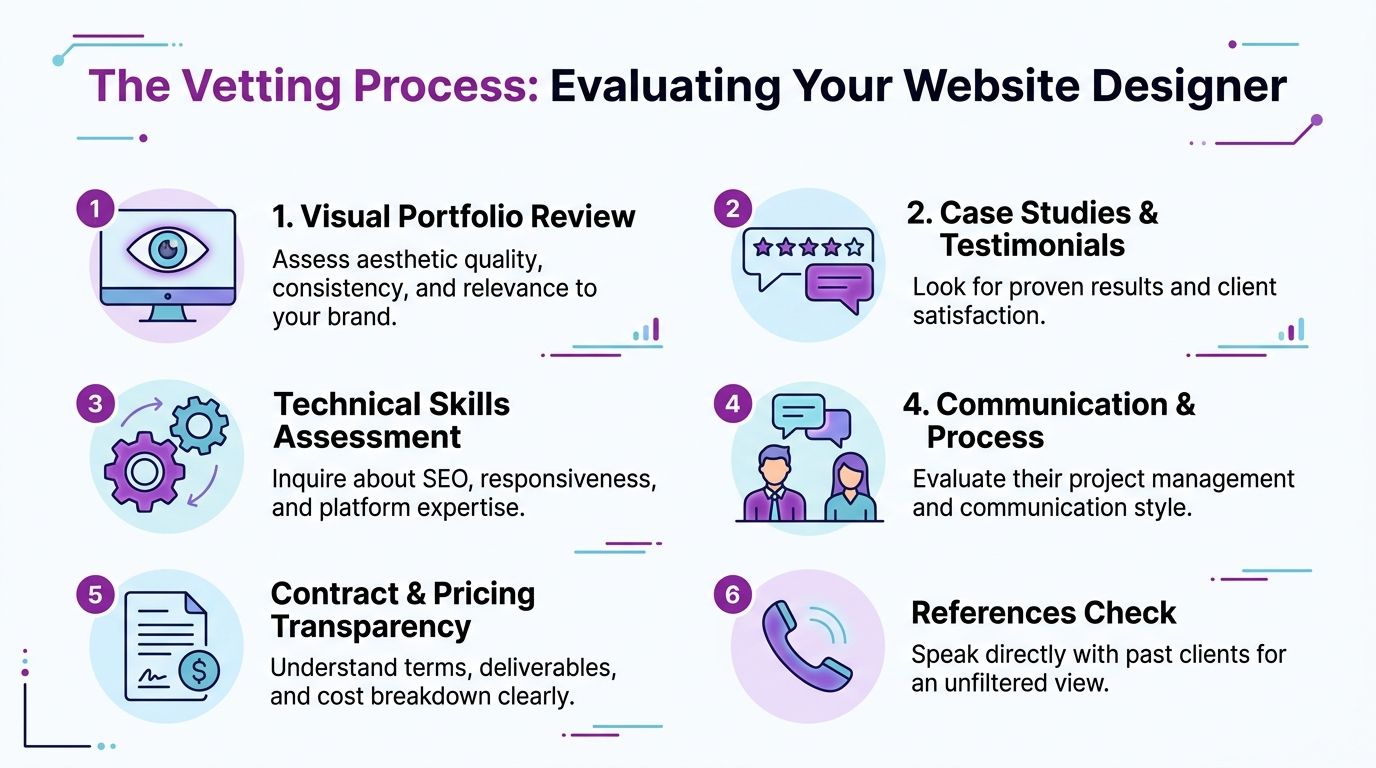
Most hiring mistakes happen when business owners compare homepages, branding styles, and day rates, then make a decision before testing whether the designer can build a site that performs.
That’s risky in a market where 77.6% of UK businesses plan a website redesign in the coming year, and where keeping bounce rates under 40% is a major performance target compared with the 55.43% industry average, according to Thunderbolt’s Surrey web design statistics.
Look past the portfolio gloss
A good portfolio should answer more than “does this look nice?”
Open several examples on desktop and mobile. Click around. Test the navigation. See how forms work. Read the copy. Check whether service pages are clear or vague.
You’re looking for signs of judgment:
- Is the layout helping users decide quickly?
- Are calls to action obvious without being pushy?
- Does the mobile version feel designed, not just squeezed?
- Do pages explain services in a commercially useful way?
A designer who only shows full-screen hero sections and stylish homepage shots may be hiding weak inner pages. Inner pages are where enquiries usually happen.
If a portfolio can’t show service pages, contact flows, or local relevance, it tells you very little about business performance.
Test whether they understand local search behaviour
Many designers say they “build with SEO in mind”. That phrase can mean almost nothing.
You need to know whether they understand how a Surrey business earns local traffic. Ask direct questions about:
- location page planning
- service plus area targeting
- internal linking between towns and services
- review integration
- structured data and schema implementation
- page hierarchy for local intent
- how the site supports Google Business Profile visibility
If they speak only about title tags and meta descriptions, the answer is too shallow.
A useful checkpoint before those conversations is to run your current listing through a Google Business Profile audit tool. That helps you ask sharper questions about how the new site will support local pack visibility rather than treating the website and profile as separate assets.
Ask how they handle content strategy
Designers often inherit weak content and then compensate with layout. That rarely works for local conversion.
Strong candidates should talk confidently about:
- page purpose before page design
- messaging hierarchy
- trust content such as reviews, process, FAQs, and credentials
- service specificity
- writing for users first, then refining for search relevance
- content ownership and revision responsibilities
If they say “you can just add the content later”, treat that as a warning. Late content causes delays, weak UX, and poor page intent.
Evaluate process, not just talent
A polished freelancer with no clear workflow can cause more trouble than a slightly less flashy team with excellent project control.
Ask them to walk you through a typical project. Listen for:
- discovery and brief review
- sitemap planning
- wireframes or prototypes
- content collection
- design approval stages
- development and QA
- testing before launch
- redirects and migration support
- post-launch checks
Specificity matters. If the process sounds improvised, it probably is.
Essential Questions to Ask Potential Website Designers
| Category | Question | What to Listen For (Green & Red Flags) |
|---|---|---|
| Portfolio | Can you show me examples similar in complexity to my project? | Green: Relevant examples, clear explanation of decisions. Red: Only visual mock-ups or unrelated industries. |
| Local SEO | How would you structure pages for Surrey service areas? | Green: Service pages, location pages, internal linking, review support. Red: Vague “we’ll optimise it later” answers. |
| Technical setup | How do you approach page speed and mobile performance? | Green: Practical testing, image handling, lean builds, mobile-first thinking. Red: “The developer handles that” with no further detail. |
| Content | Who is responsible for copy, and when is it needed? | Green: Clear ownership and timing. Red: Content treated as an afterthought. |
| Process | What does your approval process look like? | Green: Defined stages and feedback windows. Red: Open-ended revision promises with no structure. |
| Launch | What happens on launch week? | Green: QA, redirects, analytics checks, form testing. Red: “We publish it when it’s ready.” |
| Reporting | How do we know the new site is working? | Green: Enquiries, rankings, user behaviour, conversion points. Red: Focus only on design satisfaction. |
| Support | What support do you offer after launch? | Green: Clear maintenance or handover options. Red: Unclear ownership or disappearing after go-live. |
Check how they talk about trade-offs
Experienced designers don’t pretend every feature is a good idea. They explain consequences.
For example:
- A heavily animated homepage may look impressive but slow down mobile users.
- A template can reduce cost but limit scalability.
- A minimalist design can feel premium but hide critical trust signals.
- A very wide navigation can confuse users if service offerings aren’t prioritised.
That kind of reasoning is what you’re paying for.
Red flag: “We can do anything you want.”
Better answer: “Yes, but here’s what that would cost in speed, clarity, or maintenance.”
Review the commercial fit
You don’t need a designer who has built your exact website before. You do need someone who understands your sales model.
A Surrey wedding venue needs image handling, availability prompts, trust, and enquiry flow. A construction firm needs local service depth, proof of past work, and easy quote actions. An architect may need stronger project storytelling and qualification of leads.
The best designers adapt their approach to how customers buy.
References should sound operational, not theatrical
When you speak to a past client, listen for practical details. Useful references mention responsiveness, project management, handling of problems, and what happened after launch.
If every testimonial sounds like pure praise with no substance, it’s less useful than a candid comment about how the team handled feedback or solved a content bottleneck.
Making the Hire and Kicking Off the Project
Once you’ve chosen your designer, protect the decision with a proper setup. This stage decides whether the project runs smoothly or becomes a string of avoidable misunderstandings.
Well-structured redesigns pay off. Professionally redesigned websites for Surrey businesses show a 75% success rate in achieving load times under 2 seconds and conversion gains of 20% or more within 3 months, according to this website optimisation analysis.

Choose the pricing model that matches the work
Different projects suit different commercial arrangements.
A fixed project fee usually works best when the brief is clear, the page count is known, and deliverables are defined. It gives both sides structure.
An hourly arrangement can work for smaller improvements, phased work, or problem-solving where the final scope is still moving.
A retainer makes sense when the website is only part of a wider ongoing relationship involving updates, landing pages, CRO work, or SEO support.
None of these is automatically better. The issue is fit. If the scope is still fuzzy, a fixed fee can create tension. If the website is strategically important and evolving, purely hourly billing can make planning harder.
The contract needs to answer the awkward questions early
A good contract isn’t a sign of mistrust. It’s a sign that both sides want fewer surprises.
Check for clarity on:
- Scope of work: exact deliverables, page counts, revisions, functionality
- Timelines: who provides what, and when delays affect deadlines
- Payment schedule: deposit, milestones, final payment
- Ownership: design files, website code, copy, imagery, licences
- Third-party tools: themes, plugins, stock assets, ongoing subscriptions
- Launch responsibilities: redirects, testing, analytics, tracking, backups
- Support after launch: training, fixes, maintenance windows
If any of this is vague, ask for it to be rewritten before signing.
Contracts should make disagreements less likely, not just more formal.
Set the project up so your team doesn’t become the bottleneck
Many redesigns stall because the business owner is too busy to supply content, approve designs, or answer questions. That’s normal. It still needs managing.
Name one internal decision-maker. Then set rules for feedback:
- one person consolidates comments
- approvals happen by agreed dates
- content sign-off has a clear owner
- urgent requests go through one communication channel
This matters more than people expect. Even a strong designer can’t keep momentum if every page sits in limbo.
A short explainer can help align your team on what a more structured web project looks like:
Use a practical kickoff checklist
The first week should feel organised. If it doesn’t, ask why.
A reliable kickoff usually includes:
- Access setup: current website, hosting, domain access, analytics, forms, CMS
- Asset collection: logos, brand files, image folders, review sources, brochures
- Content plan: which pages are being kept, rewritten, merged, or dropped
- SEO continuity: redirect mapping, high-value pages, existing rankings, indexed URLs
- Communication rhythm: weekly calls, shared docs, approval steps
- Milestones: sitemap sign-off, design approval, development preview, launch window
This is also the right moment to decide what success looks like in practice. Not “looks better”. Things like stronger enquiry quality, easier user journeys, cleaner mobile behaviour, and more visibility for local service pages.
Don’t disappear after signing
The businesses that get the best results stay engaged. They answer questions quickly, provide honest feedback, and test the site before launch like a customer would.
If you’re ready to turn a shortlist into an actual project conversation, use Bare Digital’s contact page to start that discussion in a more structured way.
Frequently Asked Questions About Surrey Web Design
Should I hire a local Surrey freelancer or a larger agency
It depends on the job.
A freelancer can be a strong fit if the project is focused, the site is relatively straightforward, and you’re confident they personally cover strategy, design, development, and launch support well. You’ll often get direct communication and less process overhead.
A larger agency usually makes more sense when the site has multiple stakeholders, more content, deeper functionality, or stronger local SEO requirements. You may benefit from having separate specialists for strategy, design, development, and search.
The key question isn’t size. It’s capability.
How important is local SEO when hiring website designers surrey
It should be part of the build from day one, not an add-on after launch.
That matters because 87% of UK consumers use online reviews, while only 46% of small businesses have optimised Google Business Profiles, according to Create Designs. That gap creates room for Surrey businesses that combine a well-built site with strong local signals.
Ask whether the designer understands:
- service and location page strategy
- review placement and trust content
- how the website supports Google Business Profile relevance
- page structure for “near me” and town-based searches
- local schema and internal linking
If they treat local SEO as someone else’s job, you may end up paying twice.
What should I measure after launch
Start with commercial indicators, not vanity metrics.
Useful measures include:
- Lead quality: Are better-fit enquiries coming through?
- Conversion flow: Are users completing forms and calling more easily?
- Local visibility: Are key service pages becoming easier to find in local search?
- User behaviour: Are visitors reaching important pages and taking action?
Design satisfaction matters, but it isn’t enough on its own.
How involved do I need to be
More than most owners expect, but not in every detail.
Your job is to provide direction, approve content and design decisions, and keep internal feedback organised. You shouldn’t need to manage the technical work, but you do need to make timely decisions.
When owners disappear mid-project, designers start guessing. That usually shows up later in weak messaging or unnecessary revisions.
What’s the biggest mistake when choosing a web designer
Choosing on style alone.
A polished visual portfolio can hide poor process, weak content planning, bad mobile experience, and almost no local search thinking. A strong designer should be able to explain why the site will work for your Surrey customers, not just why it will look better than the old one.
If you approach this as a commercial investment rather than a creative purchase, you’ll make a far better choice.
If you want a website that does more than look the part, Bare Digital can help you connect web design decisions with local SEO outcomes, Google Maps visibility, and real enquiry growth across Surrey.