


Your phone is ringing, the website form is busy, and your diary looks full for next week. On the surface, that feels like marketing is working.
But plenty of UK business owners get stuck at exactly that point. A builder in Manchester can be flooded with quote requests and still dislike the jobs coming through. A wedding venue can get loads of enquiries but waste hours on low-fit couples. A private clinic can see steady demand while still feeling that every new lead costs too much.
That's where lead generation cost per lead matters. It gives you a simple way to judge whether your marketing is producing profitable opportunities or just noise. And if you run a local service business in the UK, you need a UK lens on that number. Generic US benchmarks rarely reflect postcode competition, local search behaviour, or the way buyers find nearby providers.
Why Your Busiest Month Might Not Be Your Best
A busy month can hide a weak pipeline.
Take a local trades firm. The owner sees more calls than usual, the inbox is full, and the team is quoting constantly. Then the month ends and the numbers don't feel right. Too many time-wasting enquiries. Too much driving to inspect poor-fit jobs. Too much admin spent chasing people who never reply.
That's the point where cost per lead, usually shortened to CPL, becomes useful. It answers a practical question. How much are you spending to generate each new enquiry?
For a wedding venue, that might mean looking at the cost of every brochure request or viewing enquiry. For an architect, it might mean every serious contact form submission. For a funeral home, it could mean every genuine local phone lead that came through Google.
CPL matters because “busy” and “profitable” aren't the same thing. If you're paying heavily for weak leads, a full inbox can still drain margin. If you're getting fewer but better local enquiries, a quieter month can be stronger.
CPL is less about vanity and more about control. It tells you whether your marketing is buying attention or buying genuine opportunities.
This is also where UK businesses need to be careful with imported advice. A lot of published benchmark content leans on US data. That can distort expectations for local firms targeting places like Leeds, Bristol, Kent, or the Cotswolds. Search competition, geography, buying habits, and service areas all affect what “good” looks like here.
If you're trying to work out whether your current numbers are healthy, it helps to sanity-check your wider digital setup too. A simple review of your online lead journey often reveals issues in targeting, tracking, or conversion friction. Tools such as this accountancy marketing assessment show the kind of diagnostic thinking that's useful long before more budget gets spent.
How to Calculate Your True Cost Per Lead
The basic formula is straightforward:
Total marketing spend ÷ total new leads = CPL
That is the figure many marketers stop at. It is also where many professionals get it wrong.

What should count in your spend
If you only count ad spend, your CPL will usually look better than reality. A proper calculation should include the full cost of generating and handling those leads.
That often means:
- Ad spend. Google Ads, Meta campaigns, paid directories, sponsored placements.
- Agency or freelancer fees. Management costs still belong in the equation.
- SEO and content costs. Location pages, blog writing, photography, landing page design, and technical fixes all support lead generation.
- Software subscriptions. GA4 setup support, CRM tools, call tracking, form tools, email tools, and data platforms.
- Admin and lead handling time. If someone in the office triages calls, replies to web forms, and qualifies leads, that time has a cost.
One commonly missed example is admin support. Prospeo notes that lead triage can add £400/month, and missing costs like this can undercount true CPL by 30-50%. That's a huge gap between the number on paper and the actual number affecting profit.
A simple UK example
Say a construction company in Sheffield spends money across several activities in one month:
- Google Ads
- agency management
- landing page updates
- call tracking software
- office admin time spent handling new enquiries
At the end of the month, the business has a batch of new leads. If the owner only divides ad spend by lead count, the number may look acceptable. Once agency fees, software, and admin time are added, the CPL often rises sharply.
That doesn't mean the campaign failed. It means the business is finally measuring it accurately.
Simple CPL calculator
Add up all monthly lead generation costs:
Ad spend
- agency/freelancer fees
- SEO/content costs
- software/tools
- admin time for lead handling
= total spendThen divide:
Total spend ÷ total new leads = CPL
If you want a useful second opinion, compare your spreadsheet against a separate explanation of calculating CPL for ad campaigns. It's a helpful cross-check for businesses that currently track spend in one place and leads in another.
Count the right leads
Not every enquiry should be counted equally.
A quick price-check call from outside your service area isn't the same as a homeowner requesting a site visit. A wedding venue brochure download isn't the same as a booked private viewing. You need a clear definition of what counts as a lead before your CPL means anything.
A practical way to keep this organised is to build one monthly sheet with:
| Item | Include it in CPL |
|---|---|
| Paid media spend | Yes |
| SEO retainers or project fees | Yes |
| Content creation | Yes |
| CRM and call tracking tools | Yes |
| Staff time on lead handling | Yes |
| Existing customer upsells | No |
| Random enquiries outside service area | Usually no |
Businesses that want a faster way to pressure-test ROI assumptions often use tools like this SEO ROI calculator for self-storage businesses. The exact sector may differ, but the logic is the same. Tie your spend to actual lead value, not just activity.
What is a Good Cost Per Lead in the UK
There isn't one universal answer, and that's the honest answer.
A “good” CPL for a wedding venue in Gloucestershire won't match a good CPL for a plumber in Birmingham or a private healthcare provider in Surrey. Service value, competition, urgency, and geography all change the economics.
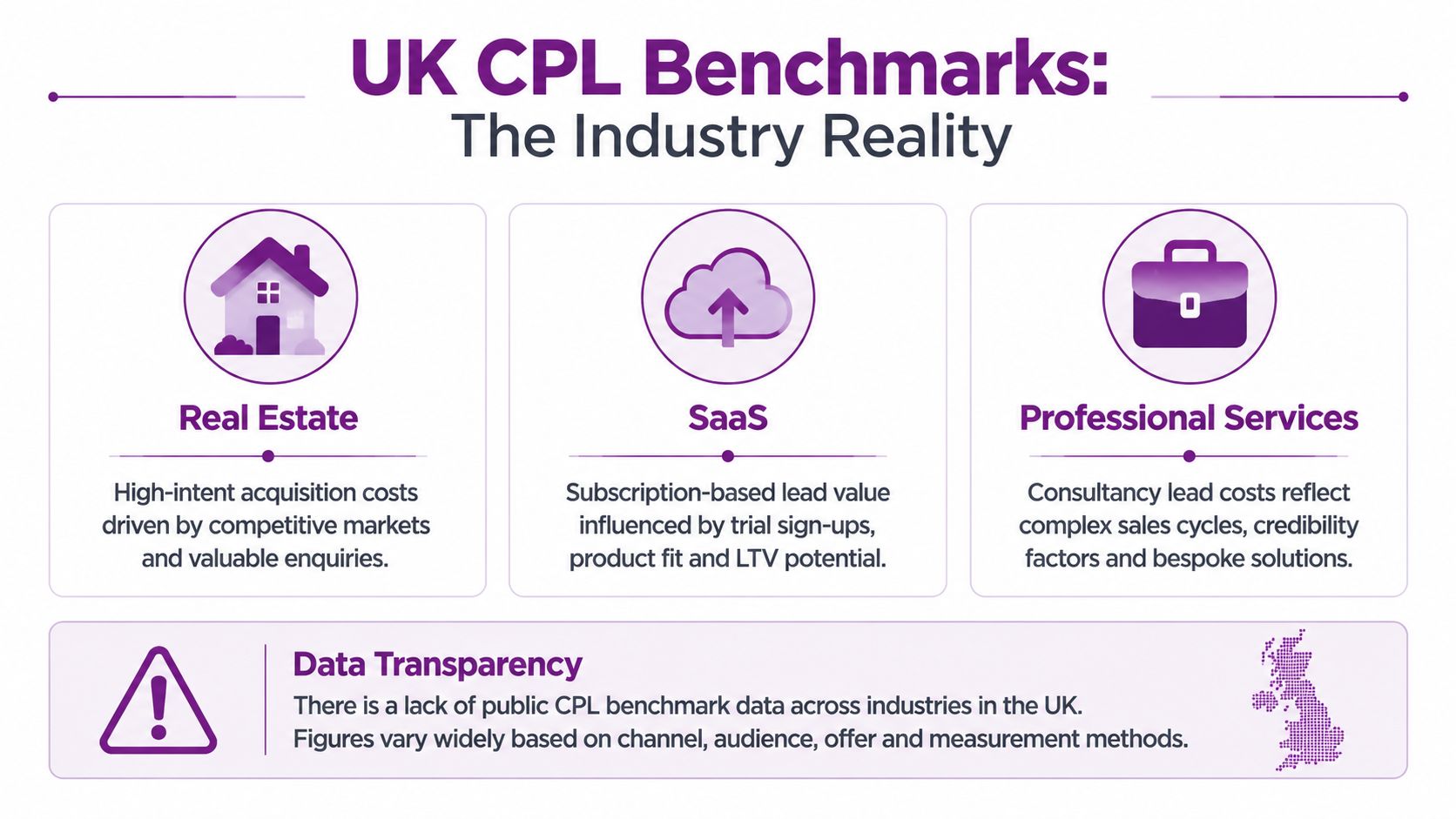
The first thing to understand is that public UK-specific CPL data is limited. A lot of reports still lean on US or global benchmarks. That creates a problem for UK small businesses, because it encourages comparisons that don't match local reality.
Why US numbers often mislead UK firms
If you run a local business, imported benchmark figures can push you in the wrong direction. They may set unrealistic targets, inflate expected ad costs, or overlook the role of Google Maps and local organic visibility.
That's why UK service businesses are usually better served by local search thinking than broad paid media averages. First Page Sage notes that inferred benchmarks suggest local UK businesses can achieve a CPL of £40–£80 through “near me” SEO, while generic paid ad CPLs can exceed £200. The same source also points out that this kind of UK-specific detail is often missing from mainstream reports.
So when a business owner asks, “What's a good cost per lead?”, the better answer is, “Good for which channel, in which area, for what type of enquiry?”
Estimated Cost Per Lead for UK local businesses
The table below should be treated as a practical starting point, not a fixed rulebook. It uses the UK local SEO benchmark range above and the broader paid ads observation that paid lead costs can exceed £200.
| Industry Sector | Estimated CPL (Local SEO) | Estimated CPL (Paid Ads) |
|---|---|---|
| Trades and construction | £40–£80 | £200+ |
| Wedding venues | £40–£80 | £200+ |
| Photographers and creative services | £40–£80 | £200+ |
| Healthcare and home care providers | £40–£80 | £200+ |
| Professional services | £40–£80 | £200+ |
That doesn't mean every firm in those sectors will hit the same number. It means local SEO often gives UK service businesses a stronger route to efficient lead generation than broad paid campaigns, especially when the buyer is searching with clear local intent.
What a good CPL actually looks like
A good CPL has to fit three things:
- Your average job value. A lead for a high-ticket architectural project can cost more than a lead for a small emergency plumbing job and still be worthwhile.
- Your close rate. If your team converts enquiries well, you can tolerate a higher CPL.
- Your service area reality. Central London competition is different from a smaller town.
A cheap lead isn't good if your team would never want the job. A more expensive lead can be perfectly healthy if it matches your ideal client and closes reliably.
For local firms, the benchmark isn't “what does the internet say?” It's whether your marketing produces profitable, qualified demand in your postcode targets.
Use ranges, not fantasy targets
The most common mistake is chasing the lowest possible number.
That usually leads to broader targeting, weaker messaging, and a pile of enquiries that waste time. A better approach is to set a range you can work within, review lead quality, and compare by channel over time. If local SEO brings fewer but stronger enquiries and paid campaigns bring more but lower-fit ones, your decision should follow profit, not volume.
The Main Factors That Influence Your CPL
Some businesses assume a high CPL means the campaign is broken. Often, it means one of the underlying levers is off.

Competition and industry pressure
A local café and a divorce solicitor don't buy leads in the same market. Neither do a handyman and a private clinic. Some sectors attract high-value cases and fierce bidding, which pushes costs up.
Even within local services, urgency changes things. Emergency trades can convert quickly because intent is immediate. Venues and architects usually face longer consideration cycles, so marketing has to do more work before the enquiry arrives.
Geography changes the maths
Targeting one affluent London borough is different from targeting a cluster of market towns. In tighter urban markets, more businesses compete for the same searches. In wider rural service areas, travel, coverage, and lower search volume create different constraints.
Postcode-level targeting matters here. A company trying to rank across multiple nearby towns often discovers that one area converts brilliantly while another burns budget.
Lead quality versus lead quantity
Many campaigns drift at this stage.
If your forms are too open, your ads too broad, or your pages too generic, you may get more enquiries but fewer useful ones. A builder who wants house extension projects doesn't benefit from dozens of tiny repair requests.
Channel choice matters more than most owners think
Not all channels buy the same kind of lead. Sopro highlights that globally a lead from LinkedIn can cost 57% more than one from Google Ads at $110 versus $70.11, while organic SEO can be more cost-effective at around $30–$90. For UK local service businesses, that reinforces a simple point. Your channel mix changes your CPL before your copy or landing page even gets a chance.
A firm chasing local homeowners through Google Maps and organic search is playing a different game from a B2B consultancy relying on LinkedIn.
Seasonality and timing
Some sectors naturally surge and dip. Wedding venues feel this. Outdoor trades feel it. Healthcare categories can fluctuate based on demand cycles and referral patterns.
Seasonality doesn't just affect volume. It changes competition, speed to lead, and how buyers compare suppliers. That means your CPL can shift even when your marketing setup stays broadly the same.
A useful way to think about CPL is as a balance of five forces:
- Market pressure. How hard your competitors are pushing in the same space.
- Location. Which postcodes or towns you're targeting.
- Lead definition. Whether you count every contact or only qualified enquiries.
- Channel mix. SEO, Google Ads, Meta, referral, outbound, and directories.
- Timing. Seasonal demand and buyer urgency.
Actionable Ways to Reduce Your Lead Generation Cost
Lowering CPL isn't about blindly cutting spend. It's about removing waste and improving conversion where intent already exists.

Fix your Google Business Profile properly
For many UK service businesses, Google Business Profile is the most effective local asset they have, yet it's often half-managed. Wrong categories, inconsistent service areas, weak photos, missing services, and no real posting rhythm all reduce visibility.
That matters because optimising your Google Business Profile can boost Map Pack visibility by 2.5x. If you rely on “near me” demand, that's one of the clearest routes to reducing lead costs without buying more clicks.
A stronger profile usually includes:
- Tight category selection. Primary and secondary categories should reflect the actual service you want to sell most.
- Consistent NAP details. Name, address, and phone information must match across core listings.
- High-intent imagery. Show the work, location, team, and proof of service quality.
- Regular updates. Posts, service updates, and fresh photos signal activity and help users choose you.
If you need a practical baseline, a structured local SEO checklist is a good place to spot the gaps that usually affect CPL before people realise it.
Build location pages that deserve to rank
Many small businesses still use one generic service page and expect it to convert visitors from every town they cover. That rarely holds up.
A dedicated page for “loft conversions in Stockport” serves a different search intent from a generic “construction services” page. The buyer wants local proof, local examples, local trust signals, and a clear reason to enquire now.
That's also why conversion performance often improves when firms stop forcing all traffic into one broad page. According to Zeliq's benchmark summary, location-specific landing pages that are Core Web Vitals compliant can yield an 18% conversion rate, compared with 5% from generic service pages.
Useful ingredients for these pages include:
| Page element | Why it reduces CPL |
|---|---|
| Specific town or postcode targeting | Matches search intent more closely |
| Fast load speed | Reduces drop-off before contact |
| Local testimonials or examples | Builds trust quickly |
| Clear service scope | Filters out poor-fit enquiries |
| Strong call to action | Moves users to call or enquire |
Practical rule: If a page could rank for every town equally, it usually won't convert any town especially well.
Tighten ad targeting before increasing budget
Paid campaigns often get blamed for high CPL when the underlying problem is targeting.
Broad keywords, loose geography settings, and vague service language attract the wrong click. A wedding photographer who targets “wedding photos” too broadly may pay for traffic from outside the region, low-budget shoppers, or users still in inspiration mode.
A better approach is to narrow the campaign around:
- exact service lines
- real service areas
- exclusion terms that remove irrelevant traffic
- ad copy that mentions location and fit
This won't always produce more leads. It often produces fewer, better ones. That's the point.
Improve the lead capture path
Some businesses spend heavily to attract visitors and then lose them at the point of enquiry.
Long forms, poor mobile layouts, slow pages, weak trust signals, and unclear next steps all inflate CPL because they waste paid and organic traffic you already earned. A local page should make the next action obvious. Call now. Request a quote. Book a viewing. Ask for availability.
This walkthrough gives a useful visual overview of lead generation thinking and conversion flow:
Test offers, not just headlines
A lot of firms only test creative at surface level. They change the headline colour, rewrite a sentence, or swap a photo.
Better CPL gains usually come from testing the offer itself. For example:
- a builder might compare “Book a site visit” against “Get a clear project cost range”
- a venue might test “Download brochure” against “Check available dates”
- a clinic might compare “Request a call-back” with “Ask a treatment question”
The offer shapes who converts. That changes lead quality and the cost attached to each useful enquiry.
Remove the friction your team complains about
Your staff already know where poor leads come from. Ask them.
They'll often point to the exact issue faster than a dashboard will. Wrong towns. Wrong job size. Weak form detail. Too many calls asking for services you don't provide. Those complaints usually map directly to higher CPL.
The businesses that reduce lead generation cost per lead most effectively tend to do the boring things well. They tighten local intent, improve the page, sharpen qualification, and fix follow-up speed.
How to Track CPL and Measure What Matters
CPL on its own is incomplete. It tells you what a lead costs, not whether that lead was worth buying.
A high CPL can still be healthy if the lead turns into valuable work. A low CPL can be dangerous if it fills the diary with poor-fit prospects that never become customers.
Move beyond the headline number
The stronger way to judge lead generation is to connect CPL to two other measures:
- CAC, or customer acquisition cost
- LTV, or customer lifetime value
If you know what it costs to win an actual customer, and what that customer is worth over time, your marketing decisions get much clearer. One accepted benchmark is a 3:1 LTV:CAC ratio, referenced in the benchmark summary from Flyweel. In plain terms, the value of a customer should be at least three times the cost to acquire them.
A lead is not the finish line. Revenue is.
For a funeral home, one qualified local lead may justify a higher CPL because service value is strong. For a low-margin service with one-off transactions, the acceptable CPL ceiling is lower.
Track the full journey
At minimum, a local business should know:
- Where the lead came from. Google Business Profile, organic search, paid ads, referral, social.
- What happened next. Call answered, form submitted, quote sent, viewing booked.
- Whether it became business. Not just an enquiry, but a real customer.
GA4 events, call tracking, CRM stages, and UTM parameters all help. They don't need to be overcomplicated, but they do need to be consistent.
Multi-location businesses need to be especially careful here. Causal Funnel notes that CPL can rise 40–60% for businesses with multiple locations if they don't have a tailored tracking strategy. That usually happens because leads get attributed to the wrong location, duplicate campaigns overlap, or postcode-level performance gets blurred into one average.
A practical reporting view
A monthly report should answer five questions:
| Question | Why it matters |
|---|---|
| Which channel produced the lead? | Shows where demand starts |
| Which location did it relate to? | Prevents postcode blind spots |
| Was it qualified? | Stops vanity reporting |
| Did it become a customer? | Connects CPL to revenue |
| Was the customer valuable? | Protects margin over time |
A tool like this Google Business Profile audit tool is useful because it supports cleaner local visibility analysis before attribution problems get baked into reporting.
Turning CPL Insight into Profitable Growth
The businesses that get the most from CPL don't treat it like a spreadsheet exercise. They use it as a decision tool.
They calculate it accurately. They compare channels properly. They separate qualified leads from weak enquiries. Then they improve the local assets that influence cost most, especially Google Business Profile, location pages, and conversion flow.
A typical multi-location care provider offers a good example. The early problem usually isn't a total lack of leads. It's messy tracking, uneven performance by town, and too many low-value enquiries from pages that are too broad. Once the business starts tracking location by location, tightening local pages, and filtering what counts as a genuine lead, CPL becomes more predictable and lead quality improves at the same time.
That's what profitable growth looks like. Not just more enquiries. Better ones, at a cost the business can sustain.
If you want help reviewing your current lead generation setup, you can contact Bare Digital for a conversation about what's driving your CPL and where the fastest gains are likely to come from.
Bare Digital helps UK businesses turn local visibility into qualified enquiries through Google Business Profile optimisation, location-focused SEO, technical fixes, and clearer reporting. If your current lead generation cost per lead feels vague, inflated, or inconsistent across towns, Bare Digital can help you diagnose the problem and build a more profitable local search strategy.






