


A lot of UK businesses reach the same point. You've done the hard work locally. Your Google Business Profile brings in enquiries, your service pages rank in your town, and referrals keep coming. But the next question gets awkward fast. Do you keep squeezing more out of one area, or do you try to win demand across the country?
That's where a national seo service starts to matter. Not as a shiny upgrade, and not as “local SEO but bigger”. It's a different growth move. You stop thinking like a business trying to dominate one postcode and start thinking like a brand that needs to earn trust, visibility, and relevance across many places at once.
For some businesses, that shift is exactly right. For others, it happens too early and weakens what already works. If you're already generating local demand, the core decision isn't whether national SEO sounds attractive. It's whether your business model, delivery capability, and search demand make national visibility the next sensible step.
When Your Local Reach Hits a National Ambition
A good local campaign often creates a new problem. You rank well in Cambridge, Leeds, or Bristol, but enquiries start arriving from outside your core area. Maybe you can serve them remotely. Maybe you've added teams in other regions. Maybe your product isn't tied to one place at all.
At that point, growth stops being a visibility problem in one town and becomes a coverage problem across the UK. A national seo service helps solve that by shifting the focus from hyper-local relevance to broader commercial visibility, deeper topic coverage, and stronger site authority.
In the UK, that matters because Google still controls most search behaviour. Google holds around 90% of UK search engine market share, which means a national search strategy is really a strategy for visibility where most UK searches happen, according to Straight North's summary of UK search market concentration.
Signs you may be ready to scale
You're usually in the right position for national SEO if some of these feel familiar:
- You already convert outside your local area through phone, video call, delivery, or travel.
- Your offer isn't place-dependent in the way a walk-in café or single-site salon is.
- Your local rankings are stable, but growth has started to level off.
- You're getting search demand from multiple counties or regions and don't want to rely only on paid ads.
- You need broader brand reach because buyers compare options nationally before enquiring.
A local-only strategy is like running one excellent branch. A national strategy is more like building a system that can earn trust at scale.
If you're still tightening the basics, a practical starting point is a local SEO checklist for UK businesses. That helps you separate unfinished local groundwork from a genuine need to scale.
Practical rule: National SEO works best when your business can fulfil demand nationally, not just attract it.
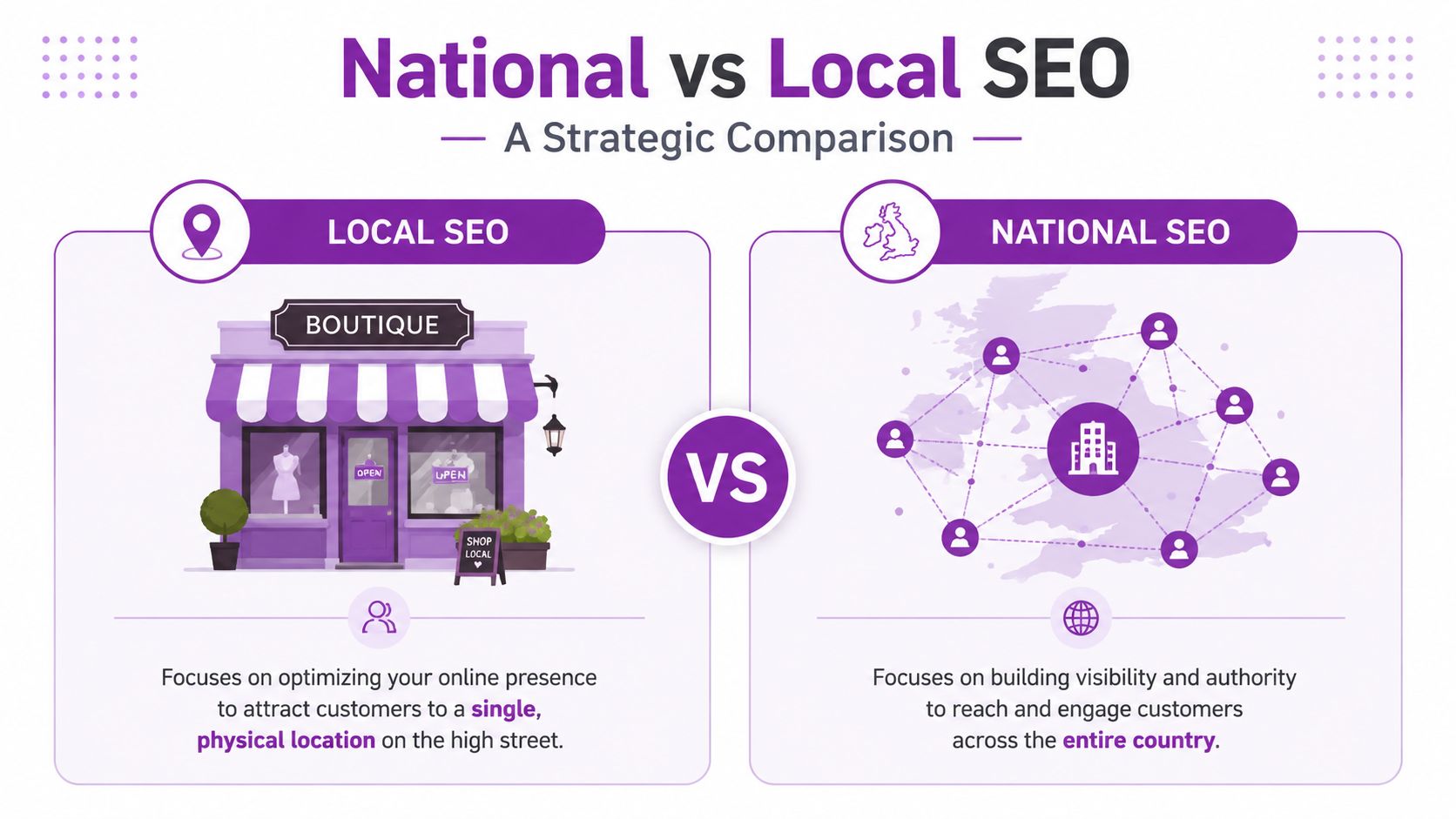
National vs Local SEO A Strategic Comparison
Local SEO and national SEO share tools, but they don't share the same job.
Local SEO is like running a strong high-street boutique. You want nearby shoppers to find you quickly, trust you, and visit or enquire. National SEO is closer to building a retail brand with reach across the country. You need stronger logistics, clearer category structure, broader messaging, and more authority.
The biggest difference is intent
Many business owners get stuck here. They assume national means “more traffic”. Sometimes it does. But it can also mean weaker relevance if searchers still think locally.
That's why the better question is often when national SEO makes sense at all. For many UK service businesses, national targeting can dilute relevance unless it sits alongside a strong multi-location structure, because buyers often begin with location-led intent. SEO Locale's discussion of national SEO trade-offs captures that tension well.
If you want a straightforward refresher on the local side of this, the Keyword Kick resource on local SEO is useful because it defines local search mechanics without agency jargon.
National SEO vs Local SEO at a Glance
| Aspect | Local SEO | National SEO |
|---|---|---|
| Audience | People in or near a defined area | People across the UK searching broader terms |
| Search intent | Often urgent or location-specific | Often broader, comparative, research-led, or brand-led |
| Keyword focus | Town, city, county, and “near me” phrases | Broad service, product, and topic terms |
| Main battleground | Google Business Profile, maps, local landing pages | Organic listings, content depth, authority, technical scale |
| Competitors | Nearby firms and regional players | National brands, publishers, aggregators, large specialists |
| Website structure | A few targeted local pages may be enough | Needs clearer hubs, clusters, and scalable architecture |
| Success metric | Calls, form fills, visits from target area | Qualified leads, broader visibility, assisted conversions, revenue |
Where businesses often choose the wrong model
Some firms jump to national SEO because local rankings feel “too small”. That's not always true. If your buyers still search by town, city, or postcode, forcing broad national pages can make your message vaguer and your conversion rate softer.
A smarter move is often to test whether your site can support both. One way to assess that is with a Google Business Profile audit tool, because it highlights whether your local presence is still carrying too much of the lead generation burden.
National reach only helps if you don't sacrifice the local signals that already convert.
The Four Pillars of a National SEO Strategy
A national seo service needs a stronger foundation than a local campaign. You're asking Google to trust your site across wider topics, broader geography, and tougher competition. That doesn't happen through one homepage rewrite or a handful of blog posts.

Technical SEO for scale
Local sites can sometimes rank with messy architecture if the competition is light. National campaigns usually can't.
At this level, technical SEO is about helping Google crawl, understand, and prioritise the right pages. That means a clean site hierarchy, sensible internal linking, canonical control, XML sitemaps, and schema markup that explains what your business does without relying on endless location modifiers.
Mobile performance matters even more here. Ofcom reports that 88% of UK adults use a smartphone and 91% go online via a mobile device, which is why Google's Mobile-First Indexing has direct ranking consequences for national campaigns, as explained in Outpace SEO's overview of mobile-first requirements. If your mobile pages hide content, weaken internal links, or load poorly, you don't just lose one local search. You can lose visibility across the country.
On-page optimisation for broad relevance
Local SEO often leans on pages such as “plumber in York” or “wedding venue in Kent”. National SEO needs a wider content map.
Instead of building isolated pages, you build topical systems. A core service page targets the main national query. Supporting pages answer adjacent questions, sector-specific concerns, and decision-stage searches. That structure tells Google your site isn't just relevant once. It's relevant repeatedly across a subject area.
For example, a national construction consultancy might need:
- A central service hub for its main offer
- Sector pages for commercial, education, or heritage work
- Process pages explaining timelines, compliance, or procurement
- Support content answering pre-sale questions clients search before enquiring
Content that builds authority
This is where many campaigns either accelerate or stall. A national site can't rely only on service pages. It needs useful, publishable content that earns attention beyond its own sales copy.
That usually means a hub-and-spoke model. You create a strong pillar page for a commercial topic, then support it with articles, guides, FAQs, and proof-led pages that answer related searches. Some businesses also need thought leadership content because national buyers compare expertise before they compare price.
One practical benchmark for campaign shape comes from Logical Position's description of national SEO deliverables, which outlines a cadence that can include up to 6 to 9 onsite content pages in month 1, followed by 2 to 3 long-form blog posts and offsite article link building each month. The exact mix will vary, but the lesson is clear. National SEO is sustained publishing and authority building, not a one-off tidy-up.
Authority beyond local citations
Local campaigns often improve with directory consistency and a handful of area-relevant links. National campaigns need stronger signals.
You need mentions, links, and references from sites that make sense in your industry or market. That could include trade publications, sector bodies, suppliers, event partners, specialist media, or useful resources your audience already trusts. The goal isn't random backlinks. It's reputation that scales.
A lot of businesses also need better proof assets before link building works well. Original guides, tools, comparison pages, and expert commentary tend to travel further than thin service copy.
For businesses needing support with local and broader organic visibility, Bare Digital offers SEO work that includes technical fixes, content support, location pages, and authority-building campaigns.
Expected Outcomes Timelines and KPIs
Most disappointment in SEO comes from a timing problem, not a channel problem. Businesses expect revenue before the foundations are visible. Agencies report rankings before the business sees leads. Both sides end up talking past each other.

A national seo service usually behaves more like building an asset than launching an advert. That's one reason ROI is such an important benchmark. Data cited by Reboot Online reports that “thought leadership and SEO” campaigns average a 748% ROI, with a break-even period of about 9 months, which helps explain why many businesses treat SEO as a compounding channel rather than a quick win, as shown in Reboot Online's SEO statistics roundup.
What tends to happen first
The first stretch usually looks quieter from the outside than it is in reality. Technical fixes get implemented. Pages are improved. Internal linking becomes more deliberate. New content starts getting indexed.
In reporting, those early gains often show up as:
- Indexation improvements where important pages are crawled and recognised more consistently
- Keyword visibility growth beyond your brand terms
- Better engagement on priority pages as messaging becomes clearer
- Cleaner attribution so organic enquiries are easier to track
These are leading indicators. They matter because they tell you the machine is starting to work.
What traction looks like later
Once content accumulates and authority grows, the pattern changes. More pages start ranking. Broader searches begin to contribute. Your site may earn visits from people who first discover you nationally, then convert through a service page, proof page, or local landing page later.
If your reporting only focuses on rank positions, you'll miss the true business picture. A more useful framework is this guide to mastering key performance indicators, because it helps separate vanity metrics from outcome metrics.
Don't judge a national SEO campaign by impressions alone. Judge it by whether qualified enquiries become easier and cheaper to generate over time.
A practical KPI model
A simple way to judge progress is to align metrics with campaign stages:
| Stage | What to watch |
|---|---|
| Early phase | Crawl health, indexation, page quality, keyword coverage |
| Traction phase | Non-branded visibility, landing page engagement, assisted conversions |
| Compounding phase | Qualified leads, sales pipeline contribution, organic revenue, ROI |
This explainer gives a useful view of how SEO work translates into business outcomes over time:
If you need to sense-check the commercial side of your campaign, a tool like this SEO ROI calculator for self-storage businesses is a good reminder that SEO should eventually be measured in revenue terms, even when the early months are operational.
Choosing Your Engagement Model and Pricing
Pricing for a national seo service confuses people because they're often comparing unlike-for-like proposals. One agency offers a monthly retainer. Another offers a technical project. A third bundles content, outreach, and reporting into one fee. The cheaper quote can look attractive while covering far less work.
The right question isn't “what does national SEO cost?” It's “what kind of engagement matches the job we need done?”

Monthly retainers
A retainer fits when the campaign needs ongoing technical work, content production, optimisation, and link acquisition. That's often the case for national SEO because the competitive environment keeps moving. New pages need publishing, old pages need improving, and authority work takes time.
This model usually suits businesses that want a steady operating rhythm and regular reporting, not one isolated fix.
Project work
A project makes sense when the problem is specific. You might need a site migration plan, a content architecture overhaul, or a technical audit before internal teams take over.
Project work can be valuable, but it won't replace an ongoing campaign if the goal is durable national growth. It's better viewed as infrastructure, not the full journey.
Hybrid models
Some businesses need both. They start with a strategy or technical project, then move into monthly execution. That can work well for firms with in-house writers, developers, or marketing managers who can share delivery.
When reviewing proposals, look for the drivers behind the cost:
- Scope of content. How many service, sector, or support pages need creating or rewriting?
- Technical complexity. Is the site simple, or does it have duplicate templates, weak internal linking, or migration risk?
- Competitive pressure. Are you up against local firms in multiple regions, or large national players?
- Reporting depth. Will the agency tie work to business outcomes or only provide ranking screenshots?
If your current priority is stronger regional visibility before a full national push, a service page like SEO services in Cambridge is a useful example of the kind of local-market detail that should already be in place before scaling broader.
A good proposal explains what work is being bought, why it matters, and what success will be measured against.
The Bare Digital Approach Tailored for UK Growth
Many UK businesses don't need a pure national strategy in the e-commerce sense. They need something more practical. They need to win locally in several places, while also building enough topical authority to be visible beyond one town.
That middle ground matters for wedding venues, construction firms, care providers, architects, funeral homes, and professional services. Buyers may discover those businesses through broader searches, but they often convert only after they see evidence tied to a region, county, or service area.
National reach without losing local conversion power
The strongest approach is often layered.
You build national-level authority with broad service pages, supporting content, and stronger site architecture. Then you connect that authority to local landing pages, service-area pages, or Google Business Profiles that convert the demand where it matters. That way, the site can rank for broader commercial themes without sounding generic to someone searching with local intent.
A lot of agencies force businesses into one model or the other. The better model asks where discovery happens and where conversion happens. Those aren't always the same place.
Reporting that reflects how people really buy
This matters even more now because Google's results pages aren't static. As AI Overviews absorb more search real estate, the value of a number one ranking is changing, which means modern national SEO should focus on authority, enquiries, and assisted revenue, not just raw click volume, as discussed in Astoundz's overview of national SEO and AI search change.
For a UK business, that changes what good reporting looks like. You may want to track:
- Enquiries by region rather than total form fills alone
- Visibility across service clusters rather than one trophy keyword
- Assisted conversions from blog, guide, and proof pages
- Local conversion quality after national discovery
That's especially relevant if you serve several counties, travel to clients, or sell high-consideration services where buyers compare options before making contact.
The practical takeaway is simple. A national seo service should expand your reach without flattening your message. If it brings more visibility but makes you less convincing to real buyers, it isn't doing its job.
Finding Your National SEO Partner A Final Checklist
Choosing an SEO partner is easier when you know what to ask. You're not buying a list of tasks. You're choosing a team that should understand how your business grows, where search demand starts, and what kind of visibility translates into revenue.
Use questions that force strategic answers, not rehearsed sales language.
Questions worth asking
How would you balance national visibility with local conversion intent?
This reveals whether they understand the tension between broad reach and area-specific trust.What would our site architecture need to look like to scale properly?
You want a clear answer about hubs, supporting pages, internal links, and technical control.How do you handle mobile-first SEO for larger service sites?
If they talk only about design and not parity, crawlability, and page content, keep digging.What metrics would you report in the first months versus later months?
Good agencies distinguish early technical signals from later business outcomes.How do you approach authority building for a business like ours?
Listen for relevance, industry fit, and quality. Not volume for its own sake.How would AI Overviews change the way you measure success?
They should talk about enquiries, assisted conversions, and proof-led content, not rankings alone.Can you show examples from businesses with a similar model?
Similar model matters more than similar size. A multi-location service brand isn't the same as a national retailer.
The right SEO partner should be able to explain trade-offs clearly. If every answer sounds easy, the strategy probably isn't deep enough.
National SEO can be a strong next move. But only when your business is ready for broader demand, your site can support it, and your strategy protects the local relevance that already converts.
If you're weighing up whether a national seo service is the right next step for your business, Bare Digital can help you assess the gap between your current local visibility and a broader UK growth plan, then map out a strategy that fits how your customers search and buy.






