
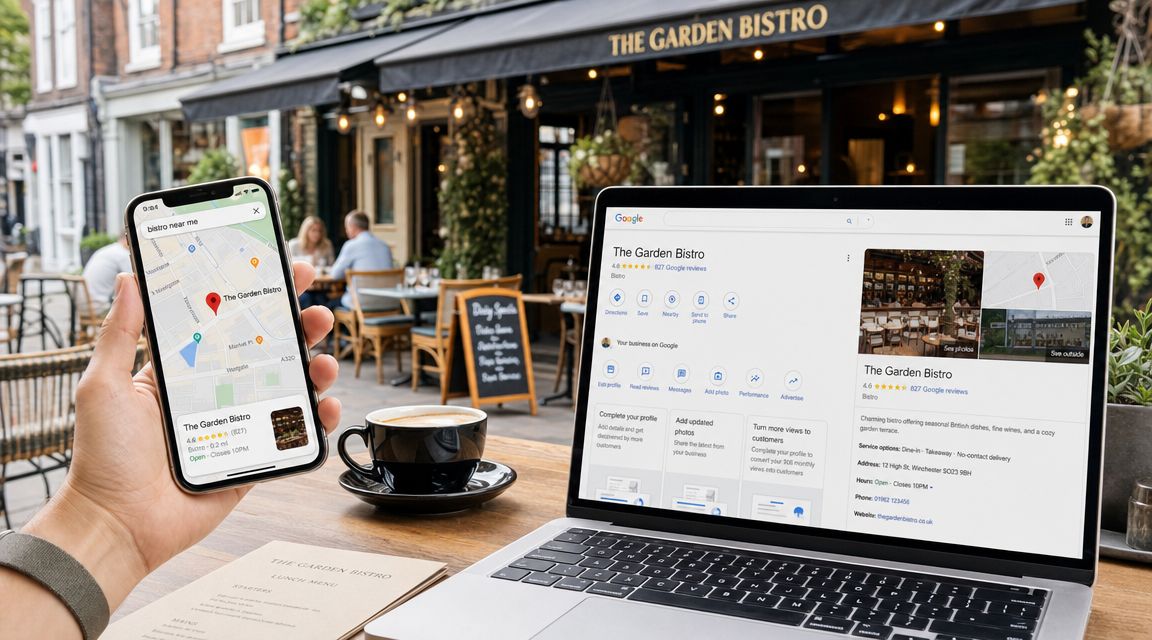

You might be serving excellent food, training staff properly, and keeping standards high, yet still seeing too many empty covers on a Tuesday night. Then you search your own restaurant name, or worse, a phrase like “Italian restaurant near me”, and your competitors dominate the map while your listing looks half-finished, your reviews are stale, and your website hides the menu in a PDF no one can parse properly.
That's the gap local SEO fills. For UK restaurants, it isn't a side task for when things quieten down. It's the system that helps hungry people find you at the exact moment they're deciding where to eat, whether they want a quick lunch, a family dinner, or somewhere to book for Saturday.
Why Most Restaurants Fail at Local SEO
Most restaurants don't fail at local SEO because they lack effort. They fail because they follow generic small-business SEO advice that doesn't match how people choose where to eat.
A restaurant isn't a solicitor's office or an accountant. Restaurant searches are fast, mobile, and full of intent. People want to know if you're open, what the food looks like, whether booking is easy, and if other diners still rate the place highly. If they can't get those answers in seconds, they move on.
Generic SEO advice misses restaurant behaviour
A lot of SEO guidance still pushes broad tasks like “write more blog posts” or “target more keywords” without addressing the actual friction points that stop a diner from booking. That's a problem in the UK, where 67% of all web traffic came from mobile in 2025, and 94% of UK consumers say online reviews influence their purchases, according to this restaurant SEO analysis.
Those two facts change the playbook.
If most discovery happens on phones, your local SEO for restaurants has to prioritise mobile decisions, not desktop browsing. If reviews influence nearly every purchase decision, then review strategy can't sit in a customer service silo. It has to sit inside your marketing system.
Practical rule: If a diner can't confirm your menu, opening times, location, and credibility within a few taps, your ranking alone won't save the booking.
The common mistakes that keep restaurants invisible
The pattern is usually the same:
Weak Google presence
The Google Business Profile exists, but it's missing categories, has old photos, or shows unreliable hours.A website built for looks, not search
The site may be attractive, but if key information is buried, duplicated, or hidden in image files and PDFs, Google gets weak signals.Reviews treated as admin
Staff ask occasionally, responses are inconsistent, and there's no process to turn happy diners into fresh public proof.No local intent strategy
The restaurant targets its brand name but ignores how people search by area, cuisine, dish, and occasion.
A proper local SEO checklist for UK businesses helps, but restaurants need a narrower operational version of that checklist. They need one built around footfall, calls, bookings, and map visibility.
What works instead
Strong restaurant local SEO is less about “doing SEO” in the abstract and more about removing hesitation. Your listing has to answer immediate questions. Your website has to support location intent. Your reputation has to look active, recent, and trustworthy.
That's why restaurants with simpler, cleaner digital setups often outperform businesses with bigger budgets. They make it easy for Google to trust them and easy for diners to choose them.
Build Your Unbeatable Google Business Profile
For most restaurants, Google Business Profile is the primary homepage. Before a diner lands on your website, they often see your map pin, reviews, opening times, photos, busy hours, booking link, and directions.
In the UK, Google is the dominant discovery channel for nearby dining searches, and Google Maps is widely used for local discovery, making map visibility the first step in the customer journey for “near me” searches, as explained in this UK local SEO breakdown for restaurants.
Get the core fields right first
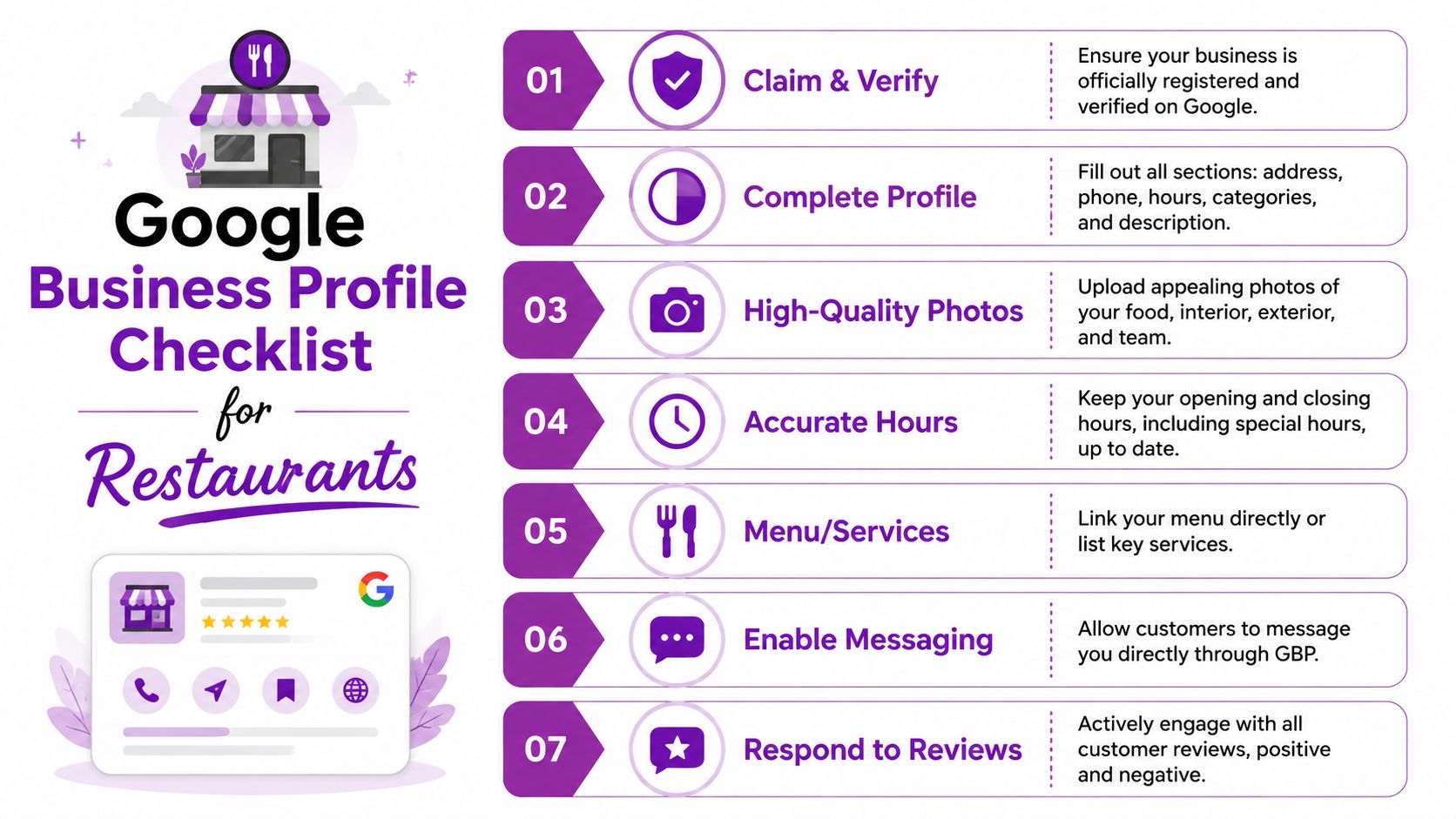
Restaurant owners often jump to photos and posts before fixing the basics. That's backwards. The essentials carry the most weight because they affect trust, consistency, and conversion.
Focus on these first:
Primary category
Choose the closest match to the main thing you are. If you're a pizza-led business, “Pizza restaurant” may serve you better than a broader category. If you're a pub with a serious food offer, think carefully about whether your main category should reflect drinks, dining, or both.Secondary categories
Add relevant supporting categories, but don't pad the profile with every possible option. Relevance matters more than volume.Name, address, phone
Your NAP has to match your website and your other listings exactly. Small differences create messy signals.Opening hours
This sounds basic because it is basic. It also breaks constantly. Holiday hours, split service, Sunday lunch changes, and seasonal closures must be updated.Booking and ordering links
If you take reservations, make that path obvious. If takeaway matters, surface that too.
Treat attributes like conversion tools
Attributes are often ignored, but diners use them to rule places in or out quickly. Outdoor seating, takeaway, dine-in, vegetarian options, accessibility, family suitability, and live music all shape decisions.
A diner choosing between two local restaurants may never read your full description. They'll compare signals. Attributes help Google understand your offer and help users decide whether your restaurant fits the moment.
A complete profile doesn't just improve visibility. It reduces uncertainty, and uncertainty is what kills bookings.
Photo strategy matters more than most owners think
Restaurants win or lose clicks on visual trust. You don't need over-styled campaign photography every week, but you do need a steady set of useful, current images.
Use a practical mix:
- Exterior shots so people can recognise the venue from the street
- Interior shots that show atmosphere, lighting, and seating
- Food shots that reflect what diners receive
- Team shots to humanise the business
- Context shots such as terrace seating, bar area, private dining, or event setup
Avoid uploading ten versions of the same dish. Build a profile that answers the diner's unspoken questions: What does it feel like? Is it casual or polished? Can I bring family? Does it look worth the spend?
Use posts and messaging selectively
Google Posts aren't magic, but they're useful for showing recent activity. They work best when tied to actual decisions: a new lunch menu, live music night, Sunday roast, seasonal terrace opening, or festive booking window.
Messaging can help if someone on your team will reply. If messages sit unanswered, turn it off. A slow response creates more damage than no messaging option at all.
Audit your profile like an operator
Don't “set and forget” your profile. Review it on a fixed schedule.
A simple monthly check should cover:
| Area | What to check |
|---|---|
| Business info | Categories, NAP, hours, links |
| Visuals | Old photos, missing exterior/interior coverage |
| Reviews | New reviews, unanswered feedback, recurring complaints |
| Features | Booking link, menu link, attributes, services |
| Competitors | What nearby restaurants show in their profiles that you don't |
If you want a structured way to review it, a Google Business Profile audit tool can help flag gaps before they cost you visibility.
Turning Your Website into a Local SEO Powerhouse
Your website doesn't replace your Google Business Profile. It supports it. That's the right way to think about local SEO for restaurants.
The most effective technical workflow is to treat GBP as the primary conversion surface, then make the website reinforce it with location pages, HTML menu content, embedded maps, and Restaurant or LocalBusiness schema, as outlined in this restaurant local SEO technical guide.
Stop hiding your menu in a PDF
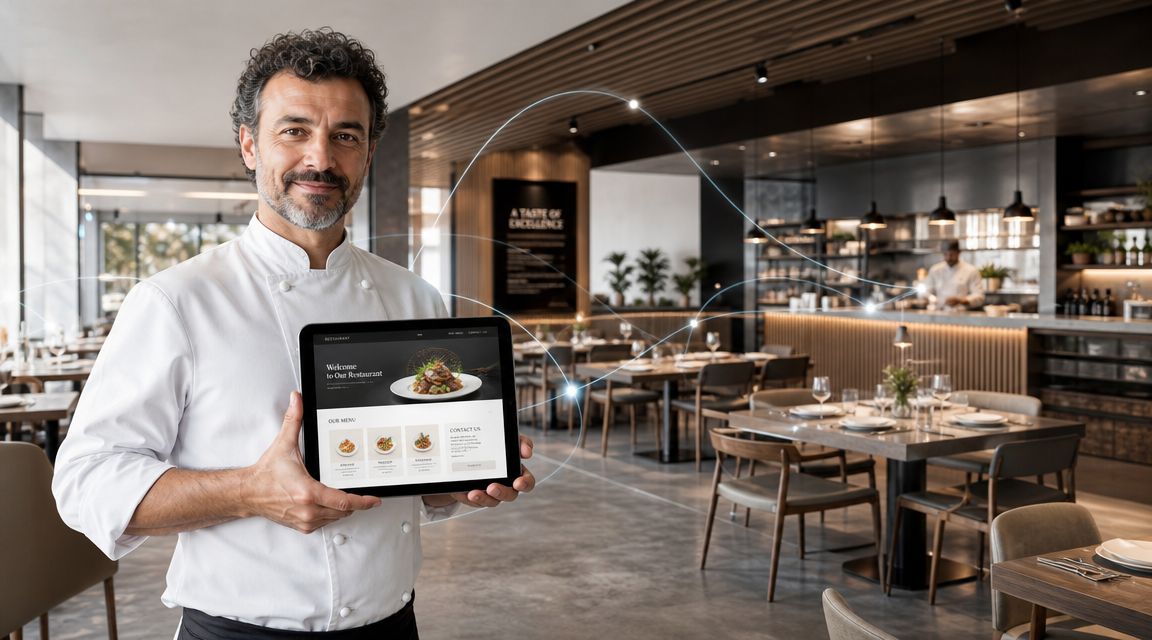
This is one of the biggest technical mistakes restaurants make. A PDF can look tidy from a design point of view, but it's a poor format for local search.
Google reads HTML pages far more reliably than menu PDFs. Diners also hate pinching, zooming, and downloading a file on mobile just to check whether you serve small plates, Sunday roast, or vegan mains.
A better setup is simple:
- Put the full menu in HTML
- Keep sections clear and crawlable
- Update prices and seasonal changes promptly
- Use the PDF only as a secondary download if you must
That change alone improves usability and gives Google stronger content to associate with your location and offer.
Build proper location pages for each branch
If you run more than one site, don't send every branch visitor to the same generic locations page. Each branch needs its own page with its own signals.
A strong location page includes:
- Unique local copy about the branch and area
- Full address and contact details
- Opening hours
- Embedded Google Map
- Menu content in HTML
- Booking link
- Useful branch-specific details such as parking, terrace seating, private dining, or accessibility
What doesn't work is cloning the same page for every branch and swapping only the town name. That creates thin pages that struggle to rank and don't help diners much either.
Add schema without overcomplicating it
Schema sounds technical, but the purpose is straightforward. It helps search engines understand exactly what your restaurant is, where it's located, and what key details belong to that location.
For restaurants, the priority is usually:
- Restaurant or LocalBusiness schema
- Address information
- Opening hours
- Menu references
- Review-related information where appropriate
You don't need to turn the website into a developer experiment. You need clean structured data that matches what's already visible on the page.
Operational takeaway: Your website should confirm the same facts your Google profile shows, not contradict them.
Mobile structure beats decorative design
Restaurant sites often lean hard into branding. Full-screen videos, oversized animations, and clever transitions can look impressive in a pitch deck, but they often get in the way of bookings.
On mobile, the page needs to make four things obvious immediately:
- What the restaurant is
- Where it is
- How to book or order
- How to see the menu
If those actions are buried, users bounce. A fast, plain, functional page often beats a beautiful one that makes people work.
Don't copy strategy from unrelated sectors
A lot of restaurant owners borrow SEO ideas from other industries and end up wasting time. Some tactics overlap, but the customer journey is different. That's true whether you compare restaurants with solicitors, salons, or even adjacent hospitality categories. You can see that difference clearly by looking at service-led examples like SEO for wedding venues, where the research cycle is much longer and the content priorities are different.
Restaurants need shorter paths, clearer actions, and stronger local intent pages.
How to Find the Keywords Hungry Customers Are Using
Keyword research for restaurants isn't about finding the biggest search volume and stuffing it everywhere. It's about matching the words diners use when they're close to making a decision.
The easiest way to do that is to split restaurant searches into three intent groups. Each group reflects a different stage of urgency and a different type of page.
Near me searches
These are the high-pressure searches. The user often wants an answer now.
Examples include:
- italian restaurant near me
- sunday lunch near me
- cocktails near me
- takeaway near me
You won't usually optimise a page by repeating “near me” over and over. Google uses location signals from the searcher, your profile, your site, and your citations. What matters is whether your business clearly matches the implied need.
For these searches, your strongest assets are usually your Google Business Profile, your location page, and your reviews.
Location-based searches
These are more explicit and often easier to shape with page content.
Think in combinations such as:
| Search type | Example |
|---|---|
| Cuisine plus place | indian restaurant in Brighton |
| Occasion plus area | birthday dinner in Manchester city centre |
| Feature plus town | restaurant with parking in Leeds |
| Neighbourhood intent | brunch in Shoreditch |
Location pages, page titles, headings, menus, FAQs, and review language all help here. If a branch is known for pre-theatre dining, riverside seating, or a strong gluten-free menu, build that into the page naturally.
Dish and experience searches
These are often overlooked, but they convert well because they reveal exactly what the diner wants.
Examples:
- bottomless brunch Birmingham
- sunday roast with parking
- vegan tasting menu London
- steak restaurant with outdoor seating
These searches can live in different places depending on the offer. Some belong on permanent landing pages. Some belong in menu pages. Some fit better as event or seasonal pages if the offer isn't always available.
The best keyword isn't always the broadest one. It's the one that matches the real decision a diner is making.
Where to place restaurant keywords
A practical placement model works better than a huge spreadsheet.
Use keywords in these places:
- Google Business Profile through categories, services, posts, and review responses
- Location pages for cuisine, area, and booking intent
- Menu pages for dishes, dietary options, and specials
- FAQ sections for parking, bookings, child-friendliness, and accessibility
- Seasonal pages for Christmas menus, Mother's Day, Valentine's bookings, and Sunday lunch
Keyword research tools can help, but so can your own front-of-house team. Ask what callers and walk-ins ask most often. Those phrases often become your most useful local search targets.
If you also run private events, buffets, or off-site food services, it's worth studying adjacent search behaviour too. A specialist example is SEO for catering companies, where menu intent overlaps with event and service-led searches.
Managing Your Online Reputation and Reviews
Review management isn't an optional clean-up task. It's one of the main drivers of local visibility and conversion for restaurants.
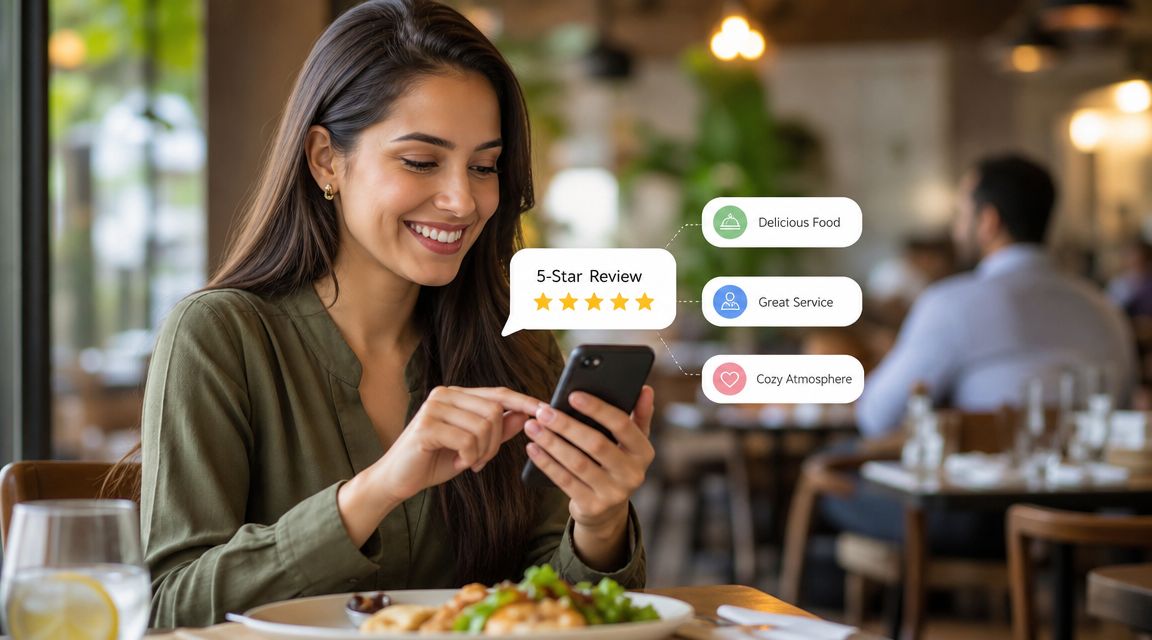
In the UK, review quality and recency materially influence restaurant choice, and Google's local ranking framework uses prominence, which means restaurants with frequent, genuine reviews are more likely to appear in the local pack, according to this overview of restaurant local SEO and reviews.
Why review velocity matters
A restaurant with excellent reviews from two years ago can still lose to a competitor with a steadier stream of recent feedback. Diners read freshness as relevance. Google does too.
That means you need a repeatable way to generate reviews from real customers. Not in a spammy burst. Not by begging every table. Consistently.
A practical workflow looks like this:
- Ask after clearly positive experiences
- Train staff on a simple verbal prompt
- Use receipts, follow-up emails, or QR codes carefully
- Direct people to the profile that matters most to your local visibility
- Respond promptly so the profile looks active
Respond like a restaurant, not a template
Review responses shouldn't read like legal disclaimers. They should sound like a business that noticed what the guest said.
For positive feedback:
Thanks for joining us for Sunday lunch. Glad you enjoyed the roast potatoes and service. We hope to see you again soon.
For negative feedback:
Sorry the wait felt too long on your visit. That's not the standard we want. If you're open to it, please contact us directly so we can look into what happened.
Short, human, specific. That's enough.
Use reviews to improve the operation
The strongest restaurants treat reviews as feedback data, not just public proof. If the same issue keeps surfacing, the SEO task is no longer just “reply better”. The business task is to fix the recurring problem.
Structured feedback collection provides this exact help. If you want better prompts for post-visit input, this restaurant survey questions guide is useful for building smarter surveys that uncover what diners liked, what nearly stopped them returning, and what staff should address next.
Build a lightweight reputation system
Don't overengineer this. Most restaurants need a weekly rhythm, not a complicated dashboard.
A simple setup:
| Task | Owner |
|---|---|
| Check new reviews | Duty manager or marketing lead |
| Respond to feedback | Named team member with tone guidelines |
| Flag recurring complaints | GM or operations lead |
| Ask for new reviews | Front-of-house after positive experiences |
Video can help if your team needs a clearer process for handling review responses and reputation workflows:
A lot of restaurants delay review work because it feels reactive. In reality, it's one of the most direct marketing levers they have. Reviews shape ranking, click-through, trust, and booking confidence in one place.
Earning Local Links and Building Authority
Links still matter, but restaurants often chase the wrong ones. You don't need random directory submissions from irrelevant sites. You need signals that tie your restaurant to a real place, real community, and real local attention.
That's what local authority looks like in practice. A theatre partnership, a feature in a city food guide, a local event page, a chamber listing, or a neighbourhood blog mention often carries more value than generic link-building activity with no geographic relevance.
What a useful local link looks like
A useful local link usually has at least one of these qualities:
Geographic relevance
The site serves your town, city, or neighbourhood.Topical relevance
It covers food, hospitality, events, tourism, or local lifestyle.Business legitimacy
It confirms who you are, where you are, and what you do.
Citations matter too. Your listings on booking platforms, local directories, maps, and business databases help reinforce consistency. They aren't glamorous, but they support entity trust.
Offline activity can create online authority
Restaurant SEO becomes far more interesting than many expect at this stage. The strongest local links often come from real-world activity.
Examples that tend to work:
Partner with a nearby venue
A pre-theatre menu with a local theatre or music venue can earn a link from their event or visitor page.Sponsor a community initiative
School raffles, charity dinners, local sports clubs, and street festivals often publish sponsor pages.Host something worth listing
Wine tastings, chef collaborations, quiz nights, and seasonal events can earn mentions from local “what's on” sites.Work with local press and bloggers
Not through mass outreach. Through a genuine story, launch, event, or angle worth covering.
A local link works best when it exists for business reasons first and SEO reasons second.
Avoid the common authority traps
Restaurant owners often waste time in three places.
First, they buy low-quality links. These rarely help and can make your profile look unnatural.
Second, they ignore citation consistency. If half your listings show an old number or wrong opening details, your authority weakens.
Third, they treat every branch the same. A Manchester branch should earn Manchester signals. A Leeds branch should earn Leeds signals. Local SEO for restaurants works best when each location builds its own footprint.
A practical authority plan
If your restaurant has limited time, prioritise in this order:
- Clean up your core citations
- Secure listings on relevant restaurant and local platforms
- Build partnerships with nearby organisations
- Create event or offer pages worth linking to
- Ask for inclusion in local round-ups where you fit
This part of local SEO compounds slowly, but it becomes defensible. Competitors can copy a category tweak. They can't instantly copy your local relationships.
Tracking What Matters and Planning Your Next Move
Restaurants often track the wrong SEO metrics. They look at broad traffic trends, vanity ranking reports, or impressions with no clear link to revenue. That's not enough.
The useful question is simpler. Are more local searchers taking actions that lead to bookings, calls, directions, and footfall?
The KPIs that actually matter
For restaurant local SEO, focus on metrics tied to real behaviour:
Google Business Profile actions
Direction requests, calls, website clicks, booking clicksLocal keyword visibility
Rankings for searches tied to cuisine, area, and profitable occasionsLanding page engagement
Are users reaching branch pages and taking action?Review activity
New review flow, response speed, recurring themesBooking and enquiry patterns
Not every booking comes from SEO alone, but trend lines matter
If your reports don't connect visibility to action, they aren't helping operations make better decisions.
Turn reporting into decisions
Use your data to ask practical questions each month.
| Signal | What it may mean |
|---|---|
| More map views but few clicks | Listing isn't convincing enough |
| More website visits but weak bookings | Pages may be unclear or slow |
| Strong reviews but poor visibility | Profile or site signals may be incomplete |
| Good rankings for one branch only | Other locations may need their own local work |
This is also the point where tools matter. Google Business Profile insights, Search Console, analytics, booking data, and call tracking all help when read together. If you want a clearer reporting structure, a GBP report setup gives one example of how local performance can be organised around actions rather than vanity metrics.
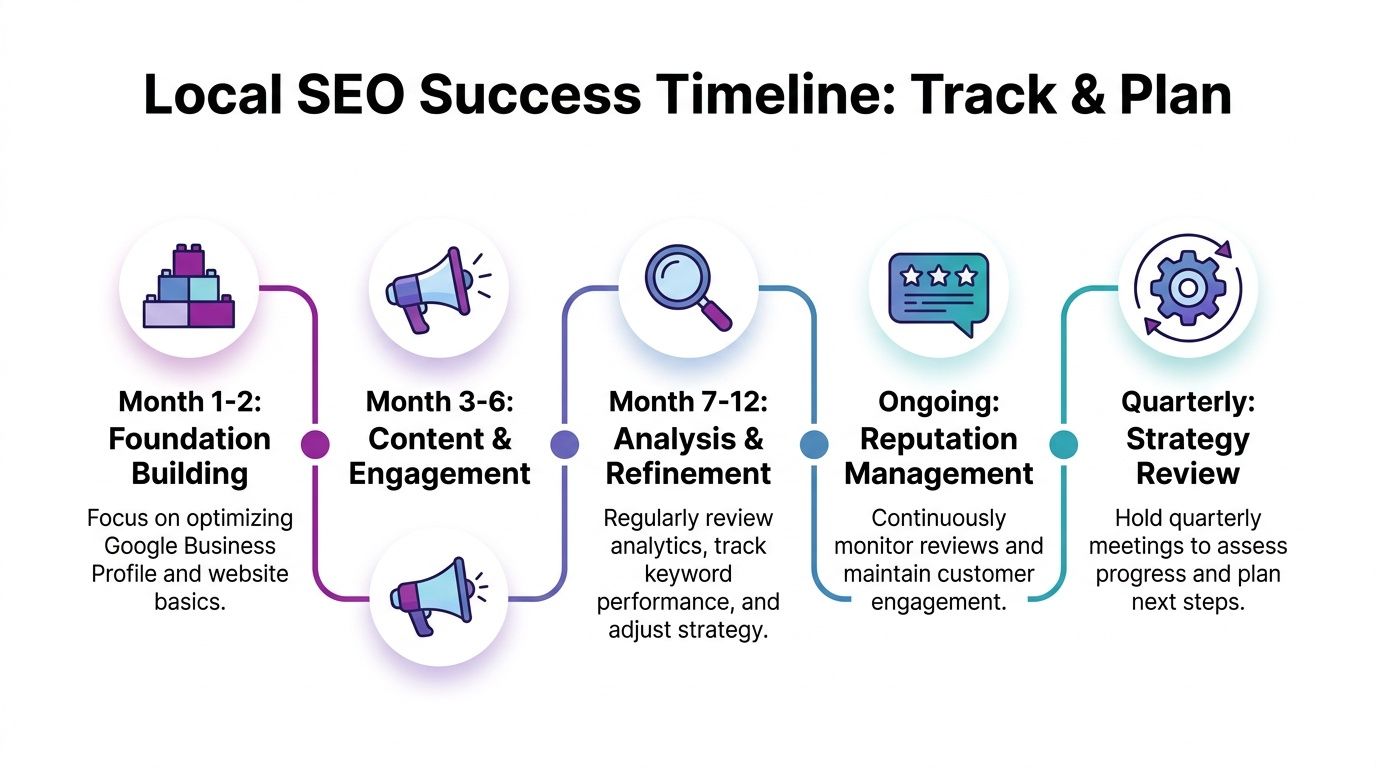
A practical ninety-day rhythm
Most restaurants don't need a giant strategy deck. They need a short sequence they can execute.
First phase
Fix Google Business Profile completeness, opening hours, booking links, categories, photos, and NAP consistency. Clean up the website basics, especially menus and location pages.
Second phase
Start generating fresh reviews consistently. Improve key location pages. Tighten internal links. Publish useful offer or event pages where needed.
Third phase
Review what's changed. Which searches improved. Which branches lag. Which review themes need operational fixes. Which local partnerships could build stronger authority.
For broader context on how local tactics fit into wider digital planning, SleekPost's expert guide is a useful reference point, especially if you're aligning SEO with paid, social, and retention activity rather than treating it in isolation.
Don't expect magic. Expect compounding gains
Local SEO for restaurants works when the basics are done properly and kept current. It's operational. The restaurants that win usually aren't doing mysterious things. They're more consistent with the details that influence discovery and choice.
One practical option for support is Bare Digital, which provides local SEO services including Google Business Profile optimisation, local keyword targeting, citation work, review support, and location-focused content.
If you want help turning map visibility into more bookings, calls, and walk-ins, Bare Digital can review your current local presence and identify the gaps holding your restaurant back.






