
A practice manager usually sees the same pattern before local SEO becomes a priority. Fee earners are busy, referrals still come in, and the website technically exists, but new enquiries from Google feel patchy and hard to explain. One month the family team gets calls. The next month conveyancing goes quiet. Nobody can say with confidence whether the firm is visible where it matters, or whether nearby competitors are taking the work.
That uncertainty is expensive because legal search is rarely casual. People often look for help when something urgent, stressful, or time-sensitive has happened. If your firm doesn't appear when they search by service and location, you don't just lose traffic. You lose live matters.
Why Local Search Is Non-Negotiable for UK Law Firms
A prospective client in Leeds needs a conveyancing solicitor. Someone in Bristol wants advice on an employment dispute. A family member in Manchester is trying to find a probate solicitor for a parent. They don't start with a broad research project. They reach for their phone, search by need and place, and compare the firms Google puts in front of them.
That's why local SEO for lawyers sits so close to revenue. It meets people at the point where intent already exists.
Google has reported a 500% increase in “near me” mobile searches, and legal marketing research notes that law firm clients commonly search by practice area plus location, such as queries like solicitor plus town or service plus area, which makes local visibility a direct response to real search behaviour, not a branding exercise (Bill4Time on local legal search behaviour).
What that means in practice
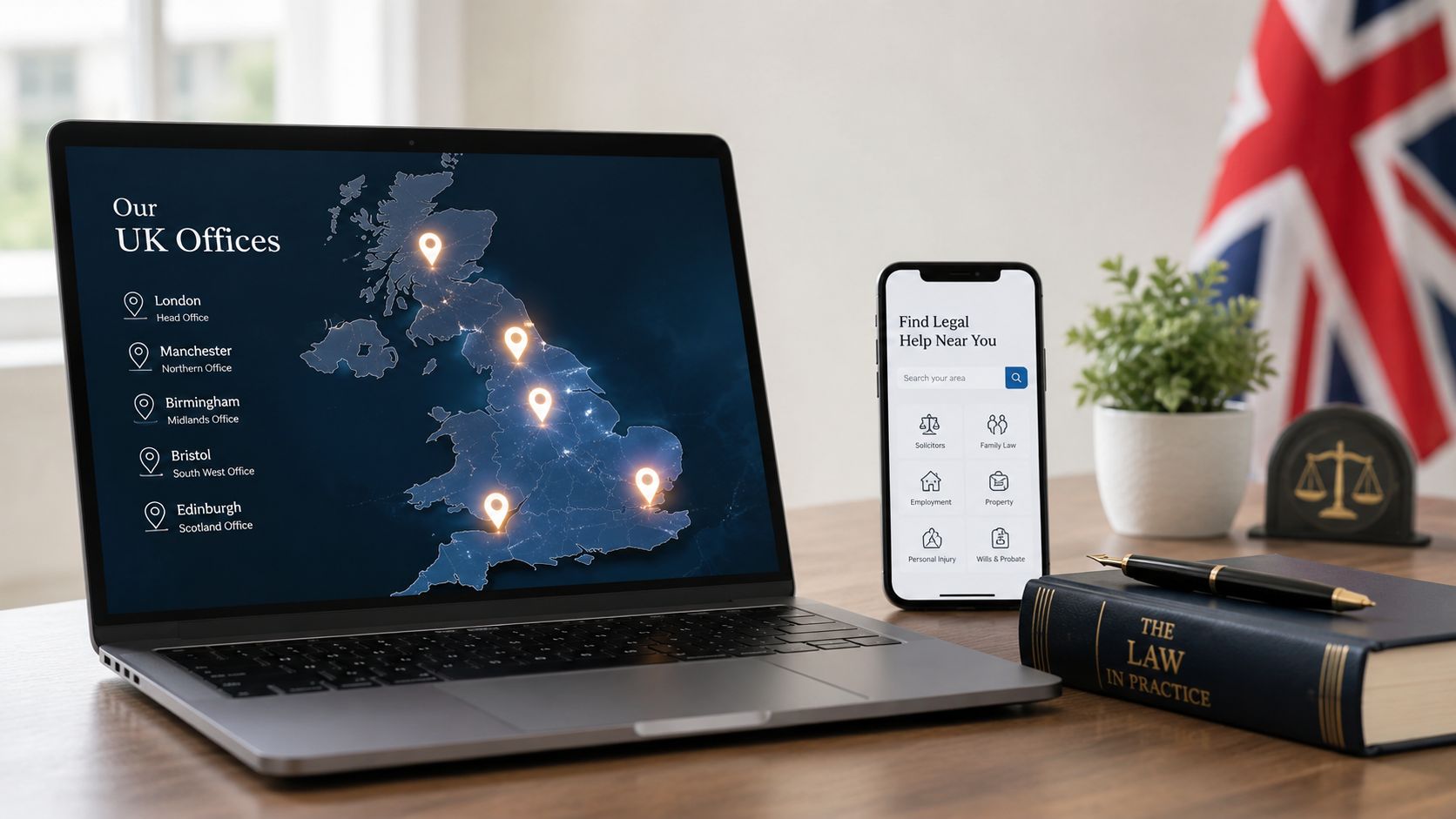
For a UK law firm, local search isn't only about ranking a homepage for a broad phrase. It's about appearing in the two places people use to decide who to contact:
- Google Maps results where proximity and trust signals shape quick comparisons
- Localised organic results where users scan practice fit, credibility, and location relevance
- Mobile search journeys where a click-to-call action often matters more than a pageview
- Service-specific searches where generic messaging loses to pages that match the exact matter type
A lot of firms still treat local SEO as a light layer on top of a general website. That's the wrong model. If your property team serves York, Harrogate, and Wetherby, but your site only has a general conveyancing page, Google has very little reason to put you in front of a user searching for a conveyancing solicitor in one of those places.
Commercial reality: local search captures prospects when they're actively comparing nearby legal options, not when they're passively browsing.
What works and what doesn't
A firm usually gets traction when it aligns its online presence with how legal clients search. That means clear office signals, specific service pages, a maintained Google Business Profile, and enough authority signals for Google to trust the listing.
What doesn't work is just as predictable:
| Approach | Likely outcome |
|---|---|
| One generic services page for all departments | Weak relevance for local intent |
| An unmaintained Google Business Profile | Fewer calls, fewer direction requests, lower trust |
| Inconsistent contact details across directories | Confused search engines and missed authority signals |
| No reviews strategy | Lower confidence at the point of comparison |
A UK law firm doesn't need gimmicks to win locally. It needs coverage where prospects are already searching, and it needs that coverage to convert into calls and form enquiries.
The Foundation Your Google Business Profile Audit and Optimisation
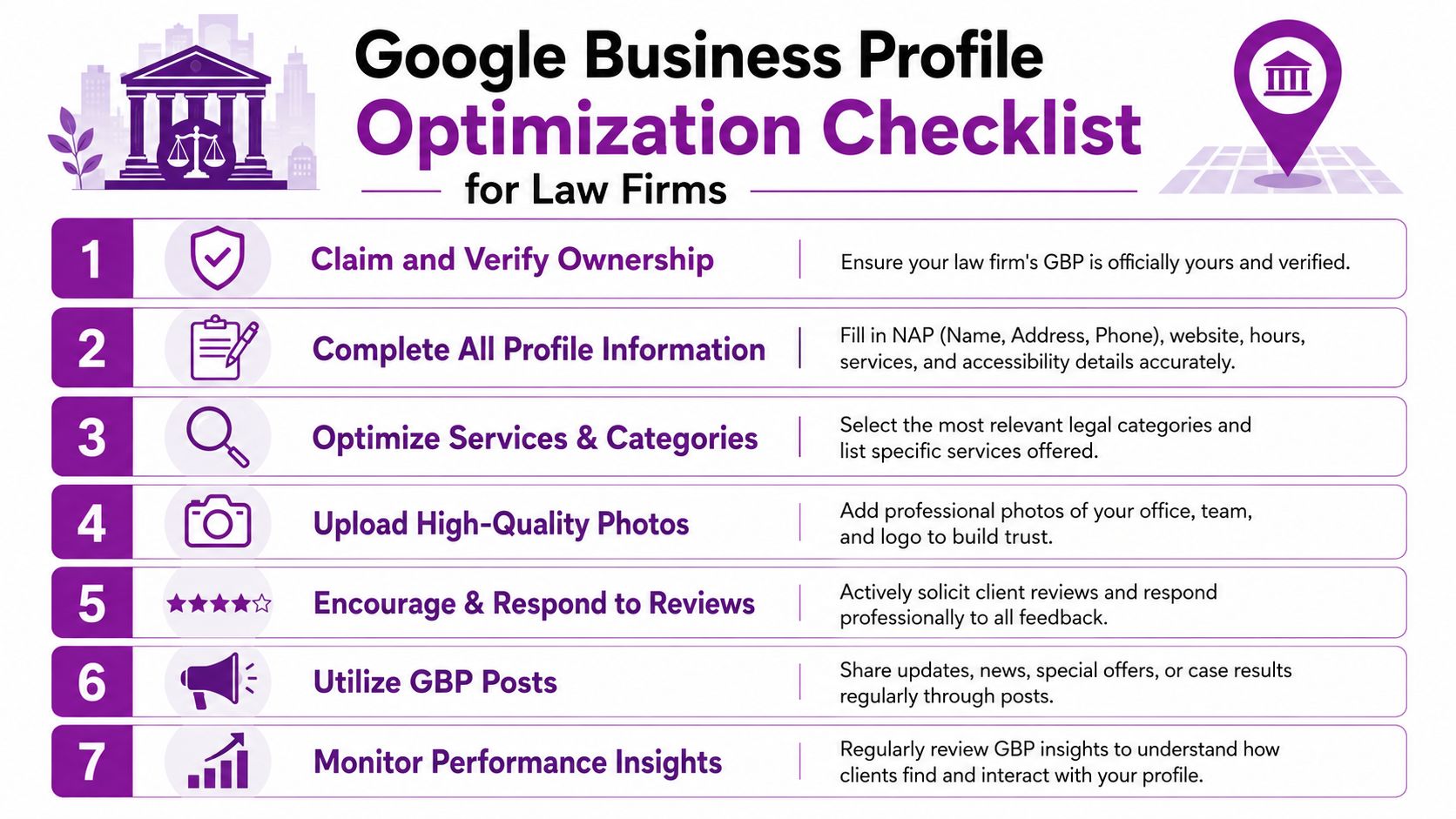
Your Google Business Profile is the closest thing your firm has to a digital front door. For many searchers, it will shape their first impression before they ever visit your website. If the profile is incomplete, inconsistent, or stale, the rest of your local SEO work has to fight uphill.
Industry guidance for lawyers identifies proximity, relevance, and authority as core local ranking factors, and stresses that firms must keep their Name, Address, and Phone number consistent across directories to avoid confusing search engines and weakening visibility (Attorney at Law Magazine on legal local SEO fundamentals).
Audit the basics before you optimise
Most firms want to jump straight to posts, photos, and reviews. Start earlier than that. First, check whether the listing reflects the business as it operates today.
Use this audit pass:
Ownership and access
Confirm the firm controls the profile inside the right Google account. This sounds obvious, but access issues are common after staff changes or agency handovers.Business name
Use the actual trading name. Don't cram keywords into the business title. It creates risk and usually causes problems later.Primary category and secondary categories
Choose categories that reflect the core work the office handles. A family law office should not try to cover every legal category under the sun.NAP consistency
Match the exact business name, address format, and phone number on your website and key directory listings.Opening hours and exceptions
Bank holidays, seasonal closures, and reception hours matter. If they are wrong, users lose trust quickly.
Turn the profile into a lead-generation asset
A complete profile doesn't automatically generate enquiries. An optimised one gives Google and the searcher enough confidence to act.
Focus on these areas:
Services section
Add the practice areas specific to that office. Keep wording plain and specific.Business description
Explain what the office does, who it serves, and where it serves. Avoid marketing fluff.Photos
Use current office images, exterior signage, reception, meeting rooms, and professional team photos. Legal buyers want reassurance that the firm is established and real.Reviews and responses
Build a steady review process and reply professionally. A blank or unmanaged review profile hurts conversion.Posts and updates
Share updates on office news, service changes, legal guidance, or community involvement. This is a useful place to signal activity without changing the main website.
A neglected profile sends the wrong signal. Searchers notice, and so does Google.
A fuller walkthrough of Google Business Profile optimisation for local businesses is useful if your team needs a structured checklist for implementation.
Common mistakes I see in law firm profiles
Some mistakes are small but costly. Others undermine the whole local setup.
| Mistake | Why it hurts |
|---|---|
| Using a call centre number on one profile and a local number elsewhere | Weakens consistency and local trust |
| Listing services the office doesn't really offer | Damages relevance and enquiry quality |
| No photos beyond a logo | Reduces trust at the comparison stage |
| Ignoring questions or reviews | Leaves objections unanswered in public |
For multi-office firms, each listing needs its own integrity. Don't clone descriptions, categories, and service sets across every office if the service delivery varies. Google wants local relevance, and prospects want accuracy.
On-Site Strategy Building High-Intent Location and Service Pages
A lot of legal websites still rely on a thin model. There is a homepage, an about page, a people page, and a broad services page covering everything from family law to probate. That structure may look tidy internally, but it doesn't match the way local legal demand appears in search.
For UK firms, the highest-value workflow is to build practice-area plus location pages around the exact search intent that drives calls. Those pages also need to reflect the firm's regulated practice areas and jurisdictional scope clearly, because legal audiences are highly sensitive to location and authority (LaGrande Marketing on local service page strategy for law firms).
A useful way to think about site structure is this:
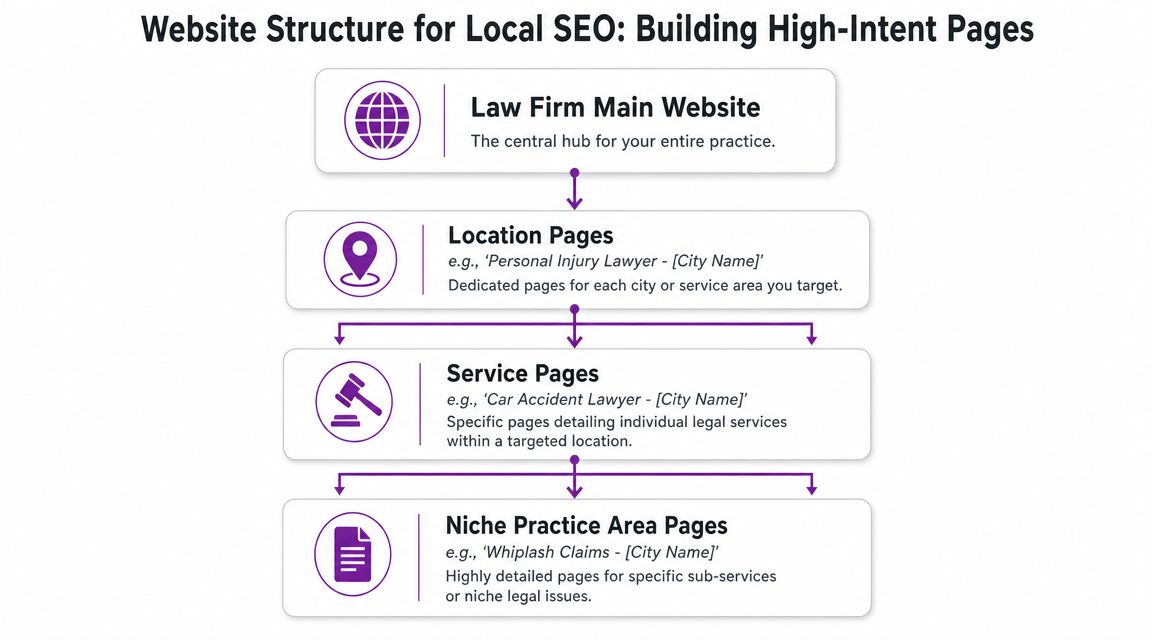
Generic pages rarely win local intent
If someone searches for a conveyancing solicitor in Sheffield, a generic conveyancing page won't be your strongest asset. A page built specifically for that service and area gives Google clearer relevance signals and gives the visitor a stronger reason to enquire.
That doesn't mean creating thin doorway pages for every town in the county. It means building pages where the service-location combination reflects genuine commercial intent and a real service footprint.
Good examples include:
- Residential conveyancing solicitors in Leeds
- Employment solicitors for employers in Nottingham
- Probate solicitors in Chester
- Family law solicitors in Reading
What a strong page includes
The best local pages do two jobs. They make relevance obvious to Google, and they make the next step obvious to the client.
Include the following:
A precise page title and H1
Match the service and place naturally.Local proof
Mention the office location, service area, nearby courts where relevant, and how the firm works with local clients.Jurisdiction clarity
State clearly what the office handles and any practical limits. UK legal buyers want confidence that the firm can act in their matter, not vague claims.Conversion paths
Include a phone number, enquiry form, and a clear next step such as booking a consultation or speaking to the relevant department.Trust elements
Add solicitor profiles, accreditations where appropriate, review excerpts, and practical FAQs.
Here's a useful reference if you're planning service area pages for SEO and need to decide how many to build and how to structure them.
Practical rule: if two pages would say almost the same thing apart from swapping town names, stop and rethink the page strategy.
This short video gives a helpful visual view of how location-led page structures support local search performance:
The trade-off firms need to accept
High-intent page building takes time. It needs input from fee earners, compliance awareness, and careful writing. But the alternative is worse. Firms either publish generic pages that don't rank for local commercial searches, or they mass-produce near-duplicate pages that don't help users.
Use this decision filter:
| Page idea | Build it? | Why |
|---|---|---|
| Core service in a city where you already get enquiries | Yes | High intent and commercial relevance |
| Service in an area you can serve but rarely target | Maybe | Build after stronger opportunities are covered |
| Town page with no office, no local proof, and no distinct content | No | Usually weak and hard to justify |
| Niche sub-service page tied to a profitable department | Yes, if demand exists | Strong fit for specific enquiries |
For local SEO for lawyers, specificity beats breadth. A smaller set of excellent pages usually outperforms a large set of lazy ones.
Building Local Authority Citations Reviews and Links
Once the profile and website are in order, the next job is authority. In local legal SEO, authority isn't built from one tactic. It comes from a combination of consistent business references, visible client sentiment, and local signals that show the firm is part of the market it wants to rank in.
I treat this as a three-part system. If one part is weak, the others have to compensate.
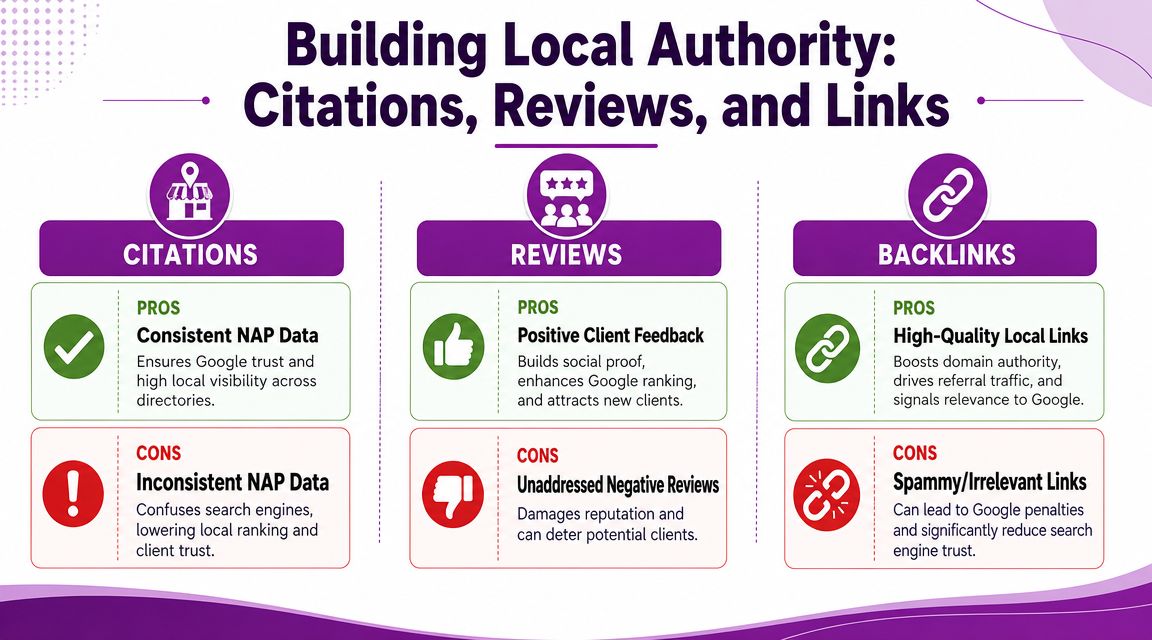
Citations need consistency, not volume for the sake of it
A citation is any directory or business listing that references your firm's details. The goal isn't to appear everywhere. The goal is to make sure the important listings agree with each other.
For UK firms, that usually means checking:
- Core business listings such as Google, Bing Places, Apple Business Connect, and major map ecosystems
- Legal directories where your firm profile may already exist in some form
- Local chambers or business directories that carry local business data
- Social profiles and legacy listings that still show old office details
If your Manchester office moved premises and half the web still shows the old address, your local authority is muddied. So is client trust.
A structured process for local directory submissions and cleanup helps because law firms often have historical listing clutter after mergers, office moves, and rebrands.
Reviews shape both trust and conversion
Reviews do more than support rankings. They answer the question every legal buyer has before making contact. Can I trust this firm with something important?
That means review generation needs a process, not a vague instruction to fee earners. The best systems are simple:
Choose the right moment
Ask after a positive matter milestone or successful completion, not at random.Make it easy
Send a direct link and a short request. Don't create friction.Route requests through staff who know the client relationship
A request from the right person feels natural. A generic email often gets ignored.Respond properly
Thank clients for positive feedback. Handle criticism carefully and professionally without discussing confidential details.
Reviews don't need to sound polished. They need to sound real and recent.
The firms that struggle here often make one of two mistakes. They either never ask, or they ask everyone in a burst and then go silent for months. A steady flow works better for trust and for operational sanity.
Local links should come from actual relationships
Link building for law firms is often misunderstood. Buying junk links or chasing irrelevant websites is a waste of time. Local links work when they reflect the firm's real footprint.
Good opportunities include:
- Community sponsorships such as a charity run, school event, or local business initiative
- Professional partnerships with accountants, mortgage brokers, or surveyors where there is a genuine referral overlap
- Local commentary on legal developments affecting residents or employers in a specific town or region
- Useful resources such as a guide to local probate steps, landlord obligations, or employment updates relevant to local businesses
If your team wants broader ideas beyond directories and sponsorships, these modern link building strategies are a useful reference point for earning coverage in ways that support authority rather than spam it.
How the three pillars work together
Citations help Google validate who you are. Reviews help users decide whether to trust you. Links help search engines understand that other relevant local entities recognise your firm.
| Pillar | Primary job | Common failure |
|---|---|---|
| Citations | Confirm identity and location | Old addresses and inconsistent phone numbers |
| Reviews | Increase trust and enquiry rate | No request process and poor response handling |
| Links | Strengthen authority and local relevance | Irrelevant placements and one-off tactics |
A law firm doesn't need a flashy off-page campaign. It needs reliable signals that support how the business operates in its market.
Measuring What Matters Tracking and Reporting on Local SEO ROI
Most law firm SEO reporting often falls apart. The firm gets a ranking update, a screenshot of Maps visibility, or a list of keywords that moved. None of that tells a partner whether local SEO is producing qualified enquiries.
Existing guides for lawyers often give little practical guidance on attribution or conversion tracking, and fail to connect visibility with CRM outcomes, call tracking, or enquiry-quality metrics, even though those are the figures a law firm partner needs to judge performance (Esquire Interactive on the attribution gap in local SEO).
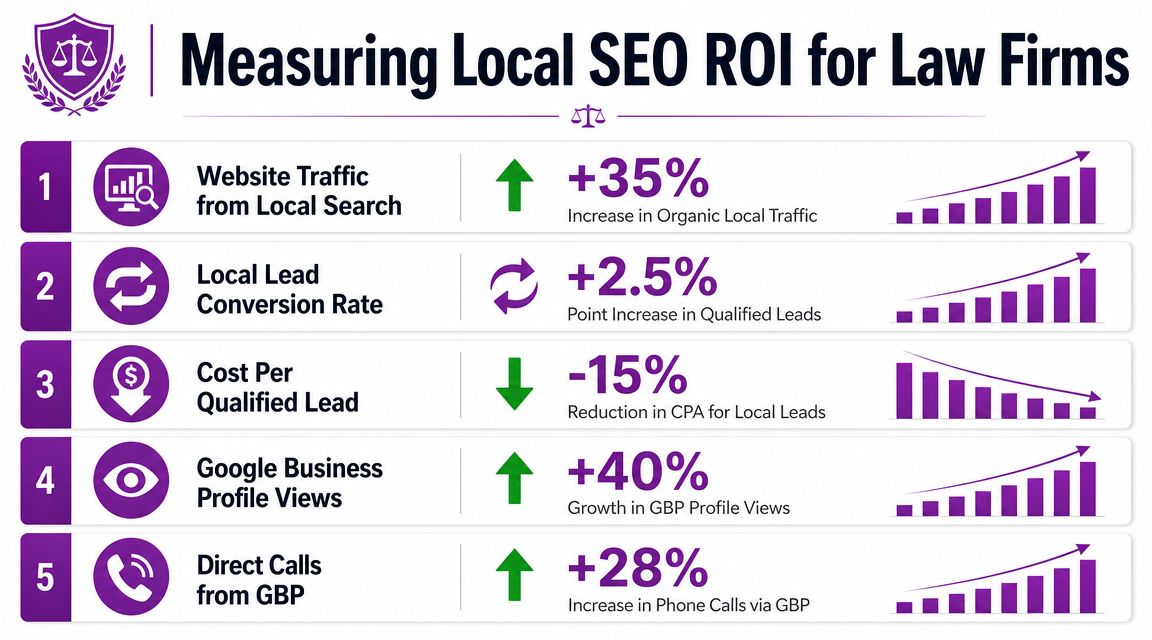
The image above shows example KPI categories, but treat those figures as illustration rather than benchmarks. Your firm needs its own baseline and its own reporting discipline.
Stop treating rankings as the main KPI
Rankings matter, but only as a supporting signal. A strong local SEO programme should answer business questions such as:
- Are more calls coming from Google Business Profile and local organic pages?
- Which office pages generate valid form submissions?
- Which practice areas produce qualified matters rather than low-fit leads?
- Are enquiries increasing in the locations the firm intends to grow?
If you don't track those outcomes, you'll end up debating visibility while the finance team asks a different question. Did this produce work?
The reporting stack that matters
For most UK law firms, I recommend a simple measurement model rather than an overcomplicated dashboard no one uses.
Track these layers:
| Layer | What to measure | Why it matters |
|---|---|---|
| Google Business Profile | Calls, website clicks, direction requests, messaging if enabled | Shows whether the profile creates action |
| Website conversion tracking | Contact form submissions, click-to-call taps, consultation requests | Ties page performance to enquiry behaviour |
| CRM or intake log | Matter type, office, lead source, qualified or not | Separates noise from real opportunities |
| Page-level performance | Which service-location pages attract and convert visitors | Informs where to expand or improve |
A monthly framework like this SEO report template for clearer reporting helps practice managers cut through vanity metrics and ask better questions.
What to include in a monthly review
Keep the report tight. If it runs to dozens of pages, nobody will use it.
A useful monthly review usually includes:
Enquiry totals from local SEO channels
Break out calls and forms where possible.Qualified enquiry notes
Which services and offices produced the strongest leads.Page winners and underperformers
Identify pages bringing in good-fit matters and pages that attract weak traffic.Google Business Profile actions
Focus on real interactions, not just impressions.Next actions
Examples include improving one office page, tightening intake tagging, or fixing a citation inconsistency.
If your report can't tell a partner which office and service line generated enquiries, it isn't finished.
The firms that prove ROI aren't always the firms doing the most SEO activity. They are the ones connecting every action to an intake outcome. That is what keeps budget, internal support, and momentum in place.
Your 12-Month Local SEO Implementation Plan
Most firms fail at local SEO for lawyers because they try to do everything at once, then lose focus when fee earning work takes over. A phased plan works better. It gives the marketing lead, practice manager, and partners a realistic sequence.
Months 1 to 3 get the basics under control
Start with operational fixes that remove friction.
- Google Business Profile cleanup so every office listing is claimed, complete, and accurate
- Citation correction across key legal and business directories
- Tracking setup for contact forms, click-to-call actions, and intake source logging
- Website review to identify missing service-location pages and weak conversion paths
This is also a good stage to define who owns what internally. If nobody owns review requests, listing updates, and intake tagging, execution slips.
Months 4 to 6 build commercial coverage
Once the foundation is reliable, create pages tied to actual demand.
That usually means launching the highest-priority practice-area plus location pages first, then tightening internal links, FAQs, and calls to action. At the same time, put a review process in place that fee earners and support staff can follow without friction.
For firms reviewing wider operational efficiency, some of these AI-powered legal tech solutions can also support intake handling, admin workflows, and response speed around new enquiries.
Months 7 to 12 scale what is already working
This phase is about authority and refinement, not random expansion.
| Focus area | Priority action |
|---|---|
| Content expansion | Add more service-location pages based on proven enquiry themes |
| Authority | Pursue local partnerships, coverage, and quality links |
| Conversion improvement | Refine page UX, contact options, and intake handoff |
| Reporting | Compare lead quality by office and practice area |
A clear planning process helps here. If your team needs a framework for sequencing work, this guide on how to create an SEO strategy is a practical starting point.
The important thing is to resist busywork. Don't publish location pages no one needs. Don't chase links with no local relevance. Don't celebrate rankings if intake quality is falling. The firms that get results from local SEO usually do fewer things, better, and measure them properly.
If your firm wants help turning local visibility into measurable enquiries, Bare Digital can help. They specialise in UK local SEO, Google Business Profile optimisation, location page strategy, and reporting that ties search activity to real business outcomes, so your team can see what's working and where the next enquiries should come from.