
A Leeds homeowner lands on your site after staring at a cracked ceiling, a rough patch after a rewire, or a room that's almost ready for decorating but still looks unfinished. They're not browsing for fun. They want to know whether you're reliable, whether the finish will be clean, and whether your quote is going to make sense.
That's why a strong landing page for a plasterer in Leeds can't just say “quality workmanship” and list a phone number. It has to answer the exact questions people ask before they call. The pages that win local enquiries do two jobs at once. They reassure the customer, and they give Google enough local relevance and trust signals to rank the business properly.
Your Essential Checklist for a Flawless Plastering Job
The first thing a customer wants is clarity. They're usually comparing a few plasterers, checking reviews in another tab, and trying to work out which business looks easiest to trust. If your landing page opens with vague claims, they'll bounce. If it opens by speaking to the situation they're in, they'll stay longer.
A good opening for a Leeds plastering page should quickly cover the buyer's biggest concerns:
- Reliability matters first: Customers want to know if you'll turn up when promised and communicate clearly.
- Price needs context: They don't expect every job to cost the same, but they do expect a sensible explanation of what changes the quote.
- Finish is everything: In plastering, the final result is the product. If the walls aren't smooth, nothing else matters.
- Mess and disruption count: Homeowners notice whether a company mentions preparation, protection, and tidy working.
The strongest pages make this information easy to scan, then support it with proof lower down the page. That's what turns a generic trade page into a conversion page. A practical framework such as this local SEO checklist for service businesses helps shape the page so it works for both readers and local search.
Practical rule: Your opening paragraph shouldn't describe your business. It should describe the customer's problem and show that you understand it.
There's a commercial reason for that approach. A customer who feels understood is more likely to keep reading. A page that keeps readers engaged sends better quality signals than one filled with empty trade clichés. In local SEO, trust and relevance often start with basic page writing done properly.
Understanding Plastering Services from Skimming to Rendering
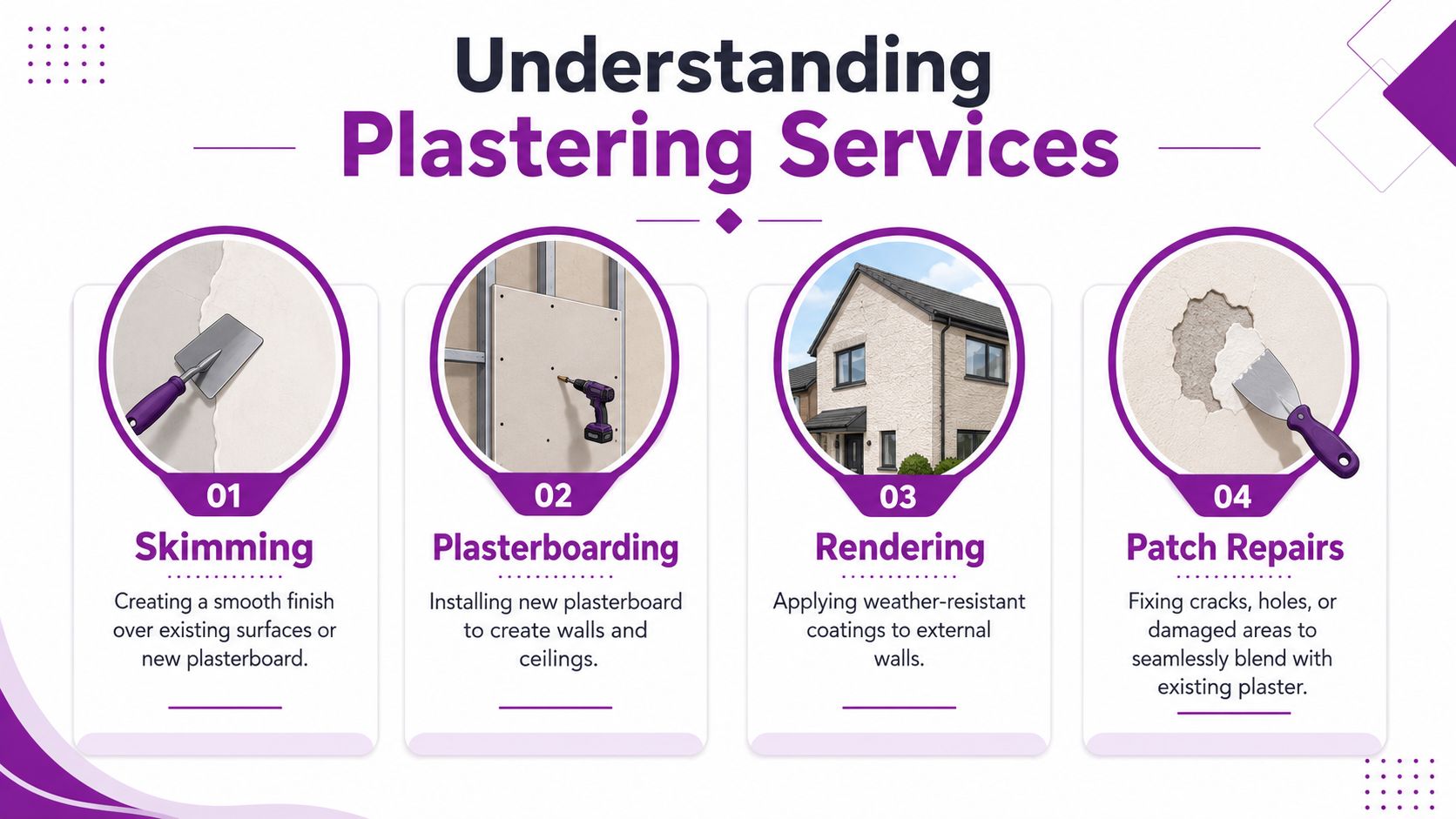
Most plastering pages fail because they list services without connecting them to real jobs. “Skimming, rendering, plasterboarding, repairs” is accurate, but it doesn't help a homeowner decide what they need. Better pages translate services into outcomes.
What customers are actually buying
A homeowner rarely searches because they're excited about plastering as a category. They search because they need a smooth wall before painting a bedroom, a repaired ceiling after a leak, or a clean finish after building work.
That means your service descriptions should sound like this in substance:
- Skimming for tired walls and ceilings: Best when surfaces are sound enough to take a fresh smooth finish.
- Plasterboarding for altered rooms: Useful when a room has been reconfigured, extended, or stripped back.
- Rendering for external protection: Relevant when outside walls need a weather-resistant finish and a neater appearance.
- Patch repairs for visible damage: Ideal for cracks, holes, and uneven areas that spoil an otherwise good room.
A page built this way does more than improve readability. It captures broader search intent. Someone may search for “ceiling repair”, “skimming after rewire”, or “fix cracked plaster wall” rather than the service label itself. A customer-facing page should reflect those realities.
Quality signals separate professionals from box-tickers
This is where better content earns trust. One of the most revealing technical concerns raised by homeowners is whether gaps should be prefilled before taping joints. A discussion in the plastering community highlights that this is a common question, and that many British plasterers skip prefilling despite it being associated with long-term structural issues, as noted in this Reddit discussion about prefilling gaps before taping joints.
That matters for SEO because quality explanations create differentiation. If your landing page says you prefill where needed before taping, prepare backgrounds properly, and explain why those steps matter, you're not just filling space. You're showing workmanship standards.
Customers don't know every trade detail, but they notice when one plasterer explains the job and another just says “free quote”.
A lot of firms avoid this level of detail because they think it scares people off. Usually, the opposite happens. Good buyers prefer a plasterer who can explain the difference between a quick cosmetic fix and a durable finish. That's especially important if you want to justify stronger pricing and attract the kind of customer who values quality over the cheapest number.
For local SEO, service content that educates tends to outperform thin pages. It covers more language variations, answers real questions, and gives Google clearer evidence of expertise. That same principle applies in adjacent property sectors too, which is why content depth matters in specialist service SEO such as SEO for architects.
Decoding Plastering Costs in Leeds
Price anxiety kills enquiries when a landing page stays vague. A homeowner sees “competitive rates” and assumes the business either hasn't thought through its pricing or doesn't want to say. A better page gives enough detail to set expectations without pretending every property is identical.
The key is transparency. Customers don't need an instant final quote from the page. They need a believable pricing framework.
What the benchmark tells you
In the UK construction sector, the benchmark labour cost for a professional plasterer is £300 per day, with an average hourly rate of £37.50. For room-based examples in Leeds, a small room (9m²) costs £1,100, while a large room (18m²) costs £1,900, according to Checkatrade's Leeds plasterer cost guide.
That's useful because it gives you a factual anchor. It also helps explain a basic pricing truth that customers often miss. More surface area means more labour and more materials.
Example Plastering Costs in Leeds 2026 Estimates
| Job Description | Average Cost |
|---|---|
| Small room (9m²) | £1,100 |
| Large room (18m²) | £1,900 |
A landing page should then explain what shifts the final quote without inventing fake precision. Wall condition, access, the amount of prep required, the type of finish, and whether it's a full room or a smaller repair all affect the total.
A smart comparison point is how other trades publish labour expectations. For example, FixyFlow's plumber rate insights show how useful rate context can be when customers are trying to budget for skilled work. The same principle works for plastering. Transparency attracts better-fit enquiries.
What works better than “prices from”
Use a short pricing explanation block instead of a bait number. For example:
- Room size changes cost directly: Larger spaces require more time and material.
- Preparation affects labour: Damaged backgrounds, awkward edges, and poor previous work increase job complexity.
- Service type matters: A patch repair and a full skim aren't priced the same way.
- Written scope reduces friction: Customers respond better when they can see what the quote includes.
A vague page invites vague leads. A transparent page filters out tyre-kickers before they call.
From an SEO point of view, cost content also opens the door to valuable search intent around “how much does plastering cost in Leeds” and similar phrases. That traffic is often high intent because the customer is already moving toward a decision.
Verifying Quality Through Portfolios and Reviews
The easiest way to understand a trustworthy plastering business is to look at how it presents finished work. Not polished branding. Actual jobs. A proper portfolio tells a story long before the customer gets in touch.

A strong gallery doesn't just show fresh white walls from one flattering angle. It shows corners, reveals, ceilings, repaired sections, and how neatly the finish blends into the room. If the photos only show distant shots or heavily edited lighting, the page loses credibility.
What to look for in a portfolio
The best portfolio images answer silent objections. Can this plasterer achieve clean lines around sockets and openings? Do repaired areas disappear into the surrounding wall? Does the room look respected rather than treated like a building site?
Use a mix like this:
- Before-and-after pairs: These help customers judge the actual transformation.
- Close-up finish shots: Good for showing flatness, edge work, and consistency.
- Different property types: Terraces, semis, extensions, loft spaces, and renovated interiors all build local relevance.
- Tidy completion photos: Clean-up is part of perceived quality.
Portfolio content also feeds SEO when it supports location relevance. If your Google Business Profile and website gallery show real Leeds work consistently, Google gets clearer service-area signals. A tool such as a Google Business Profile report can reveal where those trust signals are strong and where they're thin.
Reviews need to prove more than “great job”
In Leeds, people often ask for plasterers available “Asap” for urgent bookings, while many service pages still fail to mention real-time availability or emergency response windows. That gap in customer demand and weak website messaging is reflected in local Facebook posts seeking immediate plasterer availability.
That matters because review language should match buying urgency. A customer who needs help quickly pays attention to reviews mentioning speed, communication, and turning up when promised.
Here's a useful media example of the sort of finish-conscious trade presentation customers respond to:
Reviews are most persuasive when they mention specifics such as cleanliness, punctuality, clear quotes, and whether the finish held up well after decorating. Generic praise is nice. Detailed praise converts.
The best review profile doesn't just say you're good. It shows you're dependable when the customer is under pressure.
For local SEO, this all feeds the same machine. Regular review activity, relevant service language, fresh job photos, and an active Google Business Profile strengthen visibility and click-throughs. But none of it works well if the landing page ignores the evidence and just says “see our reviews elsewhere”.
Checking for Essential Credentials and Guarantees
A polished gallery helps, but credentials close the trust gap. Homeowners may not know every trade qualification, yet they do recognise when a business has taken the time to show proper standards clearly. That matters for conversion and for credibility in search.
What a recognised plastering qualification tells the customer
To work on most UK construction sites, including those in Leeds, a plasterer must hold a CSCS skilled worker card, which requires an NVQ Level 2 in Plastering as the industry-recognised standard proving competence, as explained in this guide to the UK plastering apprenticeship route.
For a customer, that shouldn't sit on the page as a badge with no explanation. It should be translated into practical meaning. It signals that the plasterer has been assessed against industry standards and isn't improvising their way through skilled work.
What should appear on the landing page
A well-built customer page should make these trust signals easy to find:
- Qualification detail: State the credential and what it means in practice.
- Insurance mention: Public liability cover should be visible, not hidden in small print.
- Workmanship guarantee: Explain what is covered and how issues are handled.
- Written quotation promise: This reduces disputes and sets expectations properly.
A lot of trades pages bury this information because they assume customers only care about price and availability. That's a mistake. Customers compare risk as much as cost. If one plasterer explains credentials and guarantees plainly while another offers none of that reassurance, the first business often feels safer to hire.
That same principle supports stronger E-E-A-T signals on-site. Google is looking for evidence that the business is real, qualified, and accountable. If you work in building and trade sectors, this is standard trust architecture, not optional extra. The same thinking applies across specialist SEO for construction companies, where credentials often influence both rankings and lead quality.
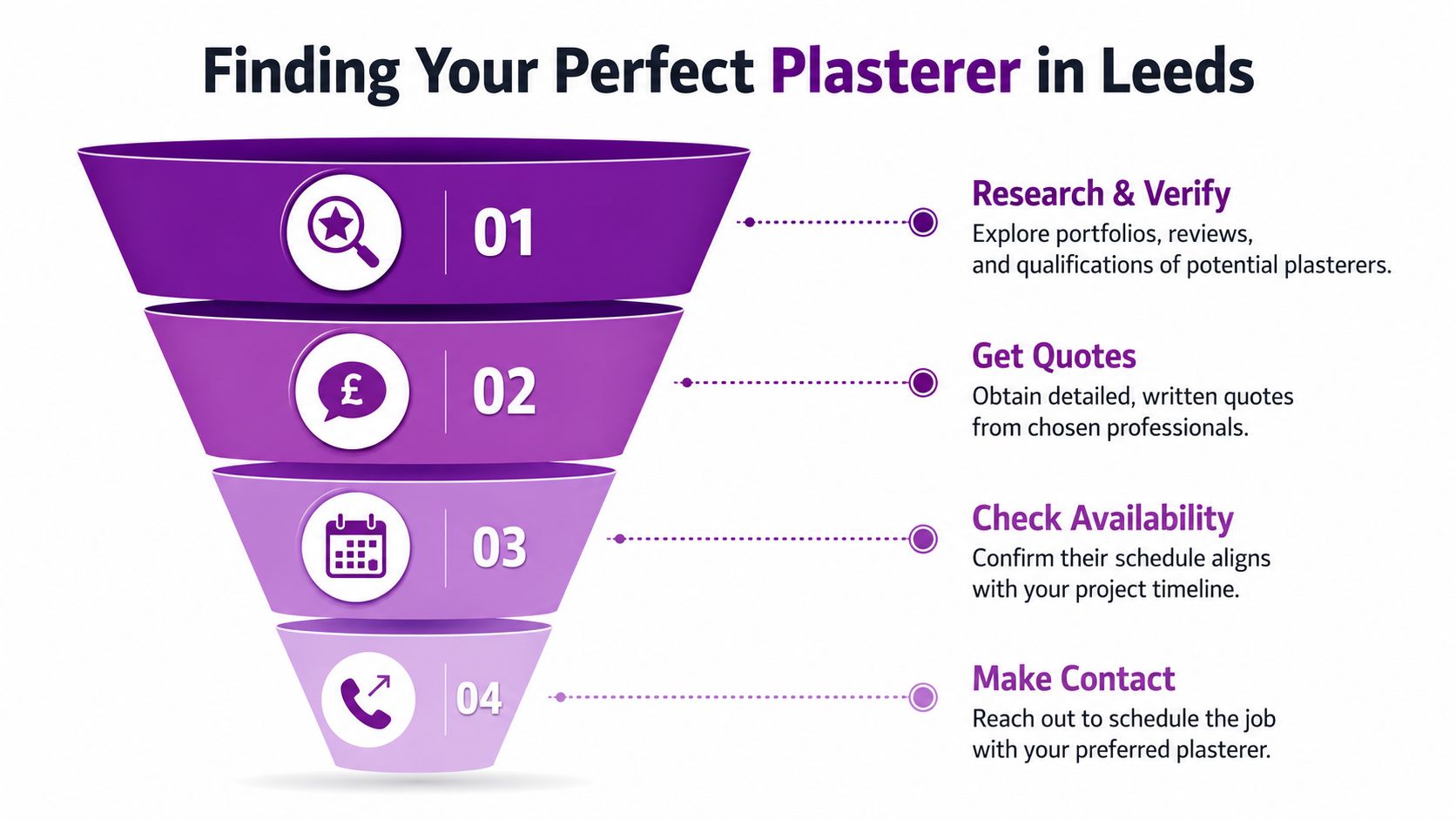
How to Find and Contact the Best Local Plasterers
A customer doesn't hire the best plasterer in theory. They hire the one they can verify quickly, understand easily, and contact without friction. That's where the landing page either turns trust into enquiries or wastes all the work above it.
The page needs to make local intent obvious. It should mention Leeds naturally, show the service area clearly, and remove every unnecessary step between interest and contact.
What helps a plasterer appear in local search
For plasterers in Leeds, local SEO focuses on “near me” searches and Google Maps visibility through Google Business Profile optimisation, schema markup, and business verification, which are described in this overview of local SEO for plasterers.
A customer-facing landing page supports that visibility when it includes:
- Consistent contact details: Your business name, address, and phone details must match across the site and local listings.
- A mapped local presence: An embedded map helps customers confirm they're in your service area.
- A mobile-first enquiry route: Tap-to-call buttons, short forms, and fast loading matter more than decorative design.
- Service-area wording: Mention Leeds and relevant local context naturally, not by stuffing place names into paragraphs.
If your Google profile is weak, this is often the first place to tighten up. This guide on how to optimize your Google Business Profile listing is a useful reference for understanding what customers and Google both need to see.
Why the page structure affects rankings and leads
The businesses that show up strongly in local search usually combine several things well. Their service pages answer questions. Their review profile supports the claims. Their contact details are easy to trust. Their Google Business Profile is active and complete.
One practical Leeds-specific point is that a plasterer can secure placement in the Google Map Pack by following a minimum three-month local SEO strategy that includes weekly keyword position tracking and quick fixes for ranking drops in the same week, as outlined in this Leeds plasterer SEO page. That doesn't happen because of one trick. It happens because the whole local presence is organised properly.
A good landing page is part buyer's guide, part trust document, part local ranking asset. It should help the customer verify your work, understand your offer, and contact you in seconds.
If you want a fast way to assess how visible and complete your profile really is, a Google Business Profile audit tool can highlight gaps that directly affect local enquiries.
If your plastering business in Leeds needs a landing page that ranks, builds trust, and turns local searches into real enquiries, Bare Digital can help. Their team specialises in local SEO for UK service businesses, including trades and construction, with practical support around Google Business Profile optimisation, local landing pages, on-page fixes, and conversion-focused content that brings in better leads.