

Your website looks decent. You've paid for design, added service pages, maybe even posted the odd blog. Yet a competitor across town keeps showing up in Google Maps, fills the top organic spots for the searches that matter, and gets the calls you expected to get.
That's the moment most UK business owners start looking into managed SEO services. Not because SEO sounds exciting, but because invisibility is expensive. A plumber in Manchester, a wedding venue in the Cotswolds, or a clinic in Surrey all run into the same issue. A good website on its own doesn't bring steady local demand if search visibility is weak.
That pressure is one reason the UK SEO market has grown so sharply. In the UK, the SEO market recorded a five-year compound growth rate of 11.2%, reached £19.2 billion in 2023, and is projected to reach £25 billion by 2028, according to UK SEO market statistics compiled by Artios. Businesses aren't spending on SEO because it's fashionable. They're doing it because local search has become part of how customers choose who to contact.
Is Managed SEO Right for Your UK Business
Managed SEO suits businesses that know they need visibility but don't have the time, internal expertise, or consistency to run search properly month after month. That includes many SMEs that started with a DIY website and some basic pages, then realised rankings don't improve just because the site exists.
A common pattern looks like this. The business owner tries to juggle quotes, staffing, operations, and marketing. SEO gets pushed to evenings or weekends, then slips altogether. Six months later, competitors have stronger Google Business Profiles, better local landing pages, fresher content, and more authority from relevant mentions around the web.
The signs you've outgrown ad hoc SEO
If any of these feel familiar, managed SEO is worth serious consideration:
- You rely on referrals too heavily and need a steadier source of inbound enquiries.
- You rank for your brand name only but not for the service and location terms buyers search for.
- Your Google Business Profile is underused or inconsistent across categories, services, and posts.
- You've had freelancers do isolated tasks without anyone owning the full strategy.
- Your website traffic exists, but leads don't because the wrong pages rank or the wrong search intent is being targeted.
Managed SEO isn't just outsourced tasks. It's ongoing prioritisation. Someone audits the site, fixes weak areas, targets local intent, tracks movement, and keeps adapting as search results shift.
Practical rule: If SEO keeps falling behind paid ads, social posts, and day-to-day operations, it usually needs an owner, not another checklist.
That said, it's not right for every business at every stage. A brand new company with no clear service focus may need positioning work first. A company with a strong in-house marketer might only need consultancy. But for most established local firms that want more calls, form fills, and map visibility, managed SEO becomes the operational answer to a strategic problem.
If you're still figuring out whether your foundations are in place, a practical starting point is a local SEO checklist for UK businesses. It helps separate small fixes from structural issues.
What a UK Managed SEO Service Actually Includes
Managed SEO gets sold in vague language far too often. “Improved visibility” and “better rankings” don't tell you what happens each month. In practice, a proper service should feel like a house being built and maintained. The foundations matter, the address matters, the rooms need furnishing, and people need roads that lead to the property.
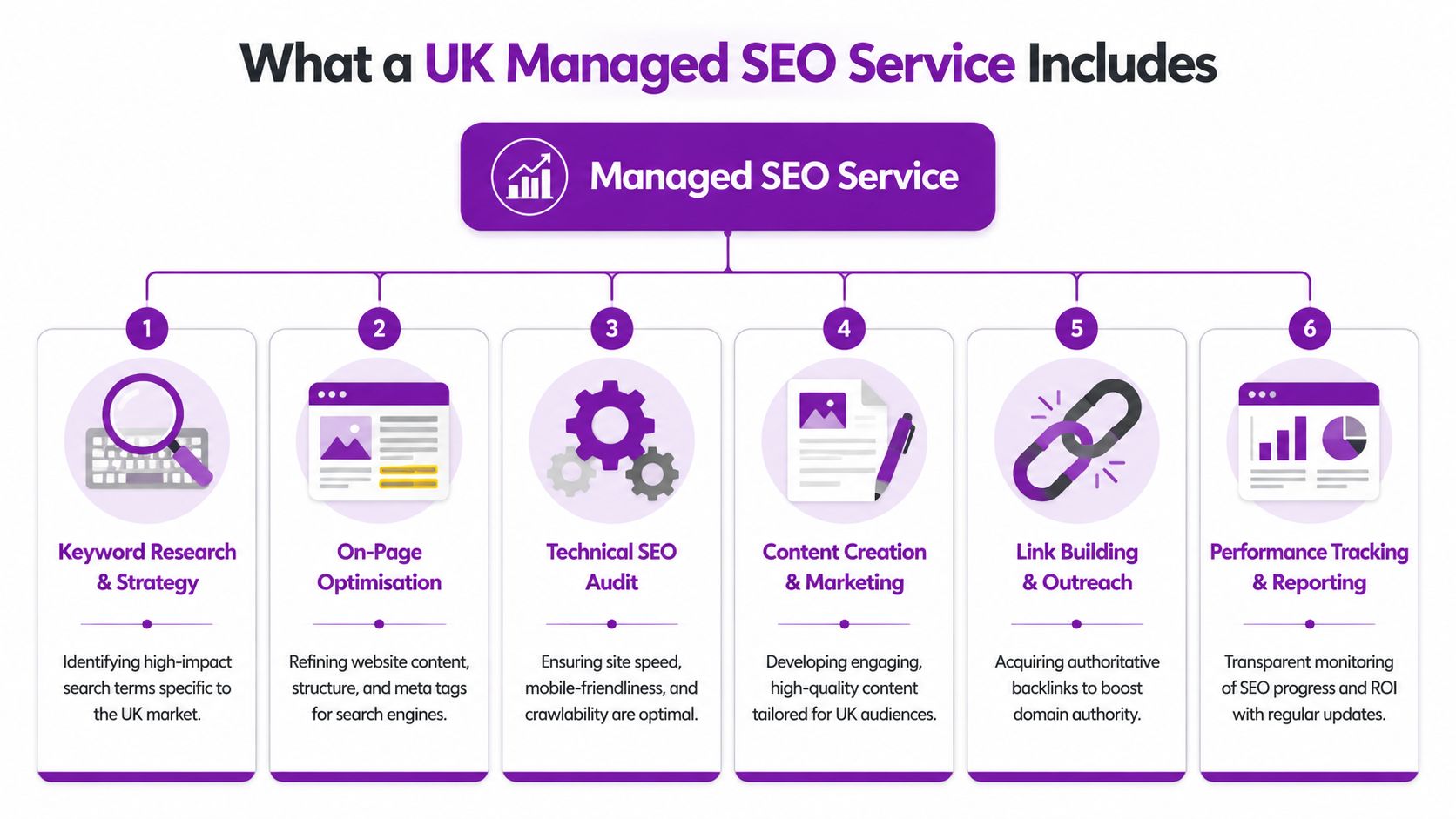
The foundation is technical SEO
Technical SEO is the part most business owners don't see, but it affects everything else. If pages are slow, hard to crawl, duplicated, poorly structured, or awkward on mobile, content and links won't perform as they should.
A managed service usually starts with an audit that checks issues such as:
- Indexing problems that stop key pages appearing properly in search.
- Site speed and mobile usability because local searches often happen on phones.
- Internal linking gaps that leave important service pages isolated.
- Metadata and heading structure so pages match their search intent clearly.
- Schema and local signals where they support understanding and prominence.
This isn't glamorous work, but it prevents waste. There's no point publishing strong pages if the site structure keeps holding them back.
The address is local SEO
For UK service businesses, local SEO is often the biggest difference-maker. That means your Google Business Profile, local landing pages, service areas, review signals, map visibility, and the way your site reflects real towns, districts, and postcode-level intent.
Generic SEO packages frequently miss the mark. They might optimise title tags and publish blogs, but still miss what drives local enquiries: precise targeting tied to the places you serve.
Data from UK-specific industry analysis shows that 68% of single-location UK SMEs see faster ROI, with 3 to 5 months rather than 6 to 12 months, when a specialist agency handles local Google Business Profile optimisation and “near me” keyword targeting directly instead of using generic managed packages, according to Essential Marketer's local SEO analysis.
That rings true in day-to-day work. A single-location business in Chester, Brighton, or York rarely needs a broad national content machine first. It needs accurate local relevance.
If your profile hasn't been reviewed properly, a Google Business Profile audit tool for local search gaps can highlight where visibility is being lost.
The interior is content strategy
Content is where most businesses either overdo it or do it badly. Managed SEO content isn't about publishing endless generic articles. It's about building the pages customers need at the moment they search.
That usually means a mix of:
- Core service pages written for commercial intent
- Location pages designed for genuine areas served
- Supporting blog content that answers real questions
- Trust content such as FAQs, process pages, and sector-specific guidance
A wedding venue might need pages around ceremony options, accommodation, and regional searches from couples planning at a distance. A roofing company may need service pages for emergency repairs, flat roofing, and storm damage in nearby towns. Different intent, different content model.
The roads are link building
Links still matter, but poor link building causes more problems than it solves. A sensible managed service focuses on earning relevant mentions and placements that make sense in the real world. Local directories, sector publications, partner websites, chambers, suppliers, and regional press can all play a role.
What doesn't work well is bulk outreach with no relevance, low-grade guest posting, or buying placements at scale just to inflate reports.
For a useful external reference on how audits should support strategic decision-making before any campaign starts, Refact's strategic SEO insights are worth reading. The key point is simple. Audit first, then prioritise.
Managed SEO should never feel like random monthly activity. It should feel like a sequence. Fix the site, sharpen the local signals, publish the right pages, then build authority around them.
The sixth part clients should insist on
Reporting belongs in the core service, not as an afterthought. If an agency can't show what changed, what was worked on, and how enquiries are trending, the service becomes hard to trust.
At minimum, reporting should connect rankings and visibility with business outcomes such as calls, leads, and booked work. Otherwise, you're paying for movement without context.
Decoding SEO Packages and UK Pricing Models
SEO pricing in the UK varies because the workload varies. A single-location trades business in a sensible market doesn't need the same campaign depth as a multi-location legal, healthcare, or property brand competing across several regions.
The most useful way to read pricing is to ask what level of operational effort the retainer supports. In the UK market, foundational managed SEO programmes typically start at £1,500 to £3,000 per month, while enterprise-level scopes can reach £6,000 to £15,000+ monthly, with costs tied to competitive intensity and required content volume, based on Visionary Marketing's UK managed SEO pricing overview.
What changes the monthly fee
Three things usually move the price more than anything else.
First, competition. Ranking a site in a low to medium competition local niche is different from competing in a crowded vertical where several agencies are already working on the main players.
Second, geography. One town is simpler than multiple towns, and multiple towns are simpler than a regional or national footprint.
Third, content and authority needs. Some campaigns need a modest stream of new pages and local updates. Others need heavy service page expansion, technical clean-up, and sustained outreach.
Cheap retainers often buy activity. Strong retainers buy focus, prioritisation, and enough delivery time to move the needle.
Typical UK Managed SEO Packages
| Feature | Growth Package (e.g., £1,500/mo) | Advanced Package (e.g., £3,000/mo) | Accelerate Package (e.g., £5,000+/mo) |
|---|---|---|---|
| Suitable for | Single-location local business | Established business in competitive local markets | Multi-location or aggressive growth campaigns |
| Technical work | Core fixes and site health monitoring | Broader technical improvement plan | Ongoing technical programme across multiple priorities |
| Google Business Profile | Optimisation and routine updates | Active optimisation plus local intent refinement | Full local visibility management across locations |
| Content | Essential service and support content | Regular service, blog, and location content | Heavier publishing cadence with strategic page expansion |
| Link building | Foundational local authority work | Consistent outreach and citation refinement | Broader authority campaign with sector and regional targets |
| Reporting | Core ranking and lead visibility tracking | Deeper KPI reporting and action reviews | Multi-layer reporting with strategic planning input |
That table isn't a universal rate card. It's a practical way to read the market.
What to challenge in proposals
When agencies send quotes, don't focus only on the headline number. Check whether the proposal explains:
- Who is doing the work and whether strategy is included
- What gets delivered monthly on content, technical work, and local SEO
- How reporting ties to enquiries rather than rankings alone
- Whether the plan reflects your locations and service mix
- What won't be included unless the scope expands
A self-storage operator, for example, may need a sharper commercial model tied to occupancy and lead value before deciding how much SEO investment makes sense. In that situation, a self-storage SEO ROI calculator is a useful planning tool.
The right package isn't the cheapest or the largest. It's the one that matches your growth stage, local competition, and internal capacity to support the campaign.
Key Performance Indicators and Realistic Timelines
SEO works best when everyone agrees on what success looks like before work begins. Too many campaigns drift because the agency tracks rankings, the owner cares about calls, and nobody ties the two together.
For local businesses, the most useful KPIs are usually the ones closest to revenue. Rankings matter, but only if they're attached to phrases that bring the right buyers. Traffic matters, but only if it lands on pages that generate enquiries.
The KPIs that actually matter
A practical managed SEO campaign usually tracks a mix of visibility and commercial outcomes:
- Organic enquiries from forms, calls, or booked consultations
- Google Business Profile actions such as direction requests, calls, and website clicks
- Rankings for service-plus-location terms that show buying intent
- Landing page performance so you can see which pages assist conversions
- Lead quality because poor-fit enquiries can make healthy traffic look better than it is
Vanity metrics create noise. A spike in visits from irrelevant searches won't help a business that needs booked jobs in a defined area.
What the first year often looks like
The work compounds. It doesn't arrive all at once.
In the early months, most of the value comes from the groundwork. Technical fixes, service page rewrites, internal linking, Google Business Profile improvements, and local page planning usually happen before ranking movement becomes obvious. That stage can feel slower to a client because the output is substantial but the visible gains are still building.
By the middle stretch, you often start to see stronger local positioning, more map visibility, better landing page engagement, and more consistency in the terms that matter. Later on, the benefits stack up because the site has stronger foundations, broader topical coverage, and clearer authority signals.
What to watch for: early reporting should show completed work, cleaner site structure, stronger local targeting, and movement in meaningful queries. If all you get is a ranking chart with no context, the reporting is too thin.
Why patience matters
SEO behaves more like compound interest than paid ads. The first part of the campaign builds the asset. The later part benefits from what's already been built.
That's why reporting needs to show trend lines, not isolated wins. A business owner should be able to look at monthly updates and answer four questions quickly:
- What was done
- What improved
- What still blocks growth
- What happens next
A clear Google Business Profile reporting view can help make local performance easier to understand, especially when map visibility is an important part of lead generation.
If an agency sets clear expectations, you won't feel strung along. You'll know why some work pays off later and which KPIs show the campaign is heading in the right direction.
How to Choose a UK SEO Agency Partner
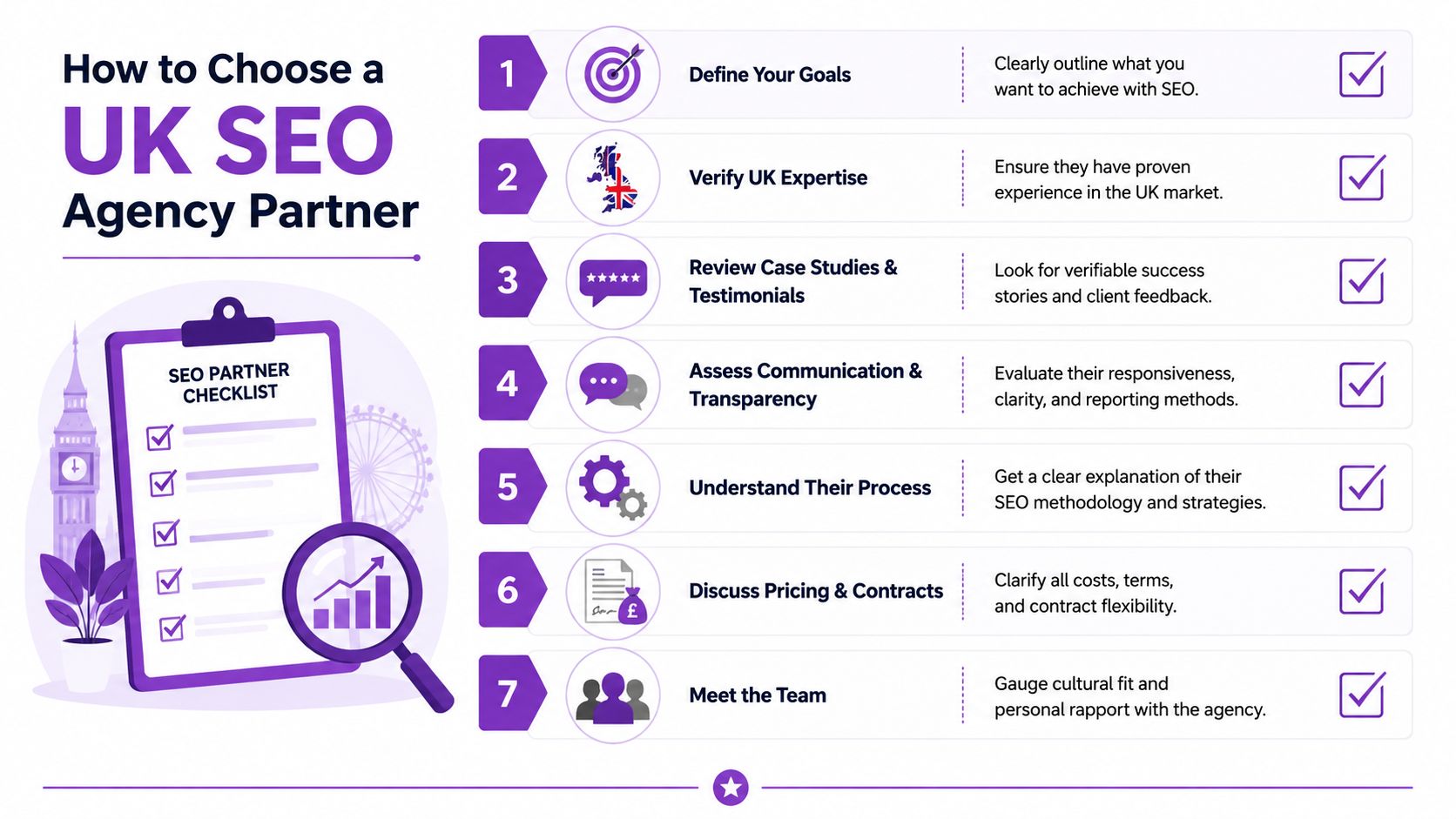
Choosing an SEO agency is less like buying software and more like hiring a specialist team that influences your pipeline. Price matters, but the bigger issue is whether the agency can think clearly about your business, your market, and your constraints.
The first thing to understand is that serious SEO expertise costs money because skilled people are doing ongoing analytical and production work. The average cost of SEO consultancy services in the UK was recorded at over £6,820 per client in 2025, and the median average SEO salary was approximately £39,719, according to Reboot Online's UK SEO statistics. Those numbers help explain why capable agencies don't price like commodity suppliers.
What a good agency should be able to explain
A credible agency should make its process understandable. Not simplified to the point of meaninglessness, but clear enough that you know how work gets prioritised.
Ask direct questions such as:
- How do you decide what to fix first
- What does month one look like in practice
- How do you approach Google Business Profile work for local visibility
- How do you report on leads, not just rankings
- What parts of the campaign depend on our input
- How do you adapt strategy if the first assumptions prove wrong
If the answers are full of mystery, jargon, or claims of a secret method, step back.
Red flags that usually signal trouble
Some agency habits are remarkably consistent, and not in a good way.
- Guaranteed rankings usually mean the sales process is overpromising.
- Obsessive focus on traffic alone often hides weak conversion thinking.
- No clear deliverables makes accountability difficult.
- Very long lock-in contracts can trap clients before value is proven.
- One-size-fits-all packages rarely fit businesses with real local nuance.
A strong partner talks plainly about trade-offs. They should be willing to say, for example, that your category pages need work before link building ramps up, or that your local area pages are cannibalising one another.
A short video can help frame what to look for in a provider before you sign anything.
How to compare agencies properly
When you review proposals, compare them on three levels.
First, strategic fit. Do they understand the difference between a single-site venue business and a multi-location service operator?
Second, communication quality. Are they responsive, specific, and able to translate SEO into business language?
Third, delivery confidence. Can they show how technical work, local optimisation, content, and authority building fit together over time?
The best SEO agency usually isn't the one that promises the most. It's the one that spots the right problems early and explains them without theatre.
Questions worth asking in the meeting
Use the conversation to test thinking, not just chemistry.
| Question | Why it matters |
|---|---|
| How would you prioritise our first 90 days? | Reveals whether they can diagnose, not just sell |
| What should we stop doing? | Good agencies remove waste as well as add work |
| How do you handle local page strategy? | Important for towns, service areas, and map relevance |
| What would reporting look like each month? | Shows whether accountability is built in |
| Who will actually work on the account? | Sales and delivery aren't always the same people |
The agency-client relationship works best when both sides can be candid. You want a partner who can challenge weak assumptions, not one who nods through every request.
Sector-Specific SEO Strategies for UK Businesses
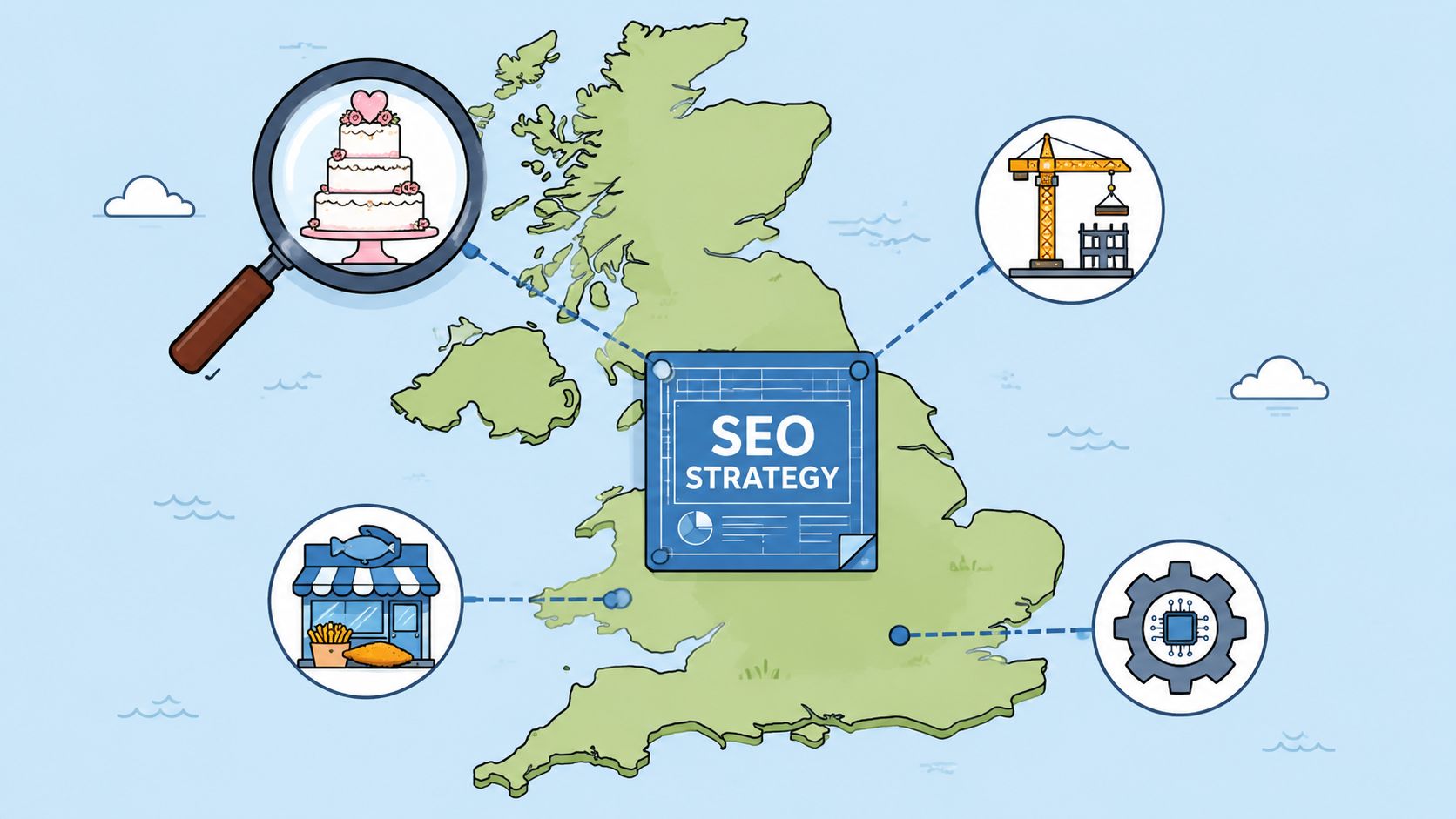
The reason generic SEO advice disappoints so many business owners is simple. Different sectors attract different search behaviour, different decision cycles, and different trust requirements. A managed campaign only works when those differences shape the plan.
Wedding venues and destination-style local search
A wedding venue in the Cotswolds doesn't just compete for “wedding venue near me”. It also competes for aspirational searches from couples planning from other parts of the country. The site needs visual-led content, strong area pages, venue detail pages, and useful planning content that answers practical questions before the enquiry form ever gets opened.
That's why venue SEO often performs best when content and local intent work together. A useful example of that sector-specific thinking can be seen in this guide to SEO for wedding venues in the UK.
Trades and urgent local intent
A plumber, locksmith, or electrician has a very different search pattern. Speed matters. Proximity matters. Mobile usability matters. The searcher often wants a provider now, not after reading a long educational guide.
For those businesses, local pages, Google Business Profile optimisation, review quality, click-to-call usability, and tight service-area alignment usually matter more than broad thought leadership content. The strongest campaigns reduce friction. They don't bury urgent commercial intent under fluffy blog posts.
Healthcare and home care where trust and compliance meet
Healthcare is where poor agency processes become risky. Rankings still matter, but so does how enquiry tracking, form handling, and reporting are managed. For UK healthcare providers, recent developments show 42% of private clinics abandon managed SEO contracts over opaque data-handling, and fines can reach £17.5 million for non-compliance, according to Healthcare SEO guidance on agency due diligence.
That should change how clinics and home care providers vet agencies. Reporting must be useful without exposing personal data. Dashboards should support decision-making while respecting GDPR principles around data minimisation.
In healthcare SEO, the reporting process is part of the service quality. If data handling feels vague, that isn't an admin issue. It's a commercial and legal risk.
Professional and creative services
Architects, interior designers, photographers, and similar firms often need a hybrid approach. They're selling expertise and taste, but they still need local visibility. Strong portfolio structure, service-location targeting, and clear proof of work tend to outperform generic blogging.
This is why managed SEO services in the UK shouldn't be bought as a standard box. The framework may be familiar, but the execution should change with the business model.
Your Next Steps to Sustainable Growth
Most businesses don't start looking for managed SEO because they want more marketing activity. They start because they want dependable enquiries from search without guessing what to do next.
That's the core value of a strong managed SEO service. It takes a channel that often feels vague and turns it into an operating system for visibility. Technical work gets prioritised. Local intent gets mapped properly. content supports real buying journeys. Reporting shows whether those efforts are turning into leads, not just impressions.
Keep the decision simple
If you're comparing agencies or deciding whether to handle SEO in-house, focus on a few hard questions:
- Do we need consistent local visibility to grow?
- Do we have the in-house time and skill to manage SEO properly every month?
- Does the proposed strategy reflect our sector and locations?
- Will reporting help us understand commercial impact clearly?
- Can we trust this team to communicate transparently when priorities change?
That keeps the conversation grounded. It stops SEO becoming a bundle of vague deliverables.
Think in assets, not campaigns
Good SEO builds something durable. Each technical fix, stronger page, local signal, and relevant mention adds to an asset your business keeps benefiting from over time. That's different from channels where visibility disappears the moment spend stops.
It also helps to stay aware of broader shifts in search and digital behaviour. If you want a wider view of where channels are heading, this overview of digital marketing trends for 2026 is a helpful companion read.
The businesses that do best with managed SEO services in the UK usually take the same approach. They choose a partner carefully, set practical goals, commit long enough for the work to compound, and judge progress by lead quality and business outcomes.
If you want a practical next step, Bare Digital offers a free SEO health check and activity plan for UK businesses that want clearer local visibility, better Google Maps performance, and a sensible route to more enquiries.