
A lot of UK business owners are in the same position right now. They've built a solid service, they've got happy customers, and word of mouth still brings work in, but online they're oddly invisible. A plumber in Leeds can be booked out from referrals and still fail to appear when someone nearby searches for “emergency plumber near me”. A wedding venue in the Cotswolds can have a stunning site and still lose enquiries to a competitor with a stronger Google Business Profile.
That gap is where most “digital marketing” advice falls apart. It talks about channels in isolation. Post on social media. Run ads. Do SEO. Send emails. The business owner is left with a pile of tasks and no clear route to more local customers.
For local and multi-location businesses, digital marketing solutions only matter when they work as a system. The aim isn't more activity. The aim is to get found by the right people, give them enough confidence to choose you, and turn that search into a call, form submission, booking, or visit.
From Local Gem to Local Leader
A good local business can stay hidden for years because it treats online visibility like an afterthought. That usually looks familiar. The website was built a while ago. The Google Business Profile was claimed, then ignored. A few social posts go out when someone remembers. Nothing is broken enough to force action, but nothing is joined up enough to drive steady local demand.
That's frustrating when the service itself is strong.
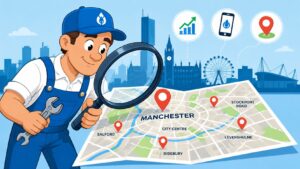
Take a trades business covering a few London boroughs. The team does good work, reviews are positive, and existing customers recommend them. But when a homeowner searches for a service in their postcode, competitors show up in Maps, their locations are clearer, and their websites make it obvious what areas they cover. The better operator doesn't always win. The clearer, easier-to-find operator often does.
Visibility has to match the quality of the service
Local growth online rarely comes from one clever trick. It comes from a connected setup:
- Search visibility: Your business appears for the services and areas that matter.
- Trust signals: Reviews, consistent business details, and strong location pages reduce hesitation.
- Conversion paths: The phone number is easy to tap, the quote form is simple, and the site answers the questions buyers ask.
That's the practical meaning of digital marketing solutions for local firms. Not buzzwords. Not random campaigns. A working system that turns local intent into leads.
If social visibility is one of the weaker parts of your setup, this guide for small business social growth is a useful companion because it shows how to make posting support the wider customer journey rather than become another time sink.
For businesses that need search-led local enquiries, the system usually starts with SEO foundations and Google visibility. That's where a specialist local partner such as Bare Digital fits in. The value isn't “doing some marketing”. It's connecting search intent, site structure, Maps presence, and lead tracking so your online footprint starts behaving like a proper sales channel.
The businesses that pull ahead locally aren't always louder. They're easier to find, easier to trust, and easier to contact.
What Exactly Are Digital Marketing Solutions
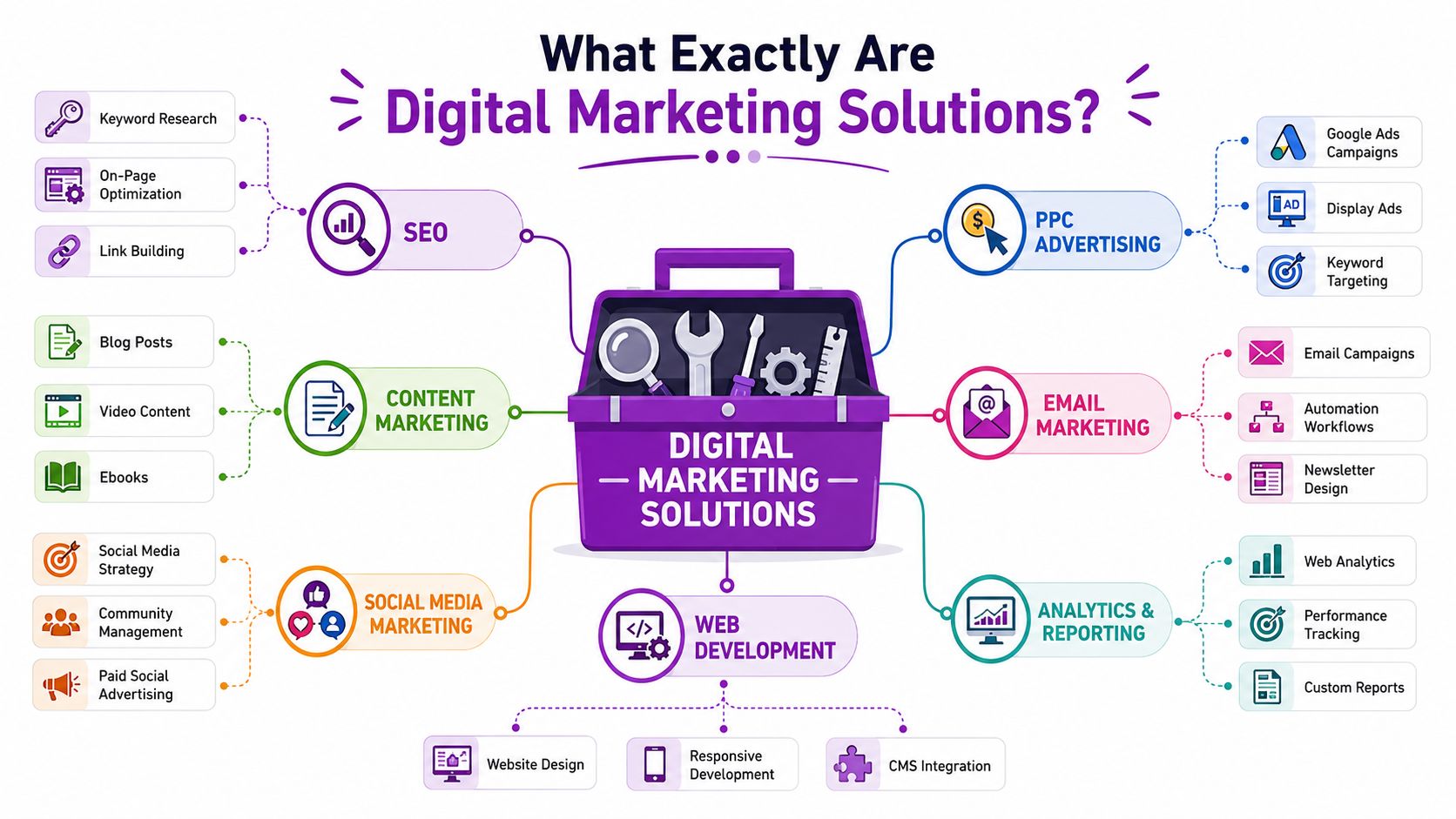
Most business owners hear the term and picture a menu. SEO, PPC, social media, web design, email. Pick two or three, hope for the best, and see what happens.
That approach usually wastes time because tactics without a blueprint behave like a pile of bricks with no house plan. You can buy good materials and still end up with nothing usable.
A solution is a joined-up blueprint
Digital marketing solutions are better understood as a coordinated system built around one commercial outcome. For a local business, that outcome is often simple: more qualified enquiries from the right areas.
It's comparable to fitting out a physical premises on a busy high street.
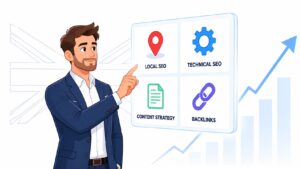
- Local SEO is the location of the shop. If you're not where buyers are looking, footfall stays low.
- Google Business Profile is the signage, opening hours, and front window. It tells people who you are and whether you're relevant right now.
- Website content is what customers see when they step inside. If the information is thin, generic, or confusing, they leave.
- Reviews and links are word of mouth. They reassure people that others already trust you.
- Paid search is the fast route to temporary prominence when you need immediate visibility.
A real solution decides how these pieces support each other. It also decides what not to do. That matters just as much.
What a weak setup looks like
A scattergun approach usually has a few common symptoms:
| Problem | What it looks like in practice |
|---|---|
| Isolated tactics | Someone runs ads, but the landing page is poor and enquiries stay weak |
| No local focus | Service pages mention the service but not the towns, postcodes, or areas served |
| No technical support | The site looks acceptable to humans but is hard for Google to crawl and interpret |
| No measurement | Reports talk about clicks and impressions, but not leads or booked work |
This is why “doing some marketing” isn't the same as having a solution.
Why AI search has changed the brief
Search has shifted again. AI-generated answers are changing how people discover businesses, especially for local intent. That means your content and site structure need to be machine-readable as well as persuasive. If you want a plain-English explanation of that shift, these MyMentions insights on AI answers are worth reading.
One practical consequence is that technical cleanliness now matters more than many small firms realise. For regulated and high-trust sectors, the same principle applies even more strongly, which is why niche service pages such as SEO for healthcare need stronger structure, clearer trust signals, and tighter local relevance than a generic brochure site.
Practical rule: If each marketing channel can be removed without affecting the others, you don't have a solution yet. You have separate activities.
The Core Components of a Local Growth Engine
Local lead generation works best when a few core parts are kept in sync. Miss one, and the whole engine starts to splutter. A business can have a polished website and still lose in Maps. It can have lots of reviews and still underperform because its location pages are thin. It can publish blogs and still get nowhere because the technical setup is poor.
Google Business Profile and local intent
For many local searches, your Google Business Profile is the first real impression. In 2025, 45% of consumers default to Google for local searches, while 15% use Google Maps and 8% use Safari, which makes Google the main gatekeeper for local intent in practice, according to BrightLocal's local SEO statistics.
That means profile quality affects visibility and conversion, not just presentation.
A strong GBP setup includes:
- Accurate core details: Business name, primary category, phone number, opening hours, and service areas need to be correct.
- Real service evidence: Photos of recent work, premises, team members, or completed projects add credibility.
- Fresh updates: Posts, Q&As, and review responses show the profile is active rather than abandoned.
If you want to sense-check the basics, a Google Business Profile audit tool can help surface obvious gaps.
Local SEO and location pages
Local SEO is where many businesses either become discoverable or stay buried. The aim isn't to rank for broad vanity phrases. The aim is to rank for the actual combinations people use when they need a nearby supplier.
For a funeral director in Manchester, that might mean clear service pages for funeral planning, cremation arrangements, and memorial services, paired with area-specific content that reflects local concerns. For a construction company, it means separate landing pages for the towns it serves, with proof, project context, and service detail on each.
The pages that work tend to share three traits:
- They match search intent. A user looking for “builder in Harrogate” should land on a page about building services in Harrogate, not a generic homepage.
- They prove local relevance. Mentioning the town once in a title tag isn't enough.
- They help people act. Strong local pages make it easy to call, enquire, or request a quote.
Technical SEO and crawlability
Technical SEO is less glamorous than content, but it's often where local campaigns win or lose. Expert insights confirm that 53% of UK businesses include Technical SEO in their SEO strategy, a prerequisite for maintaining the high domain authority and mobile responsiveness essential for capturing the 46% of searches that are local in nature, according to LocaliQ UK.
That should tell you two things. First, technical SEO isn't a niche add-on. Second, if your competitors are investing in it and you aren't, you're giving away ground.
Key areas include:
- Mobile usability: Local searches often happen on phones, in the moment, with low patience.
- Indexation control: Important pages must be crawlable and clearly structured.
- Schema and structured data: These help search engines interpret business, service, and location details.
- Site speed and stability: Slow pages bleed enquiries, especially for urgent services.
There's another shift to keep in mind. AI Overview prevalence in UK local search grew from approximately 8% to 40% across 2025, according to Rankmax local SEO statistics. That trend reinforces the need for structured data and clean page architecture because search engines are increasingly summarising, extracting, and reformatting information.
If Google can't understand the page quickly, it won't matter how good the copy is.
Reviews links and paid support
Trust is built in layers. Reviews are one of the clearest. In 2025, 42% of UK consumers trust online reviews as much as personal recommendations, according to Beyond Your Brand's SEO statistics. For local businesses, review management isn't cosmetic. It affects both visibility and whether a searcher feels safe contacting you.
Authority-building links matter too, especially for multi-location brands that need Google to treat them as established rather than thinly spread. Useful links usually come from relevant local organisations, trade associations, chambers, suppliers, sponsorships, and genuine editorial mentions.
Paid channels can support all of this when used properly. Google Ads can give immediate coverage for priority services or difficult postcodes while the organic side matures. What doesn't work is using paid campaigns as a substitute for a weak website, a neglected GBP, or poor local landing pages.
Measuring What Matters Outcomes and KPIs
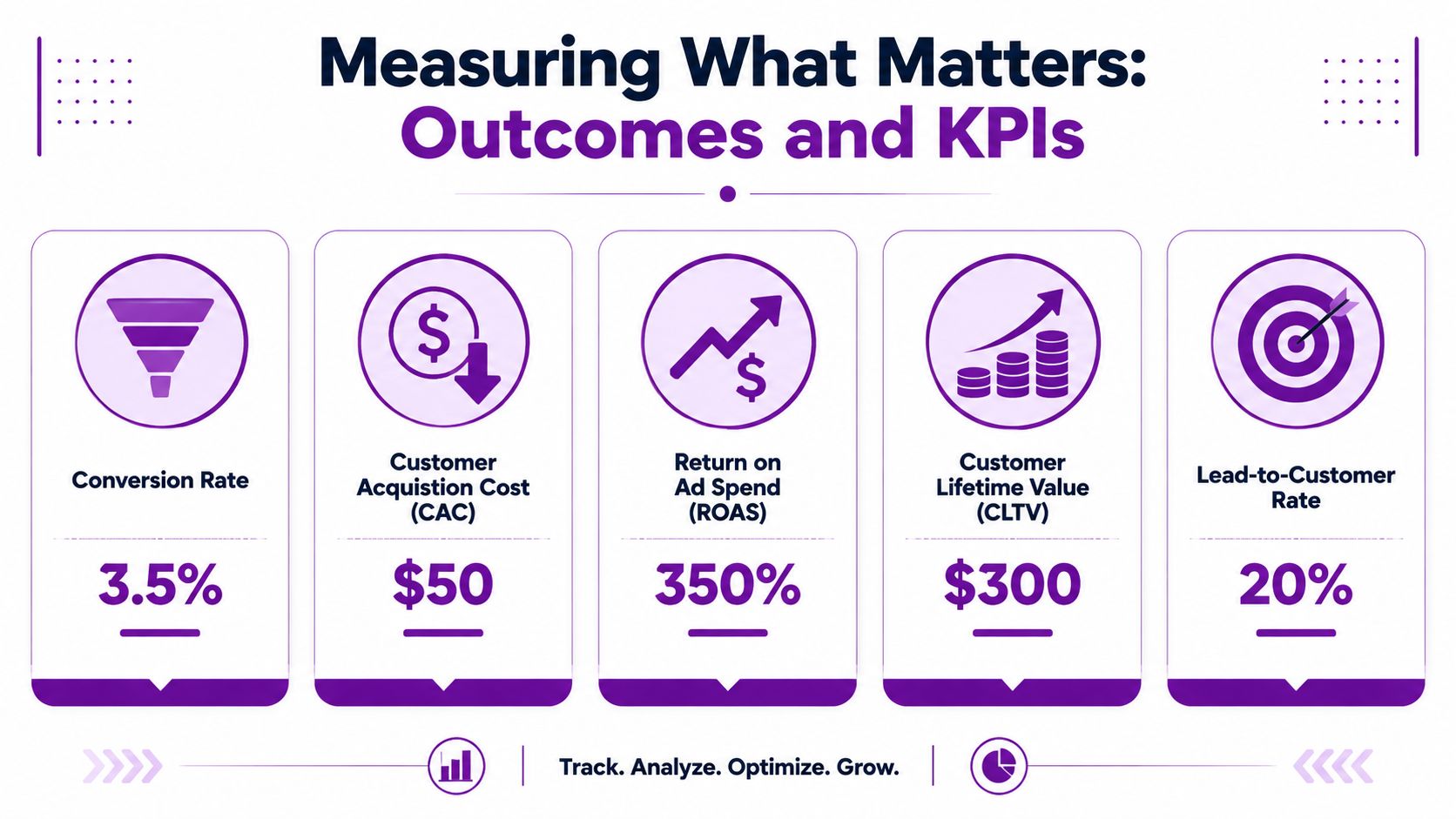
Most local businesses don't need more marketing data. They need cleaner answers to a smaller set of questions. Which channels are generating enquiries? Which locations are producing qualified leads? Which pages are attracting people who become customers?
That's a very different mindset from chasing vanity metrics.
A rise in traffic can be useful. More impressions can be encouraging. But if a construction company gets broader visibility and quote requests don't improve, the marketing hasn't done its job.
The KPIs that deserve attention
For local SEO, the best measures are usually closest to revenue:
- Phone calls from organic and GBP visibility: Especially important for urgent or high-trust services.
- Form submissions by landing page: This shows which services and areas are converting.
- Direction requests or location actions: Useful for premises-based businesses.
- Keyword coverage for service-plus-location searches: Not as a vanity chart, but as a signal of market penetration.
- Lead quality: Whether the enquiries match your target jobs, budgets, and geography.
What ROI looks like in local SEO
The useful thing about SEO is that it compounds, but only if it's measured against the right outcomes. The local SEO market in the UK is projected to reach $80 billion by 2025, with businesses achieving an average ROI of 2.5 times their investment, according to Amra & Elma's local SEO statistics. That supports what many practitioners already see on the ground. When local SEO is targeted around genuine purchase intent, it can produce measurable financial return.
Still, averages won't run your business. You need to know your own economics.
A simplified approach is:
| KPI type | Useful question |
|---|---|
| Lead volume | Are more local enquiries coming in from search? |
| Lead quality | Are these the right jobs, in the right areas? |
| Sales efficiency | Are you closing them at a healthy rate? |
| Location performance | Which towns or branches need more visibility? |
A practical example: if a construction firm sees organic quote requests rise but most of them come from outside its service area, the campaign isn't yet efficient. Better keyword targeting, stronger geographic signals, and tighter service pages usually fix that.
Set up tracking before you scale activity
This gets overlooked all the time. Businesses launch SEO work, approve content, tweak titles, post on GBP, and only later realise they can't tie any of it back to enquiries.
A simple starting point is enough:
- Track calls separately from website forms where possible.
- Tag key landing pages by service and location.
- Review enquiry quality with the sales team or front desk, not just in analytics.
- Use a planning tool to sense-check return before doubling down, such as a sector-specific SEO ROI calculator where relevant.
Reports should help you decide what to do next. If they only prove that activity happened, they're not useful enough.
Choosing Your Path In-House Agency or Fractional
Once a business decides it needs proper digital marketing solutions, the next problem is delivery. Who's going to do the work, and who's responsible when results stall?
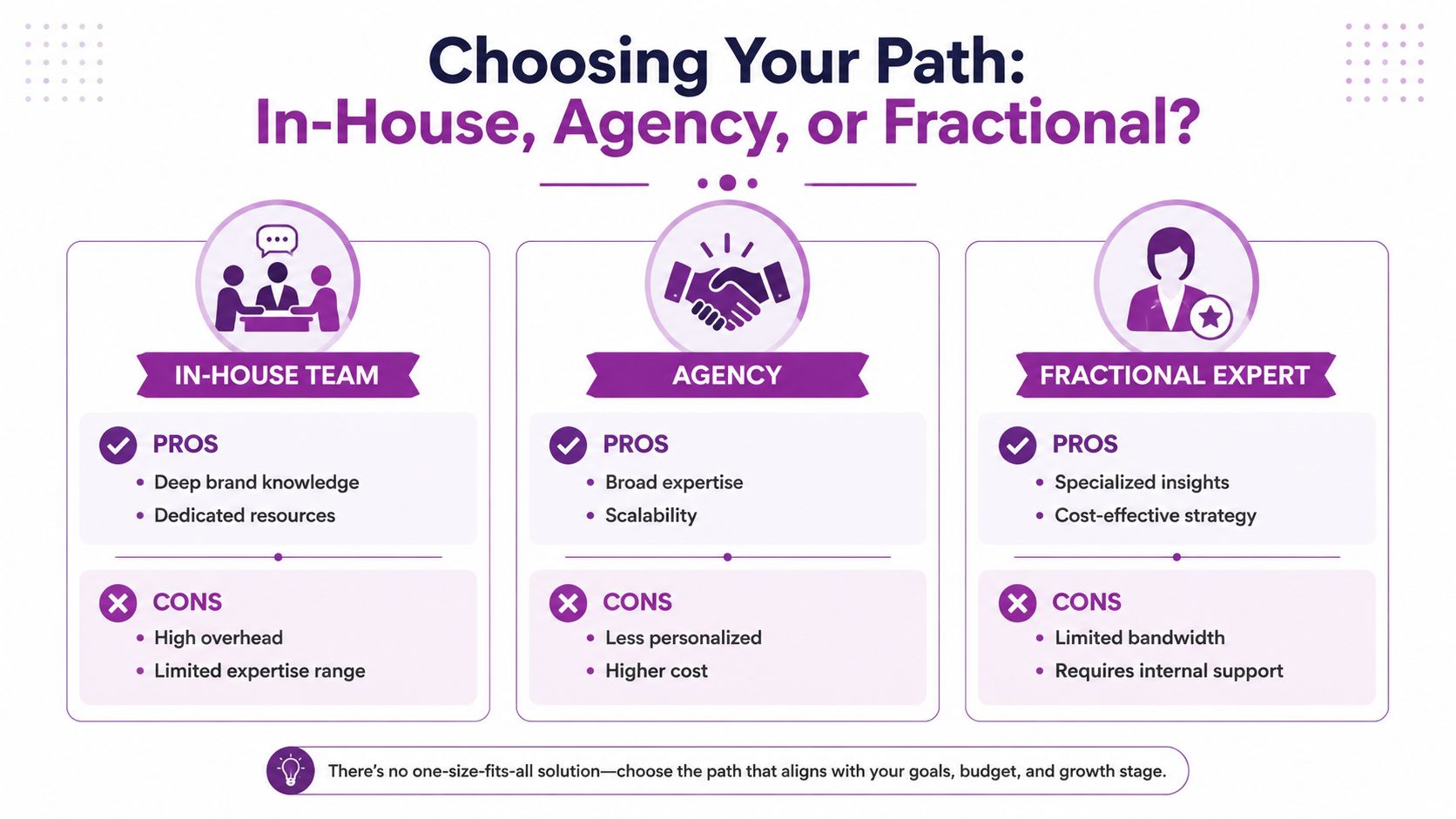
There are three common models. In-house. Agency. Fractional. None is automatically right. The best choice depends on stage, complexity, budget, and how much local search expertise you need.
A side-by-side view
| Model | Where it helps | Where it struggles |
|---|---|---|
| In-house | Strong brand understanding, fast internal communication, easy alignment with sales and operations | Hard to cover SEO, content, technical work, design, and reporting with one hire |
| Agency | Broad skill coverage, repeatable systems, external perspective, scalable execution | Can feel less embedded if onboarding is weak or the brief is vague |
| Fractional | Senior input without a full-time hire, good for strategy and oversight | Often needs internal support or specialist freelancers to execute consistently |
When in-house makes sense
An in-house marketer is often a good fit when the business already has momentum, a clear offer, and enough day-to-day marketing demand to justify dedicated resource. This works well for businesses that need quick coordination with sales teams, branch managers, or operations.
The risk is expecting one person to do everything. Local SEO alone can involve technical audits, content planning, GBP management, reporting, internal coordination, and link acquisition. That's a lot for one hire, especially if they're also expected to run socials, email, and paid media.
When an agency makes sense
An agency model usually fits businesses that want execution capacity and specialist depth without building a full team. This is often the most practical route for multi-location businesses because they need repeatable local page structures, location-level reporting, and consistent optimisation across branches.
The trade-off is that you have to choose carefully. A generalist agency may talk about full-funnel growth but still miss the details that drive local rankings. If “near me” visibility, Maps performance, and service-area landing pages are central to your revenue, local search expertise matters more than broad marketing language.
Why fractional is getting more attention
Fractional marketing is still underexplained, but it can be a smart middle ground. A growing but often undiscussed option is fractional marketing, where SMEs engage part-time specialists. 68% of UK businesses have considered or are using this model, according to Distribu Digital's piece on the rise of fractional marketing.
That appeal is easy to understand. Some businesses don't need a full-time marketing manager. They need experienced judgement for a few days each month, a clear roadmap, and oversight of trusted executors.
Fractional works best when the business knows it needs direction first, not just more hands on keyboards.
A practical rule of thumb helps:
- Choose in-house if marketing volume is constant and broad.
- Choose agency if you need specialist delivery across several moving parts.
- Choose fractional if you need senior strategy, accountability, and staged growth without full-time overhead.
Your Next Steps A Practical Checklist for Growth
Most businesses don't need a grand relaunch. They need an honest audit and a sensible order of operations. The fastest route to better results is usually fixing what blocks local visibility first, then improving what helps conversion.
If you want extra ideas beyond SEO, these practical marketing strategies for growth are useful for spotting simple gaps in content and promotion. But local search should still anchor the plan if nearby customers are your main source of revenue.
Run this quick self-check
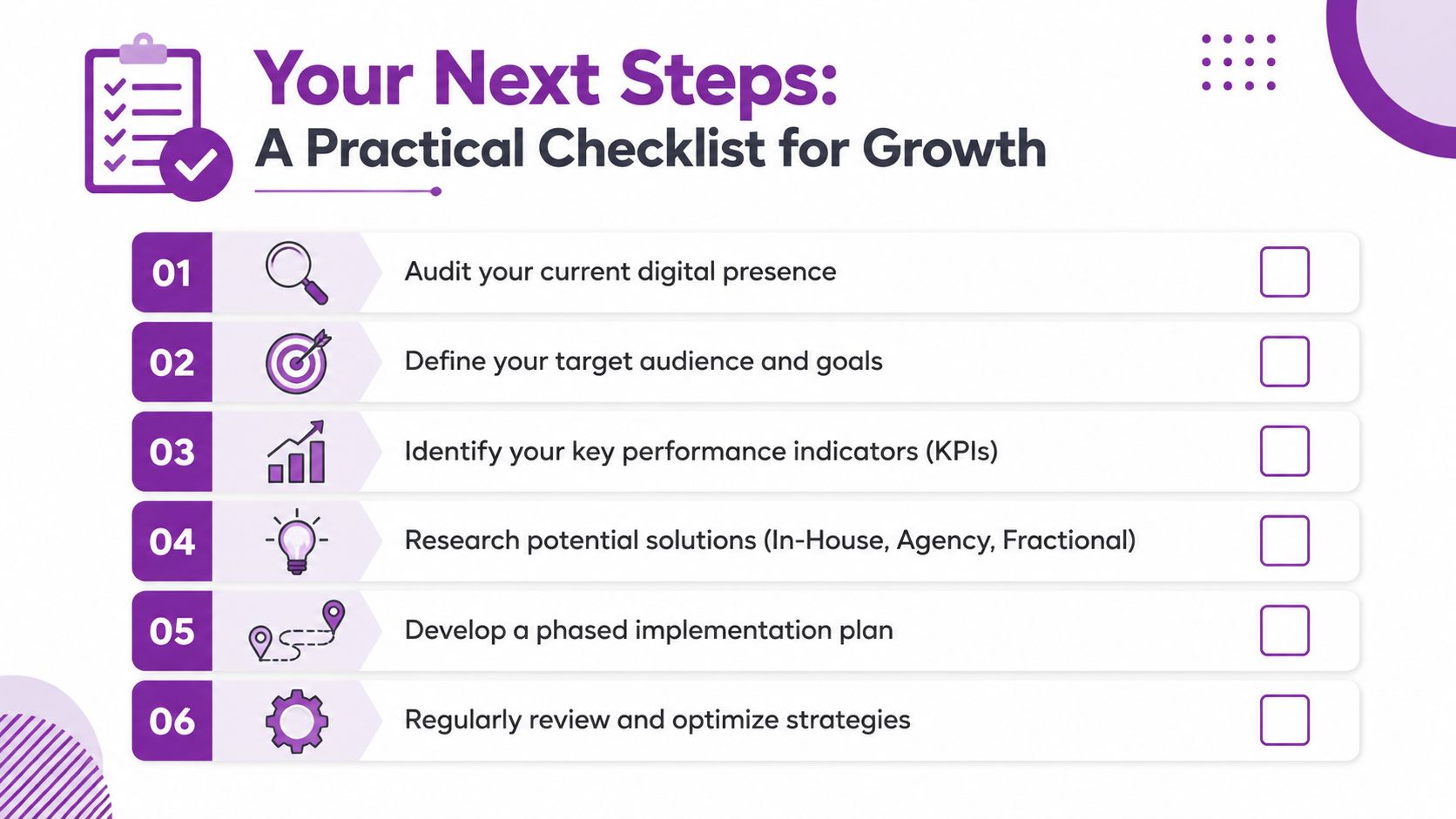
- Check your Google Business Profile: Are the categories right, hours current, photos recent, and reviews being answered?
- Test your mobile experience: Can a customer load the site quickly, understand the offer, and call you without friction?
- Review your service pages: Do they clearly state what you do and where you do it, or are they too generic?
- Look at local relevance: Do you have proper pages for key towns, branches, or service areas?
- Check trust signals: Are testimonials, accreditations, case examples, and business details easy to find?
- Audit your visibility footprint: Are your business details consistent across important directories and local mentions?
Decide what needs action now
Not every issue deserves equal urgency. Prioritise the changes that affect discoverability and enquiries first.
A useful order is:
- Fix inaccurate business information
- Improve GBP completeness and activity
- Strengthen the main service and location pages
- Resolve obvious technical barriers
- Build authority through reviews and relevant local links
That sequence works because it follows the path a real customer takes. They search, scan, compare, trust, then contact.
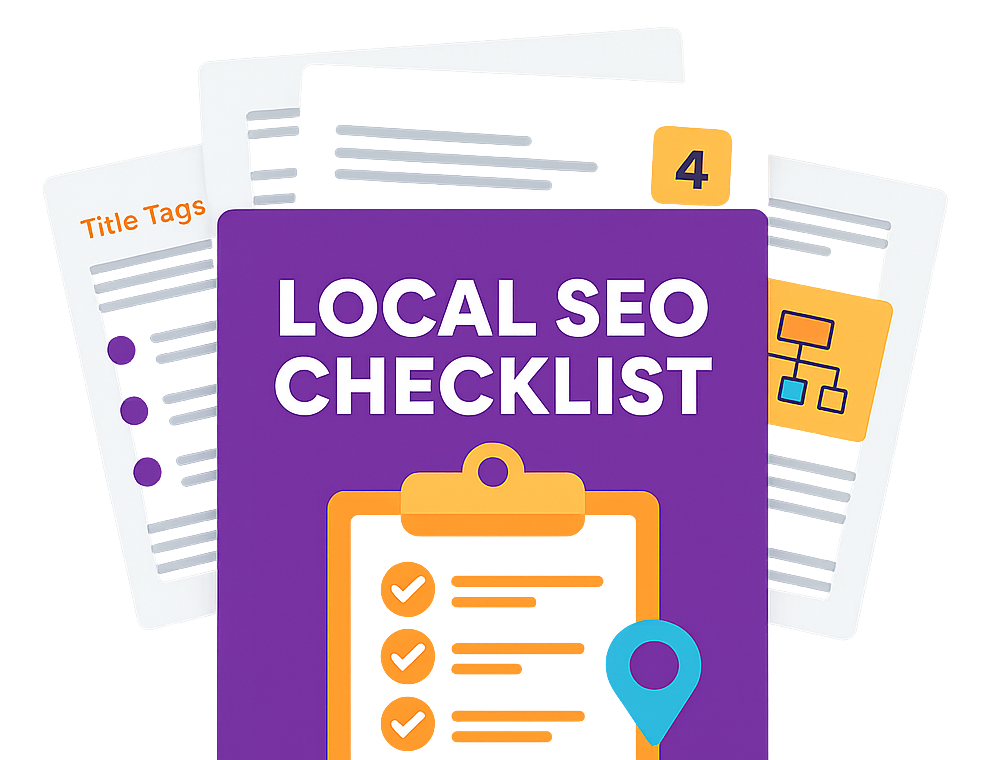
A checklist is only worthwhile if it ends in action. If you can run through these points and immediately see weak areas, you already know where the lost enquiries are likely going. If you want a more detailed benchmark, a structured local SEO checklist is a practical next step before committing budget or changing suppliers.
The businesses that grow consistently in local search aren't doing everything. They're doing the important things in the right order, and they're measuring whether those changes lead to more of the right enquiries.
If you want a clearer view of what's helping and what's holding you back, Bare Digital offers a free, no-obligation SEO health check. It's a practical review of your local visibility, website structure, and lead opportunities, followed by a straightforward activity plan you can use to decide your next move.