

You’re probably in the same spot as a lot of UK business owners.
You know search matters. You know people are looking for your service on Google. But when you ask for SEO quotes, one provider says they can do it for barely more than a takeaway order, and another sends a proposal that looks like a second rent payment.
That gap confuses people because SEO is not a standardised product. Two agencies can both say “local SEO” while offering completely different levels of work, strategy, and accountability. One might optimise your Google Business Profile, fix technical issues, build town pages, and report on enquiries. Another might upload a few keywords to a spreadsheet and call it a campaign.
For local firms, that difference affects real revenue. Done properly, SEO turns visibility into calls, form submissions, bookings, and sales. Done badly, it wastes months and can leave you paying again to clean up the damage. The upside is real too. The UK affordable SEO services sector has become a major growth driver for small businesses, with some client case studies showing a 600% increase in sales leads when the right partner and strategy were in place, as noted in this review of affordable SEO services in the UK.
This guide is for the owner who wants to buy wisely, not cheaply.
Navigating the Confusing World of SEO Quotes
A typical scenario goes like this. A construction firm in Essex, a private clinic in Birmingham, or a wedding venue in Kent asks for three SEO quotes. The first comes in suspiciously low. The second is packed with jargon. The third sounds sensible, but it is still hard to tell what you are buying.

The confusion usually starts because providers sell outcomes that business owners cannot directly inspect. If a builder quotes for an extension, you can compare materials, labour, and drawings. If an SEO provider quotes for “authority building”, “content optimisation”, or “local signals”, you need to know what those mean in practical terms.
Why the market feels hard to trust
SEO has a low barrier to entry. Anyone can launch a website, call themselves a consultant, and sell monthly retainers. That does not mean every provider is dishonest. It does mean buyers need a framework.
The best starting point is simple. Judge SEO by whether it helps you win more local business, not by how technical the proposal sounds.
For a trades company, that may mean stronger visibility in Google Maps and better service pages for town searches. For healthcare, it often means trust signals, accurate service information, and pages built around urgent or condition-based intent. For wedding venues, it usually means a different balance of local visibility, image-led pages, and content that supports high-value enquiries.
Tip: If a provider cannot explain their work in terms of calls, enquiries, bookings, or qualified leads, they are speaking to impress you, not to help you buy.
Cheap, affordable, and expensive are not the same thing
A low fee is not automatically bad. A high fee is not automatically justified. The key question is whether the work fits your market.
A sole trader targeting a single town does not need the same campaign depth as a multi-location care provider or a venue competing across several counties. Good affordable seo services uk firms scale the work to the competition, the service area, and the value of a lead.
You can see one example of a UK local SEO agency model at Bare Digital, where the service focus is on local visibility, Google Maps, on-page improvements, and lead generation rather than generic “traffic growth” language.
What a useful quote should do
A useful quote should make three things obvious:
- What will be done: Not just “SEO management”, but tasks.
- Why it matters: How those tasks improve local visibility and lead flow.
- How success is judged: Rankings matter, but enquiries matter more.
If a proposal leaves those questions unanswered, the price is almost irrelevant because you still do not know what you are buying.
Decoding SEO Pricing in the UK for 2026
SEO pricing in the UK makes more sense when you stop looking at it like a mystery fee and start looking at it like a scope-of-work problem. You are paying for research, technical fixes, content, local optimisation, reporting, and ongoing strategic decisions. The price changes based on how much of that your business needs.
According to 2026 UK market data, most small businesses invest between £500 and £2,000 per month for effective local SEO, while some entry-level packages begin around £99 and often do not include the depth needed for competitive markets, as outlined by Affordable SEO Services UK pricing data.
The three pricing models you will see
Monthly retainer
This is the most common model for ongoing SEO.
It suits businesses that need steady work every month. That includes service page improvements, Google Business Profile activity, technical maintenance, content, and reporting. If you want momentum rather than a one-off tidy-up, this is usually the right structure.
Project pricing
This works for a defined piece of work.
Examples include a technical audit, a website migration review, or a one-time local SEO setup. It can be useful if your site has obvious issues and you need a clean foundation before committing to a monthly campaign.
Hourly consulting
This tends to suit businesses with an in-house team or a developer already in place.
You pay for strategic input, audits, and recommendations rather than full implementation. It can be efficient when you only need specialist guidance, not delivery.
A practical way to think about budget tiers
SEO pricing works a lot like building an extension.
The very cheapest option may produce something that looks acceptable at first glance, but the finish is poor, the structure is weak, and you end up paying someone else to fix it. The mid-range option often creates the best long-term value because the work is planned properly, the basics are sound, and the result holds up.
Under the lower end of monthly retainers
This is often where buyers get tempted by “starter SEO” deals.
At this level, a provider usually has to limit work heavily. You may get basic reporting, light on-page edits, or a handful of directory submissions. That can be enough for a very small business in a very quiet market, but it is rarely enough for sectors where trust, content quality, and local competition matter.
Per-project pricing can start from a relatively low amount, but that end of the market can sometimes indicate corner-cutting if the provider is promising too much for too little. UK hourly consulting rates average £75 per hour, and monthly consultant retainers begin at £3,000, according to the same UK pricing overview.
The practical middle ground
For many small businesses, the sensible range is the bracket already mentioned above.
That is where you usually start seeing enough monthly work to move the needle. It can cover proper local keyword research, on-page improvements, technical fixes, Google Business Profile work, town or service-area pages, and reporting tied to business outcomes.
If you are trying to forecast the commercial side, a tool such as this SEO ROI calculator for self-storage businesses shows the kind of thinking you should apply even if you are in another sector. The principle is the same. Work backwards from lead value, close rate, and local search opportunity.
What drives a quote up or down
A provider may charge more because your brief includes:
- Multiple locations: Each location needs its own signals, pages, and optimisation.
- A weak website: Technical debt increases the workload.
- A competitive area: Ranking in central London is not the same as ranking in a smaller town.
- High-intent sectors: Healthcare, funeral services, and construction need stronger trust and conversion signals.
Key takeaway: A fair SEO quote is not the lowest one. It is the one where the monthly workload matches the difficulty of winning customers in your market.
What not to buy on price alone
A quote becomes risky when it is cheap because important work has been removed. Common omissions include no technical audit, no location pages, no Google Business Profile strategy, no content plan, and no meaningful reporting.
That is where “affordable” turns into “expensive later”.
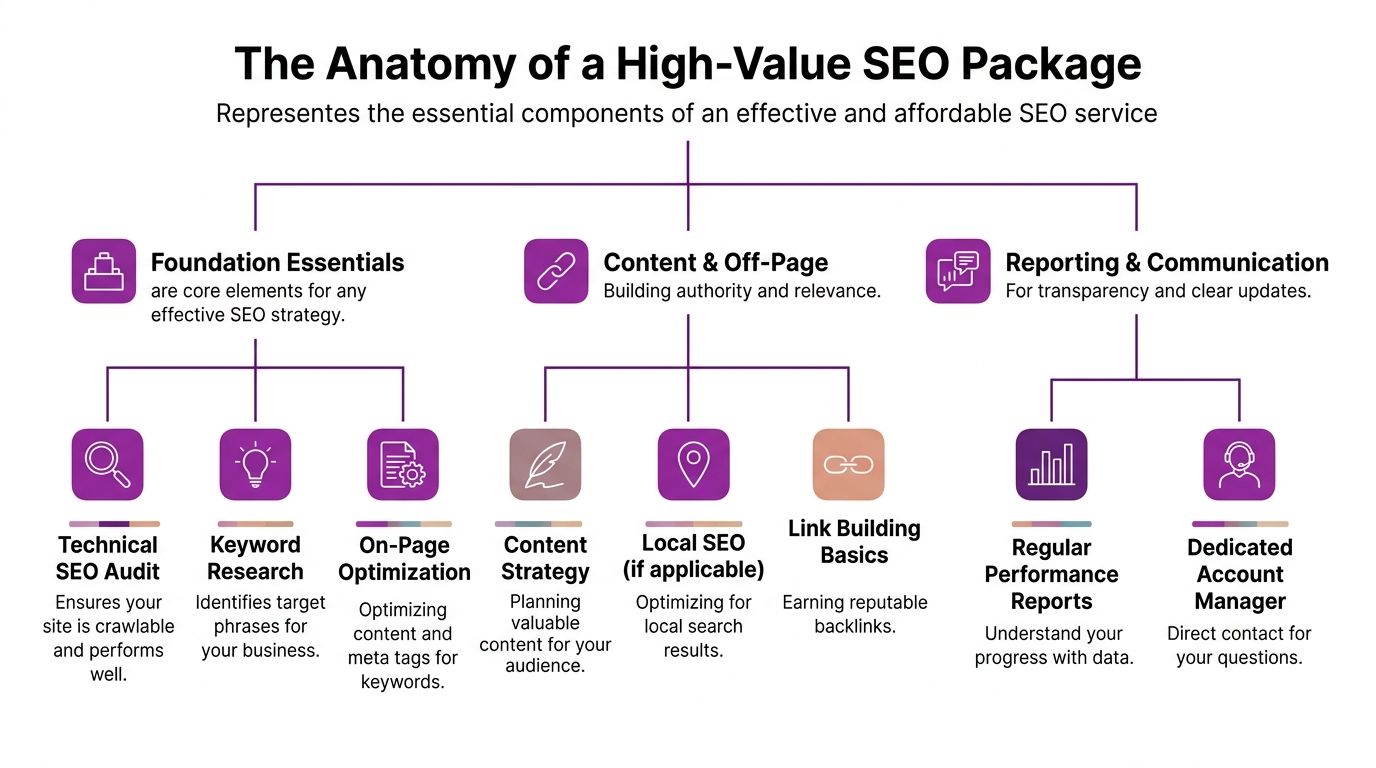
The Anatomy of a High-Value SEO Package
A good package is not defined by how many buzzwords it includes. It is defined by whether the work supports local discovery, trust, and conversion.
If you are buying affordable seo services uk, you should be able to point to each included task and say, “Yes, that helps a customer find us, trust us, or contact us.”
Foundation work that should never be skipped
Technical SEO audit
This checks whether Google can crawl, understand, and trust your site properly.
If pages are slow, broken, duplicated, or difficult to use, you are asking SEO to perform on a weak platform. A proper audit identifies those issues before money gets wasted pushing traffic toward a site that underperforms.
Keyword research with local intent
This is not just a list of broad phrases.
For local service businesses, useful keyword research maps searches to how people buy. “Emergency plumber Cambridge” is different from “bathroom renovation Cambridgeshire”. One implies urgency. The other implies research and longer consideration.
On-page optimisation
This includes title tags, headings, page structure, internal linking, and service copy.
Done well, it helps Google understand what each page should rank for. It also helps visitors confirm they are in the right place. Many weak campaigns focus only on keywords and ignore the page experience, which is often where enquiries are won or lost.
Local SEO elements that drive enquiry volume
Google Business Profile often carries more weight for local lead generation than owners realise. It can determine whether you appear in map-based searches and whether a buyer sees enough trust signals to call.
Smart SEO Tech states that it has achieved first-page Google rankings for 95% of over 500 London and UK-wide business clients within 90 days using white-hat methods such as keyword research, on-page work, technical fixes, and local optimisation, including Google Business Profile signals and “near me” targeting, as described on its affordable SEO packages page.
That does not mean every agency will match that claim. It does show what a serious local package tends to include.
Google Business Profile optimisation
A worthwhile package should cover your categories, service descriptions, imagery, updates, and alignment with your website. For service-area businesses, this is especially important because the profile often becomes the first impression before the website is even visited.
Location-specific landing pages
If you serve more than one town, you need more than a single generic “areas we cover” page.
Each location page should reflect the services, intent, and trust factors that matter in that area. Thin duplicate pages do not help much. Strong pages support both rankings and conversions.
Local link building and citations
This should focus on relevance and credibility, not volume for the sake of volume.
A local campaign often benefits from reputable directory consistency, location-relevant mentions, and links that make sense for your trade or region. Random bulk links are usually a warning sign, not a strength.
Content and reporting that connect to real business goals
A strong package also needs a content plan. That could be service support pages, town pages, FAQs, or articles that answer specific buying questions. The format matters less than the intent. Content should bring in people who are close to making a decision.
For healthcare providers, for example, the balance between educational content and service intent matters a lot. A page needs to reassure, answer concerns, and still make it easy to take the next step. This is why sector-specific SEO frameworks such as SEO for healthcare exist. The mechanics of SEO are similar across industries, but the trust signals and search intent are not.
Tip: Ask to see a sample monthly report before you sign. If it is all impressions and no connection to calls, forms, or booked enquiries, the package is missing the business layer.
A high-value SEO package should usually include:
- Clear technical priorities: Fixes ranked by impact, not a random list.
- Defined local targeting: Specific towns, postcodes, or service areas.
- Content mapped to intent: Not just “blogs”, but pages with a purpose.
- Reporting you can act on: Visibility is useful. Enquiries are what pay for the work.
Spotting Red Flags and Avoiding SEO Scams
Bad SEO rarely introduces itself as bad SEO. It usually arrives as a confident sales pitch, a low monthly fee, and a promise that sounds easy to believe when you want leads fast.

Promises that should make you pause
The biggest red flag is certainty where no honest provider can offer certainty.
No one controls Google. An agency can control its process, the quality of its work, the clarity of its reporting, and the speed of implementation. It cannot guarantee a specific ranking position on demand.
Be cautious if you hear any of the following:
- Guaranteed number one rankings: That is a sales line, not a strategy.
- Secret methods or proprietary magic: Good agencies explain their process in plain English.
- Very long contracts with no exit: If the work is good, the agency should not need a trap door.
- Vanity-only reporting: Traffic without lead quality is a distraction.
What cheap SEO often looks like in practice
Cheap SEO is not just low-priced SEO. It is SEO where the provider has to cut corners to make the account profitable.
That often means spun content, weak links, generic town pages, no real competitor analysis, and almost no strategic thinking. The report may still look busy. The business outcome usually does not.
A quick sense-check helps. If the monthly fee would barely cover a few hours of skilled work, the provider must either automate most of it, outsource it cheaply, or do very little.
Look beyond the sales deck
Ask for evidence of how they assess local visibility.
One practical way to pressure-test a provider is to see whether they can identify clear Google Business Profile issues, weak page targeting, or gaps in your service-area coverage. If they cannot spot obvious local SEO problems, they are unlikely to fix them. Tools like a Google Business Profile audit tool can also help you understand what should even be discussed in the sales process.
Tip: If the proposal talks more about “deliverables completed” than “customer actions generated”, the provider may be optimising for retention, not for your revenue.
Before you sign anything, it helps to hear how SEO scams and overpromises usually sound in the wild:
A simple test for trust
A reliable SEO provider should be comfortable answering direct questions:
- What will you work on in month one?
- How do you choose target towns or keywords?
- What happens if the site has technical issues?
- How do you report on lead quality, not just visibility?
If the answers stay vague, the risk stays high.
How to Compare Providers and Choose the Right Partner
Once you remove the obvious red flags, the true decision becomes more subtle. You are not only choosing a supplier. You are choosing a partner who needs to understand how your customers search, how your market behaves, and what makes someone contact you instead of the competitor three streets away.
That matters because generic SEO often breaks down in high-intent sectors. Businesses in areas such as funeral homes, healthcare, and construction need custom strategies built around trust signals and specific customer intent, which is a gap identified in this sector-focused review of affordable SEO.
Why industry fit matters more than most buyers realise
A wedding venue and a roofer can both target local search, but they do not need the same campaign.
A roofer may rely on urgent intent, postcode targeting, and clear proof of service coverage. A wedding venue often needs stronger visual pages, location positioning, and content that supports a longer decision cycle. A funeral home needs immediate trust, accurate local visibility, and messaging that feels calm and dependable.
When agencies say they “work with all industries”, that is not automatically a problem. The issue starts when they apply the same template to all of them.
Questions worth asking on a sales call
The best comparisons happen when you ask questions that reveal how the provider thinks, not just what they charge.
Ask for relevant examples
Do not ask, “Have you done SEO before?”
Ask, “Have you worked with businesses where the lead value, local intent, and trust requirements are similar to mine?” That may be your exact sector, or it may be another business model with comparable search behaviour.
Ask how they would approach your geography
A single-town business needs a different plan from a regional service brand.
Listen for whether they talk about Google Business Profile, service-area targeting, town pages, and competition level. If they jump straight to generic blog production, that is often a sign they have not thought through local demand properly.
Ask how they define success
Useful answers mention things like calls, contact forms, map visibility, qualified landing page traffic, and conversion paths.
Weak answers stay fixed on “more keywords” and “more traffic” without connecting that to business value.
What a strong provider usually does in discovery
They ask sharp questions back.
A solid SEO strategist will want to know where your best jobs come from, which towns matter most, which services drive margin, whether your Google Business Profile is active, and how quickly you respond to leads. That is a good sign because local SEO does not work in isolation from the rest of the customer journey.
Key takeaway: The right provider does not sell the same package to every business. They adjust the plan to your sector, your local competition, and the type of customer intent that produces revenue.
A comparison framework you can use
When you shortlist providers, score them against these points:
| Criteria | What to look for |
|---|---|
| Local strategy | Clear plan for Maps, service areas, and location pages |
| Industry understanding | Familiarity with your trust signals and buying cycle |
| Deliverables | Defined monthly tasks, not vague management language |
| Reporting | Visibility plus lead-focused metrics |
| Communication | Plain-English answers and realistic timelines |
| Flexibility | Scope suited to your size and competition |
The provider with the lowest quote will not always score best. The one with the clearest fit often will.
Sample SEO Packages and Expected Timelines
Business owners usually find SEO easier to compare when they can picture what a package includes. The names vary by agency, but the pattern is usually similar. A lighter package for small single-location firms, a broader package for growing businesses, and a deeper package for competitive or multi-location campaigns.
The details below are examples of what you might expect to see in affordable seo services uk proposals. They are not fixed industry standards.
Sample Affordable SEO Packages for UK Businesses
| Feature | Growth Package (For Startups & Solopreneurs) | Advanced Package (For Growing SMBs) | Accelerate Package (For Multi-Location & Competitive Markets) |
|---|---|---|---|
| Best fit | Single-location business with a modest local footprint | Established local business competing in a busy area | Multi-location brand or business in a highly contested market |
| Core technical work | Essential audit and priority fixes | Ongoing fixes plus wider on-site improvements | Ongoing technical management across multiple priority areas |
| Keyword targeting | Core service and town terms | Broader service clusters and local intent phrases | Multi-location and multi-service targeting |
| Google Business Profile work | Setup or optimisation and regular maintenance | Active optimisation with stronger local content support | Multi-location profile strategy and structured local activity |
| Service pages | Core page optimisation | Core pages plus expanded landing page support | Broader service architecture and local landing page scaling |
| Location pages | Limited or selective | Built for key towns or service areas | Larger rollout for multiple towns, branches, or regions |
| Content support | Light content plan | Regular content tied to service intent | Broader content plan aligned to commercial priorities |
| Link acquisition | Foundational local authority building | Ongoing relevant authority work | More consistent authority building for tougher markets |
| Reporting | Monthly visibility and enquiry-focused summary | More detailed reporting with KPI tracking | Broader reporting across locations and lead sources |
What timelines really look like
Expectations need to stay grounded here.
Reputable UK agencies report first-page Google rankings for 95% of clients within 90 days, using white-hat methods, with rankings and ROI becoming more stable after 4 to 6 months of consistent work, according to Smart SEO Tech’s package overview. That gives a helpful benchmark, but it should be treated as a provider claim, not a universal guarantee.
In practice, timelines depend on several factors:
- Your starting point: A healthy site moves faster than a broken one.
- Your market: A village service area behaves differently from inner London.
- Your sector: High-trust sectors need stronger foundations.
- Your competition: If rivals are already investing well, progress takes more work.
What tends to happen over time
First phase
Early work usually focuses on diagnosis, fixes, local targeting, and foundational on-page improvements. You may see movement in indexing, visibility, and map relevance before you see a big jump in leads.
Middle phase
This is often where service pages, content support, and location signals start compounding. Rankings become more stable. Better pages start attracting visitors who are closer to contacting you.
Later phase
Once local authority, page quality, and trust signals have had time to build, SEO often becomes more efficient. The business is no longer trying to appear from nowhere. It is strengthening positions it already earned.
Tip: Judge a provider less by whether they promise instant results and more by whether they can explain the sequence of work that leads to durable results.
Matching package depth to your business
A small photographer covering one town may do well with a focused campaign around service pages, Google Business Profile, and a handful of strong local signals.
A construction company covering several postcodes may need broader town-page coverage, stronger internal linking, and more ongoing authority work. A healthcare provider may need a more careful content and trust strategy from the start.
The right package is the one that reflects the shape of your market, not just your available budget.
Your Actionable Checklist for Hiring an SEO Agency
When you strip away the jargon, the hiring process is manageable. You need a shortlist, a few smart questions, and the confidence to reject vague offers.
Use this checklist before signing with any provider.
A practical hiring checklist
Set a realistic budget
Use the pricing ranges covered earlier as a reality check. If your market is competitive, avoid judging quotes only by who is cheapest.List the work you need
Think in terms of Google Business Profile, service pages, town pages, technical fixes, and reporting. That gives you a way to compare substance rather than sales language.Shortlist providers with relevant market understanding
Local SEO for a wedding venue is not the same as local SEO for a care provider or a builder. Look for evidence they understand your kind of search intent.Ask direct commercial questions
Ask how they measure success, what month one looks like, and how they decide where to focus first.Screen for red flags
Walk away from guaranteed rankings, unclear deliverables, or long lock-in contracts that feel difficult to escape.Review their process against your own site
If they cannot identify obvious issues on your website or Google Business Profile, they may not be the right fit.Keep a written comparison sheet
A simple one-page scorecard often beats a polished proposal. Include strategy fit, reporting, local knowledge, communication, and cost.
A good final prep step is to run through a practical local SEO checklist such as this local SEO checklist. It helps you separate essential work from optional extras.
The goal is not to find the cheapest SEO. It is to find the most sensible route to more qualified local enquiries.
If you want a low-risk first step, Bare Digital offers a free SEO health check and activity plan for UK businesses that want to understand what is holding back their local visibility before committing to a campaign.