
You're probably in one of two positions right now. Either your bathroom fitting company does solid work but too many weeks still depend on referrals arriving at the right time, or you're getting website visits and map views but not enough calls, quote requests, and booked surveys.
That gap is where local SEO matters. For a bathroom fitter, SEO isn't abstract marketing. It's the difference between showing up when a homeowner searches for help in your area and losing the enquiry to the fitter whose Google profile, website, and reviews looked more convincing at the exact moment that customer was ready to act.
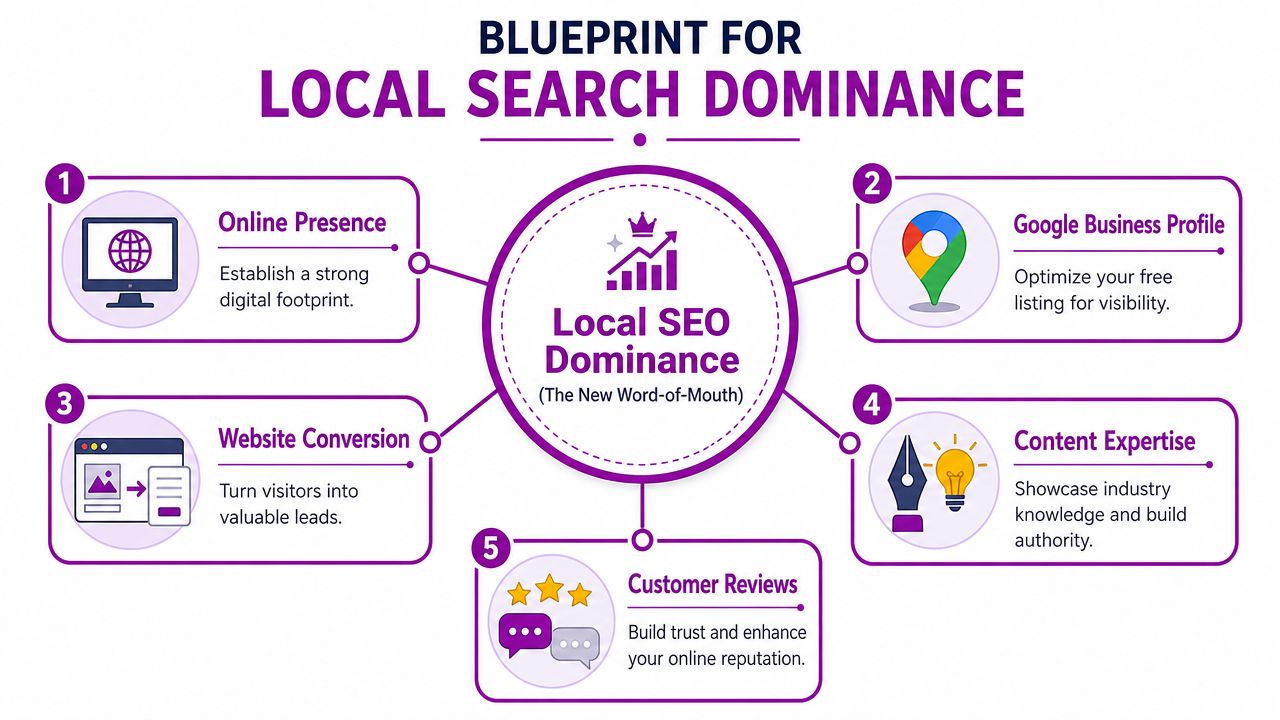
Your Blueprint for Dominating Local Search
The opportunity is already there. The UK bathroom market is large enough to support strong local search demand, with the UK bathroom hardware market generating over £20 billion in 2024, according to Statista's UK bathroom market analysis. That matters because people don't just browse for inspiration anymore. They search for installers, compare firms fast, and decide quickly based on who looks established.
A bathroom fitting business that relies only on word-of-mouth is leaving too much to chance. Referrals still matter, but referrals are uneven. Search gives you a second channel that works every day, including when no previous customer is actively recommending you.
Think of local SEO as a digital showroom that stays open 24/7. Your Google Business Profile acts like your shopfront. Your website acts like your sales rep. Your reviews act like personal recommendations at scale.
The three signals that shape local visibility
Google tends to reward local businesses that send the clearest signals in three areas:
- Relevance means your business description, services, categories, and website content match what the customer searched for.
- Distance means your location or service area lines up with where the searcher is based.
- Prominence means your business has built stronger trust signals than nearby competitors through reviews, mentions, links, and a credible web presence.
If you fit bathrooms in Leeds, “bathroom fitter” alone isn't enough. Google needs to understand that you offer bathroom fitting services in Leeds, cover nearby areas, show real completed projects, and have enough evidence to trust your business.
Practical rule: If a homeowner can't tell within a few seconds where you work, what you fit, and how to contact you, your SEO and conversion rate will both suffer.
What actually moves the needle
For trade businesses, the basics outperform fancy tactics. A practical local SEO setup looks like this:
- A fully completed Google Business Profile with the right category, service areas, photos, and reviews.
- Location-led service pages on your website for your core towns and cities.
- Proof of work through project galleries, before-and-after images, and customer feedback.
- Consistent business details everywhere your firm is listed online.
- Regular content that answers the questions homeowners already ask before they book.
If you need a benchmark for what to review first, a focused local SEO checklist for service-area businesses helps stop you missing the obvious issues that hold rankings back.
Why this matters commercially
A homeowner searching for a fitter usually isn't looking for entertainment. They want confidence. They want someone local. They want to know you can handle plumbing, finishing, timelines, and the inevitable small issues that come with bathroom work.
That's why local SEO should be treated as a business asset, not a marketing extra. Done properly, it creates a steadier enquiry flow, improves lead quality, and lets you compete beyond personal recommendations alone. For bathroom fitting services, visibility is the new word-of-mouth. The companies that realise that early usually win more of the easy enquiries.
Optimise Your Google Business Profile
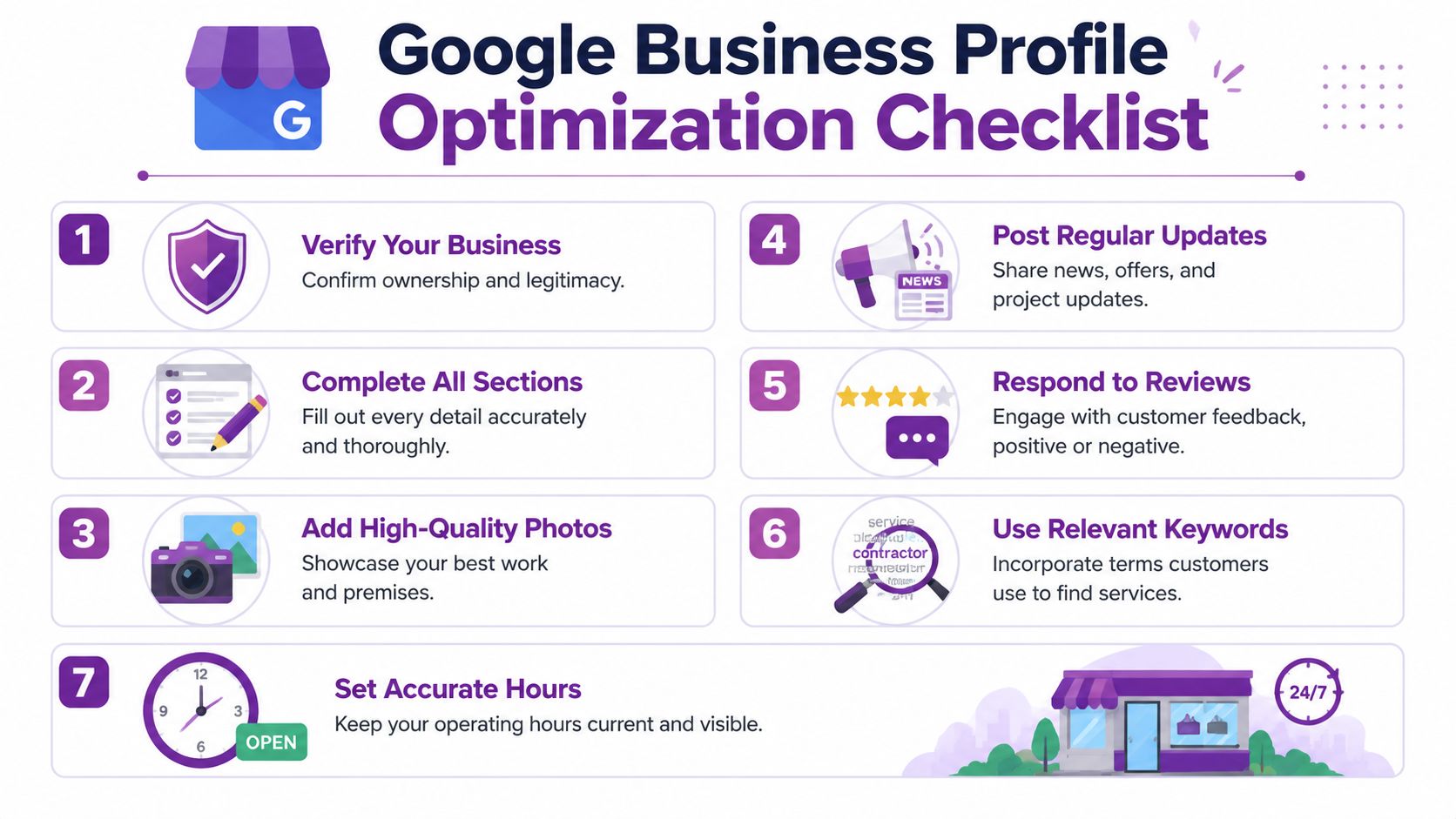
For most bathroom fitters, Google Business Profile is the most effective free marketing tool available. It's often the first thing a homeowner sees before they ever visit your website. If that profile is thin, outdated, or poorly categorised, you'll lose trust before the conversation even starts.
According to the 2025 Houzz UK Bathroom Trends Study, 89 percent of homeowners in the United Kingdom hire professional tradespeople for bathroom renovations, which shows how much demand exists for firms that are easy to discover online, as cited by Builders Squad's summary of the Houzz UK Bathroom Trends Study.
A weak profile wastes that demand. A strong one turns map views into calls.
Set the profile up like a buyer would inspect it
Start with the essentials and do them properly.
| Element | Action Required | Why It Matters |
|---|---|---|
| Business category | Choose the most relevant primary category and supporting service categories | Category choice affects when your profile appears |
| Business description | Write a clear service-led summary using your towns and core services | Helps relevance and sets expectations |
| Phone number | Use the main number you want calls to come through to | Reduces friction for enquiries |
| Service areas | Add the towns and postcodes you genuinely cover | Supports local intent without confusing Google |
| Photos | Upload completed bathrooms, detail shots, vans, team images, and before-and-afters | Visual proof increases trust |
| Reviews | Request reviews consistently and reply to each one | Reviews influence click-through and confidence |
| Opening hours | Keep them accurate, including holiday changes | Avoids missed calls and frustrated users |
A useful way to sense-check your setup is to compare it against a Google Business Profile audit tool for local businesses.
The details that improve lead quality
A profile doesn't need marketing fluff. It needs clarity.
Use a business description that tells people:
- What you do. Bathroom fitting, refits, shower installations, tiling, plumbing coordination.
- Where you do it. Name your real service area.
- Why people choose you. Clean workmanship, project management, accessible bathroom options, premium finishes, or budget-conscious refits, if those are true for your firm.
Photos matter more than many fitters think. Upload polished finished rooms, but also include practical images that reassure buyers you're a real operator. Tiled wet rooms, vanity installs, boxed pipework, shower tray work, and neat finishing all help. Before-and-after sets are especially useful because they communicate value fast.
Customers don't inspect a Google profile like a marketer. They inspect it like someone about to spend serious money on their home.
Keep it active instead of static
Many profiles are claimed once and then ignored. That's a mistake. Add updates regularly through Google Posts. Share a recently completed bathroom, a walk-in shower conversion, or a post on how to prepare for a bathroom refit. These updates help keep the profile alive and give searchers fresh signs that the business is active.
Here's a practical explainer worth watching before you edit your listing:
Reviews deserve a system, not occasional effort. Ask after completion, send the request while the customer is still pleased with the result, and make replying part of admin. Thank positive reviewers specifically. For negative or mixed reviews, stay calm, state the facts, and show that you handle problems professionally.
That last point matters because a good response can rescue trust even when the review itself isn't glowing.
Build a Website That Converts Visitors
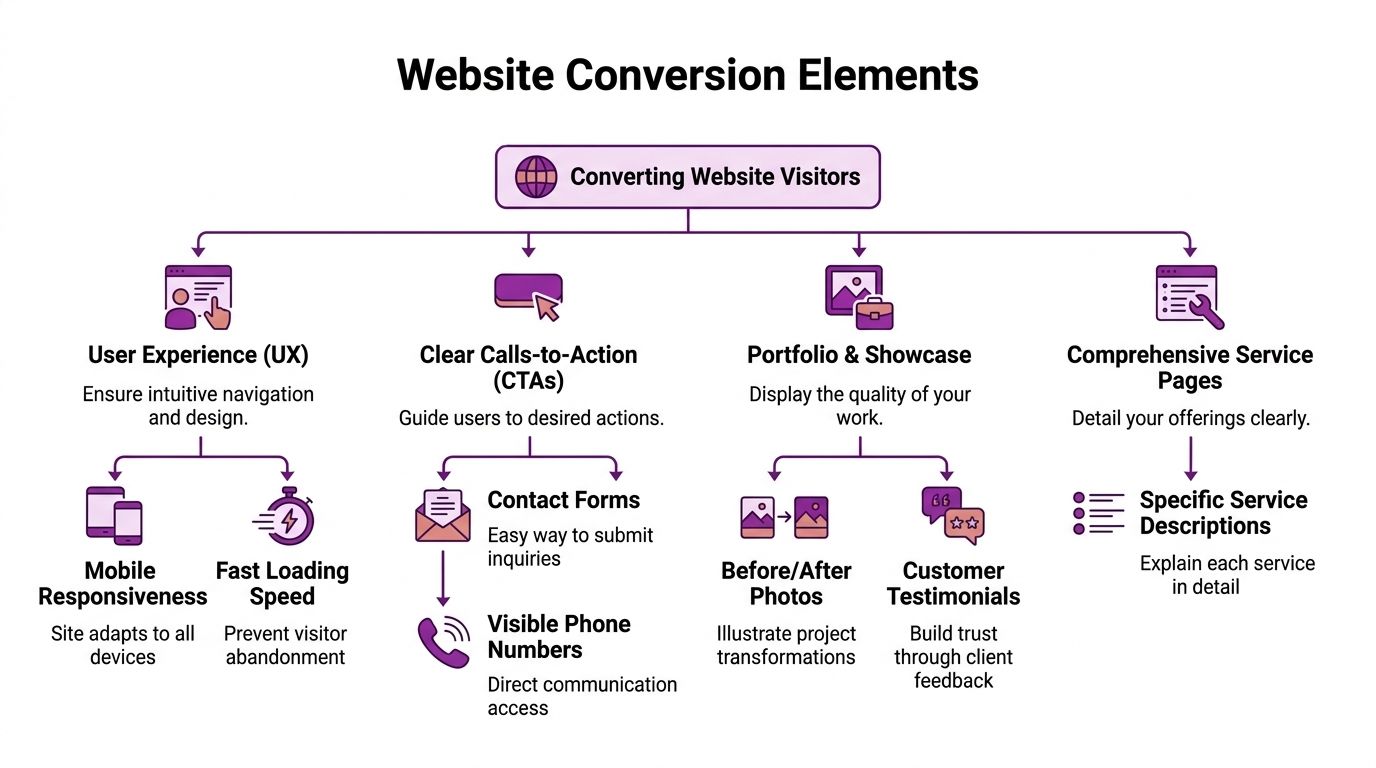
A surprising number of bathroom fitting websites exist only to prove the company exists. That's not enough. Your website has one commercial job. It needs to turn local searchers into phone calls, quote requests, and booked home visits.
The strongest sites for bathroom fitting services don't try to say everything at once. They match a clear search intent with a clear page. If someone searches for bathroom fitting in Nottingham, they should land on a page that speaks directly to Nottingham customers, shows local relevance, and makes the next step obvious.
What a high-converting service page includes
A proper location page usually needs these elements working together:
- A strong headline such as “Professional Bathroom Fitting Services in Manchester” or “Bathroom Installations in Norwich”.
- A visible call to action near the top, such as “Request a Quote” or “Book a Home Survey”.
- Service detail that explains what's included, from strip-out to fitting, finishing, and handover.
- Trust signals such as trade memberships, guarantees, review snippets, and real project photography.
- Location relevance through references to the area, nearby places served, and examples of local jobs if appropriate.
The content has to sound like a fitter speaking to a homeowner, not like an SEO plugin wrote it. The right keywords matter, but they should sit inside useful copy.
Industry reporting has highlighted the relevance of terms such as “bathroom refresh near me” and “affordable bathroom fitting UK” for homeowners improving older housing stock, as discussed in World CopperSmith's bathroom remodelling statistics article. Those phrases shouldn't be stuffed everywhere, but they do belong naturally in headings, body copy, FAQs, and page titles where they fit.
Good structure versus weak structure
A weak page often looks like this:
- one short paragraph
- a stock image
- a generic contact form
- no area detail
- no real proof of work
A stronger page does more. It answers practical objections before the customer asks them.
| Page element | Weak version | Strong version |
|---|---|---|
| Heading | “Welcome to our site” | “Bathroom fitting services in Sheffield” |
| Imagery | Generic showroom image | Real completed installs and before-and-afters |
| CTA | Contact us page link only | Phone number, form, and quote button above the fold |
| Proof | None | Reviews, accreditation badges, and recent local work |
| Relevance | No town references | Town-specific copy and service-area detail |
If you want an example of how a trade business frames a local service page around real installation intent, this guide on hiring bathroom plumbers in Eastbourne is useful for studying page framing, customer concerns, and service presentation.
Don't ignore mobile behaviour
Most homeowners checking fitters are using a phone. They're comparing businesses while commuting, sitting in the kitchen, or standing in the existing bathroom discussing quotes. If your site loads slowly, hides the phone number, or forces people through awkward menus, you'll lose them.
The best bathroom fitting website isn't the one with the most pages. It's the one that removes the fewest excuses to call.
For multi-town targeting, don't clone the same page and swap place names. Build proper pages with unique project examples, service notes, and local context. If your business serves several areas, this broader look at SEO for construction companies is a useful reference for scaling service pages without making them thin or repetitive.
Create Content That Proves Your Expertise
Homeowners rarely wake up and type “hire bathroom fitter” as their first search. They often start with uncertainty. They search for costs, timings, layout ideas, planning worries, waterproofing concerns, or whether their old bathroom really needs a full refit.
That's where content earns its keep. Good content doesn't exist to fill a blog. It answers the questions people ask before they trust someone enough to invite them into the house.

Write around real objections and fears
For bathroom fitting services, the best topics usually sit around five concerns:
Cost uncertainty
“How much does a bathroom refit cost in the UK?” works because customers want a realistic framework before they ask for a quote.Disruption to the home
Articles on timelines, preparation, and what happens during strip-out reduce anxiety.DIY risk
A practical piece on mistakes, rework, and hidden expenses attracts readers who are still deciding whether to do it themselves.Design confusion
Guides on small bathroom layouts, walk-in showers, storage, and finish choices help buyers move forward.Trust in the fitter
Posts on what to ask before hiring a bathroom installer can qualify leads and make your process look more professional.
One especially useful angle is the DIY versus professional comparison. A 2024 UK survey found that 62% of homeowners attempting DIY bathroom fittings face at least £1,200 in unforeseen corrective costs. That's a strong fact to include in a content piece about the hidden cost of getting bathroom work wrong.
Turn site knowledge into assets that rank and sell
A fitter already knows more than the customer. The mistake is keeping that knowledge trapped in the survey visit instead of publishing it.
Useful article ideas include:
- How to budget for a bathroom refit without underestimating finishing costs
- What delays bathroom installations most often
- Should you keep the same layout or move plumbing
- Walk-in shower or bath replacement for older homes
- Key difference between a cosmetic refresh and a full refit
These pieces do two jobs at once. They help you appear for earlier-stage searches, and they pre-sell your professionalism before the first call.
Field insight: The fitter who explains the job clearly usually wins more trust than the fitter who only talks about price.
Publish content people can actually use
Don't write vague inspiration posts that say nothing. Add checklists, examples of what's included in a fitting service, common red flags in old bathrooms, and practical preparation advice. Include original photos where possible.
If your WordPress site is sluggish, content won't perform as well as it should. For practical site performance improvements, it's worth learning from PageSpeed Plus on WordPress speed, especially if image-heavy gallery and blog pages are slowing down mobile users.
For businesses that also work alongside design-led trades, this guide to SEO for interior designers is helpful for thinking about how expertise content can support premium enquiries rather than just traffic.
Become the Go-To Fitter in Your Town
Local authority online works a lot like local reputation offline. If people in your town keep hearing your business name from trusted places, they're more likely to trust you. Google works in a similar way.
That's why off-page SEO matters for bathroom fitting services. Your website can claim you're established. Citations, links, and third-party mentions help prove it.
Start with citation consistency
A citation is any listing of your business name, address, phone number, and website on directories or local platforms. Yell, Thomson Local, Apple Business Connect, Bing Places, and trade-specific directories all matter if the details are consistent.
If your company name is written three different ways, your old landline still appears in one directory, and one listing points to the wrong website page, you weaken trust signals. Clean that up first.
Focus on:
- One business name format used everywhere
- One main phone number for enquiries
- One canonical website URL
- Matching address details across every directory and profile
This work isn't glamorous, but it gives your local SEO a stable base.
Build local endorsements instead of chasing random links
Many fitters hear “link building” and assume it means buying dodgy links from irrelevant websites. That's not what helps a local trade business.
Useful local links usually come from real-world relationships:
- Suppliers and showroom partners who list recommended installers
- Local charities or sports clubs you sponsor
- Chambers of commerce and town business groups
- Property managers, estate agents, and complementary trades
- Local news coverage when your business supports a project or community event
With labour accounting for roughly 40% of a bathroom renovation budget, the value of professional fitting should be framed as an investment in workmanship and long-term results, based on the BMA installer research report. That positioning also helps when building partnerships. Other local businesses are more likely to refer you when your online presence reflects quality rather than bargain-basement messaging.
A trusted local business rarely looks isolated online. It's connected to the places, firms, and communities around it.
Reputation only helps if you can capture the lead
There's a practical problem many fitters miss. Better rankings and stronger authority bring more calls, but missed calls still lose jobs. If your team is on-site all day, your lead handling process matters as much as the ranking gain. For firms reviewing that part of the funnel, this piece on how to improve lead capture for plumbers offers useful ideas that also apply to bathroom installation companies.
If your company serves one main town and surrounding villages, local authority work can be tightly focused. If you're aiming to expand into a broader area, it helps to review what a market-specific campaign looks like in practice through a service example like local SEO support in Peterborough. The principle is the same. Build proof town by town instead of trying to look national.
Measure What Matters to Your Business
A lot of bathroom fitting companies either ignore SEO reporting or drown in numbers that don't affect sales. Neither helps. You don't need a complicated dashboard to understand whether local SEO is working. You need a short list of signals tied to enquiries.
Track the three outcomes that matter most
Start with these:
Google Business Profile actions
Check how many people call, click through to the website, or request directions from your profile.Website enquiry activity
Watch contact form submissions, quote requests, and click-to-call taps from mobile users.Service page performance
Review which location and service pages attract the most engaged traffic and the most enquiries.
If a page gets visits but no contact, the issue might be weak copy, poor calls-to-action, or a mismatch between search intent and page content. If your profile gets views but not calls, the issue is often trust. Thin photos, weak reviews, or unclear service areas are common causes.
Keep the review process simple
Use Google Business Profile insights for map-level activity and Google Analytics for on-site behaviour. Add call tracking or at least make sure every major page has a clickable number. If you run paid ads as well, separate those leads from organic ones so you can see what SEO is bringing in on its own.
A simple monthly review works well:
- Check which pages brought enquiries.
- Check which towns improved or dropped in visibility.
- Check whether new reviews came in.
- Check whether calls were answered promptly.
- Decide the next priority based on that evidence.
Use reporting to make decisions, not to admire charts
Good SEO reporting should lead to action. If your York page is attracting searches but not quote requests, rewrite the opening and improve the project proof. If your Google profile gets strong photo views, upload more of the same type of work. If blog posts about cost and planning keep attracting visitors, add stronger quote prompts to those pages.
That's how SEO becomes commercially useful. It stops being “traffic” and starts becoming a repeatable source of enquiries.
Your Bathroom Fitting SEO Questions Answered
How long does local SEO take to start working
Some improvements can help quickly. A cleaned-up Google Business Profile, better photos, stronger calls-to-action, and corrected citations can all improve enquiry quality in the near term. Broader gains from content, links, and location page expansion usually take longer. Local SEO works best when treated as an ongoing system, not a one-off setup.
Can I do this myself or should I hire an agency
You can do a lot in-house if you're organised. Many fitters can handle review requests, photo uploads, service updates, and basic page improvements themselves. The harder parts are technical SEO, structured local page planning, tracking setup, and authority building at scale.
A good rule is this. If you have time, discipline, and someone who can own the process monthly, do the basics in-house. If the work keeps slipping behind jobs on site, outside help usually makes sense.
What should I prioritise first
Start with what directly affects leads:
- your Google Business Profile
- your service and location pages
- your review system
- your phone and form visibility
- your project photography
After that, add content and authority work. Many businesses try to jump to blogging before fixing weak service pages. That's backwards.
How much should I budget for SEO services
Budget depends on your competition, service area, and how much groundwork is missing. A single-town fitter with a decent website needs a different level of support from a company targeting multiple towns with several service lines. The useful question isn't “what's the cheapest SEO package?” It's “what work will increase qualified enquiries and can we measure it?”
Should I build pages for every town I cover
Yes, if you can make them useful and distinct. No, if the plan is to duplicate the same page and swap the place name. Thin location pages rarely help for long. Strong ones include relevant service detail, local proof, and a reason for that page to exist.
What content brings the best leads
The content that answers buying questions. Cost guides, planning advice, timelines, layout decisions, renovation mistakes, and service comparisons usually outperform generic trend pieces. Homeowners looking for practical answers are closer to booking than people browsing pictures with no clear intent.
Bare Digital helps UK service businesses turn local search visibility into real enquiries, calls, and sales. If your bathroom fitting company needs stronger Google Maps rankings, better location pages, or a clearer SEO plan tied to leads rather than vanity metrics, take a look at Bare Digital.