

You’ve probably done this already. You search for your own service, add your town name, and see a map full of competitors. They’ve got photos, reviews, opening hours, and a button that lets people call them in seconds. Your business might have a decent website and solid word of mouth, but in local search you’re either missing, half-listed, or showing the wrong details.
That’s where a business listing for free stops being a nice extra and starts being basic infrastructure.
For most UK businesses, the problem isn’t access. Google Business Profile, Bing Places, Yelp, Yell, FreeIndex, and other directories let you create a presence without paying for ads. The core problem is that owners rush in, create profiles one by one, and end up with conflicting names, phone numbers, categories, and addresses scattered across the web. That confusion hurts visibility and trust at the same time.
If you want free listings to generate real local enquiries, the order matters. Get your business data straight first. Then claim the platforms that matter most. Then optimise the profiles people see. That’s what works.
Why Free Listings Are a Local Business Superpower
A free listing gives you something your website often can’t get on its own. It puts your business directly inside the map results, where customers are already deciding who to contact.
In the UK, 46% of all Google searches have local intent, using terms like “near me” or specific postcodes, and the top 3 Google Maps results capture 42% of clicks for service-based queries, according to SQ Magazine’s local listing statistics. If you run a catering company, funeral home, architecture practice, care service, venue, or trade business, that matters more than most owners realise. A good website helps. A visible map profile gets the call.
A lot of small businesses still treat free listings as optional because they don’t feel like “real SEO”. That’s the wrong frame. Local SEO starts with proving your business exists, serves a place, and can be trusted. Your listing does that faster than a blog post ever will.
Why these profiles beat passive visibility
A listing is practical. It shows your phone number, route directions, service area, reviews, and imagery without forcing people to click around your site. For local intent, that speed wins.
It also catches buyers at the moment they’re ready to act. Someone searching for a photographer in Cambridge or a roofer in Leeds usually isn’t browsing for fun. They’re comparing options and choosing one.
Practical rule: If your business relies on local demand, your map visibility usually affects lead flow before your homepage copy does.
That’s why free profiles are such a strong starting point. They compress trust into a small space and remove friction from the enquiry path.
Why “free” doesn’t mean low value
The cost is zero. The value isn’t.
Businesses often spend heavily on websites, paid social, or print, then ignore the profiles that show up first when someone searches their brand or service. That creates a strange gap. You’re paying to generate awareness while neglecting the place people verify you.
If you want to estimate how local visibility changes commercial results, tools like this SEO ROI calculator for self-storage and local lead generation help frame the opportunity properly. The point isn’t the niche. It’s the mindset. Visibility in search only matters when it turns into calls, form fills, visits, and booked work.
Your Pre-Listing Blueprint for Success
Most listing problems start before a profile is ever created.
A business owner opens Google Business Profile, types the company name from memory, abbreviates the address, uses one phone number there and another on Facebook, then copies a shorter version into Yell later. Each choice feels minor. Together they create a messy citation trail that search engines and customers both struggle to trust.
The fix is simple. Build one single source of truth before you touch any platform.
Lock your core business data first
Create a basic document. A shared note, spreadsheet, or internal SOP is enough. What matters is that everyone in the business uses the same version every time.
Include these fields:
- Business name: Use your real trading name only. Decide whether it includes “Ltd” or “Limited”, then keep that exact version everywhere.
- Address format: Pick one version of the address, including unit numbers, road abbreviations, and postcode formatting.
- Primary phone number: Choose the number you want customers to call. Don’t switch between mobile, landline, and tracking numbers across listings.
- Website URL: Use one preferred version of your site URL and stick to it.
- Opening hours: Standard hours, seasonal changes, and bank holiday process.
- Service areas: Useful if you travel to customers rather than serving only from a storefront.
If you’ve got multiple branches, this matters even more. Each location needs its own clean record.
The businesses that get this right early avoid months of cleanup later.
Prepare the assets people skip
A complete profile doesn’t happen by accident. It comes from having the right materials ready before you start submitting.
Gather these next:
Primary business category
Be accurate, not ambitious. A funeral director shouldn’t choose a broad category just because it feels bigger. A wedding venue shouldn’t pretend to be an event planner unless that’s a real core service.Secondary categories
Add only what genuinely fits. These help clarify your offer, but stuffing irrelevant categories muddies the signal.Business description
Write one clean paragraph in plain English. Say what you do, where you do it, and who you help. Avoid hype and keyword stuffing.Photos
Prepare a starter set that includes exterior, interior, team, work examples, vehicles if relevant, and branding. Real images outperform generic stock because they reduce doubt.Logo and cover image
Keep branding consistent, but don’t obsess over graphic polish at the expense of real-world photos.Proof of legitimacy
Depending on platform and verification, you may need access to business email, phone, or post at the listed address.
Decide what must stay identical and what can adapt
Not every field has to be word-for-word identical across every directory. Your NAP details do. Your short description can be adapted slightly for platform fit, but the facts must remain aligned.
A practical way to stay organised is to create two sections in your blueprint:
| Field type | Rule |
|---|---|
| NAP details | Must stay identical everywhere |
| Business description | Can be adapted, but facts must match |
| Categories | Should align closely with the same core service |
| Images | Can vary by platform |
| Opening hours | Must match current reality |
If you want a broader prep framework before publishing any listings, a structured local SEO checklist for UK businesses is useful because it forces you to catch data issues before they spread.
Claiming Your Primary Digital Storefronts
A lot of free listings fail at this stage. The business owner starts creating profiles one by one, tweaks the wording as they go, and ends up with three versions of the same company online. Google sees one phone number, Bing sees another, Yelp has an old postcode, and trust starts to erode before the profile has done any useful work.
That is why claiming your main profiles needs a set order. For most UK small businesses, start with Google Business Profile, then Bing Places, then Yelp. These are the storefronts that influence branded search results, map visibility, and how other directories pick up your details. Get these right first, and the rest of your citation work becomes much easier.
Google Business Profile comes first
If there is only time to claim one profile properly this week, make it Google Business Profile. For many UK businesses, it has the biggest effect on local visibility and it is usually the first place a customer checks before calling.
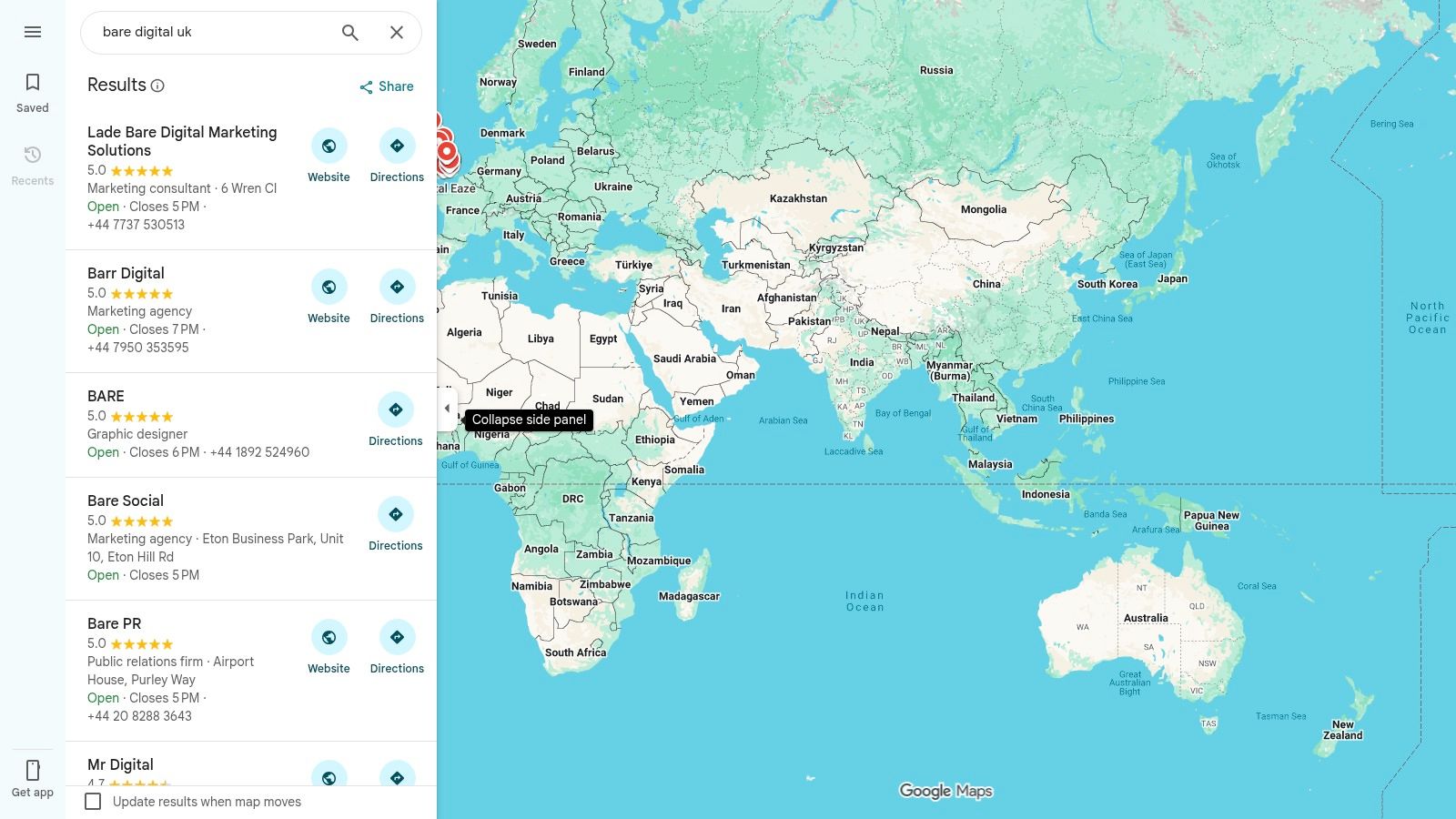
Search your business name in Google Maps before creating anything. If Google has already generated a profile, claim that listing. If you create a second one by accident, you give yourself a duplicate problem that can take longer to sort out than the original setup.
Use your blueprint exactly as written, especially for the fields that feed trust and local relevance:
- Business name: Use your real trading name. Leave service keywords out of it.
- Primary category: Pick the closest match to your main service. This helps Google understand what searches you should appear for.
- Address or service area: Set this based on how you trade. A shop, office, and mobile service business should not be configured the same way.
- Phone number and website: Match your master record exactly.
- Opening hours: Add current hours from day one. Missing or wrong hours create doubt fast.
Owners often rush past the basics because features like posts, messaging, and products feel more interesting. The basics matter more. A complete but inconsistent profile causes more problems than a simple, accurate one.
If you want to check what is missing before you make changes, use a Google Business Profile audit tool to spot weak fields and obvious setup issues.
Verification is usually where mistakes happen
Claiming the profile is only part of the job. Verification is the point where many businesses get stuck because the operational details are not in order. The email is controlled by a former staff member. The phone line goes unanswered. The listed address is in a shared office where post goes missing.
Google may verify by postcard, phone, email, video, or Search Console access. Methods vary, and they can change during the process. What matters is keeping the record stable while Google reviews it.
A few habits prevent most problems:
- Check the account every day for prompts or follow-up requests.
- Avoid changing core details mid-verification unless something is wrong.
- Make sure mail can reach the listed address if postcard verification is offered.
- Do not create another listing out of frustration if the first one is pending.
In practice, verification issues usually come back to poor preparation rather than a platform fault.
Bing Places is an easy win
Bing Places gets less attention, but I still recommend claiming it early. It gives you another authoritative citation, another branded result you control, and another place to keep your core details aligned.
The process is straightforward. Search for the business first. Claim an existing profile if one is already live. Create a new one only if nothing appears. Then copy over your exact master details, including formatting. If Google says your business closes at 17:00 and Bing says 17:30, customers notice and platforms can too.
For some firms, Bing traffic is modest. That is not the only reason to claim it. The bigger value is consistency. Free listings work best when your core business data repeats cleanly across trusted platforms.
Yelp matters for brand control
Yelp is rarely the top lead source for a UK SME, but it still deserves a claim. Unclaimed Yelp pages can rank for your business name, pull in outdated information, and create confusion if someone is checking whether you are legitimate.
Treat Yelp as a control point. Claim the page, correct the core details, add a solid description and real photos, then monitor it. That is usually enough for most local businesses. The goal here is not to spend hours polishing a profile that brings little direct revenue. The goal is to stop bad data from circulating.
It also helps to keep your wider online presence tidy. If you are cleaning up trust signals beyond directory listings, this guide on how to build your social media presence effectively is useful because social profiles often support branded searches and customer checks.
A quick walkthrough can help if you prefer seeing the process visually before editing live:
A sensible claiming order
Do these in stages, not all at once. Accuracy drops when owners try to blast through ten directories in one evening.
Use this order:
- Google Business Profile
- Bing Places
- Yelp
- Major UK directories
- Relevant industry directories
That order gives you the strongest mix of visibility, control, and data consistency. It also reduces the main reason free listings underperform for UK businesses. Inconsistent business data spread across too many platforms, too early.
Optimising Listings to Attract and Convert Customers
A claimed profile is only the shell. The businesses that get enquiries from free listings don’t stop at verification. They turn the profile into a useful sales asset.
That means adding enough detail for search engines to understand the business and enough proof for customers to trust it. Both matter. Ranking without trust wastes clicks. Trust without visibility never gets seen.
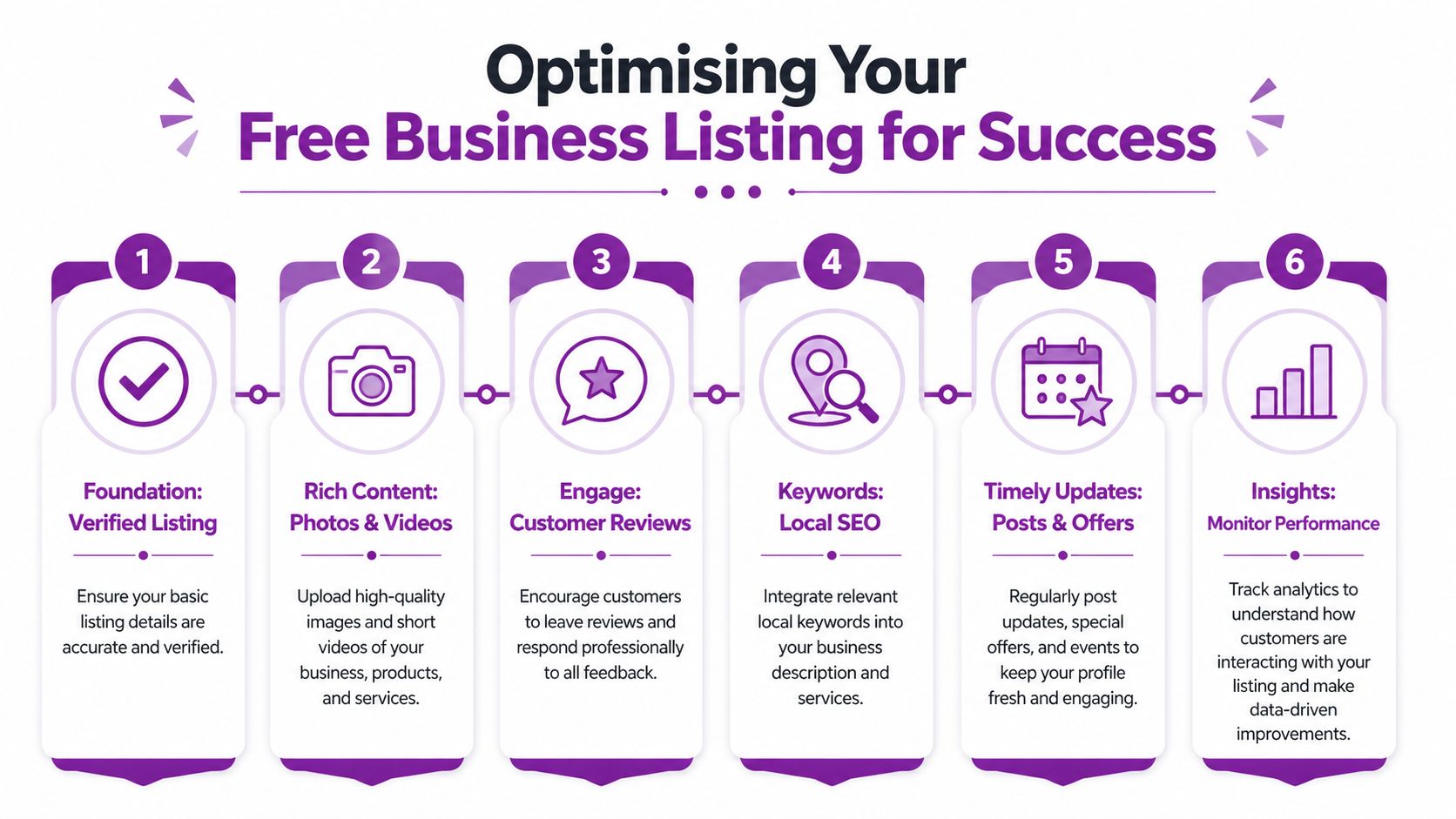
According to Moore Tech Solutions’ free listings guide, UK businesses with complete and optimised free listings see a 35% increase in organic traffic from local searches. The same source states that 76% of high-intent “near me” searches convert to enquiries when the listing features compelling photos and positive reviews, and those features increase click-through rates by 18% compared with basic profiles.
Add the details buyers actually use
A profile should answer the practical questions a prospect has before they make contact.
That usually means:
- Services: List them clearly. Don’t leave people guessing whether you handle the thing they need.
- Products or menus where relevant: Especially useful for hospitality, retail, and venue businesses.
- Attributes: Accessibility, appointment options, payment types, or service specifics where available.
- Business description: Keep it readable and local. Mention the towns or areas you serve.
If keyword research feels vague, this resource on scaling local SEO keyword discovery is worth reading because it helps turn generic service terms into place-based search language people use.
Photos do more work than most owners expect
Photos aren’t decoration. They reduce uncertainty.
For a venue, they show quality and atmosphere. For a trade business, they show workmanship and branded vans. For a care service, they show professionalism. For a funeral home, they show calm, trust, and presentation. Buyers use images to decide whether your business feels established.
Use a mix:
| Photo type | What it proves |
|---|---|
| Exterior | You’re easy to find |
| Interior | The space is real and presentable |
| Team | There are real people behind the brand |
| Work examples | You can deliver the service |
| Brand assets | The business looks established |
Reviews need a process, not a burst
Most businesses ask for reviews only when they remember. That creates long gaps followed by awkward scrambles. A better approach is to build review requests into your workflow.
Ask after a successful delivery, completed project, appointment, or handover. Keep the request short and personal. Don’t over-script it. Then respond to every review you get, including mixed ones.
Reviews influence two decisions at once. Whether someone clicks your listing, and whether they trust you when they land there.
Good responses also show you’re active. That matters more than many owners realise. A profile full of stale information and unanswered reviews looks abandoned, even if the business itself is excellent.
Use ongoing activity to show the profile is alive
Google Posts, updates, offers, event notices, and Q&A management aren’t glamorous, but they help the profile feel current.
You don’t need to publish constantly. You do need to avoid leaving the profile static for months at a time.
A steady optimisation rhythm looks like this:
- Monthly photo uploads
- Regular review requests
- Responses to all new reviews
- Service list checks after any business change
- Occasional posts for updates, offers, or recent work
- Q&A monitoring so wrong answers don’t sit there
If you want to track whether that effort is translating into visibility and interaction, a focused GBP reporting view for local performance gives you a cleaner way to assess what’s changing over time.
Avoiding the Common Pitfalls That Invalidate Your Efforts
A business owner updates their opening hours on Google, leaves the old hours on Yell, forgets an old mobile number on a directory created years ago, and then wonders why calls dip. I see this pattern constantly. Free listings usually fail because the business details do not match closely enough across the web.
That inconsistency does two kinds of damage. Search platforms get weaker trust signals, and potential customers hesitate because the business feels disorganised before they even make contact.

The silent damage of near-matching data
Near-matching details are often a significant problem. Owners usually spot the obvious mistakes. The harder issues are the small differences that look harmless but create doubt across directories, maps, and your own site.
Common examples include:
- Business name variations: “Smith & Co Ltd” in one place and “Smith and Company Limited” elsewhere
- Different phone numbers: a landline on one profile, a mobile on another
- Address wording changes: “Suite 4” on one listing and “Unit 4” on another
- Old call tracking numbers: still live on forgotten citations
- Previous premises: old addresses still indexed after a move
One mismatch rarely ruins performance on its own. Ten or fifteen weak signals across UK directories often do.
The mistakes that waste otherwise good listings
Bad results are not always caused by missing profiles. More often, they come from poor judgement during setup or a lack of control after the listing goes live.
I regularly see these issues hold businesses back:
- Keyword-stuffed business names: adding towns or services to the title creates inconsistency and can trigger platform problems
- Wrong categories: broad categories weaken relevance and make the listing less likely to appear for the right searches
- Duplicate profiles: creating a fresh listing instead of claiming the existing one splits trust and confuses customers
- Outdated hours: bank holiday and seasonal changes matter more than many owners expect
- Mismatch between listing and website: if your site says one thing and your directory profiles say another, trust drops fast
This is why preparation matters more than volume. A tidy set of accurate listings will beat a messy spread across dozens of sites.
A practical way to keep listings clean
Use one master record for your business details. Keep the exact business name, primary phone number, address format, website URL, and opening hours in one document. Every new listing should be copied from that record, not typed from memory.
Then check for drift whenever something changes. New phone system, updated trading hours, service expansion, rebrand, office move. Each one needs a full pass across your main profiles and top citations.
For local firms that want expert help cleaning up inconsistent signals before they spread, our Cambridge local SEO service for small businesses is built around that kind of citation control.
Treat free listings as an accuracy job first and a visibility job second. That order is what gets results.
High-Value Free Business Directories for UK Businesses
Once your core platforms are live and consistent, expand carefully. Don’t chase volume for its own sake. A shortlist of respected directories is more useful than spraying your details across dozens of weak sites.
For UK businesses, the best directories are the ones that support discoverability, reinforce your NAP data, and give your brand another trusted footprint. Many generic articles go wrong on this point. They recommend broad global sites and ignore the UK-specific platforms that show up in local research and citation work.
The list below is a practical toolkit, not a vanity exercise.
Top-Tier Free UK Business Directories
| Directory | Domain Authority (DA) | Notes |
|---|---|---|
| Google Business Profile | 98 | The main local visibility asset for search and maps |
| Bing Places | 94 | Strong supporting citation and branded search control |
| Yell | 71 | Established UK directory with strong local recognition |
| FreeIndex | Not provided in verified data | Useful UK-specific directory with broad business coverage |
| Thomson Local | Not provided in verified data | Longstanding UK citation source worth claiming |
| 192.com | Not provided in verified data | Useful for reinforcing business identity and location signals |
A few rules make this stage work better:
- Prioritise authority over quantity: Focus on the platforms above before adding niche sites.
- Submit only after your blueprint is fixed: Don’t use directories as a testing ground.
- Keep records of every login and live URL: This saves pain later when details change.
- Revisit your top profiles periodically: Citations decay when businesses move, rebrand, or change numbers.
For businesses serving a specific town or region, local SEO gets stronger when your directory work aligns with the area pages and location strategy on your site, making a focused regional approach, such as SEO services in Cambridge for local visibility growth, more useful than broad national messaging.
If your listings are inconsistent, incomplete, or barely visible, Bare Digital can help you clean up the foundation and turn local search visibility into real enquiries. Their team specialises in UK local SEO, Google Business Profile optimisation, and postcode-focused growth for businesses that need calls, leads, and booked work rather than vanity rankings.






