

Think of your business website as a high-performance car. Content is the high-octane fuel that powers it, while SEO is the finely tuned engine that drives you directly to your customers. They aren't separate tasks on a checklist; they are two halves of a single strategy for getting found online and growing your business.
How Content and SEO Work Together for Your Business

Many UK business owners treat content and SEO as separate jobs, writing a blog post here and tweaking a keyword there. But this disjointed approach rarely delivers the results you're looking for. The real power is unlocked when you see them as a single, symbiotic function—one simply cannot succeed without the other.
To really get how content fuels your online visibility, it helps to grasp the fundamental principles of SEO. SEO essentially provides the framework—the rules of the road—that tells search engines like Google what your content is about and why it deserves to be shown to potential customers.
To make this clearer, let's quickly break down their individual roles before we dive deeper into how they combine.
Content and SEO At a Glance
This table gives a quick summary clarifying the distinct role each element plays while highlighting their shared goal.
| Element | Primary Role | Key Objective |
|---|---|---|
| Content | To inform, engage, and solve problems for your target audience. | To provide the substance that demonstrates your expertise and answers customer questions. |
| SEO | To structure and signal the relevance of your content to search engines. | To ensure your valuable content gets discovered by the right people at the right time. |
Ultimately, both work together to achieve the same thing: connecting your business with customers who are actively searching for what you offer.
Content as Fuel and SEO as the Engine
Imagine you’ve written the most insightful, helpful article about "conservatory installation in Surrey." This is your fuel. Without SEO, that brilliant article is like premium petrol sitting in a can—full of potential but going absolutely nowhere.
SEO is the engine that puts that fuel to work. It involves:
- Keyword Research: Finding the exact phrases your ideal customers are typing into Google.
- On-Page Optimisation: Structuring your content with clear headings, titles, and descriptions so Google can understand it.
- Technical Health: Ensuring your website is fast, mobile-friendly, and easy for search engines to crawl.
When you pair powerful content with smart SEO, your website transforms from a parked vehicle into a lead-generating machine.
Content gives search engines something to rank, while SEO helps them rank it. You need both to win in today's crowded digital marketplace. Every piece of content you create is an opportunity to prove your relevance and authority to Google.
The UK Context for Content and SEO
This partnership is especially critical for local businesses. In the UK, a staggering 65% of marketing professionals actively use content marketing in their strategies. What's more, blogs are used by 60% of these marketers, with email newsletters right alongside at 61%.
These numbers show just how essential quality content has become for local SEO, particularly for small and medium-sized businesses trying to show up in those all-important 'near me' searches. Without a solid content and SEO strategy, you risk becoming completely invisible to your local audience.
Winning Local Search With the Right Content
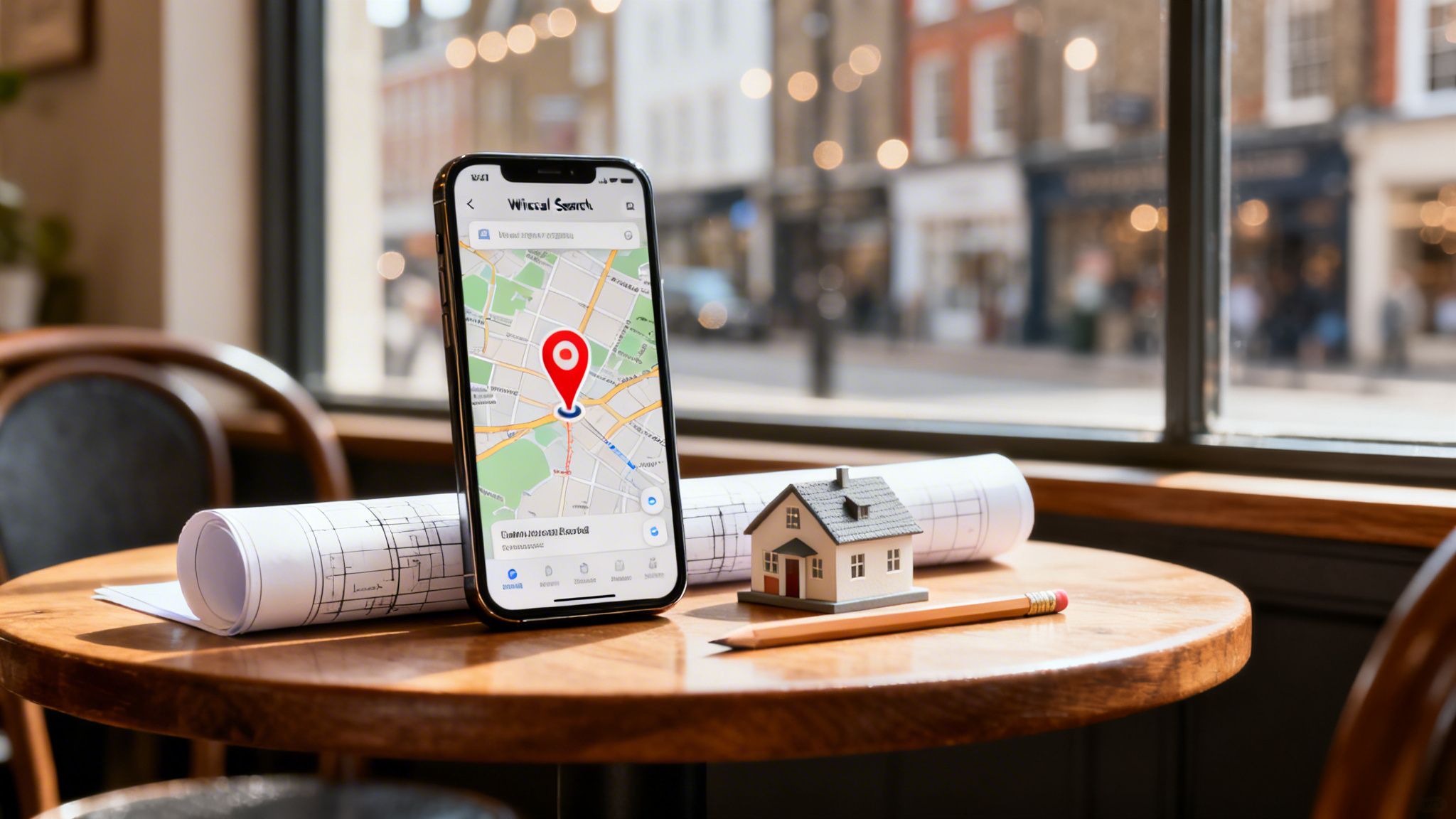
Ever wonder why one local business constantly pops up on Google Maps, while another, just down the road, is practically invisible? The difference isn't luck. It almost always comes down to one thing: targeted, location-specific content. This is where a smart content and SEO strategy becomes your best tool for local discovery.
Put yourself in Google's shoes for a moment. Its one job is to give the searcher the most relevant, trustworthy answer possible. So when someone types in "best home extension architect in Cheshire," Google goes on a mission, scouring the web for proof that a business isn't just a great architect, but is also genuinely connected to Cheshire.
This is where your content does all the talking. Simply scattering a few keywords on a service page just won't cut it anymore. You need to build a rock-solid case that your business is the go-to local authority.
The Tale of a Talented—But Invisible—Architect
Let's picture a skilled architect based in Chester. Their website is full of beautiful project photos, but it brings in very few local leads because the content is far too generic. It talks about "architectural services" without ever mentioning Chester, Cheshire, or the surrounding towns where they actually work.
Because of this, Google has no clear evidence to show their profile to a homeowner hunting for local expertise. They are, for all intents and purposes, a ghost in their own backyard.
To turn things around, the architect overhauls their content with a sharp focus on local SEO:
- Hyper-local Service Pages: Instead of a single, generic page, they create dedicated pages for services like "Home Extensions in Chester," "Listed Building Consent on the Wirral," and "New Builds in North Wales."
- Project Case Studies: They start publishing detailed case studies on completed work, such as "A Victorian Terrace Extension in Hoole, Chester," making sure to include geotagged images.
- Community-Focused Blog Posts: They launch a blog that answers local questions like, "How to Navigate Cheshire West and Chester Planning Permission," which shows off their deep local knowledge.
This laser-focused content gives Google exactly the proof it needs. Every page and post acts as another strong signal, verifying the architect’s relevance and authority within a specific geographic patch. The results soon follow.
Your content's job is to build a web of local relevance so strong that Google has no choice but to see you as the most credible answer for nearby customers. It’s about creating tangible proof that you understand and serve a specific community.
Investing in Local Dominance
As our architect's story shows, the right content and SEO strategy is a direct investment in owning your local market. It’s precisely why UK SEO budgets are bouncing back, with 61% of marketers planning to increase their spend. This revival is tied directly to the need for content that satisfies postcode-specific searches, an absolutely vital area for trades and local service businesses.
By consistently creating and publishing content that speaks directly to your local audience, you stop being just another option and start becoming the only logical choice. You can find more practical, actionable steps in our comprehensive local SEO checklist. This is how you win local search and turn that hard-earned visibility into real, paying customers.
Choosing Content Types That Attract Local Customers

Alright, you get why local content is a big deal. The real question is, what on earth should you actually create? It’s time to move from theory to action and look at the specific types of content that consistently pull in local customers and prove your relevance to Google. This isn't generic advice; it's a practical toolkit for UK businesses.
The aim is to build more than just a homepage. You need a collection of digital assets that serve different local needs. Think of every piece of content you create as a new digital doorway to your business, each one designed to welcome a specific customer searching for a solution right in your neighbourhood.
This means you have to think about all the different ways a potential customer might look for you. Some people know exactly what they need. Others are just starting their research. Your content needs to be there for both.
Core Content Types for Local SEO
To build a rock-solid foundation, every local business should start with a few essential content formats. These are proven to work because they tick all the boxes for both local searchers and Google: relevance, expertise, and proof that you operate in a specific patch.
Hyper-Local Service Pages: These are the absolute backbone of your local SEO strategy. Instead of one broad "Services" page, you need dedicated pages for each core service you offer in a particular town or county. A Manchester construction firm, for instance, should have separate pages for "Loft Conversions Manchester," "Kitchen Extensions Didsbury," and "New Build Homes Cheshire." This is how you start ranking for the super-specific, high-value searches that bring in real work.
Project Case Studies and Galleries: Words tell, but visuals sell. There’s no substitute. Detailed case studies that show off your finished work provide incredible social proof and are a goldmine for content and SEO. A portfolio page titled "Edwardian House Renovation in Leeds," packed with high-quality, geotagged photos, sends an undeniable signal to Google about where you work. For creative pros, our guide on SEO for photographers has more in-depth tips on making visual work shine online.
Community-Focused Blog Posts: Your blog is where you stop selling and start helping. It’s your best tool for building trust and proving you’re the local authority. A law firm in Bristol could write a guide on "Understanding the Conveyancing Process in Bristol." A local caterer could create a post about the "Top Wedding Venues in the Cotswolds." This kind of content catches people early in their journey and positions you as the go-to expert in the area.
Matching Content to Customer Intent
Let's be realistic: not every visitor is ready to whip out their credit card. Your content strategy has to reflect this by targeting different stages of the customer journey. By creating the right mix, you make sure your business is visible at every single step.
Think of your content like a conversation with your community. Some pieces are for introducing yourself and offering help (blog posts), while others are for closing the deal (service pages and case studies). A healthy content and SEO plan includes both.
To see how this works in practice, look at how different formats serve completely different needs.
| Content Format | Primary Goal | Target Audience Example |
|---|---|---|
| Local Service Pages | Capture immediate leads and enquiries. | A homeowner desperately searching for an "emergency plumber near me" in Cardiff. |
| Case Studies | Build trust and showcase your quality. | A couple looking for the "best wedding caterer in Kent" and wanting to see your previous events. |
| Helpful Blog Posts | Attract and educate potential customers. | A new business owner researching "how to register a business in Scotland." |
When you diversify your content like this, you create a powerful web of local relevance. Each page, post, and project you publish reinforces your geographic focus and expertise, making it a no-brainer for Google to connect you with the right local customers when they need you. This is what a smart content and SEO strategy really looks like.
Finding the Right Keywords for Your Customers
Great content starts with knowing the exact words and phrases your customers are punching into Google. Think of keywords as the digital signposts that guide people right to your front door. Getting this part right, a process we call keyword research, is the rock-solid foundation of any content and SEO plan.
It’s all about getting inside your customer’s head and understanding the specific language they use when they need you. Without this insight, you’re just shooting in the dark. You might be busy creating content about "roofing services," but your ideal customer, with rain dripping into their living room, is frantically searching for an "emergency roof repair in Bristol."
The language is similar, but the intent behind it is worlds apart. The goal is to get beyond those broad, hyper-competitive terms and zero in on the phrases that signal a real, urgent need in your service area.
Understanding the Three Types of Local Keywords
To build a content plan that actually works, you need to target keywords that capture people at every stage of their journey—not just when they’re ready to pull out their wallet. We can break these down into three main groups, each with a different purpose and needing a different kind of content.
Informational Keywords: These are used by people who are still in the research phase. They aren't ready to buy; they’re looking for answers, advice, or ideas. Answering these questions with genuinely helpful guides establishes your business as the go-to local expert.
Commercial (or Transactional) Keywords: This is where the money is. These keywords show someone is ready to hire or buy. They've done their homework and are now looking for a specific local business to solve their problem. These high-intent phrases are perfect for your main service pages.
Navigational (or Brand) Keywords: These are searches for your specific business name. While you should rank for your own name anyway, making sure your homepage and Google Business Profile are perfectly optimised creates a slick, professional experience for returning customers or people who’ve been referred to you. It's crucial to know how your profile is performing; you can get a fast snapshot by running a quick Google Business Profile audit.
By creating a mix of content that targets all three types, you build a strategy that attracts and nurtures customers from their first question to their final purchase.
Mapping Keywords to Your Content
Once you’ve found your target keywords, the next job is to map them to the right pages on your site. This simple step ensures every piece of content has one clear job to do and is perfectly optimised to rank for the most valuable searches.
Think of keyword mapping as giving each page on your website a specific job. Your service page's job is to capture leads for "loft conversions in Leeds," while your blog's job is to help people researching "loft conversion planning permission costs." Each page has a clear, focused mission.
This organised approach stops your pages from fighting each other for attention in Google and makes your whole website much easier for both visitors and search engines to get their heads around.
To make this crystal clear, here’s a table showing how different local keywords map to different types of content and stages of the customer journey.
Keyword Intent Mapping for Local Businesses
| Keyword Type | Example | User Intent | Best Content Type |
|---|---|---|---|
| Informational | "how to choose a wedding photographer" | The user is learning and gathering ideas. | Blog Post or Guide |
| Commercial | "wedding photographer in the Cotswolds" | The user is ready to compare options and book. | Service Page or Location Page |
| Navigational | "Bare Digital SEO" | The user is looking specifically for your business. | Homepage or About Page |
This simple mapping process is the key to creating a website that guides users seamlessly from one stage to the next, building trust and authority along the way.
Weaving Keywords into Your Content Naturally
The days of "keyword stuffing"—awkwardly jamming a phrase into a page over and over again—are well and truly over. Thankfully. Modern SEO is all about writing high-quality, readable content that naturally includes your target keywords and related terms.
Your first and only priority should be writing for your human audience. A good rule of thumb is to make sure your main keyword shows up in a few key places:
- The page title (Title Tag)
- The main H1 heading
- Within the first 100 words of your introduction
- In at least one subheading (H2 or H3)
After that, just let it appear naturally as you write. Google is more than smart enough to understand synonyms and related concepts. So, feel free to use variations like "emergency plumber," "24-hour call-out," and "leaking pipe repair" to add depth and context. The goal is simple: create a piece of content that is genuinely helpful and answers the user's question completely. When you do that, you make both your customers and the search engines happy.
Your Simple Workflow for Creating Optimized Content
Knowing what to write and which keywords to target is a huge head start. But for any busy business owner, that feeling of staring at a blank page can be paralysing. That’s where a repeatable workflow comes in.
A simple, structured process takes all the guesswork out of creating content. It breaks the big job of combining content and SEO into small, manageable steps, making the whole thing feel far less overwhelming. Even a one-person team can use this five-step system to get it right every time.
Step 1: Brainstorm Topics from Real Customer Questions
Forget the complex tools for a moment. Your best content ideas almost always come directly from your customers. Every single question you get asked—whether it's over the phone, in an email, or face-to-face—is a potential topic for a blog post or a service page.
Keep a running list of these questions. If you’re a local architect, for example, questions like “Do I need planning permission for a small extension?” or “How much do architect fees cost in the UK?” are absolute content gold. Answering them shows you know your stuff and directly tackles your customers' real-world concerns.
Step 2: Find and Select Relevant Local Keywords
Once you’ve got a topic, you need to find the actual words your customers are using to look for answers online. Use the methods we’ve already talked about to sniff out both the informational and commercial keywords that relate to your topic.
This simple process flow shows how you move from finding keywords to mapping them to a page and finally, writing the content.
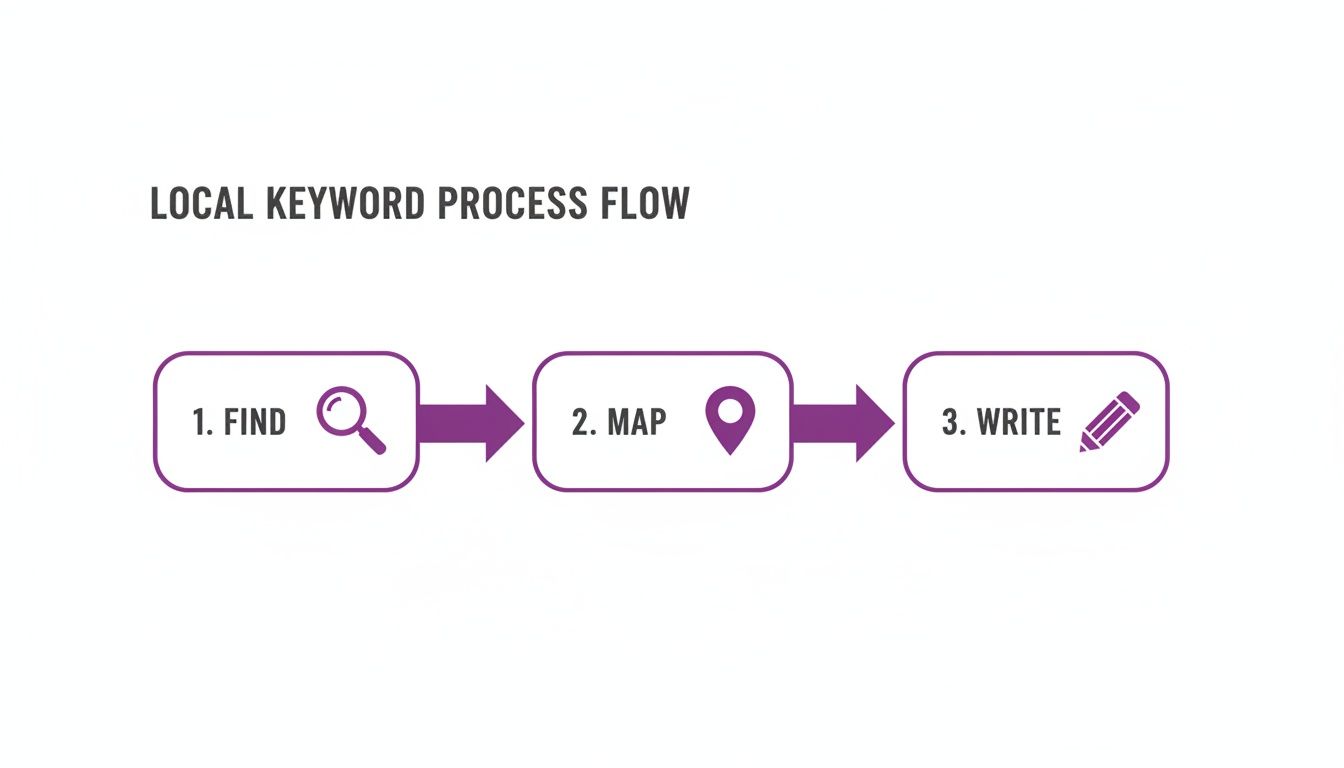
As you can see, this isn't about guesswork. It’s a deliberate journey from discovery to application. For that "planning permission" topic, you might target "do I need planning permission for a loft conversion" (informational) for a blog post, and "planning permission services Cambridge" (commercial) for a dedicated service page.
Step 3: Outline Your Content for a Clear Narrative
Before you write a single sentence, sketch out a quick outline. This is your roadmap, ensuring your content flows logically and hits all the essential points without rambling. Your outline should include:
- Your H1 Title: The main headline of the page.
- A Brief Introduction: Hook the reader and tell them what's in it for them.
- H2/H3 Subheadings: These are your section titles, breaking the topic down.
- A Conclusion: A quick summary of the key takeaways.
This structure doesn't just help your reader; it makes it much easier for search engines to figure out the hierarchy and focus of your page.
Step 4: Write for Readability and Engagement
Right, now it's time to write. But always remember who you're writing for. People scan online content, so your job is to make it as easy to digest as possible. Focus on these simple readability wins:
- Use short paragraphs: Stick to one to three sentences each. No walls of text.
- Vary your sentences: Mix short, punchy statements with longer ones to create a better rhythm.
- Add visuals: Use images, lists, and bold text to break up the page and draw attention to key points.
Your goal is not to sound like an academic paper. It's to be the most helpful, clear, and direct answer to your customer’s question. Write as you would speak to them in person.
Step 5: Perform a Final On-Page SEO Check
Before you hit that "publish" button, run through one last on-page SEO checklist. This final check makes sure all your hard work has the best possible chance of ranking. Quickly confirm that:
- Your main keyword is in your title, H1 heading, and the first paragraph.
- You’ve written a punchy meta description to earn the click from search results.
- Your images have descriptive alt text that tells Google what they're about.
- You’ve linked to a couple of other relevant pages on your own site.
Once it's live, get the word out. Share your new content on your Google Business Profile, send it to your email list, and post it across your social channels. For local businesses, a focused approach like this can deliver powerful results, which is why many companies invest in professional SEO services in Cambridge and other competitive areas. This workflow creates a sustainable system for growth, turning one-off efforts into a reliable engine for your business.
Measuring the ROI of Your Content and SEO
Creating great content is a serious investment of both your time and money. But how do you actually prove it’s working? Measuring the return on investment (ROI) of your content and SEO efforts is the only way to know what’s effective, justify your budget, and make smarter decisions down the line.
It’s all too easy to get distracted by "vanity metrics" like social media likes or a general spike in website visitors. While nice to see, they don’t pay the bills. The real goal is to draw a straight line from your content directly to tangible business outcomes that actually impact your bottom line.
Moving Beyond Vanity Metrics
To get a true picture of your ROI, you have to look past the surface-level numbers and focus on metrics that show genuine customer engagement and business growth. This means tracking how your online visibility translates into real-world leads and sales. A huge part of this is learning how to properly track content performance from day one.
For a local UK business, here are the key metrics that truly matter:
- Organic Traffic Growth: Are more people finding your website through search engines? A steady upward trend in organic traffic is a clear sign your content is starting to rank and pull in the right audience.
- Keyword Ranking Improvements: Are you climbing the search results for your most important local keywords? Watching your position for terms like "architects in Manchester" or "emergency plumber Bristol" shows your SEO is gaining real traction.
- Conversion Rate: What percentage of your website visitors from organic search are taking the action you want them to, like filling out a contact form or calling your business? This metric directly connects your traffic to potential revenue.
Free Tools to Track Your Success
You don't need to shell out for expensive software to start measuring what matters. Google provides two incredibly powerful and completely free tools that every single business owner should be using to see how their content and SEO is performing.
The most valuable data is the data that connects your online presence to your offline success. Your goal is to draw a straight line from a blog post to a new customer enquiry.
Google Search Console (GSC): Think of GSC as your direct line to Google. It shows you exactly which search queries are bringing people to your site, how your pages are performing for those queries, and your average ranking position. It’s the ultimate tool for tracking keyword improvements and spotting new content opportunities.
Google Analytics 4 (GA4): While GSC tells you how people find you, GA4 tells you what they do once they land on your site. You can monitor which pages are most popular, how long visitors stick around, and, most importantly, track specific "conversions" like form submissions or clicks on your phone number.
Connecting Content to Real-World Revenue
For any local business, the most critical measurement is the increase in direct customer actions. This is where your Google Business Profile (GBP) becomes an absolute powerhouse for tracking ROI. Inside your GBP Insights dashboard, you can see hard numbers for:
- Phone Calls: How many customers have clicked the button to call you directly from your profile?
- Direction Requests: How many people have asked for directions to your physical premises?
- Website Clicks: How many users have clicked through to your site from your Maps listing?
By tracking these figures month-on-month, you can directly attribute any increases to the enhanced visibility from your content and SEO work. This provides undeniable proof that your efforts are generating qualified local leads. For businesses in certain sectors, you can go even deeper by using a tool like our self-storage ROI calculator for SEO to forecast potential returns.
Frequently Asked Questions About Content and SEO
Even the most seasoned business owners have questions about how content and SEO really work together. It's a world filled with myths and moving targets, so let's cut through the noise.
We’ve rounded up the most common questions we hear from UK businesses to give you straight, no-nonsense answers. This is your go-to guide for clearing up confusion and moving forward with confidence.
How Long Does It Take for Content and SEO to Show Results?
Think of it like planting a tree, not flipping a switch. While you might spot small bumps in visibility in a few weeks, a proper content and SEO strategy takes time to mature. You should realistically plan for 3 to 6 months to see significant, measurable results like more traffic and leads.
You're building a business asset that grows in value over time. While local SEO can sometimes deliver quicker wins for specific keywords, the real goal is sustainable growth, not some overnight fix.
Do I Need a Blog for My Local Business?
While it’s not technically mandatory, a blog is one of the single most powerful tools in your local SEO toolbox. Your service pages are designed to capture customers who are ready to buy right now, but a blog lets you connect with everyone else who's still in the research phase.
It's your platform to answer customer questions, prove you know your stuff, and target a massive range of "informational" keywords. For instance, a local roofer can write about "winter storm preparation tips for UK homes." This attracts local homeowners long before they need an emergency repair, building trust and positioning the business as the first one they’ll call when they do.
A service page is a sales pitch; a blog post is a helpful conversation. You need both to capture leads at every single stage of the customer journey.
Is It Better to Update Old Content or Write New Posts?
Both. A healthy content strategy absolutely needs a mix of each. Regularly updating your core service pages and older blog posts is a tactic known as a "content refresh." This means adding fresh information, new statistics, or better examples to keep the page current.
This process signals to Google that your site is active and authoritative. Refreshing a page that already has some ranking power can often give you a much faster boost than writing a brand-new article from a standing start. As a rule of thumb, you should aim to review your most important pages at least once a year.
How Many Times Should I Use a Keyword on a Page?
Forget "keyword density." Honestly. This is an old-school, outdated practice that makes your writing sound robotic and can actually hurt your rankings. Modern content and SEO is all about readability and giving the user the best possible answer.
Instead, write for your reader first, not a machine. A good, natural practice is to make sure your main keyword appears in a few key places:
- Your page title (the one that shows up in the Google results)
- Your main H1 heading on the page
- Somewhere within the first 100 words or so
- In at least one subheading (an H2 or H3)
After that, just use it and its synonyms where it feels natural. The real aim is to write the most comprehensive and helpful page on the internet for that topic. Do that, and the keywords will take care of themselves.
Ready to turn your website into a lead-generating machine with a proven content and SEO strategy? The specialists at Bare Digital have over 15 years of experience helping UK businesses dominate local search. Get your free, no-obligation SEO health check and see what's possible. Start growing your business with Bare Digital today.