
Getting into digital marketing can feel like trying to shout in a crowded stadium. The secret isn't to be everywhere at once. It’s about finding the one corner of the stadium where your customers are actually listening. Get that right, and marketing stops being a drain on your budget and becomes a powerful engine for growth.
Where to Begin Your Digital Marketing Journey

Feeling overwhelmed by all the options? You're not alone. The key is to start small and focus on the things that will give you the biggest, fastest wins for your business. It's like setting up your shop on the town's busiest high street instead of a forgotten back alley—that's the power of smart digital marketing.
For most UK small businesses, the journey starts with one crucial step: mastering local search. This is the modern-day phone book, but a thousand times more effective. When a potential customer pulls out their phone and searches for "plumber in Leeds" or "best coffee near me," you absolutely have to be the business they find.
Why Local Search Is Your Strongest Starting Point
Before you get tangled up in complex strategies, your first job is to build a rock-solid local foundation. This ensures that every pound and every hour you put in contributes to real, long-term growth. Your initial focus should be laser-sharp, aimed at the channels that connect you directly with people actively looking for what you sell.
Here are the foundational bits to get right first:
- Local Search Engine Optimisation (SEO): This is simply the practice of making your business more visible when people search on Google for local services. It's about telling search engines exactly who you are, what you do, and where you operate.
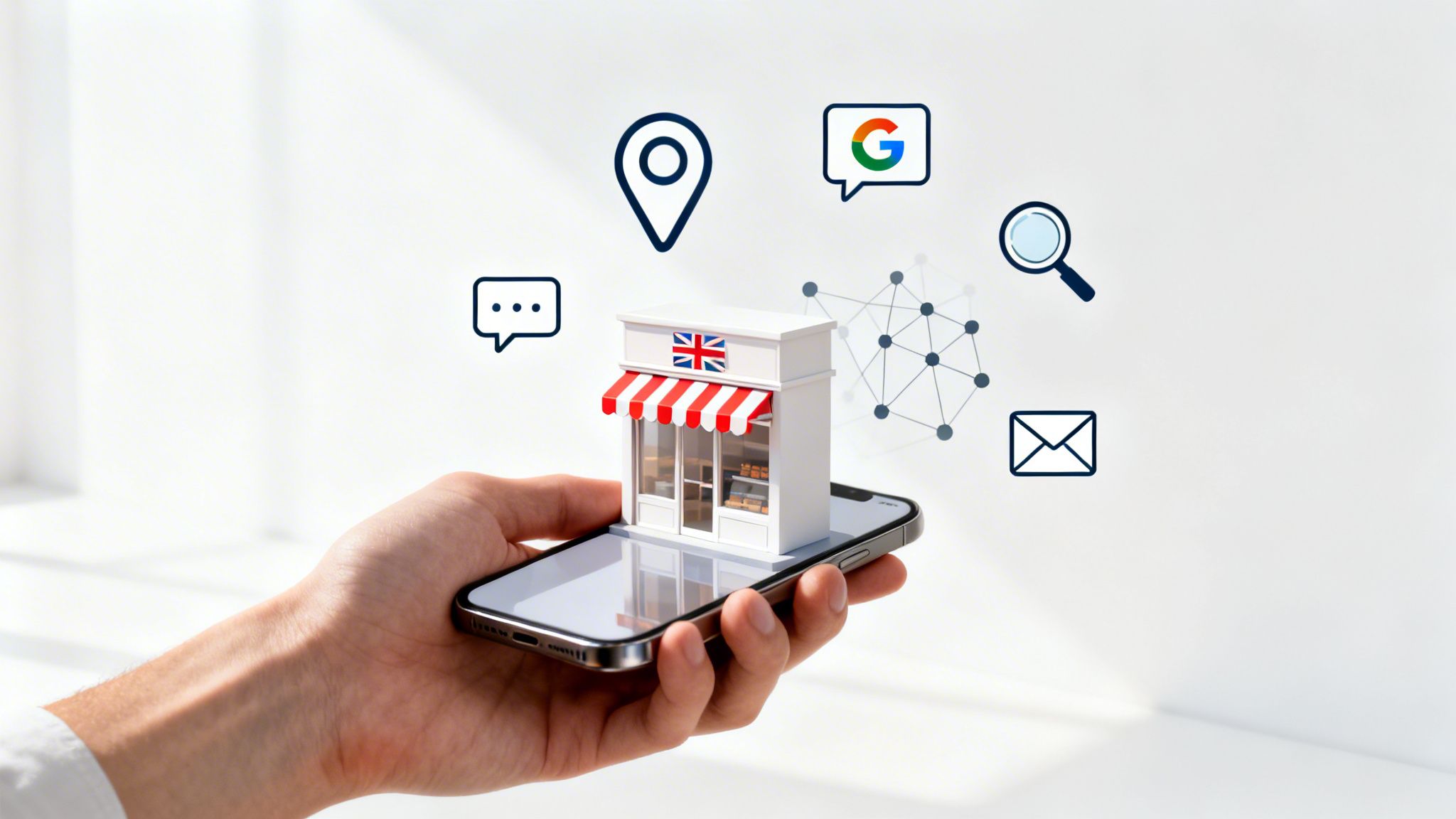
- Google Business Profile (GBP): Think of this as your digital shopfront on Google. It’s often the very first impression a customer gets, showing them your location, opening hours, photos, and, most importantly, your reviews.
- Building a Solid Online Reputation: Actively encouraging and managing customer reviews builds trust and social proof. This heavily influences both a customer’s decision to choose you and your rankings in search results.
The goal is to transform digital marketing from a confusing to-do list into an achievable, step-by-step plan. By starting with these core pieces, you ensure every action you take builds a powerful local presence that brings in a steady stream of qualified customers.
This guide is designed to demystify the entire process for businesses here in the UK, providing a clear roadmap that starts with these high-impact channels. Exploring how to handle your online presence can feel big, but resources like a practical guide to Social Media Marketing for Small Business can be an essential starting point.
To see how we put these principles into practice for local businesses just like yours, take a look at the work we do at https://www.bare-digital.com/.
Mastering the Three Pillars of Local Marketing
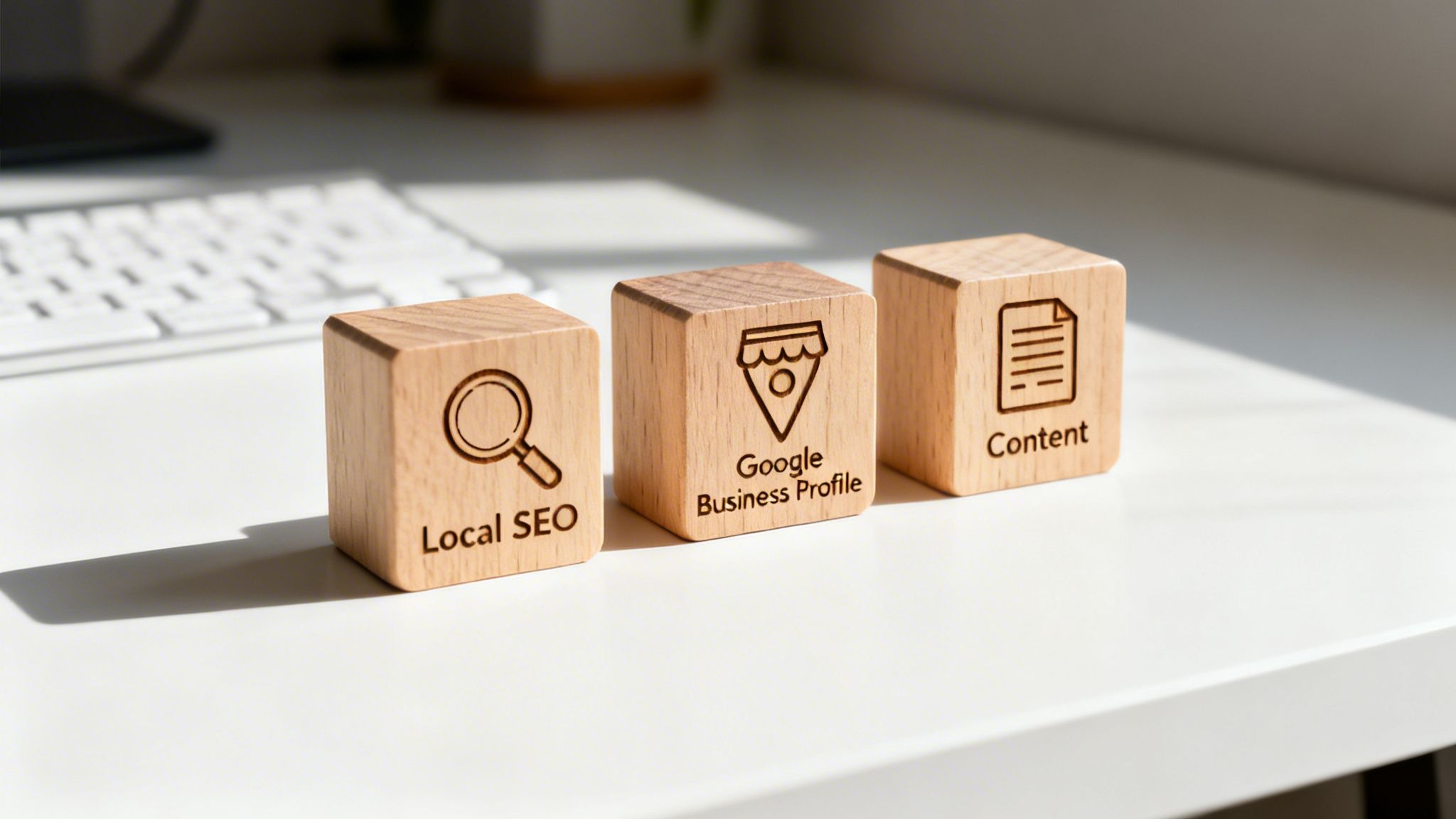
Before you get distracted by every new marketing trend, it’s vital to get the foundations right. For any UK small business, that means mastering three core pillars. Get these right, and they’ll work together to create a powerful engine for attracting local customers and proving you’re the expert in your area.
Think of it like building a house. You wouldn’t start hanging pictures before the walls are up, would you? These three pillars are your walls, providing the structure for everything else in your digital marketing for small businesses.
Pillar 1: Local Search Engine Optimisation
Local SEO is all about making sure your business shows up when a potential customer nearby needs you. When someone types "emergency plumber in Bristol" or "artisan bakery near me" into Google, Local SEO is what gets your name to the top of the list.
It's the technical work of sending crystal-clear signals to search engines about who you are, what you do, and exactly where you operate. This means optimising your website with location-specific keywords, making sure your business name, address, and phone number are spot-on everywhere online, and getting links from other local websites. Neglecting this is like having an unlisted phone number in the digital age.
Pillar 2: Google Business Profile
If Local SEO is the behind-the-scenes wiring, your Google Business Profile (GBP) is the bright, welcoming shopfront. This free profile is your business card on Google and Google Maps, and it's often the very first thing a potential customer sees. It’s where they find your opening hours, photos, services, and all-important customer reviews.
A well-managed Google Business Profile is your single most powerful local marketing asset. It’s a mini-website right there in the search results, giving customers all the information they need to call you, without even needing to click on your website.
To make your profile work for you, you need to look after it. That means:
- Keeping information accurate: Your hours, address, and phone number must always be up to date. No excuses.
- Uploading high-quality photos: Show off your work, your team, and your premises. It builds trust and gives people a feel for what you’re all about.
- Actively gathering and responding to reviews: Reviews are a huge ranking factor and the digital version of a word-of-mouth recommendation. They are pure gold.
Pillar 3: High-Quality Content Marketing
The final pillar is content marketing. This is your chance to stop selling and start helping. Content is what positions you as the go-to expert in your field by answering the real questions your customers are asking. A plumber could write a blog post on "How to prevent frozen pipes in a UK winter," while a wedding venue might create a guide to "Planning a rustic wedding in the Peak District."
This approach does two crucial things at once. First, it gives Google more valuable, relevant material to rank, which attracts people who are still in the research phase. Second, it builds incredible trust. When you’ve already helped someone for free, you become the obvious choice when they're finally ready to spend money.
This strategy is more powerful now than ever. Research shows that UK consumers increasingly value local expertise and trustworthy British brands. For a small business, showing that authority through your content can deliver a fantastic return—data suggests even micro-businesses can see their advertising spend returned almost twofold. If you’re ready to get started, our comprehensive Local SEO checklist is a brilliant resource to have by your side.
Amplifying Your Reach With Paid Ads and Social Media
Once you’ve built a solid foundation with your local SEO and content, it's time to turn up the volume. Think of this next step as moving from a steady hum to a powerful broadcast. This is where paid ads and a smart social media presence come in, actively reaching out to customers instead of just waiting to be found.
Paid search, often called Pay-Per-Click (PPC), is a bit like renting a billboard on the busiest digital motorway in the world. But here's the clever part: instead of paying for a physical sign everyone sees, you only pay when someone with a specific need—someone who just searched for "24-hour locksmith" or "artisan wedding cakes"—clicks your ad. It’s a way to buy a guaranteed spotlight right at the moment a customer is looking to buy.
Social media, on the other hand, is less of an advert and more of a conversation. It’s your digital town square, the place where you can build a genuine community, show off your brand’s personality, and chat directly with your customers. For highly visual businesses, like wedding venues or interior designers, it's an incredibly powerful way to showcase your work and build that all-important aspirational connection.
Capitalising on High-Intent Customers
Paid search is laser-focused on one thing: capturing high-intent demand. We're talking about potential customers who have already decided they need a service like yours and are actively looking for someone to provide it. Your ad appears right at the top of their search results, offering an instant solution.
This is a fantastic way to drive traffic directly to the most important pages on your website, like a service page or a contact form. When it’s done right, a PPC campaign can start generating leads and sales almost immediately, giving you a quick and measurable return that nicely complements the slower, long-term growth you get from SEO.
This infographic shows you exactly how this amplification stage fits into the bigger picture of your digital marketing journey.
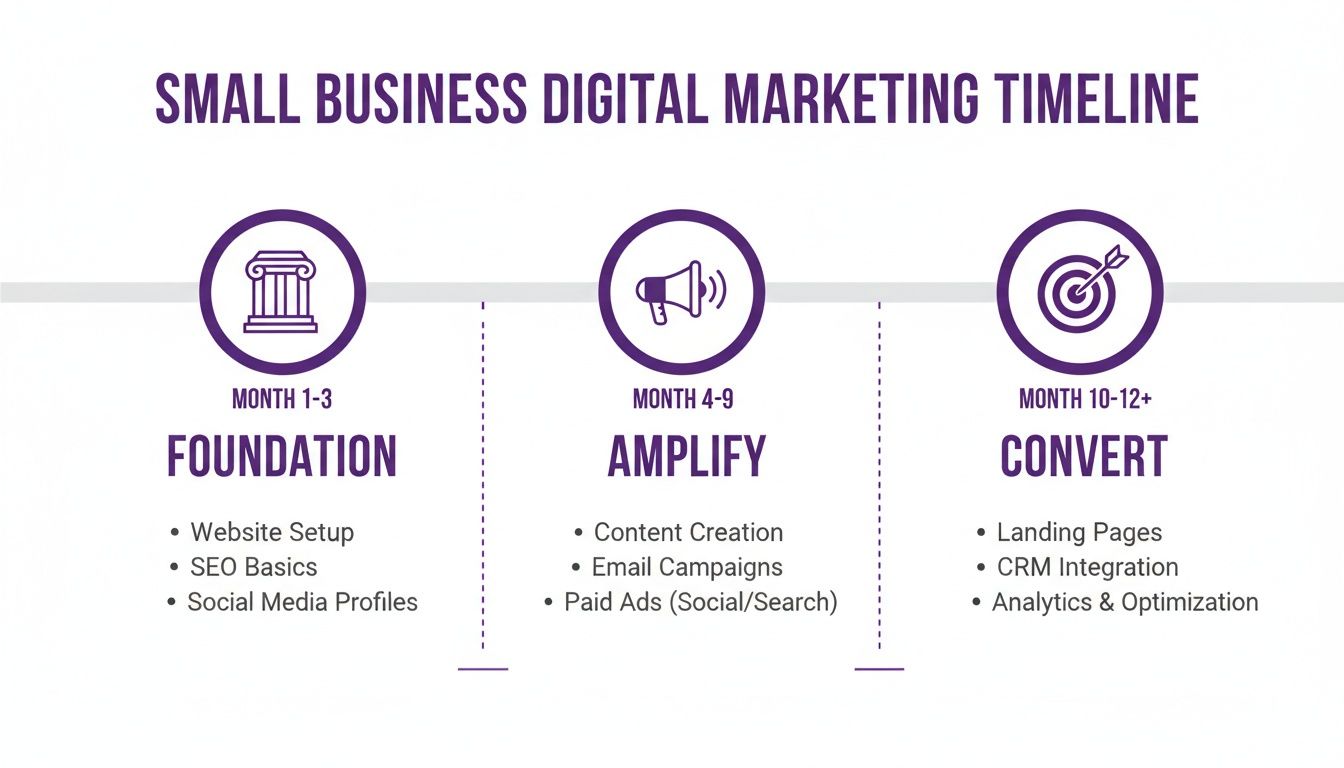
As you can see, amplifying your message is that critical second phase. You’re building on the foundational work you’ve already done to drive much wider awareness and bring people into your world.
Building a Community and Brand Voice
While paid search is brilliant for targeting immediate needs, social media is all about playing the long game by building relationships and brand loyalty. It’s where you get to:
- Showcase your personality: Are you buttoned-up and professional, or a bit more fun and informal? Social media is where that brand voice truly comes alive.
- Engage with your audience: Don't just post and run. Respond to comments, run polls, and ask questions. This two-way street is what builds a loyal community.
- Share user-generated content: When a happy customer posts a picture at your venue or with your product, sharing it is one of the most powerful and authentic endorsements you can get.
The UK's digital advertising market is ballooning, with forecasts expecting it to top £50 billion by 2026. But simply throwing money at it won't guarantee success. With search and display ads making up a massive 83% of all ad investments, you're stepping into a competitive arena. It’s a stark reminder that a poorly planned strategy will get you nowhere, no matter the budget.
The real magic happens when these channels work together, driving traffic back to the assets you already own. A compelling paid ad or an engaging social post should always lead customers back to your optimised website and your high-quality content. That's how you turn that initial visibility into a lasting relationship.
Once you have the basics down, creating a paid social media strategy that actually scales is the essential next step to boost your reach and win new customers. By combining the immediacy of paid ads with the community-building power of social media, you can both capture demand right now and build a brand that people will remember and return to for years.
Your Phased Digital Marketing Roadmap
Jumping into digital marketing can feel like trying to build a house with no blueprints. It’s overwhelming. To stop you from wasting time and money, you need a clear, phased plan that builds momentum month after month.
This roadmap breaks the journey into three manageable stages. We’ll start with the absolute must-haves, then build up to more advanced tactics once the foundations are solid. Following this structure means every action builds on the last, creating real, sustainable growth.
Let's be clear: for UK small businesses, digital marketing is no longer optional. Research shows that 62% see increased sales as their main goal. But budgets are all over the place. While some invest over £10,000 a month, nearly 10% spend a more modest £500–£1,000. You can discover more UK digital marketing statistics that paint a full picture of the current scene. This is exactly why a scalable roadmap is so critical—it needs to work for you now, and grow with you later.
Phase 1: The Foundation (Months 1-3)
The first 90 days are all about getting the basics right and claiming your patch of digital turf. The goal here isn't to be everywhere at once. It’s about building the core assets that all your future marketing will lean on. Think of it as pouring the concrete foundations before you even think about putting up the walls.
Your priorities here are laser-focused on simply being found and being able to measure what’s happening.
Priority 1: Claim and Optimise Your Google Business Profile (GBP). This is your single most important local marketing asset, period. Fill out every last section, get some high-quality photos up, and triple-check that your business name, address, and phone number are spot on. You can even see how you're stacking up with a free Google Business Profile audit.
Priority 2: Nail the On-Page SEO Basics. Make sure your key website pages—your homepage, service pages, and contact page—are properly optimised for your main local keywords. We’re talking phrases like "plumber in Bath" or "wedding photographer in Surrey." This means getting your page titles, meta descriptions, and page content in order.
Priority 3: Get Your Analytics Set Up. Install Google Analytics 4 and Google Search Console. You can't improve what you don't measure, and these free tools are essential for tracking website traffic, understanding user behaviour, and seeing your search performance right from day one.
Key Takeaway for Phase 1: Success at this stage isn't measured by a sudden flood of leads. It's about getting the setup right and being consistent. The main goal is to be correctly represented and visible in local searches when people look for you.
Suggested Budget: £300 – £750 per month. This typically covers getting some professional help with your GBP setup, the initial on-page SEO work, and solid keyword research.
Key Performance Indicators (KPIs):
- Google Business Profile views and impressions.
- Clicks for directions, calls, and website visits from your GBP.
- Initial rankings for your business name (branded search).
Phase 2: Building Authority (Months 4-9)
With a solid foundation in place, the next six months are all about proving you’re the local expert. This phase is about creating genuinely helpful content and building trust signals that tell both customers and Google that you’re a credible, authoritative choice in your market.
You’ll shift from one-off setup tasks to active, ongoing work.
Create Regular, Location-Specific Blog Content: Start publishing one or two blog posts a month that answer your customers' most common questions. A caterer in Manchester might write about "Top 5 Corporate Lunch Ideas," while a tradesperson could tackle "How to Find a Reliable Electrician in Liverpool."
Build Local Citations: A citation is simply any online mention of your business's name, address, and phone number. Your job is to systematically get your business listed in reputable local and industry-specific online directories.
Systematically Gather Customer Reviews: Put a simple process in place to ask every happy customer for a review on your Google Business Profile. Positive reviews are a massive trust signal and a powerful ranking factor you can't ignore.
Suggested Budget: £500 – £1,500 per month. This increased investment covers creating that content, outreach for building citations, and possibly some tools to help manage your reviews.
KPIs for this Phase:
- Growth in organic website traffic from non-branded keywords.
- Number of new, high-quality reviews each month.
- Improved rankings in Google Maps for your important local search terms.
Phase 3: Amplification and Growth (Months 10+)
Once you've established your authority, it's time to pour some fuel on the fire and accelerate your growth. This is where you can strategically introduce paid advertising to reach a wider audience and drive more immediate leads. By now, you have a solid organic presence to support and convert the traffic these paid campaigns bring in.
Your focus shifts from building to broadcasting.
Introduce Targeted Local Paid Search: Launch a Google Ads campaign focused on your most profitable services and the keywords that show the highest intent. Because your SEO is already in good shape, your ads will have higher Quality Scores, which helps lower your cost-per-click.
Develop a Structured Social Media Presence: Pick one or two social media platforms where your customers actually spend their time. Use them to share your blog content, showcase your work visually, and start engaging with your local community.
Suggested Budget: £1,000 – £2,500+ per month. This budget needs to account for your ad spend on top of the ongoing management for your SEO, content, and social media efforts.
KPIs for this Phase:
- Number of qualified leads from paid search (phone calls, form submissions).
- Return on Ad Spend (ROAS).
- Increased website traffic and engagement from social media channels.
To help you visualise this entire journey, we've put together a simple table outlining what the first year and beyond looks like.
Phased Digital Marketing Roadmap (0-12+ Months)
| Phase (Timeline) | Key Activities | Primary KPIs |
|---|---|---|
| Foundation (0-3 Months) | GBP setup & optimisation, basic on-page SEO, analytics installation. | GBP views, clicks from GBP (calls, directions), branded search rankings. |
| Authority (4-9 Months) | Regular local blogging, citation building, systematic review generation. | Organic traffic growth, number of new reviews, Google Maps rankings. |
| Growth (10-12+ Months) | Targeted Google Ads campaigns, structured social media marketing. | Leads from paid search, Return on Ad Spend (ROAS), social media engagement. |
Think of this table as your master plan. It’s a flexible blueprint, not a rigid set of rules. As your business grows and your budget evolves, you can adjust the dials, but the core sequence—Foundation, Authority, Growth—is the proven path to building a powerful local presence that lasts.
Tailoring Digital Tactics for Your Business Type

The marketing channels we've covered—local SEO, content, social media—are the core ingredients. But the recipe for success looks completely different from one business to the next. A one-size-fits-all approach just doesn't cut it, because a wedding venue and a plumbing firm simply don't attract customers in the same way.
The real skill is in adapting these fundamental tools to your specific industry. It’s about knowing which levers to pull, and when.
Let’s move away from theory and look at how this works on the ground. We’ll break down how three very different businesses can use the same core principles to get radically different, but equally effective, results.
The Wedding Venue: Selling the Dream
When your business is selling a dream, like a beautiful wedding venue, your marketing needs to be aspirational and highly visual. The customer journey here is a long one, often starting months, if not years, before a couple even gets engaged. Your job is to capture their imagination from day one.
Content That Inspires: Forget generic blog posts about your venue. Think like your customer and create stunning, specific guides that match what they're searching for. Target long-tail keywords like "barn wedding venues in the Cotswolds" or "intimate wedding locations near Edinburgh" to attract highly qualified couples.
Visual Platforms First: Pinterest and Instagram are your most powerful tools. These are visual discovery platforms where couples build their wedding mood boards. Your content should be designed to be pinned and saved, filled with high-quality, professional photos of real weddings at your venue.
Your GBP as a Gallery: Your Google Business Profile should be a showstopper. Pack it with a gallery of your best professional photos. Use Google Posts to highlight open days or feature a "wedding of the month," constantly showing off your venue at its absolute best. The same logic applies to other visual trades; our guide on SEO for photographers has more tips on this.
The Construction Company: Building Local Authority
For trades and construction firms, it's all about demonstrating reliability and local expertise. Customers aren't looking for a dream; they're looking for a trusted professional to solve a problem in their specific town or neighbourhood. Proximity and proof are everything.
The most powerful marketing for a tradesperson is showing you've done great work for their neighbours. Your digital strategy should be a hyper-local portfolio of your projects, building trust one postcode at a time.
Hyper-Local SEO: This is non-negotiable. Your website needs dedicated pages targeting specific service-and-location combinations. Think "loft conversions in Richmond" or "new boiler installation in Salford." This is exactly how homeowners with an urgent need actually search.
Your GBP as a Portfolio: Treat your Google Business Profile as your on-the-go project showcase. Regularly upload photos of completed jobs—before-and-after shots are pure gold here. Critically, make sure you tag these photos with the right location to reinforce your service area in Google's eyes.
Reviews are Your Currency: A steady stream of positive Google reviews is the single most powerful tool you have. When potential customers see reviews that mention specific services and local areas, it tells them you're the go-to expert in their community.
The Dentist: Earning Patient Trust
For healthcare professionals like dentists, you’re operating in a high-trust industry. While location is a factor, the main reason a patient chooses one practice over another comes down to confidence. Your digital marketing must prioritise building that trust above all else.
Content That Reassures: Your blog should answer your patients' questions before they even have to ask. Create helpful, empathetic articles on topics like "What to expect from root canal treatment" or "Are dental implants right for me?" This positions you as a caring authority, not just a faceless service.
Social Proof is Everything: Patient testimonials are your most persuasive asset. Feature video testimonials on your website and pull quotes from your best Google reviews to share on social media. This kind of social proof is far more convincing than any marketing copy you could ever write yourself.
Your GBP as an Info Hub: Proactively use the Q&A feature on your Google Business Profile. Add common questions your reception staff get all the time and provide clear, reassuring answers. This shows you're transparent and engaged. For practices with multiple clinics, creating unique landing pages for each location and managing separate GBP profiles is the key to dominating local search across all your service areas.
Measuring What Matters to Prove Your ROI
Pouring money into marketing without knowing if it's actually working is a fast way to burn through your budget. To get this right, you have to look past the "vanity metrics" like social media likes and focus on what really drives your business forward. It’s about proving that every pound you invest isn't just a cost—it's bringing new customers through the door.
The great news is you don’t need to splash out on expensive software to get started. Free tools like Google Analytics 4 and Google Search Console are incredibly powerful. They give you a clear window into how people are finding your website, which pages they’re interested in, and what they do once they get there.
Focusing on Business-Driving KPIs
For any local service business here in the UK, the only Key Performance Indicators (KPIs) that truly matter are the ones that signal a new customer is on the line. Your entire focus should be on tracking the tangible interactions that lead to real revenue.
Forget the fluff. These are the metrics that count:
- Phone Calls from Your Google Business Profile: This is a hot lead. Someone is ready to talk, right now.
- Quote Request Form Submissions: You've just captured contact details from someone actively looking for your services.
- "Get Directions" Clicks: For any business with a physical location, this is a clear sign a customer is planning to visit.
- Service Page Views: Tracking traffic to your key service pages tells you exactly which of your offerings people are most interested in.
By homing in on these actions, you move from hoping your marketing is working to knowing precisely how it’s contributing to your sales.
Digital marketing isn't a mysterious black box. It's a measurable process where every pound spent can be tracked back to real-world results, giving you the confidence to invest in your growth.
Connecting Actions to Outcomes
The final piece of the puzzle is connecting your marketing activities to these business outcomes. Did that new blog post on "loft conversions in Bristol" lead to two new quote requests from that area? That’s how you take the mystery out of reporting.
Suddenly, you start to see a clear cause-and-effect relationship. This lets you stop wasting money on what isn't working and double down on the channels that are. This simple measurement process gives you undeniable proof of your return on investment (ROI). If you fancy getting into the nitty-gritty of the financials, you can even use a calculator for SEO ROI to see exactly how these efforts stack up.
It’s this kind of clarity that transforms your marketing from a hopeful guess into a predictable strategy for growth.
Your Top Digital Marketing Questions, Answered
Getting into digital marketing can feel like you’re trying to navigate a new city without a map. It’s natural to have questions. To cut through the noise, we've rounded up the most common queries we hear from UK business owners just like you. Think of this as your go-to guide for straight answers on what really matters.
How Much Should a Small UK Business Spend on Digital Marketing?
There’s no magic number here, but a sensible starting budget for a local business is typically between £500 and £2,000 per month. This is a realistic figure that allows for professional local SEO, proper Google Business Profile management, and the initial content needed to get you noticed.
The trick is to invest smart. Start with the foundational work, like getting found in local searches, before pouring money into more expensive channels like paid ads. Most importantly, your budget needs to be tied to a clear business goal—like generating ten new enquiries a month—not just a figure you spend for the sake of it.
How Long Until I See Results From Digital Marketing?
Let’s be honest: digital marketing is a long-term game, not an overnight fix. Patience is absolutely essential.
You can often see some quick wins within 1–3 months, especially from optimising your Google Business Profile. This might be a noticeable uptick in phone calls or people asking for directions. However, the real, sustainable growth from SEO and content marketing usually takes 6–12 months to properly kick in. That’s the time it takes to build real authority and earn Google's trust.
Paid advertising gets you results faster, but those results vanish the second you stop paying. A smart strategy uses SEO for long-term, compounding growth and reserves paid ads for short-term, tactical boosts when you really need them.
Can I Do Digital Marketing Myself or Should I Hire Someone?
You can certainly have a crack at the basics yourself, like setting up your Google Business Profile. The problem is, the digital world is fiercely competitive and always changing. A DIY approach usually means a steep learning curve and a lot of expensive trial and error.
Hiring a specialist agency or freelancer gives you instant access to years of expertise, powerful tools, and strategies that are proven to get results, faster. The decision really boils down to one simple trade-off: your time versus your money. If you want to focus on what you do best—running your business—while an expert handles its growth, then hiring a professional is a strategic investment that pays for itself.
Ready to stop guessing and start growing with a clear, expert-led strategy? The team at Bare Digital specialises in helping UK businesses like yours dominate local search. We turn online visibility into measurable growth. Find out how we can help you at https://www.bare-digital.com.