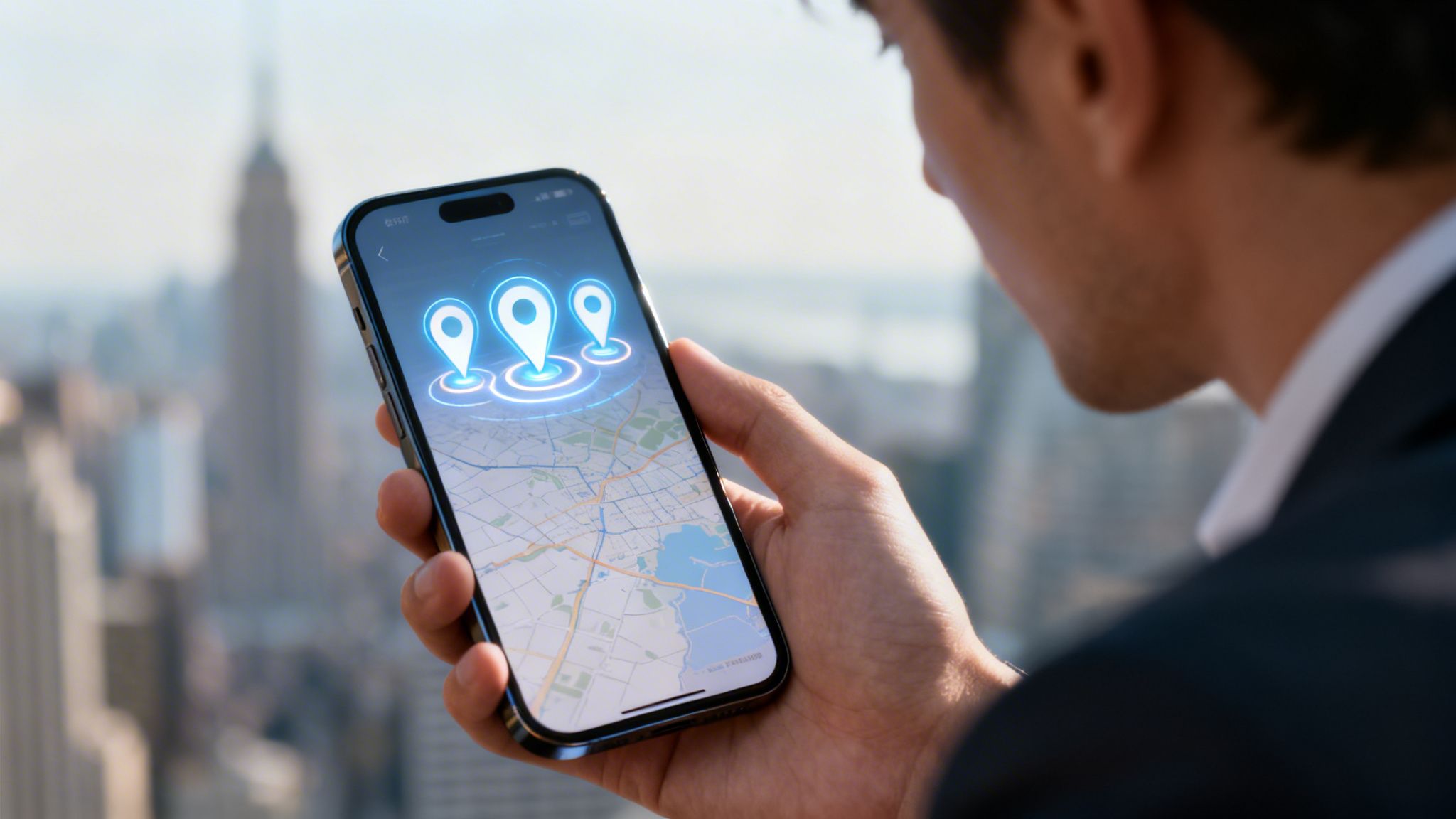

The Google 3-pack is that block of three top local businesses you see on a map whenever you search for something like 'plumber in Leeds' or 'cafe near me'. It’s the very first thing that pops up, perfectly positioned for customers who are looking for a local service and are ready to act.
Why the Google 3-pack Is Your Digital Main Street
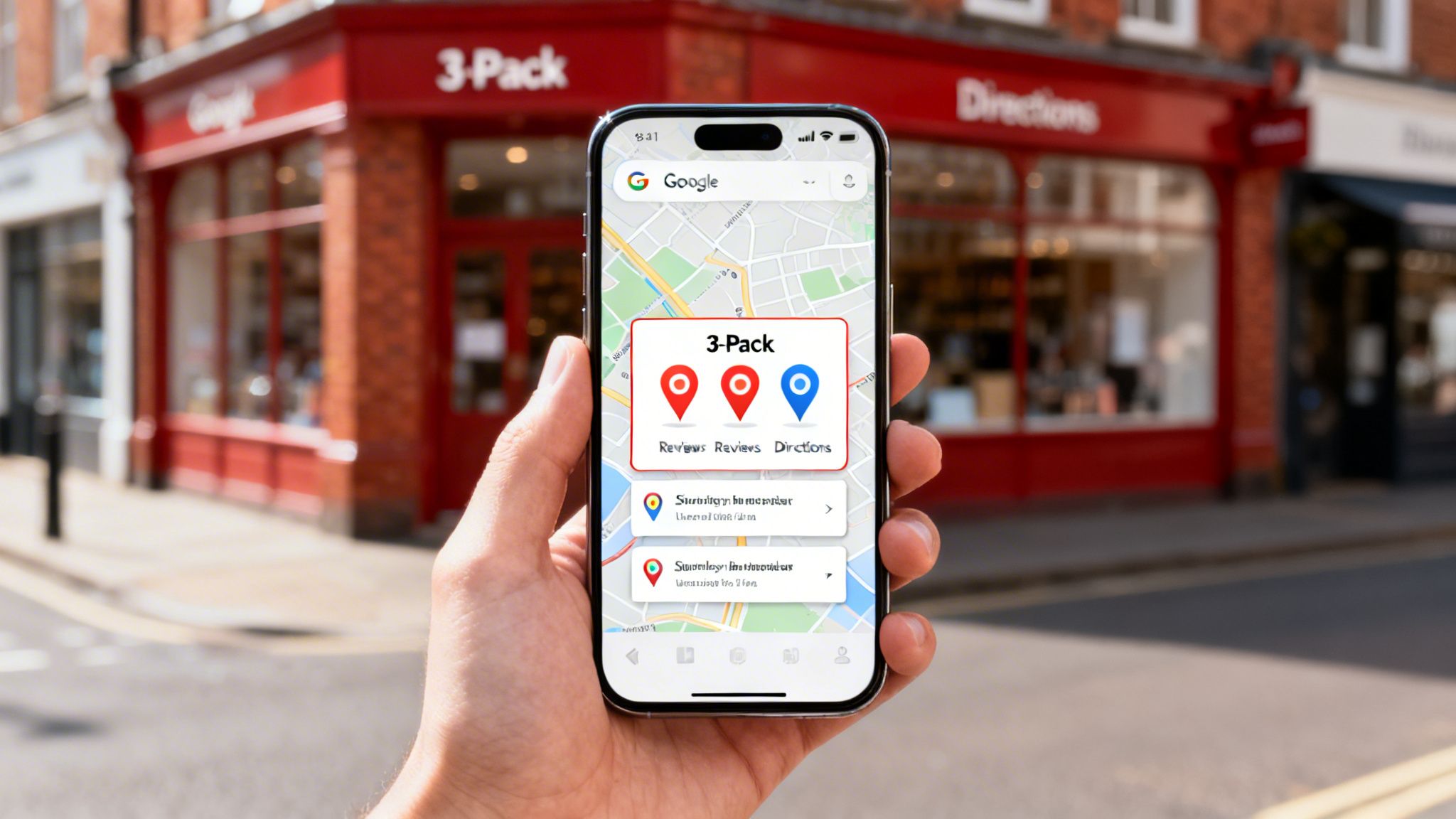
Think of the Google 3-pack as the prime real estate on your local high street, only it’s digital. It's the most prominent, most trusted, and most-clicked part of any local search. For any UK business that depends on local customers—from wedding venues to home care providers—getting a spot here isn’t just a nice marketing win. It’s a fundamental engine for business growth.
This isn't just another section on the search results page. It's an interactive launchpad designed to connect customers with businesses, fast. Each listing in the 3-pack is packed with at-a-glance information that encourages someone to take immediate action.
The Power of Prime Placement
Landing in this exclusive trio gives you a huge advantage over competitors who are stuck down in the standard organic results. The benefits are direct and easy to measure:
- Maximum Visibility: The 3-pack sits right at the top, often above all other organic results, making sure your business gets seen first.
- Increased Trust: A spot here acts as a strong endorsement from Google, signalling to users that you're a credible and relevant choice.
- Higher Engagement: Features like 'Click to Call' buttons, directions, and direct links to your website make it incredibly easy for potential customers to get in touch.
This immediate visibility is where the real value lies. Here in the UK, the 3-pack—also known as the Map Pack—pulls in a massive 44% of all clicks from local searchers. That means nearly half the people searching for 'funeral home in Leeds' dive straight into those top three map listings, often ignoring everything else. This is especially vital in a mobile-first UK where 76% of people who search for a local business on their phone visit one within 24 hours.
The Google 3-pack isn't just about ranking; it's about being the most convenient and compelling answer for a customer who is ready to buy, visit, or call right now.
It’s a Customer Conversion Tool
At the end of the day, the 3-pack isn't a vanity metric. It’s a powerful tool for driving tangible business. The journey from a 'near me' search to a phone call or a shop visit is shorter and more direct when it starts from one of these top three spots.
For local businesses, this is your digital front door. Optimising for it is a non-negotiable part of modern marketing, and our complete local SEO checklist is the perfect place to start. Throughout this guide, we’ll break down exactly how you can claim your spot on this digital main street.
Understanding How Google Ranks Local Businesses
To earn one of those coveted spots in the Google 3-pack, you first need to get your head around how Google decides who gets featured. It’s not a lottery; the algorithm is built on a framework designed to give searchers the most helpful and trustworthy local results.
Think of it as a three-legged stool. If one leg is weak, the whole thing gets wobbly. These three legs are Proximity, Relevance, and Prominence. Getting how they work together is the absolute foundation of any local SEO strategy that actually works.
Proximity: The Distance Factor
Proximity is the most straightforward of the three. It simply asks: how close is your business to the person searching? If someone in central Manchester searches for "coffee shop near me," Google is naturally going to prioritise cafés in the immediate area over those in the suburbs.
But Google’s cleverer than just measuring distance from the searcher. It also understands when someone specifies a different location. A search for "best restaurants in Soho" will pull up results in London's Soho district, whether the person is searching from London or Liverpool.
Being the absolute closest business doesn't guarantee a top spot, though. Proximity is a critical starting point, but it's heavily balanced by the other two factors.
Relevance: The Matching Game
Relevance is all about how well your business matches what the user is looking for. It’s Google’s way of playing matchmaker between a customer's problem and your services. This goes way beyond just your business name.
Google analyses everything about your online presence to figure out how relevant you are, including:
- Business Category: Making sure your primary and secondary Google Business Profile categories accurately reflect what you do (e.g., ‘Plumber’ vs. ‘Heating Contractor’).
- Services Offered: The specific services you list on your profile and website. A search for "emergency boiler repair" is far more likely to show a plumber who explicitly lists that service.
- Keywords: The words and phrases used in your business description, reviews, Q&As, and website content that line up with what people are searching for.
For example, if you're a wedding venue, having content and services about "civil ceremonies," "wedding breakfast," and "exclusive use venue" makes you highly relevant for those specific searches. The more signals you give Google that you’re a perfect match, the better your chances.
Prominence: Your Digital Reputation
Prominence is a measure of how well-known and respected your business is, both online and in the real world. It’s basically your digital authority. Being close and relevant is great, but if a competitor is seen as more authoritative, they will probably outrank you.
Prominence is Google's way of gauging trust. A business with a strong, positive online footprint is considered a safer bet to recommend to its users.
Google works out your prominence by looking at several key signals:
- Reviews: The quantity, quality, and speed at which you get new Google reviews are massive indicators. A high star rating and a steady stream of new reviews build huge trust.
- Backlinks: Links from other reputable local websites, like a local newspaper or a neighbourhood blog, act like votes of confidence, boosting your authority.
- Citations: The consistency of your business name, address, and phone number (NAP) across online directories like Yelp and industry-specific sites proves you're a legitimate operation.
- Brand Mentions: Even when your business name is mentioned without a link, it still contributes to your overall online presence.
Ultimately, a business with 200 positive reviews and mentions in local online publications will be seen as far more prominent than a new business next door with only two reviews, even if they offer the exact same service. To get a clear picture of your profile's current strength, you can run a quick check with a Google Business Profile audit tool.
Getting these three pillars right is the first step toward climbing the ranks and claiming your spot.
Your Playbook for Google 3-Pack Optimisation
Now that we know the rules of the game—Proximity, Relevance, and Prominence—it’s time to get our hands dirty. This is your practical playbook for optimising every signal Google looks at when deciding who gets a spot in that coveted Google 3-pack. Think of this as a series of missions, each one designed to make your business the most compelling choice for local customers.
We’ll walk step-by-step through turning your Google Business Profile (GBP) into a customer magnet, building a consistent digital footprint with citations, and making sure your website shouts about your local expertise. Let's get started.
Mission 1: Create and Perfect Your Google Business Profile
Your Google Business Profile isn't just another listing; it's the absolute heart of your local SEO strategy. If you want even a whisper of a chance at the 3-pack, you must have a verified and fully optimised GBP. If you haven't even claimed your profile yet, stop what you're doing and head to google.com/business to get it sorted.
Once you’re verified, your next job is to fill out every single section. An incomplete profile is a huge red flag for Google, basically signalling that you’re not all that bothered or might not even be a legitimate business.
A fully optimised GBP acts as a powerful statement to Google. It says, "We are an active, professional, and trustworthy business that is serious about serving customers in this area."
A profile that's firing on all cylinders should include:
- A Clear Business Description: Write a sharp, compelling summary of who you are and what you do. Weave in important local keywords, but keep it natural.
- Accurate Operating Hours: Keep your hours, especially for holidays, absolutely bang up to date. There’s nothing worse than sending a potential customer to a closed door.
- A Full List of Services or Products: Detail every single thing you offer. This helps Google match you to super-specific searches like “emergency boiler repair near me” instead of just “plumber.”
- High-Quality Photos and Videos: Show off your work, your team, and your premises. Profiles with more photos get more clicks and more requests for directions. Simple as that.
This following infographic neatly breaks down the core pillars your GBP optimisation efforts should be built on.
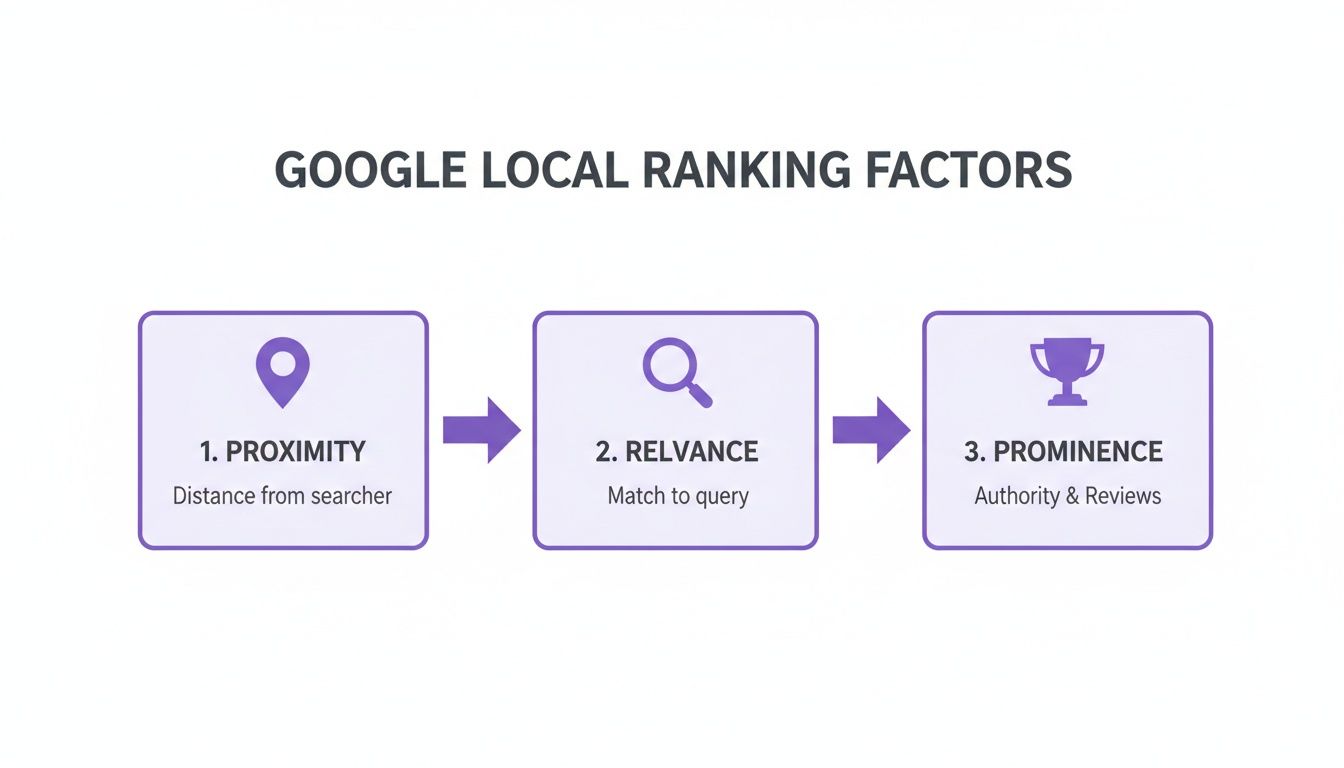
As the graphic shows, Proximity gets you in the game, but it’s the powerful combination of deep Relevance and strong Prominence that ultimately wins you a spot in the Google 3-pack.
To help you get this right, here’s a quick-reference checklist outlining the essentials for a fully optimised Google Business Profile. Following these steps will give you the best possible foundation for 3-Pack visibility.
Google Business Profile Optimisation Checklist
| Optimisation Area | Action Required | Why It Matters for 3-Pack Ranking |
|---|---|---|
| Core Information | Verify your listing and ensure Name, Address, and Phone (NAP) are 100% accurate. | This is the bedrock of trust. Inaccuracies kill your credibility with Google. |
| Categories | Select a precise primary category and all relevant secondary categories. | Tells Google exactly what you do, helping you rank for specific service searches. |
| Services/Products | Add a detailed list of every service or product you offer, with descriptions. | Boosts your 'Relevance' for long-tail searches (e.g., "flat roof repair"). |
| Business Description | Write a compelling, keyword-rich summary of your business. | Your chance to tell both Google and customers who you are and what you stand for. |
| Photos & Videos | Regularly upload high-quality images of your work, team, and premises. | Visuals build trust and engagement; profiles with more media get more interactions. |
| Google Posts | Publish updates, offers, and news at least once a week. | Signals to Google that your business is active and engaged with its community. |
| Reviews | Actively request reviews and respond to every single one (good and bad). | The most powerful signal for 'Prominence' and social proof for customers. |
| Q&A Section | Proactively add and answer common questions about your business. | Positions you as a helpful expert and addresses customer concerns upfront. |
Ticking off every item on this list is a non-negotiable part of building a profile that Google can't ignore. It systematically addresses the signals that contribute to a higher local ranking.
Mission 2: Build Consistent Local Citations
Local citations are simply mentions of your business’s Name, Address, and Phone number (NAP) on other websites and directories across the web. Think of them as digital breadcrumbs all pointing back to you. The more consistent and widespread these breadcrumbs are, the more confident Google gets that your business is a real, established entity at its listed address.
Kick things off by making sure your details are spot on across the major players:
- Yelp
- Bing Places
- Apple Maps
- Yell.com (formerly YellowPages)
From there, start hunting for industry-specific directories. A wedding venue would want to be on Hitched, while a tradesperson should be on Checkatrade. Consistency is absolutely everything. Even a tiny variation like "St." versus "Street" can muddy the waters and dilute the power of your citations.
Mission 3: Align Your Website with Local Intent
Your website and your Google Business Profile need to be working as a team. Optimising your site for local keywords is what supercharges the "Relevance" pillar, telling Google that your business is a true authority for certain services in a specific area.
Create dedicated service pages for each of your core offerings and the locations you serve. A roofer in Manchester, for example, absolutely needs pages for "Roof Repair Manchester," "New Roof Installation Stockport," and so on. These pages need to have genuinely helpful content that answers the questions local customers are asking.
To find the right keywords, you have to think like your customer. They're not searching for jargon; they’re searching for "best wedding photographer in the Cotswolds" or "electrician near me in Bristol." Use these locally-focused phrases throughout your website’s content, page titles, and image descriptions. This synergy between your site and your GBP is what builds real local authority. If you need a deeper look at how you're currently performing, you might want to get a GBP report to highlight areas for improvement.
Mission 4: Earn High-Impact Local Backlinks
Backlinks—links from other websites pointing to yours—are one of the most powerful signals for "Prominence." For local SEO, links from other businesses or organisations in your geographical area are pure gold. They are a massive local vote of confidence in your favour.
A single backlink from a respected local news blog can be worth more than dozens of cheap directory links.
Here’s how you can start earning them:
- Sponsor a Local Event: Get involved with a local charity run, school fete, or community festival. Most will be more than happy to link back to their sponsors' websites.
- Collaborate with Nearby Businesses: Team up with complementary, non-competing businesses. A wedding planner could link to a trusted local florist, who then links back.
- Get Featured in Local Media: Reach out to local bloggers and news outlets. Offer an expert opinion on a topic, share a unique business story, or create a locally-focused guide they would want to share with their readers.
Mission 5: Cultivate a Winning Review Strategy
Reviews are arguably the single most critical factor for both Prominence and for turning searchers into actual customers. The quantity, quality, and velocity (how often you get them) of your Google reviews send an enormous trust signal to the algorithm.
You need a simple, repeatable process for requesting reviews from happy customers. The best time to ask is right after a successful job or purchase when satisfaction is at its peak. You can generate a direct review link right from your GBP dashboard to make it completely effortless for them.
Most importantly, you must respond to all reviews—the good and the bad. A polite, professional reply to a negative review shows potential customers that you take feedback seriously and are committed to good service. This builds far more trust than a profile with only perfect five-star ratings ever could.
By completing these missions, you systematically build a powerful case for why your business, above all others, deserves a spot in the Google 3-pack.
Tailoring Your Strategy for Different Industries
If you think a one-size-fits-all strategy will land you in the Google 3-pack, think again. The signals that build trust for a plumber are completely different from what a wedding venue or a private clinic needs to stand out. To really get ahead, you have to ditch the generic playbook.
It all comes down to knowing what your specific customers actually care about. For some, it’s cold, hard proof of quality work; for others, it's about making an emotional connection. Let's break down how to tune your approach for a few key sectors and give yourself a real competitive edge.
For Tradespeople: Electricians, Plumbers, and Builders
For trades like plumbing, electrical work, and building, your visibility in the Google 3-pack comes down to two things: trust and proof. When a homeowner is searching, they’re often in a stressful situation. They need someone reliable who can fix their problem, fast.
Your Google Business Profile has to be a showcase of your competence. Forget stock photos; people want to see real evidence that you know what you're doing.
- Showcase Your Work: Get into the habit of uploading high-quality photos from completed jobs. Be specific with the captions (e.g., "New boiler installation in Bristol," "Full house rewire in Bath"). This doesn't just provide proof, it also reinforces your service areas.
- Detail Your Service Areas: Use the service area feature in GBP to list every single town, village, and postcode you cover. This is absolutely critical for catching those urgent, local "near me" searches.
- Highlight Qualifications: Make sure any certifications (like Gas Safe registered or NICEIC approved) are front and centre in your business description and services. This is a massive trust signal.
When it comes to reviews, you need them to scream reliability and professionalism. Gently prompt customers to mention the specific job you did and how clean and professional your team was.
For Wedding Venues and Photographers
The wedding industry is fuelled by emotion and aesthetics. Couples aren’t just buying a service; they’re buying into a dream. Your strategy for the Google 3-pack has to capture that magic and help them picture their perfect day.
For visual-first industries like weddings, your Google Business Profile isn't just a listing; it's a digital portfolio and a mood board. It must inspire and create an immediate emotional connection.
Your entire online presence needs to tell a beautiful story. Stunning images and heartfelt testimonials are your most powerful tools here.
- Curate Stunning Visuals: Your GBP photos need to be professional and breathtaking. Organise them into albums like "Summer Ceremonies" or "Marquee Receptions." Use video to offer virtual tours that draw people in.
- Leverage Emotion-Driven Reviews: Encourage couples to share their stories. A review that says, "They made our wedding day feel magical," is worth ten times more than one that just says, "Good service."
- Optimise for Aspirational Keywords: Get inside the head of an engaged couple. Target phrases like "exclusive use wedding venue Cotswolds" or "documentary wedding photographer Surrey" on your website and in your GBP description.
For Healthcare Providers: Doctors, Dentists, and Clinics
For healthcare providers, the foundation of your Google 3-pack strategy is building unquestionable trust and authority. Patients are searching for expertise, professionalism, and compassionate care. Every part of your online presence has to reflect this.
Your Google Business Profile should act like a professional directory, offering clarity and reassurance at a glance. For some businesses like self-storage, the focus might be more on security and access, which just shows how important industry-specific tactics are. You can explore more on this in our guide to SEO for self-storage facilities.
A smart tactic is to get ahead of common patient questions before they even ask.
- Emphasise Credentials: List all qualifications, specialisms, and professional memberships for every practitioner. This should be clear in your GBP description and on your website.
- Use the Q&A Feature: Proactively fill out the Google Q&A section with common queries about booking appointments, consultation processes, or available treatments.
- Manage Reviews with Empathy: Respond to every single review with care and professionalism, always remembering patient confidentiality. The best positive reviews will highlight a feeling of being listened to and well cared for.
By tailoring your approach like this, you’re aligning your business with exactly what your ideal customer is looking for. It’s how you make your listing in the Google 3-pack not just visible, but truly compelling.
Winning the 3‑Pack Across Multiple Locations
Trying to rank in the local 3‑pack for a business with multiple locations? It's a whole different ball game. You can't just copy and paste what worked for one branch and expect it to work for another. In Google’s eyes, each location is its own unique competitor, fighting for visibility in its own local neighbourhood.
The classic mistake we see is brands treating all their locations like identical clones. This leads to bland, generic content that completely misses the mark. You have to start thinking of each branch as its own small business, just one that happens to share a brand name. That shift in mindset is the first step to dominating the Google 3‑pack in every single market you operate in.
Creating Unique Local Identities
Your first job is to give each location its own distinct presence online. This means a separate, fully optimised Google Business Profile and a dedicated location page on your website for every single branch. These can't just be cookie-cutter pages; they need to be intensely local.
A location page for your Manchester branch, for instance, needs more than just an address. It should have photos of the local team, reviews from Manchester-based customers, and maybe even a blog post about a local event you sponsored. This is how you prove to Google that you’re a real part of that community, not some faceless national chain just dropping a pin on a map.
Simply changing the city name on a template page is not enough. You must create unique, valuable content that demonstrates local expertise and engagement for each branch to effectively compete for a spot in the Google 3-pack.
Building Authority for Each Branch
Once every location has its own digital home, you need to build up its individual authority, or what Google calls "Prominence." This means getting down into the weeds and building local signals for every single branch.
- Localised Citations: Make sure each branch has its own set of perfectly consistent Name, Address, and Phone number (NAP) listings in directories relevant to its specific town or city.
- Location-Specific Backlinks: Work on getting your Manchester branch featured on a Manchester business blog, and your Leeds branch mentioned by a local news outlet in Leeds. These local links are pure gold.
- Branch-Level Review Management: You have to manage and respond to reviews for each location individually. A fantastic review for your team in Bristol does absolutely nothing to help your Birmingham branch’s ranking.
This is a serious amount of work, but the payoff is enormous. The data is clear: UK businesses that grab a spot in the Google 3‑pack see a massive 126% boost in traffic and 93% more user actions like calls and direction requests. With 46% of all Google searches now having local intent, winning the 3‑pack across multiple locations is a direct line to driving more revenue.
Managing at Scale Without Losing Consistency
The big challenge, of course, is keeping your brand consistent while encouraging all this local flavour. A good approach is to use centralised templates for things like Google Posts or review responses, but then empower local managers to add their own personal, local touch.
This hybrid model ensures your brand voice stays solid while still allowing for the authentic community engagement that Google’s algorithm loves to see. For brands serious about winning local search across the board, properly tracking what’s working is crucial. Diving into the specifics of marketing attribution for multi-location businesses can give you the clarity you need to measure performance accurately.
By treating each location as its own business and building its local authority from the ground up, you create a powerful network that wins in every single market you serve.
Tracking Your Success and Proving ROI
Getting into the Google 3-pack is a fantastic win, but the real question is, what's it actually doing for your business? Visibility is great, but it doesn't pay the bills. The goal is to connect your local SEO work directly to real-world results like phone calls, bookings, and new customers walking through the door.
It's time to move beyond vanity metrics and focus on the numbers that show genuine customer intent—the specific actions people take when they find you in that coveted local pack.
Focusing on Key Performance Indicators
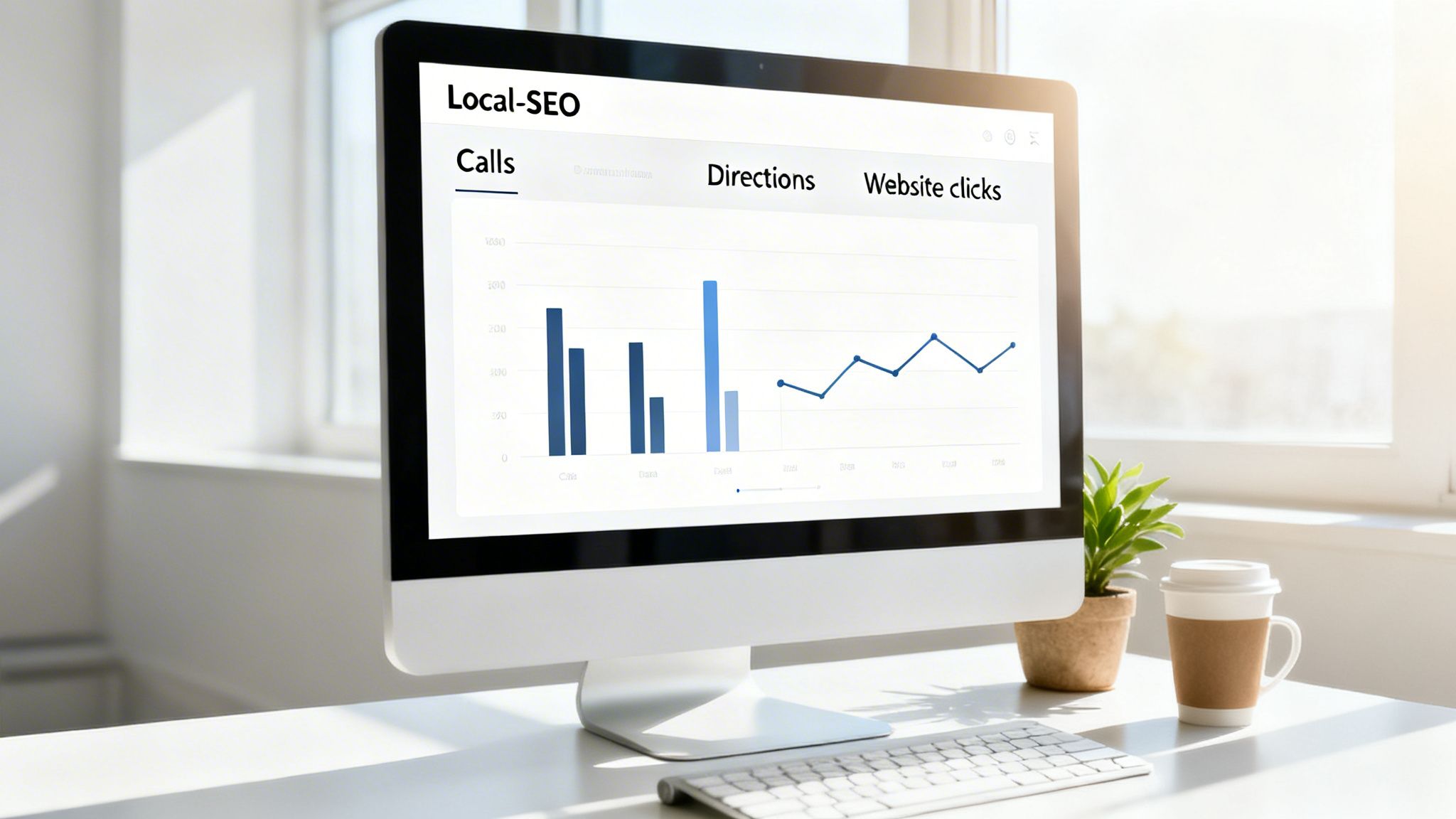
Your Google Business Profile (GBP) is a goldmine of performance data. The “Performance” dashboard gives you a direct, unfiltered look at how potential customers are interacting with your business listing. These aren't just numbers on a screen; they're clear buying signals.
The most important metrics to keep an eye on are:
- Phone Calls: How many times people tapped the 'Call' button straight from your profile. This is one of the hottest leads you can get.
- Website Clicks: The number of users who clicked through to your website. This shows they’re actively looking for more information on what you offer.
- Direction Requests: How many people asked Google Maps for directions to your premises. For any brick-and-mortar business, this is pure gold.
- Bookings: If you have this feature switched on, it tracks how many appointments were made right there on your profile.
Tracking these metrics lets you see the direct impact of your optimisation efforts. If you see a spike in phone calls right after adding new service photos, that’s a clear win you can take to the bank.
Connecting Actions to Your Bottom Line
The ultimate goal is to measure the return on investment (ROI) from all your hard work on local SEO. To get there, you need to connect the dots between the actions in your GBP and the money coming into your business. It requires a bit of simple maths, but the insight you'll gain is invaluable.
For multi-location businesses trying to dominate the Google 3-pack, solid local presence management across every single franchise is essential for tracking results accurately.
By working out an average value for each type of lead (for example, if one in five phone calls results in a £500 job), you can start putting a real financial figure against your 3-pack performance. To get you started, you might find our guide on calculating your own SEO return on investment helpful. This is how you transform SEO from just another marketing cost into a proven profit-driver for your business.
Still Have Questions About the Google 3-Pack? We’ve Got Answers.
Trying to nail down a spot in the Google 3-pack can feel like you're chasing a moving target. To cut through the noise, we've rounded up the most common questions we hear from business owners just like you.
Think of this as your go-to guide for straight answers on what actually moves the needle in local search.
How Long Does It Take to Rank?
This is always the first question, and the only honest answer is: it depends. Getting into the Google 3-pack isn’t like flicking a switch; it's a gradual climb.
For a brand-new business in a fiercely competitive market, you could be looking at six months to a year of consistent, hard work. But if you’re an established business in a less crowded niche, you might see real movement in as little as 2-3 months.
The timeline really boils down to a few key things:
- How much competition you’re up against in your local area.
- The current state of your online footprint (your GBP, website, and local citations).
- The quality and consistency of your optimisation efforts.
Why Is My Competitor Ranking and I’m Not?
It’s incredibly frustrating to see a competitor snagging a top spot, especially when you know your service is better. More often than not, it comes down to them simply doing the small things right with their local SEO.
They might have a handful more positive reviews, a more thoroughly completed Google Business Profile, or a few more high-quality links from other local websites.
Think of it like this: your restaurant might have the better food, but your competitor has a brighter sign and more glowing reviews taped to their front door. Online, those signals are what get people through the door.
Start by doing a direct, side-by-side comparison. Look at their GBP, read their reviews, and analyse their website to spot the gaps in your own strategy.
Will I Stay in the 3-Pack Forever?
Not a chance. No spot in the Google 3-pack is ever permanent. Rankings are constantly shifting based on Google’s algorithm updates, what your competitors are doing, and even how people search.
Holding onto your position is an ongoing job, not a one-time project.
The importance of the pack for UK businesses is only growing. It's expected to show up in 93% of searches with local intent by 2026, and those top spots drive a huge amount of traffic. As shown in a guide from AlmCorp, businesses that make it into the pack get 93% more actions from customers. This makes putting in the sustained effort absolutely vital. You can discover more insights about current ranking factors on AlmCorp.com.
At Bare Digital, we specialise in turning local visibility into measurable growth. If you're ready to stop guessing and start dominating the local search results, we can help. Request your free SEO health check today.