


Most UK businesses should expect SEO retainers to fall somewhere around £1,000 to £5,000 per month, but that number only means anything once you know who is doing the work and how wide the campaign needs to go. A single-location local campaign can start much lower, while competitive national or enterprise work climbs fast because the scope, content demand, technical depth, and reporting requirements all expand with it.
Regarding how much does SEO cost UK, you're probably in the same position as most owners and marketing managers. You've had one quote that feels suspiciously cheap, another that feels hard to justify, and a third that says "it depends" without telling you what it depends on.
That confusion is normal. SEO pricing in the UK isn't like buying software with a fixed plan list. It's closer to hiring trades for a property. Fixing one room is not the same as renovating a whole building, and the quote changes for reasons that are usually practical, not arbitrary.
The useful question isn't just "what does SEO cost?" It's what work is being bought, what outcomes are realistic, and what extra costs are hiding off the proposal.
The Three SEO Pricing Models Explained
Most UK SEO work is sold in three pricing models. Monthly retainer, one-off project, and hourly consulting. If you understand those first, agency quotes become much easier to compare.
A simple way to think about it is hiring a builder.
Monthly retainer
A monthly retainer is like having a reliable contractor manage an ongoing renovation. You're not paying for one isolated task. You're paying for consistent progress across multiple moving parts.
That usually suits SEO because rankings don't improve from a single action. Technical fixes, content work, internal linking, authority building, reporting, and conversion tracking all need coordination over time.
A retainer is usually the right fit when you need ongoing growth, not just diagnosis.
Pros
- Predictable budgeting: You know what you're spending each month.
- Compounding work: Fixes, content, and authority-building can build on each other.
- Strategic continuity: The provider can prioritise work in the right order instead of treating every task as separate.
Cons
- Requires trust: If the provider isn't transparent, a retainer can feel vague.
- Needs patience: SEO work often starts with groundwork before visible gains.
- Can be overkill: Some businesses don't need continuous support at the start.
One-off project
A project fee is closer to commissioning a new kitchen. The scope is defined, the deliverables are clear, and the work ends once that scope is complete.
This works well for things like a technical audit, a migration review, a content strategy, or a local SEO setup. It's useful when the business has an in-house team or another supplier who can implement the recommendations afterwards.
Project work is often sensible when the biggest problem is clarity, not execution.
Practical rule: If you need to know what's broken before committing to ongoing spend, start with a defined project.
Hourly consulting
Hourly SEO is like calling a tradesperson to fix a leak. You have a specific issue and you need focused expertise, not a long-term arrangement.
Independent UK guides place SEO hourly rates at roughly £75 to £250, and note that a £1,500 to £3,000 retainer only buys a modest number of specialist hours once technical work, reporting, and content are included according to Yellowball's UK SEO cost guide.
Hourly support is useful for:
- Small technical fixes: Indexing issues, redirects, crawl problems.
- Second opinions: Reviewing an agency plan or website migration.
- Training: Helping an internal team make better decisions.
It isn't usually the best model for full campaign growth because SEO tasks overlap. One hour spent on keyword research often creates work in content, internal linking, page structure, and reporting.
There's also a fourth model you'll see discussed, usually called performance-based SEO. It sounds attractive, but the problem is simple. SEO results lag behind the work, so providers either avoid it or build in incentives that don't always align with long-term quality. If you're weighing that option, this breakdown of performance-based SEO is worth reading before you sign anything.
UK SEO Provider Tiers Compared
Two proposals can both say "monthly SEO" and still describe very different services. One may be a single experienced consultant doing the work personally. The other may be a team with separate technical, content, digital PR, and account management resource behind it. That difference changes cost, speed, and how much can realistically get done each month.
Broadly, the UK market breaks down into four provider tiers: freelancers, small agencies, mid-sized or specialist agencies, and enterprise teams. The price rise between those tiers usually reflects delivery capacity and specialism, not a nicer slide deck.
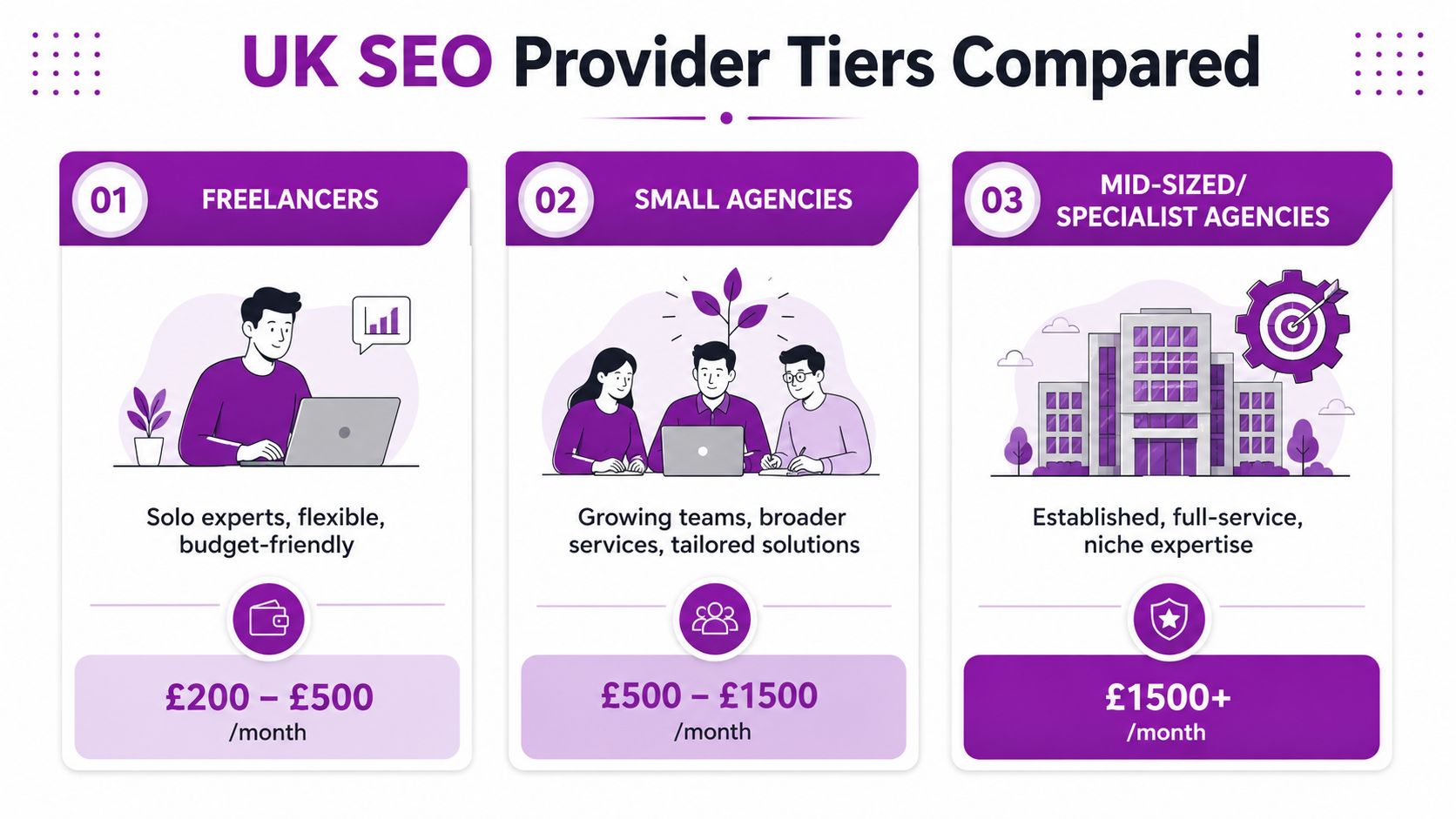
Freelancers
A strong freelancer can be the right hire for a straightforward brief. You get direct access to the person doing the work, faster decisions, and lower overhead.
They tend to suit:
- Single-location businesses
- Smaller websites
- Defined priorities, such as local SEO, technical clean-up, or advice for an in-house team
The limit is throughput. SEO rarely stays in one lane for long. A technical fix often creates content work. Content work often needs internal linking and measurement. One person can absolutely do good work, but there is a ceiling on how many moving parts they can handle at once.
Small agencies
Small agencies are often the best fit for SMEs because they add bench strength without the cost of a large agency structure. You may have one lead contact, but the work can still be split across strategy, technical implementation, content, and reporting.
That matters more than many business owners expect. If your campaign includes service pages, Google Business Profile work, light outreach, and monthly reporting, a small agency can usually keep all of that moving at the same time.
This tier often suits:
- Growing local brands
- Regional service businesses
- SMEs expanding beyond a basic local footprint
Mid-sized and specialist agencies
Pricing begins to reflect specialist depth. These providers are built for harder jobs: larger sites, more competitive sectors, multiple locations, stakeholder reporting, and campaigns where technical SEO, content strategy, and authority building all need proper coordination.
Paying more here usually buys one of two things. It buys access to people with deeper expertise in a specific area, or it buys more execution capacity across several areas at once. For a business targeting local terms in one town, that can be unnecessary overhead. For a firm trying to grow across the UK, it can be the difference between steady progress and constant bottlenecks.
Enterprise teams
Enterprise retainers are usually driven by complexity rather than ambition alone. Large ecommerce sites, regulated sectors, franchise models, and national brands often need more process, more QA, and more cross-team coordination than smaller providers can comfortably support.
Part of that spend goes on work many agencies leave out of early conversations. Analytics setup, dashboarding, consent and cookie configuration, migration support, and compliance checks all take time. On bigger accounts, those "extra" tasks are often part of the overall SEO cost.
The choice you're making
The useful question is not whether a freelancer is cheaper than an agency. It is whether the provider has the right shape for the job.
A freelancer is often a sensible option for a local business with a manageable site and clear priorities. A national campaign usually needs broader coverage. If the budget only stretches to one generalist, decisions have to be made about what gets attention first, and what waits. That is why lower-cost retainers can look fine on paper but stall in practice.
If you're comparing suppliers as a smaller business, this guide on choosing the best SEO company for small business gives a useful framework beyond headline price.
Key Factors That Drive Your SEO Cost
SEO pricing starts to make sense once you look at the workload behind the quote. In the UK, cost usually rises or falls based on three things. How wide the target area is, how hard the market is to win, and how much fixing the site needs before growth work can do its job.
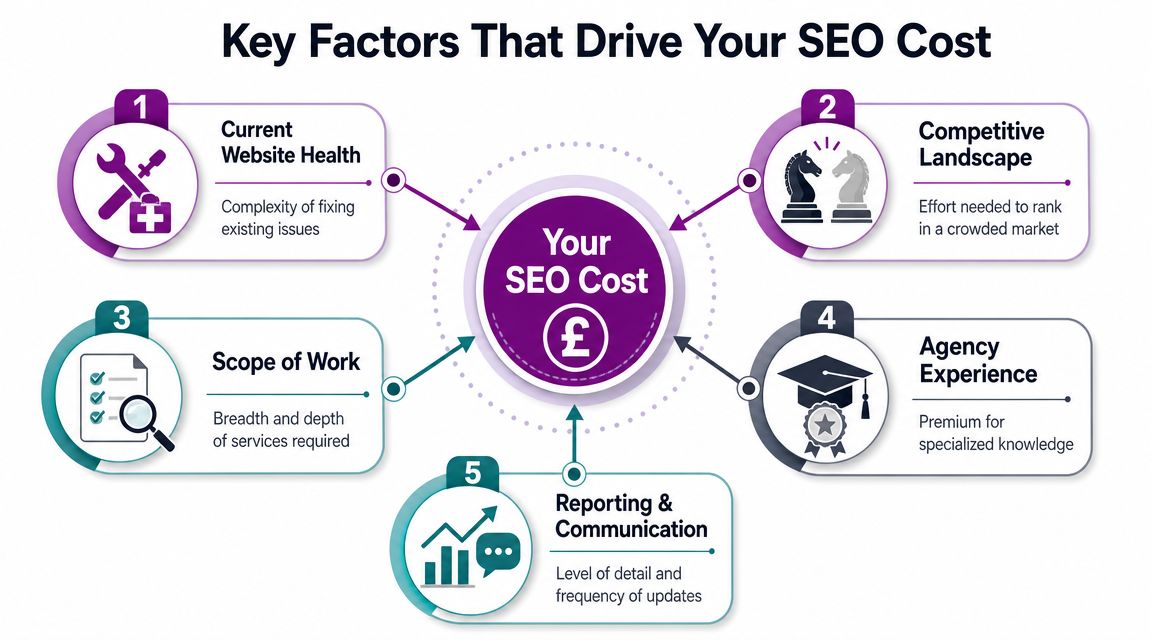
Local versus national scope
Local and national SEO often get grouped together, but they are priced differently because they solve different commercial problems.
For UK businesses, local SEO for one location might start around £300 to £500 per month, competitive local markets often need £1,000 to £1,500 monthly, and broader national campaigns generally rise to £1,500 to £5,000+ per month because they need more content, technical SEO, and link acquisition, according to Red Eagle Tech's UK SEO cost guide.
A local campaign is usually narrower. The work often centres on getting one business visible in one service area, then improving conversion from that traffic. A national campaign has a bigger brief. It may need dozens of service pages, stronger category structure, broader content coverage, and more authority signals to compete across the UK.
The easiest way to judge the gap is to look at the number of moving parts. A plumber targeting Bristol and nearby towns may need a well-managed Google Business Profile, stronger local landing pages, and consistent review generation. A software company targeting the whole UK may need content for multiple buyer intents, technical support across a larger site, and a link strategy that can compete with established publishers and category leaders.
Competition and business model
Industry pressure changes the cost just as much as geography.
A local accountant in a quieter area can often make progress with focused technical cleanup, better service pages, and steady local authority building. A legal firm, finance provider, or ecommerce brand enters a much tougher race. Competitors publish more, attract stronger links, and usually have larger sites with more pages already ranking.
That raises the standard across the whole campaign:
- Content needs to be better targeted: Pages have to match search intent closely and answer the commercial question properly.
- Authority work takes more effort: Stronger competitors usually have deeper backlink profiles and more brand mentions.
- Technical work matters more: Small site issues become expensive when they affect hundreds or thousands of URLs.
- Conversion matters earlier: In costly sectors, poor enquiry handling can waste traffic you paid hard to earn.
Business model shapes the quote too. A firm with one high-margin service and one target region can stay focused. A company expanding into multiple cities, services, or product lines usually needs more pages, more research, and more reporting because each growth area adds workload.
Current website condition
Sometimes the quote reflects growth. Sometimes it reflects repair first.
A site with weak architecture, duplicate pages, thin content, slow templates, tracking gaps, or poor internal linking will absorb budget before rankings improve. That does not mean the quote is inflated. It means the site is starting with technical debt.
I often explain this as the difference between renovating and extending a property. If the foundations are sound, budget goes into visible growth. If the structure has problems, some of the spend goes into fixing what is already there so later work is not wasted.
This is why two firms in the same sector can receive very different proposals. One has a clean site and usable data. The other has years of inherited problems from redesigns, plugins, or old agency work.
Measurement, compliance, and setup work
Many business owners only discover this part after signing. Rankings alone do not tell you whether SEO is producing profitable leads, booked calls, or sales.
If tracking is weak, the agency may first need to set up analytics, dashboarding, call tracking, CRM integration, consent configuration, and reporting logic before performance can be judged properly. Polaris Agency's SEO pricing guide notes that these items are often left out of headline pricing even though they shape how success is measured.
This matters more in the UK than many proposals admit. Cookie consent setup, GA4 event tracking, call attribution, and lead-source reporting all take time to configure properly. On paper, that can look like admin. In practice, it is what stops a business making decisions from incomplete data.
Off-page requirements
Some campaigns stay affordable because on-site improvements are enough to move the needle. That tends to happen in less competitive local markets.
Once competitors have stronger authority, off-page work becomes part of the cost. That can include relevant backlinks, local citations, digital PR, unlinked brand mentions, and broader authority building. If you want a plain-English explanation of why this work appears in some proposals and not others, this guide to what off-page SEO is breaks it down well.
The practical point is simple. Two quotes can promise the same ranking goal, but one includes the authority work needed to make it realistic, while the other leaves that cost for later.
What a UK SEO Package Actually Includes
A monthly retainer only makes sense when you can see the work inside it. "Ongoing SEO" is too vague to price properly. A useful proposal should show what gets done, how often, and why that activity matches the business goal.
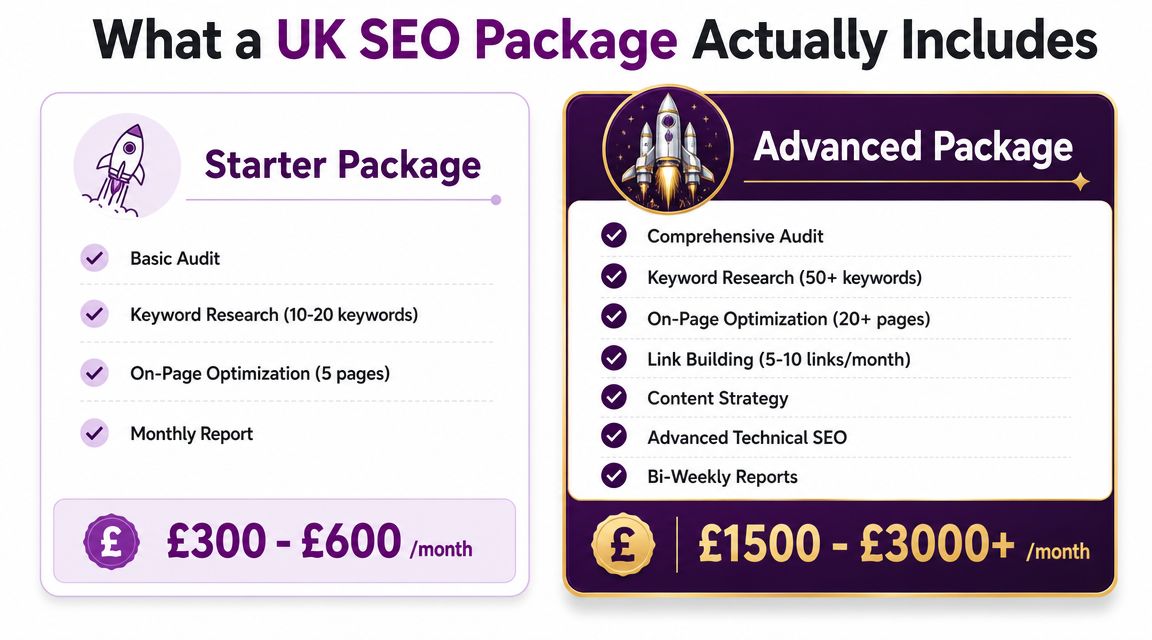
Independent UK pricing guides commonly place small-business SEO at roughly £1,000 to £2,500 per month, with broader monthly retainers often landing between £1,500 and £5,000+, and commentary suggests meaningful strategic investment often starts around £800 to £1,500 per month, based on Rubik Digital's UK SEO pricing guide.
Example one, a local growth package
Take a service business that wants more enquiries from one town and nearby areas. A sensible local package often includes:
- Google Business Profile management: Category checks, service updates, posts, image hygiene, and profile refinement.
- Local landing page work: Improving core service pages and adding area relevance where needed.
- Technical maintenance: Basic crawl checks, indexation review, metadata fixes, internal links.
- Reputation support: Review strategy and visibility around local trust signals.
- Reporting: Clear monthly reporting tied to calls, forms, direction requests, or lead actions where tracking exists.
This sort of package is not trying to rank a site for every broad commercial term in the UK. It's trying to own a practical local footprint where intent is high.
Example two, a national scale package
Now take a business selling across the UK. The package changes shape because the search footprint is wider.
That proposal might include:
- Technical SEO at scale: Deeper auditing, page templates, crawl-path review, structured fixes.
- Content production: New commercial pages, supporting articles, and internal linking plans.
- Authority work: Ongoing outreach and link acquisition to strengthen competitive pages.
- Keyword mapping: Segmenting themes across service, location, and informational intent.
- Deeper reporting: Performance views by page group, lead source, and visibility area.
The monthly fee is higher because more disciplines are active at the same time.
If a package promises local SEO, technical SEO, content, backlinks, CRO, analytics, reporting, and strategy for a very low monthly fee, ask who is doing that work and how many hours actually exist behind it.
What to ask for in any proposal
Before comparing quotes, ask each provider to show the package in plain terms.
A good package outline should include:
- Defined deliverables each month, not just "optimisation"
- Priority pages or keyword groups being targeted
- What is included in reporting
- Whether measurement setup is included or extra
- What the provider needs from your side for approvals and access
For local businesses, one practical option in the market is a provider with defined deliverables around Google Business Profile, location pages, blogs, and authority work. Bare Digital, for example, structures local SEO around those components rather than treating "SEO" as one vague monthly line item.
Understanding SEO ROI and Realistic Timelines
SEO usually disappoints people who expect it to behave like paid ads. It doesn't. Paid media is closer to turning on a tap. SEO is more like improving the plumbing of the whole building so water keeps flowing properly.
That difference matters when you're judging cost.
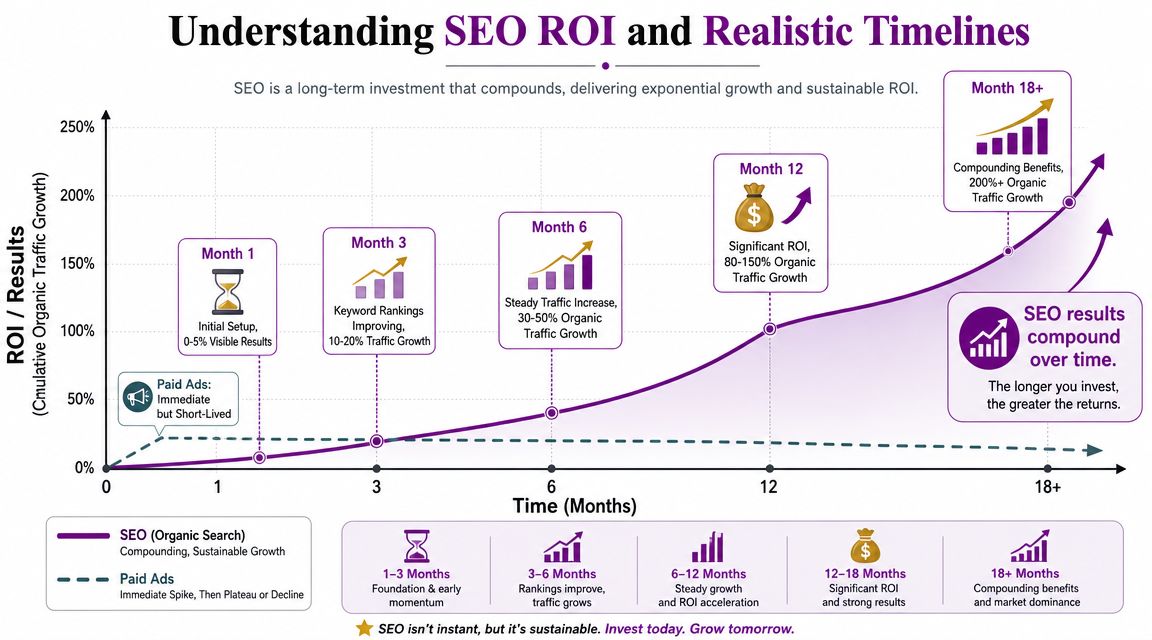
A useful visual explanation sits below.
Why results don't show instantly
In most campaigns, the first stage is not visible growth. It's groundwork.
The provider may be:
- Fixing crawl and indexing issues
- Improving weak commercial pages
- Cleaning internal linking
- Building out content gaps
- Putting measurement in place
None of that guarantees a dramatic jump next month. What it does is give the site a stronger base to perform from.
What ROI should mean in practice
A sensible SEO conversation shouldn't stop at rankings. Business owners need to ask whether the work is improving the things that matter to the company.
That often means looking at:
- Qualified enquiries
- Sales conversations
- Phone calls
- Form submissions
- Lead quality by landing page or location
If a supplier reports only rank movements but can't connect activity to commercial outcomes, the reporting is incomplete.
Why good SEO compounds
Good SEO creates assets. Strong location pages, useful service pages, a better internal link structure, and a healthier technical setup can keep producing value after the initial work is done.
That's why a cheap campaign can be expensive in the wrong way. If it produces thin pages, weak reporting, and no measurement discipline, there isn't much asset value left behind.
SEO usually feels slow at the start because you're building the foundation before the lift appears.
Patience still needs boundaries, though. You should expect a provider to explain what progress looks like before major wins arrive. Indexation improvements, page quality upgrades, stronger local profile signals, and better conversion tracking all matter before rankings move materially.
If you want a more detailed expectation-setting framework, this guide on how long SEO does take to work is a good companion read.
Critical Questions to Ask Any SEO Agency
A strong SEO agency won't be irritated by scrutiny. It should welcome it. Good providers know that most clients have been confused by vague language, recycled audits, or promises that don't survive contact with reality.
The easiest way to protect yourself is to ask questions that expose how the agency thinks.
Ask about local visibility, not just rankings
Many proposals still talk about SEO as if all clicks come from blue links. That's outdated, especially for local businesses. UK businesses increasingly deal with zero-click and map-pack competition, which makes Google Business Profile optimisation and reputation management central for sectors such as trades, healthcare, and venues, as noted in ASL Preservation Solutions' discussion of UK SEO pricing and local search.
Ask:
- How do you approach Google Business Profile visibility?
- What do you do for reviews and local trust signals?
- How do you separate Maps performance from traditional organic performance?
If the agency only talks about page-one rankings and ignores local search surfaces, that's a weak sign for local campaigns.
Ask for method, not slogans
A few direct questions reveal a lot:
-
What will you do in the first three months?
Good answers are specific. Vague answers usually mean a templated service. -
How do you build links or authority signals?
You don't need every outreach detail, but you do need a clear, low-risk method. -
What reporting do I get, and what business metrics do you track?
If reports stop at rankings and traffic, ask how enquiries are measured. -
What isn't included in this fee? Analytics setup, call tracking, or compliance work often appears separately.
Watch for red flags
Some warning signs appear quickly:
- Guaranteed rankings
- No clarity on deliverables
- No mention of measurement
- No ownership clarity for accounts and assets
- Over-focus on vanity metrics
If you're comparing agencies, this checklist for how to choose an SEO company is a practical next read.
Your Next Step to an Accurate SEO Quote
A business owner in Manchester gets two SEO quotes for the same site. One is £600 a month. The other is £2,000. The gap usually comes down to what each provider has scoped, not just how they price.
An accurate SEO quote starts with diagnosis. Target area matters. A local campaign built around Google Business Profile, service pages, and review signals costs very differently from a national campaign that needs deeper content, stronger authority work, and broader technical support. Website condition matters too. So does whether tracking is already in place or still needs to be built.
That last point catches a lot of businesses out. Agencies often headline the monthly retainer and leave out the setup work that makes SEO measurable: GA4 configuration, dashboarding, call tracking, CRM integration, cookie consent updates, and other compliance-related tasks. If those pieces are missing, you can end up paying for traffic without being able to prove which enquiries came from SEO.
Public feedback helps here, especially if you're trying to judge how a provider communicates once the sale is done. Aryan Singh's profile on Testimonial is the kind of reference point buyers use to assess consistency, clarity, and client experience over time.
The next step is simple. Ask for a quote based on your actual website, your real service areas, and the leads or sales you want SEO to generate. A useful proposal should show scope, deliverables, reporting, exclusions, and any one-off setup costs. If it only gives you a monthly fee and broad promises, it is not detailed enough to compare properly.
Bare Digital is a UK-based option for businesses that need local SEO tied to measurable enquiries rather than vague visibility claims. If you want a clear assessment of your current position, you can explore Bare Digital and review whether its local SEO approach, free health check, and activity planning match the scope you need.






