
Before you can even think about climbing to the top of Google, you have to make sure you're in the race. This is a step many UK business owners miss. They launch a beautiful new website and assume Google will find it straight away.
While Google's crawlers are pretty smart, you can't afford to just wait and hope. To really get on the radar and start making progress, you need to open up a direct line of communication with Google itself.
Your Starting Point for Google Visibility
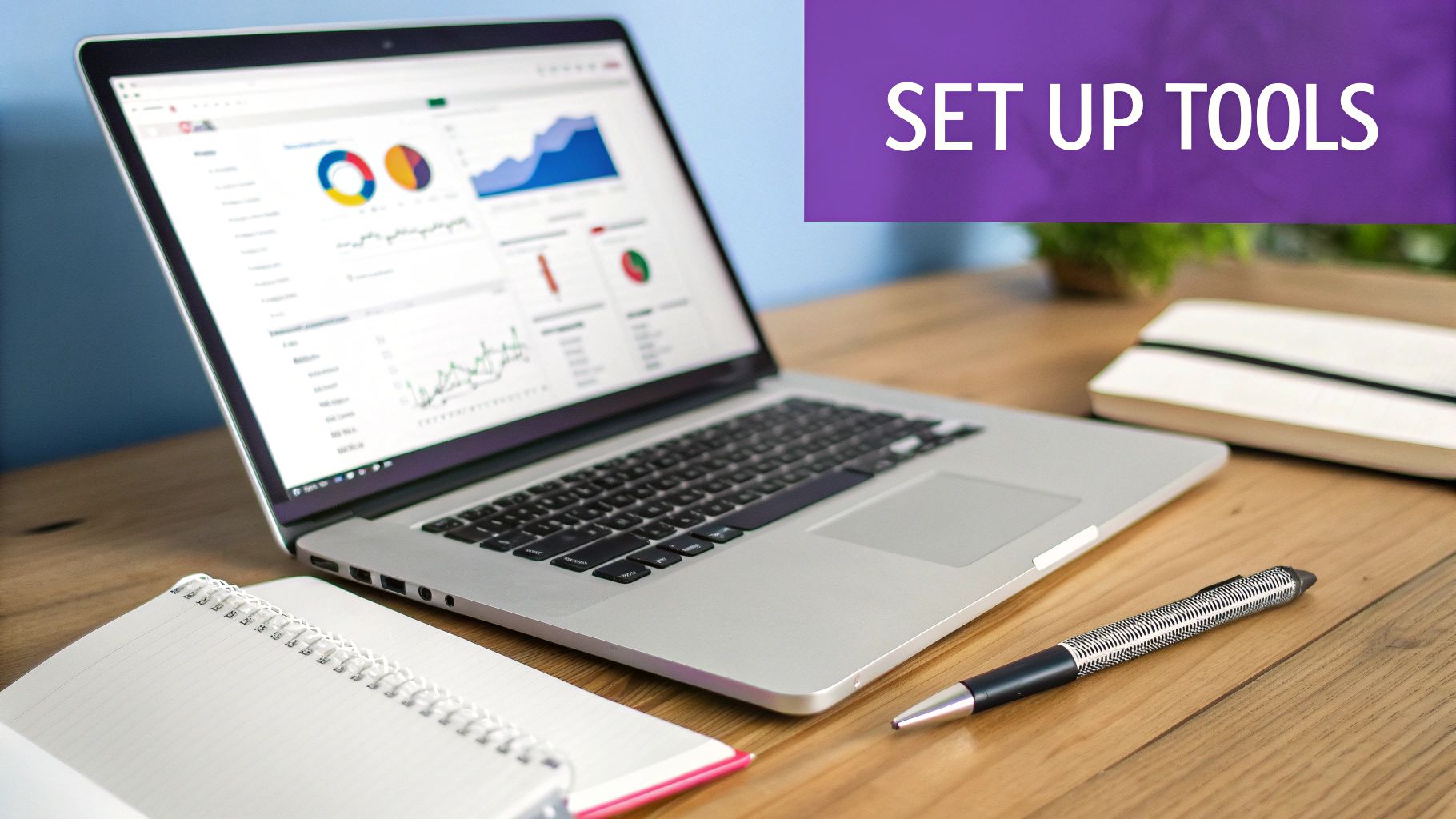
This is where two foundational tools come in, and they're completely free. Getting them set up is non-negotiable for any serious online strategy. We're talking about Google Search Console and Google Analytics.
The Two Pillars of Visibility
Think of Google Search Console as your website's direct hotline to Google. It's the platform where you officially say, "Hello, my website is here, please come and take a look." More importantly, it's where Google will send you alerts if it runs into any technical problems crawling or understanding your site.
Google Analytics, on the other hand, is your audience intelligence hub. Once people start finding you through search, Analytics tells you everything about them. Which pages are they visiting? How long are they sticking around? What actions are they taking?
When you use them together, you get the full picture—from getting seen by Google to understanding what happens when a real person clicks through. Without this data, you're flying blind, making business decisions based on guesswork instead of facts.
Key Takeaway: Don't just launch your website; introduce it to Google. Setting up Search Console and Analytics is the digital equivalent of unlocking your shop's front door and turning on the lights for search engines to see inside.
Why a Sitemap Is Your Digital Map
Once you've got those tools connected, your next job is to submit a sitemap through Search Console. A sitemap is exactly what it sounds like: a map of your website. It’s a simple file that lists all of your important pages, helping Google’s crawlers discover and index them much more efficiently.
This simple action makes sure Google knows about every crucial part of your site, from your core service pages to that blog post you just published. It's a fundamental part of the indexing process—the stage where Google adds your pages to its massive library.
If a page isn't indexed, it simply cannot appear in search results. End of story.
Submitting a sitemap helps prevent your best content from being overlooked. If you're finding this a challenge, it's worth understanding the common reasons why your website is not showing up on Google to diagnose the issue. Getting this right forms the critical foundation for all your future SEO work.
Building a Solid Technical SEO Foundation
Once you've got your direct line to Google set up, the real work begins. You need to make sure its crawlers have a clear, easy path through your website. Think of it like a shop: if the doors are locked or the aisles are cluttered, customers will turn around and leave. Technical SEO is all about tidying up and making sure everything works perfectly for both search engines and your visitors.
Before your brilliantly written content even gets a look-in, your website has to be technically sound. This isn’t about flashy design; it’s about the hidden framework that decides whether you even show up on Google at all. Even tiny technical hitches can put a massive wall between you and your potential customers.
Let's be real: getting seen on Google in the UK means competing in a packed, data-heavy space. As of May 2025, Google’s UK search share was a staggering 93.36%. That huge concentration means a seemingly small technical problem—like a slow-loading page or a site that's clunky on mobile—can quietly make you invisible to over nine out of ten people searching for what you offer.
The Need for Speed and Core Web Vitals
Website speed isn't a minor detail; it's a huge ranking factor. We live in a world of instant gratification, and a slow website is a deal-breaker. Google gets this and rewards sites that give users a fast, smooth experience.
This is where Core Web Vitals enter the picture. These are specific, real-world metrics Google uses to measure how a user experiences your page, focusing on loading speed, how quickly someone can interact with it, and whether things jump around on the screen as it loads. A poor score here can seriously hold back your chances of hitting the first page.
Mobile-Friendliness Is Non-Negotiable
It’s no secret that most searches happen on mobile phones now. Because of this, Google primarily uses the mobile version of your site for indexing and ranking—this is called mobile-first indexing.
If your website is a pain to use on a smartphone, with tiny text and fiddly buttons, you’re not just frustrating people; you're actively tanking your search visibility. A responsive design that just works on any screen size isn’t a nice-to-have anymore. It's absolutely essential if you want to appear on Google.
Expert Insight: A secure, mobile-friendly website that loads quickly is your ticket to the game. Without these foundational pieces in place, everything else you do—from writing great content to building links—will only get you so far.
Secure Your Site with HTTPS
Security is another big signal for Google. An HTTPS connection encrypts the data between your website and your visitors, keeping their information safe. Nowadays, browsers flag any non-HTTPS sites as "Not Secure," which can kill trust in an instant.
Switching to HTTPS is a simple but vital step. It tells both users and search engines that your site is trustworthy, giving you a small but important boost to your ranking potential.
The Importance of a Logical Site Structure
A logical site structure is basically a clear map for both your users and search engine crawlers. When your pages are organised in a sensible hierarchy, it helps Google understand how they relate to each other and figure out what your most important content is.
A well-planned site architecture SEO is crucial. It’s the foundation for a good user experience and makes it easy for crawlers to discover all your pages, which they have to do before they can even think about indexing them.
Finally, make it a habit to check for crawl errors in Google Search Console and double-check your robots.txt file is set up correctly. This file tells Google which parts of your site to look at and which to ignore. One wrong move here could accidentally block Google from crawling your most important pages. For a deeper dive into these checks, our comprehensive technical SEO audit checklist has you covered with a step-by-step guide.
Creating Content That Ranks and Resonates
Once your website’s technical foundations are solid, it’s your content that does the heavy lifting to get you seen. But this isn’t about just churning out blog posts. It’s about building a deliberate strategy to attract and genuinely help your ideal customers, which all starts with figuring out exactly what they’re looking for.
Start With Keyword Research
First things first, you need to uncover the actual phrases your potential customers are typing into Google. This is keyword research, and it’s the bedrock of any content plan worth its salt. Don't guess what people are searching for; use the right tools to find out for sure.
Get into your customer's head. If you’re a plumber in Cambridge, you’re not just going after "plumber." You should be digging into longer, more specific phrases like "emergency boiler repair Cambridge" or "how much to fix a leaking tap UK." These longer phrases, known as long-tail keywords, almost always have less competition and attract people who are much closer to making a decision.
Understand Search Intent
Beyond the words themselves, you have to get to grips with the why behind the search. We call this search intent. Is the person trying to learn something, buy something, or find a specific place?
For example, someone searching for "best running shoes for marathon" is in a completely different headspace than someone searching for "buy Nike Pegasus size 9." The first query needs a helpful, informative guide. The second needs a straight shot to a product page.
Key Takeaway: Matching your content to the search intent is non-negotiable. If you serve up a detailed article to someone who just wants to buy, they’ll leave. Show a product page to someone who needs advice, and they’ll bounce right off. Google has become incredibly good at figuring this out, and it rewards pages that nail the user's goal.
Master Your On-Page Optimisation
After you've identified your keywords and the intent driving them, you need to weave them into your content naturally. This is what we call on-page optimisation. It’s how you send clear signals to Google about what your page is about, making it far easier for them to rank it for the right searches.
This involves getting several key elements right for every single page you publish. Each one plays a part in telling both Google and your readers that your content is relevant and valuable. Skipping these details is one of the quickest ways to stay invisible in the search results.
The diagram below shows the core technical elements that your on-page efforts are built on.
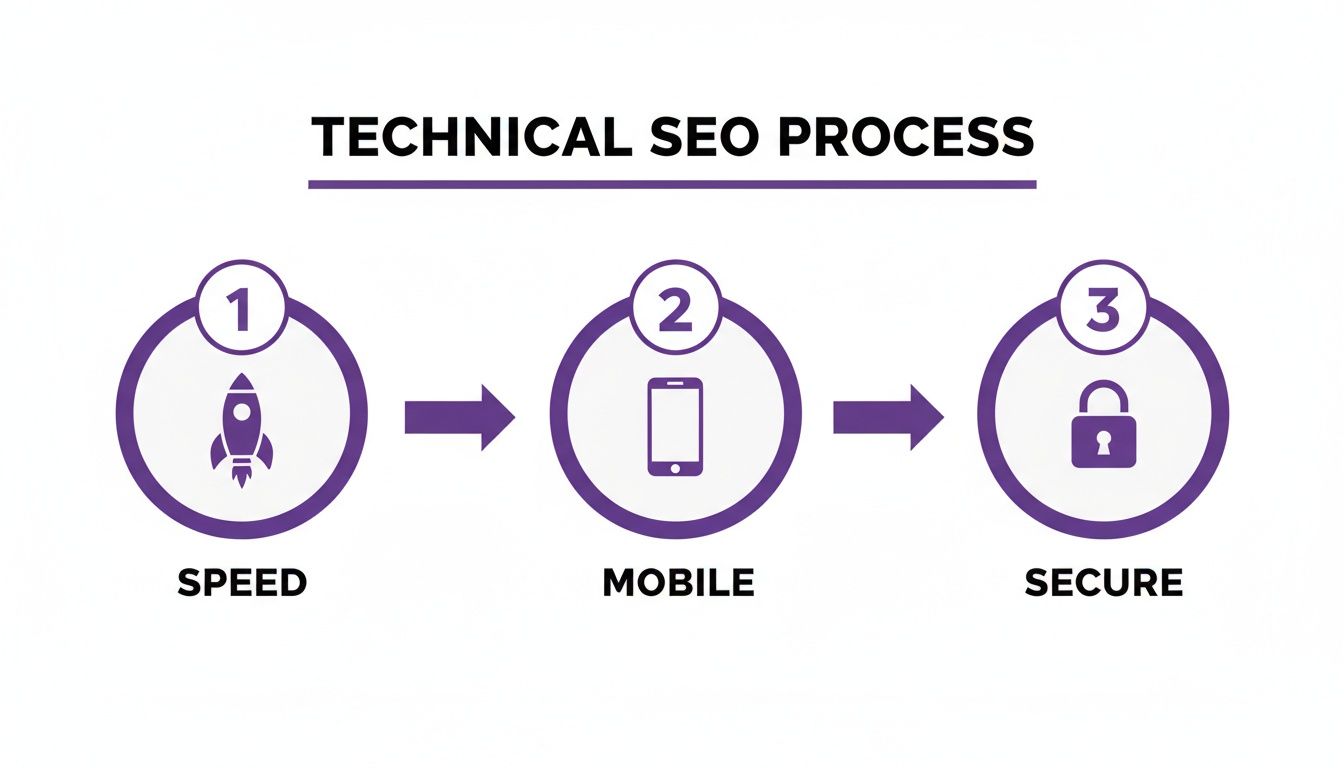
This process highlights that a speedy, mobile-friendly, and secure site forms the technical bedrock for your content. Without these in place, even the most perfectly optimised page can fail to perform.
On-Page SEO Optimisation Checklist
To make this easier, here’s a quick-reference table outlining the essentials. Think of it as a pre-flight check before you hit "publish" on any new page or post.
| On-Page Element | What It Is | Why It Matters for Google | Quick Tip |
|---|---|---|---|
| Title Tag | The clickable blue headline in Google's search results. | It's a primary signal for relevance and a huge factor in click-through rates. | Keep it under 60 characters, include your main keyword, and make it compelling. |
| Meta Description | The short text snippet that appears under your title tag. | While not a direct ranking factor, it acts as an ad for your page, boosting clicks. | Write it like an advert. Make it relevant, engaging, and include a call to action. |
| Headings (H1, H2s) | The structural titles and subtitles within your content. | They create a logical hierarchy for readers and help Google understand the page structure. | Use one H1 per page for the main title. Use H2s and H3s for sub-topics. |
| Image Alt Text | A text description of an image for screen readers and search engines. | It improves accessibility and gives you another spot to include relevant keywords. | Be descriptive and concise. Describe what's in the image. |
| Natural Keyword Use | Placing your keywords thoughtfully within your main body text. | Shows Google your content is highly relevant without looking spammy. | Write for humans first. Avoid "keyword stuffing" at all costs. |
Getting these elements right consistently will put you miles ahead of the competition.
Ultimately, your goal is to become a trusted resource. When you consistently create content that genuinely helps people solve their problems, Google's algorithms are built to recognise that value and reward you for it. To see how all these pieces fit together, you can learn more about how to create a content strategy that drives tangible results.
Winning Local Search with Google Business Profile
For any UK business with a physical address or a local service area, getting your website's technical and on-page SEO right is only half the battle. The real prize is winning in local search—that coveted 'map pack' that pops up for searches like "cafe near me" or "electrician in Cambridge."
This is where your Google Business Profile (GBP) becomes your most powerful free marketing tool.
Appearing here is non-negotiable. With Google commanding around 93.25% of all search engine usage in the UK as of early 2025, being invisible on local search means you’re invisible to almost all your potential customers.
Setting Up Your Profile for Success
Your first job is to either claim your existing profile or create a new one, then fill out every single section. Don't just pop your business name in and call it a day. Google needs details. Choose the most accurate primary category for your business, then add any relevant secondary categories to paint a full picture of what you do.
Write a compelling business description that doesn’t just stuff in keywords but actually tells your story. Make sure your opening hours, services, and any special attributes (like wheelchair accessibility or free Wi-Fi) are listed. The more complete your profile is, the more signals you send to Google that you're a legitimate, active business worth showing to people.
It’s one thing to be visible, but it’s another to turn that visibility into customers. That’s why it’s so important to learn how to optimize your Google Business Profile for conversions from the get-go.
The Power of NAP Consistency
One of the most crucial, yet surprisingly overlooked, parts of local SEO is NAP consistency. This simply stands for your Name, Address, and Phone number. These three details must be absolutely identical everywhere they appear online, from your own website to local directories and social media.
Even tiny differences—like "Ltd" versus "Limited" or "Road" versus "Rd"—can create confusion for search engines and weaken your local authority. Google relies on this consistency to verify that you are who you say you are, and that you're based where you claim to be.
Key Insight: Think of your NAP as your business's digital fingerprint. When it's consistent across the web, Google’s trust in you grows. If it’s a messy, inconsistent jumble, that trust erodes, and so do your chances of ranking in the map pack.
Encouraging and Managing Customer Reviews
Reviews are the lifeblood of a local business profile. They provide powerful social proof to potential customers and are a huge ranking factor for Google. You should be actively (and ethically) encouraging your happy customers to leave feedback.
But just getting reviews isn't enough. Responding to every single one—good or bad—is critical. A thoughtful reply to a positive review shows you value your customers. A professional and helpful response to a negative one demonstrates excellent customer service and can often resolve a situation in public view.
Keeping Your Profile Active and Engaging
A static, forgotten profile is a dead profile. Google loves to see activity, so you need to use the tools it gives you to keep your listing fresh and engaging.
- Google Posts: Share updates, special offers, events, or new products directly on your profile. These posts show up in search results and signal that your business is active and current.
- Q&A Section: Don't wait for customers to ask questions. Proactively add your own FAQs and answer them yourself. This lets you control the narrative and provide useful information upfront.
- High-Quality Photos: Regularly upload clear, professional photos of your shop, your team at work, and your products or services. Showing your business visually helps build trust and drives engagement.
Fully optimising your profile is an ongoing job, but the payoff in local visibility is immense. If you need a hand getting it right, our specialised Google Business Profile optimisation services can make sure you’re squeezing every drop of value from this essential tool.
Building Authority with Quality Backlinks
So far, we’ve spent our time tweaking and polishing the digital property you have full control over: your own website. But to really start climbing the ranks for those competitive searches, you need to pay attention to what other websites are saying about you. That’s where backlinks come in.
A backlink is just a link from someone else’s website pointing to yours. In Google’s world, each of these links is like a vote of confidence. When a relevant, respected website links to your content, it sends a powerful signal that your site is trustworthy and deserves a better spot in the search results.
But not all votes are equal. The game has changed completely over the years—it’s no longer about hoarding as many links as you can get. Today, the focus is all on quality over quantity.
Key Takeaway: A single, authoritative backlink from a well-respected industry blog or a local Cambridgeshire news outlet will do more for your search visibility than hundreds of dodgy, irrelevant links from spammy websites.
Earning Links the Right Way
So, how do you get these valuable digital endorsements without using risky, outdated tricks that could get your site penalised? The answer is to earn them naturally by creating something genuinely useful. This isn't a quick fix, but it's a long-term strategy that builds a rock-solid online reputation.
Start by thinking local. For a UK business, one of the best ways to earn natural backlinks is to create a genuinely valuable local resource.
-
Example 1: The Local Resource Hub: Let's say you're a Cambridgeshire estate agent. You could put together a detailed guide to the "Best Primary Schools in Cambridge," complete with catchment area maps, Ofsted ratings, and comments from parents. This is the kind of incredibly useful content that local parenting blogs, community forums, and even local news sites would be happy to link to.
-
Example 2: The Industry Survey: A local IT support company could survey 100 small businesses in the area about their biggest cybersecurity worries and publish the results. This original data becomes a unique asset that industry publications and business groups will want to reference and link back to.
Building Relationships to Expand Your Reach
Beyond just creating link-worthy content, building relationships is a huge part of any good link-building effort. This means getting proactive with outreach, but it has to be done with care and a focus on what’s in it for them, too.
One of the most classic methods is guest posting. This is where you write a high-quality article for another website in your industry. In return for your great content, you usually get a link back to your own site, often in your author bio. Not only does this get you a backlink, but it puts your brand in front of a whole new, relevant audience.
And don't forget the power of your local connections. Building relationships with local bloggers, journalists, and other business owners can lead to natural mentions and links over time. A simple collaboration on a local event or a shared social media campaign can open the door to digital PR opportunities that boost your authority in Google’s eyes.
How to Measure Your SEO Success
SEO isn’t a one-and-done job; it's a constant loop of doing, measuring, and tweaking. If you're not tracking your performance, you're just guessing. This is where the tools we set up earlier—Google Search Console and Google Analytics—really start to pay off, turning your efforts into a marketing channel you can actually measure.
These platforms give you the hard data to see what’s working and what’s falling flat. Instead of wondering if your strategy is making a difference, you can see the results in black and white. That's how you make smart, data-driven decisions that lead to real, sustainable online growth.
Key Metrics to Monitor in Search Console
Think of Google Search Console as your direct line to Google. It gives you the raw data on how your site is seen by the search engine, stripping away all the noise.
Here are the essential metrics you need to keep an eye on:
- Total Impressions: This is simply how many times your site popped up in search results. Seeing this number climb is a fantastic sign that your optimisation work is boosting your overall visibility.
- Total Clicks: This is the count of people who actually clicked on your link from the search results. It’s a direct measure of how well your title tags and meta descriptions are grabbing attention.
- Average Click-Through Rate (CTR): This percentage tells you how good your listings are at convincing people to click. A low CTR could be a sign that your headlines aren’t compelling enough to stand out.
- Average Position: This tracks your site’s average ranking across different keywords. Watching this helps you see if you're making your way up the search engine results pages.
Expert Insight: Don’t just glance at the big-picture numbers. Get into the ‘Performance’ report and see exactly which pages and search queries are bringing in the traffic. This is where you’ll spot your star content and find hidden opportunities to improve.
Looking back, being on Google has always been non-negotiable. Between 2015 and 2025, Google has consistently dominated the UK search market. For us on the ground, this history tells us one thing: while the algorithm will always change, Google is still the main way UK customers will find you. You can discover more insights about Google's UK market share on Statista.com.
Got Questions? We've Got Answers
Even with the best plan, you’re bound to have a few questions as you work on getting your website noticed by Google. It’s completely normal. Here are some of the most common ones we get from UK businesses, with straightforward answers to clear things up.
How Long Does It Take to Appear on Google?
This is the big one, and the honest answer is: it’s not instant. When you launch a brand new site, it can take Google anywhere from a few days to several weeks just to find and index it. You can give Google a nudge by submitting your sitemap through Google Search Console, which we always recommend.
But getting indexed is just the first step. The real goal is to rank for keywords that actually bring in customers, and that process often takes months of consistent work. This means regularly creating good content, keeping your site technically sound, and building its authority over time. It’s a marathon, not a sprint, so patience is key.
Why Has My Website Vanished from Google Search?
Seeing your site disappear from Google can be a heart-stopping moment, but there's usually a logical explanation. It could be something technical, like an accidental 'noindex' tag that's telling Google to stay away, or a crawlability issue that’s blocking the search engine bots.
It could also be the result of a Google algorithm update, which can shake up the rankings, or even a manual penalty if your site has violated Google's guidelines.
First Step: Before you panic, head straight to Google Search Console. It’s your best friend in this situation. It will flag any manual actions, crawl errors, or security problems, giving you a clear starting point to figure out what’s gone wrong.
Do I Have to Pay to Be on Google Search?
No, you absolutely do not have to pay to show up in Google's organic search results. The entire practice of getting your site indexed and ranked is based on the SEO principles we've covered, and it's fundamentally free.
The paid part is Google Ads, which is Google's advertising platform. This is where you can pay for your ads to appear right at the top of the results page. While paid ads give you immediate visibility, building your organic presence through SEO is a far more sustainable and, in many cases, more trusted way to attract traffic in the long run.
Should I Focus on Local SEO or General SEO?
This really comes down to who your customers are. If your business serves a specific geographic area—say, you're a local shop or a tradesperson in Cambridgeshire—then local SEO is critical. Your top priority should be optimising your Google Business Profile and targeting keywords that people in your area are searching for.
On the other hand, if you run a national e-commerce store or offer services without physical boundaries, your focus will naturally be broader. That said, many UK businesses find a hybrid approach works best, allowing them to secure their local patch while also competing for those wider national search terms.
Feeling a bit lost in the weeds? Let the experts handle it. At Bare Digital, our entire focus is on making businesses like yours impossible for Google to ignore. We kick off every partnership with a free, no-obligation SEO Health Check to show you exactly where the low-hanging fruit and biggest opportunities are.