
Staring at your website, wondering where on earth to even begin? It’s a common feeling. The most effective way to enhance a website is to follow a proven, three-part framework: Audit your current performance, Enhance key areas like speed and SEO, and finally, implement strategies to Grow your audience and conversions. This simple, repeatable process turns a daunting task into a manageable project with measurable results.
Your Framework for High-Impact Website Enhancement
Wondering how to improve your website without getting lost in a fog of technical jargon? The secret is to stop seeing it as one massive, overwhelming project. Instead, think of it as a continuous cycle of improvement. A high-impact website enhancement framework always puts the visitor first. Understanding and implementing top user experience best practices is the absolute foundation for creating a site that genuinely connects with your audience and turns clicks into customers.
This process breaks a complex job down into three core stages, giving you a clear path from analysis to growth.
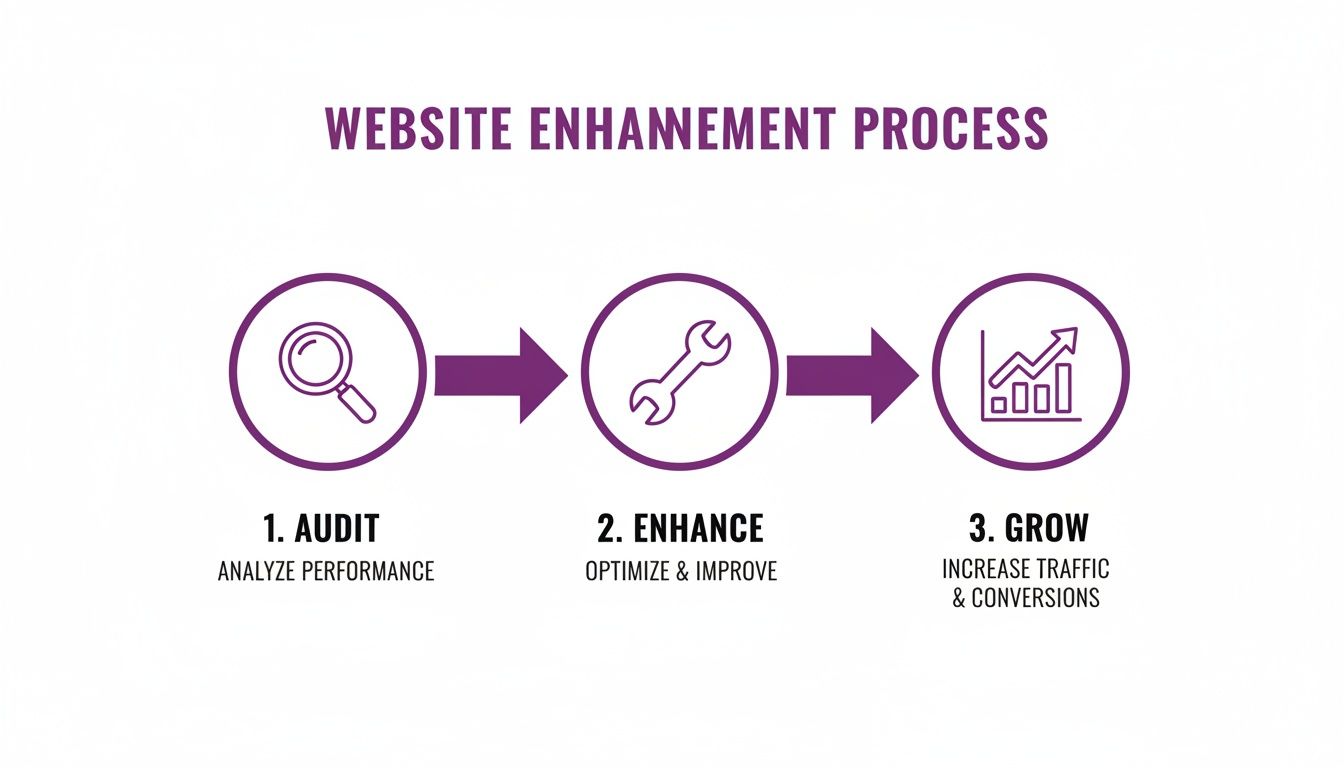
This visual shows the fundamental workflow we use for any successful website project, moving from diagnosis to action and then to expansion. The first step, without fail, is to understand exactly where you are right now before you change a single thing.
The Audit, Enhance, and Grow Cycle
This cyclical approach ensures your efforts are strategic, not just random shots in the dark. It’s a constant loop: you audit to find the problems, enhance to fix them, and then grow based on those solid improvements. This inevitably leads you back to a new audit to measure your progress and pinpoint the next big opportunity.
Your website is not a static brochure; it’s a dynamic tool for business growth. Treating it as such means committing to a process of ongoing refinement, not just a one-off redesign.
For a UK business, this framework is especially powerful. Whether you're a wedding venue in the Cotswolds or a construction firm in Manchester, this model helps you prioritise the changes that will deliver the biggest local impact. It forces you to focus on what matters most to your customers, right here, right now.
Here’s a quick breakdown of the three pillars:
- Audit: This is your diagnostic phase. You'll dive into site speed, mobile usability, on-page SEO, and local search performance. The goal isn't just to find flaws but to create a prioritised hit list of weaknesses and opportunities.
- Enhance: This is where you roll up your sleeves. Based on your audit, you’ll implement technical fixes, optimise your content, and sharpen the user experience. This could mean anything from compressing images and rewriting page titles to supercharging your Google Business Profile.
- Grow: With a solid foundation in place, the focus shifts to expansion. This involves smart content strategy, building your site's authority, and conversion rate optimisation to attract more of the right visitors and turn them into paying customers.
This guide provides a battle-tested roadmap. If you're keen to see how these principles could be applied to your business, it's worth exploring how a dedicated UK-based local SEO agency can turn your digital presence into a proper lead-generation engine.
Winning the Local Search Game with Targeted UK SEO
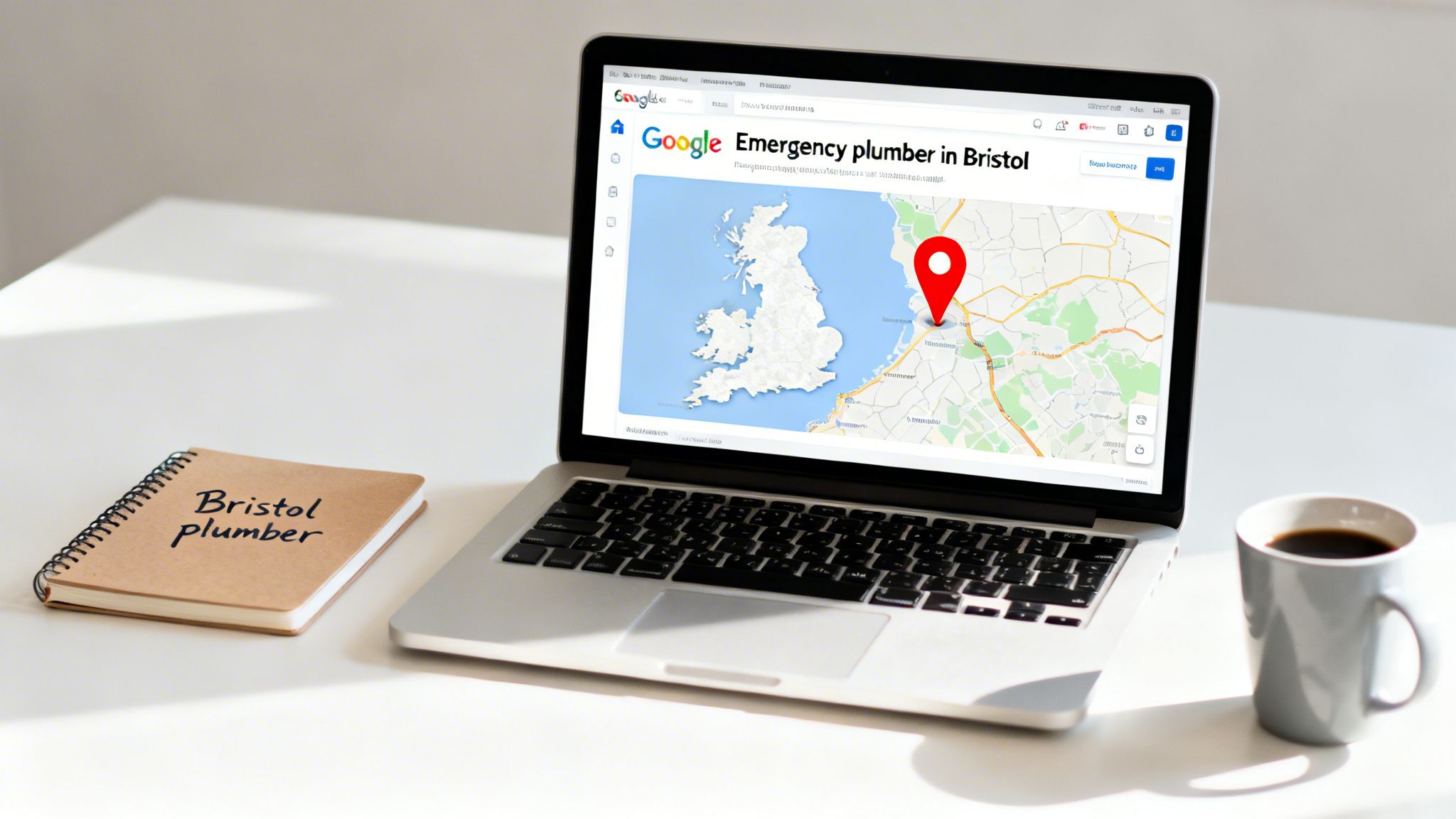
For any UK business that serves a specific area, local search isn't just another marketing channel. It's the whole game. When someone’s boiler breaks, they don't just search for a "plumber"; they search for an "emergency plumber in Bristol." This is where local SEO makes all the difference, turning that desperate online search into an actual phone call.
At the absolute heart of this is your Google Business Profile (GBP). It's that free listing on Google Maps and search that’s often the very first thing a potential customer sees. Just claiming it and walking away isn't enough. To really get seen, you need to treat your GBP as a dynamic, constantly updated mini-website.
Supercharge Your Google Business Profile
An incomplete or outdated GBP is a massive missed opportunity. Your goal should be to fill out every single section you can. It’s about giving Google—and your customers—the richest possible picture of what you do.
Think about it from their perspective. They see two local businesses on Google Maps. One has recent offers, customer photos, and a lively Q&A section. The other just has an address and phone number. Which one are they going to trust?
Here’s where to focus your efforts for the biggest impact:
- Google Posts: Use these just like a social media feed. Announce special offers, highlight new services, or share company news. Posts expire, so regular updates show Google your profile is active and looked after.
- Seed Your Q&A: Don't just wait for people to ask questions. Get ahead of the game by adding your own common FAQs and answering them yourself. Think about parking, accessibility, pricing, or booking policies—anything that removes a barrier for a customer.
- Maximise Service Attributes: Go deep into your GBP dashboard and tick every single attribute that applies to your business. For a pub, this could be "Outdoor seating" or "Dog-friendly." For a tradesperson, it might be "Free estimates" or "24-hour call-outs." These details help you show up for more specific, filtered searches.
A fully optimised Google Business Profile is your most powerful tool for dominating the Google Maps 'local pack'. It builds trust and provides instant answers, directly influencing a user's decision to contact you over a competitor.
This attention to detail really does pay off. Good local SEO directly impacts your bottom line. While the UK’s average online shopping conversion rate sits around 3.1%, organic search consistently brings in a solid 2.7% across all sectors. For local service businesses, that often translates into a steady stream of high-quality leads that are much easier to close.
Create Powerful Location-Specific Pages
If your business has more than one branch, a generic "our locations" page with a list of addresses just won't cut it anymore. Each location needs its own dedicated, unique page on your website. This is absolutely critical if you want to rank for area-specific searches like "solicitors in Cambridge" or "wedding photographer Cotswolds."
These pages can't just be thin copies with the city name swapped out. To actually work, each one needs to provide unique, local value.
Essential Elements for a High-Converting Location Page:
| Element | Why It Matters | Example |
|---|---|---|
| Unique Content | Avoids duplicate content issues and speaks directly to the local audience. | Mention local landmarks, community events you’re involved in, or specific client challenges in that area (e.g., "Navigating planning permission in Manchester"). |
| Local Testimonials | Builds immense trust by showing that people in their community have used and valued your services. | Include a photo and the town of the reviewer (e.g., "Jane D., from Harrogate"). |
| Embedded Google Map | Visually confirms your location and sends strong local signals to search engines. | An interactive map showing your exact pin for that office or shop. |
| Local Schema Markup | Gives search engines structured data about your location, improving how your listing is displayed. | This code tells Google your address, phone number, and opening hours for that specific branch. |
| Clear CTAs | Make it dead simple for visitors to take the next step. | Use location-specific calls-to-action like "Call our Leeds office" or "Get a quote in Bristol." |
By creating these rich, localised pages, you're building a powerful network of digital front doors. Each page acts as a targeted landing zone for customers in a specific area, dramatically improving your chances of turning that search into a sale. For more structured guidance on this, our comprehensive local SEO checklist can help you ensure no stone is left unturned. This is how you stop competing nationally and start winning locally.
Mastering Site Speed and Mobile-First Experiences
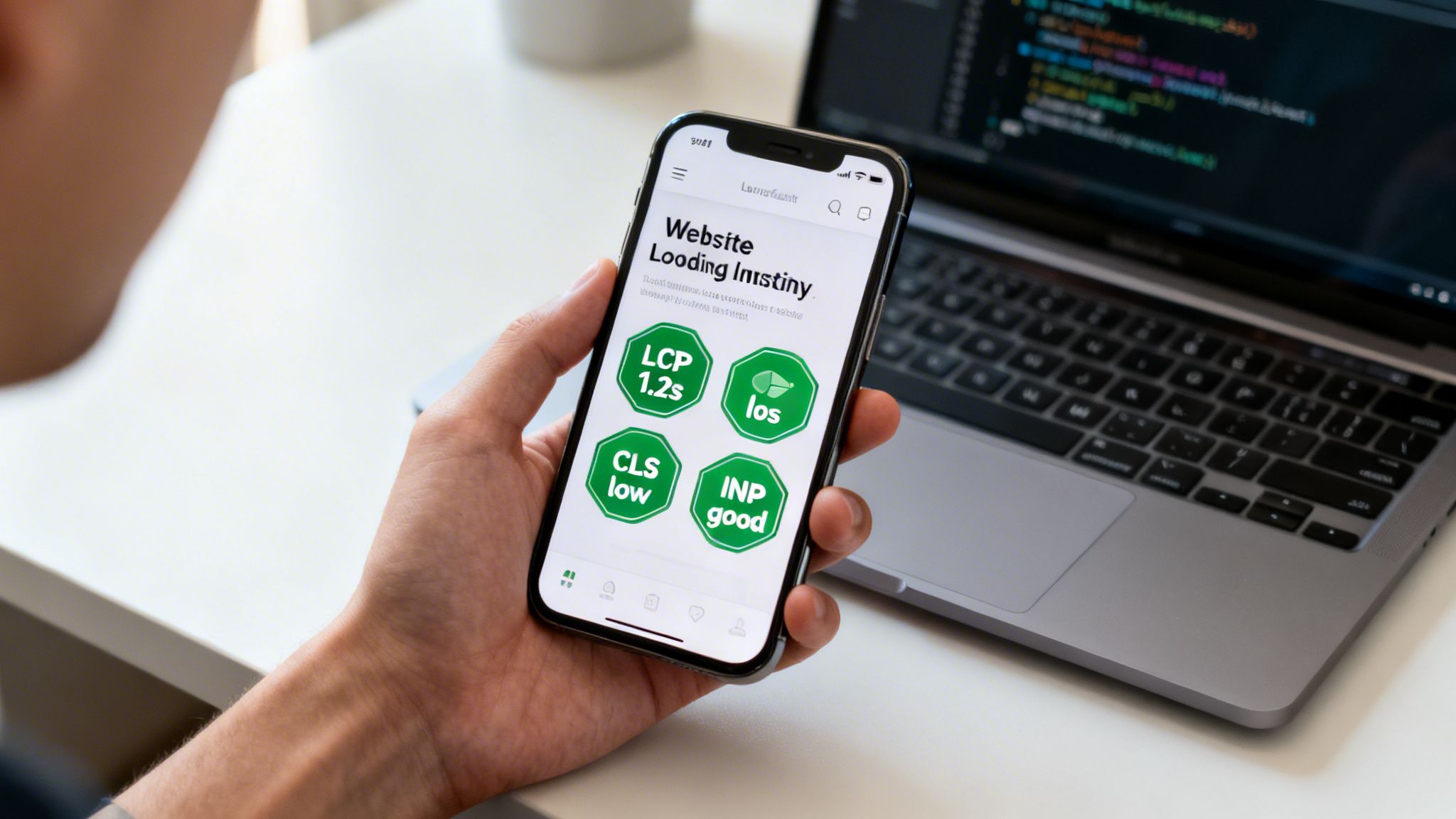
Let's be blunt. A beautiful website that’s slow, clunky, or impossible to use on a phone is worthless. Poor technical performance isn't just an IT headache; it's a leaky bucket for your business, losing you customers before they’ve even seen what you have to offer.
This is where the less glamorous but absolutely critical work begins. Nailing your site’s speed and mobile experience is the foundation of any real-world website enhancement. It all starts with how fast your site loads.
Decoding Google’s Core Web Vitals
You’ve probably heard talk of Google's Core Web Vitals (CWV). These aren’t just technical jargon; they’re Google's way of measuring the actual experience someone has on your page. Passing these vitals isn't about pleasing an algorithm—it’s about making sure your site doesn't frustrate visitors into leaving.
Let's break them down into plain English.
Largest Contentful Paint (LCP) is all about perceived loading speed. It measures how long it takes for the main event on the screen—usually a big image or a block of text—to appear. Your target is under 2.5 seconds. Any longer, and people start wondering if your site is broken.
Interaction to Next Paint (INP) looks at responsiveness. When someone clicks a button or opens a menu, how quickly does the page react? INP measures that delay. A slow response makes a site feel sluggish and is a huge source of user frustration.
Cumulative Layout Shift (CLS) tackles visual stability. Ever tried to tap a button on your phone, only for an ad to load and push everything down, causing you to misclick? That jarring movement is a layout shift, and CLS measures how much it happens.
Improving these scores is often about getting the basics right. We've put together a simple checklist to get you started on the most impactful actions.
Core Web Vitals Improvement Checklist
This prioritised checklist covers the key actions you can take to improve your website's Core Web Vitals scores. Focusing on these will have a direct, positive impact on user experience and, in turn, your SEO rankings.
| Priority | Action Item | Impact Area | Simple Tool to Check |
|---|---|---|---|
| High | Compress images to reduce file size | LCP | TinyPNG |
| High | Implement a good caching policy | LCP | PageSpeed Insights |
| Medium | Minify CSS, JavaScript, and HTML files | LCP, INP | PageSpeed Insights |
| Medium | Optimise server response times (hosting) | LCP | PageSpeed Insights |
| Low | Preload key resources like fonts | LCP, CLS | PageSpeed Insights |
Working through these technical fixes, starting with the high-priority items, will give you the biggest wins in the shortest time. A faster site delivers a better user experience and, ultimately, leads to more conversions.
Your goal should be a load time of under three seconds. Every second of delay significantly increases the probability of a user abandoning your site. A faster site equals a better user experience and, ultimately, more conversions.
Another powerful fix is a code clean-up. Over time, websites accumulate messy, unnecessary code—especially from plugins and old features—that grinds everything to a halt. A developer can help you minify your CSS, JavaScript, and HTML files, which simply means stripping out all the redundant characters to make them lighter and faster.
Embracing a True Mobile-First Mindset
With most of your UK customers now finding you on their smartphones, a mobile-friendly site is non-negotiable. But "mobile-friendly" doesn't just mean your site shrinks to fit a smaller screen. It means designing the entire experience from the ground up with a mobile user in mind.
This mobile-first approach is your golden ticket to boosting conversions. Data from across the UK reveals a clear gap: mobile conversion rates hover around 2%, while desktop sits higher at 2.6%. Closing that gap is a huge opportunity.
Here’s how to put that mobile-first philosophy into practice:
- Thumb-Friendly Navigation: People use their thumbs to get around on a phone. Make sure your key buttons and calls-to-action are large and easy to reach. Avoid tiny links clustered together.
- Simplified Forms: Filling out long, complicated forms on a small screen is a major conversion killer. Keep your contact forms as short as humanly possible. Only ask for the absolute essentials.
- Prominent Click-to-Call Buttons: A mobile user is often ready to act right now. Make your phone number a clickable button that’s always visible so they can call you with a single tap.
- Legible Text and Spacing: Don’t force people to pinch and zoom just to read your content. Use a decent font size and ensure there’s enough white space between paragraphs to stop the page feeling cramped.
By focusing on these practical technical and mobile enhancements, you're not just tidying up your website. You're removing the barriers standing between you and your next customer. For a deeper dive into improving your search presence, our insights on SEO services for Cambridge-based businesses offer more specialised strategies.
Building Authority with Expert Content and Links
With your site’s technical and local SEO in order, it’s time to move on to the elements that build genuine, lasting authority. This is where we shift from fixing what's already there to creating new assets that actively attract and persuade your ideal customers.
This really boils down to a two-pronged attack. First, you create genuinely helpful content that answers the biggest questions your customers have. Then, you go out and earn high-quality links from other respected websites, which act as powerful votes of confidence in your expertise.
Develop a Content Plan That Answers Real Questions
Great content has nothing to do with stuffing keywords into a page. It's all about positioning your business as the undisputed expert in your field. To do this, you need to get inside the heads of your ideal customers—understand their problems, their worries, and their questions—and then create detailed resources that solve them.
Think well beyond your basic service descriptions. The goal here is to build out in-depth service pages, insightful blog posts, and compelling case studies that prove your value long before a potential customer even thinks about picking up the phone.
For instance, a UK business could create hyper-specific, valuable content like this:
- An architect in London: Could write an in-depth guide titled, 'Navigating Planning Permission in the Royal Borough of Kensington and Chelsea'.
- A caterer in Scotland: Might create a visually rich post on 'Seasonal Wedding Menus Featuring the Best of Scottish Produce'.
- A construction firm in Manchester: Could publish a case study, 'A Step-by-Step Look at Our Latest Loft Conversion in Didsbury'.
This approach works because it’s authentic. It shows you understand your customers' world and have the expertise to help. A fantastic way to start is by simply brainstorming the top ten questions you get asked during initial consultations and turning each one into a detailed blog post. We cover this in much more depth in our guide to SEO for photographers, which explores how killer content can attract premium clients.
A strategic blog is one of your most powerful assets. It allows you to rank for a wider range of keywords, establishes your authority, provides content for social media, and becomes a magnet for earning valuable backlinks.
This is a long-term play, so don't expect overnight miracles. But consistently publishing one or two high-quality pieces of content each month creates a powerful compounding effect. Over 3 to 12 months, you’ll build a library of resources that works for you 24/7, continually attracting qualified leads.
Earning Links That Drive Traffic and Trust
Once you have great content, you can start focusing on the other side of the coin: link building. A backlink is simply a link from another website to yours. Search engines like Google see these as endorsements. The more links you have from high-quality, relevant websites, the more authoritative your own site appears to be.
The operative word here is quality. A single link from a respected industry publication or a well-known local business is worth a hundred links from spammy, low-quality directories.
Here are a few sustainable tactics for earning these valuable links:
- Local Digital PR: Share your expert content with local news outlets, bloggers, and community groups. If that architect's guide to planning permission is genuinely useful, a local property blog will likely be happy to link to it.
- Partner and Supplier Links: Do you work closely with other local businesses? A wedding venue could link to its preferred caterers, florists, and photographers, creating a powerful local referral network.
- Guest Blogging: Offer to write an expert article for a relevant, non-competing business's blog. In return, you get an author bio with a link back to your site.
These links do more than just boost your search rankings. They drive valuable referral traffic—people who are often highly motivated to become customers. In fact, some recent analysis points to referral traffic having a potential conversion rate of 5.4% in 2025, making it a top performer.
For businesses built on trust, like funeral homes or caterers, earning high-quality backlinks can push referral conversions towards that 5% mark, turning visibility directly into sales. You can explore more about these figures in the latest e-commerce conversion rate statistics.
Turning Clicks into Customers with Smart CRO

Getting visitors to your website is only half the job. If that traffic doesn’t turn into genuine enquiries, bookings, or sales, then all your hard work is going to waste. This is where Conversion Rate Optimisation (CRO) steps in—the art and science of turning more of your website visitors into paying customers.
For a local service business, CRO isn’t about sinking money into complex A/B testing software or hiring a huge data team. It’s about applying smart, practical principles to guide your visitors towards taking the action you want them to take. A big part of this is knowing how to optimize landing pages for higher conversions and ROI, making sure every click has the best possible chance of becoming a lead.
It all boils down to making it painfully obvious what you want the user to do next.
Craft Compelling Calls to Action
Your Call-to-Action (CTA) is the single most important signpost on your page. Passive, generic phrases like "Learn More" or "Submit" are weak and completely uninspiring. A powerful CTA needs to be specific, action-oriented, and speak directly to what the user wants to achieve.
Instead of vague requests, you need to guide them with absolute clarity.
- For a local builder: "Request a Free Quote" is miles better than "Contact Us."
- For a business consultant: "Book Your Free Consultation" beats "Get in Touch" every time.
- For a wedding photographer: "Check My Availability" is far more compelling than a generic "Enquire."
These small tweaks in language make a massive difference because they align the action with the user's intent, dramatically increasing the odds they'll click. The button itself should pop with a contrasting colour and be placed front and centre where it can't be missed.
Build Instant Trust with Social Proof
Before a potential customer will part with their money, they need to trust your business. Social proof is your shortcut to building that confidence. It's the digital version of a word-of-mouth recommendation.
A new visitor needs to feel confident in your ability to deliver. Customer reviews, case studies, and industry awards are your most persuasive tools for overcoming doubt and encouraging action.
Think about it. A home care provider can use glowing testimonials from local families to build an immediate sense of reliability. Or a wedding venue showcasing industry awards on its homepage instantly signals quality and prestige. Placing these trust signals strategically across your site, especially near your CTAs, can have a huge impact.
Some CRO changes give you a quick win, while others are part of a longer-term strategy. This table breaks down a few common tactics.
CRO Quick Wins vs. Long-Term Strategy
| Tactic | Implementation Effort | Potential Impact | Best For |
|---|---|---|---|
| Adding Testimonials | Low | High | Building immediate trust with new visitors. |
| Rewriting CTAs | Low | High | Getting a fast lift in clicks and form submissions. |
| Simplifying Forms | Low | Medium | Reducing friction and stopping last-minute drop-offs. |
| A/B Testing | Medium | High | Optimising key pages for the best possible performance. |
| Case Studies | High | High | Proving your value to high-intent, bottom-of-funnel leads. |
Quick wins are great for immediate momentum, but the real, lasting improvements come from a sustained effort to test, learn, and refine what works for your specific audience.
Remove Friction from the Final Step
Imagine a customer is ready to get in touch, but they’re hit with a long, complicated contact form asking for their life story. This friction is a conversion killer. Your job is to make it as effortless as possible for them to take that final step.
Strip your contact forms back to the bare essentials. Do you really need their full address for an initial enquiry? Almost certainly not. Stick to name, email, phone, and a message box. That’s it.
Likewise, make your phone number impossible to miss. It should be a clickable "tel:" link on mobile and clearly visible in your site’s header and footer. Don't make people hunt for it. Adding a simple, clear guarantee—like "Satisfaction Guaranteed" or "24-Hour Emergency Response"—can also provide the final nudge a visitor needs. Seeing how these changes affect your bottom line is crucial; exploring something like a self-storage ROI calculator for SEO can help you connect your website optimisations to real financial value.
Common Questions on Enhancing Your Website
Diving into a website project always brings up questions. Even with a clear plan, business owners often get stuck on the same handful of queries: how long will this all take, where should I focus my budget, and what does "success" actually look like in real terms?
Let's cut through the noise and tackle the most common questions we hear from UK businesses ready to get serious about their digital front door.
How Long Does It Take to See Results?
This is the big one. You're putting in the effort, and you want to know when it will start paying off in phone calls and quote requests. The timeline really depends on what you’re working on, as some changes deliver results much faster than others.
Technical fixes, like boosting your site speed or sorting out mobile usability issues, can show positive signs almost immediately. You might see your bounce rate drop or user engagement creep up within just a few weeks. That's because visitors are having a smoother, less frustrating time on your site.
The real game-changers, however—local SEO and content strategy—require a bit more patience. You’re typically looking at a 3 to 12-month timeframe for the most significant gains. That said, it’s common to spot early boosts in traffic and map visibility within 60-90 days, especially if your Google Business Profile was gathering dust. SEO is a marathon, not a sprint. The key is that consistent, focused effort compounds over time, building sustainable growth.
What Enhancements Matter Most for Local Businesses?
When you’re a local UK service business, not all website tweaks are created equal. With limited time and money, you have to be ruthless about prioritising the work that delivers the biggest bang for your buck by getting you in front of high-intent local customers.
If you’re wondering where to start, pour your energy into these four areas above all else:
- Google Business Profile Dominance: A fully fleshed-out and active GBP is your fast-track to winning on Google Maps. For many local customers, this is the very first interaction they’ll have with your brand.
- Specific Service and Location Pages: Stop trying to be a jack-of-all-trades on one page. You need unique, detailed pages for each service you offer and every town or area you serve. This is how you start ranking for valuable searches like 'emergency roofer in Reading' or 'bespoke kitchen designers Surrey'.
- A Fast and Flawless Mobile Site: Your website absolutely must load in under 3 seconds and be effortless to use on a smartphone. The vast majority of your local customers are searching on their phones, and a clunky, slow site will send them straight to your competitor.
- Prominent Social Proof: Make your customer reviews, testimonials, case studies, and industry awards impossible to miss. This builds immediate trust and is often the final nudge a visitor needs to pick up the phone.
Do I Actually Need a Blog on My Website?
For most businesses, the answer is a resounding yes. But it's vital to understand what a blog is for. It isn’t about posting company news or rambling updates.
A strategic blog functions as a resource hub that solves your customers' biggest problems and answers their most pressing questions. It’s your platform for proving your expertise long before they are ready to buy.
Think of it this way: a construction company could publish a detailed article on 'The real costs of a loft conversion in the UK'. This kind of content is a workhorse. It helps you rank for a much wider net of keywords, cements your authority in the industry, gives you valuable content to share on social media, and becomes a natural magnet for earning backlinks from other websites.
A blog allows you to build trust and attract customers at every stage of their buying journey, from the moment they start researching to the day they’re ready to make a decision.
How Should I Measure Success?
Measuring the success of your website project means looking way beyond vanity metrics like total traffic. You need to track Key Performance Indicators (KPIs) that are tied directly to your business goals. After all, rankings are nice, but revenue is what actually matters.
Your focus should be on tracking metrics that show a real-world business impact.
- Increase in organic traffic from local, non-branded keywords.
- More phone calls and direction requests coming directly from your Google Business Profile.
- A higher website conversion rate (more contact form submissions, quote requests, or online bookings).
- Better rankings in the Google Maps 'local pack' for your most important search terms.
Tracking these specific KPIs connects your website work directly to tangible business outcomes, like an increase in qualified leads and a healthier bottom line.
At Bare Digital, we specialise in turning these exact strategies into measurable growth for UK businesses. If you're ready to stop guessing and start seeing real results, book your free SEO health check today. Learn more at https://www.bare-digital.com.