

Getting clients for your new business all comes down to one thing: building a solid foundation before you start shouting about what you do. It's about really getting to know who you're selling to and creating a professional online space where they can find you. Success isn't about chasing every possible lead; it’s about attracting the right ones from the very beginning.
Laying the Groundwork for Client Acquisition

Starting a new business is a massive buzz, but that initial excitement can quickly turn into a single, nagging question: how do you actually get clients through the door? This guide is a practical playbook for UK SMEs, especially local service providers in areas like Cambridgeshire. We’ll get straight past the generic advice and give you a clear, actionable plan for real, sustainable growth.
The journey doesn’t start with aggressive sales calls. It starts with smart preparation. Before you spend a single penny on advertising, you need to get the fundamentals right.
The Importance of a Strategic Start
Jumping into marketing without a plan is like setting off on a road trip without a map. Sure, you’re moving, but you’ve no idea if you’re heading in the right direction. A well-thought-out approach makes sure your efforts are targeted, efficient, and—most importantly—measurable.
The initial groundwork is where most new businesses fall down. They focus on the 'what' (our service) before they've even figured out the 'who' (our client) and the 'why' (what makes us different). Getting this right saves a huge amount of time and money down the line.
This first phase involves a few crucial steps that set the stage for everything else. For a great deep dive, this digital marketing growth playbook for startups is a fantastic resource for structuring those early efforts.
Core Foundational Pillars
To build from a position of strength, your first job is to nail down these key areas:
- Understand Your Market: Who are your competitors? What are they doing well, and where are the gaps you can fill? A solid grasp of the competitive landscape is non-negotiable. To get started, you can learn more about how to conduct competitor analysis in our detailed guide.
- Define Your Ideal Client: Get laser-focused on who you're serving. This goes way beyond basic demographics; you need to understand their pain points, their goals, and what makes them tick.
- Craft Your Offer: Armed with market and client insights, you can refine your services and clearly explain what makes your business the obvious choice for your target audience.
By putting these pillars in place first, you ensure every action you take—from building your website to running your first ad campaign—is purposeful and pulls you closer to your goal of landing loyal, paying clients.
Defining Your Ideal Client and Crafting Your Offer

Before you can even think about finding new clients, you have to know exactly who you're looking for. It's a classic mistake: trying to sell to everyone. When you do that, your marketing message gets so diluted it ends up appealing to no one. The real magic happens when you get specific.
This all starts with creating a detailed client persona or ideal client profile (ICP). This isn't just a dry list of demographics. Think of it as a semi-fictional sketch of your perfect customer, pieced together from real-world data and a bit of educated guesswork.
Let's take a Cambridgeshire-based plumbing business as an example. A generic approach would be to target "homeowners". A proper persona, on the other hand, sounds more like this: "David, a 45-year-old dad of two living in St Neots. He's time-poor and can't afford a botched job, so he values reliability and clear pricing way more than the cheapest quote." See the difference? That level of detail completely changes how you talk to him.
Building Your Client Persona
Creating a solid persona means digging into both the practical and emotional sides of your target audience. Your job is to understand their world so well that you can position your service as the only logical solution to their problems.
Start by getting answers to these questions:
- Who are they, really? Think about their age, job, income, and where they live. If you're B2B, this expands to company size, industry, and the decision-maker's role.
- What are their biggest headaches? Pinpoint the exact "pain points" you solve. What keeps them up at night? What's the most frustrating part of their current situation?
- Where do they spend their time? Figure out which online and offline channels they use. Are they scrolling through LinkedIn, active in local Facebook groups, or attending industry events in Cambridge?
- What actually matters to them? Understand what drives their decisions. Is it all about price, or are they motivated by quality, speed, or top-notch customer service?
If you need a bit of a framework, HubSpot's free tool is great for guiding you through the essential questions to build out a complete profile. This isn't just busywork; it's the foundation for making sure your marketing messages land perfectly every time.
From Persona to Powerful Offer
Once you have a crystal-clear picture of your ideal client, you can sharpen your offer until it's irresistible. This is where you nail down your Unique Value Proposition (UVP)—a punchy statement that explains the benefit you provide, how you solve their specific needs, and what makes you different from everyone else.
A strong UVP is the core of your entire marketing message. It answers the one question every potential client is thinking: "Why should I pick you?"
To build yours, draw a straight line from your service features to the pain points you uncovered in your persona. If "David the homeowner" values reliability above all else, your UVP should shout about your guaranteed on-time arrival and transparent, fixed-price quotes.
Don't underestimate the competition. In the UK digital agency sector, for example, client acquisition is the single biggest challenge for 34% of leaders. In a sea of over 8,500 agencies, a generic offer is a death sentence. As clients demand measurable results, services like SEO are booming, making a sharp UVP even more vital to cut through the noise. You can dive deeper into these marketing agency industry trends for 2025 to see what's coming.
When you truly understand who you serve and what makes you their only real choice, you've set the stage for every successful client-getting strategy that follows.
Building Your Digital Shopfront with Local SEO
Now that you know exactly who you’re talking to, it’s time to build the place where they can find you. Think of your website and online listings less like a static brochure and more like your hardest-working salesperson—one that’s on the clock 24/7, attracting and educating potential clients. This digital shopfront is absolutely vital for any local business.
For a new venture, Search Engine Optimisation (SEO) isn't just a "nice-to-have"; it's a core part of building a sustainable business. Here in the UK, it’s one of the most powerful ways to get clients, with 60% of businesses already using it as a key part of their marketing. The numbers don't lie: SEO leads have a close rate of 14.6%, which blows outbound leads (like cold calling) out of the water at just 1.7%.
Especially for small businesses in competitive areas like Cambridgeshire, getting your local search strategy right can be a complete game-changer. You can find more stats on the power of organic search at SearchAtlas.
Your Most Powerful Free Marketing Tool
If there’s one tool you absolutely must master for local client acquisition, it’s your Google Business Profile (GBP). It’s that info box you see in Google Maps and on the right-hand side of search results. Best of all? It's completely free.
Leaving your profile unoptimised is like leaving money on the table. A fully fleshed-out and active profile, on the other hand, puts your business right in front of people who are actively looking for what you offer, right in your area. It’s your first and best chance to make a strong impression before they even click through to your website.
Imagine this: someone in Ely is frantically searching for an "emergency plumber." If your GBP is properly set up with your services, location, hours, and glowing reviews, you stand a fantastic chance of appearing in that all-important "local pack" at the very top of the results.
To help you get started, here's a simple action plan. This table outlines the most critical tasks to tackle first to make sure you're visible to local customers from day one.
Local SEO Action Plan for New UK Businesses
| Priority | Action Item | Key Benefit |
|---|---|---|
| High | Claim & Verify Google Business Profile | Puts your business on Google Maps and in local search results immediately. |
| High | Ensure NAP Consistency Everywhere | Builds trust with Google and avoids confusing potential customers. |
| High | Gather Initial Customer Reviews | Provides powerful social proof that influences both rankings and buying decisions. |
| Medium | Build Core Local Citations (e.g., Yell) | Reinforces your business location and legitimacy to search engines. |
| Medium | Add Location-Specific Keywords to Website | Helps you rank for searches like "service in Cambridge" or "service near me." |
| Low | Create a Local Content Piece (Blog Post) | Attracts highly relevant local traffic and establishes you as a local expert. |
Working through this checklist will give you a solid foundation, ensuring your new business doesn't just exist online but is actively being found by the right people.
Optimising Your Google Business Profile
Just getting your profile live isn't enough. The real magic happens with consistent, thorough optimisation. Google loves to see that you’re an active, legitimate business, and filling out every single section is a huge signal.
Here are the absolute non-negotiables to get right from the start:
- Complete Business Information: Your business Name, Address, and Phone number (NAP) must be identical everywhere—on your website, on Yell, everywhere. Consistency is king.
- Select Precise Categories: Be specific. If you’re a landscape gardener, choose that over the generic "Gardener." Add relevant secondary categories, too.
- Write a Compelling Description: Use the space to explain what you do, who you serve, and what makes you the best choice. Weave in keywords your customers would naturally use.
- Upload High-Quality Photos and Videos: Show off your work, your team, and your premises. Profiles with lots of photos get far more clicks and requests for directions. Start with at least 10 great images.
For a much deeper dive into turning your profile into a client-generating powerhouse, our full guide on Google Business Profile optimisation has a detailed checklist waiting for you.
A well-managed Google Business Profile isn't just a listing; it's a dynamic and interactive front door to your business. Regular posts, updated photos, and prompt responses to questions and reviews are signals of an active, customer-focused organisation.
The Power of Social Proof and Local Directories
Once your GBP is in good shape, the next step is to build trust and expand your digital footprint. This comes down to two things: getting reviews and building local citations.
Systematically Gathering Reviews
Good reviews are the lifeblood of any local business. They don’t just influence potential customers; they’re a known ranking factor for Google. Don’t just hope for them to appear—create a simple process to ask every happy client for one. A quick follow-up email with a direct link to your GBP review page makes it incredibly easy for them.
Building Local Citations
Citations are simply mentions of your business's NAP on other websites, like local directories (Yell, Thomson Local) or industry-specific sites. When Google sees your details listed consistently across multiple reputable sites, it reinforces your legitimacy and location, which is fantastic for your local SEO. A great starting point is to get your business listed in the top 10-15 UK directories to build a strong foundation.
Using Content and Outreach to Attract and Engage
Once you've got your digital foundations sorted, it’s time to stop waiting for clients to find you and start actively pulling them in. This is where content marketing and a bit of gentle outreach come into play. The goal isn't to be just another advertiser; it's to become the go-to resource in your field.
Good content marketing isn't about pumping out blog posts for the sake of it. It’s about answering your ideal client's biggest questions, sometimes before they even know they have them. Get this right, and you build trust and position yourself as the expert, making you the obvious choice when they're ready to buy.
Create Content That Solves Problems
The most effective content is simple: it solves a specific problem for your target audience. As a new business, this is your golden ticket to showing off your expertise and building some serious credibility. Start by listing the common headaches and questions your clients bring to you.
Imagine you’re an accountant based in Cambridge. You notice that local startups are always getting tangled up in VAT registration. Instead of a generic post about accounting, you could write "A Simple Guide to VAT Registration for Cambridgeshire Startups". It hits a real pain point and instantly attracts the right kind of people.
To get started, focus on a few core types of content:
- Helpful Blog Posts: Dive deep into the frequently asked questions you get. These are brilliant for SEO and build your authority over time.
- Practical Guides: Create step-by-step instructions for a process related to your work. This positions you as a helpful expert people can rely on.
- Case Studies: Nothing beats proof. Show off your successes with past clients to demonstrate the real-world results you deliver.
Building a library of genuinely useful articles is a long-term game, but it pays off. To make sure you're not just throwing content into the void, you need a plan. Our in-depth guide walks you through exactly how to create a content strategy that actually drives business.
Share Your Expertise on the Right Platforms
Creating great content is only half the job. You’ve got to get it in front of the right eyeballs. This means being strategic about where you share it—don’t just post and hope for the best.
For many B2B businesses, LinkedIn is a powerhouse. It’s the perfect place to share case studies or insightful guides to catch the attention of other business owners. The trick is to add your own take—don't just dump a link. Share a personal insight or ask a question to get a conversation going.
But don't stop at social media. Think about where your audience hangs out online. Are they in local Facebook groups for Cambridgeshire businesses? Or maybe industry-specific forums? Jump in, answer questions, and offer advice without the hard sell. It’s a natural way to build relationships that lead people back to your business.
Outreach should feel like starting a helpful conversation, not an interruption. The aim is to build relationships by consistently providing value, so when a need arises, your business is the first one they think of.
Gentle Outreach That Builds Connections
Direct outreach doesn’t have to feel cold or salesy. For a new business, it's about making genuine connections in your local community. Think of it less as chasing a sale and more as planting seeds for the future.
A great place to start is by connecting with other local businesses in non-competing fields. Follow them on LinkedIn, join local networks like the Cambridgeshire Chamber of Commerce, and just get to know people. The goal is to build a network of contacts who know what you do and might send people your way down the line.
And don’t forget the power of something tangible. A well-chosen promotional item can keep your brand in someone's mind long after a meeting ends. For some great ideas on this, check out this guide to effective promotional products. Combining helpful digital content with memorable physical outreach is a powerful one-two punch for any new business trying to land those first clients.
Using Partnerships and Referrals to Win New Business
Let's be honest, some of your absolute best clients will come from people you already know and trust. Instead of chasing cold leads, building a network of partners and referrals lets you tap into existing relationships. The result? Warmer, higher-quality leads that are much easier to convert.
These strategies are often low-cost but deliver a massive impact, which makes them a perfect fit for any new business trying to get a foothold.
The power of a genuine recommendation is huge. When a happy client or a respected local business owner puts in a good word for you, most of the hard work of building trust is already done. It’s all about creating a community around your business, where growth happens naturally because everyone helps each other out.
Building a Local Partnership Network
Think for a moment about the other services your ideal client already uses. If you’re a web designer in Cambridgeshire, who else is in their circle? It might be branding agencies, copywriters, or even local business coaches. These are your ideal partners—they offer complementary services but aren't direct competitors.
The key is finding businesses that share your values and are chasing the same type of client. Any collaboration has to feel natural and bring real value to both of your audiences.
Start by jotting down a list of potential local partners. Here are a few examples to get your gears turning:
- A photographer could partner with a local wedding venue.
- An IT support company could team up with an accountancy firm.
- A landscape gardener could join forces with an estate agent.
Once you have a list, reach out with a clear proposal that benefits both of you. Don't just go in asking for referrals; suggest how you can help them first. Maybe you could write a guest blog post for their site, run a joint workshop, or simply start by sending your own clients their way. Building these relationships takes a bit of time, but they create a steady stream of fantastic leads. A great place to look for potential partners is our ultimate guide to high-authority directory submissions, which often lists complementary local businesses.
Creating a Simple (But Effective) Referral Programme
Your first happy clients are your most powerful marketing tool. When you've done an amazing job and they're thrilled with the results, they’re usually more than happy to spread the word. You just need to make it easy and worthwhile for them.
A simple, formal referral programme takes away any awkwardness and gives clients a clear reason to send business your way. It doesn't need to be complicated at all.
A simple "thank you" can go a long way. Think about offering a small discount on their next service, a gift card to a local coffee shop, or a one-off referral fee. The goal is just to show you appreciate their effort. This is how you turn happy clients into proactive advocates for your business.
This strategy is especially powerful in a growing market. The UK digital agency sector, with revenue already hitting £20.4 billion, is expanding fast. For a new Cambridgeshire SEO agency, this growth is a massive opportunity. We already know that acquiring a new customer costs 5 to 25 times more than keeping an existing one, so using referrals from happy clients is one of the smartest, most cost-effective ways to grab your slice of the market. You can dig into more insights on the UK's digital agency landscape on capsulecrm.com.
By combining strategic local partnerships with a straightforward referral system, you create a powerful, self-sustaining engine for bringing in new business.
Bringing It All Together: Your Action Plan for Sustainable Client Growth
Finding new clients isn’t a one-and-done project you can tick off a list. It’s the engine that powers your business, and like any engine, it needs consistent fuel and maintenance. This is where you pull together everything we've talked about—from nailing your ideal client profile to forging local partnerships—into a cohesive, repeatable plan.
Think of it less like a straight road and more like a feedback loop. You start with a solid foundation, but the real magic happens when you constantly circle back to refine each part of your strategy based on what’s actually working.
Building a Growth Engine That Lasts
To make sure you’re moving forward, you need a simple way to track what you’re doing and the results you’re getting. It’s far too easy to get caught up in being busy without actually making progress. A sustainable plan is all about consistent, focused effort in a few key areas that work together to keep the leads coming in.
Each week or month, make sure you're taking action across these core pillars:
- Audience Connection: Are you consistently creating content that hits on your ideal client's biggest problems?
- Digital Presence: Have you updated your website or Google Business Profile with a new review, photo, or post?
- Networking and Outreach: Did you identify a new potential partner or follow up with someone in your network this week?
This balanced approach stops you from putting all your eggs in one basket. If one lead source dries up, you’ve got others to rely on, making your business far more resilient.
Forging a strong partnership, for example, follows a clear, structured path from the first handshake to a steady stream of referrals.
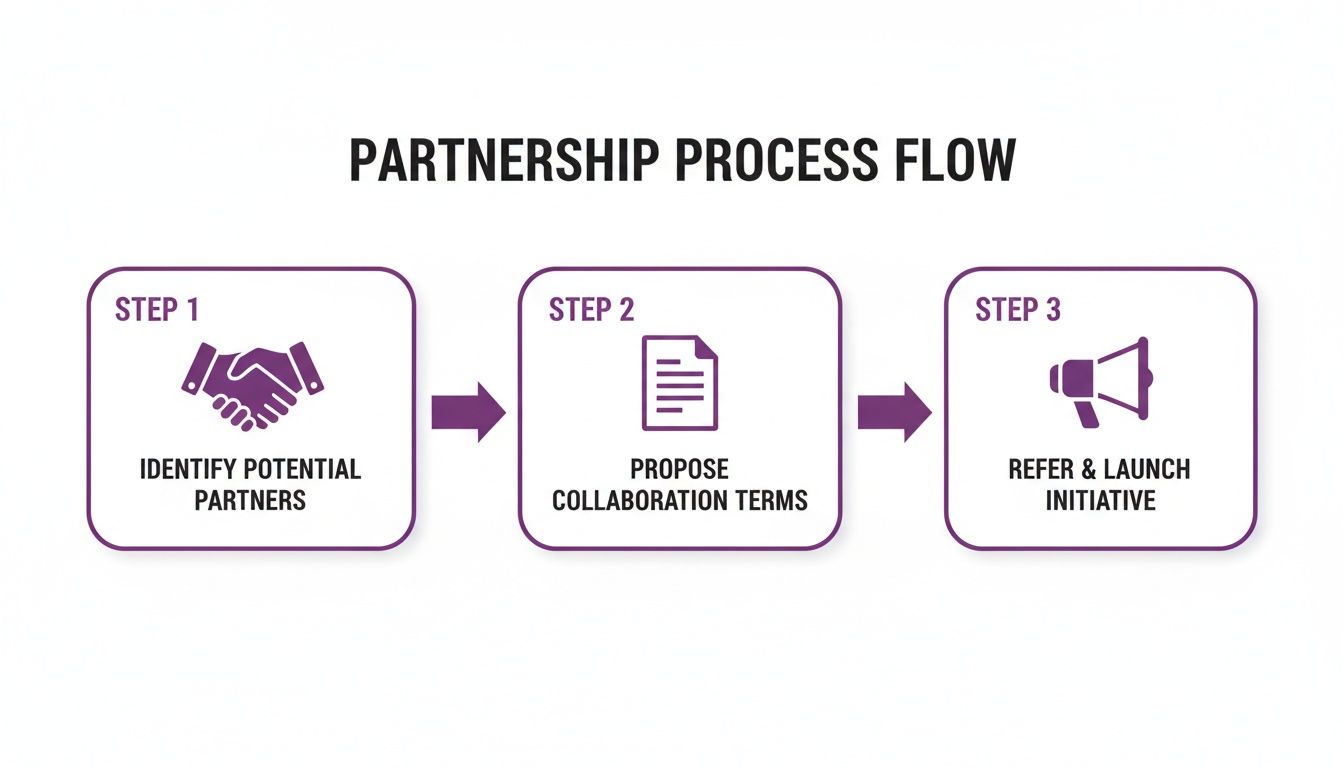
This process shows how a disciplined approach can turn casual conversations into a reliable source of high-quality leads.
Tracking What Truly Matters
To know if your plan is actually working, you have to measure the right things. Forget vanity metrics like social media followers; they don't pay the bills. Instead, focus on a handful of key performance indicators (KPIs) that tell you the real story about your business's health.
Here's the bottom line: sustainable client growth comes from consistent, focused effort. Measure what matters, adapt based on real data, and never stop tweaking your approach. It’s this disciplined process that builds unstoppable momentum.
For a local service business here in Cambridgeshire, your most important numbers might be:
- Website Enquiries: How many people filled out your contact form?
- Google Business Profile Interactions: The number of calls, direction requests, or website clicks coming directly from your profile.
- Referral Leads: How many enquiries came from existing clients or partners?
By checking these numbers regularly, you’ll quickly see which activities are bringing in the best results. From there, it's simple: double down on what works. This data-driven mindset is what turns your initial hustle into a predictable, sustainable engine for attracting new clients.
Got Questions? We've Got Answers
Getting a new business off the ground always throws up a few curveballs. Here are some of the most common questions we hear from UK business owners trying to land their first clients, with some straight-talking, practical advice to help you move forward.
How Long Does It Take to Get the First Client?
This is the million-pound question, isn't it? The honest answer is: it varies. It depends on your industry, who you already know, and how much energy you're putting into your marketing.
For a new service business here in the UK that's actively getting its local SEO in order and doing some networking, landing that first client within one to three months is a totally realistic goal.
The trick is to be consistent. Focus on the "low-hanging fruit" first—things like properly setting up your Google Business Profile and letting your personal network know what you're doing. These quick wins can seriously speed things up. Just remember, the first client is often the toughest get; things tend to snowball from there.
What Is the Most Cost-Effective Way to Get Clients?
When you're starting out and the budget is tight, the best strategies are the ones that trade your time for results, not your cash. You can build a really solid foundation this way without a massive financial gamble.
Your top three bets are:
- Local SEO: Getting your Google Business Profile sorted is completely free. It’s the quickest way to get in front of local people who are already searching for exactly what you offer.
- Content Marketing: Writing genuinely helpful blog posts or creating simple guides costs you nothing but your time. It’s a slow burn, but this approach builds trust and pulls in organic traffic for years to come.
- Networking: This doesn't have to mean stuffy events. Jump into local business groups online, like some of the Cambridgeshire-focused Facebook communities, or strike up referral partnerships with other local businesses who aren't your direct competitors. These can be a goldmine for high-quality leads at virtually no cost.
Should I Focus on One Client Acquisition Channel?
Absolutely. When you're just starting, it's so much smarter to get really good at one or two channels instead of trying to be everywhere at once. Spreading yourself too thin is a classic rookie mistake, and it usually means you’re not making a real impact anywhere.
Think about your ideal customer and ask yourself one simple question: Where do they hang out? If you're a local tradesperson in Cambridgeshire, for instance, your entire focus should be on mastering Local SEO and building a local referral network. Full stop.
Once you’ve got a predictable stream of leads coming from those core channels, then you can start looking at other things, like dipping your toe into paid social media ads or launching a bigger content campaign. Nail it, then scale it.
How Do I Ask for Referrals Without Sounding Desperate?
It's all about timing and tone. The absolute best time to ask is right after you’ve delivered a fantastic result and your client is singing your praises.
Don't frame it as a desperate plea. This is a confident, professional request. Try something like, "I'm so glad you're happy with how everything turned out. We're always looking to help other great businesses like yours, so I was wondering if you knew anyone else who might benefit from our services?"
Another great little tactic is to just build it into your offboarding process. When a project wraps up, send a final thank-you email and gently mention that you really appreciate referrals. Offering a small incentive—maybe a discount on their next project for a successful referral—can make it feel less like a favour and more like a simple business transaction.
Ready to stop chasing clients and have them start finding you instead? At Bare Digital, we build SEO strategies that drive traffic, generate leads, and deliver proper results for businesses in Cambridgeshire and beyond.
Get your free, no-obligation SEO Health Check and a tailored activity plan today.