
Improving your Domain Authority isn't about finding a magic bullet. It's a long-term play that boils down to a consistent strategy: earn high-quality backlinks, create content people genuinely want to link to, and make sure your website's technical health is absolutely flawless. Think of it as building a strong, trustworthy reputation online, one brick at a time.
What Domain Authority Actually Means for UK Websites
Before you start chasing a higher number, let's get one thing straight about Domain Authority (DA). It is not a direct Google ranking factor. It’s a predictive score created by the SEO tool provider Moz to estimate how well a website is likely to rank on search engine result pages (SERPs).
Think of it as a helpful benchmark, not a holy grail.
The score is calculated using over 40 different signals, but the real heavy lifting is done by the quality and quantity of backlinks pointing to your site. This score is then plotted on a 100-point logarithmic scale.
That logarithmic part is key. It means climbing the ladder gets exponentially harder the higher you go.
- Jumping from a DA of 20 to 30? Totally achievable with focused effort.
- Trying to get from 70 to 80? That's a monumental task, usually reserved for household names and major online publications.
Setting Realistic Goals for Your Business
For any UK business, context is king. A local service provider in Manchester shouldn't be comparing their DA to theguardian.com. Your goal should be to outperform your direct competitors, the ones you're actually up against in search results.
A brand-new local business might aim for a DA of 25 within the first year. In contrast, an established national e‑commerce brand needs to be targeting 50+ to stay competitive. You can dive deeper into what is Domain Authority and how it works in our dedicated guide.
To give you a clearer picture, here’s a breakdown of what these scores typically look like for businesses here in the UK.
Domain Authority Score Tiers and Typical UK Website Profiles
This table gives you a realistic benchmark for where your website might stand and what your next steps should be.
| DA Score Range | Typical Website Profile | Primary Focus for Growth |
|---|---|---|
| 0-20 | A new website, a small local business, or a niche blog with a limited backlink profile. | Building foundational links, local citations, and creating a solid base of quality content. |
| 21-40 | An established local business or SME with some existing brand recognition and backlinks. | Consistent content creation, targeted outreach for backlinks, and technical SEO refinement. |
| 41-60 | A national e‑commerce site or a well-known regional brand with a strong content strategy. | Scaling link-building efforts, earning links from authoritative industry sites, PR. |
| 61-80+ | A major national brand, a leading publication, or a large, authoritative industry hub. | Maintaining link profile, digital PR at scale, and protecting brand reputation. |
As you can see, the path forward changes depending on where you are right now. Brand-new sites need to focus on the basics, while established players are in a different league entirely.
Here's a common trap I see businesses fall into: they get obsessed with the DA number itself. Don't do that. Instead, pour your energy into the actions that influence the score, like building quality links and publishing brilliant content. The score is a reflection of good SEO, not the goal.
Getting these fundamentals right from the start ensures your efforts are strategic, sustainable, and deliver tangible results for your business.
Building a Flawless Technical SEO Foundation

It’s tempting to jump straight into chasing high-profile backlinks, but many businesses make the mistake of doing this while their own website is a technical mess. Before you even think about outreach, you have to get your own house in order. A strong technical and on-page SEO setup isn't just important—it's the non-negotiable bedrock for improving your Domain Authority.
Think of it this way: you wouldn't invite guests to a party in a house with a leaky roof and faulty wiring. It's the same with your website. Search engines and potential linking partners will hesitate to endorse a site that’s slow, confusing, or insecure.
Getting this foundation right makes your site a worthy recipient of the authority you want to build. A site that’s clunky or not mobile-friendly will struggle to earn and keep quality links, no matter how brilliant its content is.
Prioritise Performance and User Experience
Your website's speed and usability are no longer just nice-to-haves; they are essential signals of quality. Google's Core Web Vitals are a set of metrics that measure real-world user experience for loading performance, interactivity, and visual stability.
A slow-loading website frustrates users, which leads to high bounce rates. This tells search engines your site provides a poor experience, indirectly harming your authority. The goal is to create a seamless journey for every visitor, encouraging them to stay, explore, and maybe even link back to your content one day.
A common oversight is focusing only on desktop speed. With the majority of web traffic now coming from mobile devices, a mobile-first design isn't optional. Your site must look great and function perfectly on a smartphone, or you're already losing the battle.
A good starting point is Google's PageSpeed Insights tool. It'll analyse your site's performance and give you actionable recommendations for improvement.
Conduct a Technical SEO Self-Audit
Getting your technical SEO in shape is one of the most direct ways to support your Domain Authority goals. A well-structured, secure, and easily crawlable site is fundamentally more linkable. Here’s a quick checklist of essential areas to focus on for a self-audit.
- Secure Your Site with HTTPS: An SSL certificate is mandatory these days. It encrypts data between your site and its visitors, and browsers will flag any site without one as 'Not Secure'. This is a basic trust signal for both users and search engines.
- Fix Broken Links (404 Errors): Broken links, both internal and outbound, create a poor user experience and can waste link equity. Use a tool to regularly crawl your site and fix or redirect any links that lead to 404 error pages.
- Ensure Mobile-Friendliness: Your website must use a responsive design that adapts flawlessly to any screen size. Make sure to test it on different devices to check that all elements are accessible and easy to interact with.
- Create a Logical Site Architecture: Your site's navigation should be intuitive. A clear, hierarchical structure helps users and search engine crawlers find your most important content easily. Think of it as creating a clear map of your website.
- Submit an XML Sitemap: An XML sitemap is essentially a roadmap of your website for search engines. Submitting it to Google Search Console helps ensure that they can find and index all your valuable content efficiently.
For a more detailed walkthrough, our technical SEO audit checklist provides 15 essential elements to guide you through a thorough review.
Ultimately, a flawless technical foundation makes every other SEO activity more effective. It ensures that when you do earn those valuable backlinks, your website is in the best possible shape to benefit from the authority they pass.
Creating Content That Earns Authority
Once your technical house is in order, it's time to focus on the real engine of authority: your content. Without genuinely valuable, link-worthy articles and resources, any outreach campaign is going to feel like pushing a boulder uphill. Quality content is the magnet that naturally pulls in high-authority links, doing a lot of the heavy lifting for you.
This isn't about churning out generic blog posts for the sake of it. We're talking about creating strategic pieces—what we call linkable assets—that other websites actually want to reference. These are the deep-dive guides, original research, and handy tools that solve a real problem for your audience and for other creators in your industry.
Identify and Create Your Linkable Assets
A linkable asset is a piece of content created with the specific goal of attracting backlinks. Instead of just hoping for links, you're engineering content that journalists, bloggers, and industry experts are already looking for.
For a UK business, this could take a few different forms:
- Original Research: Think a survey on UK consumer spending habits, a study on local property market trends in Cambridgeshire, or an analysis of e-commerce return rates. Data is gold for journalists who need stats to back up their stories.
- Ultimate Guides: A massive, single resource that covers a topic from top to bottom. For a construction company, that might be 'The Complete Guide to London Loft Conversions'. For an accounting firm, 'The Definitive Guide to Contractor Tax in the UK'.
- Free Tools or Calculators: A mortgage calculator for an estate agent or a VAT calculator for a small business accountant. These practical, problem-solving tools are incredibly valuable and earn links time and time again.
The trick is to create something that offers unique value. Ask yourself: what information is missing in my industry that I could provide? What common headache can I solve with a guide or a tool? Answering these questions is the first step to creating content that builds real authority.
The Skyscraper Technique Adapted for the UK Market
The Skyscraper Technique, made famous by Brian Dean at Backlinko, is a brilliantly simple concept. Find content that already has a ton of backlinks, create something that's clearly better, and then reach out to the sites linking to the original to show them your superior version.
To make this work for the UK market, start by finding popular content on your topic, but pay close attention to its relevance for a British audience. You’ll often find that the top-ranking content is heavily US-centric. That’s your opening.
Let's say you find a popular guide on "small business grants." You could create a much better version specifically titled "A Complete Directory of Small Business Grants for UK Startups in 2024." Your asset could be better by being:
- More Current: Include the very latest grant information and deadlines for this year.
- More Thorough: Add specific regional grants for Scotland, Wales, and Northern Ireland.
- Better Designed: Present everything in a clean, easy-to-read format with a searchable table.
Once your new-and-improved asset is live, you can find the UK-based websites linking to that old, outdated resource and introduce them to your more relevant version.
Focus on Evergreen Content for Long-Term Value
While timely news pieces have their place, the true authority-builders are evergreen assets. This is content that stays relevant and useful long after you hit publish. A guide to UK tax regulations for freelancers will keep attracting links year after year, whereas a blog post about a temporary government scheme will have a very short shelf life.
Building your content strategy around evergreen topics ensures you get a continuous return on your investment. A single, high-quality guide can keep attracting new backlinks and organic traffic for years, compounding its value and steadily lifting your Domain Authority.
As you plan your content, a vital step is understanding keyword difficulty so you can target topics intelligently. This helps you strike a balance between creating ambitious, highly competitive assets and going after less difficult keywords where you can gain traction more quickly. It's this strategic approach that ensures your content efforts deliver both short-term wins and long-term authority.
Time to Run a Targeted Link Building Campaign
Right, your technical SEO is sorted and the content machine is humming along. Now for the bit that directly moves the needle on your Domain Authority: actively building high-quality links.
This isn't about chasing numbers. A targeted link building campaign is all about earning strategic endorsements from websites that are relevant and already have the authority you want. Think of it as proactively building your site's reputation across the web, one great link at a time.
I’ve found the best approach is to start with the basics and work your way up to more advanced tactics. The golden rule? Quality over quantity. Seriously, one solid link from a respected industry site is worth a hundred links from spammy, low-grade directories.
The whole process really hinges on creating great content first, as this simple workflow shows.
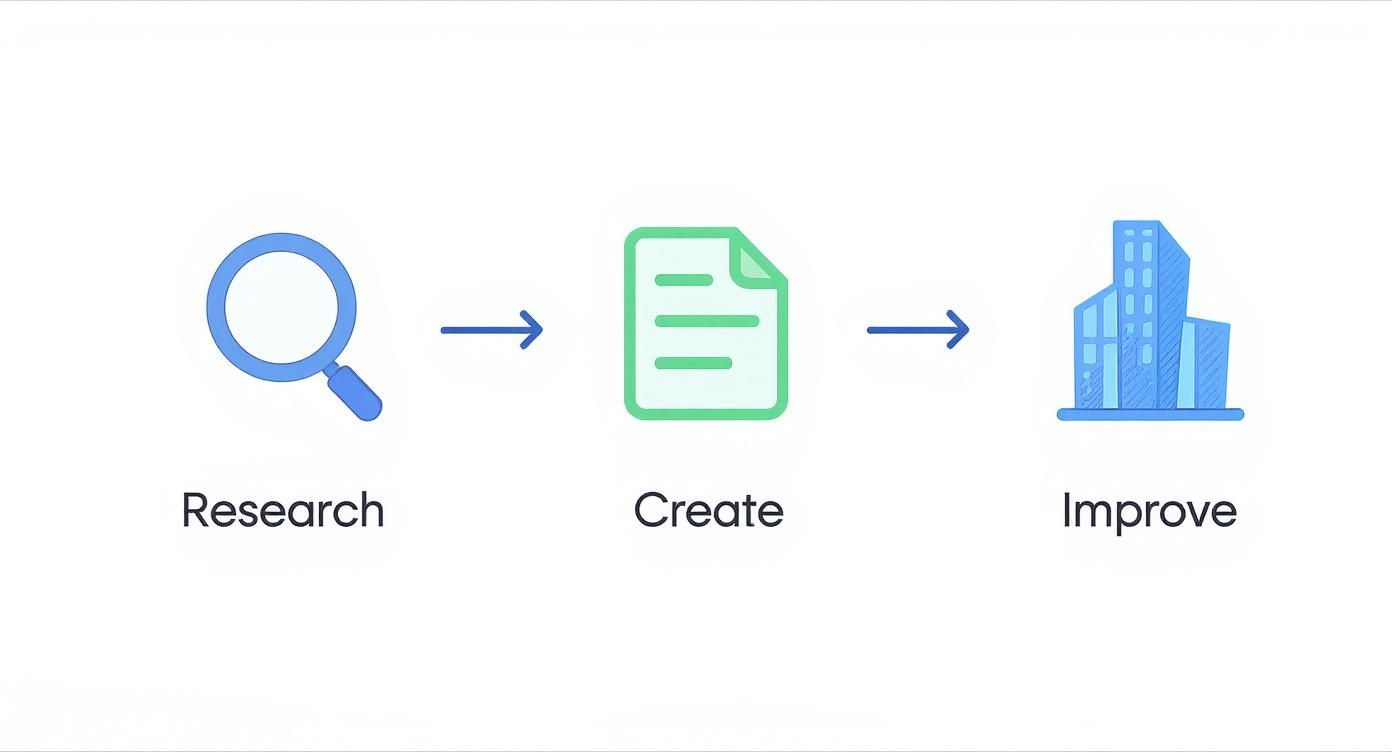
Effective link building starts long before you send that first outreach email. It begins with solid research and ends with content that people actually want to link to.
Start with Local, Foundational Links
For UK-based SMEs, especially local service businesses, the journey to a higher DA should always start close to home. Nailing down your local citations and getting links from reputable British directories is one of the fastest ways to build a solid foundation. These links are a huge signal to search engines that you’re a legitimate, active local business.
Concentrate on platforms that are already well-established and trusted. We’re not talking about any old online directory, but ones with real users and brand recognition.
- Key UK Directories: Get your business listed accurately and consistently on platforms like Yell, Thomson Local, and Scoot. Consistency is key here.
- Trade Organisations: If you join a relevant industry body, you'll often get a listing in their members' directory. That’s a super relevant, high-authority backlink right there.
- Local Chambers of Commerce: A link from your local Chamber of Commerce is a powerful vote of confidence in your local relevance and trustworthiness.
These foundational links are often seen as the low-hanging fruit of link building, but don't underestimate their collective impact. They really do get the ball rolling. If you want to dig deeper into this, have a look at these 7 Proven Directory Strategies To Boost Domain Authority.
Master the Art of Guest Posting
Guest posting still works wonders for earning quality backlinks, but only if you do it right. The aim isn't just to snag a link; it's to contribute your expertise to another website's audience. A contextual link back to your site should feel like a natural, helpful addition.
Success comes down to doing your homework and personalising your outreach. Firing off generic, templated emails to every blog in your niche is a fast track to getting ignored. Instead, actually read the blogs you want to write for. Get a feel for their tone, their audience, and the kind of stuff that does well for them.
When you pitch an editor, your email needs to show you've done this work. Suggest a few specific article ideas that fill a gap in their content, and explain why your perspective would be genuinely valuable to their readers. Ditch the spammy, self-promotional pitches. Your priority should always be providing massive value to the host site. One well-placed guest post on a high-authority UK blog can give your DA a noticeable bump.
It’s a common mistake to get fixated on a site's Domain Authority score. While it’s a useful guide, relevance is king. A link from a site with a moderate DA that’s perfectly aligned with your industry is often far more valuable than a link from a generic, high-DA news site that has zero connection to what you do.
Leverage Broken Link Building
This one’s a bit clever. Broken link building is a fantastic strategy that involves finding broken outbound links on other websites and offering your own content as the perfect replacement. It’s a genuine win-win: you help the site owner fix an error on their page (a dead link leading to a 404), and you get a quality backlink in return.
This tactic is most effective when you have a brilliant, comprehensive piece of content ready to go. For example, if you find a resource page linking to a now-defunct guide on "UK Small Business Accounting," you can pop them an email and suggest they replace it with your own up-to-date, definitive guide on the very same topic.
The process usually involves using an SEO tool to find these broken links on relevant sites. Your outreach email should be helpful, not demanding. Just point out the broken link and politely offer your superior resource as the fix. For a full breakdown of this and other methods, our guide on how to build backlinks covers it all step-by-step.
Comparing Link Building Tactics for UK SMEs
Choosing the right tactics can feel overwhelming, especially with limited resources. Here's a quick comparison to help UK SMEs decide where to focus their efforts for the biggest impact on Domain Authority.
| Tactic | Effort Level | Potential DA Impact | Best For |
|---|---|---|---|
| Local Citations | Low | Low-Medium | New businesses & local service providers needing a foundational boost. |
| Guest Posting | Medium | Medium-High | Businesses looking to build expertise and earn relevant, contextual links. |
| Broken Link Building | Medium-High | High | SMEs with strong content assets who can solve problems for other sites. |
| Digital PR | High | Very High | Established businesses ready to create newsworthy stories for top-tier links. |
This table shows a clear progression. Start with the foundational tactics and, as your resources and content library grow, move towards the higher-impact strategies.
Harness the Power of Digital PR
For businesses ready to make a serious jump in authority, digital PR is the top-tier strategy. This is all about creating content that is genuinely newsworthy—think original research, a compelling data story, or a unique industry study—and promoting it to journalists, bloggers, and news outlets.
Unlike other tactics, digital PR is about earning links because your story is simply too good to pass up. A local estate agent could survey the "Most Desirable Villages in Cambridgeshire" and earn links from local news sites. An e-commerce brand could analyse its sales data to reveal "Changing UK Consumer Trends," grabbing the attention of national business publications.
A single successful digital PR campaign can land you links from the likes of the BBC, The Guardian, or major industry publications, which can transform your authority profile almost overnight. It takes creativity, a great story, and a solid outreach plan, but the rewards are second to none in the world of link building.
How to Measure Your Link Building Success
So, you're putting in the hard yards to build links and boost your authority. How do you know if it's actually working?
Trying to improve your Domain Authority is a long game, and if you don't track your progress, it's easy to lose steam or waste time on the wrong things. The DA score itself is a decent benchmark, but getting obsessed with it is a classic rookie mistake.
DA is calculated on a logarithmic scale and usually only updates once a month. This means you won't see a jump the day after landing a killer backlink. Instead of hitting refresh on your DA score every five minutes, you'll get much further by focusing on the metrics you can actually influence day-to-day.
Moving Beyond the DA Score
Think of your DA score as a lagging indicator. It tells you what has happened, not what's happening right now. It's like looking at the final score of a football match – it tells you who won, but not how they won.
The real story is in the leading indicators: shots on goal, possession, successful passes. For SEO, these are the metrics that prove you're playing the right game.
This means you need to shift your mindset. Instead of a vague goal like "increase DA," get specific: "acquire five new referring domains from relevant UK industry sites this quarter." That’s a target you can build a real plan around. A successful campaign is built on these small, consistent wins.
Here are the key metrics you should really be tracking:
- New Referring Domains: Honestly, this is the big one. It’s the number of unique websites linking back to you. A steady stream of links from high-quality, relevant sites is the clearest signal your authority is on the up.
- Backlink Quality: Use your tools to check the authority of the sites linking to you. Are you getting nods from websites that are genuinely respected in your niche? One link from a trusted industry blog is worth more than a hundred from rubbish directories.
- Organic Traffic Growth: As your authority builds, so should your traffic. Keep a close eye on your analytics. Are the pages you're pointing links to seeing more visitors from search engines? If not, something's not clicking.
Choosing the Right Measurement Tools
A few excellent tools can help you keep tabs on these metrics, and each has its own way of measuring authority. Moz popularised Domain Authority (DA), but other platforms have their own well-regarded metrics that many pros prefer.
In a recent survey of 518 SEO experts, Ahrefs' Domain Rating (DR) came out on top, with a massive 64.1% of professionals using it as their go-to metric. Semrush's Authority Score is also widely used, preferred by 15.4% of those surveyed. Knowing what the rest of the industry values helps you benchmark your own performance. You can dig into more of these link building insights on editorial.link.
Here’s a bit of hard-won advice: be patient. Your DA score won’t budge for weeks, maybe even a few months. Don't get discouraged. Just keep your head down and focus on consistently earning high-quality backlinks. The score will eventually catch up.
Reporting on Your Progress
Tracking everything consistently lets you prove the value of your SEO work, both to yourself and to stakeholders. Pulling your findings into a clear report helps you see what’s working and where your strategy needs a tweak. A good report connects your link-building activities to real results, like more traffic and better keyword rankings.
If you need a structured way to present your data, using a monthly SEO report template is a great way to keep everything organised and easy to digest. By focusing on the actions you can control and tracking the right leading indicators, you'll build an informed strategy that genuinely improves your domain authority over the long run.
Got Questions About Domain Authority?
When you're trying to get your head around SEO, Domain Authority often throws up a lot of questions. Getting clear on the details helps you put your energy in the right place. Here are some of the most common queries we hear from UK businesses, answered straight up.
How Long Does It Actually Take to Improve Domain Authority?
Let's be realistic: improving your DA score is a marathon, not a sprint. It’s a long-term play. For a site that's fresh out of the box, you might see it climb from a DA of 1 to around 15 in the first few months as you get those initial, foundational links in place.
Getting from a DA of 20 to 30 is a much bigger hill to climb. This stage often takes a solid six months to a year of consistent, high-quality link building and content that people genuinely want to share. As you move up the scale, the pace slows down. Pushing a strong DA of 50 to 60 can easily take several years of dedicated digital PR and seriously top-tier content marketing.
The most important thing to remember is that consistency beats intensity every time. A slow and steady effort to earn quality links will always win out over short, frantic bursts of activity. Patience is your best friend here.
Can I Improve My Domain Authority for Free?
Absolutely, but what you save in money, you'll spend in time. A "free" strategy means you're rolling up your sleeves and doing the hard graft yourself.
Here’s what that typically looks like:
- Creating amazing content: We're talking about genuinely brilliant, link-worthy articles, guides, or tools that people can't help but link to.
- Manual outreach: This is the grind of personally emailing other website owners to pitch guest posts or collaborations.
- Broken link building: It involves finding dead links on other relevant sites and suggesting your content as the perfect replacement.
These tactics definitely work, but they take time to pay off. If you're looking for faster, more significant results, strategies like large-scale digital PR campaigns or using premium SEO tools almost always need some budget behind them.
Is a Low Domain Authority Score a Bad Thing?
Not always. A low DA is completely normal for new websites or businesses in super-specific niche industries. The only number that really matters is your DA score relative to your direct competitors.
Think about it this way: if your website has a DA of 20, but all the local businesses you're competing against are floating between 15 and 25, you’re actually in a great spot. A low score is only 'bad' if it's miles behind the competitors you need to outrank to get in front of your customers.
Should I Disavow Links from Low Authority Websites?
Honestly, for most businesses, the answer is a firm no. Google's algorithm has become incredibly smart over the years and is now more than capable of just ignoring low-quality or spammy links without it hurting your site.
The disavow tool should be handled with extreme care. It's really only for severe cases, like if you've been hit with a manual penalty from Google or you're trying to clean up a mess from a load of paid-for, toxic links from the past.
Pour your energy into building good, high-quality links. Your time is much better spent on positive, proactive efforts rather than obsessively trying to prune every low-authority link pointing your way.
Ready to build real, lasting authority for your website? At Bare Digital, we create SEO strategies that actually deliver for businesses across Cambridgeshire and beyond. Get your free, no-obligation SEO Health Check today and we'll send you a custom proposal within 24 hours.