
Improving your Google Maps ranking all begins with a perfectly tuned Google Business Profile (GBP). This isn’t just another online profile; it’s the absolute bedrock of your local search presence.
Your Foundation for Google Maps Dominance
Before you can even think about reviews, website fixes, or clever link-building strategies, you have to get the fundamentals right. Think of your Google Business Profile as the central information hub that Google consults first when deciding whether to show your business to a potential customer searching nearby.
Getting this foundation spot-on is non-negotiable for any UK business aiming to capture that valuable local traffic. It’s the difference between being invisible and appearing in the coveted "Local Pack"—those top three map listings that dominate search results.
Of course, the first step is making sure your profile is actually set up and verified correctly. If you're starting from scratch, it’s well worth reading a guide on listing your business on Google Maps.
Why the Local Pack Is Everything
The fight for visibility on Google Maps is so fierce for one simple reason: results. The top three spots in the Google Maps Local Pack snap up a massive 42% of all clicks from local searches in the UK. This isn’t just a statistic; it’s prime digital real estate that can transform your lead flow almost overnight.
Securing a spot here means you're one of the very first options a potential customer sees. Google’s algorithm decides who gets these top positions based on three core pillars:
- Proximity: How close your business is to the person searching.
- Relevance: How well your business profile matches what they’re looking for.
- Prominence: How well-known and trusted your business is, both online and off.
A perfectly optimised GBP sends strong, positive signals across all three of these areas.
GBP Quick-Win Checklist
Getting your GBP foundation right involves a few key actions that have a direct and measurable impact on those core ranking pillars. This table breaks down the essentials and why they matter.
| Action Item | Impact on Ranking | Real-World Example |
|---|---|---|
| Claim & Verify | Signals legitimacy and ownership to Google. The absolute first step. | A new café in Manchester verifies its listing, allowing it to start gathering reviews and appear on Maps. |
| Select Primary Category | Directly impacts Relevance. The most crucial setting for matching search queries. | A Bristol law firm chooses "Family Law Solicitor" instead of the generic "Law Firm" to attract specific cases. |
| Ensure NAP Consistency | Boosts Prominence and Trust. Mismatched details erode Google’s confidence. | A retailer ensures their name, address, and phone number are identical on GBP, their website, and Yelp. |
| Fill Out All Sections | Increases Relevance and provides a better user experience. Every completed field is a signal. | A garage adds its opening hours, a link to its booking page, and a full list of services like "MOT Testing". |
Nailing these basics isn't just a box-ticking exercise; it's about building a robust foundation that makes all your future SEO efforts more effective.
Nailing Your Business Categories
One of the most powerful levers inside your GBP is the primary business category you choose. This single selection tells Google the main thing you do, and getting it wrong is a common and costly mistake. Being too generic is a fast track to getting lost in the noise.
For instance, a specialised venue in Bristol should choose 'Wedding Venue' as its primary category, not the much broader 'Event Space'. This small change immediately tells Google to show them for high-value searches like "wedding venues near me" or "bristol wedding reception," filtering out less relevant queries.
You can add up to 10 categories in total, but your primary category carries the most weight. Use the additional categories to cover secondary services, like 'Conference Centre' or 'Corporate Events Venue', but always make sure your main offering is listed first.
The Critical Role of NAP Consistency
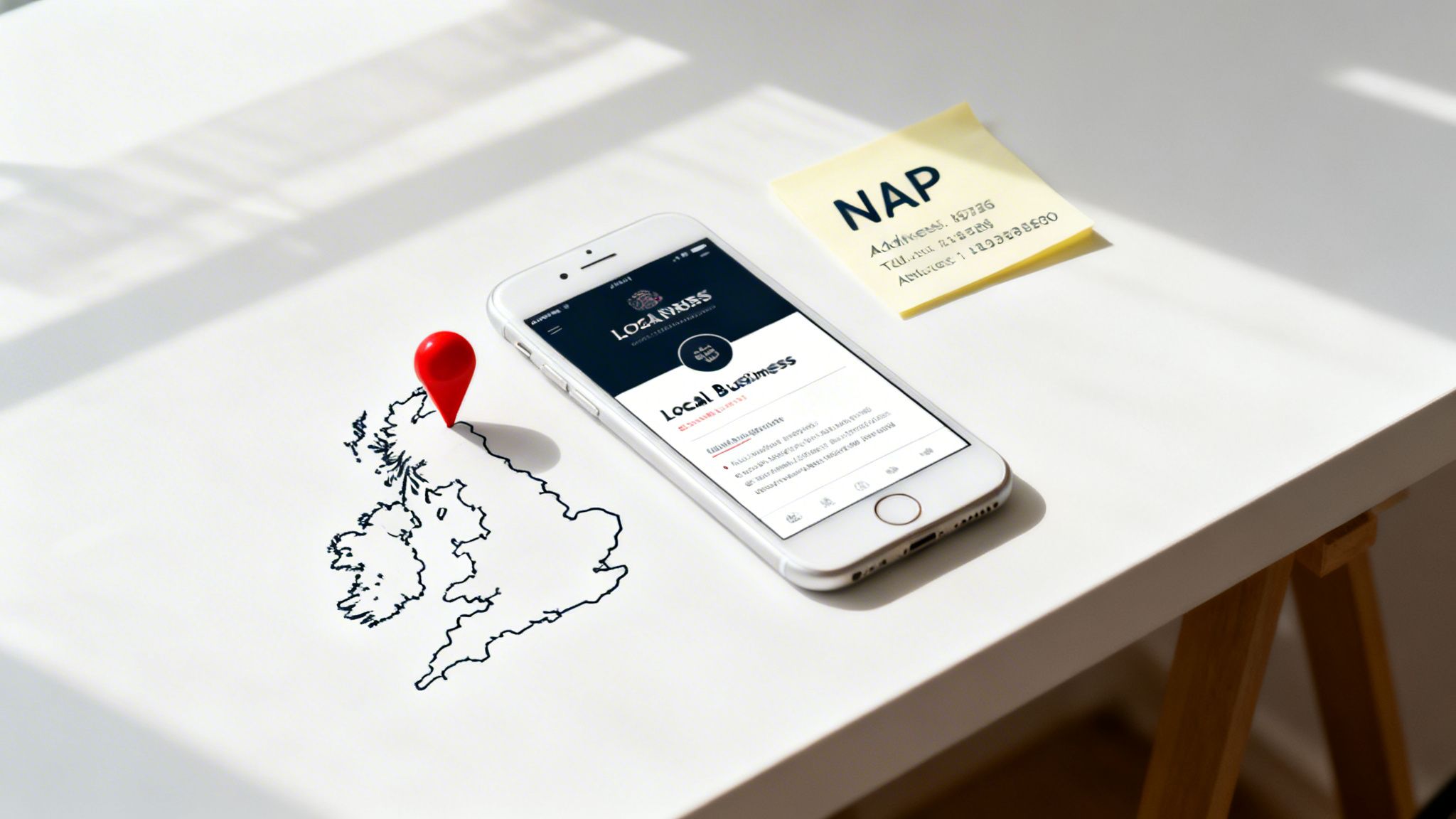
Your Name, Address, and Phone number (NAP) must be absolutely identical across your entire online presence. This means the details on your GBP must exactly match what’s on your website, your social media profiles, and every single online directory you’re listed in.
Even tiny variations—like "Ltd." versus "Limited" or "St." versus "Street"—can create confusion for search engines. This erodes the trust Google has in your business information, which directly hurts your prominence signals. Consistency, on the other hand, is a powerful sign of legitimacy.
To get a head start on this, you can use our comprehensive local SEO checklist to audit your existing online footprint and root out any inconsistencies.
This foundational work isn't the most glamorous part of SEO, but it is absolutely essential. Without a solid, consistent, and strategically categorised Google Business Profile, any further efforts to climb the Google Maps rankings will be built on shaky ground. Get these elements right, and you'll have a powerful base to build on.
Turning Relevance into Rankings with GBP Optimisation
Just having a verified Google Business Profile gets your business on the map. But a thoughtfully optimised one is what pushes you ahead of the competition and into those top spots. The initial setup is just the beginning; it’s the ongoing, strategic tweaks that signal your relevance to Google time and time again.
Think of your GBP like the front window of a high-street shop. Letting it sit untouched after you first set it up is a missed opportunity. You need to keep showing Google—and your potential customers—that you’re active, engaged, and the best local solution to their problem.
These aren't just tick-box exercises. They are fresh, powerful signals that Google's algorithm is built to reward with better visibility in the local pack.
Nail Your Business Description with Local Keywords
Your business description is a huge opportunity to tell both Google and customers exactly who you are and what you do. You have 750 characters to play with, and every single one should work hard for you.
Forget the generic marketing fluff. Instead of "We're a trusted local plumber," get specific and strategic.
A much better version would be: "Your reliable emergency plumber in Manchester, specialising in boiler repairs, blocked drains, and central heating installations for homes across Greater Manchester. We offer 24/7 call-outs."
This version naturally weaves in key services and location details. It directly matches how real customers search, helping Google connect the dots between a query like "emergency boiler repair Manchester" and your business.
Show You're Active with GBP Features
Inside your GBP dashboard are some powerful tools designed to showcase your activity and expertise. Using them consistently is a key part of climbing the Google Maps rankings.
- GBP Posts: Treat these like a mini-blog. Post about special offers, new services, or recent projects. A funeral home in Liverpool could post about a new ‘pre-paid funeral plan’ service, while a healthcare provider might share details of its upcoming ‘flu jab clinic’. These timely updates prove you're an active business.
- Geotagged Photos: Don't just upload any old pictures. When you add photos, make sure they have location data embedded. When a wedding photographer uploads a photo from a specific venue, geotagging it reinforces their service area. Add photos of your team, your premises, and your work to build trust.
- Products & Services: This section is an absolute goldmine. Be meticulous. A construction firm shouldn't just list "Building Work"; it should detail "Loft Conversions," "Home Extensions," and "Garage Conversions" as separate services, each with its own keyword-rich description. This is exactly the kind of granular detail Google loves.
For businesses without a physical shopfront, like counsellors or mobile beauticians, these features are even more important for building credibility and demonstrating authority.
A complete and fully optimised Google Business Profile is often cited as the single most important factor for ranking in Google Maps. When you combine this with consistent NAP details across the web, the effect is even stronger. In fact, creating local content that targets 'near me' searches can boost impressions by over 200% in as little as eight weeks.
Get Ahead of the Curve with the Q&A Section
The Questions & Answers section is a public-facing feature that too many businesses ignore. The catch is that anyone can ask a question, and worse, anyone can answer it. You absolutely have to take control of the conversation here.
Don't just wait for questions to roll in. Seed the section yourself by asking and answering the most common queries your customers have.
Example of Q&A Seeding:
- Question: Do you offer free quotes for home extensions?
- Answer: Yes, we provide free, no-obligation quotes for all home extension projects in the Leeds area. You can book a consultation directly through our website.
This tactic does two things brilliantly. It provides helpful information upfront, but it also gives you a natural way to include important keywords about your services and location. Regularly monitoring your profile is key, and if you're not sure how you stack up, a specialised Google Business Profile audit tool can help you spot the gaps.
Building Prominence Through Reviews and Citations
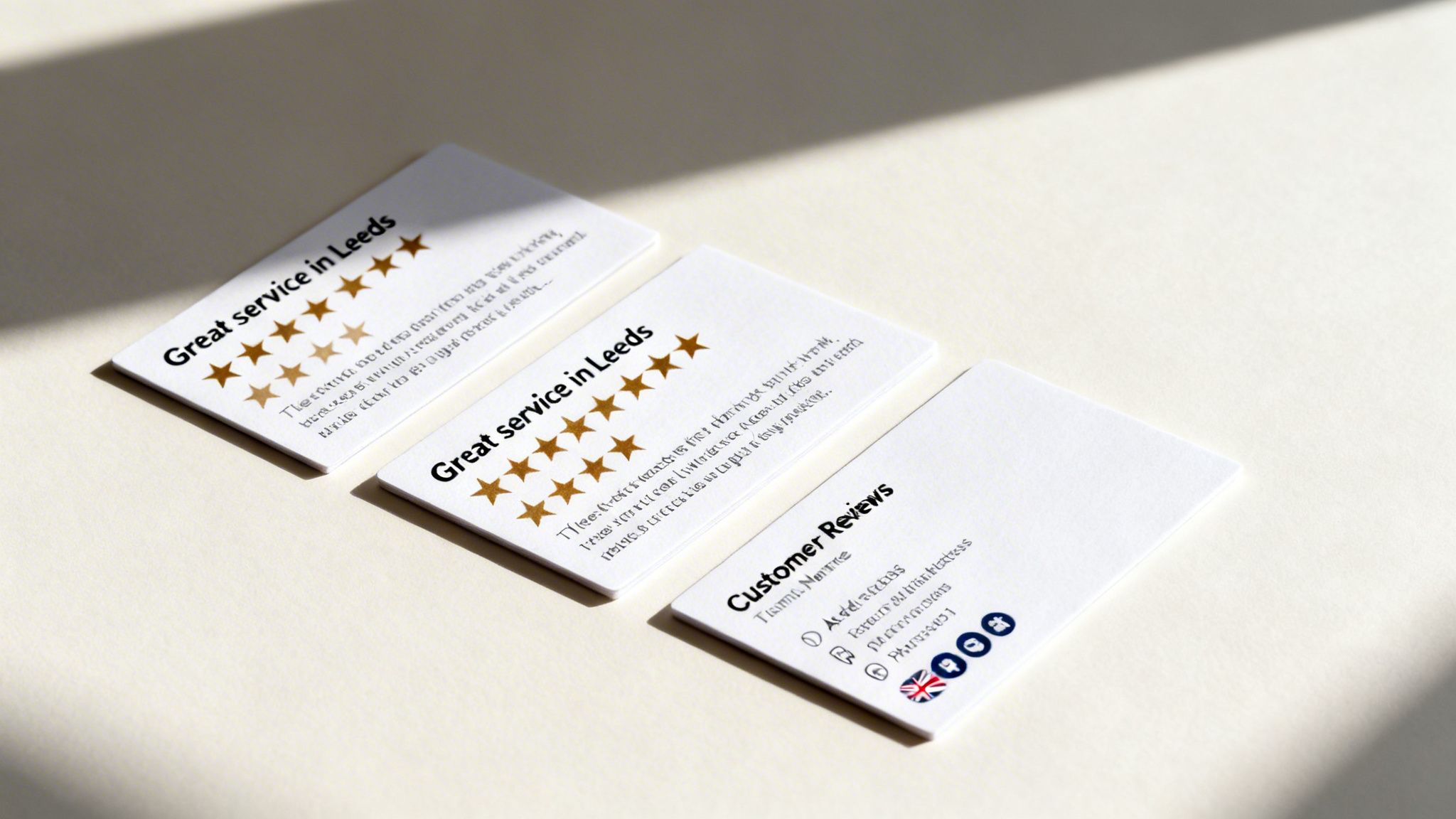
While relevance tells Google what you do, prominence is all about how well-known and respected your business is. It’s Google’s way of gauging your real-world authority, and it’s a massive piece of the puzzle when it comes to improving your Google Maps ranking.
Put it this way: if two equally relevant businesses are near a searcher, Google will almost always give the nod to the one that seems more established and trusted. Building that trust boils down to two core pillars: a steady flow of genuine customer reviews and a clean, consistent trail of local business citations.
For any business serious about climbing the local search ladder, getting these two elements right is non-negotiable.
The Power of Authentic Customer Reviews
Reviews are the digital equivalent of word-of-mouth, and they're pure gold for your Google Maps presence. They provide powerful social proof for potential customers while sending strong ranking signals directly to Google. The real key is to build a consistent stream of new, authentic reviews, not just a one-off burst of activity.
A business with a healthy volume of recent, positive reviews is a huge trust signal. In fact, a staggering 98% of consumers read online reviews for local businesses, showing just how baked-in they are to the customer journey.
But it’s not just about the star rating. The content of the reviews themselves is enormously valuable. When a customer leaves feedback that mentions a specific service and location, it reinforces your relevance for those exact search terms.
A review that says, "The best flat white in Leeds," is infinitely more powerful for SEO than a generic "Great service." It tells Google in plain English that your business is a top-tier result for coffee in that specific city.
Creating a Sustainable Review Generation Strategy
Just sitting back and waiting for reviews to trickle in isn't a strategy. You need a proactive process to gently encourage happy customers to share their feedback. Here’s a practical way to approach it:
- Time Your Request Perfectly: The best time to ask is right after a positive interaction. For a wedding venue, this might be a follow-up email the week after the big day. For a photographer, it could be when you deliver the final, beautiful gallery. Strike while the iron is hot.
- Make It Incredibly Easy: Don't make people jump through hoops. Use Google's direct review link generator and share it via email, SMS, or even on a small business card handed over after a job well done. The easier it is, the more likely they are to do it.
- Use Multiple Touchpoints: Don't be shy about asking more than once. A friendly, polite follow-up email a week after the initial request can make a huge difference to your response rate. Just be careful not to overdo it and become a nuisance.
Remember, you must never offer incentives for reviews—this is a strict violation of Google's guidelines. The goal is to encourage genuine feedback, not to buy five-star ratings.
Responding to Every Single Review
Your job isn't finished when a review is posted. Responding to every single one—good and bad—is absolutely crucial. It shows you’re an engaged business that genuinely cares about customer feedback.
- For Positive Reviews: Thank the customer by name and try to reference a specific point they made. This reinforces their positive experience and can even add a little more keyword context.
- For Negative Reviews: Always respond professionally and with empathy. Acknowledge their issue, take the conversation offline to find a resolution, and show other potential customers that you take concerns seriously.
This level of active engagement sends positive signals back to Google's algorithm, which helps to further boost your prominence.
Building Trust with Local Citations
Beyond reviews, local citations are the other half of the prominence equation. A citation is simply any online mention of your business's Name, Address, and Phone number (NAP). The more consistent your NAP is across high-authority websites, the more confident Google becomes that your business details are legitimate.
Your first port of call should be the major UK business directories. Getting a clean, consistent listing on these foundational sites is a must:
- Yell
- FreeIndex
- The Independent
- The Sun
- Thomson Local
Inconsistency is the enemy here. A profile on Yell showing "123 High St" while your GBP says "123 High Street" can seriously dilute your authority. Every single detail needs to match perfectly.
On top of that, don't forget about industry-specific directories. A construction firm should be listed on trade-specific sites, while a wedding venue needs to make sure it's on wedding planning portals. These niche citations signal your expertise within a specific field, adding another powerful layer of trust and improving your chances to rank higher on Google Maps.
Amplifying Your Reach with On-Page Local SEO
Your Google Business Profile is only half the story. To really climb the Google Maps rankings, you need to connect it to an equally impressive home base—your website. Think of your website as the ultimate proof, the anchor that backs up every claim you make on your profile and gives Google the deep, authoritative evidence it needs of your expertise and where you operate.
A website that’s slow, clunky, or a nightmare to use on a mobile phone will actively work against your local SEO. Google is obsessed with user experience, and a fast, mobile-friendly site is now a non-negotiable for getting ranked locally. This is where on-page SEO stops being a "nice-to-have" and becomes a core part of your Maps strategy.
This interplay between your profile and your website is what separates the businesses that just show up on Maps from the ones that consistently own the top spots for valuable local searches.
Create Powerful Location-Specific Pages
Generic service pages just don't cut it anymore. If you want to rank in a specific town or even a neighbourhood, you have to create dedicated pages on your website that speak directly to that local audience. These pages act as super-relevant landing spots that Google can connect to your GBP, giving your 'Relevance' and 'Prominence' scores a serious boost.
Let's say a construction firm wants to land more projects in a particular city. Instead of one vague "Our Services" page, they should be building out individual pages for their core offerings, each one laser-focused on a location.
Example: Construction Firm in Leeds
A page titled "Bespoke Home Extensions in Leeds" is going to perform far better than a general page. To turn it into a local SEO powerhouse, it needs to be packed with local signals:
- Localised Content: Talk about projects you've completed in specific Leeds neighbourhoods like Headingley or Roundhay. Show you know the area.
- Local Testimonials: Feature reviews from clients who are actually in Leeds, and make sure their location is mentioned.
- Project Photos: Showcase your work with geo-tagged images. In the captions or alt text, mention the area (e.g., "Kitchen extension on a Victorian terrace in Chapel Allerton").
- Embedded Map: Pop in a Google Map that clearly shows your main service area or office. It's a simple but powerful visual cue.
- Local Business Schema: This is a bit of code that spells out your business name, address, phone number, and services for search engines, hammering home that all-important NAP consistency.
All these elements create an undeniable link between your service and that specific location, making it a no-brainer for Google to rank you for searches like "builder in Leeds."
Use Your Blog to Target Local Questions
Your blog is one of your best tools for building topical authority and proving your Expertise, Experience, Authoritativeness, and Trustworthiness (E-E-A-T) in your local market. It’s your chance to answer the exact questions your potential customers are typing into Google. This isn't just about the hard sell; it's about becoming the go-to local resource.
By targeting these "informational queries," you catch people much earlier in their buying journey and start building trust. A local cleaning company, for example, could write an article titled "How to Prepare Your Home for an End-of-Tenancy Clean in Bristol." This not only targets a valuable local search term but also positions them as a helpful expert. Once your website is fully optimised, you can start exploring other proven local strategies to get more cleaning clients to really get the phone ringing.
Key Takeaway: Your website needs to directly support every single service and location you want to rank for on Google Maps. If you claim to offer a service in a particular town on your GBP, there must be a detailed, corresponding page on your website to back it up.
This on-page strategy is the technical blueprint for turning your website into your most powerful ally. It provides the substance and authority Google needs to see before it will reward your Google Business Profile with those coveted top rankings. For service-based industries like healthcare, establishing this digital trust is absolutely paramount. For more specific insights, you can read our guide on SEO for healthcare providers which details how to build this authority online.
Your Timeline for Measurable Ranking Growth
So, how long does all of this actually take? It's the question every business owner asks. Turning all this strategy into a concrete plan means having a realistic sense of timing. Knowing what to expect and when is vital for keeping track of progress and proving that your efforts are paying off.
Local SEO isn’t about flipping a switch for overnight success; it’s about building steady, undeniable momentum. The first fixes to your Google Business Profile (GBP) get the ball rolling, but real, lasting growth comes from layering on reviews, local citations, and solid on-page SEO over the following months.
Let's break down what that journey typically looks like and what you should be watching for at each stage.
The First 30 Days: Foundations and Early Signals
The first month is all about getting your house in order and grabbing the low-hanging fruit. Your entire focus should be on your Google Business Profile. This is when you'll comb through every single section, making sure it’s 100% complete, fine-tuning your business categories, and uploading a batch of high-quality, geotagged photos.
The immediate goal is to give Google a sudden, strong hit of relevance signals. You won't leap into the top three spots overnight, but you should start seeing some encouraging signs. You might notice your profile appearing for more specific, long-tail searches (like “24-hour emergency plumber in Chorlton”) or a small uptick in profile views.
During this phase, keep a close eye on your GBP Insights. The key metrics to watch are 'Discovery' searches and the specific queries people are using to find you. These tell you if your initial optimisations are starting to land.
Months 2-3: Building Real Momentum
Now things get interesting. This is where your efforts really start to compound and deliver more noticeable results. As you move into the second and third months, your focus expands to building authority through reviews and citations. You should have a solid system in place to consistently request new customer reviews, and your citation building campaign will be in full swing.
This one-two punch of a perfectly tuned profile and growing off-page authority is incredibly potent. We often see businesses get an initial ranking bump within two to four weeks from GBP optimisation alone. But it’s when you add the reviews and citations that meaningful traffic increases start to appear, typically around the six to eight-week mark.
With Google Maps listing 250 million places globally, UK businesses that secure a spot in the Local Pack can hoover up 42% of clicks—a prize well worth the effort. You can read the full analysis of these UK ranking factors on SmartPubTools.com.
During this phase, look for a steady climb in:
- Website clicks: More people are finding you on Maps and taking the next step.
- Direction requests: A fantastic indicator of high-intent customers planning a visit.
- Phone calls: The ultimate conversion for most service-based businesses.
This is also a great time to start calculating the return on your investment. You might find our self-storage ROI calculator for SEO handy for putting these metrics into a business context.
Months 3-12: Securing Your Spot
This longer-term phase is all about cementing your position and aiming for consistent dominance in the top-three "Local Pack" rankings. The work here shifts to your website, involving sustained on-page SEO, regular content creation, and ongoing authority building. Your website truly becomes the foundation of your local strategy.
The timeline below shows how your website’s on-page SEO, service pages, and blog content build on each other over the year.
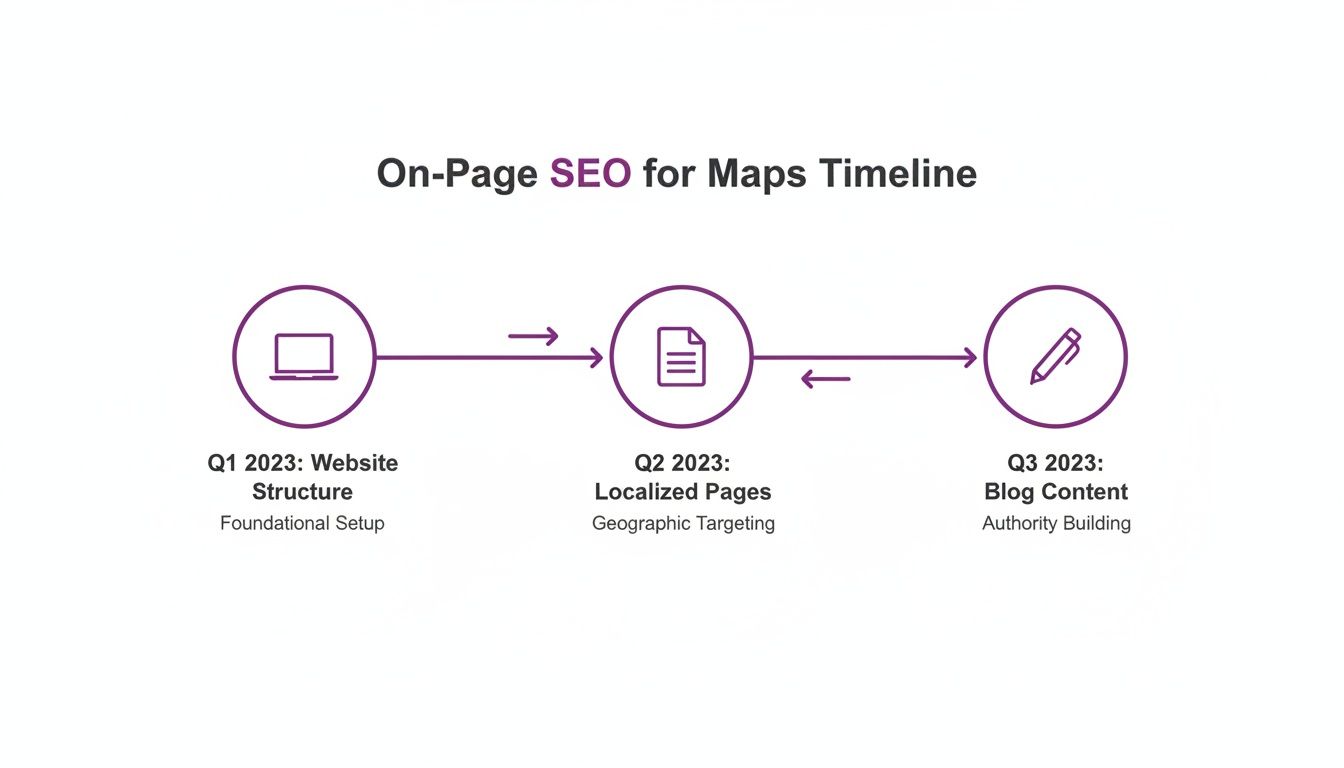
This sustained effort reinforces your relevance and authority, making it much harder for competitors to push you out of those top spots.
By this stage, you are no longer just tweaking a profile; you are building a recognised local brand. You should be consistently publishing blog posts that answer local customer questions and building out highly-detailed, location-specific service pages.
The name of the game now is consistency. Keep that stream of reviews coming in, keep publishing GBP Posts, and keep adding genuinely helpful content to your site. Over these months, you should see your rankings for high-value, competitive keywords stabilise, delivering a predictable flow of leads month after month.
The 12-Month Google Maps Ranking Roadmap
To tie this all together, here is a high-level roadmap. It breaks down the typical flow of a 12-month local SEO campaign, outlining the core actions and the results you should expect to see along the way. Think of it as a playbook for managing expectations and tracking your success.
| Phase (Timeline) | Core Actions | Expected Outcomes & KPIs to Watch |
|---|---|---|
| Month 1: The Foundations | Full GBP audit and optimisation. Geotagged photo uploads. Primary & secondary category review. Initial citation audit. | Small improvements in visibility for long-tail keywords. Increase in GBP ‘Discovery’ searches. More relevant search queries appearing in Insights. |
| Months 2-3: Building Authority | Launch consistent review generation process. Start citation cleanup and building. Create first GBP Posts. | Noticeable increase in direction requests, website clicks, and phone calls. Initial rankings appear for broader, more competitive terms. |
| Months 4-6: On-Page Alignment | Optimise website homepage and service pages with local keywords. Build out initial set of location pages (for multi-location businesses). | Improved organic traffic from local searches. Rankings begin to solidify in the top 5-10 positions for core keywords. |
| Months 7-12: Scaling and Dominance | Consistent local content creation (blog posts, case studies). Ongoing review and citation management. Targeted local link building efforts. | Stable top-3 "Local Pack" rankings for high-value keywords. Predictable, month-on-month lead flow. Increased brand recognition in the local market. |
This roadmap isn't set in stone—every market is different. But it provides a reliable framework for what a well-executed Google Maps SEO strategy looks like in practice, moving you from initial setup to sustained, profitable visibility.
Frequently Asked Questions About Google Maps Ranking
As you start working on your Google Maps presence, you're bound to have questions. It's a field filled with nuance, where questions about timelines, websites, and ads are always bubbling up.
This section is here to give you straight, no-nonsense answers to the questions we hear all the time from UK businesses. Let's clear up the confusion so you can move forward with confidence.
How Long Does It Really Take to See Results on Google Maps
This is always the big question, and the honest answer is: it happens in phases. You're not just flicking a switch.
You can often spot the first signs of movement within 2-4 weeks after a thorough Google Business Profile optimisation. These are usually early wins for more specific, long-tail searches.
However, to achieve more stable rankings that bring in consistent traffic, you're looking at closer to 6-8 weeks. This gives Google enough time to index your new local citations and for your review strategy to start building some real momentum.
For businesses in really competitive markets or major cities, landing a spot in that coveted top-three "Local Pack" can be a 3-6 month journey. That kind of long-term success comes from ongoing work—consistent local content, sustained review generation, and building up your authority over time.
Does My Website SEO Actually Affect My Maps Ranking
Absolutely, and it's a factor that gets underestimated far too often. Google treats your website as the ultimate source of truth about your business, using it to double-check and build on what it sees in your Google Business Profile.
The signals from your website directly feed into your "Prominence" and "Relevance" scores, which are two of the main pillars of the local ranking algorithm.
- Mobile-friendliness and page speed are massive user experience signals that Google takes very seriously.
- Relevant on-page content, especially on your location-specific service pages, confirms your expertise.
- Local business schema markup gives Google structured, easy-to-read data about your NAP, reinforcing consistency.
A strong on-page SEO strategy gives Google the confidence it needs to rank your GBP listing higher. A great place to start is by generating a comprehensive Google Business Profile report to see exactly how well your profile and website are currently aligned.
Should I Use One GBP for My Multiple Locations
No, and this is a critical mistake that will torpedo your visibility. Every single physical location with its own unique address and phone number must have its own unique Google Business Profile.
This is absolutely essential for ranking in local searches specific to each area. A single, generic profile just can't compete effectively in multiple distinct geographic markets.
Managing multiple locations demands a highly organised strategy. You have to ensure absolute NAP consistency across the board, cultivate reviews for each individual branch, and create localised GBP Posts. It's more work, but treating each location as its own entity is the only way to maximise your visibility across all the areas you serve.
Think of it this way: a customer searching in Bristol is never going to be shown a business profile that’s only optimised for London. Each profile needs to target its own local audience.
Do I Need to Pay for Google Ads to Rank Higher on Maps
No, paying for Google Ads does not directly improve your organic ranking on Google Maps. The two systems are completely separate. Your organic position is determined purely by the algorithm based on relevance, proximity, and prominence.
That said, running Local Search Ads can be a powerful complementary tactic. These paid ads place your business right at the top of the Maps results, marked with a "Sponsored" label.
This gives you immediate, guaranteed visibility while you work on improving your long-term organic position in the background. It's a way to get leads in the door right now, but it won't give your organic SEO a boost. Many savvy businesses use both, creating a strategy that covers short-term visibility and long-term authority.
At Bare Digital, we specialise in turning these strategies into measurable growth for UK businesses. Our team builds bespoke local SEO campaigns that drive rankings, increase qualified traffic, and deliver a tangible return on investment. If you're ready to dominate your local market, discover how we can help at https://www.bare-digital.com.