

Getting your website to rank higher on Google really comes down to three things: making sure your site is technically solid so Google can read it, creating content that actually answers people's questions, and building enough authority to show you're a voice worth listening to.
If you nail these three pillars—technical optimisation, content relevance, and site authority—you’ll have a powerful foundation for real, lasting growth in the search results.
Your Starting Point for Better Google Rankings
For most small and medium-sized UK businesses, SEO can feel like a minefield. You know you need to show up on Google, but just figuring out where to begin is often the biggest challenge.
The good news? You don’t have to do everything at once. A focused, step-by-step approach always beats trying to do a little bit of everything and getting nowhere.
The trick is to see SEO not as one big task, but as a few key efforts that work together. I often compare it to building a house: you need a solid foundation (technical SEO), the rooms and furniture (your content), and a good reputation in the neighbourhood (your authority and backlinks). If any one of those is shaky, the whole thing is at risk of falling down.
This flowchart shows exactly how these three core pillars—Technical, Content, and Authority—build on each other to improve your Google ranking.
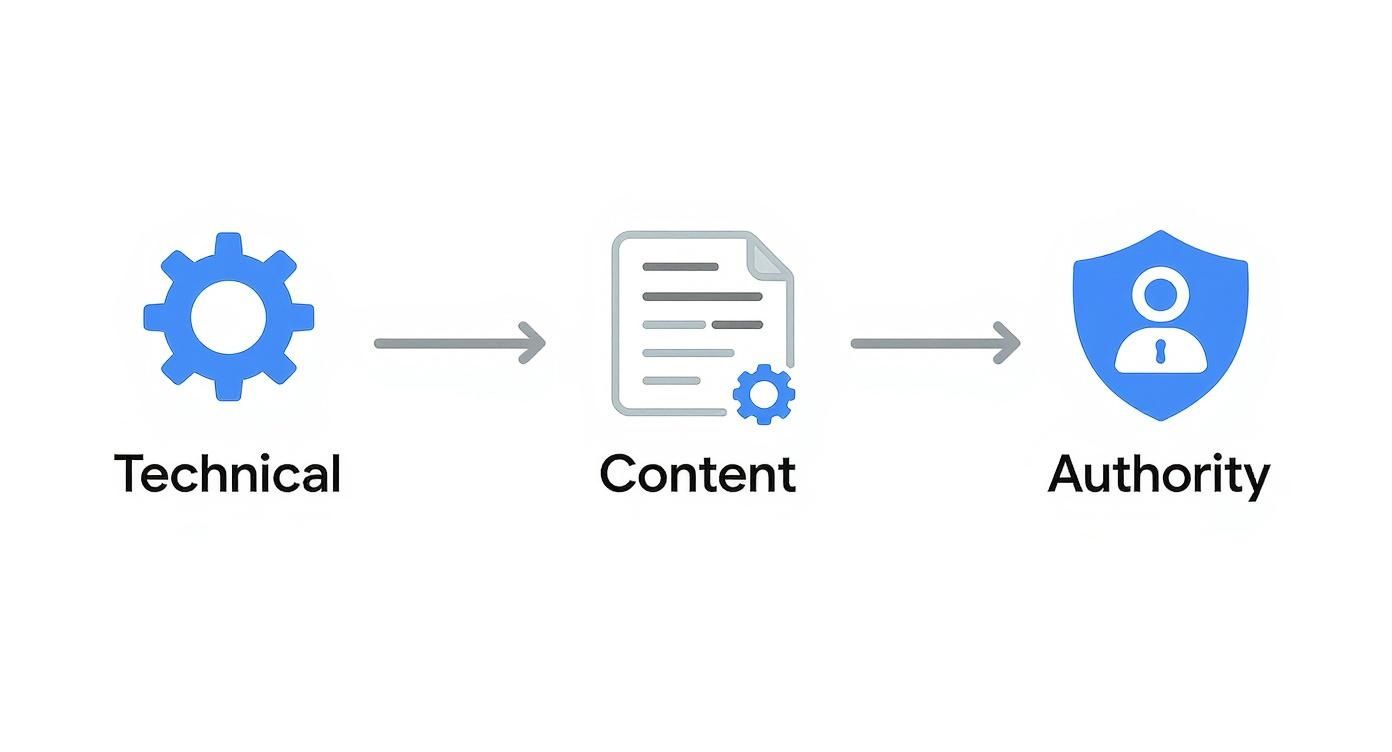
As you can see, a strong technical base gets your quality content seen, which in turn helps build the authority you need to climb the rankings.
To help you get started, here's a quick overview of where to focus your efforts first.
Your Prioritised Google Ranking Action Plan
This table breaks down the three core pillars into a clear, actionable plan, giving you a realistic idea of what to tackle first, how long it might take to see movement, and the tools we recommend for the job.
| SEO Pillar | High-Priority Action | Typical Timeline | Recommended Tool |
|---|---|---|---|
| Technical SEO | Fix indexing issues, improve site speed, and ensure mobile-friendliness. | 1-3 Months | Google Search Console, Screaming Frog |
| Content & On-Page | Identify core keywords, optimise existing pages, and create content that answers customer questions. | 3-6 Months | Ahrefs, Semrush, AnswerThePublic |
| Authority & Links | Set up a Google Business Profile, get listed in key UK directories, and create link-worthy content for outreach. | 6-12+ Months | BrightLocal, Google Business Profile |
This plan isn't about doing everything at once; it's about making smart, sequential moves that build momentum over time.
How To Prioritise Your SEO Efforts
With a limited budget and even less time, knowing what to do first is everything. Here’s how I always suggest clients think about it:
- Technical Health First: Before you do anything else, you have to be sure Google can actually find, crawl, and understand your website. This is non-negotiable. Check for indexing problems, make sure your site works brilliantly on mobile, and tackle slow-loading pages. Our SEO checklist for a new website is a great resource for walking through these foundational checks.
- Then, Content Relevance: Once the technical house is in order, turn your attention to the content. What problems are your customers trying to solve? What questions are they typing into Google? Your entire goal is to become the best, most helpful answer they can find.
- Finally, Build Authority: Authority is something you earn over time. It comes from consistently publishing brilliant content and getting signals of trust from around the web, like backlinks from other reputable sites. This is more of a long game, but it all starts with creating content that is genuinely worth linking to in the first place.
A crucial early step in getting your content right is knowing who you're up against. Taking the time to learn about building a comprehensive competitor analysis framework will pay dividends, helping you spot gaps in the market and fine-tune your strategy from day one.
Remember, the goal isn't just to rank—it's to rank for the searches that actually matter to your business. A technically flawless site with the wrong content won't bring in customers, and amazing content on a broken site will never get seen. Start with the foundation and build up from there.
Mastering Your On-Page and Content SEO
If your technical setup is the foundation, your content is the house itself. It’s what people actually come to see, and it’s what Google analyses to figure out if your site is the right answer for someone’s search. Nailing your on-page and content SEO is all about making every single page work harder to improve your Google ranking.
This isn't about clumsily stuffing keywords into your text. It’s about getting into the heads of your potential UK customers, understanding what they're really looking for, and creating content that genuinely helps them. When you get this right, a simple blog post or service page transforms into a powerful asset that pulls in traffic month after month.
Uncovering What Your Audience Really Wants
All great content starts with solid keyword research. You have to understand your ideal customer. What problems are they trying to solve? What questions are they tapping into Google?
Think beyond the obvious. A plumber in Cambridge will naturally target "plumber in Cambridge," but their customers are also searching for things like:
- "how to fix a leaking tap"
- "emergency boiler repair cost"
- "best combi boiler for a small flat"
These are what we call long-tail keywords. They’re more specific, usually have less competition, and often signal a much stronger intent to buy or take action. By creating content that answers these specific queries, you position yourself as a helpful expert and catch people much earlier in their decision-making process.
Crafting Titles and Descriptions That Get Clicks
Your title tag and meta description are your shop window in the search results. They’re the first thing a user sees, and they can be the difference between someone clicking on your site or a competitor's. A well-written title can have a huge impact on your click-through rate (CTR), which is a big thumbs-up to Google.
Just look at the numbers. UK search data shows the average CTR for the #1 spot on Google is around 27.6%. This plummets to just 15.8% for the second position. Once you’re off the first page, less than 1% of people will click. Small tweaks matter—titles that include numbers see a 14.7% uplift in clicks. It just goes to show how minor changes can make a real difference.
A great title should be:
- Clear and Concise: Keep it to around 50-60 characters.
- Keyword-Focused: Pop your main keyword in, ideally near the start.
- Compelling: Use action words, numbers, or questions to spark curiosity. For example, "Emergency Plumber Cambridge | 24/7 Call Out" is much punchier than "Plumbing Services."
A compelling title and meta description don’t just help your ranking; they convince a real person that your page holds the answer they’re looking for. Think of it as the cover of a book—it has to be good enough to make someone open it.
Structuring Content for Readability and SEO
Once someone clicks through, the page structure is what keeps them there and helps Google understand the hierarchy of your information. This is where headings are your best friend.
- H1 (Main Title): One per page, and only one. It should contain your primary keyword and perfectly match the page's content.
- H2s (Subheadings): Use these to break your content into logical chunks. They’re also great spots for secondary keywords and related questions.
- H3s (Sub-subheadings): Perfect for organising information even further within your H2 sections, like introducing lists or bullet points.
This clear structure makes your content easy to scan for busy readers and lets search engine crawlers quickly grasp what your page is all about. Well-structured content is a cornerstone of good optimisation, and you can explore more on-page SEO best practices in our detailed guide.
The Power of Smart Internal Linking
Internal linking is simply the practice of linking from one page on your website to another. It sounds simple, but it’s an incredibly powerful technique for boosting your Google ranking.
Smart internal links do three key things:
- They guide users through your site, keeping them engaged and pointing them towards other relevant content.
- They help search engines discover your pages and understand how they all relate to each other.
- They spread "link equity" (or authority) around your site. A link from a high-performing page can pass some of its ranking power to a page that needs a boost.
For example, on your "boiler repair" service page, you could naturally link to a blog post you wrote called "5 Signs Your Boiler Needs Replacing." This is genuinely helpful for the reader and signals to Google that you have real expertise on the topic.
Building a Solid Technical SEO Foundation
Think of technical SEO as the foundations of your house. It’s not the flashy part your customers see, but if the foundations are cracked, the whole building is unstable. It's all about making sure search engines like Google can find, understand (crawl), and catalogue (index) your website without hitting any roadblocks.
You can have the most brilliant content and a killer keyword strategy, but without a solid technical base, none of it will perform as well as it should. Let's walk through the essential checks and fixes to make sure your website is a place Google loves to visit, free from the technical gremlins that could be torpedoing your rankings.
https://www.youtube.com/embed/IrFAeQgzE7w
Is Google Even Seeing Your Website?
Before you start tweaking meta descriptions or chasing backlinks, you need to answer one simple question: is Google actually indexing your pages? If Google can't find your content, it simply doesn't exist in its search results. It’s a complete non-starter.
The best place to get this answer is Google Search Console. This free tool is your direct line to Google, offering priceless insights into how the search engine sees your site.
Getting it set up is your first job. Seriously. Do it now.
Once you’re in, the URL Inspection tool lets you check the index status of any page on your site. It’ll tell you if a page is on Google, if it's eligible to be, and if there are any crawling or mobile usability problems holding it back.
From this dashboard, you can dive deep into reports on your site's health, clicks, impressions, and indexing status.
Another must-do is submitting an XML sitemap through Search Console. Think of a sitemap as a map of your website that you hand directly to Google, showing it all your important pages. This helps Google discover and index your content much more efficiently, which is especially important for new websites or those with a lot of pages.
Speed and Usability Are Non-Negotiable
How fast your website loads is a huge ranking factor. It’s also just common sense. A slow website is frustrating, causing people to hit the back button and sending a clear negative signal to Google. Most people simply won't wait longer than three seconds for a page to load.
Google made this official with its Core Web Vitals, a set of specific metrics that measure the real-world experience users have on your site.
The big three you need to know are:
- Largest Contentful Paint (LCP): How long does it take for the main piece of content (like a big image or a block of text) to show up?
- First Input Delay (FID): How quickly does your site respond when someone clicks a button or interacts with something?
- Cumulative Layout Shift (CLS): Does the page content jump around annoyingly as it loads? That’s CLS, and it drives users mad.
Think of Core Web Vitals as Google's way of scoring your site's user-friendliness. A site that is fast, responsive, and stable gets a thumbs-up because it provides a better experience—and that’s all Google really wants for its users.
To see how your site stacks up, use Google's free PageSpeed Insights tool. It will analyse your pages and spit out a report with specific, actionable recommendations, like "compress these images" or "reduce server response time." Getting your site loading quickly is a cornerstone of good SEO, so if you want to dig deeper, it’s worth learning how to improve website speed.
On top of speed, your website absolutely must be mobile-friendly. With most searches now happening on phones, a responsive design that adapts to any screen size is essential. Neglecting this is no longer an option if you’re serious about ranking. For a complete walkthrough of all the crucial checks, our comprehensive technical SEO audit checklist covers everything you need to know.
Dominating Local Search in the UK
If you run a business with a physical address or a defined service area in the UK—whether you're a baker in Brighton or a plumber in Perth—local SEO isn't just a nice-to-have. It's the lifeblood of your business.
It’s all about making sure that when someone nearby searches for what you offer, your business pops up. This is exactly how you capture those high-intent “near me” searches and get customers to either walk through your door or pick up the phone.
The entire strategy for getting seen in your local area hinges on one key platform: your Google Business Profile (GBP). Seriously, think of it as your digital shopfront on Google. A well-tended profile can land you in the coveted ‘map pack’—that box with three local businesses you see right at the top of local search results.
Building Your Ultimate Google Business Profile
Just setting up a Google Business Profile is easy, but optimising it is where you really pull ahead of the competition. An incomplete profile is a massive missed opportunity. Your mission is to fill out every single section with information that's accurate, detailed, and actually helps a potential customer.
Nail the fundamentals first:
- Business Name: Make sure it’s your exact, real-world business name. No stuffing keywords in here.
- Categories: This one’s huge. Pick the most specific primary category you can (e.g., "Wedding Photographer," not just "Photographer"). Then, layer on any other relevant secondary categories.
- Service Area: Clearly define the towns, cities, or postcodes you cover. This is non-negotiable for any business that travels to its customers.
- Business Description: Write a punchy summary of what you do, making sure to weave in terms people would actually search for.
Once you’ve got the basics down, start adding high-quality photos and videos. Show off your work, your premises, and your team. This stuff brings your business to life and builds instant trust. And don't forget to use the Google Posts feature to share updates, offers, and news—it shows Google (and customers) that you're active and open for business.
The Power of Customer Reviews and Engagement
Positive reviews are one of the most powerful ranking signals in local SEO, period. They offer social proof to potential customers and scream "trustworthy" to Google. A steady stream of four and five-star reviews will give you a significant leg up in the map pack.
You need to actively encourage your happy customers to leave a review. Make it as easy as possible by sending them a direct link to your GBP review page.
Getting reviews is only half the battle. Responding to every single one—good or bad—is just as crucial. A thoughtful reply to a positive review shows you appreciate your customers. A professional, helpful response to a negative one demonstrates excellent customer service and can turn a bad situation around.
Ensuring Consistent Local Citations
A local citation is simply any online mention of your business's name, address, and phone number (what we in the biz call NAP). These pop up on local business directories, industry-specific websites, and social media profiles. Think of sites like Yell, Thomson Local, or even your local Chamber of Commerce.
The golden rule with citations is consistency. Your NAP information must be identical everywhere. Tiny inconsistencies, like using "Ltd." on one site and "Limited" on another, can confuse search engines and water down your local authority.
Do a quick audit of your online presence. Search for your business and check the main directories. If you spot any discrepancies, claim the listings and fix them right away. This simple bit of digital housekeeping is a foundational step in building a rock-solid local search presence and owning your local market.
Building a Backlink Profile That Lasts
Think of backlinks—links from other websites pointing to yours—as votes of confidence in Google’s eyes. They act as a powerful signal that your content is credible, authoritative, and genuinely worth showing to people searching for what you do. The days of chasing any old link, regardless of its quality, are long gone. Today, it’s all about quality, not quantity.
This means stepping away from spammy, outdated tactics and focusing on earning high-quality, relevant links. For a small business, this isn't about launching complex, expensive campaigns. It’s about building genuine relationships and creating content so valuable that others in your industry or local community want to link to it.
Finding Genuine Link Opportunities
The best links always come from websites that are topically relevant to your business. If you’re a local bakery in Manchester, a link from a Manchester food blogger is worth far more than a random link from a tech website in another country. Your first job is to identify these potential partners.
Start by looking for:
- Local Blogs and News Sites: Are there community bloggers, local news outlets, or lifestyle magazines covering your area? These organisations are often hungry for local stories and expert input.
- Industry-Specific Publications: Every industry has its own trade publications, forums, or influential blogs. Becoming a go-to source for them is a brilliant way to establish yourself as an expert.
- Non-Competing Local Businesses: Think about businesses that serve the same customers but don’t directly compete. For instance, a wedding photographer could team up with a local florist or venue.
Putting together a simple spreadsheet to track these potential partners is a great way to stay organised. Just note their website, contact information, and a quick idea for how you could collaborate.
The Art of Personalised Outreach
Once you have a list of targets, it's time for outreach. This is where so many people fall flat, sending out generic, templated emails that get deleted in a heartbeat. The secret to success is personalisation.
Your email needs to show you've actually taken the time to understand their website and their audience. Reference a specific article they've written or mention something you admire about their work.
Don’t just ask for a link. Offer value first. Propose a genuine collaboration, offer a unique insight they can quote, or provide a resource that would be genuinely useful to their readers. An email that starts with "I loved your recent article on…" is far more likely to get a response than one that just says "Please link to my website."
The real goal is to start a conversation and build a proper relationship. For more detailed advice, check out our guide on how to build backlinks effectively.
Creating Link-Worthy Assets
By far, the most sustainable way to earn backlinks is to create something that people naturally want to share. This is often called a "linkable asset." Instead of constantly asking for links, you create something so good that links just start coming to you.
For a local business, this could be:
- A unique local study: A survey of the "best dog-walking spots in Bristol" or an analysis of "Cambridgeshire's independent coffee shop scene."
- A helpful local resource: An interactive map of local attractions or a comprehensive guide to planning a local event.
- Expert commentary: Offering your unique data or expert opinion on a trending topic in your industry.
This approach flips the dynamic from asking for a favour to providing a valuable resource. It takes more effort upfront, but it pays off massively in the long run by building your authority and attracting high-quality links organically. This strategy is more important than ever as Google's algorithms evolve. With Google holding a staggering 93.3% of the UK search market, its updates are paramount. Recent major core updates caused significant visibility drops for even the largest UK news websites, with some facing declines as large as 76%. This just goes to show how crucial a robust SEO strategy is, and a strong backlink profile is a core part of building that authority.
Keeping Score: How to Measure SEO Success and Adapt
Getting your Google ranking to a better place isn't a "set it and forget it" job. It's a constant loop of doing, measuring, and tweaking. You can spend ages creating content and building links, but if you aren't tracking what's actually working, you're just guessing. Measuring success is what lets you double down on the good stuff and ditch what isn't delivering.
This all starts with two essential (and totally free) tools from Google: Google Analytics and Google Search Console.
Think of Search Console as your direct line to Google. It tells you how Google sees your site and which keywords you're showing up for. Analytics, on the other hand, tells you what people do after they click through to your website. You need both to get the full picture.
The Metrics That Actually Matter
To get a real sense of your performance and figure out how to improve your Google ranking, you need to monitor a few core metrics. It's easy to get lost in vanity numbers, so focus on the data that signals genuine progress and, ultimately, helps your business.
Here are the essentials to keep a close eye on:
- Organic Traffic: How many visitors are coming from search engines? The goal is a steady upward trend over time.
- Keyword Rankings: What search terms are bringing people to you? Jump into Search Console to check your average position for your most important phrases.
- Click-Through Rate (CTR): This is the percentage of people who see your site in the search results and actually click on it. If your CTR is low, it could be a sign that your page titles or descriptions aren't grabbing attention.
- Top Performing Pages: Which of your pages or blog posts are pulling in the most organic traffic? This is gold dust—it tells you exactly what kind of content connects with your audience.
By checking this data regularly, you'll start spotting opportunities everywhere. See a page that's stuck on page two for a really valuable keyword? That's your cue to give it a content refresh and a bit of optimisation to nudge it onto page one.
Rolling With the Punches in SEO
The world of SEO is always on the move, thanks to Google's algorithm updates and new tech. Staying on top of these shifts is vital if you want to succeed long-term. Just look at how AI in search is already changing how people behave online here in the UK.
For instance, after Google's June 2025 core update, we saw UK websites get a massive spike in search impressions, nearly doubling overnight. This was tied directly to the wider use of AI Overviews in the search results.
While these AI summaries can drop the click-through rate for the top organic result by around 34.5%, the data shows nearly half of users (49%) still click on the traditional blue links after seeing one.
What does that tell us? While getting your content ready for AI-driven features is becoming more important, having high-quality, in-depth content on your own website is still absolutely critical. You can dig into more data on how British SEO professionals are adapting and learn more about the impact of the June 2025 core update. Making smart, data-led decisions based on these trends is what will keep your SEO efforts effective and bringing in a return.
A Few Common Questions About Google Rankings
Once you start digging into SEO, a few questions always pop up. It's completely natural. Getting your head around these helps set the right expectations and gives you a solid footing for the journey ahead.
Let's tackle some of the most common ones we hear from business owners.
How Long Does It Take to Actually See SEO Results?
This is the big one, isn't it? The honest answer is, it depends. SEO is a long-game, not a quick-fix. For a brand-new website with very little authority, you might start to see some flickers of positive movement for less competitive keywords within four to six months.
But for the more valuable, competitive search terms, it can realistically take six months to a year or even longer to really cement a strong position on the first page. It all comes down to factors like how competitive your industry is, where you're starting from, and how consistently you stick to the plan.
Think of SEO like planting a tree. You do the hard work upfront—preparing the soil, planting the seed—but the real growth happens steadily over time with consistent care. You can't expect a giant oak the day after you plant the acorn.
What’s the Difference Between Organic and Paid Search?
It’s so important to understand the two main types of results you see on a Google search page. They look similar, but they're fundamentally different.
- Paid Results (Google Ads): These are the ads you see right at the top, usually with a little "Ad" label next to them. Businesses pay Google every single time someone clicks on their link. It’s a fantastic way to get instant visibility, but that visibility vanishes the second you stop paying.
- Organic Results: These are the "natural" search results that appear just below the ads. You can't buy your way into these spots. Google's algorithm decides these rankings based on things like relevance, authority, and user experience—all the stuff we've covered in this guide.
While ads can give you a great short-term boost, building your organic ranking is a sustainable, long-term asset that drives consistent traffic for free.
Why Do My Google Rankings Keep Bouncing Around?
Seeing your rankings jump up and down can be a bit nerve-wracking, but it's a completely normal part of the process. There are a few reasons for these shifts:
- Google Algorithm Updates: Google is always tinkering with its ranking algorithm. Sometimes they roll out major updates that can cause significant shifts for everyone.
- Competitor Activity: You’re not the only one working on SEO. If a competitor publishes a brilliant new piece of content or lands some powerful new backlinks, they might leapfrog you for a bit.
- Changes in Search Behaviour: What people search for can change with the seasons, news, or trends, which affects which pages Google decides to show.
The key is not to panic. Instead, just keep your head down and focus on consistently creating great content and keeping your website technically healthy. That long-term, steady approach will always win out over the short-term bumps in the road.
Ready to stop guessing and start ranking? Bare Digital offers a free SEO Health Check and a transparent, bespoke Activity Plan to show you exactly how we'll improve your Google ranking. Get your custom proposal within 24 hours and see how our cost-effective, data-driven strategies can deliver real results for your business.