
Knowing how to increase your online sales starts with a simple, unavoidable truth: you can't improve what you don't measure. Before you spend a single penny on a new marketing campaign, you need to build a solid foundation. That means taking an honest look at your current digital performance to find the gaps.
Building Your Foundation for Online Sales Growth
Jumping straight into paid ads or a flurry of social media posts without a baseline is like trying to build a house on sand. It just won’t hold up. Whether you’re a local service provider here in Cambridgeshire or a national e-commerce store, the starting point is always the same: a clear, honest audit of your digital presence.
This initial step isn't about getting tangled up in technical jargon. It’s about getting a grip on two core areas:
- Search Engine Optimisation (SEO): How easily can potential customers actually find you on Google?
- Conversion Rate Optimisation (CRO): Once they land on your site, how good is it at turning them into paying customers?
By looking at these two areas first, you stop guessing and start building a strategy based on real data. Every decision you make from here on out will be smarter, more targeted, and, ultimately, more profitable. The proof is in the numbers—in Great Britain, the share of internet sales recently hit 26.3% of all retail, a figure that's been climbing steadily since 2018.
Start with a Simple Performance Audit
A proper audit shines a light on what’s working and, more importantly, what isn't. It helps you set clear Key Performance Indicators (KPIs)—a fancy term for the specific goals you want to hit, like increasing your website traffic by 20% or boosting product page conversions by 5%.
Think of it this way: a local bakery in Cambridge might discover through an SEO audit that they rank well for "cakes in Cambridge" but are completely invisible for "wedding cakes Cambridgeshire," a much more valuable search. A quick CRO review could reveal that 70% of their online visitors abandon their shopping basket at the payment stage, all because the shipping costs are unclear.
These are the kinds of foundational insights that pave the way for real, sustainable growth. If you're just starting out, running through a comprehensive https://www.bare-digital.com/seo-checklist-for-new-website/ is a great way to make sure you've covered all the essential bases from day one.
The process is straightforward: Audit, Analyse, and then Act.
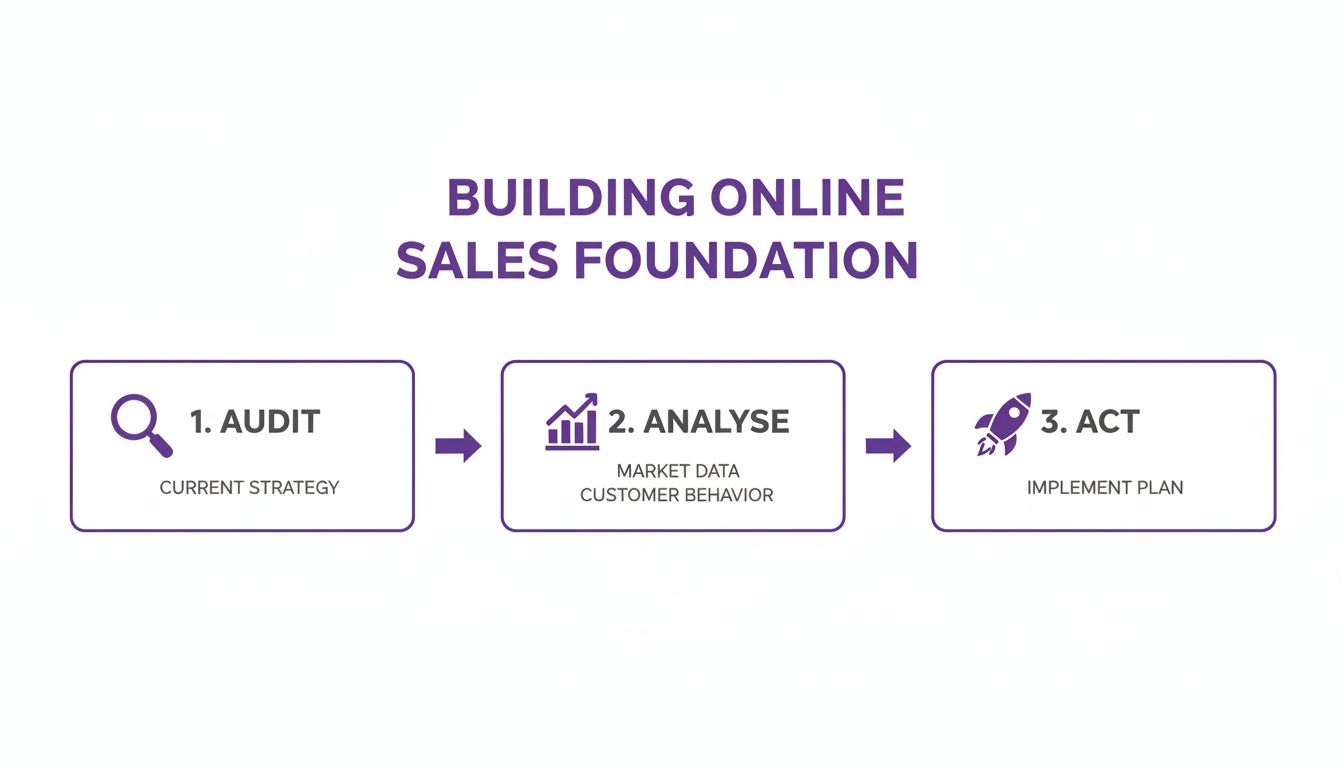
This simple cycle of continuous improvement—spotting the issues, understanding the data behind them, and then taking informed action—is the key.
To get you started, I've put together a quick checklist to guide your initial audit. It covers the basics of what you should be looking for.
Your Initial Sales Growth Audit Checklist
This table breaks down the essential questions you need to answer before you start investing in new traffic or campaigns. Think of it as your pre-flight check.
| Audit Area | Key Question to Answer | Simple Action or Tool |
|---|---|---|
| SEO Health | Are we showing up on Google for our main products/services? | Do a few searches for your top keywords. Use a free tool like Ubersuggest to check your rankings. |
| Website Traffic | Where are our visitors coming from right now? | Check your Google Analytics account under Acquisition > Traffic acquisition. |
| User Experience (UX) | Is our website easy to navigate on a mobile phone? | Grab your phone and try to buy something or fill out a contact form. Was it frustrating? |
| Conversion Funnel | At what stage are we losing potential customers? | Look at your checkout or contact form drop-off rates in Google Analytics. |
| Local Visibility | Does our business appear correctly on Google Maps? | Search for your business name and check your Google Business Profile. |
Answering these questions gives you a clear starting point and helps you focus your efforts where they'll make the biggest difference.
To build a robust foundation for online sales, consider a performance-first playbook that outlines comprehensive strategies for e-commerce, such as how to increase Amazon sales effectively.
This foundational phase ensures every pound you invest in marketing has the best possible chance of delivering a return. Without it, you’re just hoping for the best. With it, you're building a predictable engine for growth.
Getting the Right People to Your Website
So, you’ve audited your site and it’s primed for action. Now for the real challenge: getting people to actually see it. Having a digital storefront is one thing, but you need to actively guide genuinely interested visitors through its virtual doors. This isn't about chasing vanity metrics like page views; it's about attracting a steady stream of high-quality traffic—the kind of visitors who are actually looking to buy what you sell.
The most resilient way to build this flow is with a multi-channel approach. When you blend the long-term stability of organic search with the immediate impact of smart paid advertising, you create a robust system for growth. It’s a combination that ensures you’re visible to customers at every stage of their buying journey.
Mastering Search Engine Optimisation (SEO)
At its heart, Search Engine Optimisation (SEO) is the art of making your website attractive to search engines like Google. Get it right, and you place your business directly in front of customers at the exact moment they’re searching for a solution you provide. It's a long-term investment that pays serious dividends in sustainable, free traffic.
But forget just stuffing keywords onto a page. Modern SEO is all about understanding user intent. What problem is the searcher actually trying to solve? For a Cambridgeshire-based plumbing service, a potential customer isn't just searching for "plumber"; they're searching for "emergency plumber near Cambridge" or "how to fix a leaking tap."
Your content needs to answer these specific questions. Create helpful blog posts, detailed service pages, and FAQs that get right to the heart of your customers' pain points. This not only helps you rank higher but also builds trust by positioning you as the expert they need. If you're looking for a deeper dive, our detailed guide on how to get more traffic to your website offers more advanced techniques.
Winning with Local SEO
For businesses serving a specific geographic area, Local SEO is an absolute game-changer. It’s all about optimising your online presence to attract more business from relevant local searches—those "near me" queries that have become second nature to mobile users.
Your Google Business Profile (GBP) is the cornerstone of this strategy. It’s your free listing that appears in Google Maps and the local search results. Make sure it's fully completed and optimised with:
- Accurate Information: Your name, address, phone number, and opening hours must be consistent everywhere online. No exceptions.
- High-Quality Photos: Showcase your premises, products, and team. Give potential customers a real feel for your business before they even get in touch.
- Customer Reviews: Actively encourage satisfied customers to leave reviews. Positive feedback is one of the most powerful local ranking factors there is.
Responding to reviews—both good and bad—shows you value customer feedback and are an engaged local business owner. This simple act can make all the difference when a potential customer is deciding between you and a competitor.
Key Takeaway: Don't just claim your Google Business Profile; treat it like a second homepage. Regularly update it with posts, photos, and special offers to signal to Google that your business is active, relevant, and the best choice in the area.
A Smart Approach to Paid Advertising
While SEO builds long-term momentum, paid advertising delivers immediate visibility. Platforms like Google Ads and social media channels let you place your business directly in front of a highly targeted audience. The key to success, especially on a tight budget, is precision.
Instead of broad, expensive campaigns, focus on long-tail keywords in Google Ads. These are longer, more specific phrases that tend to have lower competition and much higher conversion rates. For example, rather than bidding on the costly term "women's shoes," a boutique in Ely could target "handmade leather boots Ely." See the difference?
On social media platforms like Facebook and Instagram, you can get incredibly granular with their targeting options. You can build audiences based on:
- Demographics: Age, gender, location, and language.
- Interests: Hobbies, pages they've liked, and groups they're in.
- Behaviours: Past purchase behaviour or even the type of device they use.
Start small. A budget of £10-£20 per day is plenty to test different ad variations and see what resonates. Track your Return on Ad Spend (ROAS) meticulously. The goal isn't just to get clicks; it's to get clicks that convert into sales. Once you find a winning formula, you can scale your investment with confidence.
Turning Your Website Into a Sales Machine
Getting traffic to your site is only half the job. If those hard-won visitors land on a confusing, slow, or untrustworthy website, they'll be gone in a flash. This is where Conversion Rate Optimisation (CRO) steps in, transforming your site from a simple online brochure into a powerful sales engine.
The mission is straightforward: make it as easy and appealing as possible for a visitor to become a customer. It's about polishing every single touchpoint, from the moment they arrive on your page to that final, satisfying click on the 'confirm purchase' button.
Ultimately, it’s about getting inside your users' heads and removing any friction that gets in the way of a sale. I’ve seen time and again how small, data-driven tweaks here can lead to massive jumps in revenue, making your existing traffic infinitely more valuable.
Crafting a Seamless User Experience
A brilliant User Experience (UX) is the invisible backbone of any website that converts well. When you get it right, your customers don't even notice it—they just find the entire process of browsing and buying to be completely natural and intuitive.
First up, your website absolutely must have a mobile-first design. With most online traffic now coming from smartphones, a site that’s clunky or hard to navigate on a small screen is just throwing customers away. Think big, tappable buttons, simple menus, and lightning-fast load times.
Navigation needs to feel logical and predictable. A visitor should be able to land on your site and figure out what they need in just a few clicks. Can someone new to your homepage instantly grasp what you sell and how to find it? Confusing menus and cluttered layouts are notorious conversion killers.
Key Insight: A good user experience isn't just about looking pretty; it’s about seamless functionality. A smooth, frustration-free journey builds subconscious trust, making customers feel much more comfortable hitting that 'buy' button.
The Anatomy of a High-Converting Product Page
Your product and service pages are where the real decisions happen. This is your digital sales pitch, and every single element has to work in harmony to persuade the visitor it’s time to act.
A truly killer product page always nails these key components:
- Professional Imagery and Video: People want to see exactly what they’re getting. Use high-resolution photos from multiple angles, show the product in a real-world setting, and think about adding a short video to really bring its benefits to life.
- Compelling and Clear Copy: Your descriptions should shout about the benefits, not just list the features. How does your product solve a problem or make the customer's life better? Use bullet points to make the key advantages easy to scan.
- Powerful Trust Signals: Displaying customer reviews, testimonials, and any industry awards or guarantees is huge for building credibility. A potential buyer is far more likely to trust the word of a fellow customer over your own marketing spiel.
- An Unmistakable Call-to-Action (CTA): Your 'Add to Basket' or 'Enquire Now' button needs to pop. Use a colour that stands out from the rest of the page and write clear, action-focused text. Don't make people hunt for what to do next.
When these elements come together, they answer a customer's questions, soothe their doubts, and gently guide them toward making a purchase. Our agency has seen how tiny adjustments in these areas can give sales a serious lift. For a deeper dive, check out our detailed guide on how to improve website conversion rates.
Streamlining the Checkout to Reduce Abandonment
One of the most frustrating leaks in any online sales funnel is shopping basket abandonment. Countless studies show that a huge percentage of people who add items to their basket never actually finish the purchase. More often than not, it's because of a clunky, surprising, or overly complicated checkout process.
To plug those leaks, your checkout needs to be a masterclass in simplicity.
Cut out every unnecessary step and form field. Only ask for the information you absolutely need to process the order. Another game-changer is offering a guest checkout option; forcing users to create an account is a massive barrier that sends many potential customers running.
Finally, be totally transparent with all costs upfront, especially shipping. Unexpected charges popping up at the last second are the number one reason people abandon their baskets. Honesty here builds trust and sets the right expectations from the start.
Making Data-Backed Decisions with A/B Testing
So, how do you actually know if a change will improve your sales? You test it. A/B testing, or split testing, is the practice of comparing two versions of a webpage to see which one performs better.
It’s simple, really. You show one version (the control, or 'A' version) to half of your visitors, and the second version (the variation, or 'B' version) to the other half. Then you sit back and measure which version gets you more conversions.
Here's a quick visual of how A/B testing works by splitting traffic between two different page designs to measure performance.
This whole process allows you to make decisions based on what your users actually do, not just on what you think will work.
You can test almost anything, but it’s smart to start with the high-impact stuff:
- Headlines: Does a benefit-focused headline outperform a question?
- Call-to-Action Buttons: Does changing the button colour from blue to orange get more clicks? Does "Buy Now" convert better than "Add to Basket"?
- Offers: Does a 20% Off discount work better than a "Free Shipping" offer?
Recent data shows just how powerful smart promotions can be. For example, UK online retail sales in Great Britain saw weekly averages between £1.5 and £2 billion in October. That’s an increase of around 10% year-on-year, pushing the online share of all retail to over 27%. This growth was fuelled by seasonal demand and perfectly timed promotions, proving that testing and rolling out the right offers is a core tactic for boosting online sales.
Mastering Retention to Boost Lifetime Value
True online growth isn't just about finding new customers; it's about turning the ones you already have into loyal, repeat buyers. I see so many businesses pour their entire budget into acquisition, but the real gold is in retention. After all, acquiring a new customer can cost five times more than keeping an existing one. That makes retention one of the most cost-effective ways to sustainably increase your online sales.
It’s really a shift in mindset. You stop chasing one-off transactions and start building genuine, long-term relationships. When you focus on creating a great post-purchase experience, you don't just encourage repeat business. You also boost the Customer Lifetime Value (CLV)—the total revenue you can expect from a single customer over time.
The Power of Smart Email Marketing
Email marketing is far from dead; it’s the absolute cornerstone of effective customer retention. When done right, it's so much more than a generic monthly newsletter. It’s a direct line to your customers, delivering personalised, timely, and genuinely useful content right where they’ll see it.
One of the most powerful tools in your email arsenal is the abandoned basket reminder. Setting up an automated email sequence to gently nudge a customer about the items they left behind can recover a surprising amount of lost revenue. Often, a simple prompt is all it takes to get them back to finish the purchase.
Go a step further and create segmented email campaigns based on past purchase history. For instance, a customer who bought a particular product could get emails with tips on how to use it, or maybe recommendations for complementary items. This personalised approach shows you actually understand their needs and keeps your brand top of mind. For more great ideas on keeping customers engaged, check out these 10 Proven Customer Retention Strategies to Maximize LTV.
Building Trust with Social Proof
In the online world, trust is everything. Before pulling out their wallets, modern consumers are actively looking for the opinions and experiences of others. This is why social proof, like customer reviews and testimonials, is so vital.
Don't just sit back and hope for feedback. Actively encourage your happy customers to leave reviews on your website, Google Business Profile, or relevant third-party sites like Trustpilot. A simple, polite follow-up email a week or two after their purchase can work wonders.
Once you’ve got those glowing reviews, shout about them! Feature them prominently on your product pages, homepage, and even in your marketing emails. A powerful testimonial placed right next to a 'Buy Now' button can be the final nudge a hesitant buyer needs.
Expert Tip: User-generated content, like photos of customers using your products, is an incredibly authentic form of social proof. Run a contest or offer a small incentive to encourage customers to share their photos on social media with a specific hashtag.
Implementing Simple Loyalty Programmes
Everyone likes to feel appreciated. A simple loyalty programme is a brilliant way to reward your best customers and give them a reason to come back again and again. This doesn't need to be some complex, enterprise-level system.
Here are a few straightforward ideas that any business can get started with:
- A Points-Based System: Customers earn points for every pound they spend, which can be redeemed for discounts on future purchases.
- Tiered Rewards: As customers spend more over time, they unlock new tiers with better perks, like exclusive access to new products or free shipping.
- Early Access Offers: Give your loyal customers a head start on sales or new product launches as a thank you for their continued support.
Comparing Customer Retention Tactics
Choosing the right retention strategies depends on your resources and goals. Some tactics offer quick wins, while others are a longer-term investment. Here's a look at how some of the most common methods stack up.
| Retention Tactic | Typical Effort and Cost | Potential Sales Impact | Best For |
|---|---|---|---|
| Email Marketing | Low to Medium. Requires setup and content creation. | High. Can drive immediate repeat sales and recover lost revenue. | E-commerce and service businesses with an existing customer list. |
| Loyalty Programmes | Medium. Involves setup and ongoing management. | High. Fosters long-term loyalty and increases purchase frequency. | Businesses with frequent repeat purchasers, like retail or coffee shops. |
| Customer Reviews | Low. Mainly involves automating follow-up requests. | Medium. Builds trust and can significantly improve conversion rates. | All businesses, especially those in competitive local markets. |
| Personalised Offers | Medium. Requires customer data analysis. | High. Makes customers feel valued and increases the relevance of marketing. | Businesses that can track and segment customer purchase history. |
Ultimately, the most effective approach often involves a mix of these tactics. Start with one or two that feel manageable and build from there.
These programmes create a sense of community and make customers feel valued, which is a powerful driver for long-term loyalty. When you combine these retention tactics with a solid plan for attracting new visitors, you create a powerful cycle of growth. A great starting point is learning how to create a content strategy that aligns with both your acquisition and retention goals, ensuring every piece of content serves a purpose.
Making the Most of Seasonal Trends and Promotions
Timing is everything in retail. Honestly, a well-thought-out promotional calendar can be the difference between a good year and a great one, especially if you know how to tap into those key seasonal peaks to drive sales. It's about getting in sync with the collective buying mood.
From the January sales rush to the summer holidays and the massive end-of-year shopping frenzy, the retail calendar is full of opportunities. The real trick is to plan ahead, making sure your offers and marketing messages line up with what customers are already thinking about.
This isn’t just about slapping a discount on your products. It's about building a cohesive campaign that grabs attention and creates a real sense of urgency.
Planning Your Promotional Calendar
First things first: you need to map out the entire year. Pinpoint the major UK retail events that actually matter to your business and your customers. A local gift shop in Cambridgeshire, for example, will have a very different focus from a national software provider.
Your calendar should include:
- Major Holidays: Christmas, Easter, and Bank Holidays are the obvious starting points.
- Retail Events: Black Friday and Cyber Monday are pretty much non-negotiable for most e-commerce businesses now.
- Seasonal Shifts: Think "Back to School" in late summer, "Get Ready for Winter" in autumn, or "Summer Garden" promotions.
Once you have these key dates locked in, you can start brainstorming specific offers. A common mistake I see is defaulting to straight discounts, which can absolutely hammer your profit margins.
Instead, get creative. Promotions like "Buy One, Get One Free" (BOGOF), free shipping thresholds, complimentary gifts with a minimum spend, or exclusive bundles often work much better. They can drive a higher average order value without devaluing your core products.
Executing a Cohesive Campaign
A successful seasonal campaign needs a multi-channel approach where every single touchpoint tells the same story. Your marketing across email, social media, and paid ads has to be perfectly synchronised to create the biggest impact.
Let's take a Black Friday campaign as an example. It might look something like this:
- Early Teasers: A week or two beforehand, start dropping hints to your email subscribers and social media followers to build some anticipation.
- VIP Early Access: Give your loyal customers and email list a 24-hour head start on the sale. It makes them feel valued.
- Launch Day Blitz: Go live with coordinated posts on social media, a prominent banner on your website, and targeted paid ads driving traffic straight to your sale items.
- Urgency Reminders: In the final hours, send out "Last Chance" emails and post countdown timers on social media to capture any last-minute buyers.
This unified approach ensures your message is consistent and reinforces the urgency of the offer, making it far more compelling.
The Power of Q4 Shopping Events
The final quarter of the year, anchored by Black Friday, is absolutely crucial. The data consistently shows a massive spike in online consumer spending during this period. In November, for instance, online sales values in Great Britain often see a huge jump.
One recent report noted a 0.7% month-on-month increase, pushing online sales to 28.6% of all retail, directly influenced by Black Friday promotions. You can dig into the complete dataset from the Office for National Statistics.
This just goes to show how critical it is to have your campaigns, stock levels, and website performance ready for the surge. A slow website or an out-of-stock bestseller during this peak can mean thousands in lost revenue. You have to be prepared.
Answering Your Top Online Sales Questions
When you're trying to grow a business online, you’re bound to have questions. It's completely normal. In this final section, I'll tackle some of the most common queries I hear from UK business owners who are serious about increasing their online sales. Let's get you some clear, straightforward answers.
How Long Does It Take to See an Increase in Online Sales from SEO?
This is the big one, isn't it? The honest answer is that SEO is a long game, not an overnight fix. While you might see a small bump from technical fixes within a few weeks, you should realistically budget for three to six months before seeing significant, needle-moving growth in organic traffic and sales.
The exact timeline really depends on a few things: how competitive your industry is, the current state of your website, and how consistently you invest in quality content and link building. For a local business in Cambridgeshire, for instance, targeting local keywords can often bring results faster than a national brand fighting for much broader, more competitive terms. Consistency is everything here.
What Is the Most Cost-Effective Way to Increase Sales on a Small Budget?
If you're working with a tight budget, the trick is to squeeze every last drop of value from the assets you already have. Hands down, the most cost-effective tactic is almost always email marketing. Sending targeted offers and updates to your existing customer list consistently delivers one of the highest returns on investment in the game.
Beyond email, here are a few other low-cost, high-impact moves:
- Champion your customer reviews: This is powerful social proof, and it costs you nothing but a bit of time to ask for them.
- Optimise your product pages: Go back and improve your descriptions, add better photos, and make your case more compelling. It’s a core part of Conversion Rate Optimisation (CRO) that only costs your time.
- Double down on Local SEO: If you serve a local area, this is often less competitive and incredibly effective at attracting ready-to-buy customers.
- Get real on social media: Pick one or two channels where your customers genuinely hang out and focus on building a real community, not just broadcasting ads.
On a small budget, your goal isn't to be everywhere. It's to be brilliant in a few key places. Make every pound you spend work as hard as it possibly can.
Should I Focus on New Customers or Retaining Existing Ones?
It’s the classic dilemma, but the data is clear: while you need both, retaining existing customers is almost always more profitable. It can cost five times more to land a brand-new customer than it does to keep a current one happy.
A balanced approach is best. Use smart retention strategies like personalised email marketing and simple loyalty programmes to build a stable, predictable revenue base. Then, you can reinvest a portion of those profits into smart acquisition channels like SEO and targeted paid ads to fuel sustainable growth.
Especially in the early days, pouring your energy into retention is a brilliant way to prove your business model and build the cash flow you need to expand.
How Do I Know if My Marketing Is Actually Increasing Sales?
If you’re not tracking, you’re just guessing. To truly understand what's driving your sales, effective tracking is non-negotiable. You have to put systems in place that attribute sales back to your marketing efforts.
Start with a free tool like Google Analytics and make sure you have e-commerce tracking enabled. This will show you exactly which channels—be it organic search, email, or social media—are bringing in the sales. Pay close attention to your overall Conversion Rate, which is the percentage of website visitors who end up buying something.
For specific campaigns, like a Christmas promotion or a new Facebook ad, use unique discount codes or add UTM parameters to your links. This lets you isolate their direct impact and accurately measure your return on investment. The only way to know what’s really working is to get comfortable with your data.
Feeling overwhelmed by the complexities of SEO? At Bare Digital, we specialise in creating bespoke search engine optimisation strategies that drive real results for UK businesses. Get in touch today for your free, no-obligation SEO Health Check and a tailored plan to boost your rankings and increase your online sales. Find out more at https://www.bare-digital.com.