
Before you can even think about boosting your website's authority, you need to know exactly where you stand. It all starts with a proper diagnosis: measuring key metrics like Domain Authority (DA) and getting under the bonnet of your backlink profile to see what’s helping and what’s hurting you. This initial audit is crucial—it ensures every move you make is backed by data and aimed at what will actually impress the search engines.
Diagnosing Your Current Website Authority
Trying to build website authority without first understanding your starting point is a bit like setting off on a road trip with no map and no idea where you are. You’ll definitely be moving, but probably not in the right direction. This diagnostic phase lays the groundwork for every strategy that follows, making sure your time and money are spent where they'll make a real difference.
Think of website authority as your site's reputation in Google's eyes. It’s a reflection of how trustworthy and expert your site is, built largely on the quality and number of other websites linking back to you.
Getting to Grips with Authority Scores
Several industry-standard tools have developed metrics to put a number on this reputation. You'll see a few different names, each calculated slightly differently, but they all aim to do the same thing:
Now, it's important to remember these scores (usually from 0-100) aren't direct Google ranking factors. Their real power is in comparison. A "good" score is completely relative; it only matters in the context of your direct competitors. If you want to dive deeper, you can find out more about what is Domain Authority in our detailed guide.
To bring this to life, let’s look at the highly competitive UK find-a-trade sector. Here, the top players have Domain Authority scores ranging from 55 to 90. For most businesses, a DA between 40-50 is considered average, 50-60 is good, and anything over 60 is excellent. It's no coincidence that a giant like Checkatrade, with its massive DA, shows up for over 30,000 keywords in position 3 alone. That's what high authority gets you: immense visibility and a steady stream of organic traffic.
Here's a general guide to understanding where you might sit.
Website Authority Score Tiers
| DA Score Range | Tier | What It Means for Your Business |
|---|---|---|
| 0-30 | New/Developing | You're just starting out or have minimal backlinks. Competition will be tough. |
| 31-50 | Average | You have a decent foundation. You can compete for less competitive keywords. |
| 51-70 | Good/Strong | You are a recognised player in your niche and can challenge for more valuable keywords. |
| 71+ | Excellent | You're an authoritative leader, likely a well-known brand that's trusted by both users and search engines. |
This table helps put your own score into perspective and sets a realistic target for your efforts.
Kicking Off Your Initial Audit
Your first proper step is a comprehensive site audit. Don't just glance at the headline score; a thorough health check is essential. Using a solid ultimate site audit checklist can be a massive help in making sure you don't miss anything important. This process is all about looking beyond a single number and digging into the nitty-gritty of your backlink profile.
A website's authority isn't just a number—it's the sum of its digital relationships. Think of a strong backlink from a trusted industry source as a public vote of confidence, telling search engines your content is credible and worth showing to people.
This simple three-step process is the best way to approach your diagnosis.
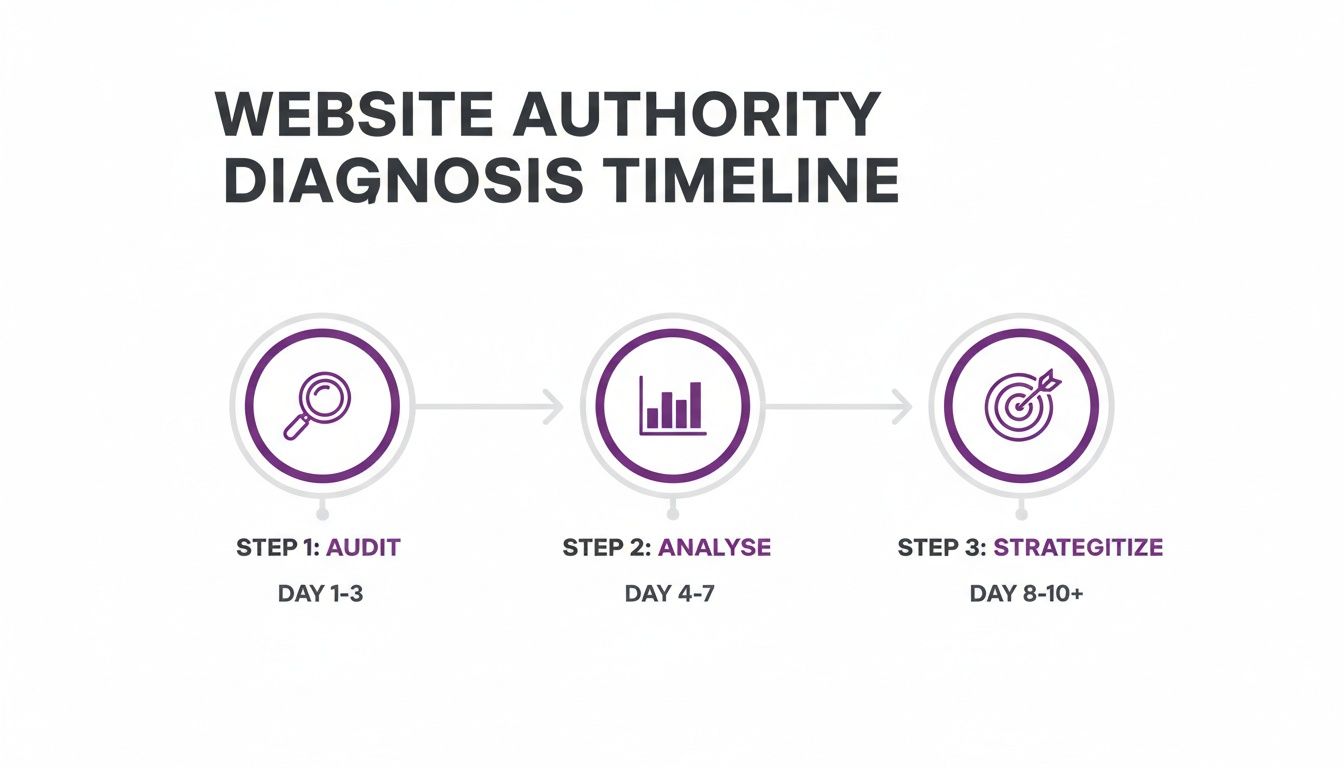
As the visual shows, a successful diagnosis flows from auditing your site, to analysing the findings, and finally, to building a focused strategy based on that data.
Analysing Your Backlink Profile
Once you have your baseline scores, the real detective work begins. You need to understand who is linking to you and why. Are your links coming from authoritative industry blogs, local Cambridge news sites, and respected business directories? Or are they from low-quality, spammy websites that add no value?
Here's a simplified breakdown of what you're looking for:
- High-Quality Links: These are your gold dust. They come from websites with high authority themselves and are directly relevant to what you do.
- Toxic Links: These can actively damage your SEO. They often come from link farms, sites that have been penalised, or domains that have nothing to do with your business.
- Link Gaps: This is where the opportunity lies. Analyse your competitors' backlink profiles to see who is linking to them but not to you. This list is a goldmine for your future outreach campaigns.
By sorting the good from the bad, you can build a clear plan to disavow the harmful links and focus on earning more of the good ones. This diagnostic phase isn't just about finding a score; it's about understanding the story behind that score so you can write a better one for the future.
Get Your Technical SEO House in Order
Think of your website as a house. Before you start decorating with fancy content and inviting guests with backlinks, you have to make sure the foundations are solid and the wiring is safe. That's exactly what technical SEO does. It’s the behind-the-scenes work that lets search engines like Google find, crawl, and properly understand everything on your site.
A website that’s technically sound is seen as trustworthy and reliable – a direct nod to its authority. Ignore this, and even the most groundbreaking content can get lost in the digital ether, simply because Google can't access it properly.
Is Your Site Fast and Mobile-Ready?
Let's be blunt: a huge chunk of your visitors are on their phones. Google knows this, which is why it now operates on a mobile-first indexing basis. This means the mobile version of your site is the one that really counts for ranking.
If your site is a mess on a phone – with tiny text, fiddly links, or slow-loading images – you're actively hurting your authority. Page speed is also a confirmed ranking factor. A slow website isn't just annoying for users; it’s a red flag for search engine crawlers, too.
Here are a few things you can do right now to speed things up:
- Shrink Your Images: This is often the quickest win. Use a tool like TinyPNG to compress image files without losing visual quality.
- Go Responsive: Your website's design should automatically adapt to any screen size, whether it's a huge desktop monitor or a small smartphone.
- Minify Your Code: This just means stripping out unnecessary characters from your site's HTML, CSS, and JavaScript. Many caching plugins can handle this automatically.
A great free tool to see where you stand is Google's PageSpeed Insights. It gives you a clear performance score and tells you exactly what to fix.
You'll get separate scores for mobile and desktop, with a prioritised list of what's slowing you down.
Build a Logical Site Structure
A well-organised website is like a tidy shop; customers (and search engines) can find what they're looking for without getting frustrated. A messy structure, however, creates a confusing experience and can lead to "orphan pages" that Google's crawlers never even find.
The best way to think about this is like a pyramid.
- The Homepage: This is the very top.
- Main Categories/Services: These are the key sections of your site, linked directly from the homepage. For a Cambridgeshire business, this could be "Garden Design," "Landscaping," and "Patio Installation."
- Specific Pages/Sub-categories: These are the more detailed pages that live under your main categories, like a specific service page for "Lawn Care in Ely."
This kind of hierarchy makes it easy for people to navigate and helps spread authority (or "link equity") from your powerful homepage down to the rest of your site. It just looks and feels more professional.
If a first-time visitor can't figure out what you do and where to go in under ten seconds, you have a problem. A confusing site doesn't just lose you a sale; it tells search engines you aren't a reliable source of information.
Talk to Google in its Own Language with Structured Data
Structured data (often called Schema markup) is a special kind of code you can add to your website. It’s like putting little labels on your content that tell search engines exactly what they're looking at.
For instance, you can use it to explicitly tell Google:
- "This page is about a local business, and here is its address in Cambridge."
- "This is a recipe, and it takes 45 minutes to cook."
- "This is an article written by Jane Smith."
- "This is a product, and its price is £49.99."
When you give Google this level of clarity, it can index your content more accurately. The reward? You might get rich snippets in the search results – those little extras like star ratings, FAQs, or event dates that make your listing stand out. It’s a brilliant way to show off your expertise and build authority directly with the search engines.
For a more exhaustive look at the technical checks you should be making, our complete technical SEO audit checklist covers all of this and much more.
Creating Content That Naturally Builds Authority
Right, with the technical nuts and bolts tightened up, it's time to get into the heart of the matter: your content. Let's be clear, high-quality content is the single most powerful lever you can pull to build trust, prove you know your stuff, and ultimately, boost your website's authority. This isn't about just churning out blog posts for the sake of it. The goal is to become the go-to resource in your corner of the world.
This is where we need to talk about topical authority. Instead of dotting your content around random subjects, you strategically build a whole ecosystem of information that screams "expert" to search engines. You want Google to look at your site and think, "Aha, these guys are the most reliable source for this topic."
Planning Your Content Pillars and Topic Clusters
The most effective way I've seen to build this kind of authority is by using the 'pillar and cluster' model. It's an organisational method that makes it crystal clear to Google that you've got a comprehensive grasp of a particular subject.
- Pillar Page: Think of this as your masterpiece. It’s a long, comprehensive piece that covers a broad topic from top to bottom. Your ultimate guide.
- Topic Clusters: These are shorter, more focused articles that dive deep into the specific sub-topics you touched on in your pillar page. Crucially, every one of these cluster posts links back up to the main pillar.
This structure creates a tightly-knit web of internal links. It shows Google how everything fits together and constantly reinforces your expertise on that core pillar topic. Grasping this is a fundamental part of learning how to create a content strategy that actually works.
Let's make this real. Imagine a local accountancy firm right here in Cambridgeshire that wants to bring in more small business clients. Their content plan could look something like this:
- Pillar Page: "The Ultimate Guide to Small Business Tax in the UK". This would be a beast of a page, covering everything from registering for tax to deadlines and allowances.
- Topic Clusters: Then, they'd create a series of supporting blog posts on nitty-gritty subjects, like:
- "A Simple Guide to VAT Returns for Cambridgeshire SMEs"
- "How to Set Up Payroll for Your First Employee"
- "Claiming Business Expenses: What You Really Need to Know"
- "Understanding Corporation Tax Deadlines"
Each of these articles would point back to the main guide. This tells Google, in no uncertain terms, that this firm is an authority on small business tax.
Creating Genuinely Link-Worthy Assets
While that solid pillar-and-cluster model builds your internal authority, the holy grail is creating content so good that other websites can't help but link to it. These 'linkable assets' are magnets for high-quality backlinks, which are pure gold for increasing your site's authority.
The best content doesn't just answer a question; it becomes the definitive resource that others cite when they need to make a point. That's when you start earning links without even asking.
It's time to think beyond the standard blog post. Your focus should be on creating things that offer unique, tangible value to your audience and even your industry peers.
Types of Content That Attract Backlinks
Not all content is created equal when it comes to earning links. I've found over the years that some formats are just naturally more shareable and citable. Putting your energy into these can really speed things up.
Here are a few types of link-worthy assets that consistently get results:
-
Original Research and Data: This is a big one. You could survey local businesses in Cambridgeshire about their biggest challenges, or analyse some public data to spot a new trend. Journalists and bloggers absolutely love original data, and they will always link back to you as the source.
-
In-depth Guides and Tutorials: Don't just write a guide; create the guide. If your tutorial is genuinely the most thorough and practical resource out there, people will naturally reference it as the gold standard.
-
Free Tools and Calculators: A simple, genuinely useful tool can be an incredible link magnet. For example, a financial advisor could create a "Pension Contribution Calculator," or a marketing agency could offer a "Return on Ad Spend Calculator." These provide instant value and get linked to from all sorts of resource pages.
-
Compelling Infographics: People love to share visual content. A well-designed infographic that makes a complex process easy to understand or presents data in a beautiful way can attract links from a huge range of websites.
By focusing your efforts on building this kind of strategic content ecosystem, you stop being just a writer of articles and start becoming a producer of valuable assets. This approach doesn't just serve your audience better; it sends all the right signals to search engines, cementing your website as a genuine authority in its field.
Executing a Strategic Link Building Campaign
So, you’ve got your content strategy humming along and you're creating genuinely useful stuff for your audience. That’s brilliant. Now it’s time to get proactive about building authority, and the most direct way to do that is by earning backlinks.
Think of backlinks as a vote of confidence from other websites. A single, solid link from a high-quality, relevant site can do more for your authority than hundreds of dodgy ones. This part of the process is all about strategy and smart effort, not just sitting back and hoping for the best. A good link building campaign is built on earning genuine links that signal to search engines that you're a credible voice in your field.
Uncovering Opportunities with Competitor Analysis
One of the best places to start is by having a nosey at what’s working for your competitors. By digging into their backlink profiles, you can unearth a goldmine of opportunities. We're looking for what SEOs call 'link gaps'—sites that link to your rivals but haven't yet linked to you.
It's a bit like digital detective work. Using a tool like Ahrefs or Semrush, you can pinpoint exactly who is linking to the top-ranking pages for your target keywords. The goal isn't to copy them link-for-link. Instead, you're looking for patterns and identifying websites that are clearly interested in your subject matter. This detective work hands you a pre-qualified list of prospects to reach out to.
You'll come across a few common tactics when you start digging. Here's a quick comparison of what to expect.
Effective Link Building Tactics Comparison
| Tactic | Effort Level | Potential Authority Impact | Best For |
|---|---|---|---|
| Guest Blogging | Medium | Medium to High | Establishing expertise and reaching new audiences. |
| Broken Link Building | High | High | Providing value by helping webmasters fix their site. |
| Digital PR | High | Very High | Creating newsworthy assets that attract top-tier media links. |
| Unlinked Mentions | Low | Medium | Capitalising on existing brand recognition by requesting a link. |
Mastering the Art of Outreach
Once you've got a list of potential websites, you need to actually reach out to them. This is where so many campaigns fall apart. A generic, copy-and-paste email is just going to get deleted. Real success comes from personalisation and offering genuine value.
Take broken link building, for instance. Your email shouldn't just bluntly state, "You have a broken link on your page." A much better approach is to be genuinely helpful. Start by complimenting a piece of their content, then politely point out the dead link. As a helpful suggestion, you can then offer your own relevant resource as a potential replacement. You've framed your request as a solution, not a demand.
The secret to effective outreach isn't asking for a link; it's demonstrating why linking to your content benefits the other person's audience. When you solve a problem for them, the link becomes a natural byproduct.
Contributing guest articles is another fantastic method. Instead of just begging for a link, you offer to write a high-quality, original piece of content for their blog. They get free, expert content for their audience, and you get an author byline with a valuable link back to your site. It’s a classic win-win that builds both relationships and authority.
Using Digital PR for High-Authority Links
For businesses, particularly local SMEs, digital PR can be a real game-changer. This strategy involves creating something genuinely newsworthy and then pitching it to journalists, bloggers, and local news outlets. It’s less about direct link requests and more about creating a story that people want to write about.
Let’s imagine a Cambridgeshire-based estate agent. Instead of writing another generic blog post on house prices, they could conduct a unique survey on "The Most Desirable Villages for Commuters in Cambridgeshire." Then they'd publish a detailed report with all that juicy, original data.
This is exactly the kind of unique local insight that publications like the Cambridge Independent or local lifestyle blogs are crying out for. When they cover your story, they will almost always link back to your report as the source. Links from respected news organisations are pure gold for building website and local authority. This approach doesn't just earn powerful backlinks; it cements your reputation as the go-to local expert.
Building Regional Authority With Local SEO
For a local business, chasing broad, national website authority can feel like a fool's errand. What really moves the needle—what gets the phone ringing and brings people through the door—is regional authority. It’s about proving to Google and, more importantly, to your local customers that you are the go-to expert in your specific patch.
Mastering local SEO is the most direct way to build this focused authority, making your business the obvious choice for anyone searching nearby. It all starts with your most powerful local marketing tool.
Your Google Business Profile Is Non-Negotiable
Think of your Google Business Profile (GBP) as your digital shopfront. It's often the very first impression a potential customer gets, showing up prominently in Google Maps and those coveted local search results. A neglected profile doesn't just look unprofessional; it actively harms your local authority.
Claiming and optimising your profile is mission-critical. This isn't a "set it and forget it" task. You need to use every feature Google gives you to showcase what makes your business tick.
- Fill Out Everything: Don't just list your name and address. Detail your services, products, opening hours, accessibility info, and write a compelling business description.
- Use Real, High-Quality Photos: Show off your premises, your team in action, and your finished work. Fresh, consistent images tell people you’re an active, thriving business.
- Post Regular Updates: Use Google Posts to share offers, news, and events. This keeps your profile looking current and gives people a reason to check back.
- Answer Questions: Get ahead of customer queries by populating the Q&A section yourself. It provides instant value and shows you're on the ball.
Your GBP is an interactive hub, not a static business card. The more you engage with it, the more Google will reward you.
Reviews, of course, are the lifeblood of your local reputation. Make it a habit to ask happy customers for a review. Just as importantly, respond to every single one—good and bad. A thoughtful, professional response to a negative review can often build more trust than a page full of five-star praise.
The Power of Consistent Citations
Once your Google profile is sorted, it's time to make sure your business details are consistent everywhere else online. A citation is simply any mention of your business's Name, Address, and Phone number (NAP). When your NAP is identical across dozens of online directories, it sends a massive trust signal to search engines.
Inconsistencies—an old address on Yell, a typo in your postcode on a trade site—create confusion and water down your local authority. The aim is to create a clean, uniform digital footprint that leaves no room for doubt.
Think of consistent NAP information as a chorus of voices all confirming your identity. The more directories that sing the same tune, the more confident Google becomes that you are who and where you say you are.
For UK businesses, start with the directories that carry the most weight:
- Big National Players: Yell, Thomson Local, The Independent.
- Industry-Specific Sites: For a Cambridgeshire builder, this might mean Checkatrade. For a local restaurant, it’s TripAdvisor.
- Hyper-Local Listings: Hunt down any Cambridgeshire-specific business directories or community websites.
Getting your details right across these platforms is a foundational task. For a full breakdown of every element you need to get right, our complete local SEO checklist offers a clear, step-by-step framework.
Earning Links From Your Local Community
Just like with national SEO, links are a huge ranking factor. But for local businesses, a link from another respected local organisation is pure gold. It’s a powerful endorsement that proves you're a genuine, integrated part of the local business community.
You probably have more opportunities here than you realise. Start with the relationships you already have.
- Local Suppliers and Partners: Do you work with other businesses in Cambridge? Check if they have a partners page and ask for a link.
- Community Sponsorship: Sponsoring a local kids' football team or the village fete is a great way to give back, and it often comes with a thank-you link from their website.
- Host a Local Event: Run a free workshop or a charity coffee morning. Then, reach out to local bloggers and community news sites to help spread the word.
By getting actively involved in your community—both online and off—you build the kind of regional authority that a national competitor simply can't fake. It's this targeted approach that builds a rock-solid foundation for your website's authority, right where it matters most: on your own doorstep.
Your Top Questions on Website Authority Answered
Building up your website's authority can feel like a bit of a dark art, and it's completely normal to have questions. After all, there are a lot of moving pieces. Let's tackle some of the most common questions we get from business owners trying to get a stronger foothold online.
How Long Does It Take to See Real Progress?
Let's set expectations straight from the start: building website authority is a long game. It’s not something you can tick off a list in a month.
For a completely new website, you're realistically looking at six to twelve months of consistent, focused effort before you start seeing a noticeable shift in metrics like Domain Rating or Authority Score. Even for websites that have been around for a while, making significant gains often follows a similar timeline.
The secret ingredient is consistency. A steady drumbeat of brilliant content creation and quality backlink acquisition, month in and month out, creates a snowball effect. Think of it as a marathon, not a sprint – the reward comes from persistent, patient effort.
Can I Actually Build Authority Without Any Link Building?
Technically, maybe. Realistically? It’s incredibly tough and not a path I’d recommend. Backlinks are still one of the most powerful signals you can send to search engines. They act as third-party votes of confidence, telling Google that other people trust and value your expertise.
Sure, you can get your technical SEO in perfect shape and publish amazing content to build your topical authority. But without those external endorsements from other websites, your growth will be frustratingly slow and eventually hit a glass ceiling. The most effective strategy will always weave together great content, solid technicals, and smart link building.
A simple way to think about it: Your great content is the amazing product you've built. Backlinks are the word-of-mouth recommendations that get people in the door. You can't thrive without both.
What's More Important: Content or Backlinks?
Ah, the classic SEO chicken-and-egg debate! The honest answer is that they are completely codependent. You can't separate them because one fuels the other. Exceptional content is what earns you exceptional backlinks.
If you don't have genuinely valuable, insightful, or useful content on your site, your outreach for links will go nowhere fast. Why would anyone link to something average? On the flip side, you could write the most groundbreaking article in your industry, but if no one links to it, Google may never realise how important it is.
They work in a powerful, virtuous cycle. To see exactly how this synergy translates into tangible results, it’s worth reading this guide on how to increase organic traffic and drive growth.
At Bare Digital, we specialise in creating bespoke SEO strategies that build genuine authority and drive measurable results for Cambridgeshire businesses. If you're ready to see how a targeted approach can transform your online presence, get your free, no-obligation SEO Health Check today. https://www.bare-digital.com