
To have any chance of ranking higher on Google Maps, your first job is to claim and properly fill out your Google Business Profile (GBP). This isn't just about ticking a box; it's about meticulously choosing your primary business category, making sure your details are identical everywhere online, and actively managing your profile. This is the absolute bedrock of your local visibility.
Your Foundation for Google Maps Dominance
Before you can dream of hitting that coveted "Local Pack" at the top of the search results, you need a rock-solid foundation. This isn’t about some secret trick. It's about systematically showing Google that your business is a legitimate, active, and trusted choice for local customers. Whether you're a boutique hotel in the Lake District or a tech startup in Manchester, the principles are the same.
Google's algorithm for local search all comes down to three core pillars. Getting your head around these is the first step in figuring out how to climb the rankings on Google Maps.
- Proximity: How close is your business to the person searching? You can't change your physical location, but you can make damn sure it's accurately listed.
- Relevance: How well does your business match what the user is looking for? This is hugely influenced by the information you feed into your Google Business Profile.
- Prominence: How well-known and trusted is your business online? Google figures this out from things like your online reviews, links from other sites, and mentions across the web.
The Three Pillars of Local Ranking
Understanding these three concepts is essential. While proximity is largely out of your hands, you have immense control over your relevance and prominence. Your journey to the top of Google Maps begins by mastering these two areas, starting with your Google Business Profile.
The table below breaks down these three pillars, what they mean to Google, and the very first thing you should do for each.
| Pillar | What It Means for Google | Your First Actionable Step |
|---|---|---|
| Proximity | "How close is this business to the searcher's physical location?" | Verify your business address in your Google Business Profile and ensure it's pinned correctly on the map. |
| Relevance | "How well does this business profile match the user's search query?" | Choose the single most specific and accurate primary business category for what you do. |
| Prominence | "How well-known and trusted is this business in the real world and online?" | Start actively encouraging your happy customers to leave you detailed Google reviews. |
Getting this right from the start puts you on the front foot, giving Google the clear signals it needs to trust and recommend your business.
For any UK business, landing a spot in the Local Pack can completely transform your lead flow. The top three positions hoover up a staggering 42% of all clicks from local searches. This is prime digital real estate you can't afford to ignore. According to a major local search ranking factors report, the single most important factor for ranking in the Local Pack is your primary business category.
This one choice tells Google the core nature of your business. Getting it spot on is non-negotiable.
Crucial Tip: A law firm must choose 'Family Law Solicitor' over a generic 'Legal Services'. A café must choose 'Coffee Shop' over 'Restaurant'. This specific choice directly connects you with high-intent searchers and is a massive relevance signal.
The timeline below shows how Google's focus has evolved over the years, layering relevance and prominence on top of the original proximity factor.
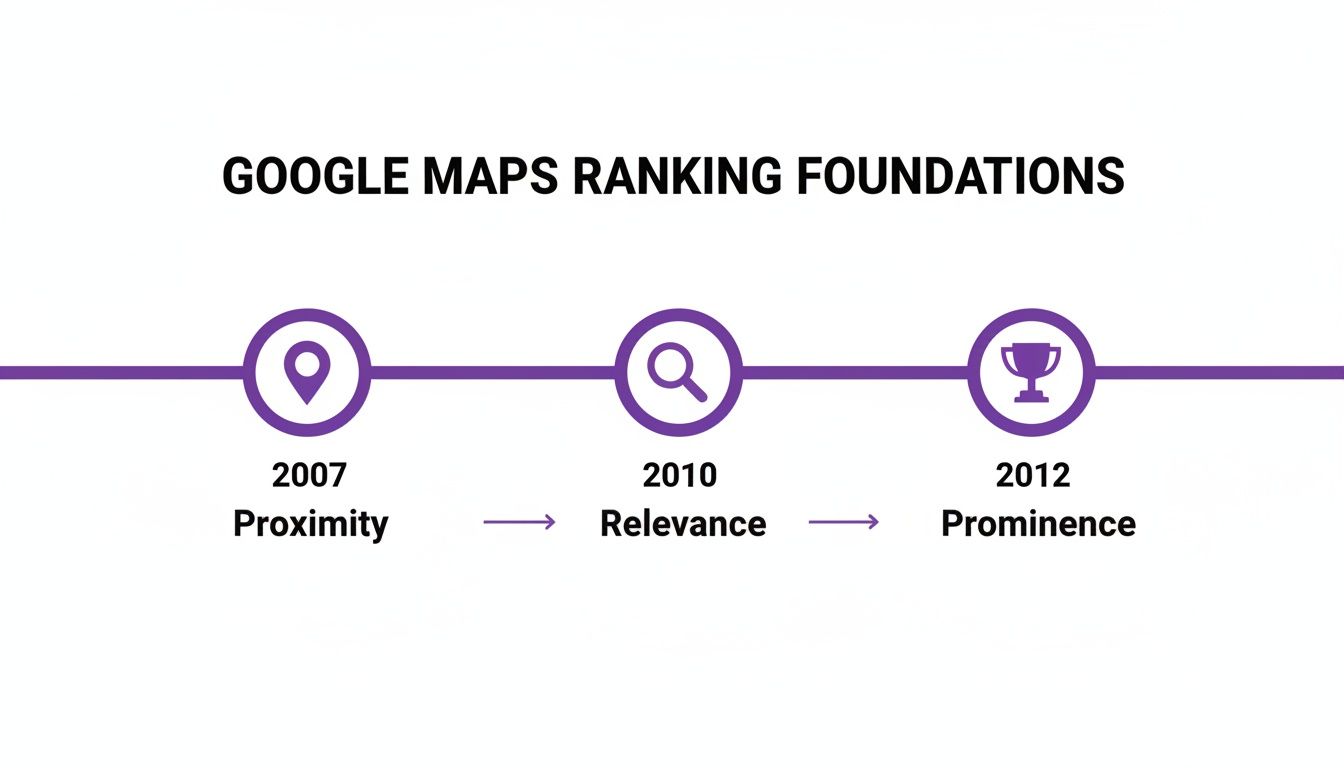
It’s clear that while being close to the searcher still matters, the algorithm now puts enormous weight on signals that prove you are a relevant and authoritative business.
Auditing Your Foundation for Immediate Wins
Consistency is the other side of the relevance coin. Your business Name, Address, and Phone number (NAP) must be identical across your website, your GBP, and every other online directory. Any inconsistencies, even small ones, act as a red flag that erodes Google's trust in your data and will hurt your ranking.
Before you dive into more advanced tactics, run a quick audit on your foundation. This simple check can uncover basic issues that are holding you back right now.
- Check Your Primary Category: Is it the most specific and accurate option available? Go look now.
- Verify Your NAP: Is your name, address, and phone number 100% consistent with what’s on your website’s contact page? Check the spacing, the abbreviations, everything.
- Complete All Profile Sections: Are your business hours, services, photos, and description fields completely filled out? An incomplete profile looks neglected and untrustworthy.
Fixing these basic elements sends immediate positive signals to Google. For a more structured approach, you can use our comprehensive local SEO checklist to make sure you cover all the essential bases. Building this solid foundation is the first, most important step in your quest to dominate local search results.
Mastering Your Google Business Profile
Think of your Google Business Profile (GBP) as your digital front door. For most local customers, it’s the very first, and sometimes only, interaction they’ll have with your brand. Getting your head around Google Maps rankings means moving past the idea that GBP is just a static listing. It’s a dynamic, powerful marketing tool, and every single section is an opportunity to send strong signals to Google about who you are and what you do.
This means you need to give your GBP the same care and attention you give your main website. It’s not a ‘set it and forget it’ task. From the words you use in your description to the photos you upload, consistent, detail-oriented management is what separates the businesses at the top of the map pack from everyone else. Let's break down how to turn every feature into a signal that tells Google you’re the best result for a local searcher.
Crafting a Keyword-Rich Business Description
Your business description is prime real estate. So many businesses waste this 750-character space with a fluffy mission statement. Don’t. Use it to tell Google and your customers exactly what you do and, crucially, where you do it. This is your chance to weave in those valuable local keywords naturally.
A Glasgow roofer, for example, shouldn't just write "We fix roofs." A much stronger description is: "Your trusted local experts for emergency roof repair in Glasgow. We specialise in slate roof repairs, flat roofing, and chimney services for residential properties across the West End and Southside."
This simple tweak does two critical things:
- It tells Google your specific services and service areas, helping you show up for those longer, more specific searches.
- It speaks directly to the customer’s problem, instantly confirming you’re the right person for the job.
This is a small change that can have a huge impact on your relevance for the terms that actually drive business.
Choosing Secondary Categories to Widen Your Net
Your primary category is easily the most important ranking factor on your profile, but stopping there is a massive mistake. Secondary categories are your ticket to capturing a much wider audience. Think about all the related services you offer that someone might search for.
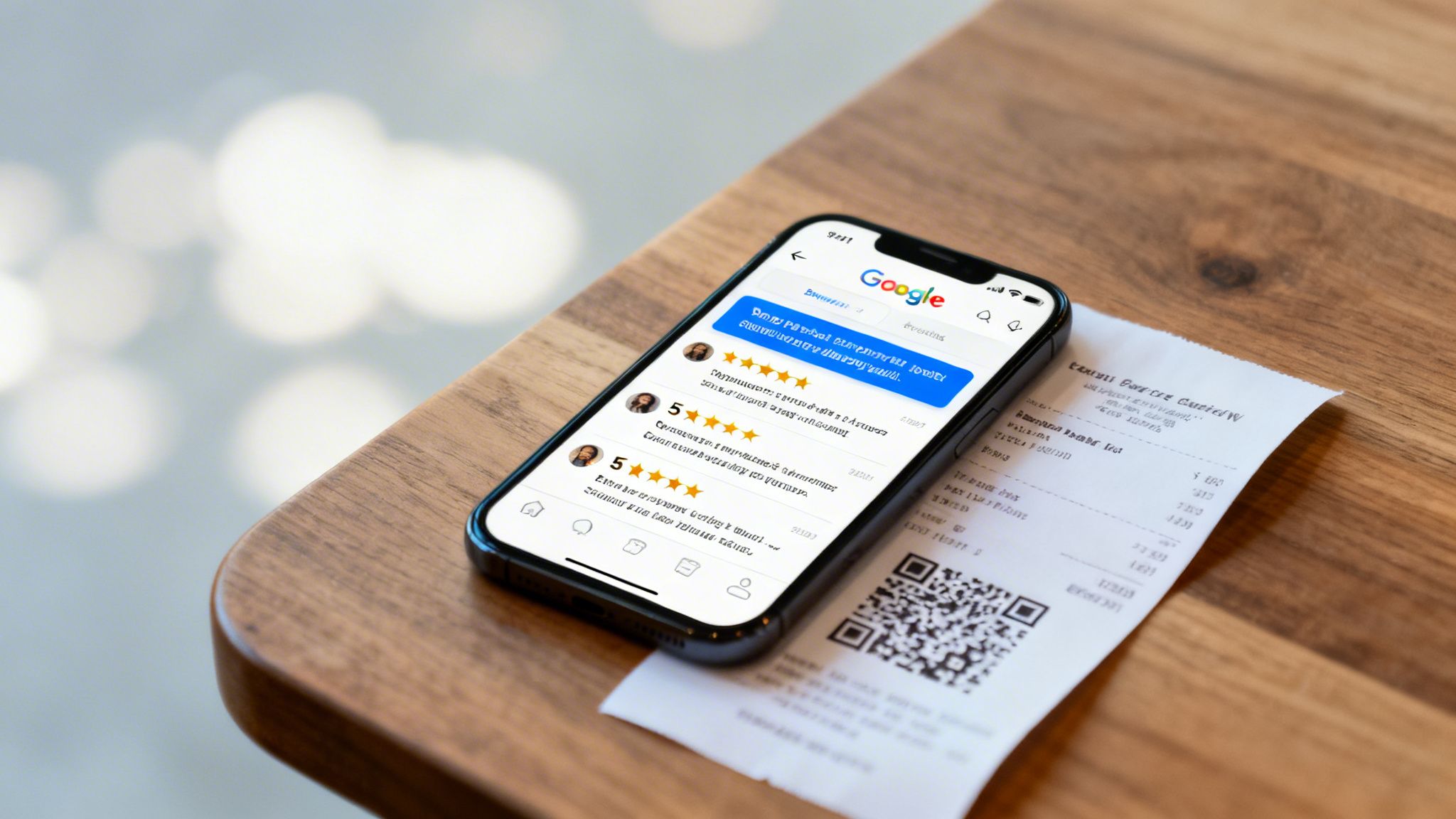
A Brighton-based vegan bakery might have 'Bakery' as its primary category, but it should also add secondary categories like:
- Coffee shop
- Cake shop
- Wedding cake shop
- Gluten-free restaurant
Each category you add is another door for a potential customer to walk through. Brainstorm every adjacent service you provide and add them all. Just be sure they're relevant—adding categories you don't actually fit can dilute your profile's focus.
A common mistake is to only select one or two categories. Go through Google's full list and select every single one that accurately describes a facet of your business. This simple action can dramatically increase the number of keywords your profile is eligible to rank for.
For a deeper dive, understanding the power of Google My Business for 'near me' searches shows just how customers are finding local services today.
Leveraging Products and Services for Maximum Visibility
The 'Products' and 'Services' sections are two of the most underused features on GBP. This is your chance to build out a detailed catalogue of everything you offer, right there on the search results page. This is not the place for vague, one-word entries.
Each service you list should have a detailed description and, where it makes sense, a price. For example, a home care provider in Leeds could list a service for "Personal Care Services" and describe it as: "Compassionate assistance with daily activities such as bathing, dressing, and meal preparation for elderly residents in North Leeds." This level of detail provides powerful, specific keywords for Google to index.
And the 'Products' feature isn't just for e-commerce sites. A law firm could create 'Products' for its "Will Writing Service" or "Conveyancing Package," complete with descriptions and fixed fees. It makes your offerings tangible and transparent for potential clients, building trust before they even click through to your website.
If you want a complete review of your current setup, our free Google Business Profile audit tool can quickly highlight areas for immediate improvement.
Keeping Your Profile Active and Engaging
An active profile tells Google your business is open, thriving, and responsive. A dormant profile does the opposite. You need to use the features Google gives you consistently.
- Google Posts: Share updates, offers, and news at least once a week. These appear directly on your profile and are perfect for promoting seasonal deals or showing off recent work.
- Geotagged Photos: Constantly add high-quality, new photos. Here’s the key: make sure your phone's location services are on when you take pictures at your business or on a job. This embeds geographic data (geotags) into the image file, which is a powerful signal that reinforces your location to Google.
- Proactive Q&A: Don't just wait for customers to ask questions. Seed your own Q&A section by asking and answering the most common queries you get. Think about parking, your booking process, or service areas. This lets you control the narrative and address customer concerns upfront.
- Enable Messaging: Turn on the messaging feature so customers can contact you straight from your profile. Responding quickly is vital here. A fast response time signals to Google that you’re attentive and provide a great user experience.
Building Authority with Reviews and Engagement
Reviews are the social proof of our time. For local businesses, they’re the currency of trust, and Google pays very close attention. In fact, a steady stream of genuine reviews is one of the clearest signals for ‘Prominence’—a core pillar of how Google ranks businesses in the local pack and on Maps.
But just hoping for feedback isn't a strategy. To really climb the rankings, you need a proactive system for generating a constant flow of positive reviews. Just as importantly, you need to engage with every single one. This tells both potential customers and Google’s algorithm that you’re an active, attentive business that values its community.
Creating a Sustainable Review Generation System
The simplest way to get more reviews is to ask for them. The trick is getting the timing and method just right. You want to make it incredibly easy for a happy customer to leave feedback right at the peak of their satisfaction—not a week later when the feeling has faded.
Here are a few proven tactics that work without breaking Google's rules:
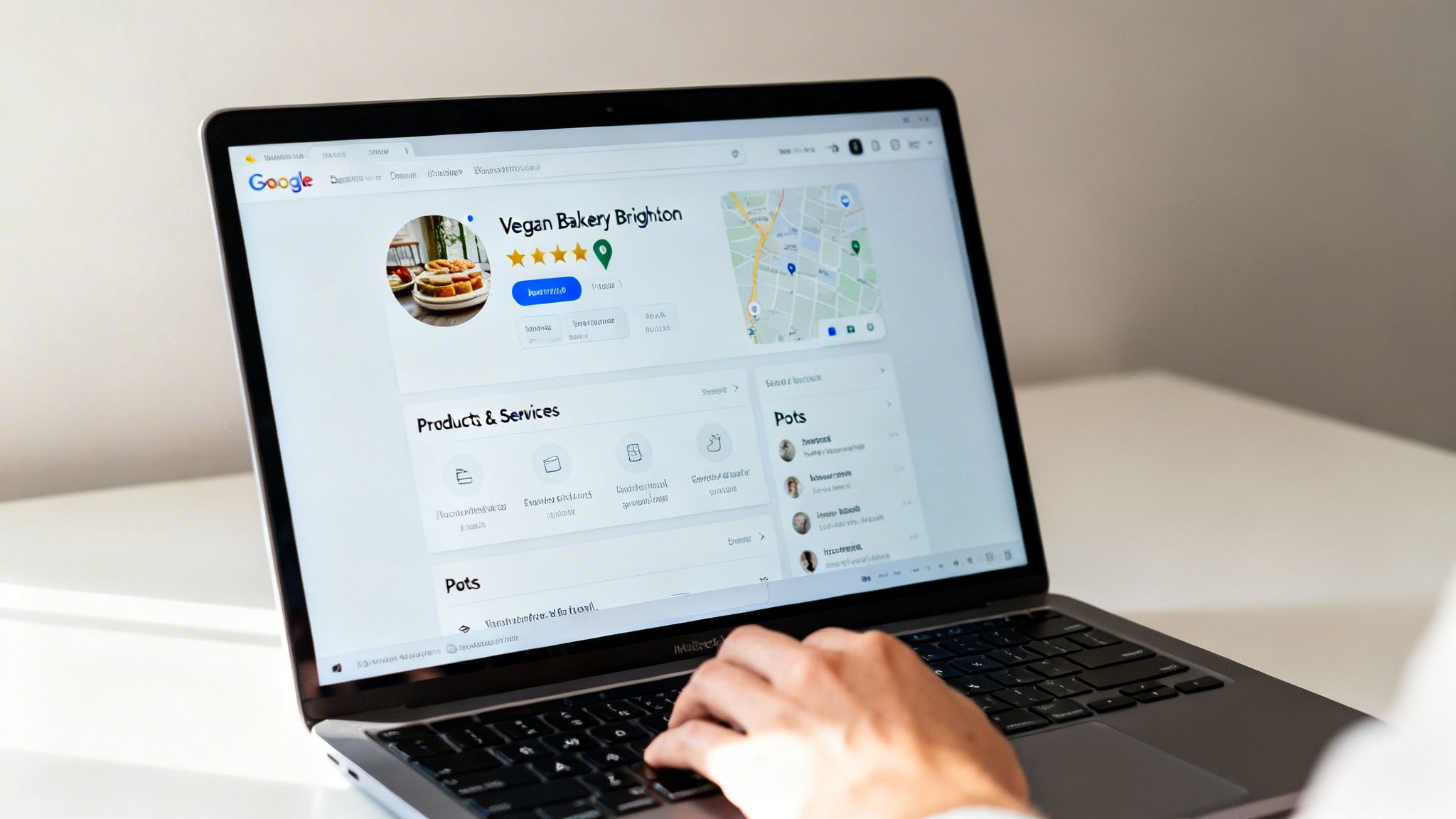
- QR Codes: A restaurant in York could pop a small QR code on the bottom of its receipts that links straight to its Google review page. This removes all the friction for the diner.
- Email & SMS Follow-ups: A plumber can set up an automated email or text to go out a few hours after a job is done. A quick "thanks for your business" with a direct review link is incredibly effective.
- Verbal Prompts: A personal trainer can simply say at the end of a great session, "I'd be really grateful if you could share your experience on Google. It really helps other people find me."
The aim is to make it a natural, low-effort next step. Just remember never to offer incentives or discounts for reviews. This is a big no-no in Google's policy and can get your profile penalised.
The Art of Responding to Every Review
Responding to reviews is completely non-negotiable. It completes the feedback loop and shows prospective customers that you're an engaged business owner who genuinely cares. It’s also another chance to reinforce your brand voice and even weave in relevant keywords naturally.
Responding to reviews—both good and bad—is one of the clearest signals of an actively managed and customer-focused business. Google's algorithm rewards this engagement, as it indicates a healthy, thriving business that values its community.
For positive reviews, a simple "Thanks so much!" is good, but a great response is better. Mention the service they used. For example, "We're so glad you enjoyed the wedding cake tasting! It was a pleasure helping you plan the sweet side of your special day."
Negative reviews, while they can sting, are a golden opportunity. A prompt, professional, and empathetic response can turn a critic into a fan and shows other readers that you take accountability. Always thank them for the feedback, apologise for their poor experience, and offer to take the conversation offline to resolve it properly.
Turning Customer Language into Ranking Power
Pay close attention to the exact words your customers use in their reviews. They are handing you valuable long-tail keywords on a silver platter—phrases you might not have even thought of.
If you see multiple people mentioning your "dog-friendly patio" or your "quick emergency call-out service," you know these are key selling points that resonate with real people. This customer-generated content is a goldmine.
- Spot Trends: Identify popular services or features you should be shouting about in your GBP description and posts.
- Discover Keywords: Uncover the exact phrases real people use when talking about businesses like yours.
- Reinforce Relevance: When customers mention a specific service and your location (e.g., "the best MOT in Bristol"), it sends a powerful local relevance signal straight to Google.
Managing your reputation effectively is a crucial part of any local SEO strategy. You can see exactly how your profile is performing by checking out our comprehensive GBP report for a deeper analysis. By building a system for generating and responding to reviews, you create a powerful flywheel of trust and authority that will significantly boost your chances of ranking higher on Google Maps.
Aligning Your Website for Local SEO Success
Your Google Business Profile is a powerhouse, but it doesn't work in isolation. To really climb the local rankings, your website needs to be perfectly in sync with your GBP, reinforcing every single signal you send to Google. Think of your website as the definitive source of truth about your business.
It’s where you provide the depth and context that your profile can only hint at. When Google’s crawlers see the same consistent information on your site that’s on your profile, it builds an immense amount of trust. This directly boosts your prominence and relevance scores, which is crucial for ranking higher on Google Maps.
Optimising Your Core Service Pages
Every service you offer needs its own dedicated page on your website. This is your chance to go into real detail, moving beyond the short descriptions in your GBP to answer every question a potential customer might have. Getting this right is a huge part of matching local search intent.
Your page titles, headings, and the actual content need to be filled with local keywords. A generic page titled "Our Electrical Services" just won't cut it anymore. Instead, you need pages like "Commercial Electricians in Birmingham" or "Domestic Fuse Box Upgrades in Solihull." This tells Google exactly what you do and where you do it, connecting you directly with people making those specific searches.
For example, a local photographer could learn a lot from our insights on SEO for photographers, which digs into how to target local clients with properly optimised service pages.
Each service page should be a complete resource, including:
- Detailed descriptions of what the service involves.
- The specific areas and postcodes you cover.
- Answers to frequently asked questions about that service.
- Testimonials from happy clients who used that exact service.
This level of detail doesn't just convince potential customers; it gives Google a goldmine of relevant keywords to index, strengthening your connection to the local area.
Creating Unique Multi-Location Pages
If your business has more than one physical location, creating a dedicated page for each branch is absolutely non-negotiable. A single 'Contact Us' page listing all your addresses is a common and very costly mistake. It just dilutes your geographic signals and confuses Google.
Each location page has to be unique and packed with information specific to that branch. Think of it as a mini-homepage for that individual community.
A winning location page should always include:
- The full, consistent Name, Address, and Phone number (NAP) for that specific branch.
- Unique content describing the local area, the team, or any special services offered at that location.
- An embedded Google Map showing the exact pin for that branch.
- High-quality photos of that specific location's exterior and interior.
- Reviews and testimonials from local customers.
This approach ensures each of your locations can rank on its own for searches in its immediate area. A "dental practice in Chelsea" can rank for Chelsea searches, while your "dental practice in Islington" captures traffic there, without the two competing against each other.
Key Takeaway: Never, ever use duplicate content across your location pages. Google penalises boilerplate text. Each page needs its own voice and local flavour to be effective. It’s more work, but it’s essential for multi-location success.
Implementing LocalBusiness Schema Markup
Schema markup is like a secret language you can use to speak directly to search engines. It's a small piece of code you add to your website that explicitly labels your key information, removing any guesswork for Google. For local SEO, LocalBusiness schema is your most powerful tool.
This code clearly identifies your:
- Business Name
- Address
- Phone Number
- Opening Hours
- Geographical Coordinates
By implementing this, you're spoon-feeding Google the exact NAP data you want it to associate with your business, ensuring it's perfectly consistent with your GBP. This structured data is a powerful trust signal that can give you a significant edge over competitors who don't bother with it.
Essential Technical Website Health
Finally, don't forget that your website’s technical performance is a massive factor, especially for users searching on the go. Nearly 60% of Google searches happen on mobile devices, and those local "near me" searches are overwhelmingly mobile.
If a potential customer clicks from your Google Maps profile to a slow, clunky website, they will hit the back button immediately. This high bounce rate is a huge negative signal to Google. Your website absolutely must be:
- Mobile-First: It has to look and work perfectly on a smartphone screen.
- Fast: Your pages should load in under three seconds to keep users engaged.
A technically sound website provides the smooth user experience that Google wants to reward. It’s the final piece of the puzzle that ensures the traffic you earn from your high-ranking Maps profile actually turns into real enquiries and sales.
Boosting Prominence with Citations and Local Links
Your Google Business Profile and website are your digital storefronts, but Google also looks for outside proof to gauge your ‘Prominence’. It wants to see your business being talked about across the wider web. This is where off-page local SEO, especially citations and local links, becomes non-negotiable for any UK business serious about ranking higher on Google Maps.
Think of it like getting a reference. If a handful of reputable people all vouch for you, others are far more likely to trust you. For Google, these "vouchers" are simply mentions and links from other websites. They act as third-party endorsements that confirm your business is a real, active, and important part of your local community.
The Power of Consistent Citations
A citation is simply a mention of your business’s core information online: its Name, Address, and Phone number (often called NAP). These pop up on business directories, social media profiles, and industry websites. The secret to making them work for you is absolute consistency.
Every single citation has to match the NAP on your Google Business Profile and your website, right down to the last comma. A tiny difference like "St." versus "Street" or "&" versus "and" can create small fractures in Google's confidence. This confusion can directly hurt your Maps ranking.
Your first job is to run a citation audit. Search for your business name and find all the places it’s listed. Look for old addresses, wrong phone numbers, or slight variations in your business name, and get them fixed immediately.
Prioritising High-Quality UK Citation Sources
Not all citations are created equal. You need to focus your energy on well-established and relevant directories. For UK businesses, this means starting with the big national players before drilling down into more niche, industry-specific sites.
Your priority list for UK citation building should look something like this:
- Major UK Directories:
- Yell
- Thomson Local
- The Independent
- The Sun Directory
- Industry-Specific Sites:
- A tradesperson should be on Checkatrade or TrustATrader.
- A wedding venue needs a profile on Hitched or Guides for Brides.
- A restaurant absolutely must be listed on TripAdvisor and TheFork.
- Hyperlocal Sites:
- Your local Chamber of Commerce.
- Community forums or local news websites.
Expert Tip: Setting up profiles on these sites isn't a one-and-done job. Make sure you completely fill out every single profile field, adding photos, descriptions, and business hours. An incomplete profile on a major directory can look just as bad as an inconsistent one.
Earning Valuable Local Links
Beyond simple directory listings, local backlinks are one of the most powerful signals you can earn. A backlink is an actual, clickable link from another website to yours. When a respected local site links to you, it passes on some of its authority, which can give your prominence a significant boost.
Imagine you run an accountancy firm in Cambridge. A link from the Cambridge Chamber of Commerce website is a massive vote of confidence. Or if you’re a personal trainer in Bath, getting featured in a local health blog provides a highly relevant endorsement. Our experts providing SEO services in Cambridge have found that building these local partnerships is an incredibly effective way to get powerful mentions.
Here are a few actionable ways to start earning these links:
- Sponsor a local charity event or a youth sports team. This often gets you a link from their website's sponsors page.
- Host a small community workshop. For example, a design agency could offer a free branding workshop for local startups, attracting links from event listing sites.
- Partner with non-competing local businesses. A wedding photographer and a local florist could cross-promote on each other’s blogs, leading to mentions and links.
Beyond these traditional local tactics, it's worth knowing that leveraging press releases for SEO can also be a strategic way to build authority and secure valuable links when you have a genuinely newsworthy announcement. By systematically building a clean citation profile and earning powerful local links, you give Google undeniable proof of your business’s importance, directly fuelling your climb up the Google Maps rankings.
Common Questions on Ranking Higher in Google Maps
Even with the best playbook, a few tricky questions always pop up when you’re trying to climb the Google Maps rankings. We hear them all the time from UK businesses.Let's cut through the noise and give you some straight, practical answers to the most common queries we get.
How Long Does It Take to See Ranking Improvements?
Everyone asks this, and the honest answer is: it depends. But with consistent effort, you can generally expect to see real movement within 3 to 6 months.
A lot comes down to your starting point and how competitive your patch is. A new funeral home in a small town will likely see results much faster than an interior designer in a crowded London borough.
Some fixes can bring quick wins, sometimes in just a few weeks. Correcting your main GBP category or sorting out messy NAP details often gives a nice little boost. But building real, lasting authority with reviews and local links is a longer game. The truly sustainable gains really start to build up over a 6 to 12-month period. Think of it as a marathon, not a sprint.
Do I Need a Physical Address to Rank on Maps?
Yes and no. For a standard Google Business Profile with a pin on the map, you absolutely must have a verifiable physical address. Google needs to send a verification postcard there to confirm you’re a real, legitimate business at that location.
However, if you're a Service Area Business (SAB)—like a plumber, a mobile dog groomer, or a photographer who travels to clients—you can hide your physical address. Instead, you just define the areas you serve.
Your business will still show up on Maps for searches in your chosen region, but there won't be a specific pin pointing to your home or office.
While businesses with a proper storefront can have a slight edge thanks to the proximity factor, a well-optimised SAB profile can absolutely dominate the rankings. The trick is to saturate your service area with strong signals of relevance and prominence.
My Competitor Is Using Fake Reviews and Keyword Stuffing
It’s incredibly frustrating watching competitors cheat their way up the rankings. First things first: focus on your own game. Building a genuinely strong, authentic profile is a sustainable strategy that always wins in the long run.
But you don't have to just sit there and take it. You can and should report spam.
- For Fake Reviews: Go to the review on Google Maps and flag it. Be clear about why it violates Google's policies—maybe it's from a fake account, a disgruntled ex-employee, or shows a clear conflict of interest.
- For Keyword Stuffing in the Business Name: When you see a competitor like 'ABC Plumbers – Emergency Boiler Repair Bristol', you can suggest an edit. On their Maps listing, click "Suggest an edit" and change their business name back to what it actually is: 'ABC Plumbers'.
For more serious or persistent issues, you can file a formal complaint using the Google Business Profile redressal form. It might take a while for Google to take action, but reporting spam helps keep the whole ecosystem fair for everyone.
At Bare Digital, we turn local searches into real customers. Our team has over 15 years of experience helping UK businesses like yours dominate Google Maps and drive measurable growth. If you're ready to move beyond questions and start seeing results, get in touch for a free SEO health check and a clear activity plan. Learn more at https://www.bare-digital.com.