

Writing SEO content is really about one thing: creating valuable, high-quality material that gives a searcher exactly what they're looking for. It's a careful mix of art and science. The art is in the writing itself, but the science lies in structuring it so that search engines can easily understand what it’s about. The golden rule? Always focus on the user's intent first, and let keyword optimisation follow.
Your Blueprint for High-Performance SEO Content
Modern SEO content has moved far beyond trying to game the system. Today, it’s all about delivering genuine value that lines up perfectly with what people are actually searching for. Before you even think about writing, you need a robust content marketing strategy in place. This isn't just a suggestion; it's the foundation of your entire blueprint.
A solid framework is what transforms your efforts from just randomly publishing articles into building a strategic engine that drives consistent, long-term organic growth.
The whole process really boils down to three core pillars: a deep understanding of your audience, a strategic content structure, and meticulous on-page optimisation. You need a reliable framework for success before a single word is written. This means getting to the bottom of what your audience truly wants, figuring out the best way to structure that information, and finally, knowing how to measure the impact of your work.
The Core Pillars of Success
For businesses here in Cambridgeshire and right across the UK, this blueprint is your guide to building lasting customer trust. It’s about creating content that doesn't just pull in visitors but holds their attention long enough to turn them into loyal customers.
This simple flow chart breaks down the essential stages of creating effective SEO content, from the initial idea right through to the finished piece.
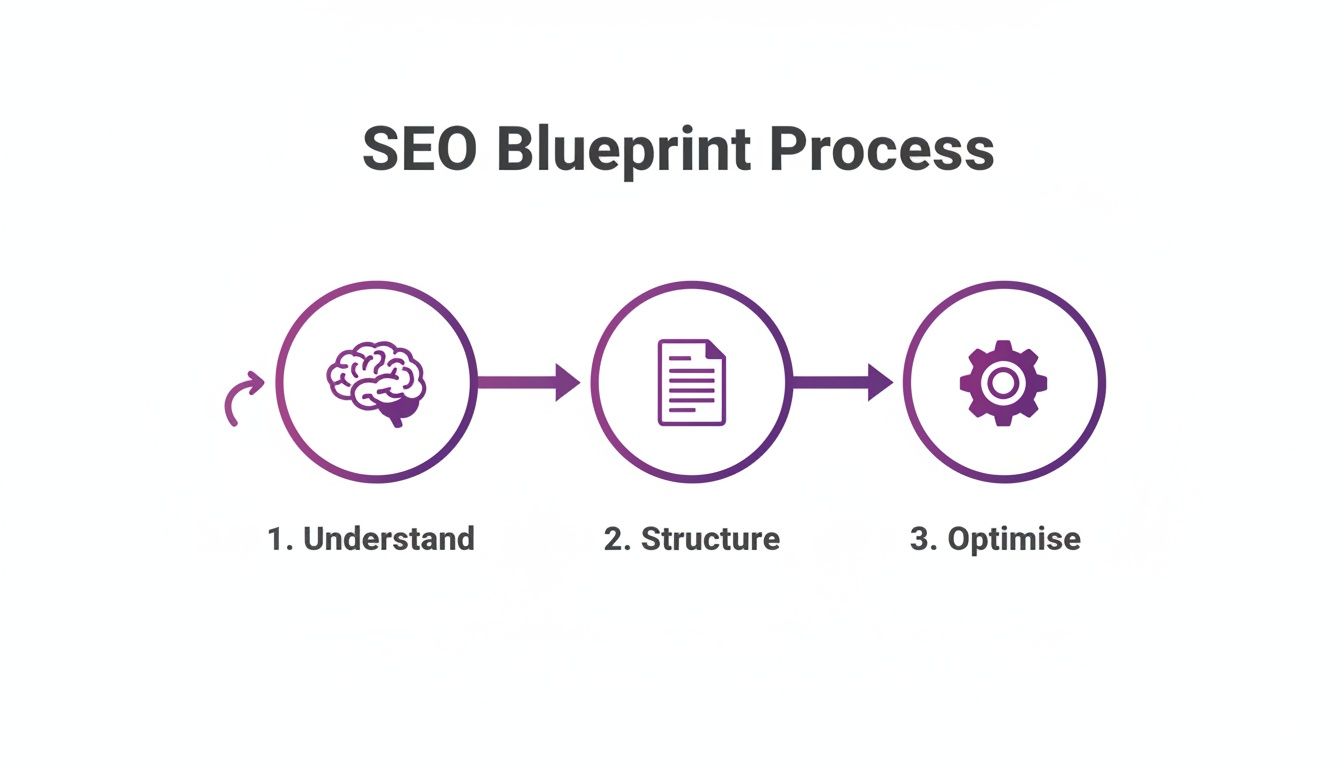
As the graphic shows, real success starts with understanding user needs. From there, you structure the content logically and finish by applying all the necessary technical optimisations.
To give you a clearer picture, here’s how these pillars translate into practical, day-to-day actions for a small or medium-sized enterprise (SME).
Core Pillars of Modern SEO Content Writing
| Pillar | Key Objective | Example Tactic for an SME |
|---|---|---|
| Understand | To grasp exactly what the user is looking for and why. | A local plumbing company in Cambridge could use Google's "People Also Ask" to find common questions like "how to fix a leaking tap" and create a detailed DIY guide. |
| Structure | To organise content in a clear, logical way that's easy for both users and search engines to follow. | An e-commerce site selling hiking boots might structure a blog post with H2s for "Best Boots for Beginners," "Waterproof Options," and "How to Choose Your Size." |
| Optimise | To apply technical SEO elements that help Google index and rank the content effectively. | A small accountancy firm could optimise a service page by including a compelling meta description, relevant internal links to their blog, and schema markup for local business. |
Getting these fundamentals right is what separates content that just exists from content that actually performs and delivers for your business.
Why a Strategic Approach Matters
Here in the UK, writing SEO content that Google trusts is less about keyword stuffing and more about demonstrating depth, clarity, and a solid grasp of user intent. While it's true that adding a blog can boost organic traffic by a staggering 437%, the reality is a bit more sobering.
Recent data reveals that 73% of people admit to only skimming blog posts, with the average time spent on a page being a mere 37 seconds. This tells us one thing loud and clear: most SEO content fails to hold attention long enough to convert readers into actual enquiries or sales.
The goal is to move beyond simply attracting clicks. Effective SEO content writing aims to end the search journey, providing such a complete and satisfying answer that the user has no need to return to Google and click on another result.
This is precisely why a thoughtful blueprint isn't just a "nice-to-have"—it's non-negotiable. It ensures every single piece you publish is designed not just to rank, but to resonate, engage, and ultimately, drive real business results.
Finding Keywords That Drive Real Business Results
Great content starts with knowing the exact words and phrases your customers are punching into Google. Forget casting a wide net with generic terms. The real gold is in finding keywords that signal someone is ready to learn, compare, or buy. Get this right, and you're building your content on solid rock.
This isn't just a hunch; the data backs it up. In a huge study of 17,000 marketers, 46% of the most successful ones said search engine optimisation was key to their content's performance. Right behind that, 47% credited deep audience research. It's clear: knowing your audience and knowing their keywords are two sides of the same coin.
Ultimately, this process isn’t just about getting more traffic. It’s about getting the right traffic.
Decoding the Why Behind the Search
Before you even think about opening a keyword tool, you need to get your head around user intent. This is the 'why' behind every single search. Frankly, it's the most critical part of the entire process. If you misunderstand what a searcher really wants, even the most brilliantly written article will fall flat.
We can boil search intent down to three main buckets:
- Informational Intent: The searcher needs information or an answer. Think "how to unblock a sink" or "what is corporation tax". They're in learning mode.
- Commercial Intent: They're in the research phase, weighing up their options before making a decision. Queries like "best waterproof jackets UK" or "Dell vs HP laptops" fit here.
- Transactional Intent: This person is ready to pull the trigger and make a purchase or take action. These are high-value phrases like "buy Barbour jacket Cambridge" or "emergency plumber near me".
Mapping your content ideas to these intent types is absolutely fundamental. An informational query needs a comprehensive guide, not a hard sell. A transactional query is best served by a slick product or service page. This alignment is precisely what tells Google your page is the right answer for the searcher.
A classic mistake is trying to shove a sales pitch at someone with informational intent. You have to meet them where they are. Provide value, build trust, and then you can think about the sale. Pushing a "Buy Now" button on someone who just wants to learn is a fast track to a high bounce rate.
Finding Your Golden Keywords
Once you're clear on intent, it's time for the fun part: finding your keywords. While there are some seriously powerful paid tools out there, you can uncover absolute gems for free. If you want to go deeper, our guide explains more about what is keyword research.
First, brainstorm a list of "seed" keywords. These are the broad topics at the heart of your business. For a local shop in Cambridge selling outdoor gear, this might be "outdoor clothing," "hiking gear," and "waterproof jackets."
From there, use these free resources to dig deeper:
- Google's "People Also Ask" (PAA) box: Pop in a seed keyword and see what questions Google spits out. These are pure gold for long-tail keywords with clear informational intent.
- Google Autocomplete: Just start typing a search. The suggestions Google offers are a direct window into what real people are looking for right now.
- AnswerThePublic: This tool is brilliant for visualising all the questions people have around a topic, giving you a mountain of content ideas.
Professional tools like Semrush can then help you sort the wheat from the chaff, categorising keywords by intent and showing you how hard they'll be to rank for.

This kind of data lets you prioritise the low-hanging fruit—keywords with clear intent and less competition that can start driving results quickly.
Your goal is to build a focused list of primary and secondary keywords for every piece of content. Don't get obsessed with huge search volumes. Often, the most profitable keywords are the long-tail phrases that perfectly match a very specific need. For a masterclass on finding these high-impact terms, check out this guide on how to conduct keyword research like an expert.
How to Structure and Write Compelling SEO Content
Right, you’ve done the keyword research and you know what your audience is looking for. Now it’s time to move from spreadsheets and data to the actual craft of writing. This is where you turn that blueprint into a living, breathing piece of content that real people will want to read and Google will want to rank.
A logical structure is the absolute backbone of any high-performing article. It makes your content a breeze to read for humans and dead simple for search engines to understand. From a headline that begs to be clicked to an intro that pulls the reader in, every single element has a job to do.
Let's break down how to put it all together.
Crafting Headlines and Meta Descriptions That Win the Click
Think of your headline and meta description as your shop window on the search results page. It doesn't matter if you've written the most brilliant article in the world—if these two little snippets don't grab attention, no one will ever see it.
For your headline (officially, the title tag), you need to keep it under 60 characters or it'll get chopped off in the search results. Make sure your main keyword is in there, preferably near the start, and try to spark some curiosity or promise a clear benefit.
What makes a title irresistible? Adding numbers, the current year, or interesting adjectives can make all the difference.
- Before: "Coffee Tables for Small Flats"
- After: "15 Best Coffee Tables for Small Spaces (2024 Buyers Guide)"
See the difference? The second one is specific, feels current, and tells the user it's a list, which is exactly what someone with this search query wants to see.
Next up is your meta description. This is your 155-character sales pitch. While it’s not a direct ranking factor, a good one convinces people to click, which improves your click-through rate (CTR)—a signal Google definitely pays attention to. Include your main keyword and a subtle call to action. For a proper deep dive, our full guide covers everything you need to know about how to write meta descriptions.
Building a Logical and Scannable Structure
Here’s a hard truth: people don't read online, they scan. Hitting your visitors with a giant wall of text is the fastest way to send them running back to Google. That's why a well-organised structure using headings and subheadings (H1, H2, H3s) is non-negotiable for readability and SEO.
Your main title is always your H1 tag. Think of it as the title of the book.
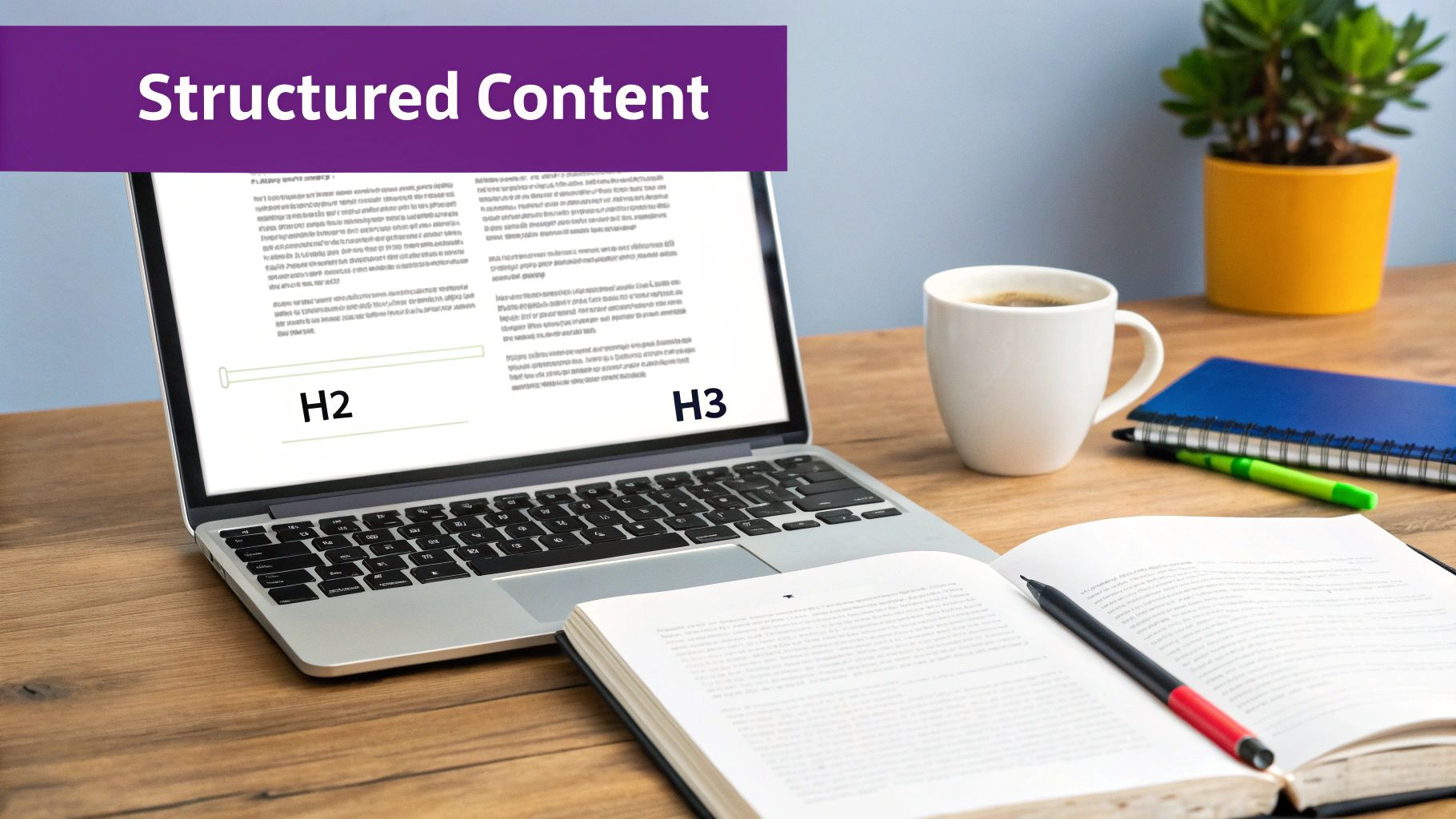
Your main sections should be wrapped in H2 tags, which act like the chapter titles. Then, you can break those chapters down further with H3 tags for the key points within each section.
This hierarchy doesn't just look neat; it creates a logical path for readers to follow. It also gives search engine crawlers massive clues about what your content covers and how it's all related.
Your goal is to make your content as easy to digest as possible. Stick to short paragraphs—two or three sentences, max. Break things up with bullet points, numbered lists, and bold text to make key information pop. This all adds up to a better user experience and keeps people on your page for longer.
Writing Introductions That Hook and Body Copy That Delivers
You’ve got about three seconds to convince someone to stick around. Your introduction has to grab them by the collar and pull them in. A great little trick for this is the APP method (Agree, Promise, Preview).
- Agree: Kick off with a statement your reader will immediately nod along with. It shows you get their problem.
- Promise: Quickly let them know you’ve got the solution they’re looking for.
- Preview: Give them a quick teaser of what they'll learn if they keep reading.
This simple formula builds instant rapport and manages their expectations right from the start.
Once you’re into the main body of the article, your job is to deliver on that promise. Answer the user’s question thoroughly, using your outline to stay on track. Make sure each section flows smoothly into the next; transitional phrases are your friend here.
Always write with clarity in mind. Ditch the jargon and use simple language. Weave your secondary keywords and related phrases in where they feel natural, not forced. Remember, you're writing for a person first and an algorithm second. If a sentence sounds clunky, rewrite it. That commitment to quality is what separates okay content from truly effective SEO content.
Mastering On-Page and Technical Optimisation
You've written a great piece of content. Now it’s time for the final polish—the on-page and technical tweaks that turn a good article into something search engines can easily find, understand, and rank.
Think of it as getting your content ready for its debut on Google. It’s all about sending the right signals, ensuring all your hard work gets the visibility it deserves. From the words you use in your image descriptions to the structure of your URL, every little detail helps communicate quality and relevance to search crawlers.
Getting The Technical Essentials Right
Technical optimisation sounds complex, but getting the fundamentals right is simpler than you think and has a huge impact. These are the non-negotiable checks to run through before you hit ‘publish’.
First up, your images. Search engines can't actually see what's in a picture, so you need to spell it out for them. This boils down to two key things:
- File Names: Ditch the generic
IMG_9876.jpg. Rename your image file to something descriptive likeseo-content-writing-checklist.jpg. It gives immediate context. - Alt Text (Alternative Text): This is just a short, written description of the image. For our example, something like "A checklist showing key on-page SEO tasks for content writing" works perfectly. It’s crucial for both SEO and accessibility.
Next, take a look at your URL. It needs to be clean, concise, and include your primary keyword.
A classic mistake is letting your CMS auto-generate a long, messy URL from your headline. Always edit it. For an article titled "10 Ways to Write Better SEO Content," your URL should be a simple
/write-better-seo-content.
Implementing Basic Schema Markup
Schema markup is a snippet of code you add to your website that acts like a cheat sheet for Google. It helps search engines understand your content better and can unlock those eye-catching "rich snippets" in search results.
You don't need to be a developer to get this done. There are plenty of free online tools that will generate the code for you. For most articles, two types of schema are especially handy:
- Article Schema: This tells Google that your page is, in fact, an article. You can specify the author, publication date, headline, and more.
- FAQ Schema: If your article has a question-and-answer section, using FAQ schema can get those Q&As to show up directly in the search results. This takes up more screen real estate and can seriously boost your click-through rates.
This extra layer of detail helps your content pop on a crowded results page, giving you a clear edge over competitors who aren’t bothering with it.
Strategic Keyword Placement And Internal Linking
While the days of cramming keywords into every sentence are long gone (thankfully), strategic placement is still vital. Your main keyword should appear naturally in a few key spots: the title, the first 100 words, at least one subheading (an H2), and sprinkled throughout the body copy.
Just as important is your internal linking. This simply means linking from your new article to other relevant pages on your own website.
Internal links do two very important jobs. First, they guide your readers to other useful content, keeping them on your site longer. Second, they help search engines map out the relationships between your pages, which builds your site's topical authority. A well-linked site is a strong signal to Google that you're an expert on a particular subject.
To make sure you've covered all your bases, here’s a quick checklist to follow.
On-Page SEO Checklist for Every Article
Running through a quick checklist before publishing can save you a lot of headaches later on. It ensures every piece of content you produce is fully optimised from day one.
| Element | Optimisation Action | Why It Matters |
|---|---|---|
| URL Slug | Short, descriptive, and contains the primary keyword. | Improves user experience and provides clear signals to search engines about the page topic. |
| Title Tag | 50-60 characters, includes the primary keyword near the start. | This is your main headline in search results; it's a major factor for click-through rates. |
| Meta Description | 150-160 characters, compelling summary with a call-to-action. | Acts as your ad copy in SERPs, encouraging users to click on your result over others. |
| Headings | One H1 per page, with H2s and H3s used logically to structure content. | Helps both users and search engines understand the content hierarchy and key topics. |
| Keyword Placement | Primary keyword appears in the title, first paragraph, and at least one H2. | Reinforces the topic of the page without resorting to unnatural keyword stuffing. |
| Image Optimisation | Descriptive file names and alt text on all images. | Improves accessibility and gives search engines context for your visual content. |
| Internal Links | Add 2-3 links to relevant, existing pages on your site. | Distributes page authority, improves site navigation, and helps Google index your site. |
| Schema Markup | Add Article or FAQ schema where appropriate. | Enhances your listing in search results, potentially leading to higher click-through rates. |
This checklist isn't exhaustive, but it covers the fundamentals that make a real difference.
To dive deeper and ensure your entire site is technically sound, it’s worth running regular checks. Our technical SEO audit checklist is a great starting point for spotting common issues that could be holding your content back. This final optimisation phase ensures no stone is left unturned.
Turning Your Content Into Conversions
Getting traffic is great, but traffic alone doesn't pay the bills. The real goal is turning those readers into customers. This is where we stop just attracting an audience and start generating actual business, transforming your articles from simple information sources into powerful tools of persuasion.
The idea is to gently guide your reader towards the next logical step. That might be signing up for a newsletter, filling out a form, or actually making a purchase. You’re moving them along their journey with you, one compelling call-to-action at a time. This is absolutely critical, as for many UK businesses, organic search is the most profitable marketing they can do.
In fact, the latest UK data shows 49% of marketers say organic search delivers the highest return on investment of any digital channel. It outperforms paid ads, social media, and email. This really hammers home why writing SEO content that converts is one of the smartest investments a UK business can make. You can find more stats on the powerful ROI of content marketing on digitaloft.co.uk.
Placing Calls-to-Action That Actually Work
A call-to-action (CTA) is just a prompt to get your reader to do something. Simple enough. But where and how you place them is the difference between getting a click and getting ignored. Shouting "Buy Now!" at someone who's just started their research is a surefire way to scare them off.
Your CTAs need to match what the reader is thinking at that exact moment.
- Informational Content: For a post like "how to choose a waterproof jacket," the reader isn't ready to buy. A soft CTA works best here. Think "Download our free jacket buying guide" or "Get more outdoor tips in our newsletter."
- Commercial Content: In an article comparing the "best hiking boots for beginners," they're much closer to a decision. A more direct approach like "Explore our range of hiking boots" or "Check the latest prices" makes sense.
- Transactional Content: On a product page for a specific boot, their intent is crystal clear. This is where you put your "Add to Basket" or "Buy Now" buttons, making them big, bold, and impossible to miss.
A classic mistake is sticking a single CTA at the very bottom of the page. Most people's attention has wandered by then. Weave relevant, contextual CTAs throughout your content where they feel like a natural next step, not a salesy interruption.
Getting these details right is the first step towards better results. For a much deeper look, check out our full guide on how to improve website conversion rates.
Measuring What Truly Matters
If you don't measure it, you can't improve it. Writing brilliant SEO content is only half the job; you have to prove it's actually working. This is where tools like Google Analytics 4 (GA4) and Google Search Console become your best friends, helping you track performance and show a clear return on investment.
These platforms let you look past simple traffic figures and focus on the metrics that really affect your bottom line.
This screenshot from a Google Analytics 4 "Traffic acquisition" report shows you exactly where your visitors are coming from.
In this report, you can quickly see which channels, like "Organic Search," are bringing in the most sessions and engaged users.
Here are the key metrics you absolutely should be tracking:
- Organic Traffic: How many people are finding your content through search engines? Is that number going up over time?
- Keyword Rankings: Head over to Google Search Console to see which keywords you’re ranking for and in what average position.
- Click-Through Rate (CTR): Of all the people who see your article in the search results, what percentage actually clicks through? A low CTR could mean your title or meta description needs a rewrite.
- Conversions: This is the big one. Set up goals in GA4 to track how many visitors from organic search complete a key action—like submitting a form or making a purchase worth a certain amount in GBP (£).
By keeping a close eye on these KPIs, you can see what’s working, spot opportunities to do better, and prove the real-world value your SEO content is bringing to the business.
Common Questions About Writing SEO Content
Even the most seasoned marketers get tripped up on the finer points of SEO content. It's a field filled with nuance, where questions about word count, keyword usage, and publishing cadence are always bubbling up. This section is here to give you straight, no-nonsense answers to the questions we hear all the time.

Think of this as your quick-reference guide for those nagging questions that pop into your head right before you hit 'publish'. Let's clear up the confusion so you can move forward with confidence.
How Long Should an SEO Article Be?
There's no magic number here. The real goal is to cover your topic so thoroughly that the reader has no questions left. While some UK search data points to top-ranking articles hovering between 1,400 and 1,600 words, treat that as an observation, not a strict rule.
The honest answer? Your article should be as long as it needs to be.
A deep-dive guide on a complex topic will naturally need more space than a quick post answering a simple question. Instead of aiming for a word count, focus on creating the single most valuable resource on the subject. A detailed 2,000-word article that truly helps the reader will almost always beat a flimsy 500-word post that leaves them searching for more answers.
How Many Keywords Should I Use?
This is a classic question that comes from an older, more rigid way of thinking about SEO. It’s time to forget about ‘keyword density’. A much better approach is to focus on one primary keyword and sprinkle in around three to five related, secondary keywords.
The key is to write for humans first. Google’s algorithms are now incredibly smart at understanding context, synonyms, and related ideas.
Here's a simple framework to follow:
- Place your primary keyword in your title tag, your introduction, and at least one H2 subheading.
- Work it into the body of your text a few more times where it sounds completely natural.
- Use your secondary keywords to add depth and context, often as subheadings or to introduce new paragraphs.
The goal is topical relevance, not keyword repetition. If you focus on comprehensively answering the searcher’s query, you will naturally use the right language that signals your expertise to search engines.
How Often Should I Publish New Content?
Consistency will always trump sheer frequency. For most small to medium-sized businesses (SMEs), publishing one high-quality, fully optimised article per week is a fantastic and ambitious goal.
But let’s be realistic. One truly exceptional article per month is infinitely more valuable than four rushed, low-quality pieces. Quality over quantity is the golden rule here.
And don't forget that updating and refreshing your existing content is an incredibly powerful SEO tactic. A smart, sustainable strategy involves both creating new articles and regularly improving your older, high-potential posts to keep them relevant.
Can I Use AI to Write My SEO Content?
AI tools can be brilliant assistants. They’re fantastic for brainstorming ideas, mapping out an article structure, and smashing through writer's block. They can absolutely speed up the early stages of creation.
However, you should never publish AI-generated text directly without a heavy dose of human oversight. Google’s guidelines are heavily weighted towards content that demonstrates Experience, Expertise, Authoritativeness, and Trustworthiness (E-E-A-T). Purely AI content almost always falls flat, lacking the unique insights, brand voice, and real-world experience that builds a genuine connection with your audience.
So, use AI as a powerful apprentice. But always make sure a human expert edits, fact-checks, and refines the final piece to meet your quality standards and reflect your brand's unique perspective.
Feeling ready to turn traffic into tangible results? At Bare Digital, we specialise in creating high-performance SEO content that drives rankings, traffic, and conversions for businesses across Cambridgeshire. We offer a free SEO Health Check to get you started. Get your free, no-obligation SEO proposal today.