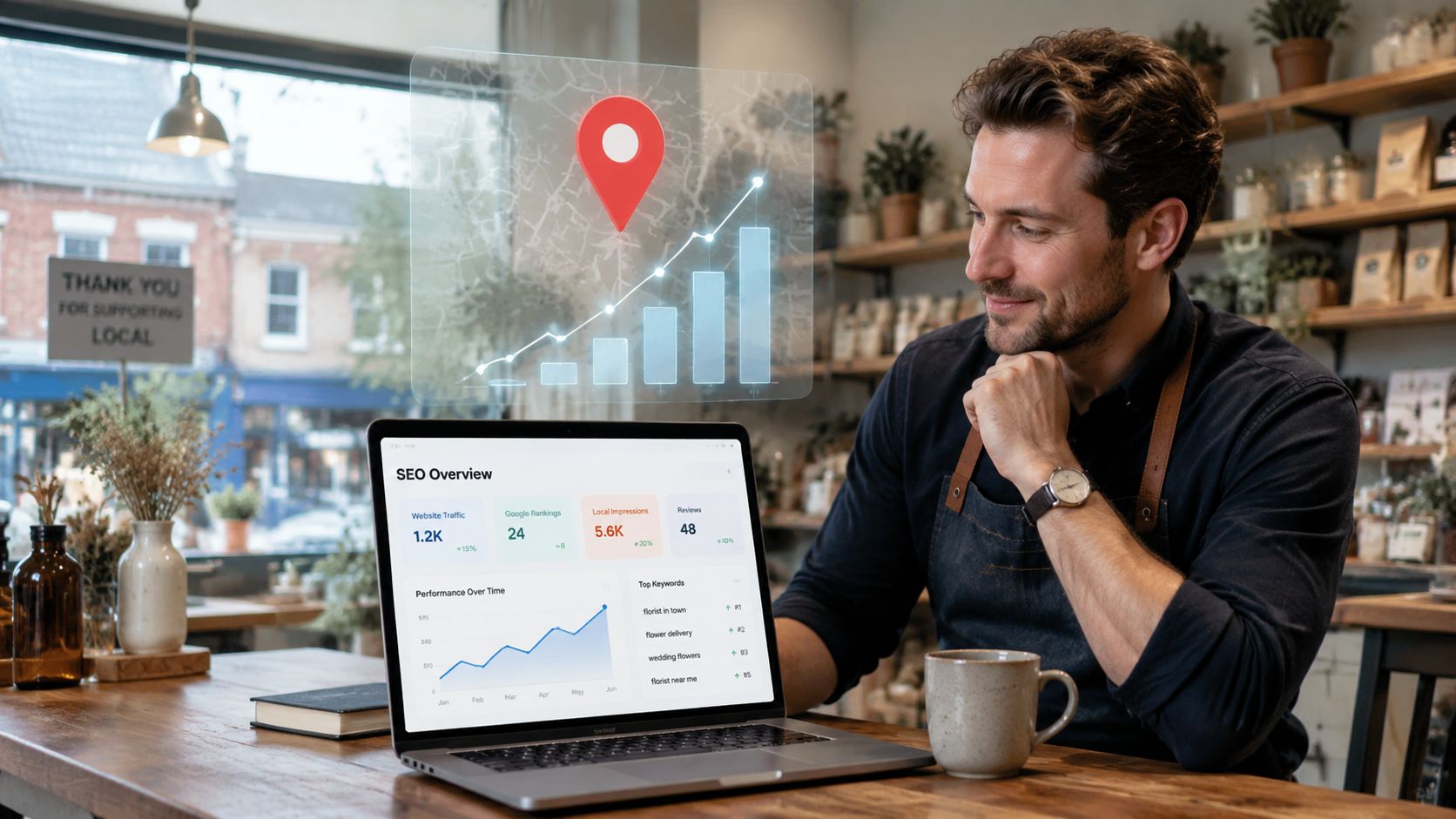

You run a solid business. Customers like the work, referrals come in, and people in your area do search for what you sell. Yet when someone types your service plus town into Google, a competitor shows up in the map results, another firm takes the organic spots underneath, and your own site is hard to find.
That's the local visibility problem in plain English. It usually isn't because your business is worse. It's because Google can't easily connect your website, your location signals, and your authority into one clear answer for the searcher.
For UK businesses, this matters because Google still controls the vast majority of search demand. In December 2024, Google held 93.67% of desktop search market share in the UK and 90.8% on mobile, according to UK search market data referenced by Lumar. If you want to improve site rankings in the UK, you're mostly trying to improve your visibility in Google.
The Local Visibility Challenge for UK Businesses
A lot of business owners get stuck because most SEO advice is either too broad or too technical. You'll see endless tips about backlinks, content, AI tools, domain authority, and ranking factors, but very little about what to fix first when you're a plumber in Leeds, a wedding venue in Surrey, or a multi-location care provider serving several postcodes.
Google's own guidance is much simpler than the noise around it. It says rankings are influenced by signals such as meaning, relevance, and quality. That means local SEO usually works best when the basics are strong: your site is crawlable, your service pages match search intent, and your local business signals are complete and consistent.
If your website isn't attracting enough search traffic in the first place, it helps to understand the wider causes before chasing rankings. This Webtwizz guide to increasing visitors gives a useful breakdown of the common reasons sites stay quiet, especially when the problem is a mix of visibility, weak content targeting, and poor conversion paths.
Practical rule: Local SEO gets easier when you stop asking, “How do I rank for everything?” and start asking, “What does Google need to trust me for this service in this area?”
The businesses that improve site rankings fastest usually do fewer things, in a better order. They don't publish ten weak pages before fixing a broken Google Business Profile. They don't buy links before sorting duplicate location pages. They don't chase national phrases when they're not yet visible in their own town.
For a single-location business, the priority is usually depth and clarity around one area. For a multi-location brand, the challenge is structure. Each branch or service area needs its own clear signals without competing against the others.
That's the roadmap that follows. Start with measurement. Fix the foundation. Strengthen your Google Business Profile. Build location-led content. Add trust signals. Then measure what changed in calls, forms, and real enquiries.
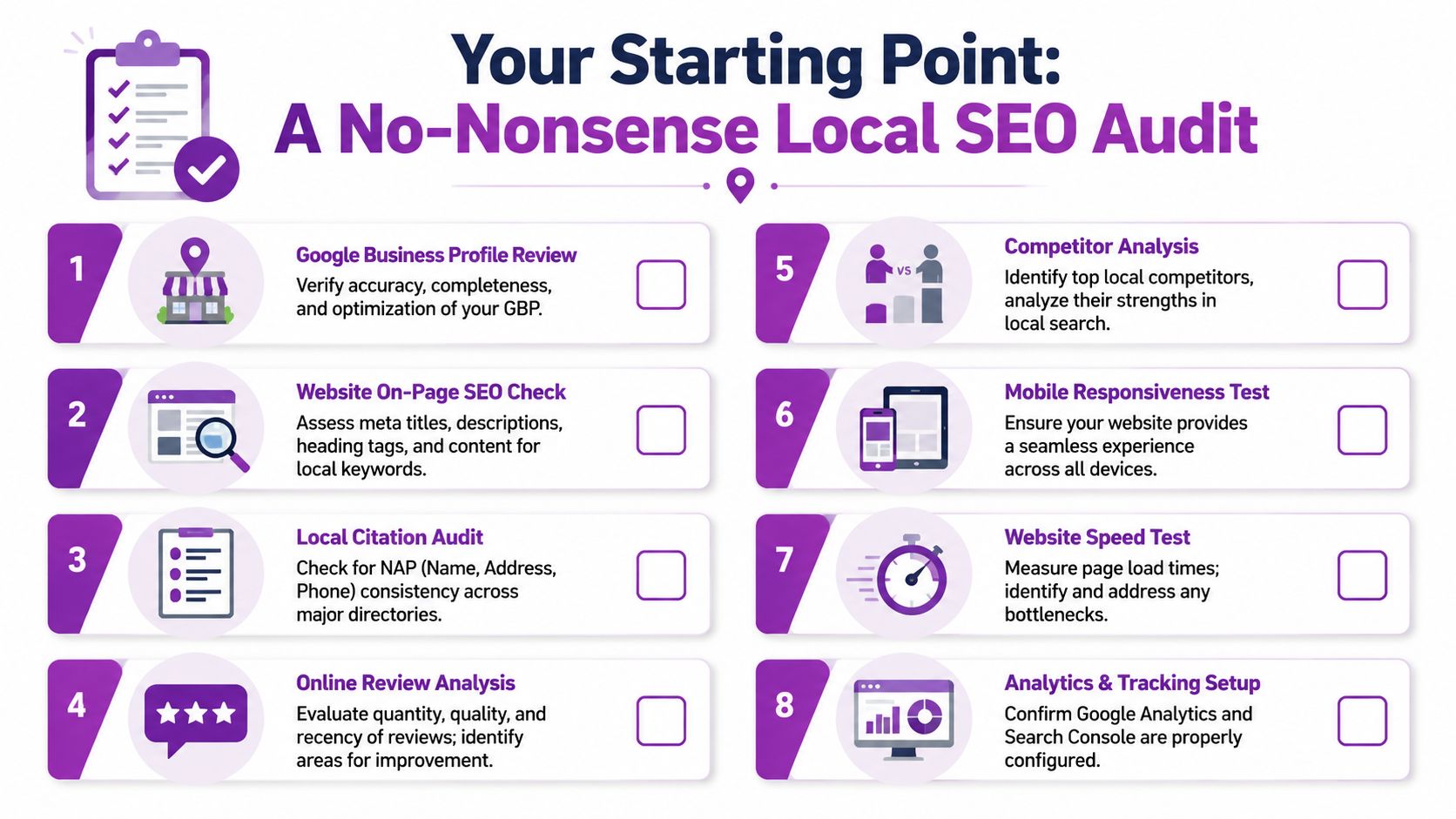
Your Starting Point A No-Nonsense Local SEO Audit
Before changing anything, get a baseline. Without one, you won't know whether a later jump in rankings came from your website changes, your Google Business Profile work, or simple seasonality.
Google's own SEO Starter Guide supports starting with measurement in Search Console and Analytics, and it highlights technical blockers such as crawl issues, slow pages, mobile usability, broken links, and duplicate content as core problems to address first.
Check what Google already knows about you
Open Google Search Console and look at the Performance report. You're looking for three things first:
- Queries with local intent such as service plus town, service plus county, or “near me” variations.
- Pages with impressions but weak clicks, which often means the page is being seen but not chosen.
- Pages already close to page one, because these often move faster than brand-new pages.
Then open your analytics platform and check which pages bring in organic traffic and which ones lead to contact form submissions, calls, or booking actions. Rankings matter, but rankings without leads are just vanity.
Search like a customer
Do a manual Google search for your top services in your actual target areas. Use normal searches, not just the terms you wish ranked.
Check:
- Map Pack presence. Are you visible in Google Maps for your main service plus location searches?
- Organic service pages. Does Google show the right page, or a weaker one like your homepage or an old blog post?
- Brand presentation. Does your business name, address, phone number, opening hours, and review profile look trustworthy at a glance?
This simple check often reveals the underlying problem. Sometimes the site is fine, but the Google Business Profile is incomplete. Other times the profile is strong, but the site has no proper location pages.
Record a baseline you can actually use
Create a simple sheet and track the following by service and area:
| What to track | Why it matters |
|---|---|
| Main service keywords by town or postcode | Shows whether visibility is improving where revenue comes from |
| Landing page tied to each keyword group | Prevents multiple pages competing for the same intent |
| Search Console impressions and clicks | Helps spot pages that need title or content improvements |
| Enquiries by page or location | Connects SEO work to leads, not just traffic |
| GBP calls, clicks, and direction requests | Shows whether map visibility is turning into action |
A lot of firms overcomplicate this. You don't need an enterprise dashboard on day one. You need a before picture.
If a page gets seen often but clicked rarely, the issue is usually packaging or intent mismatch, not just “more SEO”.
Audit the technical blockers before the content
Many local businesses want to jump straight into writing new pages. That's often the wrong order.
Check these first:
- Broken internal links that lead users and crawlers nowhere.
- Indexation issues where important pages aren't properly discoverable.
- Slow key pages, especially on mobile.
- Duplicate or overlapping content, common on service-area and multi-location sites.
- Weak internal linking between related services and locations.
If you want a practical checklist to work through, Bare Digital's local SEO checklist is a useful framework for reviewing visibility, technical issues, and local signals in one pass.
Separate single-location and multi-location problems
Single-location businesses usually have one of two issues: either the site is too generic, or the location signals are too thin.
Multi-location businesses often have a different problem. Their branches or area pages overlap so heavily that Google can't tell which page should rank for which place. You end up with internal competition and weak relevance across all of them.
That distinction matters. The audit should tell you whether you need sharper local relevance, better technical hygiene, or a cleaner page structure. Until you know that, every fix is guesswork.
Fixing Your Website's Foundations for Local Success
A local business website doesn't need to be flashy. It needs to be easy for Google to crawl and easy for customers to use. That means clean structure, clear service targeting, sensible page hierarchy, and no obvious technical friction.
The biggest mistake here is assuming more pages automatically means better rankings. In practice, weak pages often dilute relevance instead of strengthening it.
Start with speed, mobile use, and indexation
For most local businesses, the first wins come from fixing basic technical housekeeping.
Focus on:
- Mobile usability because local searches often happen on phones, with users ready to call or visit.
- Page speed on service and location pages, especially where large images or clunky scripts slow things down.
- Indexation and crawl access so Google can discover and understand the pages you want to rank.
- Canonical and duplication issues if multiple pages cover near-identical services in nearby areas.
If you're not sure whether Google is discovering your key URLs properly, this guide to Google sitemap submission is a helpful reference for making sure your sitemap is submitted and your important pages are easier for Google to find.
Tighten your on-page targeting
Once the technical basics are stable, fix the signals on the page itself. Most local service pages don't need clever writing tricks. They need to be specific.
A strong local page usually has:
- A clear page title built around service and place.
- A useful meta description that improves click appeal in search.
- One obvious H1 that matches the page's purpose.
- Subheadings that answer real local questions rather than repeating the keyword mechanically.
- Content written for the buyer, not for a search engine.
Bad local pages tend to sound like this: “We provide professional plumbing services with high-quality plumbing solutions for all your plumbing needs in Bristol.” That's repetition without meaning.
Better local pages explain what you do, where you do it, the types of jobs you handle, and why someone nearby should trust you.
Decide whether to refresh or create
Many businesses waste months. They keep launching fresh pages when an existing page already has some visibility and needs improving.
SEO guidance from Semrush's improve SEO resource emphasises updating pages that already have authority and targeting lower-competition terms. For UK local businesses, that usually means you'll get faster movement by improving pages already near page one than by chasing broad national keywords from scratch.
Use this decision table:
| Situation | Better move |
|---|---|
| Existing page already ranks and matches the intent | Refresh and strengthen it |
| Existing page ranks for the wrong place or service | Rework structure or split carefully |
| No page exists for a distinct location or service intent | Create a new page |
| Several pages overlap heavily | Consolidate into one stronger page |
Working rule: If Google already gives a page some visibility, earn more from that page before building a new one.
Build clean service and location architecture
For a single-location business, you may only need a homepage, core service pages, and one well-developed location page if your service area is wider than your physical base.
For a multi-location business, each branch or service area needs a distinct page with its own purpose. Don't clone one template across ten towns and swap the place name. That usually produces thin, near-duplicate pages that struggle to rank.
A stronger setup looks like this:
- One primary page per location or branch
- One primary intent per page
- Descriptive URLs
- Internal links between related services and locations
- Locally relevant details such as service availability, team coverage, or area-specific FAQs
If you want an example of how local service pages can be structured around geography and intent, Bare Digital's SEO services in Cambridge page shows the kind of local targeting and service framing many businesses need to adopt.
Write for the search and the click
A page can rank reasonably well and still underperform because the title and snippet don't earn the click. That's why improving site rankings isn't only about position. It's also about presentation.
Check whether your page title tells the user:
- what the service is
- where it's offered
- why your result is worth clicking
When a local page has the right structure, the right intent, and fewer technical issues, Google has a much easier job. That's what foundations are for. They don't create demand, but they stop your site wasting it.
Dominating the Map Pack with Your Google Business Profile
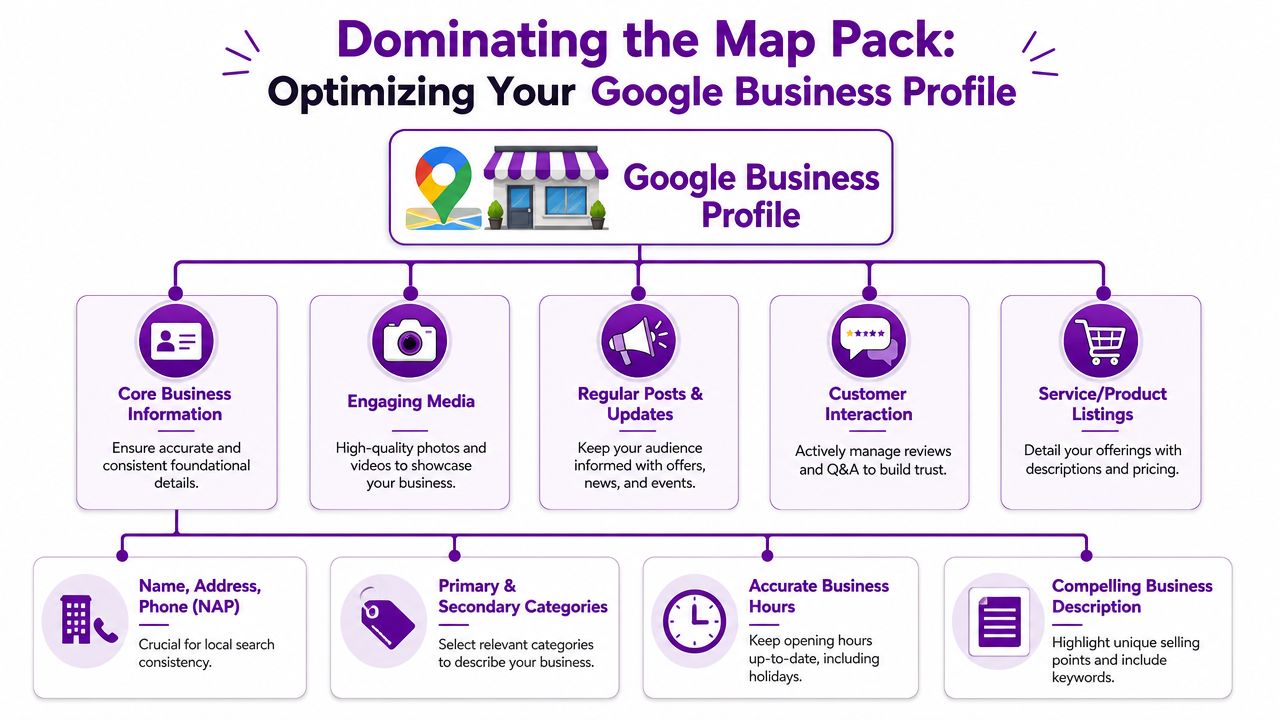
If you're a local business, your Google Business Profile often drives visibility faster than any other single asset. It can appear before your website in the results, it shapes what people see in Google Maps, and it influences whether someone calls you, requests directions, or visits your site.
Google is explicit about this in its own Business Profile guidance. It states that businesses with complete and accurate profile information are more likely to appear in local search results. It also warns that missing or inaccurate details can stop a profile showing for relevant searches.
Fill every field that helps a customer decide
An incomplete profile sends two bad signals. It makes Google less confident, and it makes customers hesitate.
At minimum, make sure these are fully accurate:
- Business name
- Address
- Phone number
- Primary category and relevant secondary categories
- Opening hours
- Website link
- Services or products
- Business description
- Photos and videos
For service-area businesses, be precise. Don't try to look bigger by being vague. Relevance beats sprawl.
Categories matter more than most businesses realise
The primary category helps Google understand what you are. Secondary categories help it understand what else you do. Choose them carefully.
A common mistake is selecting broad categories that sound impressive but don't align with your main revenue-driving service. Another is adding too many fringe categories and diluting relevance.
For example, if most of your leads come from one service, the primary category should reflect that core offer, not a side service you'd like to grow someday.
Reviews aren't just reputation management
Reviews influence trust immediately. They also give Google fresh signals about what customers say you do and where you do it.
What matters in practice:
- Consistency. New reviews over time are healthier than long periods of silence.
- Specificity. Reviews that mention services and locations help reinforce local relevance.
- Responses. Replying shows the profile is actively managed.
Don't script your customers. Ask for honest feedback and make it easy for them to leave it.
A neglected profile tells both Google and the searcher the same thing. This business may not be active.
Media, updates, and activity signals
Most businesses upload a few photos once and never touch the profile again. That leaves money on the table.
Keep adding:
- Exterior and interior images
- Team photos
- Recent project photos
- Short videos where appropriate
- Posts about offers, updates, or events
These additions do two jobs. They improve click confidence, and they show the profile is still current.
Here's a useful visual walkthrough of profile optimisation in practice:
Single-location and multi-location profiles need different handling
A single-location business should concentrate on completeness, relevance, and review flow around one core market.
A multi-location business needs discipline. Every branch should have its own accurate profile, its own corresponding landing page, and its own local signals. Problems usually appear when locations share phone numbers inconsistently, point all profiles to one generic page, or use weak branch data.
Use this comparison:
| Type of business | Priority in GBP work |
|---|---|
| Single location | Complete one strong profile and align it to the best local landing pages |
| Multi-location brand | Keep each profile distinct, accurate, and mapped to the correct branch page |
| Service-area business | Clarify services and coverage without creating vague or misleading location signals |
Match your profile to your website
Your Google Business Profile shouldn't float separately from the site. The categories, services, descriptions, and linked pages should make sense together.
If your profile says one thing and your landing page says another, Google gets mixed signals. So do potential customers.
A practical review process looks like this:
- Search your own brand and main local terms.
- Compare the profile details with the linked landing page.
- Check whether the page supports the service and area being promoted.
- Fix mismatches first.
If you want a structured way to assess those profile gaps, this Google Business Profile audit tool can help flag missing fields, weak optimisation, and local visibility issues.
For many UK businesses, this provides the fastest local lift. Not because Google Business Profile replaces the website, but because it strengthens the exact layer of search where local buying decisions often begin.
Creating Content That Captures Local Customers
Once the foundations are solid and your Google Business Profile is in shape, content becomes the differentiator. Through content, you stop looking like another generic local business and start becoming the most relevant answer for the searches you want.
The key is to build content around intent, not around a pile of keywords.
Service pages and location pages do different jobs
A common local SEO mistake is trying to make one page rank for every service in every area. That usually produces a vague page that ranks poorly for all of it.
Instead, separate the two ideas:
- Service pages explain what you do.
- Location pages explain where you do it and why you're relevant there.
For a single-location firm, that may mean a tight set of service pages supported by one strong local page or a handful of carefully chosen area pages.
For a multi-location brand, each location page should be tied to a real branch, team, or service footprint. It needs unique value. Not just the same text with a different town inserted.
What a strong local landing page includes
A useful location page often contains:
- The main service and place combination in the title and heading
- Original copy about the area, customer needs, or delivery model
- Proof of local relevance, such as projects, testimonials, or service details tied to that area
- Internal links to related services
- Clear conversion paths such as calls, forms, or booking actions
This pattern aligns well with practical SEO advice that combines local relevance with authority building. The broader commercial goal is simple. Bring in qualified local visitors and convert them.
If you're thinking about SEO as part of a wider customer acquisition system, this effective local business lead generation resource is worth reading because it frames visibility, trust, and conversion as one process rather than separate tasks.
Content test: If you remove the town name from the page and it could belong to any business anywhere, it probably isn't strong enough.
Use supporting content to capture nearby-intent searches
Blog content still matters for local SEO, but not in the old “write anything weekly” sense. It works best when it answers local buying questions, planning questions, or trust questions.
Examples:
- a wedding venue writing about seasonal planning in a specific county
- a builder explaining extension considerations in a local housing market
- a funeral director answering practical questions families ask in the area
- a photographer covering local venue logistics or timing advice
That kind of content helps in two ways. It builds topical relevance around the main service, and it creates internal linking opportunities back to your core money pages.
Single-location versus multi-location content strategy
The content model changes depending on business type.
| Business setup | Best content focus |
|---|---|
| Single location | Fewer, stronger pages with deep local relevance |
| Multi-location | Distinct branch or area pages plus shared supporting topic content |
| Service-area business | Core service pages supported by carefully selected service-area pages |
A single-location business usually benefits from concentration. Build authority around one centre of gravity.
A multi-location business needs separation and consistency. Each location must have enough unique information to stand on its own, but still fit into one coherent site structure.
Build clusters, not isolated pages
Google understands context better when related pages support each other. That's why isolated location pages often underperform. They sit alone with no topical backing.
A stronger setup links:
- service page to location page
- location page to relevant FAQs or guides
- blog content back to the commercial page
- nearby-intent articles into the local cluster
For sector-specific inspiration, Bare Digital's SEO for wedding venues page shows how a niche local business can combine service intent, venue-specific search behaviour, and supporting content themes.
The point isn't to produce more content for the sake of it. It's to make every page help Google answer a local question more confidently.
Building Trust and Authority with Citations and Links
A local business can have a decent website and still struggle if the rest of the web sends weak or inconsistent trust signals. That's where citations and links come in.
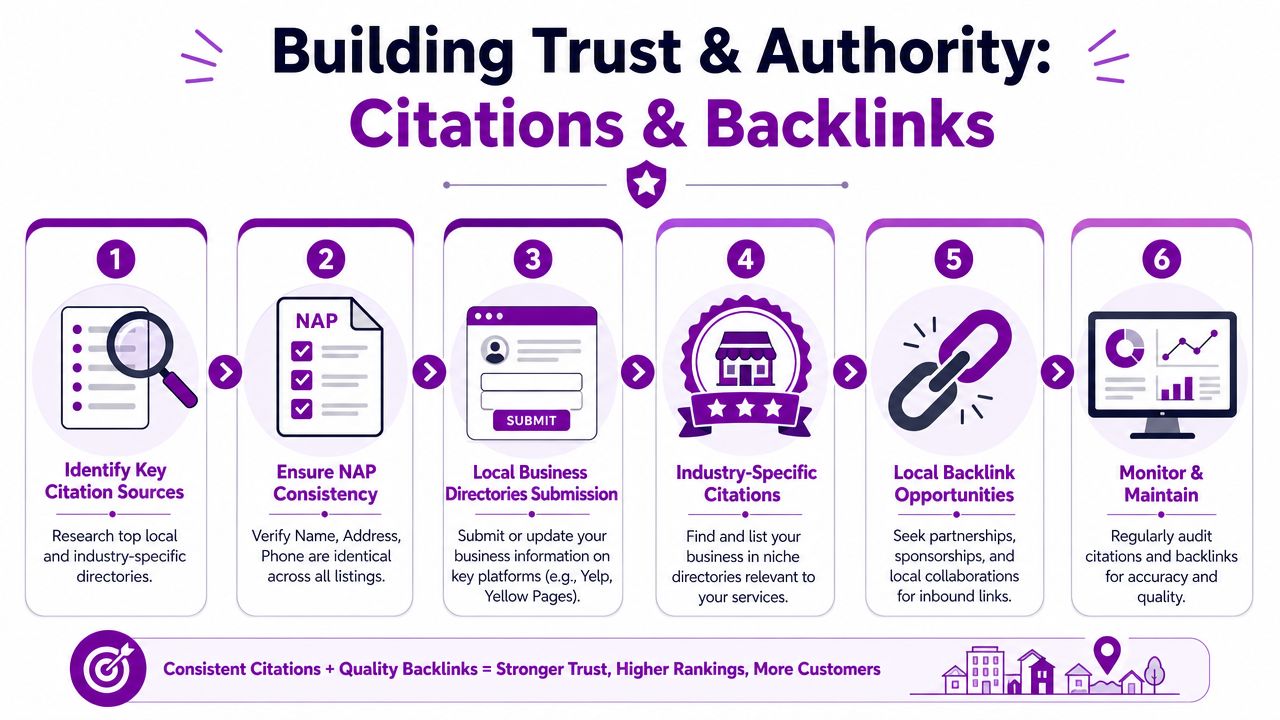
Citations are mentions of your business details on other sites. Links are clickable references from other sites to yours. They serve different roles, but both help Google validate that your business is real, relevant, and tied to a place.
Fix citation consistency before chasing links
Many local firms have old addresses, tracking numbers, duplicate directory entries, or conflicting business names spread across listing sites. That inconsistency weakens trust.
Start by checking your core business details everywhere they appear:
- Business name
- Address
- Phone number
- Website URL
- Opening hours where relevant
This doesn't have to be glamorous work. It does have to be accurate.
Build citations where they actually help
Not every directory matters equally. Prioritise the places customers and search engines are likely to trust.
That usually means:
- Major business directories
- Relevant local directories
- Industry-specific portals
- Trusted local association listings
Don't treat citation building as a numbers game. Better a smaller set of clean, consistent listings than a long tail of poor ones.
Earn links through real local activity
Local link building works best when it reflects something your business does in the community or sector.
Strong examples include:
- Sponsoring local events
- Supporting a charity or sports club
- Joining a chamber of commerce or trade body
- Supplying a local project that gets covered online
- Contributing expert input to local publications
Those links make sense because they arise from real-world relevance.
A practical local SEO pattern is to combine Google Business Profile work, location pages, and authority signals together. The SEO checkup guide on improving Google rankings describes this pattern and recommends location landing pages, schema markup, and nearby-intent supporting content as part of the same system.
Relevance beats randomness. One good local link from a genuinely connected source often helps more than a batch of unrelated ones.
What doesn't work well
Local businesses still lose time on the same off-page mistakes:
- Buying low-quality links
- Submitting to irrelevant directories
- Ignoring duplicate listings
- Relying on backlinks while the site itself is weak
- Creating location pages with no supporting authority or relevance
Off-page SEO isn't a substitute for local relevance. It strengthens it.
Keep authority building aligned to your commercial pages
If you earn a local mention or citation, make sure it supports the page that matters. A branch mention should ideally reinforce the branch page. A service-specific mention should point to the service page, not always the homepage.
For businesses in trades and property-related sectors, Bare Digital's SEO for construction companies page is a good example of how authority-building, local service targeting, and page intent can be aligned around actual enquiry terms.
The local businesses that improve site rankings most reliably aren't always the loudest. They're often the ones that look the most consistent everywhere Google checks.
Measuring What Matters and Planning Your Timeline
A common local SEO scenario looks like this. Rankings improve for a few terms, the Google Business Profile gets more views, and everyone assumes the campaign is working. Then the phone stays quiet, form leads barely change, and no one can say which pages or locations are producing real business.
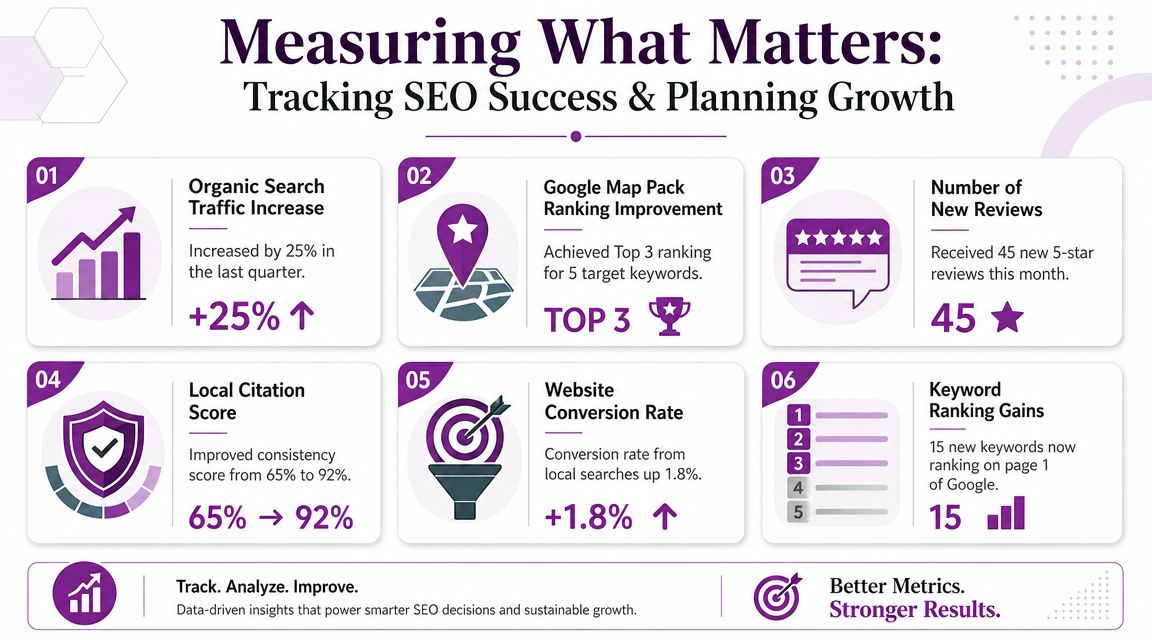
That gap usually comes from tracking visibility without tying it back to enquiries. As noted earlier, Google owns the vast majority of search demand in the UK, so the job is not to watch every metric. The job is to measure whether your work is increasing qualified local demand from Google Search and Google Maps.
Track the local SEO signals that connect to revenue
Start with a short list. If reporting becomes too broad, useful patterns get buried.
Track:
- Search Console impressions for core service pages, location pages, and key query themes
- Clicks and click-through rate on pages that target commercial local intent
- Map visibility for your priority searches in the towns or postcodes that matter
- Calls, forms, bookings, and direction requests
- Landing page performance by branch, town, or service area
- Lead quality, not just lead volume
These metrics work together. A page can gain impressions because Google is testing it more often, but if clicks stay weak, the title, meta description, or page intent may be off. If your Google Business Profile drives calls and direction requests while website visits stay flat, that is not automatically a problem. For some single-location businesses, especially trades, hospitality, and clinics, the profile may convert better than the site for high-intent searches.
Multi-location businesses need a stricter setup. Branch-level reporting matters because one location can improve while another stalls, and head office totals often hide that.
Use a review rhythm you will actually keep
Weekly spot checks are fine for major changes. Monthly review is where most local businesses should make decisions.
A useful monthly check looks like this:
| Review area | What to ask |
|---|---|
| Ranking movement | Which priority service and location terms improved, dropped, or stayed flat? |
| Search Console data | Which pages are getting more impressions but failing to win clicks? |
| Lead quality | Are enquiries coming from the right towns, services, and customer types? |
| GBP engagement | Are calls, website clicks, and direction requests increasing on the right profiles? |
| Page overlap | Are two pages competing for the same term and splitting performance? |
Keep the review simple enough to repeat. A spreadsheet, Looker Studio dashboard, or monthly export can all work. The method matters less than consistency.
Plan your rollout in the right order
Local SEO improves faster when the work is sequenced properly.
Phase one
Fix what blocks performance now. That usually means technical issues, weak service pages, missing local signals, conversion problems, and an incomplete or poorly managed Google Business Profile.
Phase two
Improve location relevance. Build out the right town or branch pages, tighten internal linking, and correct citation inconsistencies. Single-location businesses can often do this quickly because there are fewer moving parts. Multi-location brands need firmer templates, cleaner governance, and a clear rule for how each branch page differs.
Phase three
Add supporting content, earn relevant local links, and refine pages that are already showing traction in Search Console. This stage works best once the foundations are stable, because authority and content perform better when Google can already understand the site structure.
Speed matters less than order. I have seen businesses waste months publishing articles and chasing links before fixing thin location pages or broken internal linking. The result is usually activity without much movement.
Set realistic timelines
Some changes show up quickly. Google Business Profile improvements, technical fixes, and page intent changes can affect visibility within weeks. Content depth, stronger authority signals, and branch-level trust usually take longer.
The timeline also changes by business type. A single-location solicitor in a mid-sized town can often see clearer gains sooner than a nationwide self-storage brand trying to align dozens of branches, pages, and listings. More locations create more opportunities, but they also create more points of failure.
Consistency wins here. Businesses that improve site rankings steadily tend to keep publishing useful local content, maintain accurate profiles, and review performance every month. Businesses that work in bursts usually lose momentum just as pages start to gain traction.
Know when to change course
Some targets deserve patience. Others do not.
If a broad term is dominated by national brands or aggressive local competitors, better returns often come from work that is closer to conversion:
- refreshing a page that already sits near page one
- improving a high-impression page with weak click-through
- consolidating overlapping pages
- expanding coverage around a profitable service-area cluster
- strengthening the branch or town pages already generating leads
This is where trade-offs matter. Chasing the biggest keyword can look ambitious, but improving the pages that already attract the right local searches usually produces leads sooner.
If you want a clearer plan to improve site rankings for your business, Bare Digital helps UK companies turn local visibility into measurable enquiries through Google Business Profile optimisation, technical SEO, location landing pages, and local authority building. A sensible next step is a proper health check so you can see what's blocking rankings now, what should be fixed first, and where the quickest local gains are likely to come from.