
In simple terms, local listings for business are the digital version of your shopfront, appearing on online maps, directories, and search engines. Think of them as your business's essential online footprint, ensuring customers can find your name, address, and phone number whenever they search nearby.
Why Local Listings Are Your Digital Shopfront
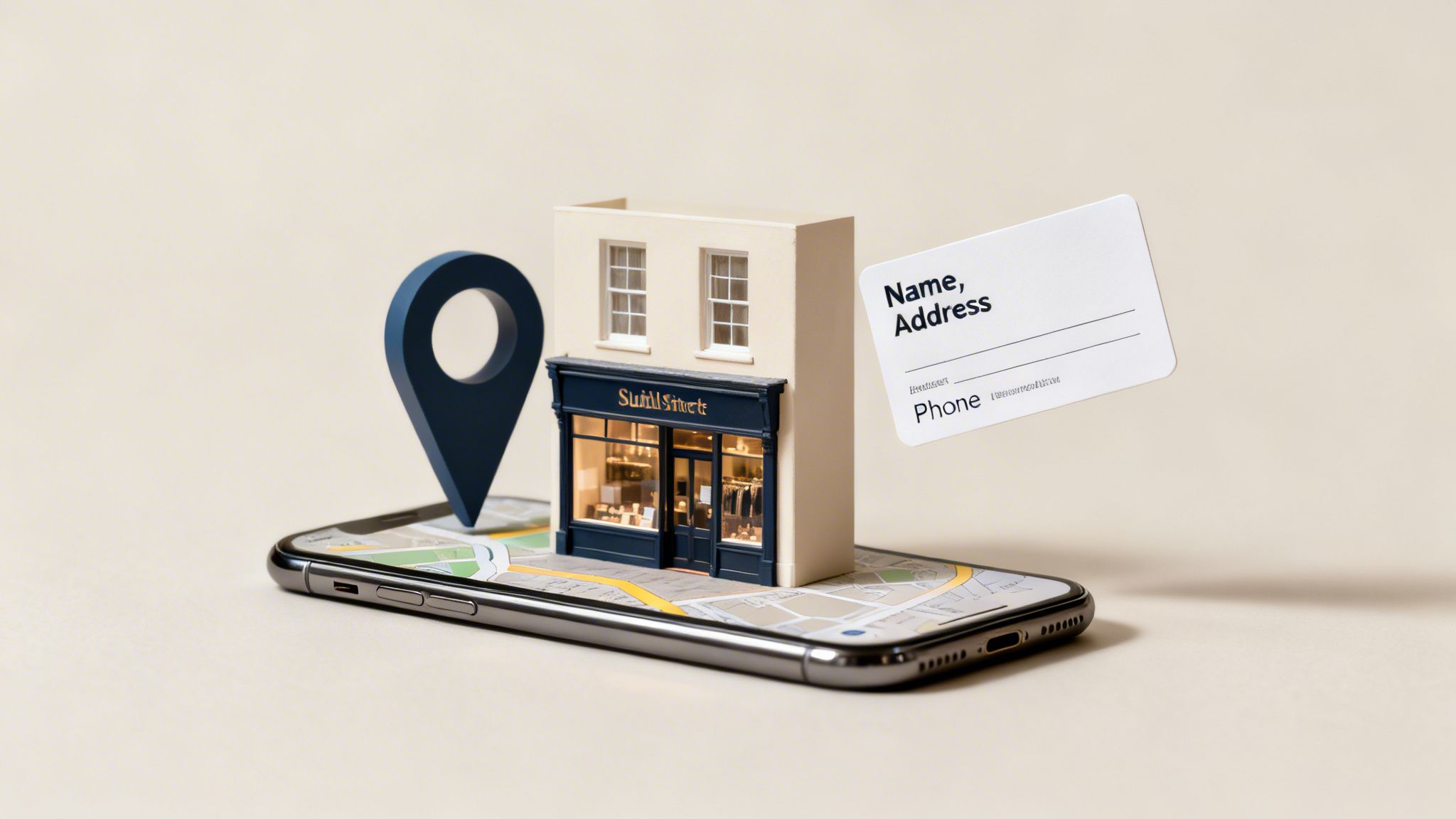
Imagine your business has multiple, slightly different addresses scattered across the internet. One says "High Street," another "High St," and a third has an old postcode. A potential customer looking for you gets confused, and so does Google. This confusion is precisely what effective management of local listings for business prevents.
These listings are much more than simple online entries; they are your business's virtual presence on critical platforms like Google Maps, Bing Places, Yell, and countless others. They act as digital signposts, guiding customers directly to your door, phone line, or website.
For any UK business—from a local plumber in Manchester to a boutique hotel in the Cotswolds—mastering these listings is not optional. It's the foundation of modern local marketing.
The Power of Your Digital DNA
The core of any successful local listing strategy is your NAP data—Name, Address, and Phone number. This information acts like your business's unique digital DNA. Just as consistent DNA is vital for a healthy organism, consistent NAP data across all online platforms is crucial for a healthy online presence.
When your business name, address, and phone number are identical everywhere online, search engines see this consistency as a powerful signal of trust and authority. This directly improves your chances of appearing in valuable "near me" searches.
This consistency builds credibility not just with algorithms but with real people. When a customer finds the same, accurate details on Google, Facebook, and a niche industry directory, it reinforces that your business is legitimate and reliable.
Turning Visibility into Customers
Ultimately, the goal of managing local listings for business is to drive tangible results. Every accurate listing is an opportunity to convert a searcher into a customer. Here’s how it works in practice:
- Increased Foot Traffic: A perfectly optimised Google Business Profile guides users with driving directions straight to your physical location.
- More Phone Calls: "Click-to-call" buttons on listings allow mobile users to contact you with a single tap, generating high-quality leads.
- Higher Website Clicks: Listings direct interested searchers to your website, where they can learn more, book an appointment, or make a purchase.
For sectors like construction, home care, or professional services, where trust is paramount, a well-managed set of local listings acts as the first handshake with a potential client. It establishes your legitimacy before they even speak to you.
To explore how a specialised agency can help, you might be interested in learning more about the bespoke local SEO strategies from Bare Digital, which turn online visibility into measurable growth. Mastering your digital shopfront is the first, most important step toward winning in your local market.
Right, you know that getting your business listed online is crucial, but where do you even start? The sheer number of online directories can feel overwhelming, and it's easy to waste time scattering your details all over the place. A focused, strategic approach always wins.
Think of it like setting up shop in the real world. You’d open on the busiest high street first, not some quiet back alley. In the digital world, that high street is Google, and it’s where you absolutely must plant your flag first.
Start with the Undisputed Champion: Google Business Profile
Google Business Profile (or GBP) isn't just another listing. It is the absolute cornerstone of your local online presence. When a potential customer searches for a "plumber in Leeds" or "best coffee near me," the information they see in that prominent map pack at the top of the page is pulled straight from a Google Business Profile.
A well-optimised GBP acts like a mini-website right there on Google. It’s your single most powerful tool for grabbing the attention of local customers, showcasing your address, opening hours, photos, and customer reviews. Neglecting it is like boarding up your most visible shopfront—you become practically invisible to the vast majority of people searching nearby.
Build Your Presence on Core UK Directories
Once your Google profile is in great shape, it’s time to secure your spot on other established, high-authority UK directories. These platforms still get a lot of traffic, but more importantly, Google uses them as trusted sources to double-check and verify your business information.
Here are the key platforms UK businesses should be on:
- Yell: The digital version of the famous Yellow Pages, Yell is still a highly recognised brand among UK consumers and a valuable citation source for Google.
- Thomson Local: A long-standing UK directory that’s adapted well to the digital age. Thomson Local is especially strong for trades and local services and is becoming more important for voice search on devices like Amazon Alexa.
- Foursquare: This global platform is influential because its location data feeds into other big apps and services, including Apple Maps. Getting listed on Foursquare has a knock-on effect.
- Bing Places for Business: As the UK's second-biggest search engine, having a complete and accurate listing on Bing Places is a smart move to capture a different slice of the search market.
Keeping your details consistent across these core platforms sends powerful trust signals to search engines, reinforcing that you’re a legitimate, active business. Managing these foundational listings is a crucial part of any solid local SEO service. If you're in a competitive spot, our local SEO services in Cambridge can give you the expert support you need to stand out from the crowd.
A targeted presence on the right platforms is far more effective than a scattered, inconsistent approach across hundreds of low-quality directories. Focus on quality and consistency over sheer quantity.
To help you prioritise, here's a quick look at the main players.
Top UK Local Listing Platforms at a Glance
This table breaks down the most important platforms for UK businesses, showing you who they reach and why they matter for you.
| Platform | Primary Audience | Key Benefit for UK Businesses |
|---|---|---|
| Google Business Profile | Virtually all local searchers | The #1 driver of visibility in local search and Google Maps. Non-negotiable. |
| Yell | UK consumers looking for established local businesses and services. | High brand recognition and a strong, authoritative citation for SEO. |
| Thomson Local | UK homeowners and consumers searching for trades and local services. | Strong focus on service-based businesses and increasing voice search visibility. |
| Bing Places | Users of the Bing search engine and Microsoft ecosystem. | Captures a significant secondary search market beyond Google. |
| Foursquare | Mobile users, app developers, and services like Apple Maps. | Its data underpins other major platforms, extending your reach indirectly. |
Getting these core platforms right builds a rock-solid foundation for your local online presence before you move on to more specialised directories.
Find Your Niche with Industry-Specific Directories
Beyond the big names, there's huge value in finding directories tailored to your specific industry or local area. A wedding photographer needs to be on sites like Bridebook and Hitched. A builder, on the other hand, belongs on Checkatrade or the Federation of Master Builders directory.
These niche directories put you right in front of a highly relevant audience who are actively looking for the exact services you offer. They also provide powerful, industry-relevant backlinks and citations that scream to Google that you are an authority in your field. This targeted approach often drives much higher quality leads than general directories.
Industry forecasts predict that by the end of 2026, over 78% of UK consumers will rely on directory platforms to discover local businesses. For service-based businesses, a platform like Thomson Local can offer cost-effective enhanced listings that outperform pricier options for postcode-specific visibility. Understanding these trends is key to a smart directory strategy that keeps you ahead of the competition.
Your Step-by-Step Listing Optimisation Playbook
Knowing where to list your business is half the battle. The other half is turning those basic profiles into magnets for new customers. A neglected listing is like a poorly stocked shop with the lights off—it exists, but it’s certainly not bringing anyone through the door. This playbook gives you a clear, actionable process for transforming your local listings for business from simple entries into powerful assets that drive both rankings and revenue.
This process flow shows you exactly where to focus your efforts, starting with the absolute essentials and then branching out to more specialised platforms.
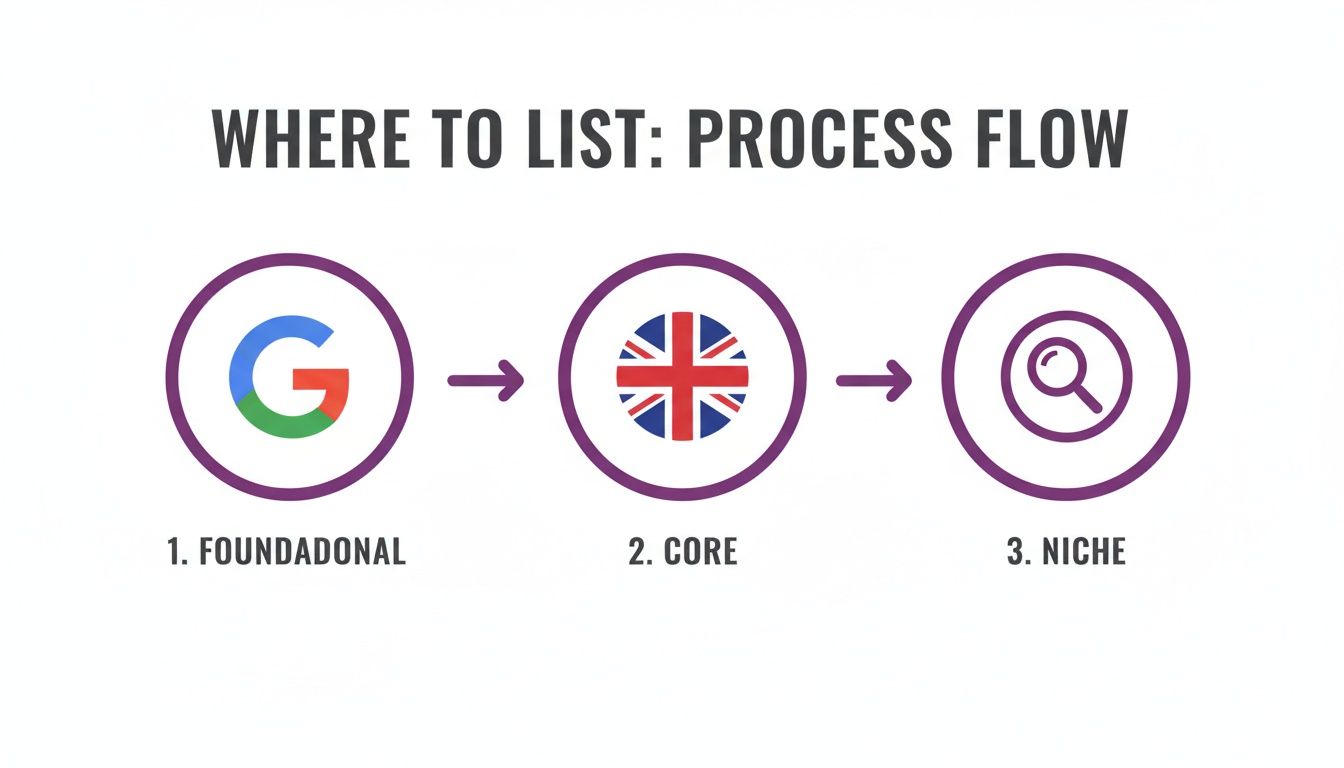
As you can see, the strategy is straightforward. Begin with Google, expand to the core UK directories that matter, and then target the niche platforms that are relevant to your specific industry. It's all about maximum impact.
Claim and Verify Every Profile
First things first. You have to officially claim ownership of your business listings. On platforms like Google Business Profile, this usually means getting a postcard sent to your business address with a PIN, or sometimes getting a code via a phone call.
Why is this so critical? An unclaimed listing can be hijacked and edited by anyone—including competitors or a disgruntled former employee. This can lead to wrong information spreading across the web, damaging your reputation and sending potential customers to the wrong place. Verification locks your profile down, proving to the platform and to searchers that you are the legitimate owner. It’s the digital equivalent of getting the keys to your own shop.
Complete 100% of Profile Fields
An incomplete profile is a massive missed opportunity. It’s that simple. Search engines like Google actively reward completeness. A profile that’s 100% filled out gives the algorithm far more data to understand what you do, where you are, and why you’re the right choice for a searcher.
Think of each empty field as a blank answer on a test. The more questions you answer, the higher your score. Businesses with complete listings can get up to 7x more clicks than those with patchy, missing information.
This means you need to go way beyond the basic Name, Address, and Phone number (NAP). Make sure you’ve filled out every single field:
- Website URL: A direct link to your site.
- Opening Hours: Don't forget to include special hours for bank holidays.
- Business Description: A compelling, keyword-rich summary of what you do.
- Services/Products: A detailed list of everything you offer.
- Attributes: Special features like "Wi-Fi available," "Wheelchair accessible," or "Online appointments."
Choose the Right Business Categories
Picking the right categories is one of the most powerful levers you can pull to rank in relevant searches. You absolutely have to choose a primary category that represents the very core of your business. If you’re a restaurant that also does catering on the side, "Restaurant" must be your primary category.
You can then add secondary categories to catch all the other things you do, like "Caterer" or "Event Venue." This tells Google to show your business not just to people looking for a place to eat, but also to those planning an event. Choosing hyper-specific categories helps you show up in front of customers with serious buying intent.
Use High-Quality Photos and Videos
People buy from businesses they can see and trust, and visual content is a huge shortcut to building that trust. Listings with photos get 42% more requests for driving directions and 35% more clicks through to their websites than listings without them.
Your photos should tell the story of your business. Make sure you include images of:
- Your exterior and interior: Help customers spot your location from the street.
- Your team at work: Puts a human face on your brand.
- Your products or finished work: Showcases the quality you deliver.
- Happy customers (with their permission, of course): This is powerful social proof.
Adding new photos regularly also signals to Google that your business is active, which keeps your profile looking fresh for potential customers. If you're looking for more ways to polish your online presence, our comprehensive local SEO checklist offers plenty of extra actionable steps.
Gather and Respond to Customer Reviews
Reviews are the lifeblood of local listings for business. A steady stream of positive reviews is one of the strongest local ranking factors there is, and it directly sways buying decisions. Most customers now trust online reviews as much as a personal recommendation from a friend.
Your strategy here has two parts. First, you need a simple process for encouraging your happy customers to leave feedback. Second, you have to respond to all reviews—the good and the bad. Replying to positive reviews shows you appreciate the business, while a professional response to negative feedback shows you're accountable and serious about customer service. For some businesses, this might even mean actively working to get TripAdvisor reviews as part of a wider reputation management plan.
Advanced Strategies to Dominate Your Local Market
So you’ve got your core local listings in good shape. That’s the solid foundation. Now it’s time to build the rest of the house—the part that gets you noticed and helps you properly dominate your local search results. These advanced strategies go beyond just being visible; they create a real competitive edge that’s tough for anyone else to copy.
The first step is to think smaller to win bigger. This means adopting a hyperlocal citation strategy, which is all about getting your business mentioned on directories and websites specific to your town, county, or even your neighbourhood.
Think about your local council’s business directory, the chamber of commerce website, or even local blogs that cover your specific patch. Mentions from these sources are incredibly powerful. They send a huge signal to Google that you are a genuine, trusted part of that specific community. It's the digital version of getting a recommendation from a respected local figure.
Speak Search Engines' Language with Schema Markup
Imagine you could add a secret layer of information to your website that only search engines can read. This information would spell out, without any room for error, that you're a local business, what your opening hours are, the services you provide, and even show off your five-star reviews. That's precisely what Schema markup does.
Schema is a type of structured data—a kind of 'secret language'—that you add to your website's code. It translates your key business information into a format that search engines can understand instantly and accurately.
Implementing LocalBusiness schema can help you earn rich results in search, like:
- Star ratings appearing directly under your business name.
- Event schedules or opening times displayed right on the results page.
- A more detailed and eye-catching knowledge panel.
This helps you take up more space on the search results page and provides instant social proof, which encourages more people to click through to your site.
Engage Actively with Google Business Profile Features
Your Google Business Profile isn't a static, set-and-forget listing. It's a dynamic platform for engaging directly with potential customers. Two of its most powerful—and most underused—features are Google Posts and the Q&A section.
Think of Google Posts as your business's social media feed directly on the search results page. Using them regularly signals to Google that you are active and keeps your profile fresh for customers.
Use Google Posts to announce a special offer, share some company news, highlight a new product, or link to your latest blog post. The Q&A feature, meanwhile, lets customers ask questions directly on your profile. You can even proactively add your own common questions and answers (like "Do you offer free parking?"). This shows you understand what customers need and saves them time.
In the UK, small businesses are the absolute backbone of the economy. In fact, 5.64 million of them make up 99.18% of the total business population. For these businesses, actively managing local listings can lead to 34% more engagement when updated monthly. You can find more insights on how active directory management boosts visibility for UK businesses and find valuable statistics for your strategy.
Create Hyper-Targeted Location Pages
If your business serves multiple towns or has more than one branch, creating dedicated landing pages for each location is a total game-changer. A generic "services" page just won't cut it if you want to rank well in different geographic areas.
Each location page should be uniquely optimised for that specific town or neighbourhood. It needs to include:
- The full name, address, and phone number for that specific branch.
- An embedded Google Map of the location.
- Unique content about the local area, the services offered there, or the team.
- Testimonials from customers in that specific region.
This tactic lets you capture highly targeted search traffic, like "architects in Norwich" or "plumbers in Ipswich," by proving your relevance for each individual market. For an even deeper dive, check out our guide on how to generate and analyse a Google Business Profile report to inform your location-specific strategy.
Beyond just appearing in search, local businesses can use advanced strategies to really dominate their market. For example, restaurants can massively increase customer engagement with a specialized loyalty application for restaurants, turning those one-time visitors you found via your listings into loyal, repeat customers.
How to Audit Your Listings and Measure What Matters
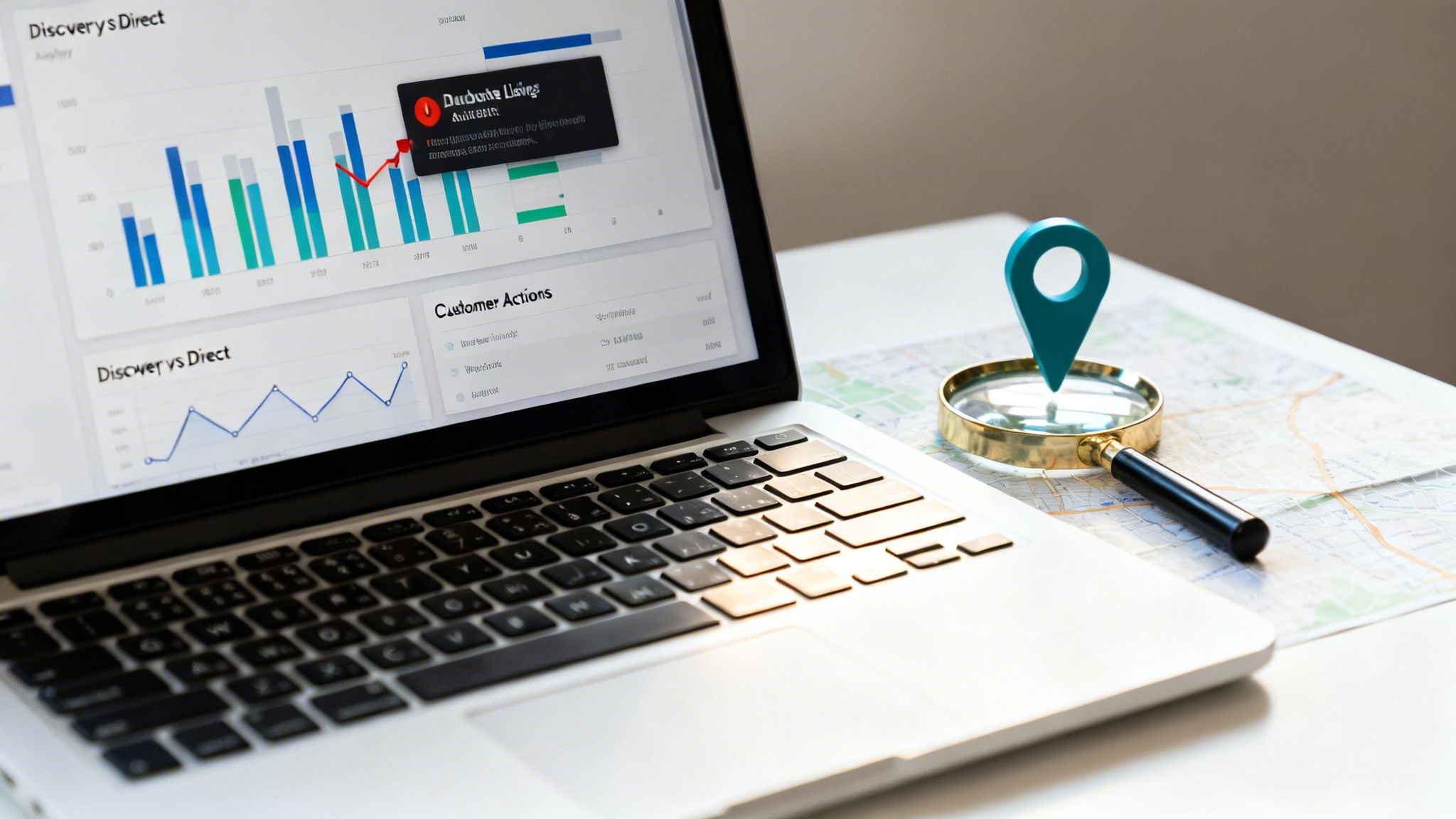
Treating your local listings for business as a one-time setup is a classic mistake. It's more like tending to your shopfront. You wouldn't just put up the sign and then walk away for a year. It needs constant care to stay looking its best and bringing customers through the door.
Without regular checks, your digital presence can quietly fall into disrepair. Outdated opening hours, rogue duplicate profiles, and unanswered questions can sabotage your local SEO and turn away perfectly good customers. Let's walk through a clear framework for auditing your listings and tracking the numbers that actually matter to your bottom line.
Conducting Your Local Listing Audit
An audit is your first step to getting things back under control. Think of it as a health check for your online reputation—a systematic review of your business’s presence across the web to spot and fix the problems hurting your visibility.
The main culprits you're hunting for are inconsistencies and duplicates. Inconsistent listings, where your business Name, Address, or Phone number (your NAP) are different from site to site, confuse both customers and search engines. Duplicate listings, often created by accident over the years, split your reviews and your ranking power, weakening your entire presence.
You could do this manually by searching for your business on all the major platforms, but honestly, it’s a slog. A specialised tool makes this process far more efficient. For a detailed walkthrough, check out our guide on using a Google Business Profile audit tool to get this done properly.
Key Performance Indicators That Actually Matter
Once your listings are clean and consistent, you need to see what impact your efforts are having. It's easy to get lost in vanity metrics, but what you really need are Key Performance Indicators (KPIs) that connect directly to real-world goals, like more phone calls and more customers walking in.
Here are the core metrics to focus on inside your Google Business Profile Insights:
- How customers search for you: This shows whether people are finding you by searching your name (Direct) or by searching for a category, product, or service (Discovery). A high number of Discovery searches is brilliant news—it means your optimisation is pulling in new customers who didn't even know you existed.
- Customer actions: This is the most important data you have. It tracks real, tangible interactions like clicks to your website, requests for driving directions, and phone calls made straight from your listing. This is your ROI.
- Search queries: This report shows the exact phrases people used to find your business. It’s an absolute goldmine for understanding what your customers want and helps you fine-tune your keywords.
Tracking these metrics allows you to connect specific optimisation activities—like adding new photos or updating your services—to real-world results. For example, you might notice a spike in phone calls the week after you publish a new Google Post with a special offer.
In the fierce UK market, proactive tracking is a massive advantage. The UK's 5.64 million small businesses face intense local competition, but those who master their directory listings see 34% more engagement by making regular monthly updates. With a significant number of new businesses failing due to poor visibility, actively managing and measuring your performance isn't just a good idea—it's crucial for survival and growth, as highlighted by recent UK small business statistics.
Interpreting Your GBP Insights for Growth
Understanding the story behind the data is where the real growth happens. Don’t just glance at the numbers; look for the trends. Are more people finding you through Discovery searches this quarter? That means your category and service optimisations are paying off.
Are website clicks down but phone calls are up? Maybe your latest offer is encouraging people to get in touch immediately. By reviewing these insights regularly, you can double down on what works and tweak your strategy, ensuring your local listings for business are always working as hard as you do.
Common Local Listing Mistakes and How to Avoid Them
I've seen so many businesses get the hard parts of SEO right, only to stumble at the final hurdle with their local listings. Even tiny, seemingly harmless errors can undo all your hard work, confuse customers, and dent your reputation.
By getting wise to the most common pitfalls, you can sidestep these costly mistakes and build a local presence that actually works.
The absolute worst offender is NAP inconsistency. Think of it like this: if you give out three different postcodes for the same party, people will get confused and just give up. It’s chaos. When your business Name, Address, and Phone number (NAP) are different across the web, it kills trust with both customers and search engines, which is poison for your local rankings.
The Pitfall of Inconsistent NAP Data
Imagine a plumber in Bristol. On Yell, they're "J. Smith Plumbing." On Google, they're "John Smith Plumbers." And over on Thomson Local, they still have an old mobile number listed. This kind of mess makes search engines think twice about recommending the business because they can't be sure which information is real.
The fix is straightforward but needs a bit of discipline. You have to audit every single one of your listings and decide on one, official format for your NAP. Every mention of your business, from a major directory to a tiny local blog, needs to match this standard exactly.
A single source of truth for your business details isn't just a good idea; it's non-negotiable. Conflicting information is a massive red flag for search engines, signalling that your business might be unreliable or even out of business, causing your visibility to nose-dive.
Another classic blunder is keyword-stuffing your business name. It might feel like a clever trick to change "Smith's Bakery" to "Smith's Bakery Best Cakes and Bread Bristol," but this is a direct violation of Google's rules. It’s a fast track to getting a penalty, which could even mean having your profile suspended. Just stick to your real-world business name.
Neglecting Your Digital Reputation
Setting up your listings and then walking away is another critical mistake. This "set it and forget it" approach usually rears its ugly head in two places: customer reviews and incomplete profiles.
Here’s what you need to dodge:
- Ignoring Customer Reviews: When you don't reply to reviews—the good and the bad—it sends a clear message that you're not engaged. A thoughtful response to a negative comment can even turn a furious customer into a loyal one.
- Choosing Incorrect Categories: Picking a category that's too broad or just plain wrong means you’re invisible to your perfect customer. Be specific. A "Family Law Solicitor" gets far better leads than a generic "Solicitor."
- Forgetting to Update Information: If you don't update your holiday hours or add a new service, you're telling customers you don’t value their time. This leads directly to frustrated customers, lost sales, and miserable reviews.
At the end of the day, managing your local listings for business needs constant attention. Treat them like a dynamic, interactive tool for connecting with customers, not a dusty entry in an old phone book. By steering clear of these common slip-ups, you'll ensure your digital shopfront stays accurate, inviting, and brilliant at driving growth.
Frequently Asked Questions About Local Listings
Getting to grips with local listings can feel like you're piecing together a puzzle. To cut through the confusion, we've rounded up the most common questions we hear from UK businesses just like yours. Think of this as your quick-fire guide to getting straight answers on what really matters.
How Long Does It Take to See Results from Local Listings?
This is the big question, and the honest answer is: it’s a long game. While small tweaks like updating your opening hours can show up almost instantly, you should expect to see real, meaningful shifts in your rankings within 3 to 6 months of consistent work.
Think of it as building a relationship with Google. Every new photo you upload, every positive review you earn, and every consistent business detail you publish slowly builds trust and proves your authority. You might see a small uptick in phone calls or website clicks within a few weeks, but securing and holding onto those top spots is the result of compounding effort over several months, not a quick fix.
Can I Manage My Own Local Listings?
Absolutely. If you run a single-location business in a less competitive area, managing your own listings can be a great way to stay on top of your online presence. As long as you can dedicate the time to keep everything updated, a DIY approach can be perfectly effective.
However, bringing in a specialist agency becomes vital when you're juggling multiple locations, fighting for visibility in a crowded market, or simply don't have the time to do it properly. Professionals use specialised tools and proven strategies to speed up growth, track your return on investment, and lock in a competitive edge that’s tough to achieve on your own.
What Is the Difference Between a Local Listing and a Citation?
It's a simple but crucial distinction. Think of a local listing as a full, structured business profile you actively create and manage on a platform like Google Business Profile or Yell. It has dedicated fields for your name, address, phone number, photos, services, and more.
A citation, on the other hand, is any mention of your core business details—Name, Address, and Phone Number (NAP)—anywhere online. This could be on a local blogger's recommendations page, a supplier's website, or an event sponsorship page.
So, every complete local listing is a powerful type of citation, but not every citation is a full listing. A successful strategy for local listings for business requires building both to maximise your visibility and authority.
Ready to stop guessing and start ranking? The team at Bare Digital has over 15 years of experience helping UK businesses like yours dominate local search. Get your free SEO health check and a clear action plan by visiting https://www.bare-digital.com.