


You're probably in one of two positions right now. Either your business is good at what it does, but nearby customers still aren't finding you when they search. Or you do appear on Google now and then, yet the phone doesn't ring enough, the quote requests feel patchy, and a competitor across town keeps showing up above you in Maps.
That gap is where local seo for businesses matters most. It isn't about chasing vanity rankings. It's about turning searches from people nearby into booked appointments, showroom visits, calls, and form fills.
The opportunity is bigger than many owners realise. Local search represents 46% of Google searches, and “near me” queries grew by more than 900% over two years, according to this local search statistics roundup. For UK firms, the commercial intent is the part that matters. People searching locally usually need something soon, in a real place, from a real business they can trust.
If you run a venue in Surrey, a solicitor in Leeds, a funeral director in Birmingham, or a plumber covering South Manchester, local visibility often beats broader national traffic. A smaller number of highly relevant local visitors is worth far more than a flood of clicks from people who will never enquire.
That's also why businesses are paying more attention to content workflows and visibility systems that support local discovery across search formats. Teams looking at that wider picture often also explore tools like Moonb, especially when they want content production to support search intent rather than just fill a blog.
Introduction Why Local SEO is Your Biggest Growth Lever
Local SEO sits at the point where digital marketing meets buying intent. Someone searches for “wedding venue Kent countryside”, “emergency dentist near me”, or “accountant in Nottingham”, and Google has to decide which businesses deserve attention right now. If your profile, website, and location signals are stronger than the firm down the road, you win that moment.
That's why it often outperforms channels that rely on interruption. You're not trying to persuade someone to care. They already care. They're looking.
Why local intent beats broad traffic
A broad SEO campaign can drive visits. A local campaign can drive enquiries with much less waste.
For many UK businesses, commercial value comes from people who are already narrowing their options by geography. They want a provider nearby, they want reassurance, and they want enough information to act without friction. That's why local search tends to shorten the path from impression to conversion.
Practical rule: If your customer usually chooses a supplier within a town, borough, postcode cluster, or short travel radius, local SEO should sit near the top of your marketing priorities.
There's another reason this matters now. Search behaviour isn't limited to classic blue links anymore. People move between Google Search, Google Maps, business profiles, and AI-assisted answer formats. If your business data is weak, inconsistent, or thin, you don't just lose rankings. You lose visibility across several discovery surfaces at once.
What growth looks like in practice
For a local business, growth from SEO usually starts with four simple outcomes:
- More qualified calls: People searching for a service in the right area.
- Better form enquiries: Fewer vague leads from outside your service zone.
- Higher-quality visits: Users landing on the exact page for their town or service.
- Stronger trust before contact: Reviews, photos, FAQs, and accurate details doing some of the selling for you.
Many businesses get stuck. They claim a profile, add a few town names to their homepage, and assume the job is done. It isn't. The businesses that keep showing up have built a local signal system. Their Google Business Profile is complete, their website supports it, their location pages are distinct, and they measure visibility properly.
That's the lever. Done well, local SEO compounds.
Master Your Google Business Profile
Your Google Business Profile is often the first thing a potential customer sees. Before they click your site, they're checking your reviews, opening hours, photos, services, and whether your listing looks active or neglected.
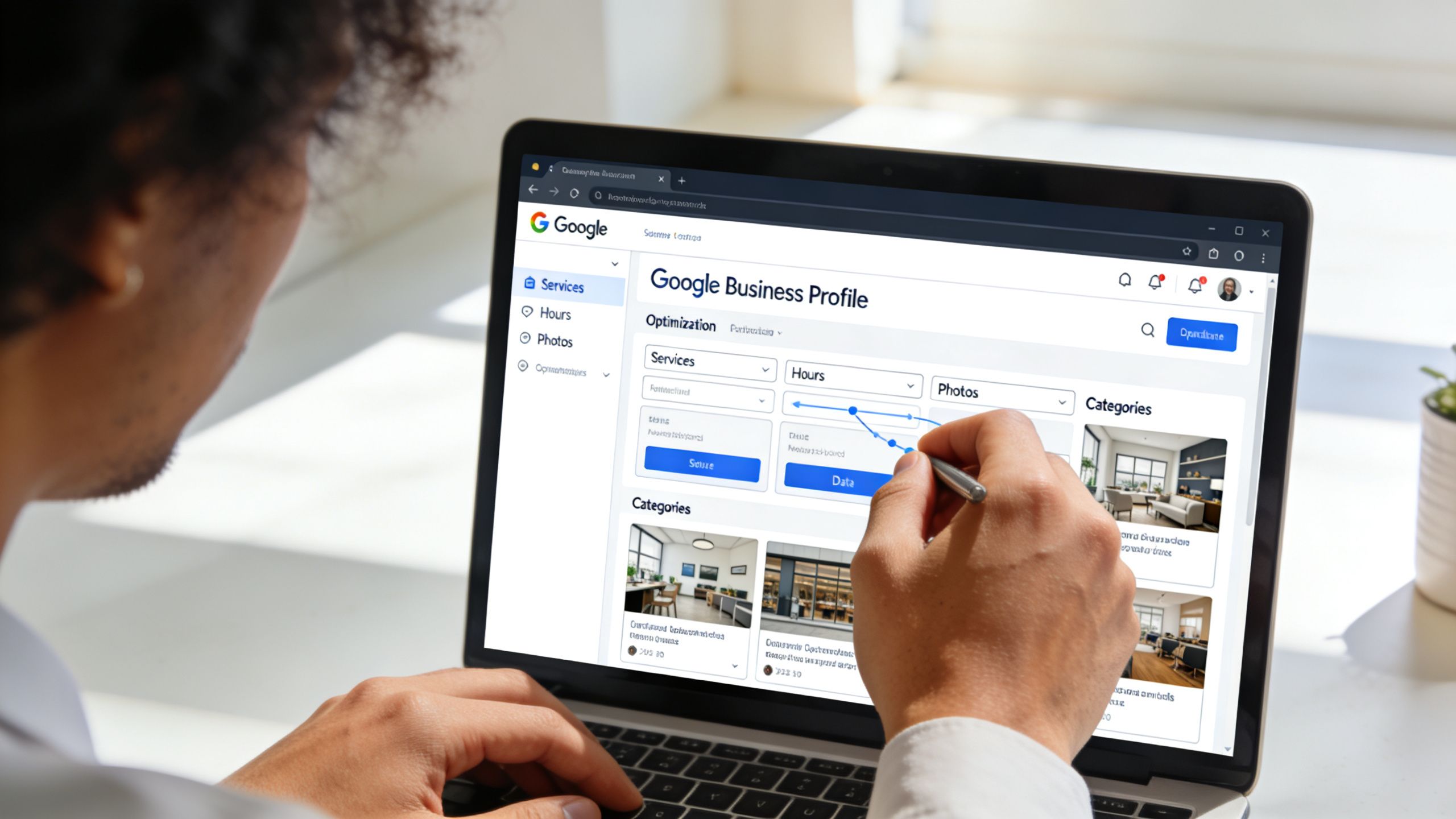
If I'm reviewing a local campaign and the profile is weak, I don't expect the rest of the local SEO setup to perform well. That's especially true in competitive UK markets where several businesses offer nearly the same service in a tight radius.
Get the fundamentals right first
Start with accuracy, not cleverness.
Your primary category matters because it tells Google what you are. Secondary categories help refine that, but they shouldn't dilute the core service. A wedding venue in the Cotswolds might be tempted to add every related category going, but the cleaner approach is to anchor the listing to the main commercial offer and use services, description, photos, and posts to add depth.
Focus on these core fields:
- Primary category: Choose the closest match to the main revenue-driving service.
- Secondary categories: Add only those that reflect real services at that location.
- Business description: Write clearly for customers, not for keyword stuffing.
- Services and products: Add them properly so Google can connect your profile to specific search intent.
- Attributes: Use them where relevant because they shape click decisions before a user even visits your site.
- Opening hours and special hours: Keep them current. Inaccurate hours create friction fast.
If you want a practical walkthrough on the moving parts involved in optimizing your Google Business Profile, that resource is useful as a companion to the hands-on work.
Activity matters because stale profiles look risky
An inactive profile sends the wrong signal to users and to search systems. Fresh photos, updated services, and relevant posts help keep the listing useful.
For a venue, that might mean recent ceremony photos, seasonal availability updates, or answers to common booking questions. For a dentist, it could be treatment updates, team photos, and information about emergency appointments. For a trades business, before-and-after images and job-area updates often do more than a polished stock gallery.
A strong GBP answers the customer's next question before they ask it.
That same logic now extends beyond Maps. As this guide on local SEO and AI search points out, the question isn't whether local SEO still matters. It's how you stay visible as discovery shifts toward AI overviews and answer engines. Structured, accurate GBP data is easier for those systems to reuse.
Here's a useful explainer if you want to see the profile setup process in action:
Turn the profile into a lead asset
A good profile doesn't just exist. It helps qualify and convert.
A practical weekly routine looks like this:
- Check for suggested edits so wrong details don't sit live.
- Review new photos and remove weak or misleading user uploads where appropriate.
- Add one meaningful post tied to a real service, offer, event, or FAQ.
- Answer questions in the Q&A area before misinformation builds up.
- Review service lists and keep them aligned with the website.
For businesses that want a quick benchmark before changing anything, a Google Business Profile audit tool can help identify missing fields and consistency issues.
The trade-off is simple. You can treat GBP as a listing, or you can treat it as a sales surface. The businesses that do the second usually get more from local search.
Find the Keywords Your Local Customers Use
Most local keyword research fails because businesses start with what they call themselves, not what customers type when they need help.
A builder might brand itself as a “property improvement specialist”. The customer searches for “kitchen extension builder Bristol” or “garage conversion company near me”. If your pages don't align with those phrases and the local intent behind them, you'll miss demand that's already there.
Start with three local query types
For local seo for businesses, I group keywords into three buckets.
| Query type | Example | Best page fit |
|---|---|---|
| Near me intent | wedding venue near me | GBP, homepage, core service pages |
| Town or city modified | accountant in Sheffield | location page or main service page |
| Micro-area intent | roofer in Didsbury | dedicated local page if the area matters commercially |
The first bucket matters because users often let Google infer location. The second is the bread and butter of local SEO. The third is where many firms win, especially in dense urban areas where one city page is too broad.
Build a keyword map, not a giant list
A long spreadsheet of terms isn't a strategy. A keyword map is.
Take one service and assign intent to one page only. If you run a home care business covering several towns, don't try to make the homepage rank for every service in every location. Give the homepage a broader role, then map specific combinations to the right supporting pages.
A simple page structure often looks like this:
- Homepage: Brand + broad location + main offer
- Service pages: One core service per page
- Location pages: One target town or local area per page
- Blog or advice content: Questions, comparisons, and local informational searches
This reduces cannibalisation. It also makes internal linking easier because each page has a clear job.
Look for the language customers actually use
Useful inputs include Google autocomplete, the “People also ask” area, your own enquiry forms, sales calls, GBP questions, and Search Console queries. That's where you'll find the wording customers naturally repeat.
For businesses trying to balance classic local intent with newer AI-driven discovery patterns, mastering localized keyword research for AI is worth reading. It helps frame keyword research around retrieval and reuse, not just old-school ranking positions.
If a phrase sounds polished but no customer would ever say it on the phone, it probably doesn't deserve a main page.
One more trade-off matters here. Don't create a page for every slight wording variation. “Solicitor in York”, “York solicitor”, and “law firm York” may deserve the same destination page if core intent is the same. Split pages only when the user need or local angle actually changes.
Good local keyword research feels less like chasing volume and more like matching service, geography, and urgency.
Align Your Website with Local Search Signals
Your website confirms what your Google Business Profile suggests. If your profile says one thing and your site says another, Google gets mixed signals and users lose trust.
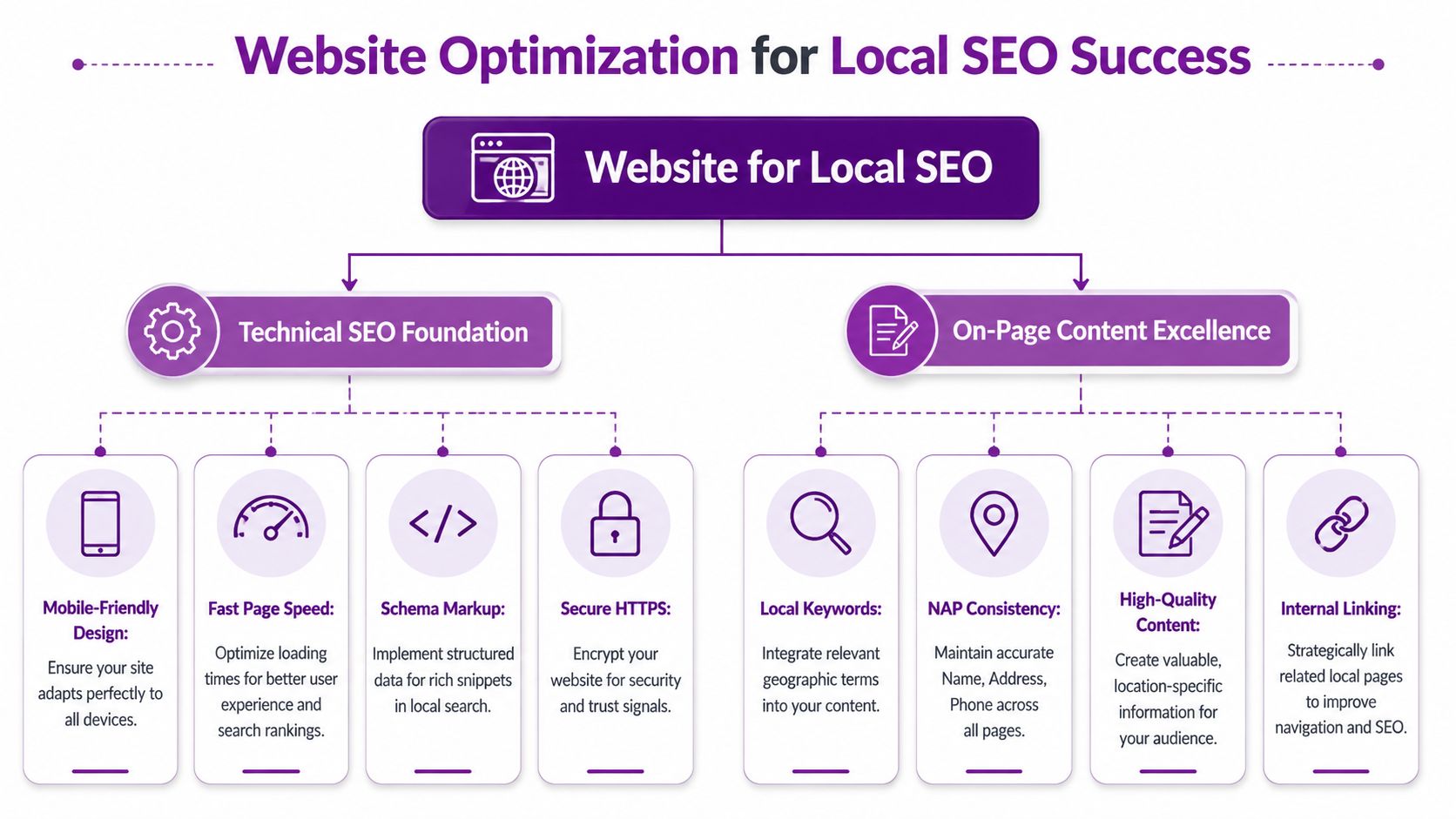
The technical side of local seo for businesses doesn't need to be complicated, but it does need to be tidy. The strongest setups align around three local ranking pillars: proximity, relevance, and prominence. You can't control proximity, but you can do a lot about the other two and make your location signals clearer.
Relevance starts with page intent
If you want a page to rank for a local service, the page has to make that relationship obvious.
That means the right service on the right page, with the right local cues:
- Titles and headings: Include the service and the target area where it fits naturally.
- Body copy: Explain the service in the context of that location, not by stuffing place names.
- Image alt text and captions: Use them sensibly where photos accurately depict the location or local service work.
- Internal links: Connect service pages and location pages so the site structure reinforces your priorities.
A lot of businesses get this half-right. They mention a town in the title tag but leave the page generic. Google can spot that. So can customers.
NAP and schema are the technical backbone
This is the part many firms skip because it isn't glamorous. It's also the part that often separates a decent local setup from a reliable one.
According to Sitebulb's guidance on local ranking signals, businesses with complete GBP profiles are 2.8x more likely to rank in the Local Pack, and NAP consistency across 40+ directories correlates with a 4.1x ranking improvement. The takeaway isn't “submit everywhere and hope”. It's that complete, consistent local data performs better than incomplete, conflicting data.
Your NAP means name, address, and phone number. It should match across:
- Your contact page
- Location pages
- Website footer
- Google Business Profile
- Major citations and directories
Then there's LocalBusiness schema. That's structured data that helps search systems interpret your business type, address, service area, and other key details. It should reflect what's displayed on the page. If the schema says one address and the visible content says another, you've created a trust problem.
Technical check: Schema should confirm on-page reality, not try to override it.
A practical local SEO checklist is useful here because it forces you to verify the details businesses often assume are fine.
What usually goes wrong
The most common local website problems are dull, repetitive, and costly:
| Problem | What it causes |
|---|---|
| Different phone numbers across pages | Trust and consistency issues |
| One generic service page for every location | Weak relevance signals |
| Schema that doesn't match visible content | Technical confusion |
| No internal links between local pages | Poor signal reinforcement |
There's also a UK-specific issue with targeting at the wrong level. Some businesses optimise around postcodes because that's how they think operationally, but customers may search by town, borough, or neighbourhood instead. Your site should reflect how people look for you, not just how your dispatch system is organised.
A strong local website doesn't need to be flashy. It needs to be clear, consistent, and easy for both Google and customers to understand.
Create Compelling Location-Specific Pages
A lot of multi-location businesses are nervous about location pages. Fair enough. Most examples online are thin pages with a town name swapped in five times and nothing useful on them.
That's not a duplicate content strategy. That's a trust problem with a URL.

The page has to earn its place
A location page should answer a local customer's practical questions. If it doesn't, it probably shouldn't exist.
The common fear is, “Won't Google penalise us if we make pages for several towns?” The better question is whether each page offers unique value. As this guide on structuring local pages notes, many guides say to create local pages but don't explain how to make them distinct with local proof points, unique FAQs, and service constraints relevant to the specific town or postcode.
That distinction matters. A page for “funeral director in Chester” should not be a clone of the “funeral director in Ellesmere Port” page. The local concerns, travel patterns, chapel references, and service expectations may differ.
What makes a location page genuinely different
Here's a framework I use when reviewing or planning these pages.
- Local proof: Add testimonials, reviews, or examples tied to that place.
- Service reality: Explain what you do or don't offer in that area.
- Travel detail: Mention route access, parking, nearby landmarks, or service radius.
- Local FAQs: Answer questions people in that area commonly ask.
- Relevant imagery: Use photos that reflect the branch, the team, or local jobs where possible.
For a wedding venue, local relevance can go deeper than “venue in X”. The page might mention nearby churches, registry offices, accommodation options, and travel times from major routes. If you want an example of how local trust and service positioning intersect in that sector, this guide on SEO for wedding venues shows the kind of location-aware content structure that tends to work.
One page, one main intent
Cannibalisation begins when businesses try to squeeze too much into one page.
A cleaner model is:
- One page for one main service in one area.
- Supporting internal links to related services or neighbouring locations.
- Unique calls to action based on how customers in that area tend to enquire.
If you're a service-area business, resist the temptation to create dozens of wafer-thin pages for every village in reach. Start with the areas that matter commercially. Build depth before breadth.
A page doesn't become local because you change the heading. It becomes local when someone in that town reads it and thinks, “Yes, this is for me.”
A quick quality test
Ask these four questions before publishing any location page:
| Question | If the answer is no |
|---|---|
| Would this page help a customer choose us? | It's probably filler |
| Does it include area-specific information? | It's too generic |
| Is the main service intent clear? | It may cannibalise another page |
| Would we keep it live if SEO didn't exist? | It likely lacks real value |
That last one is harsh, but useful. If the page only exists to catch a phrase and offers no meaningful local help, it's the wrong page.
Build Authority with Citations and Local Links
If relevance tells Google what you do, authority helps validate that you're a credible local choice.
Many campaigns go off course: A business gets sold a giant citation package, ends up listed on a pile of low-quality directories, and assumes that volume equals progress. It usually doesn't.
Citations need consistency and relevance
Citations still matter because they reinforce business identity. But the job isn't to appear everywhere. The job is to appear accurately in places that make sense for your sector and geography.
For a UK business, that usually means focusing on:
- Core business directories: The established platforms people and search engines recognise.
- Industry directories: Places tied to your profession or trade.
- Local platforms: Chambers, town guides, local business groups, or trusted regional listings.
The key is consistency. If your address format, phone number, or trading name drifts from platform to platform, you're weakening the same signals you're trying to strengthen.
Links beat mentions when they carry local trust
A local backlink from a relevant organisation usually has more strategic value than a random listing on a generic site nobody visits.
Good local link opportunities often come from actual business activity:
- Sponsoring local events
- Working with venues or suppliers
- Supporting charities or community projects
- Joining regional trade groups
- Earning coverage in local publications
This is why a scattergun approach underperforms. Ten poor links from irrelevant pages don't create much trust. One good link from a respected local association or event partner can support both visibility and credibility.
What works better than mass submission
Think about link building like reputation building. If a local wedding photographer gets links from venues, florists, and regional wedding directories, that profile makes sense. If the same photographer gets dozens of links from unrelated business directories with no local angle, it looks manufactured.
A practical authority routine looks like this:
- Audit existing citations for consistency.
- Fix wrong or duplicate listings first.
- Build out the most relevant missing directories.
- Identify local organisations you already have a relationship with.
- Turn real-world partnerships into online mentions and links.
The trade-off is speed versus quality. Bulk citation work is quick. Useful local authority takes longer, but it supports rankings in a way low-grade submissions rarely do.
Track Performance and Scale for Growth
A lot of local SEO reporting looks tidy and tells you almost nothing. A rank tracker says you're “position 3”, the owner feels reassured, and yet enquiries stay flat. That happens because local visibility is not uniform.
A business can rank well in one part of a city and disappear a few streets away where the best customers are.

Why standard rank tracking misleads local businesses
For local seo for businesses, single-point rankings are often too blunt. They hide variation across neighbourhoods, boroughs, and service areas.
That's why geo-grid measurement matters. As Rankmax's local map pack analysis explains, businesses in the local map pack get 126% more traffic and 93% more calls, website clicks, and direction requests than those below them. The same source also notes that geo-grid heatmaps reveal local “dead zones” that standard trackers miss.
If you cover a city like Manchester or Glasgow, that matters. “Ranking in the city” isn't a reliable business KPI if the profitable postcodes are weak.
What to track instead
Good local reporting focuses on business outcomes and location-specific visibility.
Use a measurement set like this:
- Geo-grid visibility: Where you appear strongly and where you don't.
- GBP actions: Calls, website visits, and direction requests.
- Page-level enquiries: Which location pages generate leads.
- Lead quality by area: Which towns or districts produce the right kind of customer.
- Conversion paths: Whether users call from GBP, submit forms, or move through several pages first.
Weak enquiries with strong rankings usually point to one of two issues. Wrong intent, or weak conversion messaging.
That's why I'd rather see a business understand its dead zones than celebrate an average ranking report. The dead zones tell you where to improve pages, categories, internal links, reviews, or profile relevance.
How to scale across multiple locations
Scaling local SEO doesn't mean cloning one branch page twenty times. It means building a repeatable system.
| Area | Standardise | Keep local |
|---|---|---|
| Technical setup | Schema format, NAP structure, page templates | Branch details, service area specifics |
| GBP process | Posting cadence, review requests, category review | Photos, FAQs, offers, local updates |
| Content production | Page structure and QA process | Testimonials, landmarks, access info, service constraints |
| Reporting | KPI dashboard and review cadence | Geo-grid maps and local lead analysis |
For a multi-location brand, the most useful approach is usually:
- Pick one location and benchmark it properly.
- Improve GBP, website alignment, and location content.
- Measure local visibility with geo-grids.
- Note what changed in rankings, actions, and lead quality.
- Roll the winning process into the next branch with local adjustments.
If you need to tie SEO activity back to commercial outcomes, especially across multiple sites or service areas, a tool like this SEO ROI calculator for self-storage shows the sort of thinking businesses should apply to return, not just rankings. The category is specific, but the measurement principle is useful more broadly.
Scale comes from process discipline. Not from producing more pages faster.
Your Path to Local Market Leadership
The businesses that win local search usually aren't doing one magical thing. They're doing the basics properly, then improving the details competitors ignore.
They keep their Google Business Profile accurate and active. Their website reinforces clear local signals. Their location pages help real customers instead of padding out the sitemap. Their authority comes from credible citations and local relationships. And they measure visibility where customers are, not from one convenient pin on a report.
That's the current shape of local seo for businesses in the UK now. It has to work for Google Maps, for organic search, and increasingly for AI-shaped discovery surfaces that rely on clean business data and reusable content.
Local SEO also rewards patience in a way many channels don't. Once your pages, profile, citations, and internal systems are aligned, the gains tend to compound. Better visibility brings more engagement. Better engagement strengthens trust. Stronger trust improves conversion.
If you run a service business, venue, clinic, trade company, or multi-location brand, this is still one of the clearest routes to sustainable lead generation. Start with the location that matters most. Fix what's inconsistent. Build what's missing. Measure properly. Then repeat.
For businesses exploring a more sector-specific route, this page on SEO for self-storage is one example of how local strategy changes when you match SEO to a particular business model and buying journey.
If you want help turning local visibility into measurable enquiries, Bare Digital works with UK businesses on Google Business Profile optimisation, location page strategy, technical local SEO, and reporting that connects rankings to leads.






