
Ask any small business owner what a good marketing budget is, and you’ll probably get a dozen different answers. The truth is, there's a solid benchmark to start with. For most small businesses in the UK, a sensible marketing budget sits somewhere between 7% and 12% of total revenue.
If you're a startup just getting off the ground or a business in a serious growth spurt, you’ll need to be a bit more aggressive. In those cases, expect to invest closer to 15% to 20% to build that crucial early momentum and start winning market share.
Framing Your First Marketing Budget

Putting together your first marketing budget can feel a bit like guesswork. Many business owners fall into the trap of seeing it as just another cost to keep as low as possible. But that’s a surefire way to stall your growth before you even begin. A well-planned budget isn’t an expense—it’s an investment in your future.
Think of it like this: you wouldn't put just a tenner's worth of petrol in your car and expect to drive from Cambridge to Edinburgh. Your business is no different. It needs enough fuel in the tank to reach its goals, pull in new customers, and make a name for itself.
How Much Should You Spend?
For a UK small or medium-sized enterprise (SME), the simplest and most reliable way to start is the percentage of revenue model. This method ties your marketing spend directly to your company's performance, making sure your budget scales up or down with your income. It keeps things realistic and sustainable.
Industry data backs this up. Gartner’s recent marketing report shows that UK businesses are now spending an average of 7.7% of their total revenue on marketing. With the median turnover for a UK SME sitting at around £295,000, that works out to about £22,715 a year.
This figure lines up perfectly with what we see on the ground. Most marketing experts advise small businesses to set aside 7–12% of their revenue for marketing. For startups hungry for growth, that number often needs to be 15–20% to make a real impact.
A marketing budget should be viewed as an engine for growth, not just a line item on an expense sheet. The goal isn't just to spend, but to invest every pound in activities that generate a measurable return and drive the business forward.
Quick Guide to Setting Your First Marketing Budget
To make it even clearer, here’s a quick table showing how your budget might look depending on your business stage, based on a typical UK SME turnover.
| Business Stage | Recommended Percentage of Revenue | Example Annual Budget (on £295,000 Turnover) |
|---|---|---|
| Startup (0-2 years) | 15-20% | £44,250 – £59,000 |
| Growth (2-5 years) | 10-15% | £29,500 – £44,250 |
| Established (5+ years) | 7-12% | £20,650 – £35,400 |
This table provides a solid starting point, helping you move from uncertainty to a clear, strategic plan for your marketing investment.
Matching Your Budget to Your Business Stage
A one-size-fits-all budget just doesn't work. Where your business is right now will dictate how much you need to invest to get the results you want.
Here’s a simple way to think about it:
- Startup Phase (0-2 years): In the beginning, it's all about getting your name out there and winning your first customers. You need to make some noise. A higher investment of 15-20% of projected revenue is often what it takes to get noticed.
- Growth Phase (2-5 years): You’ve got a steady stream of customers, and now it’s time to scale. Allocating 10-15% of revenue helps you reach new audiences, double down on what’s working, and stay ahead of the competition. This is the perfect time to explore proven small business growth strategies.
- Established Phase (5+ years): For a mature business, the game shifts to maintaining your market share and keeping your existing customers happy. A budget of 7-12% is usually enough to keep the momentum going and protect your position.
By thinking about your budget in this way, you can create a realistic plan that fuels customer acquisition and drives sustainable success for your business.
A marketing budget without clear goals is like setting sail without a map. You're spending money, sure, but you have no real way of knowing if you're getting anywhere or justifying the investment. To turn your budget from a simple list of expenses into a powerful tool for growth, every pound you spend needs to be tied to a specific, measurable business outcome.
This means looking beyond the superficial vanity metrics—things like likes on a social media post or a brief spike in website visitors. While they can feel encouraging, they don't actually tell you if your marketing is helping the business grow. Real success comes from focusing on the numbers that actually impact your bottom line.
From Vague Ideas to SMART Objectives
Instead of a general goal like "get more website traffic," a strategic approach uses the SMART framework. This simple method ensures your objectives are well-defined and actionable, turning wishful thinking into a clear plan.
Your marketing goals need to be:
- Specific: State exactly what you want to achieve. Don't say "more leads"; aim for "increase qualified sales leads."
- Measurable: Define how you'll track progress. This is where Key Performance Indicators (KPIs) come in.
- Achievable: Set realistic targets based on your budget and resources. Aiming for a 500% increase in sales in one month is probably setting yourself up for disappointment.
- Relevant: Make sure the goal directly supports your bigger business objectives, like increasing overall revenue or growing your market share.
- Time-bound: Set a clear deadline. A goal without a timeframe is just a dream.
By applying the SMART framework, a vague idea transforms into a powerful, trackable objective like: "Increase qualified leads from organic search by 20% within the next six months." This statement is precise, measurable, and directly connects your marketing activity to a real commercial outcome.
Focusing on KPIs That Matter
Once you have your SMART objectives locked in, you need the right Key Performance Indicators (KPIs) to track your progress. These are the numbers that reveal the true health of your marketing and prove its value.
For any small business, there are three KPIs that are absolutely essential:
- Customer Acquisition Cost (CAC): This tells you exactly how much you're spending, on average, to win a new customer. To figure it out, just divide your total marketing spend over a certain period by the number of new customers you gained in that same period. A lower CAC means your marketing is getting more efficient.
- Return on Investment (ROI): This is the ultimate measure of profitability. It answers the simple but crucial question: "For every pound we put into marketing, how many pounds did we get back in profit?" When you're connecting your marketing budget to business goals, it’s essential to understand and apply these proven strategies to improve marketing ROI.
- Lead Conversion Rate: This KPI tracks the percentage of leads who take the action you want them to, whether that’s making a purchase or booking a consultation. It shows you how effective your marketing is at turning initial interest into actual business.
By linking every part of your marketing budget to these concrete goals and KPIs, you create a system of accountability. It stops being about "spending" and starts being about investing in predictable growth. This data-driven approach not only helps you make smarter decisions but also clearly demonstrates the value of your marketing to the entire business.
Building Your Marketing Budget From Scratch
Creating a marketing budget doesn't have to feel like guesswork. It’s not about pulling a number out of thin air; it’s about building a clear financial plan that actually supports your growth. You can boil it down to four simple actions: figure out your total spend, research what things really cost, allocate the money smartly, and set up a system to track what’s working.
Think of it this way: a good budget ensures every pound you spend has a purpose. It's an investment, not just an expense, with each part working towards a specific goal that moves your business forward.
Let’s walk through how to build that solid foundation.
Calculating and Researching Your Costs
Before you start deciding where to put your money, you need to know two things: how big your pot is and what the services you need actually cost in the real world.
First, set your total marketing budget using the percentage of revenue model we talked about earlier. For example, if your business turns over £200,000 and you've earmarked 10% for marketing, you have an annual budget of £20,000. That breaks down to about £1,667 per month to play with.
Once you have that number, it's time for a reality check. Many small businesses get a shock when they see the price tags for professional services. It's crucial to research what things cost so you can set a realistic budget. For instance, understanding the typical SEO costs for a small business or the going rate for a pay-per-click (PPC) campaign in your industry is essential if you want to see actual results.
This simple flowchart shows how a budget is the starting point, connecting your investment to tangible goals you can track.
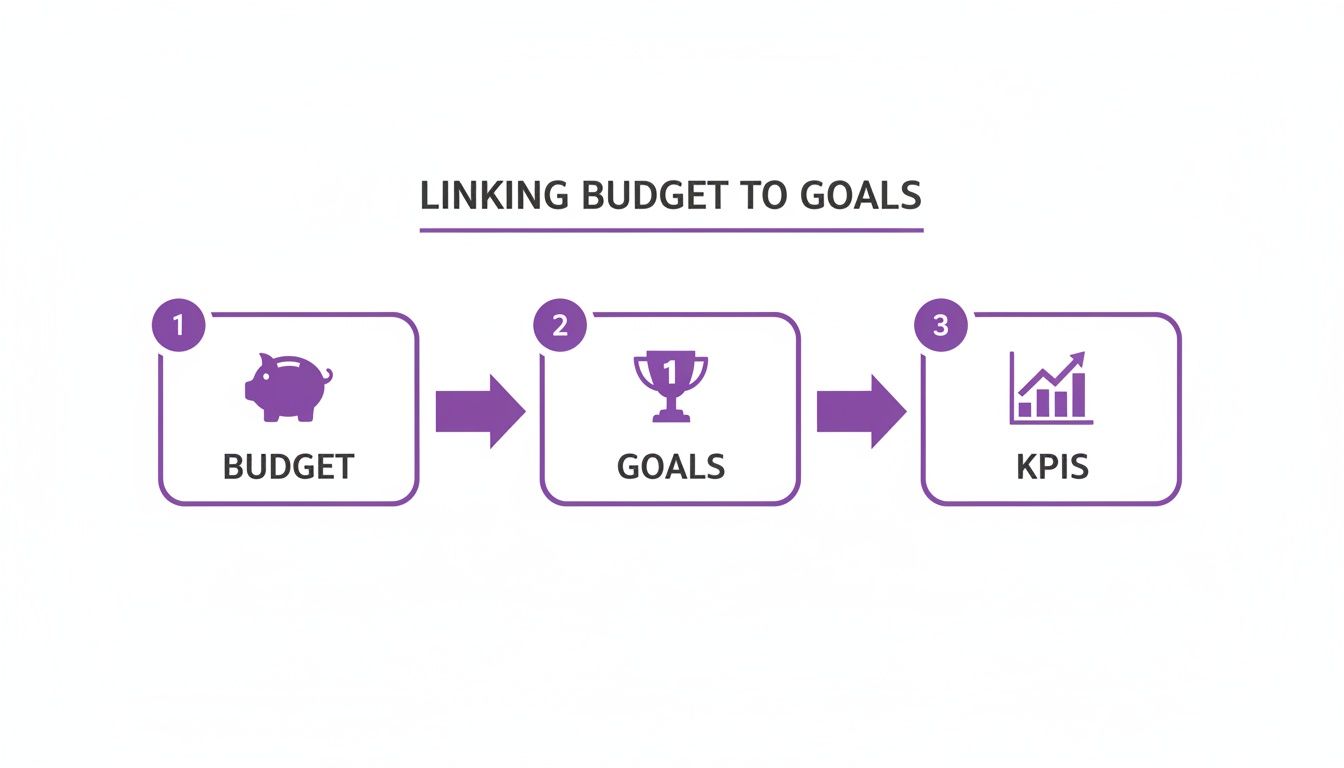
As you can see, the budget isn't the finish line; it’s the fuel that powers your journey towards measurable outcomes.
Allocating Your Funds Strategically
With a total figure in mind and a grasp on market rates, you can now start carving up the pie. One of the most effective ways for a small business to do this is with the 70/20/10 rule. It’s a beautifully balanced approach that protects your core marketing while still leaving room to innovate and find new growth channels.
Here’s the breakdown:
-
70% on Proven Channels: The bulk of your budget goes here, on the marketing activities that are already bringing in the goods. This might be your SEO, content marketing, or a specific social media platform that consistently delivers leads. These are your bread-and-butter strategies, the reliable workhorses.
-
20% on Emerging Opportunities: This slice is for channels that are showing promise but aren't quite proven winners yet. Maybe you've had a bit of success with email marketing or a new social channel is starting to gain traction. This 20% lets you invest more to see if you can scale it into a core part of your strategy.
-
10% on Experiments: And finally, the fun part. This last bit is for pure experimentation. It’s your budget for testing out new ideas, dabbling in different platforms, or trying a wild creative campaign without risking your main marketing spend. If it fails, the loss is small. But if it succeeds, you might have just found your next big thing.
To give you a clearer picture, here’s how a small UK business might allocate a monthly budget using this rule.
Sample Monthly Marketing Budget Allocation (£1,500)
This table shows a practical example of how the 70/20/10 rule could be applied to a £1,500 monthly marketing budget for a UK-based SME.
| Category (70/20/10 Rule) | Marketing Channel/Activity | Allocated Budget (£) | Purpose |
|---|---|---|---|
| 70% – Proven | SEO & Content Marketing | £750 | Drive consistent organic traffic and build authority. |
| 70% – Proven | Google Ads (Brand/Core Service) | £300 | Capture high-intent leads from proven search terms. |
| 20% – Emerging | LinkedIn Ads | £300 | Scale up a promising B2B channel showing early results. |
| 10% – Experimental | TikTok Content Creation | £150 | Test a new platform to reach a different audience. |
This kind of structured allocation ensures your budget is balanced, protecting your current revenue streams while simultaneously exploring future ones.
Comparing Budgeting Methods
While the 70/20/10 rule is brilliant for steady, balanced growth, there's another popular method worth mentioning: objective-based budgeting.
With this approach, you start with the end in mind. You define a clear goal (like "generate 50 qualified leads per month") and then work backwards to calculate the marketing investment needed to hit that target.
For a UK small business, the biggest advantage here is the direct link to results—you’re spending precisely what’s needed to achieve a specific outcome. The catch? It’s tough for new businesses without historical data to accurately forecast those costs. You could easily end up with a budget that’s way too high or far too low.
For most SMEs, starting with a framework like the 70/20/10 rule provides a more stable and predictable foundation to build upon.
Allocating Funds for Maximum Impact
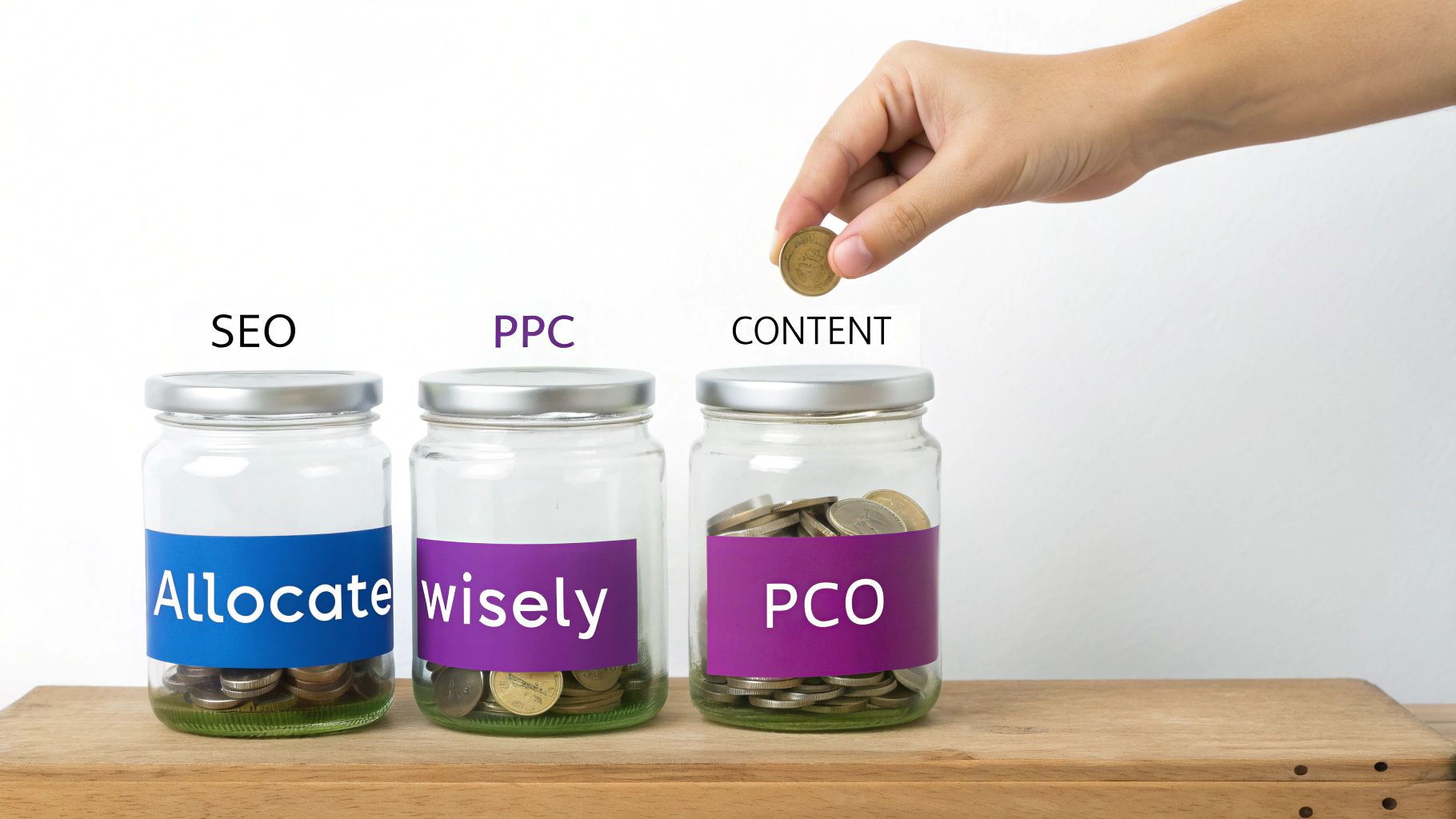
So, you’ve landed on a total figure for your marketing budget. Great. The next, and arguably more important, question is where exactly to spend it. A classic mistake is to spread your funds too thinly across every channel under the sun, which just ends up diluting your impact.
The real goal is to be surgical. You want to make focused, strategic investments in the handful of areas that will actually move the needle for your business.
This means getting to grips with the most effective digital channels for UK SMEs and picking a mix that lines up with your goals. For some, dominating the local scene is everything; for others, it's all about driving immediate sales. Making the right choices here is what turns your budget from a line item expense into a genuine growth engine.
Core Digital Marketing Channels for UK SMEs
Before you can slice up the pie, you need to know what your options are. Each of the main digital channels plays a different role, comes with its own costs, and suits different types of businesses.
- Search Engine Optimisation (SEO): Think of SEO as the long game. It’s all about improving your website’s visibility in search results organically. You’re earning traffic, not paying for every click, which builds a sustainable asset over time.
- Pay-Per-Click (PPC) Advertising: This is the opposite of SEO – it’s built for speed. You pay for ads to show up at the top of Google or on social media, driving immediate traffic from people who are actively looking for what you sell.
- Content Marketing: This is about creating genuinely useful and relevant stuff—blog posts, guides, videos—to attract and hold the attention of your ideal customers. It builds trust and authority, and it’s the fuel for a great SEO strategy.
- Email Marketing: This is your direct line to people who’ve already shown an interest in your business. It's incredibly effective for nurturing leads and encouraging repeat business, often delivering one of the best returns on your investment.
These four pillars form the foundation of most solid digital strategies. The trick is knowing which ones to lean on most heavily based on your business model and what you're trying to achieve.
Matching Channels to Your Business Type
Here's the thing: not all channels work equally well for every business. Your spending should reflect your unique needs. A local plumber in Cambridge has entirely different priorities than a national e-commerce brand, and their marketing spend should show it.
For instance, that Cambridge plumber will get the best bang for their buck by investing heavily in local SEO. The aim is simple: when someone frantically searches "emergency plumber near me," they need to be the first name that pops up. That investment leads directly to phone calls and jobs.
On the other hand, a new online clothing brand needs to shift stock and get cash flowing. For them, a bigger chunk of the budget should go towards PPC advertising on platforms like Google Shopping and Instagram. This gets their products right in front of people ready to buy, driving immediate revenue while their organic presence has time to grow.
The most effective marketing budget for a small business isn't about being on every platform; it’s about dominating the few that matter most to your target customers. Strategic focus always outperforms a scattered approach.
Typical Costs and Strategic Roles
Knowing the typical investment each channel requires helps you build a realistic budget.
| Channel | Strategic Role | Typical Monthly UK Cost |
|---|---|---|
| SEO | Builds long-term organic traffic and authority. | £500 – £2,000+ for SMEs |
| PPC | Generates immediate, targeted traffic and leads. | £300 – £1,500+ (ad spend) |
| Content Marketing | Establishes expertise and supports SEO. | £400 – £1,200+ |
| Email Marketing | Nurtures leads and drives repeat business. | £20 – £150+ (software) |
These numbers are just a guide, of course, but they show that you need to invest properly to see real results. For startups, getting the balance right between long-term brand building and short-term sales is crucial, and our guide on marketing strategies for startups digs deeper into this. To get your allocation spot-on, exploring these marketing budget allocation best practices can also offer some really practical ideas.
Making Your Budget a Living Document
A marketing budget should never be a document you create in January and then file away until next year. The best ones aren’t static spreadsheets; they’re living, breathing plans that adapt to what’s happening on the ground.
Treating your budget this way is what turns marketing from a hopeful expense into a predictable engine for growth.
It all comes down to committing to regular reviews. By digging into your performance data monthly or quarterly, you get the clarity needed to make smart, informed decisions. This isn't about finding fault; it’s about spotting what’s working and cutting what isn't before it drains your resources.
You quickly learn what's delivering a strong return on investment (ROI) and what's failing to gain traction. This lets you stop throwing good money after bad and instead double down on the channels that are actually bringing in business.
The Art of Intelligent Reallocation
Imagine your small business is spending £400 a month on paid social media ads, but the data shows they’re generating very few qualified leads. At the same time, your investment in Search Engine Optimisation (SEO) is consistently bringing in high-quality enquiries from customers actively looking for you.
A static budget would force you to keep pouring money into the underperforming channel. A living budget, however, empowers you to act. You can intelligently shift that £400 away from the ineffective ads and reinvest it into your proven SEO strategy, amplifying what already works.
This kind of agility is what separates businesses that just survive from those that truly thrive. It’s a proactive approach that ensures every pound in your marketing budget for a small business is working as hard as it possibly can.
Responding to Market Shifts and Economic Pressures
When times get lean, the knee-jerk reaction is often to make sweeping cuts across the marketing budget. While this seems prudent on the surface, it’s usually a mistake. Slashing spend on effective, long-term channels like SEO can do more harm than good, creating a growth vacuum that's incredibly difficult to recover from later.
Savvy businesses take a different approach. They don’t just cut; they reallocate with even greater focus. Analysis of UK marketing budget trends confirms this shift. Despite economic pressures, a net balance of UK companies recently increased their marketing spend, moving funds away from traditional media and towards data-backed strategies. You can explore more insights about UK marketing spend trends on sopro.io.
During uncertain times, the goal isn’t to stop spending, but to spend smarter. This means protecting and even increasing your investment in resilient, high-ROI activities that provide measurable, long-term value, such as customer relationship management and brand building.
Your review process should clearly identify these core channels. By reallocating funds towards them, you not only weather the storm but can emerge in a much stronger competitive position.
Setting a Review Cadence
To make this all work, you need a consistent schedule. A structured review cadence ensures you have enough data to make meaningful decisions without letting underperforming activities run for too long.
Here’s a simple but effective framework to follow:
- Monthly Check-in (Light Touch): A quick review of your key performance indicators (KPIs). Are you on track with your goals? Make a note of any major red flags or standout successes.
- Quarterly Review (Deep Dive): This is where you make the big decisions. Get granular and analyse the performance of each channel against what you’ve spent.
- Annual Overhaul (Strategic Planning): Use the insights gathered over the entire year to build your new budget from the ground up, setting fresh goals for the year ahead.
This disciplined approach transforms your budget from a rigid constraint into a dynamic tool for navigating the path to sustainable growth.
Your Cambridgeshire Advantage with a Local Expert
All the strategies we've touched on so far—from setting percentages to allocating funds—give you a solid foundation for any marketing budget for a small business. But let's be honest, national averages will only get you so far.
To make a modest budget truly punch above its weight, you need to apply it with local intelligence. This is especially true in a market as unique and competitive as Cambridgeshire.
Operating here means navigating a real mix of communities, from the buzzing tech and student hubs in Cambridge city to the industrial heart of Peterborough. Your ideal customer in St Neots has completely different search habits and needs than one in Ely. A generic, one-size-fits-all approach just gets lost in the noise.
Making Every Pound Count with Local Focus
For a Cambridgeshire SME, the secret to outperforming bigger competitors isn't about outspending them. It's about outsmarting them with a razor-sharp local strategy. This is where a deep, hands-on understanding of the regional market becomes your most powerful asset, turning a limited budget into a precision tool.
Instead of spreading your funds thinly across broad, hopeful campaigns, a localised approach concentrates your investment right where it delivers the most impact. This means zeroing in on things like:
- Local Search Engine Optimisation (SEO): Making sure your business pops up at the top of Google when a local customer is searching for exactly what you offer.
- Targeted Social Media Advertising: Reaching potential customers within specific Cambridgeshire postcodes with offers that actually matter to them.
- Community Engagement: Building a genuine reputation within the towns and villages you serve, becoming the go-to name.
This hyperlocal focus ensures your marketing spend isn't wasted on an audience that will never walk through your door or visit your website.
Partnering with a Local SEO Specialist
This is where Bare Digital fits in. We're not just another agency looking at spreadsheets from afar; we are your local partners, based right here and deeply plugged into the Cambridgeshire market. We know what it takes to get a local business noticed, whether that’s ranking on Google Maps or creating content that genuinely connects with the community.
By partnering with an expert who understands the local digital landscape, you transform your marketing budget from a simple expense into a strategic investment in local visibility and customer acquisition. It’s about ensuring every pound is spent connecting you with customers right on your doorstep.
We provide transparent, cost-effective monthly contracts designed specifically for the needs of SMEs. We believe in showing you exactly where your investment is going and the results it’s generating through clear, no-fluff reporting. Our approach to SEO in Cambridge and the wider county is built on delivering measurable outcomes, from higher search rankings to a real-world increase in direct customer enquiries and footfall.
Got Questions? We’ve Got Answers
Navigating marketing finance for the first time? It’s completely normal to have questions. To help you plan your investment with confidence, we’ve tackled some of the most common queries we hear from small business owners right here in the UK.
Think of this as a quick-fire round to address those nagging concerns and get you moving forward with a solid financial strategy.
What’s a Realistic Minimum Marketing Budget for a New Business?
For a brand-new UK business turning over less than £100,000, a realistic starting point to get any meaningful traction is usually between £500 and £1,000 per month.
Anything less, and you risk diluting your efforts so much that you won't see a noticeable return. This amount is enough to fund foundational activities like a focused local SEO campaign or a small, targeted paid social media push – just enough to start making some noise in today's crowded digital spaces.
How Often Should I Review My Marketing Budget?
The best practice is to sit down for a formal, in-depth budget review quarterly. This gives your strategies enough time to bed in and produce useful performance data, but it’s still frequent enough to let you pivot away from anything that’s clearly not working.
While the big review happens every quarter, you should be keeping an eye on your key performance metrics at least monthly. This allows you to spot any major problems or brilliant opportunities that might need immediate attention, keeping you agile and responsive.
Should I Hire an Agency or Do It Myself on a Small Budget?
This is a classic dilemma, and it really comes down to your in-house expertise and, just as importantly, your time. Going the DIY route might seem cheaper on paper, but effective marketing demands a massive time commitment and a high level of specialist skill.
For many businesses on a smaller budget, bringing in a specialist agency often delivers a far better return on investment.
An agency gives you instant access to expert knowledge, proven processes, and professional tools that can be incredibly expensive to buy on your own. A flexible monthly contract can provide all that expertise without the long-term financial commitment of hiring a full-time employee.
Should My Marketing Budget Include Salaries?
For clarity and accurate performance tracking, it’s much better to keep them separate.
Your marketing budget should cover the direct operational costs of your campaigns and activities. Think of things like:
- Ad spend on platforms like Google or Facebook.
- Fees for agencies or freelance specialists.
- Subscriptions for marketing software and tools.
Salaries for your in-house marketing team are typically classed as a separate human resources or capital cost. Keeping them apart allows you to properly measure the ROI of your campaigns because you’re comparing the direct investment against the returns it generates.
Ready to make your marketing budget work harder for your Cambridgeshire business? At Bare Digital, we specialise in creating cost-effective SEO strategies that deliver measurable results. Get your free, no-obligation SEO Health Check today and discover how local expertise can drive real growth.