
Getting started with online marketing can feel like you're standing at the foot of a mountain without a trail map. This guide is your trail map. We're going to cut through the noise and build a clear, practical strategy for marketing your online business, focusing on the methods that actually deliver results and real, measurable growth.
Your Starting Point in Marketing for Online Businesses
Think of your business as a brilliant new shop, and your potential customers are out there wandering the high street. Your marketing job is simply to build clear, inviting roads that lead them straight to your front door. These roads are your marketing channels—the different pathways you use to connect with your audience.
For any new business, knowing which roads to build first is absolutely critical. Spreading your budget and energy too thin is one of the most common mistakes, leading to burnout and wasted cash. A focused approach almost always wins. A good guide on how to start an online business can help you lay the foundational groundwork for your entire operation, setting you up for success from day one.
Your marketing should actively work for you and bring you results. Regularly. It’s not about going on marketing sprees, getting overwhelmed, disappearing, and doing it again. You must be both strategic and realistic when you market your business online.
To get this right, you need to get your head around two core ideas:
- Marketing Channels: These are the specific platforms you use to reach people, like Google search (SEO), social media, or paid ads (PPC).
- The Customer Journey: This is the path a person takes from the first time they hear about your brand to the moment they become a happy, paying customer.
Choosing Your Initial Channels
For most new online businesses, just a handful of channels will give you the biggest bang for your buck early on. Let's look at the main contenders. Search Engine Optimisation (SEO) is the art of getting your website seen in Google's search results, grabbing the attention of customers who are actively looking for what you sell. Social media is where you build a community and talk directly with your audience. Pay-Per-Click (PPC) advertising is like renting a massive, flashing billboard on a digital motorway, driving instant traffic to your site.
To help you prioritise, here's a quick look at the main digital marketing channels, what they're for, and the kind of businesses they suit best.
Digital Marketing Channels at a Glance
| Marketing Channel | Primary Goal | Best For… |
|---|---|---|
| Search Engine Optimisation (SEO) | Earning long-term visibility in search results and attracting organic traffic. | Businesses whose customers actively search for solutions, products, or services online. |
| Social Media Marketing | Building a brand community, engaging with customers, and driving top-of-funnel awareness. | Brands with a visual product or a strong personality that can build a loyal following. |
| Pay-Per-Click (PPC) Advertising | Generating immediate, targeted traffic and leads for specific offers or keywords. | Businesses needing quick results, testing new offers, or targeting high-intent customers. |
| Email Marketing | Nurturing leads, retaining customers, and driving repeat purchases through direct communication. | All online businesses, especially e-commerce and service providers, to build relationships. |
This table should give you a clearer picture of where to focus your initial efforts and budget. Getting these foundational strategies right from the very beginning is what we do day in, day out at Bare Digital.
Mapping Your Customer's Journey from Stranger to Buyer
Effective online marketing isn't about just shouting into the digital void and hoping for the best. It’s about understanding the specific path people take from being a complete stranger to becoming a loyal customer. This path is what we call the customer journey.
Think of it as a roadmap that tracks every single touchpoint, from the moment someone first hears about you to the day they decide to buy. Getting your head around this process is the key to delivering the right message, at just the right time, making the sale feel like a natural next step for them.
The whole thing can be boiled down to a simple, three-stage funnel. By matching your marketing efforts to where a person is in that funnel, you build trust, prove your value, and gently guide them towards a decision.
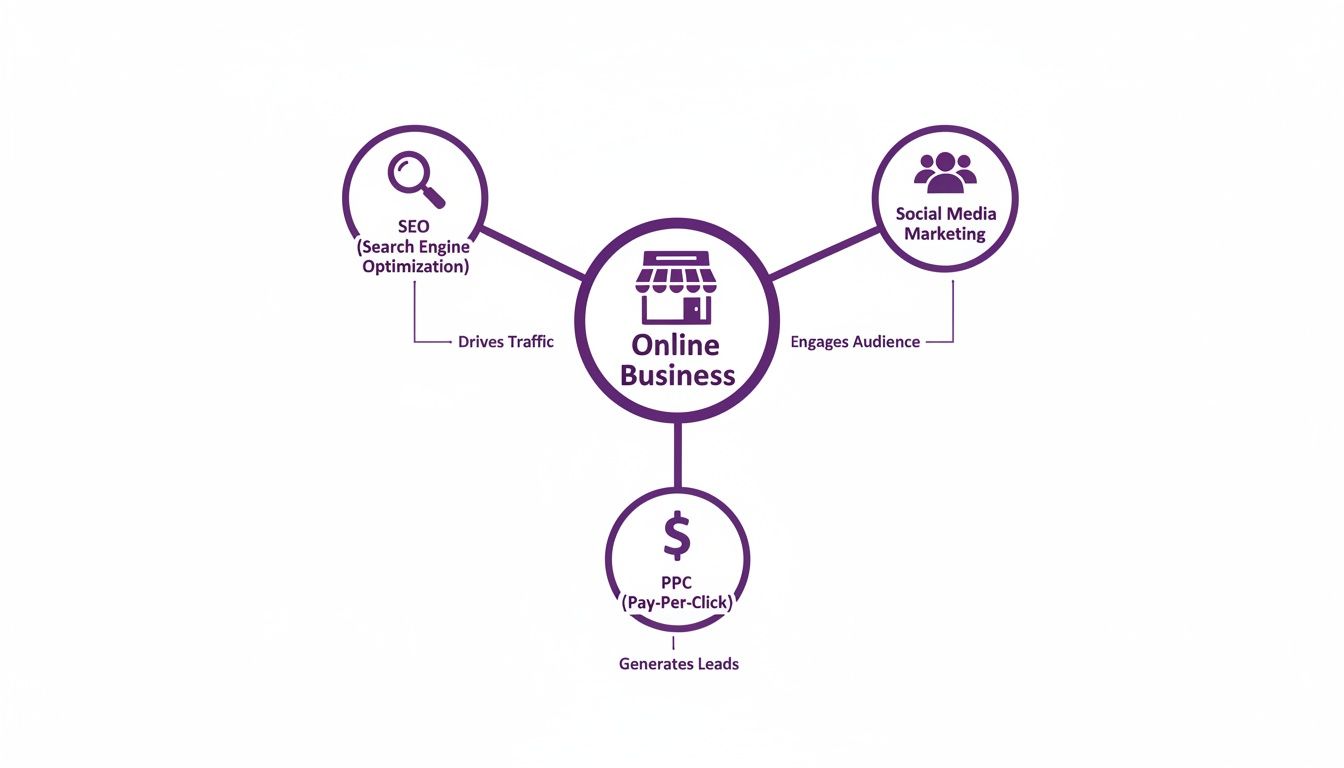
This mind map shows how your main marketing channels—like SEO, social media, and PPC—aren't just separate tactics. They’re all interconnected roads that lead potential customers right to your doorstep.
The Three Core Stages of the Customer Journey
Let's break the journey down into its three essential parts. Each one answers a different question brewing in your customer's mind.
1. The Awareness Stage
This is where you meet the "stranger". At this point, people have a problem they need to solve or a desire they want to fulfil, but they probably have no idea your business even exists. Your only job here is to get on their radar in a genuinely helpful way.
- Customer's Question: "I have a problem or a need. How do I fix it?"
- Your Goal: Introduce your brand as a credible solution and start building a flicker of brand recognition.
- Example Channels: A newly engaged person searching "wedding venues near Cambridge" on Google (SEO), a homeowner scrolling through Instagram and seeing a sponsored post from a local interior designer (Social Media), or someone in a panic clicking a search ad for an "emergency plumber" (PPC).
Great marketing here isn’t about going for the hard sell. It’s about making sure you’re a visible, trustworthy resource right when someone first realises they need help.
2. The Consideration Stage
Once someone knows you exist, along with a handful of your competitors, they move into the research phase. They’re now actively comparing their options, digging into reviews, and trying to figure out who offers the best fit for their specific needs. Your goal is to build trust and show them exactly why you’re the best choice.
- Customer's Question: "Okay, out of these options, which one is actually right for me?"
- Your Goal: Showcase your expertise, build trust, and clearly differentiate yourself from the competition.
- Example Activities: Someone reading through the detailed customer reviews on your Google Business Profile, comparing service features on your website, or downloading a free guide that proves you know your stuff. A recent study found that 56% of consumers simply don't trust a business without a website, which shows just how vital a professional online presence is at this stage.
3. The Conversion Stage
This is the final hurdle, where a curious prospect is ready to become a paying customer. They've done their homework and are poised to make a decision. Your job is to make the buying or booking process as smooth and simple as humanly possible.
- Customer's Question: "How do I buy this thing or book this service?"
- Your Goal: Secure the sale and deliver a seamless, positive transaction from start to finish.
- Example Activities: A customer moving through the checkout process on your e-commerce site, filling out a contact form to request a consultation, or calling you to book an appointment. Any friction here—like a confusing form or a painfully slow-loading page—can make you lose a sale you worked so hard to win.
By mapping these three stages for your own business, you can stop guessing and start building a cohesive strategy that guides people all the way from their first search to their final click.
Right, you’ve got a map of how your customers think and act. The next step is to start building the actual roads they’ll travel to find you.
One of the most common mistakes I see online businesses make is trying to be everywhere at once. They stretch their budget thin across a dozen platforms, burn themselves out, and end up with a mishmash of inconsistent efforts that never gain any real traction.
The smarter way? Pick a few core channels and completely master them. It's not about shouting from every rooftop; it's about having meaningful conversations in the places your customers actually hang out.
Inbound vs Outbound Marketing
First things first, you need to decide on your direction. Are you going to pull customers towards you, or are you going to push your message out to them?
Inbound Marketing (Pull): This is all about creating valuable, helpful content that attracts people who are already looking for what you do. Think of it as setting up a brilliant shop on a busy high street. People are already there, browsing, and your job is to draw them in. SEO and content marketing are classic examples.
Outbound Marketing (Push): This is a more direct approach. You’re proactively reaching out to find potential customers and tell them about your business. It’s like sending a representative out into the town square to start conversations. Paid ads on Google or social media fall squarely into this camp.
A truly strong strategy uses a bit of both. You can use outbound tactics to get faster results from your long-term inbound efforts. For instance, running a targeted ad campaign to promote a genuinely helpful blog post uses a 'push' to get more eyes on your 'pull' asset.
Selecting Your Primary Channels
Okay, let's get specific. Which channels should you actually be focusing on? The right answer depends entirely on your business, your audience, and, of course, your budget.
1. Search Engine Optimisation (SEO)
SEO is the art and science of getting your website to rank at the top of search engines like Google for the phrases your customers are typing in. It’s the ultimate inbound strategy because it connects you with people at the exact moment they’re looking for a solution. For any business serious about long-term, sustainable growth, SEO is foundational. And for those targeting a specific area, a laser-focused approach like local SEO services in Cambridge becomes an absolute non-negotiable.
2. Pay-Per-Click (PPC) Advertising
PPC lets you jump the queue. You can place ads right at the top of the search results or in social media feeds, and you only pay when someone actually clicks. It’s like renting a prime billboard on a digital motorway to capture immediate traffic. It's the perfect tool for generating leads quickly, testing new offers, and reaching very specific audiences with pinpoint precision.
3. Social Media Marketing
This is less about the hard sell and more about building a community. Social media is where you show off your brand’s personality, talk directly with your audience, and build the kind of trust that moves people into the 'Consideration' phase of their journey. Not every platform is a good fit. A B2B consultant will find their tribe on LinkedIn, while a visual brand like a boutique clothing store will feel right at home on Instagram. As businesses choose their channels, using tools for AI UGC can be a game-changer for creating compelling content and ads at scale.
The best marketing strategy is the one you will actually commit to. Quality, consistency, and a clear plan will always outperform sporadic, half-hearted efforts across a dozen platforms.
4. Email Marketing
Often overlooked as old-fashioned, email is one of the most powerful and profitable channels you have. Why? Because you own the list. Unlike with social media, you’re not fighting against an algorithm to reach your own audience. It’s the perfect channel for nurturing leads, retaining customers, and driving repeat business. It's no surprise that as marketing budgets tighten, savvy businesses are reinvesting in owned channels like email for its incredible return on investment.
Start by choosing just one or two channels that align perfectly with your customer journey map and your business goals. Master them, measure everything, and only then think about expanding. This focused, deliberate approach is the most efficient way to build a marketing machine that delivers real, measurable growth for your online business.
Winning Locally with Essential UK SEO Strategies
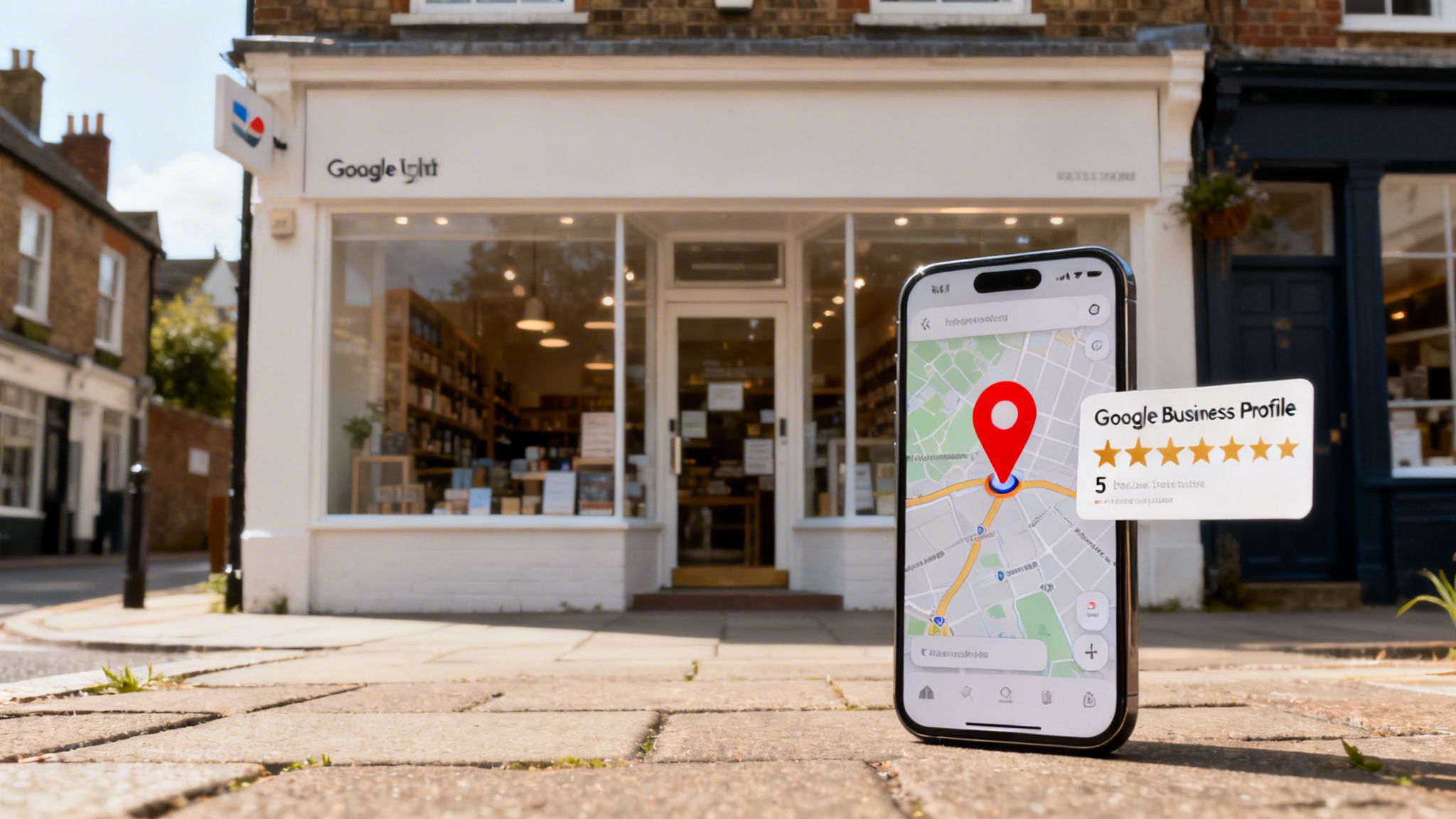
For most UK businesses, the first and most important battle is won on home turf. Even if you operate entirely online, showing up when nearby customers start searching is a huge advantage. This is where local Search Engine Optimisation (SEO) comes into play, and frankly, it’s a non-negotiable part of modern marketing.
Think of it like this: local SEO makes sure you’re the first name that pops up on Google Maps when someone searches for "best caterer near me" or the top result for "solicitors in Manchester". If you have a physical location or serve a specific area, this isn't some optional extra. It’s absolutely critical.
Getting local search right isn't about some secret, complex formula. It really boils down to three core areas. Get these right, and you’ll build a defensive wall around your local market that competitors will find incredibly difficult to breach.
Master Your Digital Storefront
Your Google Business Profile (GBP), which used to be called Google My Business, is the single most powerful tool you have for local SEO. It's your digital shopfront, your online business card, and your review hub all in one. Neglecting it is like boarding up the front window of a high-street shop.
Getting it optimised is straightforward, but it demands a little attention to detail. This is your chance to hand-feed Google all the vital information it needs to trust your business and recommend you to local searchers.
Here’s where to put your focus first:
- Complete Every Single Section: Don't skip a thing. Fill out your services, opening hours, business description, and accessibility info with care. The more complete the profile, the more Google trusts it.
- Choose the Right Categories: Be specific. If you're an "Interior Designer," choose that, not a generic "Designer". Add secondary categories that accurately show your specialisms.
- Upload High-Quality Photos: Show off your work, your team, and your premises. Regularly adding new, high-quality images tells Google your business is active and up to date.
A well-managed Google Business Profile is more than just a listing; it's a dynamic, interactive platform that directly influences customer decisions. Data shows that businesses with complete and accurate profiles are perceived as more reputable.
Create Powerful On-Page Signals
Your website needs to scream "local" to the search engines. It’s not enough to just pop your town name in the footer; you need to weave your location into the very fabric of your site. This process, known as on-page SEO, helps Google connect the dots between what you do and where you do it.
Imagine a plumber in Bristol. Their website should have a dedicated page for "Boiler Repair in Bristol", another for "Emergency Plumbing in Clifton", and so on. These location-specific pages are incredibly effective at capturing highly motivated local customers who are ready to book a job. Each page should talk about the services offered in that specific area, creating a powerful geographical signal.
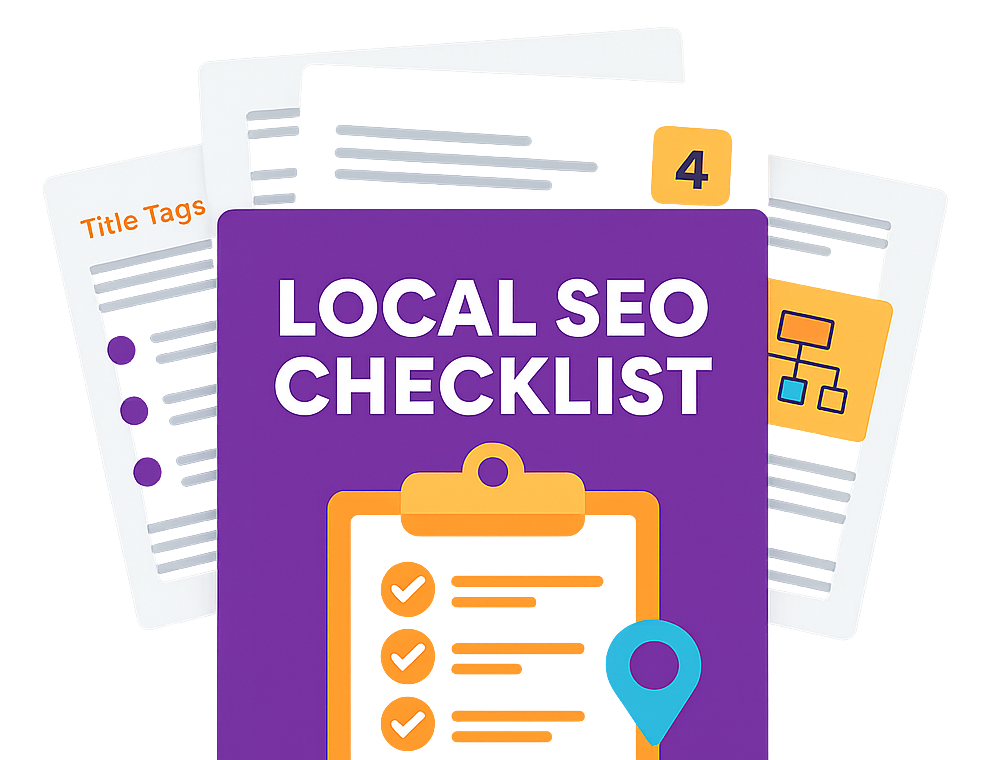
On top of this, make sure your business name, address, and phone number (your NAP) are identical across your entire website. This consistency is a massive trust signal for search engines. To get this perfectly aligned, our comprehensive local SEO checklist offers a step-by-step guide to get everything right.
Build Local Authority with Backlinks
The final piece of the puzzle is earning local "votes of confidence". In the world of SEO, these votes come in the form of backlinks—links from other websites pointing to yours. When another local business, a regional news outlet, or a community group links to your site, it’s telling Google that you’re a legitimate, respected part of the local business community.
Think of it like getting a personal recommendation from a well-known person in your town. The more reputable the source, the more weight that recommendation carries.
Here are a few ways to earn valuable local backlinks:
- Sponsor a local charity event or a kids' sports team.
- Join your local Chamber of Commerce, which almost always includes a link in its member directory.
- Team up with other non-competing local businesses on a joint promotion.
By mastering these three areas—your Google profile, your website's local signals, and your local backlink profile—you lay a rock-solid foundation for dominating your local market.
Budgeting and Prioritising Your Marketing Spend
Trying to market your business without a budget is like setting off on a road trip with no fuel gauge and an out-of-date map—you’re just guessing, and you'll run out of steam fast. Forget complex theories; what you need is a practical way to spend your money that actually gets results.
It all boils down to one core principle: start small, measure everything, and double down on what works.
Every pound you spend must be tied directly to a business goal. If you’re a brand-new venture, that might mean getting your Google Business Profile looking stellar to grab local interest and running a small, targeted ad campaign to get the phone ringing. An established business, on the other hand, might invest more in long-term content and SEO to build a sustainable flow of organic traffic. The key is to make deliberate, strategic decisions.
"To make wise budget allocation decisions, we must understand which efforts have been successful and which haven’t." – Harvard Business School Professor Sunil Gupta
This insight gets to the heart of it. Budgeting isn’t a one-off task you can tick off a list; it’s a constant cycle of investing, measuring, and refining. When you track your spending against the results, your marketing stops being an expense and becomes a predictable engine for growth.
A Framework for Prioritisation
To help you figure out what to fund first, what comes next, and what can wait, you need to think in terms of impact versus effort. Not all marketing channels are created equal. Some give you quick wins, while others are a slower burn but deliver much greater rewards over the long haul.
A simple way to organise your thinking is to group your potential marketing activities into three tiers:
- Tier 1 (Now): These are your absolute non-negotiables. For almost any business, this means having a professional website and a fully optimised Google Business Profile. They’re the foundations that make all your other marketing possible.
- Tier 2 (Next): Once that foundation is solid, you can move onto channels that proactively drive growth. This could be kicking off a local SEO campaign to rank for "near me" searches or running a pay-per-click (PPC) campaign to get immediate traffic for a key service.
- Tier 3 (Later): These are the activities you scale up once you've got a steady stream of leads and you're clear on your return on investment. This is where you might expand your content marketing with regular blogging, launch a smart email follow-up sequence, or start exploring strategic partnerships.
Putting It Into Practice
Let’s get practical. Imagine a new UK-based service business with a modest starting budget. Their priority list might look something like this:
- Fund First (Tier 1): Invest in a well-designed website and get the Google Business Profile 100% complete. These actions build instant credibility and visibility. After all, a study showed 56% of consumers simply don't trust a business if it doesn’t have a website.
- Fund Next (Tier 2): Put a small monthly budget towards a local SEO campaign to start building rankings for key service terms. At the same time, run a tightly-focused Google Ads campaign with a small daily spend to generate immediate enquiries and test which keywords work best.
- Fund Later (Tier 3): As money from those initial campaigns starts coming in, reinvest a chunk of it into creating genuinely helpful blog content. This answers customer questions and expands your SEO reach. Once you have a customer list, you can bring in an email marketing tool to nurture those relationships and bring in repeat business.
This tiered approach stops you from spreading your resources too thin. You focus your budget where it will have the most impact at each stage of your growth, making sure every marketing pound is spent with purpose.
Of course, a big part of this is knowing what return you’re actually getting. Here’s a sample budget to show how a small UK business might break down an initial £15,000 investment.
Sample Marketing Budget Allocation for a UK SME
| Marketing Activity | Budget Allocation (£) | Primary Goal |
|---|---|---|
| Website & GBP Setup (Tier 1) | £2,500 | Build foundational credibility and visibility |
| Local SEO Campaign (Tier 2) | £6,000 (at £500/month) | Build long-term organic rankings for local terms |
| Google Ads Campaign (Tier 2) | £4,500 (at £375/month) | Generate immediate leads and test keywords |
| Content & Email (Tier 3) | £2,000 | Reinvest early profits into long-term assets |
This is just an example, but it shows how you can prioritise spending to get a mix of immediate results and long-term growth.
Calculating the return on these activities is absolutely crucial. You can learn more about how to do that with our guide on calculating the ROI for your SEO efforts. This disciplined process is what transforms your budget from a restriction into a powerful tool for strategic growth.
Measuring What Matters for Business Growth
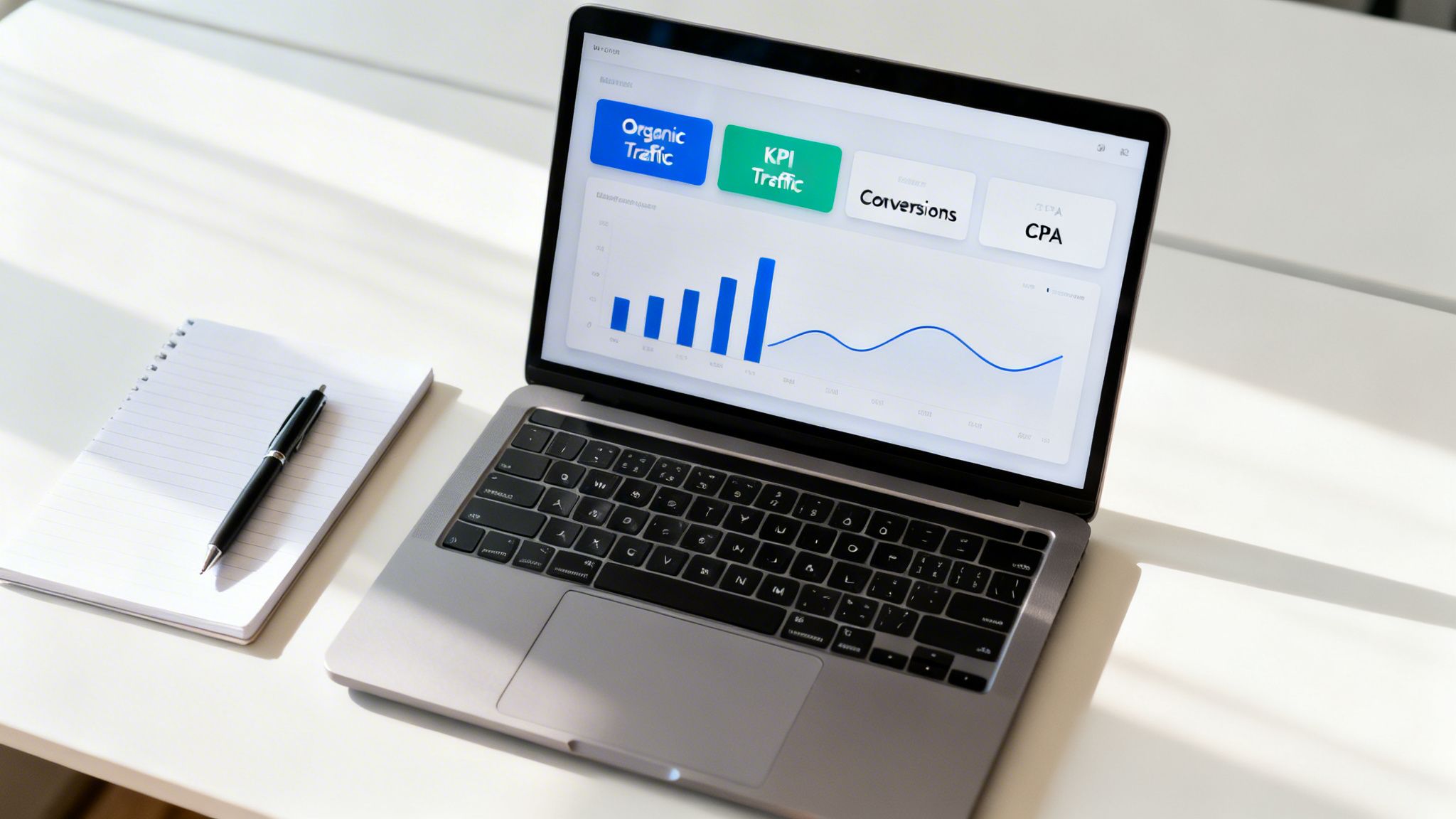
If you don't measure it, you can't improve it. It’s a bit of a cliché, but it’s true. Diving into your analytics can feel like stepping into a cockpit full of flashing lights, with countless charts and metrics all demanding attention. The key is to ignore the noise and focus on what actually reflects business growth.
This means looking past the vanity metrics. Things like social media likes, follower counts, and even raw page views might feel good, but they don’t pay the bills. Instead, you need to track the Key Performance Indicators (KPIs) that show your marketing is delivering a tangible return.
Measuring success and allocating a budget are two sides of the same coin. To make wise budget allocation decisions, we must understand which efforts have been successful and which haven’t.
This shift in focus—from "busy" metrics to business metrics—is what separates stagnant campaigns from those that produce predictable, scalable growth. It’s about connecting every pound spent to a real-world outcome.
Core KPIs for Your Main Channels
Each marketing channel has its own set of vital signs. Rather than getting bogged down tracking dozens of data points, it’s far better to concentrate on the handful that matter most for each activity. This clarity is what allows you to make quick, data-driven decisions.
For example, when looking at your website's performance, it's not just about the volume of traffic but the quality of that traffic. You can perform a quick health check of your online presence with our free Google Business Profile audit tool to see where you stand.
Let’s break down the essential KPIs for the most common marketing channels.
For Search Engine Optimisation (SEO):
- Organic Traffic: This is the number of visitors landing on your site from unpaid search results. A steady increase shows your visibility is growing.
- Keyword Rankings: Specifically for high-intent terms that signal a person is ready to buy (like "emergency plumber near me" versus "what is plumbing").
- Conversions: The number of visitors who complete a desired action, like filling out a contact form or making a purchase. This is the big one.
For Pay-Per-Click (PPC) Advertising:
- Cost Per Acquisition (CPA): This is your bottom line—the total cost of acquiring one new customer through your campaign. Knowing your CPA is crucial for profitability.
- Return On Ad Spend (ROAS): For every pound you spend on ads, how many pounds do you get back in revenue? A ROAS of 4:1 means you generate £4 for every £1 spent.
Using Free Tools to Track Your Progress
You don't need a suite of expensive software to get started. Free, powerful tools from Google provide all the data you need to make informed decisions and prove your marketing is working.
1. Google Analytics 4 (GA4): Think of this as your central hub for tracking website performance. It shows you where your traffic is coming from (organic search, social media, paid ads), what pages people are visiting, and most importantly, whether they are converting into leads or customers.
2. Google Search Console: This tool is purely for monitoring your website’s health and performance in Google Search. It reveals which keywords are driving traffic, highlights technical issues that could be hurting your rankings, and helps you understand how Google sees your site.
By regularly checking these core KPIs with these free tools, you move from guessing to knowing. You can confidently stop what isn’t working, invest more in what is, and build a marketing strategy that compounds its success over time.
Got Questions About Marketing Your Online Business?
Dipping your toes into the world of digital marketing can feel like you're standing at a crossroads with a dozen conflicting signposts. It’s completely normal to feel a bit lost. It's easy to get tangled in a web of advice, leading to "analysis paralysis" where you end up doing nothing at all.
To cut through the noise, we've pulled together straight answers to the most common questions we hear from business owners just like you. The key is to start small, be strategic, and remember one crucial thing.
The best marketing strategy is the one you will actually commit to. Quality, consistency, and a clear plan will always outperform sporadic, half-hearted efforts across a dozen platforms.
This single idea should be your North Star. It’s far better to master one channel than to be mediocre on five.
How Much Should I Spend on Marketing?
There’s no magic number here, but a solid rule of thumb for new businesses is to set aside 5-10% of your projected revenue for marketing. The most important shift in mindset is to see this not as a cost, but as an investment in growth.
Start with a modest budget, track your return on investment (ROI) like a hawk, and then reinvest what works back into the campaign. For example, if you spend £100 on Google Ads and it brings in £500 in sales, reinvesting a chunk of that profit is a no-brainer.
How Long Does It Take to See Results?
This really depends on the channel you choose. The timeline for seeing a return can vary dramatically.
- PPC & Paid Social: You can start seeing traffic and leads within hours of launching a campaign. This is fantastic for immediate results, but the tap turns off the moment you stop paying.
- SEO & Content Marketing: This is the long game. It can take 3-6 months to see the first signs of traction and 9-12 months to achieve significant, business-changing results. The trade-off is that these results are sustainable and compound over time.
A balanced strategy uses both. You can use PPC for quick wins and to gather valuable data, while you build your long-term SEO foundation in the background. This gives you leads coming in today while you build an asset for tomorrow.
Which Marketing Channels Should I Use?
Whatever you do, don't spread yourself too thin. For most UK service businesses, the most effective starting point is a powerful, focused trio:
- A Professional Website: This is your digital headquarters. It's completely non-negotiable.
- A Fully Optimised Google Business Profile: This is the absolute cornerstone of your local visibility.
- Local SEO: This is how you capture that "near me" search traffic from customers who are ready to buy.
Once these fundamentals are solidly in place, you can strategically layer on other channels like targeted paid ads or social media, depending on where your ideal customers spend their time. The goal is to be present where your customers are looking, not everywhere all at once.
Ready to stop guessing and start growing? The team at Bare Digital specialises in building foundational marketing strategies that deliver measurable results for UK businesses. Get your free SEO health check and see where you stand today.