

Imagine your business had a permanent storefront on the busiest high street in the world, pulling in customers 24/7 without you paying a penny in rent. That’s the real power of SEO as a marketing strategy. Unlike paid ads that vanish the moment you stop paying, SEO builds a valuable digital asset that grows on its own and delivers results for years to come.
Why SEO Is a Powerful Marketing Strategy
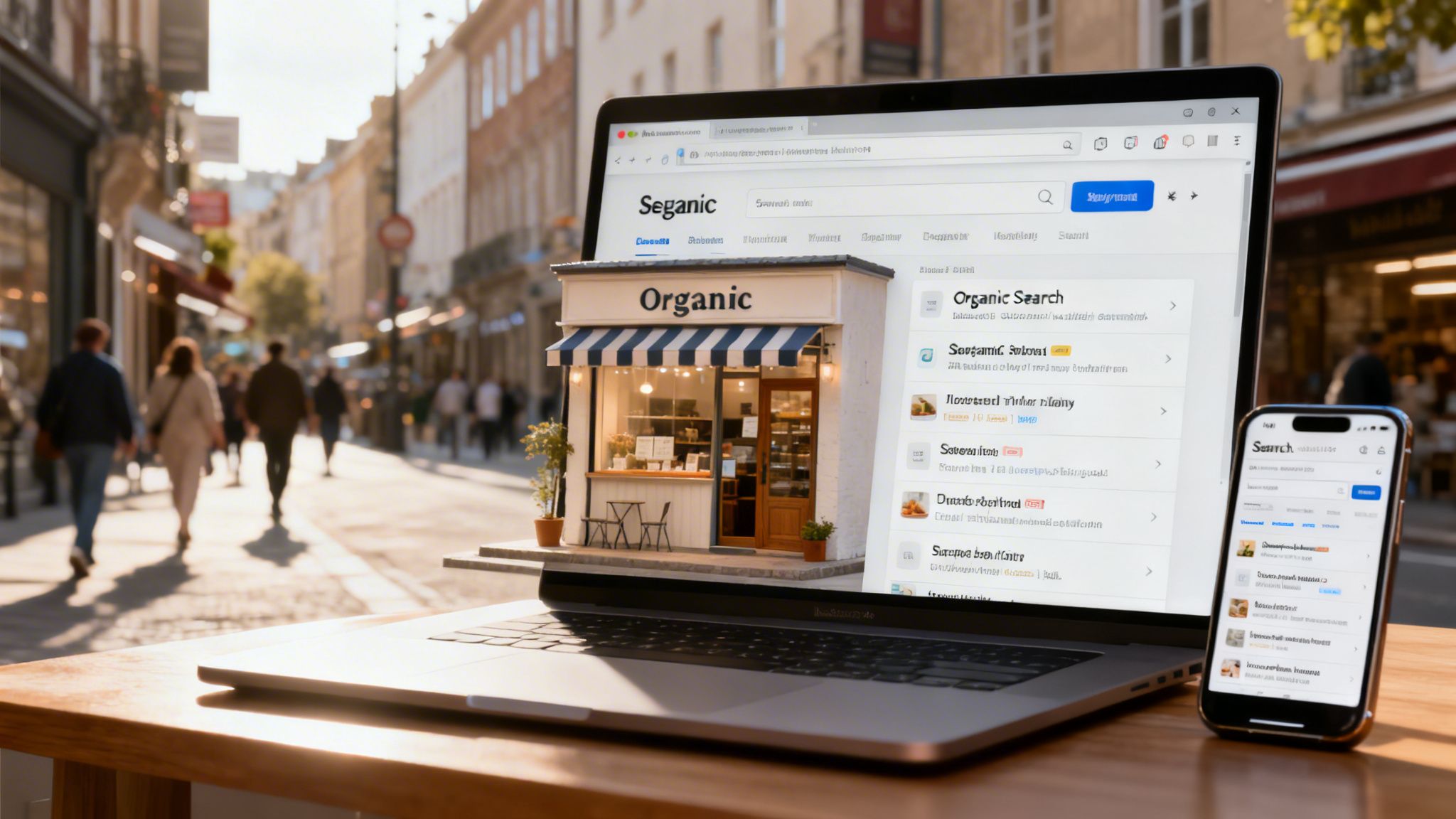
While most marketing channels feel like a constant drain on your budget, Search Engine Optimisation (SEO) plays a completely different game. At its heart, SEO is the practice of improving your website so it shows up higher in Google’s search results for the things your customers are actually looking for, like "wedding venue in the Cotswolds" or "emergency plumber near me."
Think of it this way: you’re not renting attention, you’re building an asset.
Every piece of helpful content you create, every technical fix you make, and every quality link you earn is another brick in your digital foundation. That foundation doesn't crumble when you pause a campaign. Instead, it gets stronger over time, creating a reliable, self-sustaining source of traffic and new business. This compounding effect is exactly why SEO is a cornerstone of sustainable growth.
Capturing High-Intent Customers
When someone turns to Google, they aren't just scrolling aimlessly; they are actively looking for an answer, a product, or a solution to a problem. SEO puts your business directly in front of these motivated people at the very moment they need you. For any UK business, that direct line to high-intent customers is an absolute game-changer.
The data backs this up in a big way. Here in the UK, organic search is responsible for a staggering 53.3% of all website traffic, leaving paid ads and social media in the dust. This traffic is incredibly valuable because the top result on Google gets around 27.6% of all clicks, while the poor souls on the second page get a tiny 0.63%. You can dig into more of the numbers in this breakdown of UK SEO statistics. It shows that first-page visibility isn't just nice to have; it's essential.
A Cost-Effective, Long-Term Investment
So many marketing tactics feel like being on a treadmill—you have to keep running (and paying) just to stand still. SEO is how you get off it. While it certainly requires an upfront investment of time and resources, the returns are durable and grow exponentially over time.
Investing in SEO is like planting a tree. It takes time and patience to grow, but once it's mature, it provides shade and fruit for years with very little ongoing effort. Paid advertising, on the other hand, is like buying fruit from the shop—you get it instantly, but you have to go back and buy it again tomorrow.
This table gives a quick summary of the fundamental differences between investing in SEO and relying on paid marketing channels.
At a Glance: SEO vs Paid Advertising
| Aspect | SEO as a Marketing Strategy | Traditional Paid Advertising |
|---|---|---|
| Cost Model | Upfront investment, then compounds | Pay-per-click/impression, ongoing cost |
| Asset Building | Creates a permanent digital asset | Rents temporary visibility |
| Longevity | Results are lasting and cumulative | Traffic stops when payment ends |
| Trust Factor | Builds high authority and credibility | Often viewed with scepticism |
This long-term value makes SEO an incredibly cost-effective strategy. The leads you generate today from an article you wrote a year ago are essentially free, contributing to a much higher return on investment than channels that demand your money day in and day out. It’s a shift from short-term spending to long-term asset building.
How SEO Amplifies Your Entire Marketing Mix
Thinking of SEO as its own separate job, walled off from everything else, is one of the most common and costly mistakes a business can make. A truly effective SEO strategy doesn't just sit in a corner; it acts as the central hub, feeding and strengthening every other channel in your marketing mix.
It doesn't just pull in traffic. It generates priceless intelligence that makes all your marketing efforts smarter, sharper, and far more efficient. This creates a powerful cycle where insights from search inform your other channels, and the activity from those channels turns around and boosts your SEO. It’s an ecosystem where every part helps the others thrive.
Fueling Your Content and Social Media
Content marketing is the engine of modern digital outreach, but SEO is the high-octane fuel it needs to run. Keyword research doesn't just give you a list of topics to write about; it hands you a direct line into the exact problems, questions, and needs of your target audience.
Imagine a local catering company in Manchester. Instead of just blogging about their menus, SEO insights might reveal that potential clients are searching for "unique wedding food ideas for small venues" or "corporate event catering trends." By creating content that directly answers these questions, they hit several goals at once:
- Attract Qualified Leads: They pull in traffic from people who are actively planning events and looking for a supplier right now.
- Build Authority: Providing genuinely helpful answers establishes them as trusted experts, not just another vendor.
- Create Social Media Assets: A single, detailed blog post can be sliced and diced into dozens of social media updates, infographics, and short videos, massively extending its reach.
This SEO-led approach transforms content from a hopeful shot in the dark into a targeted magnet for your ideal customers. And it doesn't just stop with text; extending your content’s reach can involve mastering podcast show notes for SEO, ensuring your audio content is just as discoverable.
Sharpening Your Paid Advertising Campaigns
SEO and Pay-Per-Click (PPC) advertising are often viewed as rivals, but they work best as close partners. The keyword data and performance insights you gather from your organic SEO efforts are pure gold for optimising your paid campaigns.
By testing keywords organically first, you can identify the highest-converting terms before you spend a single pound on advertising them. This de-risks your PPC budget and ensures you're bidding on search phrases that have a proven track record of driving business results.
This collaboration leads to a much healthier return on your ad spend. You can focus your budget on the keywords you already know work, point ads to SEO-driven landing pages that have a high Quality Score, and write ad copy that resonates because it’s based on language that's already winning organically.
Bridging Online Visibility with Offline Success
For local UK businesses, the link between a digital presence and real-world action is everything. Strong local SEO translates directly into more foot traffic, phone calls, and in-person appointments.
When a potential client searches for a service "near me" and finds your business pinned to the top of Google Maps, that is a direct result of a well-executed SEO strategy. It’s the modern-day equivalent of a word-of-mouth referral, happening at the exact moment someone needs you.
A wedding photographer, for instance, relies entirely on their online portfolio and local visibility to get bookings. When they rank for terms like "documentary wedding photographer Bristol," they capture the attention of couples in their immediate service area. As you can see in this guide on SEO for photographers, optimising for these local searches is what connects them with nearby clients who are ready to hire, driving tangible business growth from online discovery.
Essential Local SEO Tactics for UK Businesses
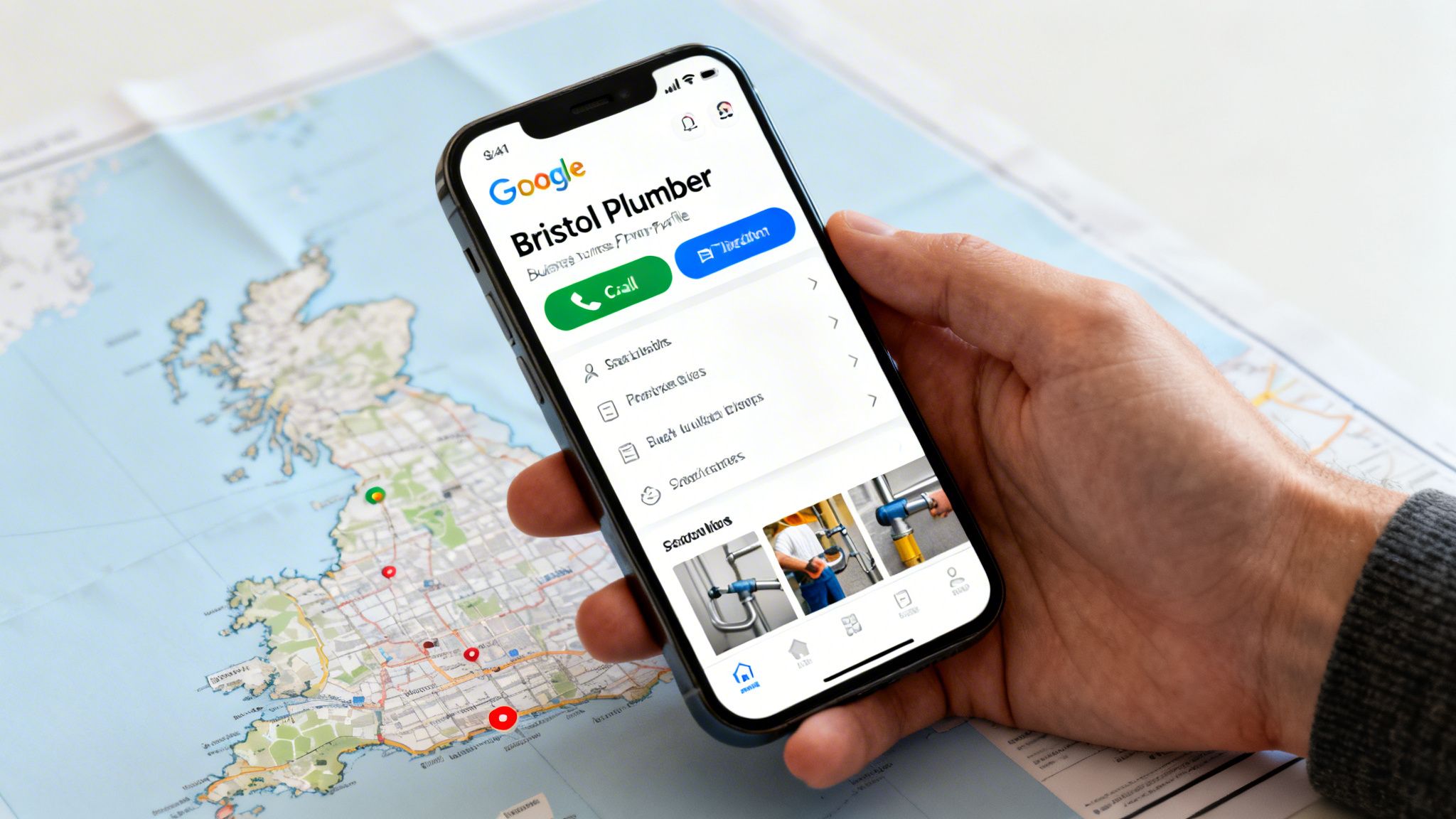
This is where the high-level strategy hits the pavement. It’s the point where a broad understanding of SEO is channelled into direct, actionable tactics that get the phone ringing. For any UK business serving a specific area—whether that’s a single town or multiple regions—local SEO is the engine that turns online visibility into real-world customers walking through your door.
The goal isn't just to be found online; it's to be found by the right person, in the right place, at the exact moment they need you. This means showing up for the searches that scream commercial intent, like "emergency plumber in Bristol" or "wedding venue near Bath."
Success hinges on convincing Google that you are the most relevant, trustworthy, and authoritative local solution for that search. The following tactics are the absolute building blocks for earning that status and dominating your local search results.
Optimise Your Google Business Profile
Your Google Business Profile (GBP) is no longer just a simple listing. Think of it as your digital storefront on the world's biggest high street. When a potential customer searches for a local service, your GBP is often the very first, and sometimes only, interaction they have with your brand. Treating it as an afterthought is a costly mistake.
A properly optimised GBP provides immediate answers and builds instant trust. This is where you transform your profile from a static business card into a dynamic, hard-working sales tool.
- Complete Every Single Section: Fill out your business name, address, and phone number (NAP), along with your hours and website, with 100% accuracy. Inconsistencies erode trust with both Google and your potential customers.
- Select Precise Categories: Choose a primary category that best describes your core business (e.g., "Wedding Venue") and then add secondary categories for other services you provide ("Event Planner," "Corporate Events").
- Showcase Your Services: Use the 'Services' section to detail everything you do, using the keywords your customers would actually search for. A caterer should list out "Corporate Catering," "Wedding Catering," and "Private Party Catering" as distinct services.
- Use High-Quality Photos and Videos: Regularly upload clear, professional images of your work, your team, and your premises. Photos drive engagement and prove you are a legitimate, active business.
- Publish Regular Posts: Share updates, special offers, and company news using Google Posts. This signals to Google that your business is active and gives searchers fresh content to engage with.
This focused effort ensures that when someone searches for what you do, your business appears not just as a name, but as a compelling, professional, and ready-to-help solution. For an even more detailed approach, you can explore our complete local SEO checklist to ensure no stone is left unturned.
Conduct Local Keyword Research
Understanding the exact words and phrases your local customers use isn't just a good idea—it's the absolute foundation of a successful strategy. You need to get inside their heads and speak their language. This means going beyond generic terms and focusing on the high-intent, location-specific queries that signal someone is ready to take action.
The significance of this cannot be overstated. With 46% of all Google searches carrying local intent, optimising for these terms is non-negotiable for UK businesses. In fact, a recent survey revealed that 64% of firms are now actively using local SEO tactics to capture this valuable traffic. You can explore the full survey and find out more about these UK SEO statistics.
Think like your customer. A person needing a quick repair doesn't search for "plumbing services"; they search for "24-hour plumber in Leeds" or "fix leaking tap near me." Your keyword strategy must capture this urgent, specific intent.
Start by brainstorming your core services and bolting on local identifiers:
- [Service] + [Town/City] (e.g., "interior designer Harrogate")
- [Service] + [County] (e.g., "architectural services Cornwall")
- [Service] + "near me"
- "best" + [Service] + [Neighbourhood] (e.g., "best coffee shop Shoreditch")
These keywords will then guide everything from your website content to your GBP optimisation, ensuring you attract the most qualified local leads.
Create Location-Specific Landing Pages
For businesses serving multiple towns or cities, creating dedicated landing pages for each key location is an incredibly powerful tactic. A generic "services" page is simply not enough to convince Google that you are a relevant choice for someone searching in a specific town where you don't have a physical office.
These pages act as dedicated digital hubs for each service area you cover. For example, a multi-location healthcare provider should have separate, unique pages for "care homes in Brighton," "dementia care in Hove," and "respite care in Worthing."
Each page should be uniquely optimised with:
- The location name in the URL, H1 title, and meta description.
- Unique content that discusses your services within the context of that specific area.
- Local testimonials, case studies, or photos from projects completed in that location.
- An embedded Google Map showing the service area.
This approach demonstrates a clear, tangible commitment to serving that community, making it far more likely that Google will rank you for location-based searches in that area.
Building Authority with Digital Recommendations

While the right keywords and technical fixes get your website onto the starting grid, it's authority that ultimately gets you over the finish line. So, how does Google decide which businesses to trust? It looks for digital recommendations—or as we call them in the SEO world, backlinks.
Think of a backlink as a vote of confidence. When another website links to yours, they’re effectively telling Google, “This business is the real deal. They know their stuff, and I’m happy to send my own audience their way.” It’s one of the most powerful trust signals you can build as part of your SEO as a marketing strategy.
But not all votes carry the same weight. A single link from a well-respected local news site or a major industry blog is worth far more than a hundred links from obscure, irrelevant websites. The goal isn’t to hoard links; it’s to earn them from credible sources.
Earning Local Votes of Confidence
For UK businesses with a local focus, earning links from other local organisations is a massive advantage. These links tell Google in no uncertain terms that you are a trusted and important part of the community you serve, cementing your relevance for all those "near me" searches.
Just think about these real-world examples:
- A Bristol wedding venue is featured in a popular UK wedding blog, with a link straight to its booking page.
- A Manchester construction company gets a mention in the local paper for its work on a community project, linking to its online portfolio.
- An Edinburgh interior designer sponsors a local charity run, earning a link from the event’s official partners page.
Each of these is a powerful, relevant endorsement that signals to Google that this business is a key player in its specific location and industry. This is the kind of authority that can't be faked, and it’s what leads to higher, more stable search rankings.
Practical Ways to Earn Those Links
Proper link building has nothing to do with spammy emails or paying for placements. It’s about creating real value and building genuine relationships within your community and industry. It’s an ongoing process that proves your expertise.
Building authority through links is less about asking for favours and more about becoming a resource worth mentioning. When you create valuable content or participate in your community, links often follow naturally as a result of the value you’ve provided.
Here are a few proven ways to start earning those valuable digital recommendations:
- Create Community Resources: Build something genuinely useful for your local area. A real estate agent, for instance, could create a "Best Primary Schools in Kent" guide that local parenting blogs and community forums would be thrilled to link to.
- Forge Local Partnerships: Team up with non-competing businesses nearby. A photographer could partner with a wedding venue to get listed as a "preferred supplier" on their website, creating a link that benefits both parties.
- Get Listed in Quality Directories: Make sure your business is listed in reputable local and industry-specific directories, like your local Chamber of Commerce. While you're building authority, it's also smart to use a Google Business Profile audit tool to ensure your foundational local signals are rock-solid.
Measuring SEO Success with Business-Focused KPIs
Pouring money into an SEO strategy is one thing, but proving it’s actually making you money is a different game entirely. It’s far too easy to get sidetracked by "vanity metrics"—things like social media shares or a general rise in website visitors—that feel good but don’t actually put cash in the bank.
A smart SEO strategy is measured with Key Performance Indicators (KPIs) that connect directly to your business’s bottom line. This means you stop thinking about just "doing SEO" and start focusing on its real-world impact. Every blog post, every technical tweak, every link you build should have a clear purpose that you can trace back to a business outcome.
Moving Beyond Vanity Metrics
To get a true picture of performance, you have to separate the encouraging signs from the cold, hard business results. Some numbers show you’re on the right track, but others tell you you’ve arrived at your destination.
Here’s a simple way to think about your KPIs:
- Leading Indicators (The Signals): These metrics tell you that your strategy is starting to work. Think of things like better keyword rankings for your main services, a steady increase in organic traffic, and higher click-through rates (CTR) from Google.
- Lagging Indicators (The Results): These are the numbers that really matter to the business. They are the direct outcomes of your SEO work, like a jump in phone calls, more contact form submissions, and actual sales or bookings coming from organic search.
Focusing on the lagging indicators ensures you’re measuring genuine growth, not just digital busywork. A bump in keyword rankings is great, but it’s only valuable if it leads to more phone calls.
The KPIs That Truly Matter
For any UK business, especially one serving a local area, the most important KPIs are the ones that show a potential customer is taking a step closer to buying from you. These are the metrics you should live and breathe.
The ultimate goal of SEO isn't just to be found; it's to be chosen. Tracking conversions—the actions that signify a customer choosing you—is the only way to measure whether your visibility is translating into real business.
Your dashboard should put these crucial actions front and centre:
Organic Traffic Growth: This is your foundation. A steady month-on-month rise in visitors finding you through search engines is the first sign your visibility is expanding and you're reaching a wider audience.
Keyword Ranking Improvements: You have to track your position for high-intent, commercial keywords (e.g., "wedding caterer Manchester," "emergency architect London"). Climbing the rankings for these terms puts you directly in front of people who are ready to buy.
Conversion Rate: This is the percentage of your organic visitors who actually do something useful. Tracking this KPI tells you how good your website is at turning that hard-earned traffic into genuine leads.
Goal Completions: These are the actions themselves. You need to have tracking set up in Google Analytics for form fills, clicks on your phone number, requests for directions from Google Maps, and e-commerce sales. These are your leads.
Connecting these dots shows you how a specific SEO activity, like publishing a new service page, directly leads to your most important business goals. What’s more, with the right tracking, you can even figure out your return on investment. If you're curious, our self-storage ROI calculator for SEO is a good example of how this can be modelled.
Calculating Your Return on Investment
At the end of the day, the most persuasive KPI is Return on Investment (ROI). SEO consistently delivers fantastic returns because it builds a long-term asset for your business.
The data speaks for itself. SEO boasts an impressive average ROI of 825% across industries. Leads from organic search close at a 14.6% rate, which is miles ahead of the 1.7% for outbound marketing. With organic traffic costing 61% less per lead than paid search, it's a remarkably efficient route to sustainable growth. You can find more UK-centric SEO insights that highlight its powerful financial impact.
Your Phased Roadmap to SEO Growth
Jumping into SEO can feel like a massive commitment, but it doesn't have to be overwhelming. The most successful strategies don't try to do everything at once. Instead, they break the work down into manageable phases, building momentum and delivering early wins along the way.
Think of it like building a house. You wouldn't start hanging pictures on the walls before you've laid the foundations and built the frame. SEO works in exactly the same way—get the essentials right first, and everything else becomes stronger and more effective.
Phase 1: The Technical and Foundational Audit (Months 1-2)
The very first step is to get your house in order. Before we can even think about attracting new visitors, we need to check the health of your website and make sure there are no underlying issues holding you back. This is all about building solid foundations.
This initial phase is a deep-dive audit that covers the non-negotiables:
- Site Speed: We check how fast your pages load. Slow sites frustrate users and Google alike.
- Mobile-Friendliness: Your site has to work perfectly on a smartphone. No exceptions.
- Crawlability: We make sure search engines can actually find and understand your content.
- Google Business Profile: A full-on optimisation of your profile to start capturing immediate local traffic.
Alongside this, we conduct in-depth keyword research to get a crystal-clear picture of what your customers are actually searching for. This groundwork sets the stage for everything that follows, ensuring our efforts are targeted from day one.
Phase 2: Content Creation and On-Page Optimisation (Months 3-6)
With a technically sound website, it’s time to start building the rooms and decorating them. This is where we focus on creating genuinely valuable content and optimising your existing pages to compete for the keywords we found in phase one.
The focus here shifts to building out high-quality service pages, location-specific landing pages for the areas you serve, and blog posts that answer your customers’ most pressing questions. Every single piece of content is carefully crafted to be the best answer for a specific search.
This process is a continuous loop of tracking, analysing, and improving.
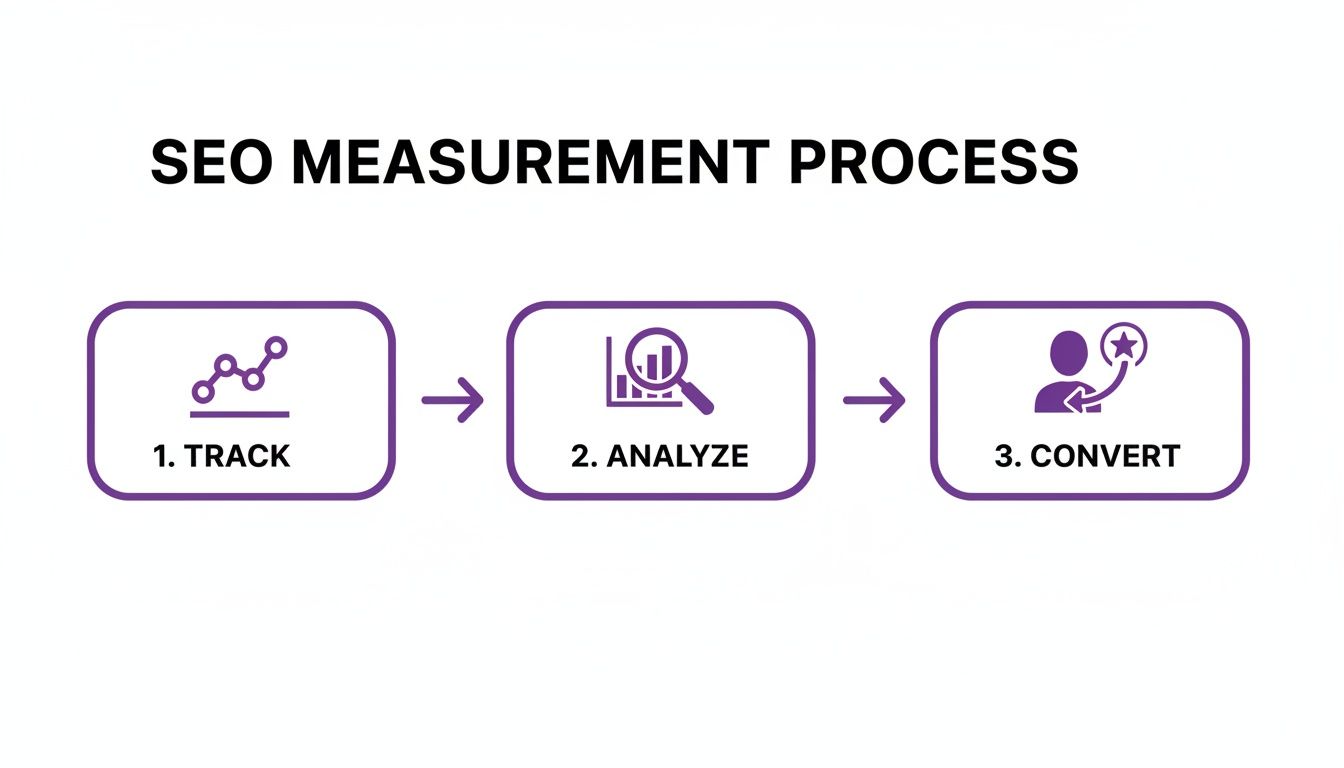
You track what's working, analyse the data to understand why, and then use those insights to convert more visitors into customers. For those who want to get really granular, you can unlock powerful insights by using advanced SEO strategies using GA4 data.
Phase 3: Authority Building and Expansion (Months 7-12+)
Once you have a solid foundation and a library of great content, the final phase is all about building your reputation and amplifying your reach. This is primarily done by earning high-quality backlinks from other reputable websites in your industry or local area.
This is where your website transforms from a simple online brochure into a powerful, self-sustaining lead generation machine. The authority you build here creates a protective moat around your search rankings, making them far more resilient to competitor activity and Google's algorithm updates.
This is an ongoing effort of digital PR, outreach, and relationship building. It’s what signals to Google that you’re not just another voice in the crowd, but a trusted leader in your field.
If you’re interested in seeing how a structured approach like this could help grow your business, you can find out more by visiting our main Bare Digital site.
Got Questions About SEO Strategy? Here Are the Straight Answers
Trying to get your head around SEO can bring up a lot of questions, especially when you’re busy running a business. To cut through the noise, we've rounded up the most common queries we hear from UK business owners about building a winning SEO marketing strategy.
How Long Does It Take to See Results from an SEO Strategy?
This is the big one, and the honest answer is: it depends, but it's a long-term game. While some quick wins, like optimising your Google Business Profile, can show a flicker of movement in weeks, a proper SEO strategy is more like a marathon than a sprint.
You should start seeing real, meaningful traction—a noticeable lift in qualified traffic and leads—within 3 to 6 months. Think of it as building momentum. The results are cumulative; the authority and rankings you build in the first year will keep paying dividends for years to come. That’s a world away from paid ads, where the traffic stops the second you turn off the tap.
Is SEO Still Effective with the Rise of AI Search?
Absolutely. In fact, it’s more critical than ever. While AI Overviews are changing the look of search results, the core principles of great SEO are precisely what Google’s AI is looking for. A solid strategy built on demonstrating your real-world experience, expertise, authoritativeness, and trustworthiness (E-E-A-T) is your ticket to success.
In this new world, getting your business mentioned in an AI-generated summary is a huge win. That's the new top spot. And the AI models look for deep, helpful content and strong local signals to decide who to feature.
Your goal is to become the trusted source that AI systems rely on for their answers. The only way to do that is with a rock-solid SEO foundation.
Can I Do SEO Myself or Should I Hire an Agency?
Getting your hands dirty with the basics is a fantastic start. Managing your own Google Business Profile or writing blog posts helps you understand your customers and your digital footprint on a much deeper level. We always encourage it.
However, a specialised agency brings years of experience, advanced tools, and a dedicated team to the table. They handle the tricky layers of technical SEO, content strategy, and link building at a scale that's tough to manage in-house. This frees you up to focus on what you do best—running your business—while experts wrestle with the ever-changing world of Google. For most businesses, that partnership delivers a faster, bigger return on their investment.
Ready to turn your online visibility into real business growth? Bare Digital offers a free SEO health check and a clear activity plan to show you exactly how we can help. Get your free SEO plan today.