

For law firms, SEO isn't just a marketing buzzword—it's a direct line to new clients. Think of it as your most powerful business development tool, a strategic set of practices designed to put your firm in front of high-value clients the moment they search for legal help online.
Why SEO Is a Non-Negotiable for UK Law Firms

Reputation used to be built on word-of-mouth referrals and old-school networking. While those connections still matter, the way potential clients find and vet solicitors has been completely transformed.
Today, the journey to finding legal representation almost always starts with a search engine.
This simple shift has huge implications. If your firm doesn't show up on the first page of Google, you're practically invisible to the overwhelming majority of people who need your services. SEO is the discipline of making sure your website appears, and appears prominently, when people are searching for the exact legal expertise you offer.
The Modern Client Journey Starts Online
Let’s be realistic about how it works now. Someone gets into a minor car accident and needs to know their options for a personal injury claim. What’s the first thing they do? They pull out their phone and search for something like "personal injury solicitor near me."
They’ll scan the top few results, glance at some reviews, and click through to a couple of websites before they even think about making a call. Your online presence is your new front door. A sharp SEO strategy makes sure they find your door first, not your competitor's. This is especially vital for smaller and mid-sized firms trying to stand out against established players with deep marketing pockets.
SEO levels the playing field. It’s not about who has the biggest ad budget; it’s about who provides the most relevant, high-quality answers online. A well-executed strategy lets a boutique firm in Cambridge compete head-to-head with a massive London practice for the right kind of client.
A Competitive Edge in a Growing Market
The UK legal sector is fiercely competitive and it’s only getting bigger. It now generates over £40 billion annually, with growth projected at around 5% each year. In this environment, every single client matters.
A properly optimised online presence does more than just bring in leads—it builds your authority. When your website consistently ranks for key legal topics, it sends a clear signal to both Google and potential clients that you are a trusted expert in your field. This is the bedrock of effective SEO for attorneys in today's market. For a wider view on smart SEO tactics, check out these practical Search Engine Optimization tips.
Ultimately, you can't afford to be passive. A proactive SEO strategy isn't just a good idea; it's an essential investment in your firm's growth and long-term stability. To get a better feel for the immediate impact, see the 8 unmissable benefits of local SEO for UK businesses in 2025 and start thinking about how to capture clients right in your area.
Mastering Local SEO to Attract Nearby Clients

Your firm’s expertise might be world-class, but let's be honest—your most valuable clients are probably just around the corner. For solicitors, local search isn't just a part of the marketing plan; it's the main event.
Think about it. When someone in your town needs urgent legal advice, their first move is almost always a quick search for "family law solicitor in Cambridge" or "conveyancing services near me." Grabbing their attention at that exact moment is how you build a steady pipeline of qualified leads.
This is where a sharp, focused approach to SEO for attorneys makes all the difference, putting your firm front and centre before they even see your competitor down the road.
Nail Your Google Business Profile
Your Google Business Profile (GBP) is your digital front door. It’s often the very first impression a potential client gets, showing up right at the top of Google Search and on Maps. Just having a profile isn't enough; you need to fine-tune it to genuinely stand out.
Get the basics right, but don't stop there. Go deeper than just your firm’s name and address.
- Be Specific with Categories: Don't just pick the generic "Law Firm." Choose the most precise primary category, like "Family Law Attorney." Then, layer in secondary categories for all your other practice areas, such as "Divorce Lawyer" or "Estate Planning Attorney."
- Define Your Service Areas: Clearly list the specific towns, cities, and postcodes you cover. This tells Google exactly where to show your profile to the right people.
- Write a Compelling Description: Ditch the dry corporate speak. Write a description that speaks directly to a potential client's problems and explains what makes your firm the best choice to solve them.
Once that's sorted, start using the profile’s features actively. Google Posts are perfect for sharing recent case successes (anonymously, of course), announcing free consultations, or posting short insights on local legal issues. This regular activity signals to Google that you're an active, relevant business.
The Power of Consistent NAP Information
Consistency is the bedrock of local SEO. Your firm's Name, Address, and Phone number (NAP) must be absolutely identical everywhere it appears online. A tiny variation, like "Ltd" versus "Limited," can confuse search engines and weaken your local authority.
Make sure this information is exactly the same across:
- Your website’s header, footer, and contact page.
- Your Google Business Profile.
- Major legal directories like The Law Society or Find a Solicitor.
- Local business directories and your Chamber of Commerce listing.
Think of inconsistent NAP information like having a dozen slightly different business cards floating around the internet. It creates doubt for search engines trying to confirm your legitimacy and location, which can directly tank your local rankings. A quick audit and clean-up of these details can deliver a surprisingly fast boost.
Build a Steady Stream of Positive Reviews
In the legal world, trust is everything. Online reviews are today’s word-of-mouth referral, and they're a huge ranking factor for local search. A constant flow of recent, positive reviews tells both Google and potential clients that your firm is reputable and gets results.
Don't just wait for reviews to happen. Actively and ethically encourage satisfied clients to leave their feedback. A simple way to do this is by sending a follow-up email after a case concludes, with a direct link to your Google Business Profile review page.
Responding to every review—good and bad—is equally crucial. A thoughtful reply to a positive review shows you appreciate the feedback, while a professional and empathetic response to a negative one demonstrates that you take client concerns seriously. This active management builds a powerful layer of social proof that will set your firm apart. For a deeper dive into this, our complete guide to local SEO for law firms has even more tactics you can use.
Creating Authoritative Content That Wins Trust
Content is the very heart of your SEO strategy. While local SEO gets potential clients to your digital doorstep, it’s authoritative content that invites them inside and convinces them you’re the right choice. This means moving far beyond simple service descriptions. You need to create resources that cement your firm's reputation as a knowledgeable, trustworthy authority in your field.
Your website has to do more than just list what you do; it must prove your expertise by answering the pressing questions potential clients have before they even think to ask. When someone’s searching for a solicitor, they’re often stressed, confused, and looking for clarity. Your content should be that source of clarity, building their confidence in you long before they ever pick up the phone.
Get this right, and your website transforms from an online brochure into a client-generation machine, working 24/7 to build trust and demonstrate your value.
Structuring High-Value Practice Area Pages
Think of your practice area pages as the most important real estate on your entire website. They are the digital equivalent of a consultation room, where a potential client comes to figure out if you have the specific expertise to solve their problem. To make them work, they absolutely must be structured to answer questions, not just sell services.
A properly optimised practice area page should be a comprehensive, one-stop resource. Of course, you need to clearly explain the legal service, but that's just the start. You have to go deeper.
- Answer Common Questions Head-On: Every practice area page needs a dedicated FAQ section. Seriously, think about the first five questions a client always asks on that initial call and answer them right there. For a family law page, this might be "How is child arrangement decided?" or "What are the grounds for divorce in the UK?"
- Show, Don't Just Tell, with Case Studies: Anonymised case studies are incredibly powerful. Briefly outline a client's problem, the approach your firm took, and the positive outcome you achieved. This gives potential clients tangible proof that you get results.
- Explain the Process: Legal journeys can feel intimidating. Demystify the process for them. Use a simple, numbered list or a timeline graphic to walk potential clients through the typical stages of their case. This manages expectations and goes a long way toward reducing their anxiety.
When you structure your pages this way, you’re providing immediate value and showing a deep understanding of what your client is going through. It’s a cornerstone of any effective content strategy. For more advanced techniques, you can dive into these content marketing best practices.
Leveraging Video to Build a Personal Connection
In a profession built on trust, video gives you a unique chance to build a personal connection that text alone simply can't match. Explaining a complex topic like the conveyancing process or the steps in a personal injury claim in a short, approachable video can be far more engaging and reassuring than a long-winded article.
Video and other trust signals are massive in the UK legal market. Research shows that a huge 89% of businesses now use video marketing, and an incredible 95% of viewers retain a message more effectively through video. For UK law firms, establishing expertise, authoritativeness, and trustworthiness (what Google calls E-E-A-T) is non-negotiable, especially when a staggering 81% of prospective clients check out a firm’s online presence before making contact. You can dig into more insights about digital marketing trends for UK law firms on legalfutures.co.uk.
A simple two-minute video featuring a solicitor calmly explaining a legal issue can do more to build rapport and trust than pages of text. It puts a face to the name and shows the human side of your practice, which can be the deciding factor for a client choosing between two otherwise similar firms.
To make your content strategy truly effective, it’s important to blend different formats to meet various client needs and search intents.
This table breaks down some of the most effective content types for law firms.
High-Impact Content Types for Law Firms
| Content Type | Primary SEO Benefit | Example Application |
|---|---|---|
| In-Depth Guides | Establishes topical authority, targets long-tail keywords | A comprehensive guide on "The UK Divorce Process from Start to Finish." |
| FAQ Pages | Captures voice search queries, addresses specific user intent | A dedicated FAQ page answering common questions about personal injury claims. |
| Explainer Videos | Improves engagement, builds personal connection, increases time on page | A short video with a solicitor explaining the basics of creating a will. |
| Blog Posts/Articles | Attracts organic traffic, targets niche keywords, showcases expertise | A blog post on "Recent Changes to UK Employment Law for Small Businesses." |
| Client Case Studies | Builds trust and credibility, provides social proof | An anonymised case study detailing a successful commercial property dispute. |
By diversifying your content, you not only improve your SEO performance but also provide genuine value that helps potential clients make an informed decision.
Integrating Trust Signals Throughout Your Site
Trust signals are the visual and written cues that constantly reinforce your firm's credibility and professionalism. They shouldn’t be tucked away on a single "About Us" page; they need to be strategically woven into the very fabric of your website. These elements provide constant reassurance to visitors, validating their decision to consider your firm.
Here are some of the most effective trust signals for a law firm's website:
- Client Testimonials: Display genuine, positive feedback from past clients. Place them prominently on relevant practice area pages and your homepage, not just on a testimonials page no one visits.
- Legal Accreditations and Awards: Showcase logos from The Law Society, Lexcel, or any specialist accreditations your solicitors hold. These are instant credibility boosters.
- Detailed Solicitor Bios: Go beyond just qualifications. Create detailed biographies for your legal team that highlight their experience, notable cases, and personal approach. A professional photograph is essential—it adds that crucial human element.
- Clear Contact Information: Make your phone number and physical address ridiculously easy to find on every single page. This simple detail signals that you are a legitimate, accessible business ready to help.
When you combine expertly structured practice area pages, engaging video, and strategically placed trust signals, you create a website that doesn’t just rank well—it excels at turning visitors into clients.
Your Law Firm's Technical SEO Health Check
All your hard work on content and local SEO can be completely torpedoed by technical gremlins lurking in your website's code. These issues often fly under the radar but can seriously sabotage how search engines find, understand, and ultimately rank your firm's pages.
Think of technical SEO as the foundations of your digital office. If the foundation is cracked, it doesn’t matter how slick the interior is; the whole structure is at risk. A solid technical base ensures potential clients have a smooth, fast, and secure experience, which is exactly what Google wants to see.
Is Your Website Fast and Mobile-Ready?
Let's be honest, a potential client's first interaction with your firm is probably happening on their phone while they’re stressed and looking for immediate help. If your website is slow or a mess to navigate on a mobile device, they’re gone. You’ve lost them before you even had a chance to say hello.
Website speed and mobile-friendliness aren't just trendy extras anymore; they are core ranking factors. Google’s "mobile-first" approach means it primarily looks at the mobile version of your site for ranking. No excuses.
- Page Speed: Your pages need to load in under three seconds. Anything slower and you'll see your bounce rate climb, which tells Google your site isn't delivering a great user experience.
- Mobile Responsiveness: Your website must automatically adjust to fit any screen, from a big desktop monitor to the smallest smartphone. Text has to be readable without pinching and zooming, and buttons need to be easy for a thumb to tap.
A fast, responsive site is a non-negotiable part of SEO for attorneys. It signals to both clients and search engines that your firm is professional, modern, and ready to help.
Building a Logical Site Structure
A well-organised website works like a clear map for both people and search engine crawlers. A logical structure helps Google figure out which pages are most important—like your key practice area pages—and how everything connects.
This all starts with a simple, intuitive navigation menu. A potential client looking for information on "conveyancing" shouldn't have to click through five confusing layers to find what they need. A clean hierarchy gets them to the right information, fast.
Internal linking is your secret weapon here. When you link from a relevant blog post back to your main "Family Law" service page, you're sending a powerful signal to Google that this page is an authority on the topic. It also keeps visitors on your site longer, letting them explore more of your expertise.
A tidy site architecture is a straightforward yet incredibly powerful way to improve user experience and your search rankings. For anyone wanting to really get into the weeds, this complete technical SEO audit checklist provides 15 essential elements to go through.
Demystifying Schema Markup for Law Firms
Schema markup is essentially a special vocabulary you add to your website's code to help search engines understand your content on a deeper level. For law firms, this is a massive opportunity to stand out in a sea of identical search results.
By using "LegalService" schema, you can spoon-feed Google important details like:
- Your firm's specific practice areas (e.g., personal injury, employment law).
- The geographic areas you serve.
- Your opening hours and contact information.
Google can then use this data to create "rich snippets"—those eye-catching, detailed listings in the search results that might show star ratings, FAQs, or other useful info. These enhanced listings don't just look better; they seriously boost click-through rates, driving more qualified leads right to your digital doorstep. It's a technical tweak with a real competitive edge.
This infographic breaks down how you build that crucial client trust, starting with proving your authority through great content.
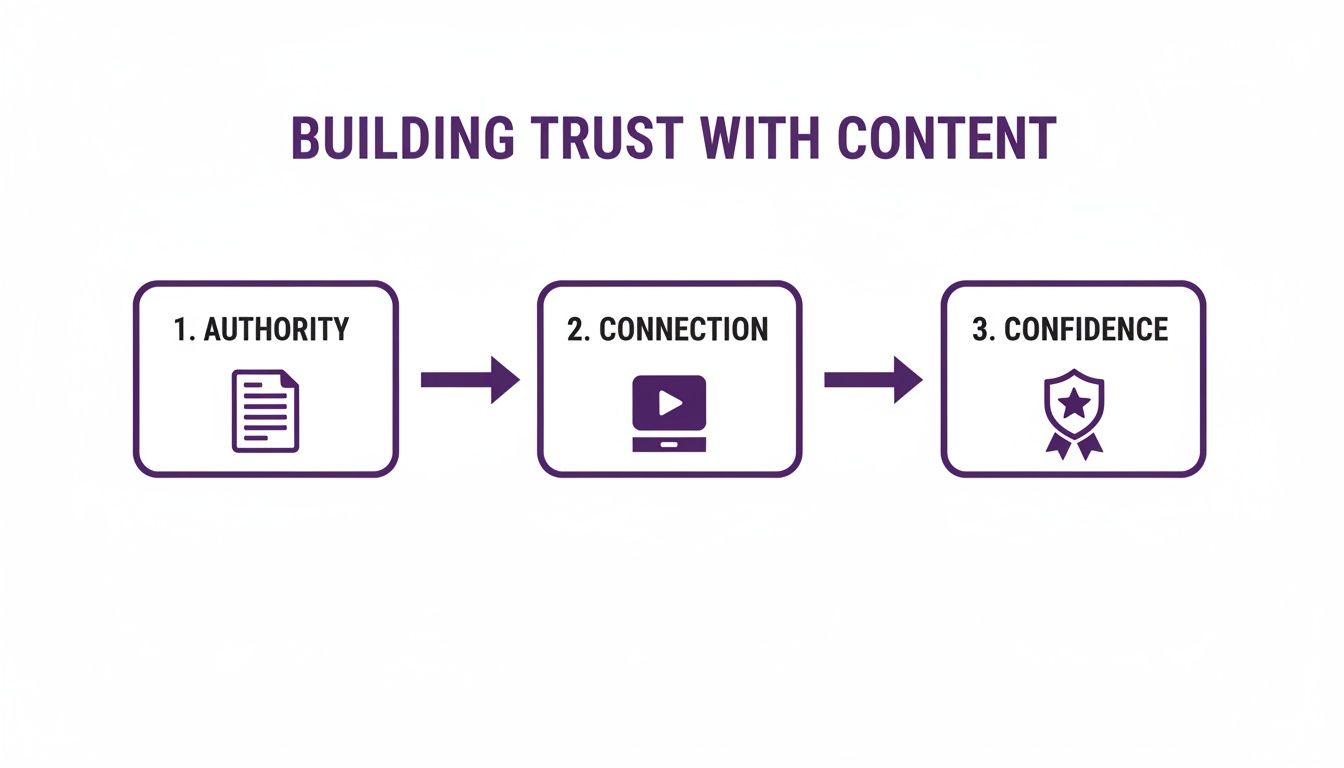
It’s a simple process: demonstrate your authority and make a genuine connection, and you’ll build the confidence a potential client needs to pick up the phone.
Building Links and Digital PR for Solicitors

If your website's content and technical setup are the engine, then high-quality backlinks are the rocket fuel. In the eyes of Google, a link from a respected website is a massive vote of confidence. It tells the search engine that your firm is a credible, authoritative voice in the legal world.
But let’s be clear: not all links are created equal. The game isn’t about collecting as many as you can. It’s about earning them from the right places. A single link from a prestigious legal publication carries far more weight than dozens from irrelevant, low-quality directories. A smart approach to link building is a cornerstone of effective SEO for attorneys.
Earning Links Through Expertise and Contribution
The best, most sustainable way to build a strong backlink profile is to stop chasing links and start earning them. How? By proving you’re the expert. When you create genuinely valuable resources, other sites will naturally want to reference and share them.
This positions your firm as a thought leader and makes link building feel a lot less like a chore.
Here are a few practical ways to do it:
- Contribute to Legal Publications: Write insightful articles or guest posts for reputable legal journals or industry blogs. Sharing your expert take on a recent court ruling or a change in legislation is a fantastic way to earn a powerful backlink.
- Create "Link-Worthy" Content: Think bigger than a basic service page. Develop a comprehensive guide, original research, or a helpful checklist that solves a real problem for clients. A detailed article on "The Complete Conveyancing Process for First-Time Buyers in the UK," for example, is far more likely to be linked to than a generic sales page.
- Offer Expert Commentary: Journalists and bloggers are always looking for expert sources. Get your solicitors known as the go-to experts in their practice areas, and you can earn high-authority links from news articles and reports covering relevant legal stories.
This approach transforms link building from a tedious task into a genuine business development activity. You're not just getting a link; you're showcasing your firm's deep knowledge and experience.
Think of it this way: your firm’s expertise is a valuable asset. Digital PR is simply the process of sharing that asset in a way that earns public recognition—and powerful backlinks—in return. It’s about building your reputation both online and off.
Securing Foundational Local and Niche Links
While aiming for those high-authority national publications is crucial, don't overlook the foundational links that cement your local and niche relevance. These are often easier to get and provide essential signals to search engines about who you are and where you operate.
Think of these as the solid base of your backlink profile, reinforcing all those local signals we talked about earlier.
Key Directories and Community Sponsorships
- Prestigious Legal Directories: This is non-negotiable. Securing listings in respected, solicitor-specific directories like The Law Society or Find a Solicitor is a must. These are highly trusted sources that provide immediate credibility.
- Local Business Associations: A link from your local Chamber of Commerce or a business improvement district reinforces your connection to the community you serve. It’s a clear signal to Google that you’re a real, local entity.
- Sponsorships and Events: Sponsoring a local charity event, a community sports team, or a business award often comes with a backlink from the organisation's website. It’s a brilliant way to build goodwill and earn a relevant local link at the same time.
By combining high-level digital PR with these fundamental local tactics, you create a balanced, authentic backlink profile. This strategy tells search engines that your firm is not only a respected authority in its field but also a trusted pillar of the local community—a powerful combination for driving real, sustainable ranking improvements.
The Future of Legal SEO and How to Prepare
The ground is shifting under our feet. Search is changing, and it's being driven by massive leaps in artificial intelligence. For law firms, staying ahead no longer means just tweaking for minor algorithm updates. It’s about bracing for a fundamental change in how potential clients find legal help. Being proactive is the only way to stay visible.
This evolution demands a new chapter in the traditional SEO for attorneys playbook. The rise of AI-powered search, like Google's Search Generative Experience (SGE), is going to put a huge emphasis on direct, conversational answers. This will inevitably change how—and where—clients first interact with your firm online.
Adapting to an AI-Driven Search World
The biggest change coming down the line is the pivot to answer-led search results. Instead of just serving up a list of blue links, search engines are increasingly giving users a summarised answer right at the top of the page. Your content strategy has to evolve to meet this head-on.
To get ready, you need to start creating content that answers very specific legal questions with absolute clarity and authority. It’s less about chasing broad keywords and more about zoning in on the exact problems your clients are trying to solve.
- Structure for Direct Answers: Use clear headings and subheadings. Break down complex legal topics into simple, digestible chunks.
- Embrace Conversational Language: Write like a human. Address the user's query directly, as if you were speaking to them.
- Prioritise FAQ Formats: Build dedicated FAQ sections into your practice area pages. This structure is perfectly designed for AI to pull from for its summaries.
This isn't some far-off future; the effects are already being felt. In the UK legal sector, while 52% of SEO professionals see Google Discover as a major traffic source, a telling 39% view these new AI features as a potential threat to their website traffic. To stay ahead of the curve, you need to be across the latest SEO trends for law firms in 2025.
The Dual Role of AI in Your Firm
While AI throws up new challenges for getting seen, it also hands you some incredibly powerful tools to make your SEO efforts sharper and more efficient. The trick is to use these tools for the heavy lifting—the analysis and research—without losing the human touch that actually builds trust with a client in distress.
AI can be a game-changer for tedious tasks like keyword research, competitor analysis, and spotting content gaps. What it can't do is replicate the nuanced understanding, empathy, and authority of an experienced solicitor.
The future of legal SEO is a partnership. Use AI to crunch the data and give you insights, but rely on human expertise to craft the final, authoritative content that connects with a client's real-world legal problem. It’s about enhancing your professional judgment, not replacing it.
Think about how your firm can integrate AI tools responsibly.
| Task | How AI Can Help | Where Human Expertise is Crucial |
|---|---|---|
| Content Research | Identifying trending topics and common client questions at scale. | Providing accurate, jurisdiction-specific legal analysis and context. |
| Competitor Analysis | Quickly breaking down top-ranking content for structure and keywords. | Understanding the strategic why behind a competitor's content. |
| On-Page Optimisation | Suggesting improvements for meta descriptions and title tags. | Ensuring all content reflects the firm’s unique tone and values. |
This balanced approach is even more critical when you consider the financial realities. With 34% of UK firms pointing to budget constraints as a major hurdle and many working with less than £1,000 a month for SEO tools, using AI for efficiency isn't just smart—it's essential.
By embracing these changes now, your firm can navigate the evolving search landscape, turning what looks like a disruption into a genuine opportunity for growth and cementing your position as a trusted legal authority online.
Ready to build an SEO strategy that drives real results? Bare Digital offers a free, no-obligation SEO Health Check and a customised Activity Plan to show you exactly how we can boost your firm's online visibility. Get your personalised proposal within 24 hours.